


 by Tom Gurney
Tom Gurney BSc (Hons) is an art history expert with over 20 years experience
Published on June 19, 2020 / Updated on October 14, 2023
Email: tomgurney1@gmail.com / Phone: +44 7429 011000
El bufón el Primo (Traditionally Identified as Sebastián de Morra): Introduction
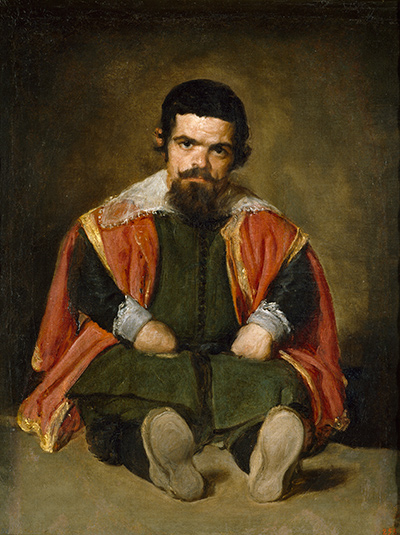
Two worn soles face out of Diego Velázquez’s portrait before there is a clear sense of the room in which the man is sitting. The hands are drawn in against his waist, the scarlet garment spreads to either side and his eyes meet ours above the narrow strip of visible floor. The Museo Nacional del Prado presents this oil on canvas as El bufón el Primo, dated 1644. The work, accession P001202, was long known as Don Sebastián de Morra. The two names reflect different readings of the surviving records, including a bill from a royal campaign and inventories whose descriptions have to be matched to the right canvas. [1] [2] [3] [4] [5]
At a Glance
Contents
- A seat close to the floor
- How Sebastián de Morra entered the catalogue
- What the cloth tells us about Fraga
- A disputed word in an inventory
- From the Royal Palace to a print
- Scale in the other seated portraits
A seat close to the floor
Velázquez brings the viewer down towards the sitter’s level. The projection of the shoes makes the effect particularly clear. Each sole is turned far enough towards us to conceal much of the upper of the shoe. The one on our right catches a broader wash of light and the one on our left tilts inwards. Behind them the legs seem to recede quickly into olive-dark folds. The deep shadow where the sitter meets the floor and the softer one extending beyond the shoe on our right give the forward projection somewhere to end. There is barely a shoe’s length of painted floor between the figure and the bottom of the frame. You can see how he is seated before you can judge how far away the wall might be. [2]
The coat hangs in broad panels from the shoulders. With the elbows turning in towards the waist, the opening between the panels draws the eye to the hands. One set of knuckles catches more light. The other hand is tucked so far back into the surrounding cloth that you can follow its outline more easily than its fingers. Above them, a line of small dark fastenings climbs the front of the body and disappears into the shadow under the beard. The near symmetry of shoes, hands and shoulders gives the pose its stability. The head tips slightly to one side and the collar spreads farther over one shoulder, so that the gaze feels more specifically directed than the arrangement of the body might suggest. [2]
Most of the lightest paint is concentrated at the collar and cuffs. In the Prado’s detail of the shoulder you can see the red showing through parts of the thin white collar. Small bright loops and flecks catch along its uneven edge. The gold braid beside it is denser and runs in a single broad band towards the elbow. From farther away, the braid, the cuffs and the lit surfaces of the shoes make a series of short accents down the picture. They keep the eye moving between the face and the floor even though the background offers little indication of how much space surrounds the sitter. The richness of the clothes depends on small changes of opacity and touch, visible where cloth overlaps cloth. [2]
How Sebastián de Morra entered the catalogue
Sebastián de Morra was a real member of the Habsburg household. The Prado’s 1990 catalogue records his service to Cardinal-Infante Ferdinand of Austria in Flanders and his entry into the household of Prince Baltasar Carlos in 1643. The prince’s will left him arms, including a silvered smallsword, and two badges with fleurs-de-lis. Those records say something about Morra’s place in the household. Their connection to this painted sitter depends on matching the surviving portrait to earlier descriptions. [2] [4]
In 1666 an inventory of the Royal Alcázar in Madrid recorded two portraits, one naming Morra and the other naming El Primo. Following the palace fire of 1734, a rescue inventory listed a full-length portrait by Velázquez without a personal name. José Manuel Cruz Valdovinos follows the number 116 in the rescue list through the 1747 Buen Retiro inventory and into the rooms of Infante Don Javier in the new Royal Palace in 1772. He reports that the number also appears on the stretcher. The repeated number helps link the canvas to its later movements even where successive entries describe its subject in generic terms. The picture entered the Prado from the royal collection in 1819. [2] [3] [4]
The name many visitors remember came from Pedro de Madrazo’s Prado catalogue of 1872. He attached Sebastián de Morra to this painting with a question mark. Madrazo read the Alcázar inventories alongside a royal wardrobe entry recording a black suit for El Primo. He associated that suit with the man in black in the separate canvas now called Bufón con libros (Buffoon with Books). That left the red-coated man as the likely match for Morra in his reading of the inventory pair. By 1990 the Prado exhibition catalogue used Don Sebastián de Morra as its heading, although its entry still credited Madrazo with proposing the identification. A painted garment had acquired considerable weight in a chain of reasoning that began with two names in a palace inventory. [1] [2] [3] [4]
What the cloth tells us about Fraga
Velázquez accompanied Philip IV to Aragón during the campaign of 1644. A bill for a wooden box records that a portrait by Velázquez of a man called El Primo was sent from Fraga to Madrid. A separate bill records a box made to transport the king’s portrait. The painting of the king can be tied to the surviving King Philip IV of Spain in the Frick Collection, New York. The problem is finding the surviving canvas, if any, that corresponds to the first bill. El Primo means ‘the cousin’ in Spanish, but the bill gives a sobriquet, leaving the sitter’s personal name open. [3] [6]
In 2012 Pablo Pérez d’Ors, C. Richard Johnson Jr. and Don H. Johnson published a comparison of the original cloth in the Frick and Prado portraits. X-radiographs allowed them to map variations in the spacing of the threads. The warp, which runs vertically in both pictures, shows a common sequence of bands where threads are closer together or farther apart. The researchers concluded that the two supports very likely came from the same bolt. Since the king sat for his portrait at Fraga in 1644, that relationship places the red-coated sitter’s portrait close to a documented moment in Velázquez’s career. The authors proposed that P001202 was the painting of El Primo named in the shipping bill. The identification requires the inference that this piece of cloth was used for the work sent in that box. [3] [6]
The pictures themselves share bright passages of red and intricately lit neckwear. Where the standing Philip holds a baton and a hat, which give each hand a public function, the seated man’s hands are close to his body. Philip’s coat makes a broad vertical display across his chest, while the other man’s red garment falls open and follows the pose down towards the floor. One picture went on view in a Madrid church for a victory celebration. The evidence connecting the two supports gives us a way to see how Velázquez could use related materials and colours for portraits with very different demands. [2] [3] [6]
A disputed word in an inventory
The 2012 study also drew on records of a work in the collection of the Marquess of Carpio. The description brings to mind the Prado’s canvas down to the dark clothing under the red coat, the pale collar and the soles of the shoes. It includes a jug at the side, an object absent from the Prado picture as we see it. A version illustrated in the study has a vessel at the right. The authors accepted a reading of the sitter’s nickname as Primo in the Carpio records and proposed that the surviving version was the work those entries describe. Roberto Fernández Castro has since traced its possible history as a separate painting. Its wider space on the right makes the absent jug in Madrid worth considering. X-radiographs show that the Prado canvas was cut down and now incorporates other canvas around its irregular original portion. A related painting can suggest what changed at an edge, although several versions could have shared a feature now missing from the Prado work. [3] [7]
Cruz Valdovinos revisited the case in 2024. He reads Plinio in the Carpio inventory of 1689 and points to the same name in a 1677 inventory of the collection. He also questions whether the surviving version is the one in those records, given the recorded dimensions. His argument retains the close connection to Fraga and proposes that the present painting is the portrait of Morra recorded in the Alcázar. He distinguishes that work from the documented portrait of El Primo sent from Fraga, and returns the name Diego de Acedo, El Primo, to the man with books. The Prado’s public display text keeps the titles El bufón el Primo and Bufón con libros. [1] [3] [4]
A further distinction concerns the court records about Acedo himself. He worked in the royal chamber secretariat, where his duties included applying a stamp of the king’s signature to documents. The 2012 authors doubted that he was the same man as El Primo, for whom a wig and crown were made, likely for a performance. Cruz Valdovinos argues that a court officer could take part in such an entertainment and draws on records that connect the nickname and name, including a 1680 clothing entry for a nephew. That entry comes some twenty years after Acedo’s death, a gap that the 2012 authors considered significant. The Prado title tells us which identification the museum uses for the painting, while the documents allow different readings of who used the nickname and where each likeness ended up. [1] [3] [4]
From the Royal Palace to a print
In 1778 Francisco de Goya etched this composition after Velázquez. The Real Academia de Bellas Artes de San Fernando catalogues the copperplate as Retrato del bufón El Primo, M-3598. The inscription on the plate gives the royal palace in Madrid as the location of Velázquez’s painting and identifies the sitter only by his association with Philip IV and his short stature. A newspaper advertisement that year offered nine prints after Velázquez and referred collectively to two seated figures with dwarfism. This was more than three decades before the portrait entered the public museum. Buyers could thus recognise and circulate the likeness in print well before the name Morra appeared in the Prado catalogue. [2] [4] [8]
Scale in the other seated portraits
Velázquez used a different arrangement in the portrait traditionally identified as Francisco Lezcano, Prado P001204. A rock shelter backs the head and a strip of blue-grey sky and distant land opens on our right. The hands meet over a small object and one dark shoe projects forward. The break at the edge of the shelter gives us a way to gauge the space behind the sitter. In P001202 the floor meets a subdued brown surround, and the paired soles supply the clearest sign of recession. The figures each fill much of their canvas, but in the Lezcano picture the ground can be followed away into the landscape. In the red-coated portrait it seems to extend principally towards us. [2]
In the separate Buffoon with Books, P001201, a large open volume projects towards the lower right. The creamy edges of its pages carry the light across the black clothes, and further books and papers spread along the ground. Each composition directs the eye differently. In the book portrait it can travel along the width of the open pages out towards the edge. In the red-coated portrait the lit shoes and cuffs lead back up towards the face. Even at a distance, once you can no longer make out the individual marks in the collar or the cuffs, the shape of the pose still holds. [1] [2]
 Diego Velazquez.jpg)
Portrait traditionally identified as Francisco Lezcano. Compare the two seated figures and their settings while keeping both traditional sitter identifications qualified. View Portrait Traditionally Identified as Francisco Lezcano.
Artworks directory
Frequently Asked Questions
Museo Nacional del Prado, P001202 [5]
1644 [1]
Velázquez brings the viewer down towards the sitter’s level. The projection of the shoes makes the effect particularly clear. Each sole is turned far enough towards us to conceal much of the upper of the shoe. [2]
Sebastián de Morra was a real member of the Habsburg household. The Prado’s 1990 catalogue records his service to Cardinal-Infante Ferdinand of Austria in Flanders and his entry into the household of Prince Baltasar Carlos in 1643. The prince’s will left him arms, including a silvered smallsword, and two badges with fleurs-de-lis. [2] [4]
Discussion
Look again at the images and ideas explored in El bufón el Primo (Traditionally Identified as Sebastián de Morra). These editorial prompts invite your observations.
Reader Insights
How does the low viewpoint change your sense of where the sitter is relative to you?
Which archival details help connect a portrait to a named sitter?
Join the Conversation
Share a detail, comparison or question about El bufón el Primo (Traditionally Identified as Sebastián de Morra) below.
References
- Museo Nacional del Prado, Reencuentros. Parada V. Una Corte a nuestro encuentro, section “El otro palacio”, for the public display title, date and traditional identification. Spanish. View source.
- Julián Gállego and Museo del Prado, Velázquez, exhibition catalogue, Madrid, 1990, cat. 54, pp. 326–329, full plate p. 327 and shoulder detail p. 329. See also cat. 52, plate p. 317, and cat. 55, plate p. 331, for P001204 and P001201. Spanish. View source.
- Pablo Pérez d’Ors, C. Richard Johnson Jr. and Don H. Johnson, ‘Velázquez in Fraga: a new hypothesis about the portraits of El Primo and Philip IV’, The Burlington Magazine, 154, 2012, pp. 620–625, especially figs. 9–14 and notes 24–26, 30–35. View source.
- José Manuel Cruz Valdovinos, ‘Rompiendo una lanza por Don Diego de Acedo, “El Primo”, y otra por Morra, el enano vestido de colorado’, Archivo Español de Arte, 97 (386), 2024, article 1256, especially fig. 7 and notes 1–2, 32–35, 52–55 and 60–67. Spanish. View source.
- Museo Nacional del Prado, El bufón el Primo, collection record P001202, exact object link. Spanish. View source.
- The Frick Collection, The King at War: Velázquez’s Portrait of Philip IV, exhibition, 26 October 2010–23 January 2011. View source.
- Roberto Fernández Castro, ‘Diego Velázquez y la historia de los dos retratos de El Primo, entre calcos y prototipos’, Anales del Instituto de Investigaciones Estéticas, 45 (123), 2023, especially pp. 121–129 and the section “De la Colección del marqués del Carpio a la actualidad”. Spanish. View source.
- Real Academia de Bellas Artes de San Fernando, Francisco de Goya after Velázquez, Retrato del bufón El Primo, 1778, Calcografía Nacional, copperplate M-3598, inscription and the Gazeta de Madrid notice of 28 July 1778. Spanish. View source.







