



 by Tom Gurney
Tom Gurney BSc (Hons) is an art history expert with over 20 years experience
Published on June 19, 2020 / Updated on October 14, 2023
Email: tomgurney1@gmail.com / Phone: +44 7429 011000
The Surrender of Breda: Introduction
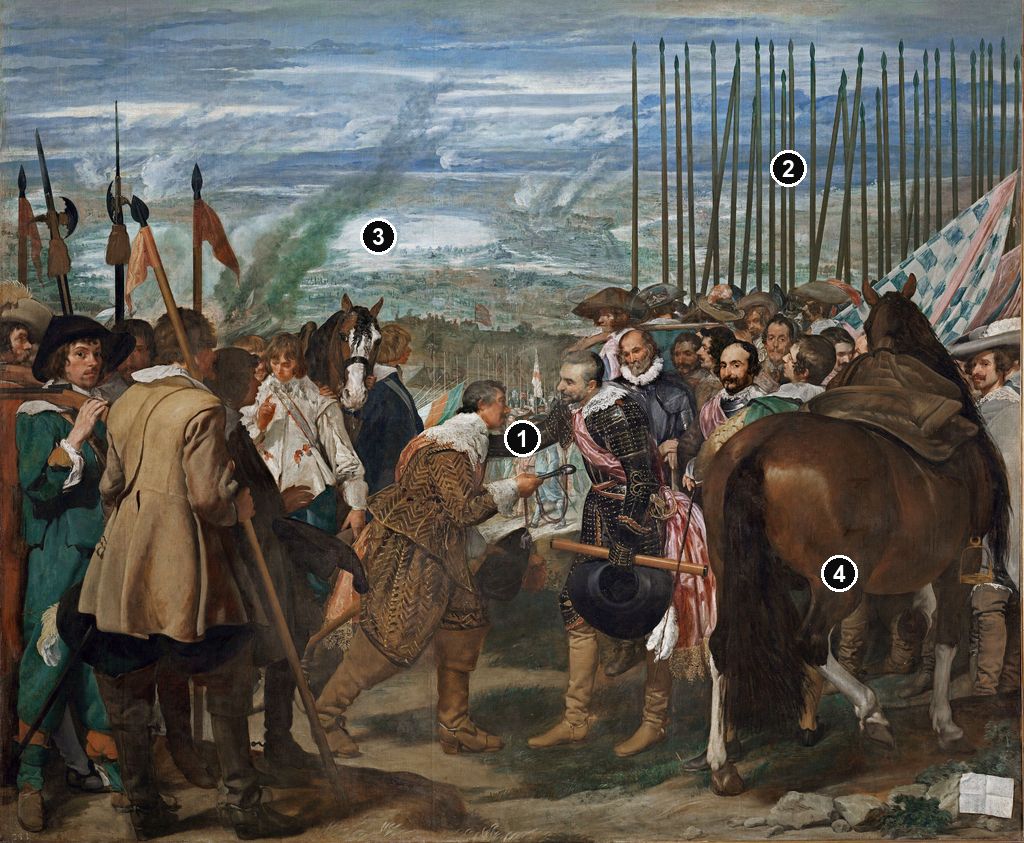
Justinus of Nassau still has hold of the key. He offers it at arm’s length, with its dark loop extending towards Ambrogio Spinola. The man who is about to take possession of Breda has reached for something else. Spinola puts his right hand at Nassau’s shoulder and inclines his head towards him. The key remains visible in the gap between them, a small object held above the feet of soldiers marching in the distance. For the moment there is time to see Nassau as an officer and an interlocutor before he relinquishes the city. [1] [2]
Diego Velázquez painted this encounter around 1635 to commemorate the surrender of Breda in June 1625. The oil painting, also known as Las lanzas or The Lances, measures 307.3 × 371.5 cm in the Museo Nacional del Prado’s educational catalogue and is the work numbered P001172. It was made for the Salón de Reinos, or Hall of Realms, at Philip IV’s Buen Retiro palace in Madrid. In that room the almost private manner of the exchange belonged to a very public account of the victories of the reign. [1] [2] [3]
At a Glance
- PaintedAbout 1635 [1]
- EventThe surrender of Breda in 1625 [3]
- CollectionMuseo Nacional del Prado, P001172 [1] [2]
Contents
- The distance between a hand and a key
- Why it is also called The Lances
- From agreement to occupation, June 1625
- The landscape behind Nassau
- Annotated details
- What the stage could contribute
- Whose faces are in the picture?
- The surrender in the Hall of Realms
- Different surfaces, one scale
- From the royal collection to the Prado
- What Breda’s townspeople were promised
- How the terms became news
- A funeral procession and a silver medal
The distance between a hand and a key
Nassau is the man on the left, in patterned brown and gold. Look first at his boots. They are separated by a long step, with the rear heel lifted and the front knee bent. His whole body follows the inclination of his head. Spinola’s stance is tighter, with both feet placed beneath him and his weight easier to imagine as settled. Yet he leans from the waist, bringing his face down towards Nassau’s. He, too, has left the more formal posture his equipment would allow. By pausing the handover here, Velázquez allows each man to set something in motion. [2] [3]
Their hats hang low, close to the space between their knees. That small symmetry matters. An uncovered head would have been conspicuous among the men in hats behind them, and here the two bare heads have a clear contour against the distance. Each gentleman has recognised the standing of the other. The equipment they retain gives the gestures their unequal weight. Spinola’s left hand holds the baton of command against his thigh, with his hat hanging underneath it, while the key and its trailing cords extend from Nassau’s ungloved hand. The baton can stay with its owner. The key is about to change hands. [2] [3]
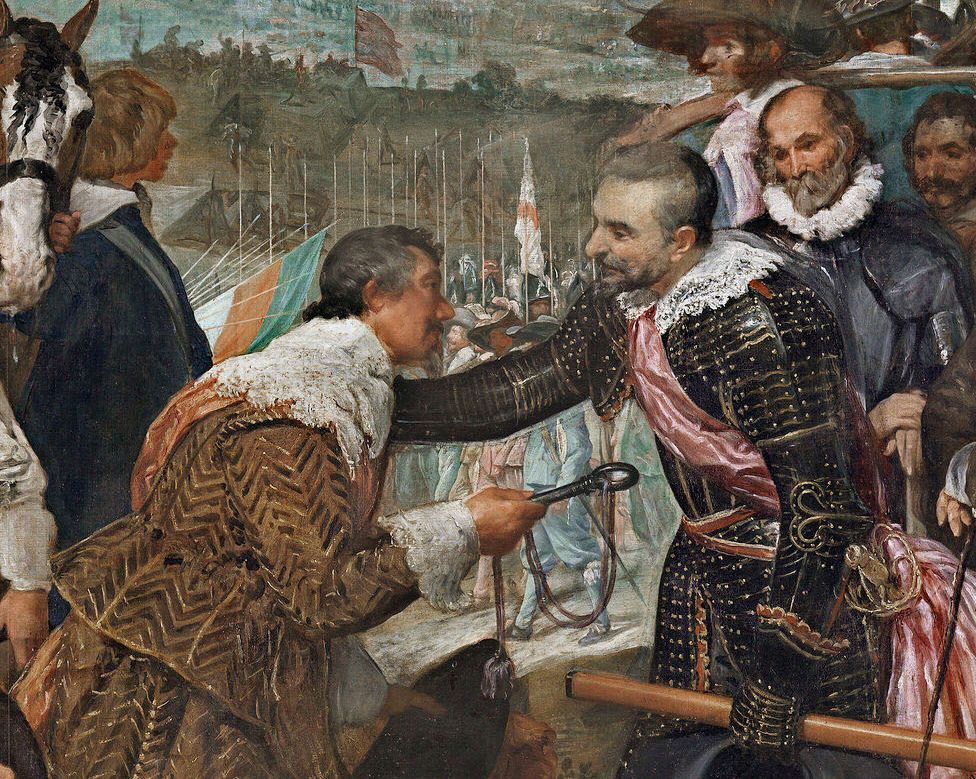
There are two nearly parallel reaches at the centre. Below, Nassau’s lace-edged sleeve ends in a hand advancing towards Spinola. Above it, the articulated plates of Spinola’s sleeve run in the opposite direction. The exact point of contact is partly hidden by Nassau’s collar and profile. We can read the restraint or support through the angle of the arm even with so little of the hand in view. The Prado’s 1990 catalogue describes Spinola as helping Nassau to rise. Luis Ribot likewise reads the gesture as preventing the governor from bowing further. Nassau’s knees are bent and his boots are still planted in a step, so the picture sustains the approach and the interruption at once. [2] [3]
The key would scarcely register if Velázquez had left it against the dense pattern of the governor’s coat. It falls instead against the pale blue and green of the departing figures below their faces. The dark metal briefly becomes the sharpest thing in an otherwise hazy opening. Its loop projects towards the pink sash, while the fine cords curve down towards the hats. Looking from the object to the two faces brings a change of speed. The key tells us promptly what is happening. It takes longer to decide how much Nassau’s face, seen at an angle and crossed by light and shade, lets us know about his response. [2]
Spinola has a more open face from this viewpoint. The line of the mouth and the slight turn of the head can read as a smile. A viewer could take that for solicitude, satisfaction or the ease allowed a victor, as Julián Gállego suggests. Each possibility belongs to the way the encounter is staged. The campaign is recorded and the participants are named, but a face made to meet another face in a painting can carry more than the record tells us about either man’s feelings. [2] [3]
The people who stand around them
On the left, a figure in a buff coat turns his back on us. The broad shape of his shoulder and the long shaft running down beside him edge the space where Nassau stands. That body, seen close enough to obstruct the scene, assigns the viewer a position among people who have gathered. The youth in green nearer the margin turns his eyes directly out. Farther in, the soldier in white looks down towards his own raised hand. Each face seems to have arrived a fraction of a second apart. The ceremony holds the gathering together without making every participant face the centre. [1] [2]
Spinola’s attendants on the other side are packed into a narrower area. Some stand sideways, allowing only a forehead, cheek or beard to emerge between larger heads. Others turn nearly full face. Look for the greying man with the broad white ruff just behind Spinola’s shoulder, and the dark-bearded man a little farther to the right. Their heads sit on either side of a deeper interval of shade. A few inches of painted space can contain a succession of men at different distances. Even where faces are interrupted by hats and shoulders, there is enough to give each man a distinct direction of attention. [2]
The difference between the two groups also comes through the cloth. Spinola’s rose sash breaks into broad lights and gathers down by the hilt of his sword. Echoes of the colour appear among the officers behind him. Across the canvas, the openings between darker coats are filled by white, buff and green, and by pennants above the group. Ribot discusses red and orange as colours associated with the opposing armies while noting the variety of soldiers’ dress. Velázquez makes allegiance visible through recurring details in a crowd of differently dressed people. [2] [3]
It is tempting to make the gestures add up to a single reaction to defeat or victory. The people are doing more ordinary things, too. One man cranes for a view. Another has part of his face hidden by someone closer. A hand holds a shaft in place. These observations keep the two parties from reading as formal processions that have stopped in order to frame a document of state. The bustle becomes especially visible beside the reserve of the two men who have stepped forward.
Velázquez's The Surrender of Breda 5-minute lesson · Artful Videos · Watch on YouTube
Why it is also called The Lances
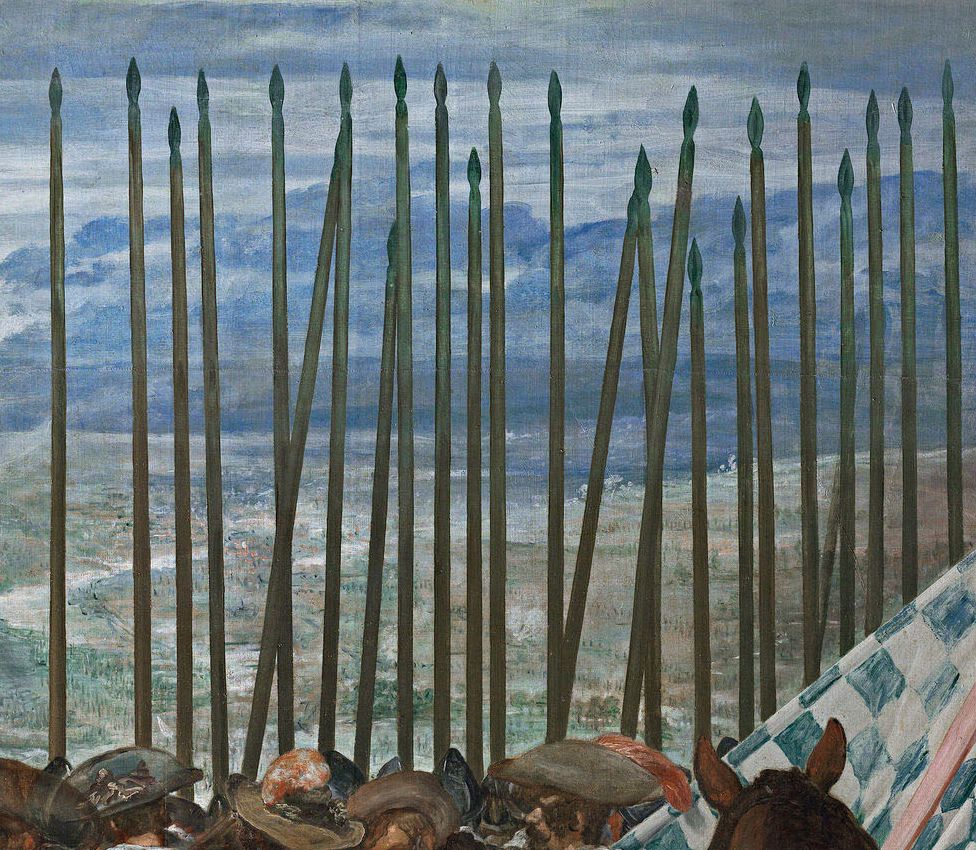
The great stand of upright weapons emerges from behind the Spanish officers. Its height is apparent only when you compare the tips with the people holding them. The shafts carry the lower half of the picture into the sky, where their points interrupt the long horizontal bands of cloud. They are commonly described as pikes, and the established Spanish title Las lanzas gives this whole passage its name. The contrast with the fewer polearms among Nassau’s party supplies an immediate impression of unequal force. The viewer can see discipline as an arrangement of bodies and equipment before knowing anything about the campaign. [1] [2] [3]
Look along the tops and the order becomes more particular. There are narrow spaces, wide spaces, and shafts which lean into one another. On the right the bright diagonal of a banner cuts across the verticals. At the left, the heads of different weapons vary in profile and the pennants drop unevenly. Gállego notes the diagonals within the Spanish grouping and reads them with the flag as part of a composition built on crossing lines. The painting gives the impression of a disciplined formation in the open air, where hands adjust their burdens. [2]
The pikes give very different information depending on where you look through them. A shaft near the middle can appear sharply in front of blue sky. Trace it down and it passes over indications of distant land and disappears into a bank of hats. That is one of the ways the canvas establishes a long view without a conspicuous framework of architectural perspective. As the darker intervals close on the right, the fields seem to recede behind a screen. In the middle there is room for an almost unobstructed fall into the distance. The ranks simultaneously assert the presence of an army and establish how near it is. [2]
The tilted weapon and fluttering fabric at the left offer a route back down to Nassau. At the right the banner runs into the horse’s head and the cluster of men. The horizontal baton provides another line through this convergence. It is shorter and thicker than the soldiers’ shafts, and is held low enough to make its relationship with Spinola’s stance clear. From across a room the mass of pikes might announce the subject first. Step closer and the baton, the key and the hand across the shoulder take over the work of telling it.
A horse at the edge of the company
The nearest horse fills much of the right foreground. Velázquez shows it from behind and at an angle, so that its broad flank is closer to us than its head. One hind leg is firmly planted and the other bends across in front of it. A stirrup and the folded shapes on the saddle hang in front of faces and boots. The turn across the back of the animal takes the eye from the swell of the body towards the ears, which are scarcely higher than the hats of the men behind. From there the lines of the banner lead out into the sky. [2]
On Nassau’s side another horse looks almost straight out, its pale blaze picked up among the changing angles of human faces. The visible head is small beside the nearer animal’s flank. The two belong to the same gathering and make very different claims on the eye. Together they help put the officers at a middle distance between us and the pale ranks below. Compare the solid brown curve of the hindquarters with the tiny marks through the interval at the key. The immediate sense of distance is a consequence of what the horse screens off and what the two commanders leave open. [2]
For a court audience, a horse could also recall the standard image of a commander mounted above his troops. Velázquez had that option available. In the same palace room Philip IV on horseback held a baton and wore armour above the ground from which the spectator looked up. Spinola retains the signs of command while meeting Nassau on foot. The saddle that remains in the picture makes it easier to imagine the difference a mounted greeting would have made. It also puts Spinola’s act of stepping towards a man on the losing side in the foreground of the story. [2] [3] [4]
From agreement to occupation, June 1625
Breda was a fortified town in northern Brabant, close to Holland. It was valuable to both the northern United Provinces and the Spanish Habsburg monarchy. In 1621 the Twelve Years’ Truce had expired and Philip IV had come to the Spanish throne. Hostilities in the Low Countries resumed while Habsburg forces were also committed in the Thirty Years’ War. Spinola was a Genoese nobleman in the service of the Spanish king. Justinus of Nassau, a son of William of Orange, was governor of Breda. The encounter brought together men who had held important commands on different sides of a long war. [3] [5]
The investment of the town began in 1624 and ran into the following June. Much of the work of the siege was done out of view of any encounter between the commanders. Trenches and fortified lines were built to encircle the town. It was hard to bring supplies in or to break the ring from outside. Ribot cites Isabel Clara Eugenia’s letter to Philip IV about the scale of the works, in which she reckoned the perimeter took three and a half hours to travel. The rear of the canvas offers a sense of such breadth even before we attach names to the columns and waterways. [3]
The garrison endured hunger and disease. The date of the agreement, 2 June 1625, is distinct from the formal handover associated with 5 June. The terms permitted the surviving defenders to leave with arms, standards and baggage. The order of departure had an importance quite apart from the scene between the commanders. To leave in formation with colours was a way of preserving the standing of a defeated garrison, and accepting terms spared the town the exposure to violence and plunder associated with taking it by storm. From the perspective of the people who had been shut up inside, the question of what soldiers were allowed to do after occupying the town had immediate consequences. [2] [3]
The sources agree on the terms and the departure. The exchange of a key in the foreground is on different footing. Ribot associates a handover of keys with 5 June. Jonathan Brown reads the accounts of the garrison’s departure as placing Spinola on horseback, observing from a distance. Héctor Ruiz Soto, returning to Herman Hugo’s account, draws a distinction between a meeting of the two commanders and the ceremonial transfer of a key, which capitulations in the Low Countries did not generally stipulate. The painting gives political possession its own visible ceremony. [3] [6] [7]
The canvas puts the gesture of courtesy where we might otherwise have seen the work of enforcing those terms. Small moving groups through the gap recall the passage of troops. Behind them smoke is still rising, and the field contains more than one moment of the campaign. This arrangement gives the people in the middle distance a role distinct from the attendants. The ceremony in front concerns control of a city. The departure behind makes clear that the transfer entails the movement of many people across contested ground. [2] [3]
Breda changes hands again
When Velázquez painted the scene, the conquest lay roughly a decade in the past. It was still an achievement Philip IV could claim. The Dutch recovered Breda in 1637, after a new siege led by Frederick Henry of Orange. Breda’s municipal heritage account dates the second capitulation to 6 October. A composite print published by Jan van Hilten in the same year illustrates the departure of the Spanish garrison on 10 October. The distinction between capitulation and departure matters in 1637 just as it does in the chronology of 1625. [1] [3] [8] [9]
The print, attributed by the Rijksmuseum to Salomon Savery, makes a revealing counterpart to the canvas. A view of the town, an image of a preacher with the soldiers before they move towards the trenches, and the procession out are accompanied by particulars of fighting near gates and by printed terms. The reader can move from event to event and check descriptions against the depicted sites. Velázquez combines intervals of time inside a single landscape and lets the viewer infer what happened through the disposition of people and things. Pictures of victory could give prominence to very different things even within a few years of one another. [2] [9]
The Spanish garrison’s departure also places the promise of the Buen Retiro canvas within an unusually short interval. The date of the Dutch recovery belongs to the history of the town. The continued display of Velázquez’s picture belongs to the history of the Spanish court. The painting could keep the act of possession present in Madrid long after possession itself had passed back to the United Provinces. [2] [8] [9]
Annotated Details from The Surrender of Breda
Follow the exchange between the commanders, the lances and the landscape behind them.
Details from THE SURRENDER OF BREDA
Spinola reaches towards Nassau
Spinola’s hand meets Nassau’s shoulder while Nassau bends forward. The small key lies below their meeting, where their arms lead the eye. [1] [2]
The ranks of lances
The thin uprights rise from an uneven line of faces. Slight shifts in angle and height keep the cluster from becoming a uniform screen. [1] [2]
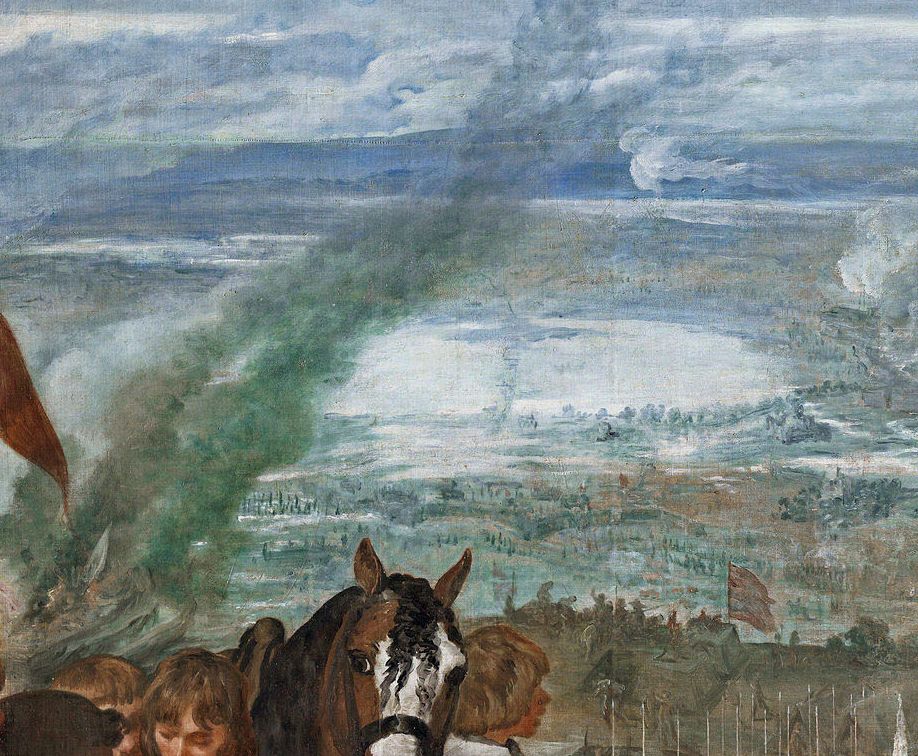
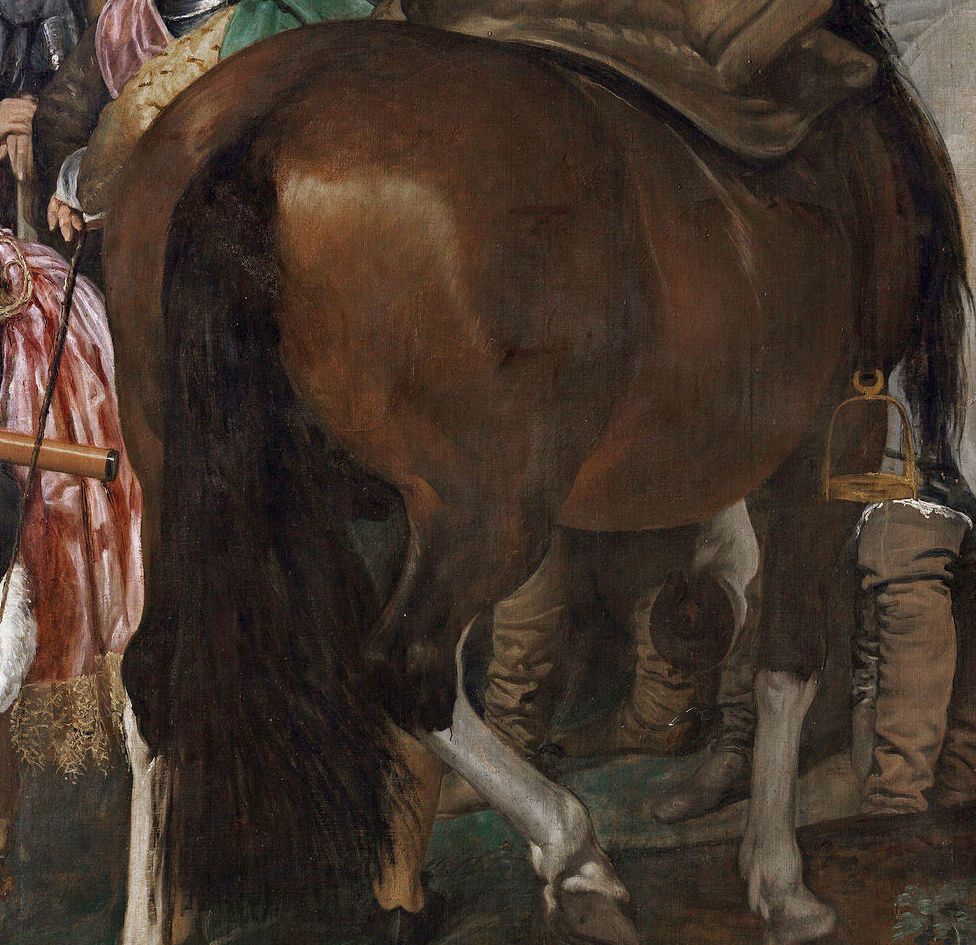
The landscape behind Nassau
Start just above the key and work upwards. The small upright weapons and light-coloured figures behind the coats give way to unbroken areas of grey-green. Narrower ranks farther back shrink to dark marks. A plume of smoke angled over the horse’s head introduces a deeper strip of country. Farther to the right, a different plume rises against the light. Pale areas of ground and water remain visible between them. Variation in size is only one of the reasons this painted space opens out. The sharper foreground edges and stronger changes from dark to light give way to soft transitions in which it can take a moment to distinguish one piece of information from the next. [1] [2]
The terrain has the general character of a siege landscape, with low, watered ground and widely separated groups. Gállego emphasises that Velázquez had never seen Breda. The historian Luis Ribot connects the prospect to Jacques Callot’s monumental Siege of Breda, in which entrenchments and inundations are available for much closer inspection. Callot’s etching was issued in six large plates designed to be joined. The Bibliothèque nationale de France’s record describes the accompanying tables, which explained letters, numbers and other signs in four languages. A viewer could use the print to locate something very specific, then recover its position within the whole operation. Velázquez uses comparable kinds of scenery to make a plausible depth beyond the actors. His ground gives enough information to recognise the circumstances of a siege without the apparatus of a map. [2] [3] [10]
A second comparison is available within the Prado. Peeter Snayers painted several views of Breda, including Isabel Clara Eugenia at the Siege of Breda, P001747. Isabel Clara Eugenia had commissioned Callot’s print. The Prado’s account of its own impression observes that the close correspondence between the print and Snayers’s painting gives particularly strong grounds for thinking he used it. The relationship is easier to see there than it is in a proposal to identify one exact stretch of Velázquez’s distance with a detail from the plates. [2] [10] [11]
Snayers introduces a foreground of people and horses and gives a very large share of the view to the earthworks, water and the spread of the country. Gállego reproduces his Bird’s-eye View of the Siege of Breda and Capture of Breda alongside Velázquez’s picture. In Snayers, the eye can travel a considerable way along the routes across the country before returning to foreground figures. Velázquez keeps the possible lines of travel smaller and less continuous. He opens a strip between one face and another and makes the main view of the ground available through their exchange. Both approaches give campaign space a role. Where Snayers offers the elevated view from which operations become intelligible, Velázquez places us close enough to the immediate gathering for bodies to get in the way. [2] [3] [11]
This work in Velázquez’s career
The Surrender of Breda (current article)
c. 1635 [1]Las Meninas
1656 CatalogueWhat the stage could contribute
The siege appeared in print and on stage well before it became one of the great paintings of the Buen Retiro. In Calderón de la Barca’s El sitio de Bredá, the defenders and the Spanish enter by different approaches. The stage direction calls for Nassau to appear at the gate with the keys laid on a dish. He attributes his reversal to fortune and asserts that fear has no part in his decision. Spinola accepts the surrender and honours his opponent’s courage, saying that the vanquished man’s valour gives fame to the victor. Only then does he take possession in the name of Philip IV. [1] [2] [12]
The drama gives the two men time to establish what they think the act of surrender means. Nassau can state the conditions in which he yields. Spinola can admire bravery and claim the accomplishment for the king in the same speech. Gállego and the Prado’s educational guide connect that exchange to the gestures in the painting. The resemblance is strongest in the way honour is extended across the divide. The objects are handled differently. Velázquez brings a single key out between the two figures and gives Spinola an arm free to meet the governor. He also lets witnesses respond quietly across the picture. Calderón’s spectators hear a proclamation of the king’s name and a call for music. [1] [2] [12]
Ribot gives particular weight to the writings of the Jesuit Herman Hugo, whose Latin account of the siege was published at Antwerp in 1626 and soon appeared in Spanish. That publication and his later book on cavalry already allowed Madrid readers to encounter Spinola as a historical protagonist. A military account, a play and a commemorative canvas all offered forms in which the same victory could be made intelligible to an audience. The readiest connection to the play is the idea of respect paid in public. The marks of the actual siege in the distance also make sense in relation to campaign imagery and the written history of the event. [2] [3] [12]
Ruiz Soto shows how the quite small flags between the officers can call up another part of Hugo’s account. The large orange, white and blue flag slants down towards the ground. Beyond it, a much narrower pale standard runs almost vertically. Hugo describes the Dutch troops lowering their flags in passing, even though the terms allowed them to carry the flags high. Ruiz Soto reads the difference in angle as a trace of the encounter between the two forces, giving the recession in space its own terms of submission and acceptance. The foreground has kept the key aloft. The interval behind it gives a much less prominent object, a slanting flag, some of the burden of conveying defeat. [7]
The sense of encountering the men at their meeting belongs to the picture. Its air of truth comes in part from the refusal of a single front-facing tableau. From the left, the men in buff and green stand between the onlooker and the party nearest Nassau. To the right the horse keeps us from seeing exactly what all of Spinola’s attendants are doing. Even the key is presented across a view obstructed by sleeves. Velázquez makes the detail on which the whole agreement depends visible under the kinds of restrictions someone standing nearby might experience. The invention acquires the conditions of a witnessed event. [2]
Whose faces are in the picture?
The parts played by Spinola and Nassau establish their identities. Their exact likenesses are another question. Velázquez and Spinola travelled on the same voyage from Barcelona to Genoa in 1629, and Spinola died in 1630, before the picture was made. Gállego records the suggestion that the painter could have made a study during the journey. The encounter supplied an opportunity. The proposed study belongs to the history of how scholars have tried to explain the resulting likeness. [2] [3]
The Rijksmuseum’s Portrait of Justinus of Nassau, attributed to the workshop of Jan Antonisz van Ravesteyn, offers an independent contemporary image. An inscription names him, and his armour and turn of the head follow the format of a set of portraits. Velázquez sets the face at a more difficult angle, close to the shoulder and overlapping the arm reaching across. Gállego discusses the possibility that a print might have helped the painter and draws attention to differences between Nassau’s apparent and actual age. A secure identification in one portrait makes it possible to compare how he was portrayed without requiring that particular work to have served as Velázquez’s model. [2] [5]
Identification becomes more difficult in the crowd. In the nineteenth century Carl Justi proposed names for several of the Spanish officers. The faces look individual enough to have encouraged that kind of inquiry. Brown reviews later candidates for some of these men, including the long-faced figure near the chequered standard whom he associates with Carlos Coloma through a likeness by Van Dyck. Such comparisons are evidence of a different kind from the account naming Coloma among officers connected with the siege. The dress and company indicate rank, while a particular face must be matched across pose, medium and purpose. The man almost cut off at the far right, beyond the horse’s neck, has often been called Velázquez himself. The identification has been supported with a suggested resemblance to the Metropolitan Museum’s Portrait of a Man. In the Met’s study of that picture Jonathan Brown records the comparison and questions the proposed identity. The New York picture has been attributed to Velázquez on the evidence of the painting, while the name of its sitter remains open. The suggestion that he portrayed himself at Breda depends on a further judgement about a face at the edge of a historical invention. [2] [6]
Two drawings attributed to Velázquez
The Real Academia de Bellas Artes de San Fernando keeps two distinct studies of cloaked men attributed to Velázquez, a smaller profile on squared laid paper, D-2212, and a larger sheet, D-2213. The first reached the Academy by royal gift in 1818. The other entered in 1836 from the Valparaíso monastery collection. The Academy records conflicting opinions on both attributions and an earlier proposal of Juan Carreño de Miranda’s authorship for the larger drawing. [13] [14]
Squaring a sheet gives a practical means of comparing proportions or transferring an image. Its presence is tangible evidence of work done to the smaller drawing. The intended destination of the figure needs evidence of its own. The Academy’s records give the anonymous figures descriptive titles, and the link of either sheet to Spinola or this canvas remains unestablished. What survives allows us to see how a profile and the fall of a heavy cloak could be investigated on paper. The related problem of identifying preparations and copies is part of the surviving evidence for Velázquez’s drawings. [13] [14]
The surrender in the Hall of Realms
In the early 1630s Philip IV’s court was building and furnishing the Buen Retiro palace. By the time the battle paintings were in place in 1635, The Surrender of Breda formed part of a sequence of twelve recent victories. Gállego dates it probably before 28 April 1635. A dispatch from the Tuscan ambassador of that date described the subjects in the room. Study of the surviving payments and inventories has been important in working out precisely which canvas the notices describe, since some titles and identifications changed in later inventories. [2] [4] [15]
The battle paintings occupied the stretches of wall between the openings and shared the room with ten canvases of Hercules by Francisco de Zurbarán above the windows. At its ends, five equestrian likenesses represented three generations of Philip IV’s family. Coats of arms high in the room gave the constituent realms a visible place. At one end, the equestrian portrait of Baltasar Carlos hung above a doorway between the portraits of his parents. Its sharply foreshortened horse suits a viewer looking from below. The boy holding a baton for the command he was expected one day to exercise belonged to the same room as Spinola holding a baton at the moment of a specific victory. [4] [15]
A picture at that scale could command attention by itself. In the Salón it was encountered among repeated formats, opposed walls and different levels of display. Hercules’ labours could make the strength and endurance celebrated by the recent victories seem to have deep roots. The equestrian portraits brought the victories, fought by the monarch’s commanders, into a wider account of succession. Breda’s own foreground makes a participant look as if he could step towards a viewer. Its original surroundings put that bodily immediacy in the service of a dynastic claim. [4] [15]
It is possible to know those broad relationships with more confidence than the exact hang at every date. A Prado-published architectural proposal for the surviving hall illustrates the reconstruction put forward by José Álvarez Lopera. Paintings of comparable height appear between the architectural divisions, each given a separate space in a sequence that extends far beyond a single view. Seen alongside the catalogue evidence that the works were made for this place, the proposal helps a viewer imagine the difficulty of taking in the whole programme at once. A visitor would move along the room, continue looking after passing one canvas, and see a different disposition of officers, terrain and gestures in the next. [2] [4] [15] [16]
Other ways of receiving a surrender
The comparison with Jusepe Leonardo’s Surrender of Jülich is especially close, because it depicts Spinola again. Leonardo keeps the commander mounted while a man on the defeated side kneels and extends the keys upwards. The vertical distance separating the hands establishes the terms of the encounter at a glance. Breda’s ground-level meeting shifts the evidence of rank elsewhere, into the baton, the massed pikes and the weight of the group that Spinola leaves behind him. The two paintings were made for the same royal hall. They show how distinctly the same claim to victory could be expressed in the bodily relationship between a giver and a receiver. [3] [15]
The name Jülich also appears in a comparison outside the Hall of Realms. Rubens’s Capture of Jülich for Marie de’ Medici, now in the Louvre, belongs to an earlier campaign than the one Leonardo depicts. In a detail of Rubens’s far larger composition, commanders reach towards one another to exchange keys while horses, troops and the country extend behind them. Ruiz Soto proposes that Velázquez might have known this invention indirectly through Rubens and makes the case for a broader kinship between paintings that associate military success with the possibility of concord. The route by which an image might have passed from one painter to the other remains hypothetical. We can see the difference in emphasis between the two pictures. Rubens gives the equestrian queen the commanding place and sets the surrender behind her. Velázquez makes the people handing over the captured town large enough to give the meeting an identity of its own. [7]
Juan Bautista Maíno’s Recovery of Bahia represents another victory of 1625 for Philip IV, in this case as king of Portugal as well as Spain. Maíno places the nursing of a wounded man prominently at the left and directs attention on the right to a displayed image of the king. Dutch prisoners kneel before it, and the commander Don Fadrique de Toledo points to the pictured sovereign. Royal clemency is exercised through a portrait within the painting. In Breda, one commander’s action gives visible shape to mercy. The equestrian portraits at the ends of the Hall of Realms could supply the connection to Philip IV that Maíno chose to incorporate directly. [3] [4]
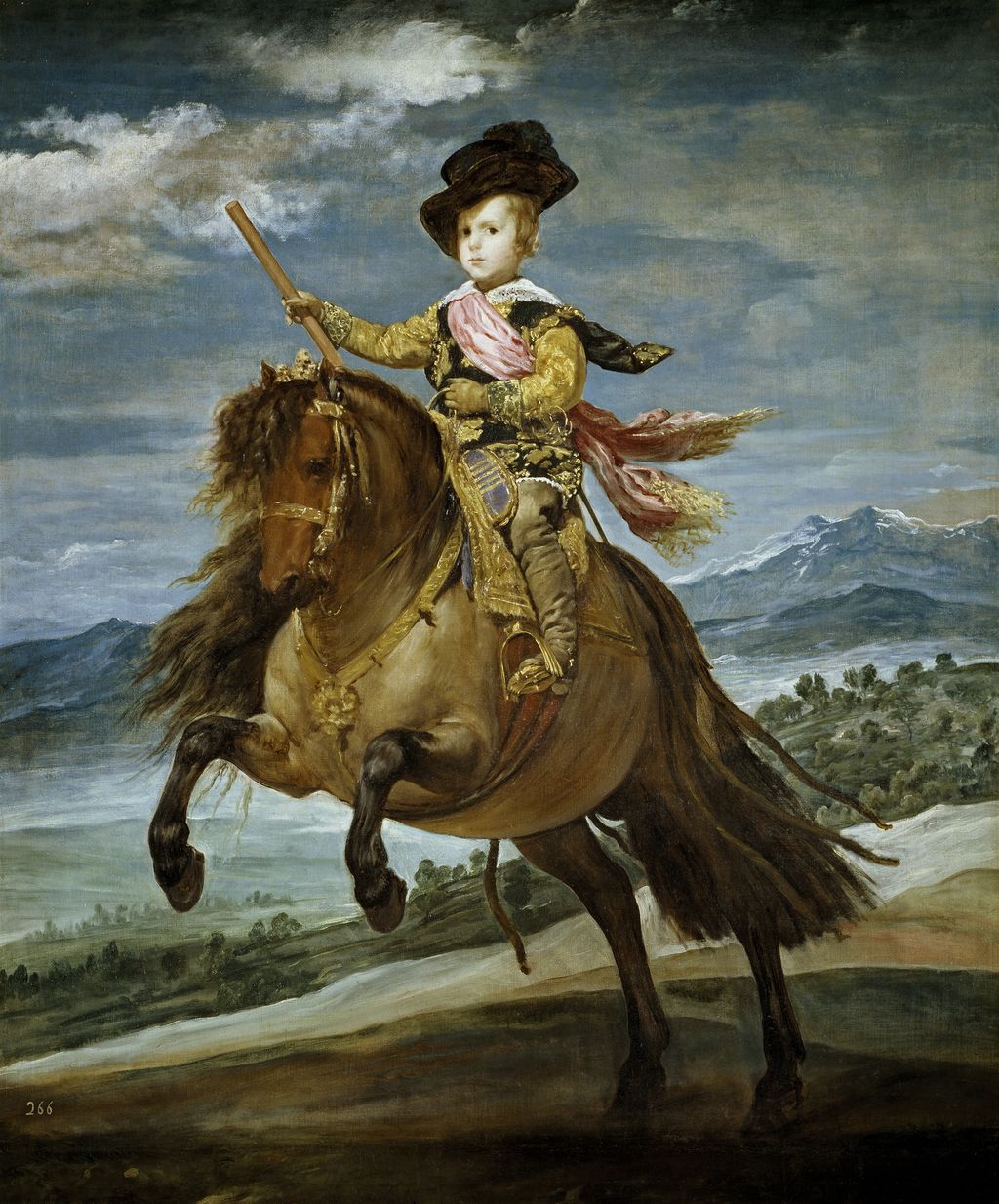
Prince Baltasar Carlos on Horseback. The mounted prince provides a comparison from the same palace programme. The wall position of the portrait shaped its unusually emphatic silhouette. View Prince Baltasar Carlos on Horseback.
Different surfaces, one scale
A close look at Nassau’s sleeve reveals a change from the broken highlights of his collar to the alternating brown slants of the coat. The slants follow the turn of the arm and describe a fabric substantial enough to hold its shape. In the dark armour opposite, tiny lights run across rows of plates, breaking where the arm turns. The decoration suggests smooth, hard surfaces markedly different from the fabric beside them. The eye accepts the blue-grey distance as a third kind of surface. Over these few inches paint has to give the sense of cloth, reflected light on metal and air between two parts of a landscape. [2]
Gállego makes much of the variety of handling. The soldier in white has irregular accents around his sleeve and body which make the cloth seem mobile. Across the picture, longer and less interrupted transitions help establish the weight and curve of the horse. The latter can look more emphatic than some nearby human faces and yet seem to have very little detail when we attend to its largest surfaces. Turn finally to the folded pale sheet among the stones at lower right. A few divisions and changes in value give it a physical presence against the ground, close to the edge of the frame. Brown identifies it as a cartellino, the feigned slip of paper on which a painter might place a signature or date. It is blank here. He reads that absence as a confident assertion of authorship made without a written name. The paper can also be seen as one more object at our feet, where the painter makes the nearest patch of ground feel within reach. [1] [2] [6]
These differences have a second effect at the distance required for a canvas over three metres high. The sharper highlights can tie together areas too far apart for the eye to take in at once. A touch of white on a sleeve takes us to the edges of a lace collar and can carry us across to a horse’s leg or the paper on the ground. Dark masses work differently. They press against the lighter ground and scale the distance between planes. In The Spinners, the movement between figures at a wheel and an illuminated space farther back again depends on how much light and precision Velázquez gives to separate kinds of work. In Breda there is no indoor threshold. Paint and overlap make the passage from the still large bodies near us to almost illegible movement in the distance. [2]
From the royal collection to the Prado
The Prado’s 1990 catalogue records the canvas at the Buen Retiro from 1635 to 1703, in inventories of the new Royal Palace in 1772 and 1794, and in the museum from 1819. Following those dated records gives the picture a second history. It began as part of a purpose-built setting in which military history was one subject among many. Manuel Gago Rodríguez links its transfer to the removal of the Velázquez paintings from the Buen Retiro under Charles III around 1762. When Antonio Ponz described the hall in the 1770s, a later siege picture appears to have filled the space once taken by Breda. The similar size and subject could help the new arrival fit the wall, even though the correspondence of subjects and patrons had begun to come apart. Later, in the museum, chronology, authorship and the grouping of schools could determine its neighbours. [2] [4]
In 1819 the new museum displayed sixteen works from the Hall of Realms in two rooms. Their size remained an important consideration, as Gago Rodríguez shows, but they no longer occupied the same architectural relation to one another. When José de Madrazo directed the publication of a lithographic series of paintings in the royal collection, Breda and Jülich were again part of a series with several other subjects from the old room. Readers could look from page to page or consult an individual impression. The prints made after Velázquez’s paintings give some idea of how far the pictures came to travel from the walls for which they were made. [4]
In the nineteenth century Velázquez’s scene supplied a precedent for another Spanish painting of a surrender. José Casado del Alisal’s The Surrender of Bailén, dated 1864, commemorates the defeat of a French army during the Peninsular War. Gállego draws attention to the courtesy of the Spanish commander Castaños, who uncovers in front of the defeated party. The two pictures use a gap between assembled forces and let a gesture in that gap carry the story. Casado places his opposing parties under a clear opening in the landscape and makes the formal salutation an event for the group. At Breda the most consequential movement is so close to the two heads that a spectator some way off may first see only an arm spanning the interval. [2] [3]
Conservators, too, have had to study the canvas at many distances. In an interview for the Prado, María Teresa Dávila recalls restoring The Lances and The Spinners with her sister Rocío, as their work on Velázquez continued after the treatment of Las Meninas. The recollection places Breda within a shared conservation effort on paintings of very different subjects and surface effects. Look at where a contour falls away, how a highlight sits on the cloth, or where a rising plume becomes indistinct against the sky. [2] [17]
Standing far enough back, it is possible to take the scale of the pikes and the landscape in together. Coming nearer makes room for other parts of the scene, such as the face that peeps past the horse, or the pale ranks that are still on the move between the commanders. Return to the key and see how little space it needs. The governor has tilted his whole body forward to offer it. The commander has bent to meet him, one hand still occupied by the baton of the army that has brought them there. All the ground on which the siege took place begins to disappear behind those few inches of painted air.
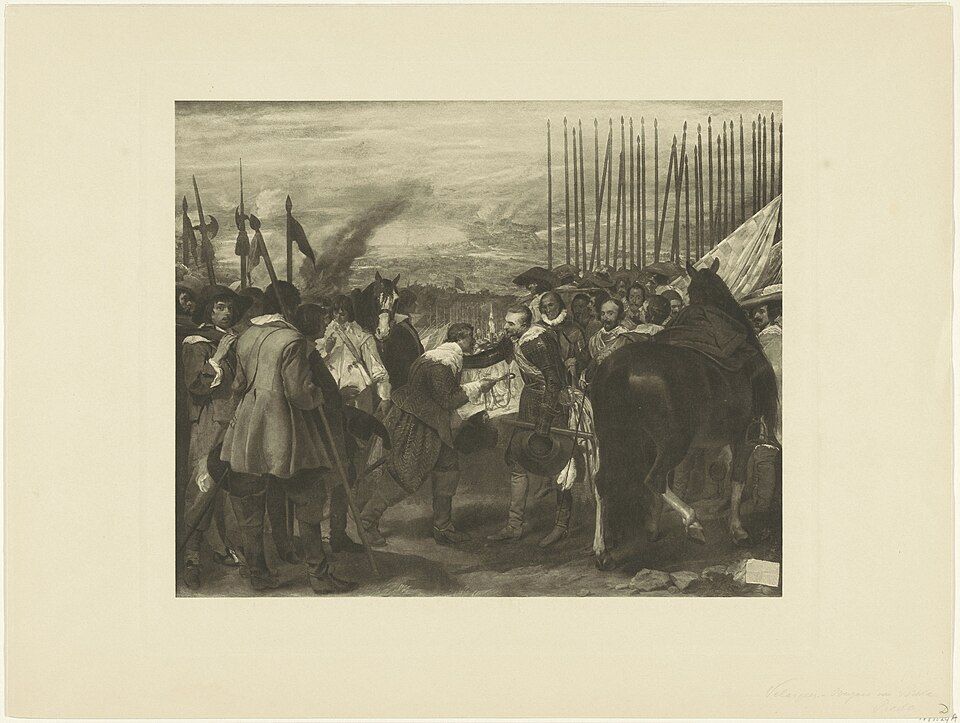
Anonymous reproduction after Velázquez, The Surrender of Breda, 1900–04, Rijksmuseum RP-R-1904-288. The catalogue identifies this as a reproduction. Compare how the central exchange, horses and vertical lances read on paper. Image source. CC0 / Public domain. Resized for display.
What Breda’s townspeople were promised
Breda’s magistrates described the siege from inside the town. In a February appeal for relief they reported that residents had fed the garrison from their own stores while they had anything to spare. They named bread and rapeseed oil as the food that remained and said that even the oil was growing scarce. They reminded the authorities that citizens had contributed money and silverware to pay soldiers. By 27 April the magistrates were writing again, with bread almost gone, no grain for brewing even small beer and insufficient medicine for the sick. Both letters asked for urgent help, so their authors had reason to emphasise the extremity. They also allow us to see who had been doing the work of keeping the town and its defenders going. [18]
The agreement that ended the siege dealt separately with the garrison and the inhabitants. The military articles made arrangements for people who could neither march out with the colours nor expect to leave on the same timetable. Boats were to carry the sick and officers’ belongings, with navigation kept open for twelve days. Soldiers too ill to depart on the appointed day could remain until they recovered and then leave under the same conditions as the rest. The townspeople’s articles addressed the traffic in the other direction as well. Residents who were absent could return under the agreement, while outsiders who had taken shelter in Breda could depart with their belongings. Under the arrangements for people leaving the town, carts and boats could be brought in from elsewhere if local transport proved insufficient. [19]
Religious terms affected decisions that might take a household months. The articles allowed citizens two years to remain without a religious test, subject to a condition about giving no scandal, and to arrange their affairs if they chose to leave. Public exercise of the Reformed religion was among the requests rejected in the negotiations. Preachers were allowed to leave immediately with their families and goods and given time to dispose of property. A garden was to serve as a Protestant burial ground for the two years, with the option of taking bodies outside Breda for burial. The agreement spells out what families could do about a house they might sell or a grave they could no longer use. Those decisions extended the handover well beyond the day on which the troops marched out. [19]
How the terms became news
Someone following the war in 1625 could read about the surrender without ever seeing the same terms as a reader elsewhere in Europe. The Dutch editions examined by Carmen Espejo-Cala, Paul Arblaster and Javier Díaz-Noci printed the full articles. In the Amsterdam and Dordrecht translations, a small typographical detail directed attention to the limits of the agreement. Printed pointing hands marked the accompanying note about the refusal of public Reformed worship and of the Prince of Orange’s hereditary rights of lordship. Those marks enabled a reader scanning a long agreement to go straight to what the negotiations had failed to secure. A copy of the Rotterdam edition also had a practical use for people who needed to know what the articles permitted, down to the arrangements for hiring transport. [19]
The researchers traced two abbreviated accounts as well. One carried material they judge to be partly based on hearsay. Another reached readers in Spain, Italy and France in versions that stressed the restrictions on Protestants and gave less space to the concessions. The researchers propose that the latter may have come from Spinola’s field chancery. There was an argument over the wisdom of granting terms at all on that scale. Herman Hugo records criticism that Spinola had been too ready to agree and replies that the king’s army could ill afford to remain tied down outside Breda. The prospect of redeploying troops gave the commander a practical reason to reach agreement quickly. [19]
The versions in print suggest why Spinola’s hand is such an economical choice for the canvas. A pamphlet could specify which party had secured a concession and which had given one up, and a reader could think the terms generous on one count and severe on another. Velázquez gives the agreement a physical counterpart in a movement that anyone in the palace could read. Spinola stretches his arm the instant that Nassau’s position is most exposed. Even a viewer who knew the arguments over the terms could see that display of courtesy and make a separate judgement about the settlement it accompanied. [19]
A funeral procession and a silver medal
A print issued in Antwerp the year Breda fell takes the departure as an occasion for mockery. An anonymous etcher shows a procession with a peat barge under a funeral cloth, drawn by horses and followed by mounted mourners. Spinola watches from farther back, with celebratory fires in Breda. The dialogue set in type below the scene gives a Brabanter and a Hollander places in the argument. As Marianne Eekhout explains, the joke depended on a trophy once displayed in the town. In 1590 soldiers of the Dutch Republic had entered Breda’s castle hidden in a barge used to carry peat. The boat was kept and displayed as a reminder of the capture. It was burned after Spinola’s victory. Putting it in a mock funeral turned the garrison’s departure into a burial of the memory of the earlier Dutch success. [20] [21]
Velázquez’s foreground lends itself to a comparison with that Antwerp print. The etcher gives the barge the prominence of a coffin at the head of a procession and makes the defeated party available for ridicule. In the canvas an object also concentrates attention, but the key is small enough for a viewer to see it and look straight on to the face of the man who holds it. Both images are celebrations of Habsburg victory. For the print’s joke to work, its audience needed to recognise what the barge had once meant. The key could be understood in Madrid with very little knowledge of the town’s own history. [20] [21]
After the Dutch recovery in 1637, Johannes Looff’s silver medal set three episodes within a circle seven centimetres across. The barge recalls the capture by stealth in 1590. Breda appears as a woman seized by Hunger, a reference to the siege that ended in 1625. A sword-bearing arm comes out of the clouds above the town, which Eekhout reads as a sign of Divine Providence in the latest victory. On the medal the hunger that Breda’s magistrates had described in letters becomes an image in its own right. With Velázquez, the people who approach the centre are still in command of how they carry themselves. The sovereign change is visible in what passes between two men, while the medal makes the town itself a body that can suffer. [18] [21] [22]
Artworks directory
Frequently Asked Questions
About 1635 [1]
Discussion
Look again at the images and ideas explored in The Surrender of Breda. These editorial prompts invite your observations.
Reader Insights
How do the empty space and gestures around the key shape the encounter between Spinola and Nassau?
What happens to your reading of the scene when you look past the commanders to the smoky landscape?
Join the Conversation
Share a detail, comparison or question about The Surrender of Breda below.
References
- Museo Nacional del Prado, Espacios Barrocos, “Las lanzas o La rendición de Breda”, oil on canvas, c. 1635, 307.3 × 371.5 cm. Spanish. View source.
- Julián Gállego, Las lanzas o La rendición de Breda, catalogue no. 35, in Antonio Domínguez Ortiz, Alfonso E. Pérez Sánchez and Julián Gállego, Velázquez, Museo del Prado and Ministerio de Cultura, 1990, pp. 212–219. For the equestrian series see also nos. 36 and 40, pp. 221–222 and 240–244. Spanish. View source.
- Luis Ribot, “La rendición de Breda, triunfo estratégico de Felipe IV en la guerra de los Países Bajos”, in Un paseo militar por el Museo del Prado / A Military Stroll through the Museo del Prado, Ministerio de Defensa, pp. 76–83. See also Isabel Clara Eugenia en el Sitio de Breda, pp. 68–75, La recuperación de Bahía de Todos los Santos, pp. 90–97, and La rendición de Bailén, pp. 172–177. Spanish and English. View source.
- Manuel Gago Rodríguez, “La dispersión de la serie pictórica del Salón de Reinos y su fortuna museográfica durante los primeros años del Real Museo de Pinturas (1635–1838)”, Philostrato. Revista de Historia y Arte, no. 14, 2023, pp. 23–46, especially the opening discussion and sections on the distribution of the works and their entry into the Royal Museum. Spanish. View source.
- Rijksmuseum, Portrait of Justinus of Nassau (1559–1631), workshop of Jan Antonisz van Ravesteyn, SK-A-536. English collection record with Dutch description. View source.
- Jonathan Brown, “A Restored Velázquez, a Velázquez Restored”, in Velázquez Rediscovered, The Metropolitan Museum of Art, 2009, pp. 12–15, figs. 7–9. The portrait discussed is 49.7.42. View source.
- Héctor Ruiz Soto, “La concordia entre las armas. La rendición de Breda, Rubens y Velázquez”, Archivo Español de Arte 98, no. 390, 2025, article 1463, especially pp. 6–11, fig. 6 and notes 76–88. Spanish with English abstract. View source.
- Erfgoedweb Breda, “Tachtigjarige oorlog: de linie van 1637”, section “Overgave”. Dutch. View source.
- Rijksmuseum, Verovering van Breda en de uittocht van het Spaanse garnizoen, 1637, attributed to Salomon Savery, published by Jan van Hilten, RP-P-AO-16-45E. English collection record with Dutch description. View source.
- Bibliothèque nationale de France, Jacques Callot, Le siège de Breda, Antwerp, 1628, general catalogue record for the six plates and explanatory tables, CB426878110. French. View source.
- José Manuel Matilla, “Sitio de Breda”, Jacques Callot, Museo Nacional del Prado, Memoria de actividades 2004, p. 32, including the comparison with Peeter Snayers’s P001747. Spanish. View source.
- Pedro Calderón de la Barca, El sitio de Bredá, Jornada III, closing stage direction and lines 999–1026, Biblioteca Virtual Miguel de Cervantes. Spanish. View source.
- Real Academia de Bellas Artes de San Fernando, Estudio de hombre de perfil con capa hacia la derecha, attributed to Diego Velázquez, D-2212. Spanish. View source.
- Real Academia de Bellas Artes de San Fernando, Estudio de hombre con capa, attributed to Diego Velázquez, D-2213. Spanish. View source.
- Ramón Torner Marco, Jusepe Leonardo. Un pintor bilbilitano en la Corte de Felipe IV, Centro de Estudios Bilbilitanos, Institución Fernando el Católico, 2003, pp. 55–61, particularly Rendición de Juliers, Museo del Prado P000858. Spanish. View source.
- David Chipperfield Architects and b720 Fermín Vázquez Arquitectos, Museo Nacional del Prado, 1204SDR, competition proposal 1204SDR, panel 3, “Salón de Reinos”, after José Álvarez Lopera. Spanish. View source.
- María Teresa Dávila Álvarez, “We Restored Practically the Entire Velázquez Collection”, Voices of the Prado, interview recorded 29 November 2017. English transcript. View source.
- Hans van der Meer, “Een cryptogram uit belegerd Breda 1625”, transcriptions of Breda magistrates’ letters from the States General archive SG 4946, February letter lines 11–23 and 30–37 and 27 April letter lines 2–11. Dutch. View source.
- Carmen Espejo-Cala, Paul Arblaster and Javier Díaz-Noci, “Plain truth and misinformation in Early Modern news networks: the translation of the articles of capitulation of Breda (1625) in European journalism”, Janus. Estudios sobre el Siglo de Oro 13 (2024), pp. 96–136, especially pp. 104–108, 121–123 and appendix 1, pp. 129–131 (G3, G7, C2–3, C5, C9 and C12–13). English. View source.
- Rijksmuseum, Spotprent op het verlies van Breda, 1625, anonymous, Antwerp, etching with letterpress, RP-P-OB-81.100. Dutch. View source.
- Marianne Eekhout, “Celebrating a Trojan Horse. Memories of the Dutch Revolt in Breda, 1590–1650”, in Memory before Modernity: Practices of Memory in Early Modern Europe (Brill, 2013), pp. 129–147, especially pp. 129–130, 133–135 and 140–145, figs. 7–8. English. View source.
- Rijksmuseum, Johannes Looff, Inname van Breda door Frederik Hendrik, silver medal, NG-VG-1-723. English catalogue with Dutch description. View source.







