


 by Tom Gurney
Tom Gurney BSc (Hons) is an art history expert with over 20 years experience
Published on June 19, 2020 / Updated on October 14, 2023
Email: tomgurney1@gmail.com / Phone: +44 7429 011000
Prince Baltasar Carlos with an Attendant: Introduction
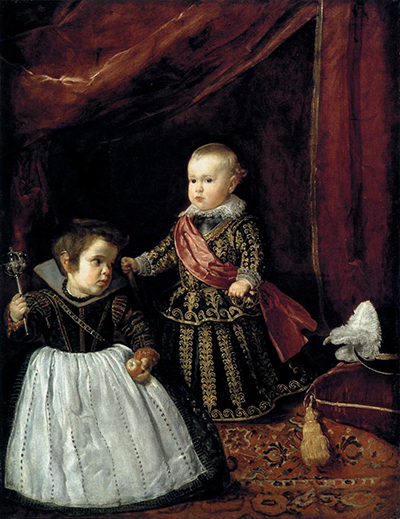
Baltasar Carlos stands beneath a curtain, holding a commander’s baton in a hand that barely closes around it. His arm reaches towards the left of the picture, where an attendant holds up a rattle. The attendant’s head turns towards the right, while the prince’s face remains almost square to us. Lower down, a white apron spreads across the foreground and a plume rises from the hat on the other side. Between these two flashes of white, Velázquez gives the prince the small, extraordinarily exacting task of standing still. [1] [2]
The Museum of Fine Arts, Boston, calls this oil painting Don Baltasar Carlos and an Attendant and dates it to 1632. The canvas measures 128 by about 102 centimetres and entered the museum in 1901. Baltasar Carlos, born in October 1629 to Philip IV and Isabel de Borbón, was the heir to the Spanish throne. He died in 1646, aged sixteen. The military dress in the Boston portrait gives an idea of what the court was already preparing to ask of him. [1] [2] [3]
At a Glance
- CollectionMuseum of Fine Arts, Boston, 01.104 [1]
- Dated by the museum1632 [1]
- MediumOil on canvas [1] [2]
Contents
- The baton and the rattle
- A carpet and a curtain
- The attendant at court
- An early portrait of the heir
- How the prince stands and rides in other portraits
The baton and the rattle
The prince’s costume has to do much of the work of representing command. A pinkish red sash crosses the dark coat and bunches at his left side. Loops and curls of gold reveal the contour of the shoulders, turn along the hem and repeat in long rows down the skirt of the garment. A lace collar catches light just below the cheek. The sword appears principally through the hand on its hilt. The other hand takes the baton away from the body, carrying the design outward into a patch of shadow near the attendant’s head. On the right, the plume bends across a red cushion trimmed in gold. Setting the hat aside leaves the prince’s short fair hair and round forehead fully exposed. [1] [2]
The attendant has a stiff pale collar and a diagonal band, both legible against the dark upper garment. The pale apron is full enough to fill much of the lower left of the painting. Thin lines of openwork descend through it, broken and bent by the folds, while the gold embroidery on the prince’s clothing follows a more regular pattern. The attendant’s torso faces outwards, with arms separated by a similar distance to the prince’s. The face has a much sharper turn. Held upright in one hand, the rattle ends in a cluster of lights. The apple in the other hand sits low against the apron, where the rounded shape and warmer colour make it immediately visible. [2] [3]
Rattle and apple belong plausibly to the world of a small child. Their placement also invites a comparison with the baton and sword. The rattle rises into the light, while the darker baton angles down from the prince’s fist. The apple has been compared with an orb and the rattle with a sceptre. Janet Ravenscroft, who studies the place of people with dwarfism at the Habsburg court, points out that Spanish kings were generally portrayed without those attributes. The resemblance works best as a possible play on the shapes and uses of objects. It helps explain how two people holding very different things can echo each other across the painting. [2] [3]
A carpet and a curtain
The prince occupies the higher and more central position. The attendant stands to the left, closer to the bottom edge, where most of the feet disappear into shadow and cloth. It is difficult to use the floor as a ruler. A patterned carpet fills the foreground, and changes in its pattern and projection interrupt the eye’s path into depth. The large gold tassel of the cushion hangs over the carpet at the right, helping to put the hat between the viewer and the dark fall of curtain. Along the top, heavier folds of fabric sweep diagonally towards the upper right. The vertical strip of lit trim beyond the prince checks that movement and divides the background from the narrower space occupied by the cushion. [2]
Julián Gállego, writing in the Prado’s 1990 exhibition catalogue, took a close look at the horizontal division in the carpet. He wondered whether the attendant might stand before a painted portrait of the prince, with the carpet in the foreground and the floor under the prince belonging to different spaces. This was one proposed explanation for the differences in handling and viewpoint. Even the ordinary reading of two figures sharing an interior depends on the viewer bridging a gap which the carpet leaves unusually conspicuous. The combination of a figure low and close and another standing high in a field of dark cloth gives the smaller canvas something of the sense of looking up that Velázquez would develop in the Prado equestrian portrait. [2]
The attendant at court
The Prado catalogue uses the older Spanish title El príncipe Baltasar Carlos con un enano, familiar in English as Prince Baltasar Carlos with a Dwarf. Boston’s current title calls the second person an attendant. Records of the Spanish Habsburg household show that people with dwarfism served in varied capacities. They could spend time close to members of the royal family and were sometimes represented in rich dress within the royal entourage. Surviving portraits and household records tell us more about the court’s view of such service than they do about this person’s life. In Boston the sitter has a big share of the foreground, a particularly bright area of costume and a gaze that draws us away from the prince. The attention Velázquez gives to the turn of the head makes this person difficult to pass over, even in a picture that carefully establishes rank. [1] [2] [3]
The sitter’s name, age and gender remain uncertain. Gállego describes how Camón Aznar took the clothing to be feminine and how Jonathan Brown treated the identification as a possibility. Ravenscroft notes that children of both sexes wore a pinafore over a skirt. Francisco Lezcano, who served Baltasar Carlos and is named in the Prado’s later portrait The Boy from Vallecas, has also been suggested. Gállego sets out the difficulty. The dates proposed for the Boston canvas precede Lezcano’s recorded service to the prince, and the identification therefore depends on further conjecture about when the second figure was painted. [2] [3]
An early portrait of the heir
Francisco Pacheco says that after returning from Italy in early 1631 Velázquez painted the young prince for the king. His account gives no particulars that identify the attendant or describe this composition. The 1990 catalogue reports traces of an age inscription which earlier writers read as one year and four months, pointing to early 1631. It also records Jonathan Brown’s proposal that the canvas was painted around the Castilian nobility’s oath of allegiance to Baltasar Carlos in 1632, the year given in the current Boston record. The picture’s military accessories suit a portrait of the heir, and the ceremony gives a possible reason to have commissioned one. The painting itself shows two people in an interior, without assembled nobles or the act of swearing an oath. [1] [2] [3] [4]
The care lavished on the gold costume has itself had a bearing on how the painting has been understood. The Prado catalogue reports Elizabeth du Gué Trapier’s account of X-rays of the Boston canvas. Its finding concerns the decorative embroidery of the prince’s garment, which Aureliano de Beruete had thought might have been added later. According to the catalogue’s summary of Trapier, the X-rays supported the embroidery’s place in the original paint. The finding gives a reason to take the unusually fine ornament as part of the initial presentation of the prince. [2]
How the prince stands and rides in other portraits
In the larger Prince Baltasar Carlos on Horseback at the Prado, painted in 1634–35 for the Hall of Realms at the Buen Retiro, a baton still extends from the prince’s right hand. His left hand now holds the reins, and the horse’s body carries him towards the viewer. The ground drops into a distant landscape. Boston gives us a much smaller field, where the carpet and curtain keep the prince within a shallow interior and the attendant is large enough beside him to make us aware of the child’s scale. In the Prado’s Prince Baltasar Carlos in Hunting Dress of 1635–36, the boy is again on foot. A long gun angles upwards at his side, and a dog at his feet and the landscape behind him set the scale of his upright figure. The hunting costume and setting belong to the portrait for the Torre de la Parada. [2] [5] [6]
The Wallace Collection’s Prince Baltasar Carlos in the Riding School, attributed to Velázquez’s studio and dated about 1640–45, places the prince on a horse with a riding master nearby and spectators at a greater distance. The Wallace identifies the long implement being brought forward as a lance and the setting as a tiltyard at the Buen Retiro. Here the prince’s position is part of an action, as if the next moment will carry him away from the person handing him the lance. In Boston the smaller movement belongs to the attendant’s turning head. The prince has already assumed his position, with the baton at arm’s length and the other hand on the sword. The picture leaves him at that early stage when the gestures of command still have to be learnt one by one. [2] [7]
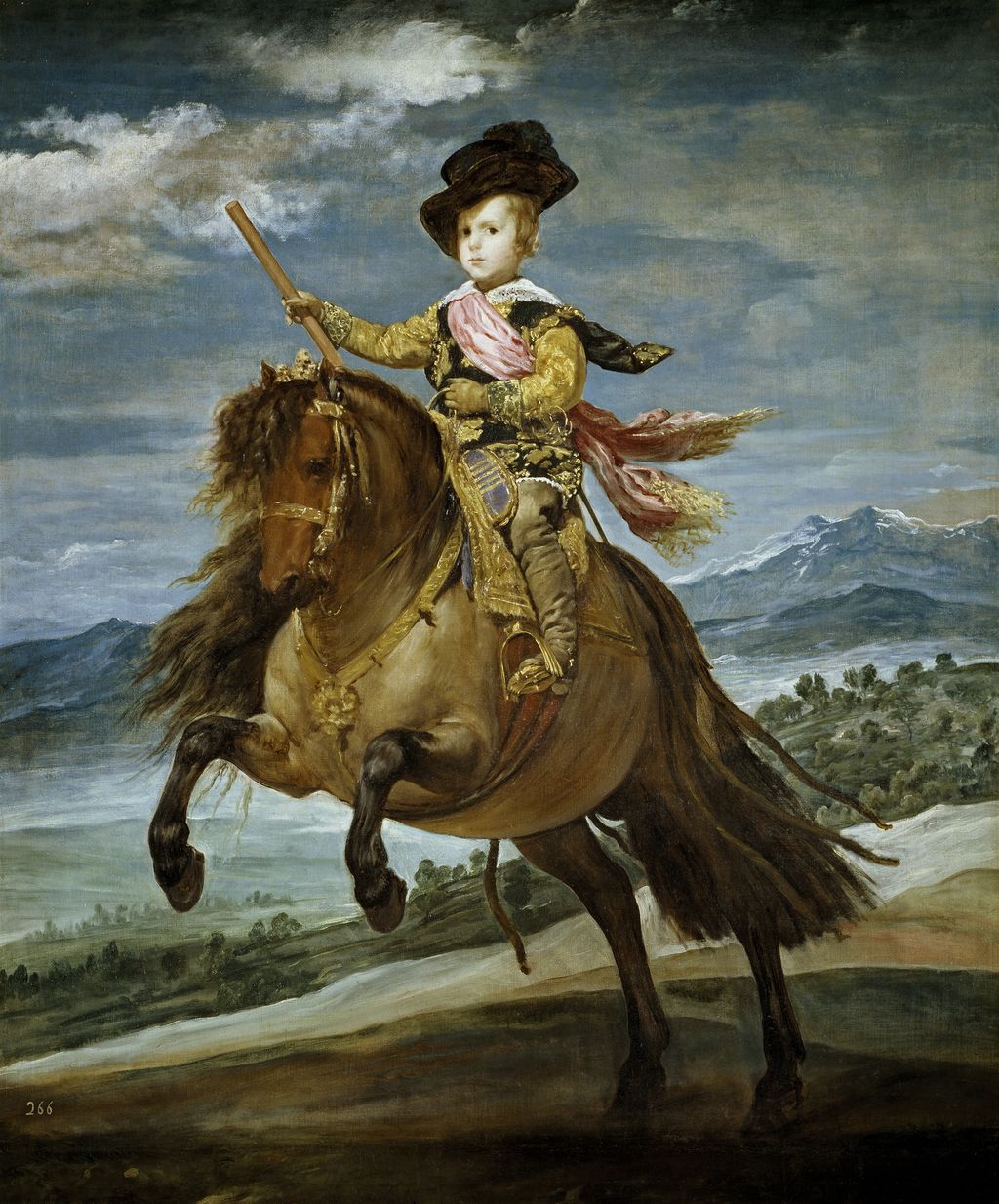
Prince Baltasar Carlos on Horseback. The mounted portrait gives the baton and military costume a different emphasis within the Hall of Realms. View Prince Baltasar Carlos on Horseback.
Artworks directory
Frequently Asked Questions
Museum of Fine Arts, Boston, 01.104 [1]
1632 [1]
Discussion
Look again at the images and ideas explored in Prince Baltasar Carlos with an Attendant. These editorial prompts invite your observations.
Reader Insights
Where does the light draw your eye between the baton, rattle and plume?
What role does the attendant’s gesture play in how you read the portrait?
Join the Conversation
Share a detail, comparison or question about Prince Baltasar Carlos with an Attendant below.
References
- Museum of Fine Arts, Boston, Don Baltasar Carlos and an Attendant, Diego Rodríguez de Silva y Velázquez, 1632, accession 01.104, object 31124, European Paintings collection listing. View source.
- Julián Gállego and Museo Nacional del Prado, Velázquez, Madrid, 1990, cat. 33, pp. 202–207, with full plate on p. 203. Spanish. View source.
- Janet Ravenscroft, ‘Ordinary Marvels: The Case of Dwarf Attendants in Habsburg Spain’, in Robin O’Bryan and Felicia Else, eds., Giants and Dwarfs in European Art and Culture, c. 1350–1750, Amsterdam University Press, 2024, pp. 241–272, especially pp. 253–255 and fig. 7.2. View source.
- Francisco Pacheco, Arte de la pintura, Seville, 1649, Book I, chapter VIII, account of the return to Spain. Spanish transcription by Santiago Arroyo Esteban, Universidad Complutense de Madrid. View source.
- Julián Gállego and Museo Nacional del Prado, Velázquez, Madrid, 1990, cat. 40, pp. 240–245, El príncipe Baltasar Carlos, a caballo, P001180. Spanish. View source.
- Julián Gállego and Museo Nacional del Prado, Velázquez, Madrid, 1990, cat. 45, pp. 276–280, El príncipe Baltasar Carlos, cazador, P001189. Spanish. View source.
- The Wallace Collection, Prince Baltasar Carlos in the Riding School, Studio of Diego Velázquez, about 1640–45, P6. View source.







