


 by Tom Gurney
Tom Gurney BSc (Hons) is an art history expert with over 20 years experience
Published on June 19, 2020 / Updated on November 5, 2026
Email: tomgurney1@gmail.com / Phone: +44 7429 011000
Prince Baltasar Carlos on Horseback
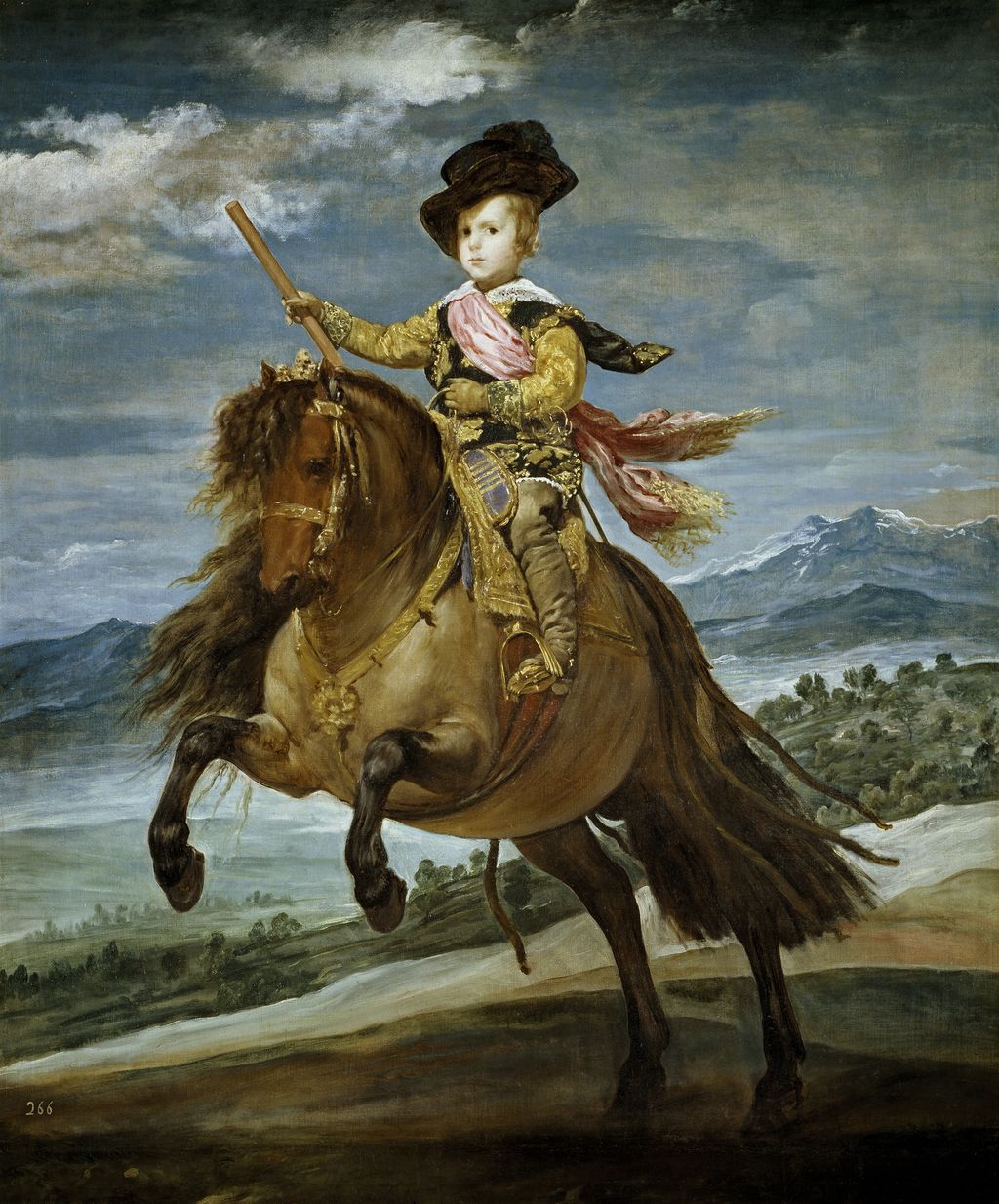
A small boy sits high above us on a powerful brown horse. Its forelegs rise into the air, its mane spreads across its neck, and its rounded chest seems to push beyond the picture. The rider remains remarkably composed. He holds a commander's baton out in his right hand while his left gathers the reins close to his body. Beneath the large dark hat is an unmistakably young face: serious, alert and still soft with childhood. Velázquez makes the difference between the child's size and his public importance the heart of the portrait.
The boy is Baltasar Carlos, also known in English as Balthasar Charles, the son of Philip IV of Spain and Isabel de Borbón. Painted for the royal palace of the Buen Retiro in Madrid, his equestrian portrait belonged to an ensemble that presented the ruling family across three generations. The Museo Nacional del Prado dates the oil painting to 1634–1635 and gives its dimensions as 211.5 × 177 cm. Its Spanish title is El príncipe Baltasar Carlos, a caballo. [1] [2]
At a Glance
Where the painting sits in Velázquez’s career
Contents
A child dressed for command
The picture gives Baltasar Carlos the equipment of an adult military leader. A broad pinkish crimson sash crosses his chest, a sword hangs at his side, and the baton makes a firm diagonal against the sky. His golden clothes and elaborate saddle bring the ceremonial richness of the court into this open landscape. Tall riding boots enclose his lower legs. Nothing about the costume suggests an accidental encounter with a child at play. The Prado's 1990 catalogue explains equitation as preparation for a prince's future command of armies. [1]
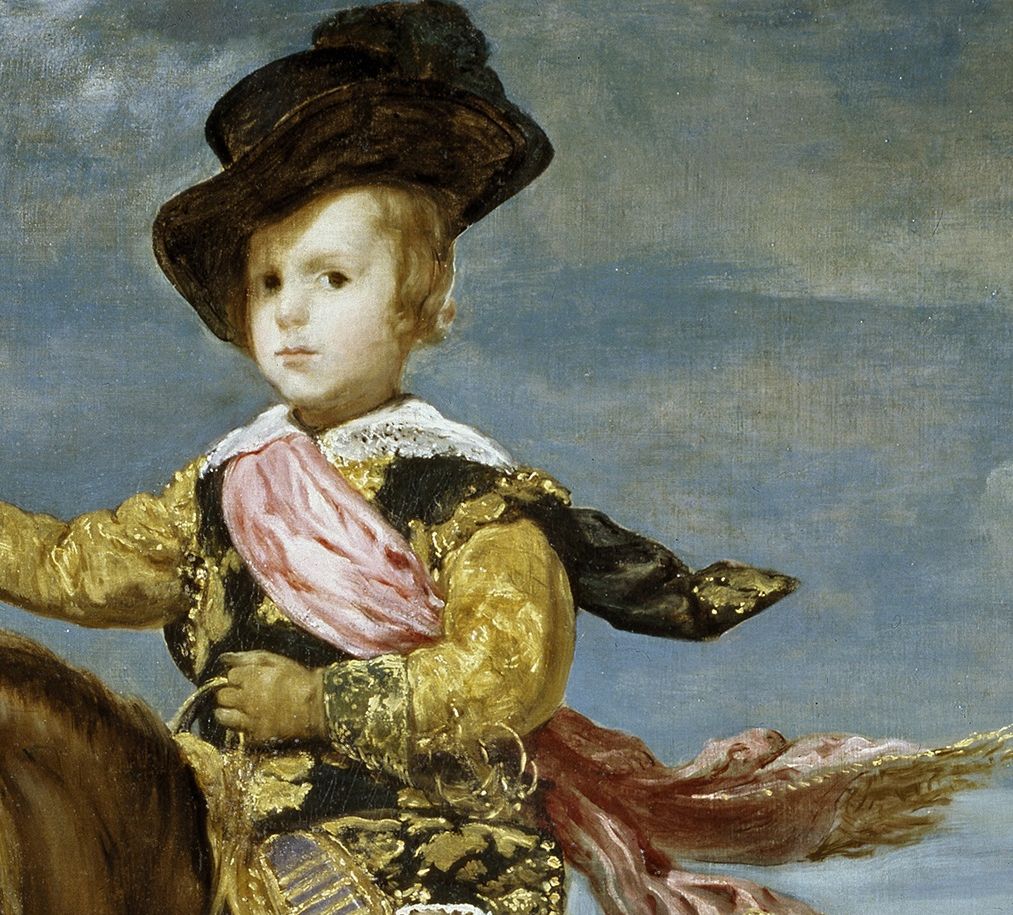
Yet Velázquez allows the boy to remain a boy. The round cheek and small mouth do not harden into a warrior's face. His head turns towards the spectator while his body follows the horse, so that we encounter an individual presence within the public pose. His expression can look solemn, even absorbed in the business of holding himself correctly. That impression comes from the painting's visible balance of ceremonial gestures and youthful features; it does not require us to imagine what he privately felt.
Look at the different directions of movement. The baton rises towards the left, the horse's head bows down, and the sash trails out behind the rider towards the right. The hanging sleeve and loose fabric extend the sense of air passing through the scene. Against them, the boy's upright torso feels unusually steady. Gállego's catalogue commentary notices this contrast between the fluttering accessories and the undisturbed appearance of the child. The portrait makes command look like composure amid movement. [1]
Why the horse looks so large
The horse's broad body can be startling. Its belly and chest occupy a great deal of the canvas, while the legs look comparatively fine. Seen from the front at ordinary picture height, the proportions are difficult to ignore. But this portrait was designed for a place above a doorway, between the equestrian portraits of the prince's parents in the Salón de Reinos, or Hall of Realms. Visitors would look upwards towards it. The 1990 Prado catalogue connects this original position with the sharply foreshortened presentation of horse and rider. [1]
Imagine approaching the doorway beneath the animal. The lifted forelegs and advancing chest would become an energetic projection into the room above your head. The perspective therefore belongs to the picture's architectural setting as well as to the animal itself. We lose something when we treat the unusual proportions simply as a mistake to be corrected. Velázquez was making an image that needed to carry across a large ceremonial space and from a pronounced angle below.
The pale diagonal of ground beneath the horse also helps. It cuts across the darker foreground, giving the animal a slope against which its lifted body becomes legible. Beyond it, bands of green land fall away towards the mountains. Nearness and distance are brought together with striking economy: the horse presses forwards while the landscape opens backwards. The child's figure occupies their meeting point, suspended between the physical force of the mount and the spaciousness of the country behind him.
The family in the Hall of Realms
The portrait originally made its argument alongside other paintings. The five royal equestrian portraits represented Philip III and Margarita of Austria, their son Philip IV with Isabel de Borbón, and the young Baltasar Carlos. The arrangement joined the reigning king to his parents and his heir. The prince's placement above the doorway, with his own parents to either side, gave a family relationship a visible architectural form. [1]
The surrounding room enlarged the meaning. Its name referred to the coats of arms of the Spanish monarchy's realms displayed high on the walls. Below them hung pictures of recent military victories, including Velázquez's The Surrender of Breda, and Zurbarán's paintings of the labours of Hercules. Gállego describes this combination in the Prado catalogue's account of the equestrian series. Within such company, a child carrying a baton became part of a much larger statement about inherited rule, strength and the future. [1]
There is a useful comparison with Philip IV's equestrian portrait. Both father and son appear mounted, equipped with signs of military authority and set against a landscape. But the prince's small figure above the rounded horse makes his performance of kingship especially visible. We can recognise the responsibilities being represented before the child has grown into them. The family ensemble supplied the continuity; Velázquez supplied the particular face and body that keep the heir from becoming merely an emblem. [1]
Annotated Details from Prince Baltasar Carlos on Horseback
Follow the three numbered details to look more closely at the forms and surfaces discussed in the article.
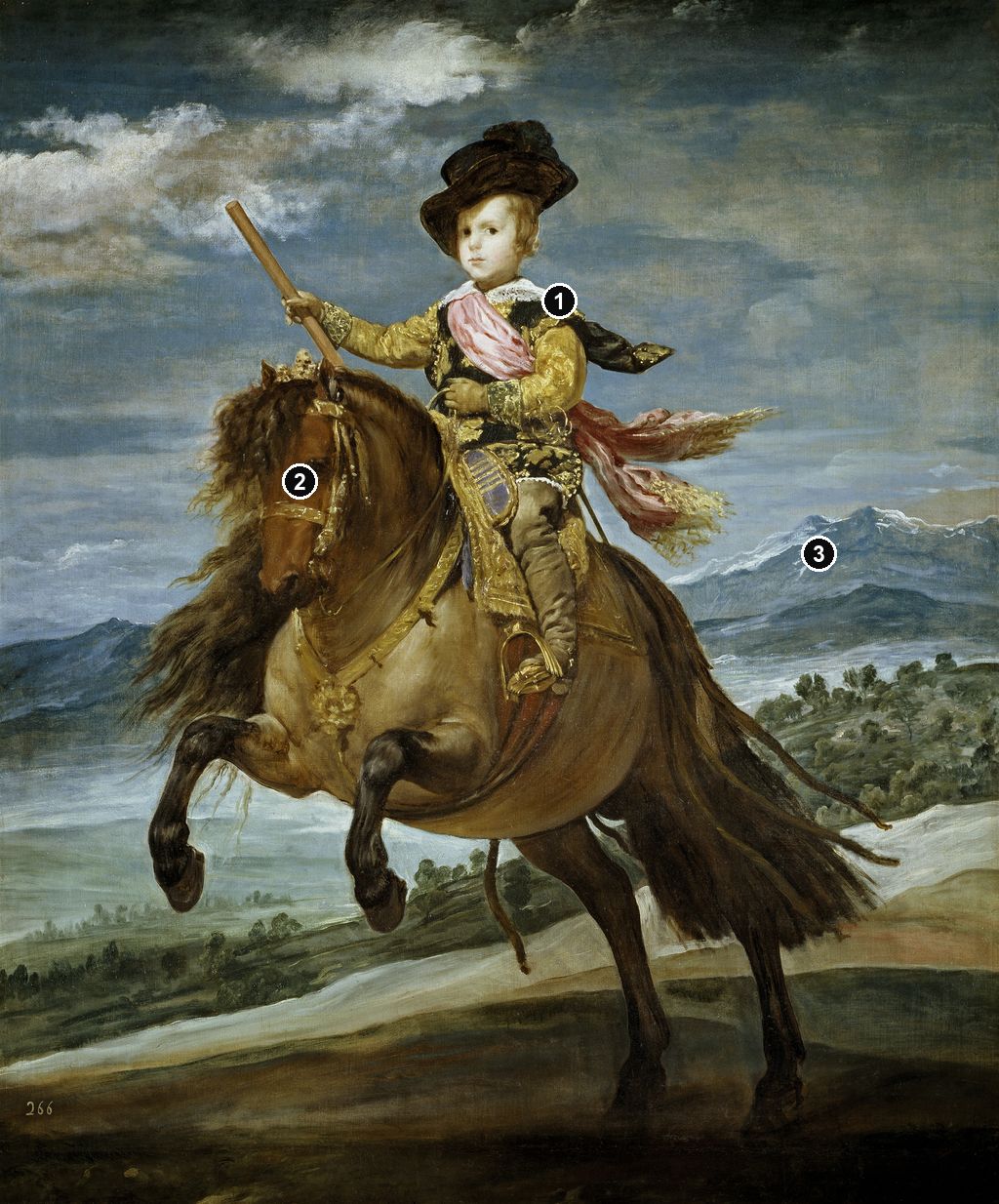
Details from PRINCE BALTASAR CARLOS ON HORSEBACK
Museo Nacional del Prado. Public-domain reproduction via Wikimedia Commons.
Costume and command
The pale face sits above a dense pattern of gold and black. The pink sash crosses the chest, interrupting the denser patterns of the collar, sleeve and doublet. [1]
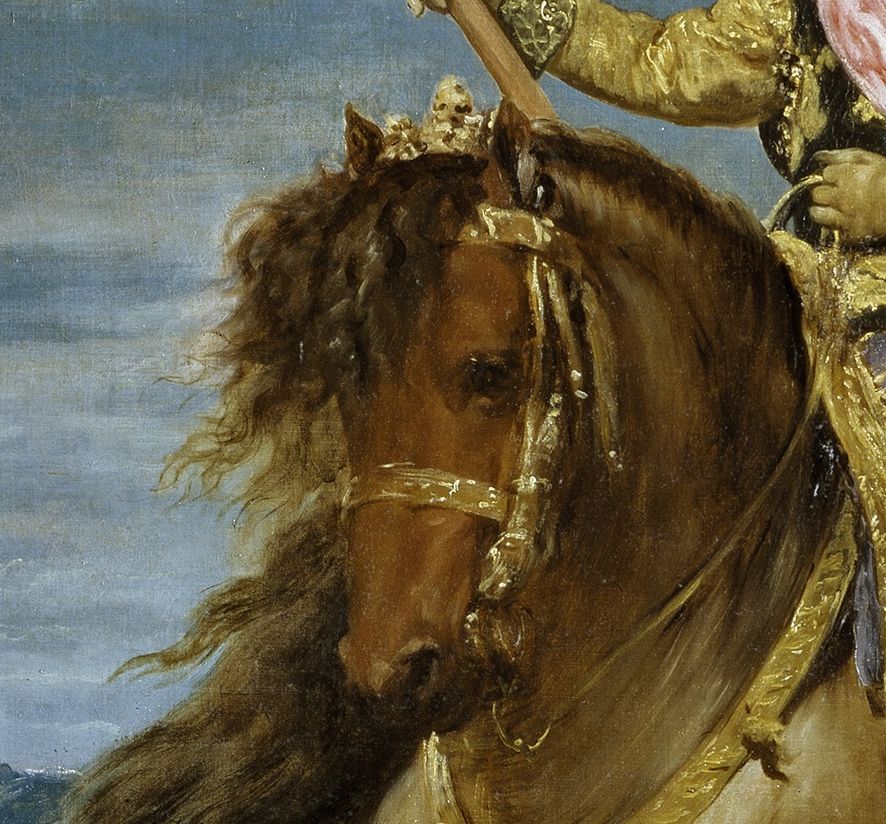
The horse’s turning head
The mane breaks into loose dark strands beside the bridle. Follow the turn from the head towards the broad neck and chest: the horse’s mass gives the child a much larger presence.
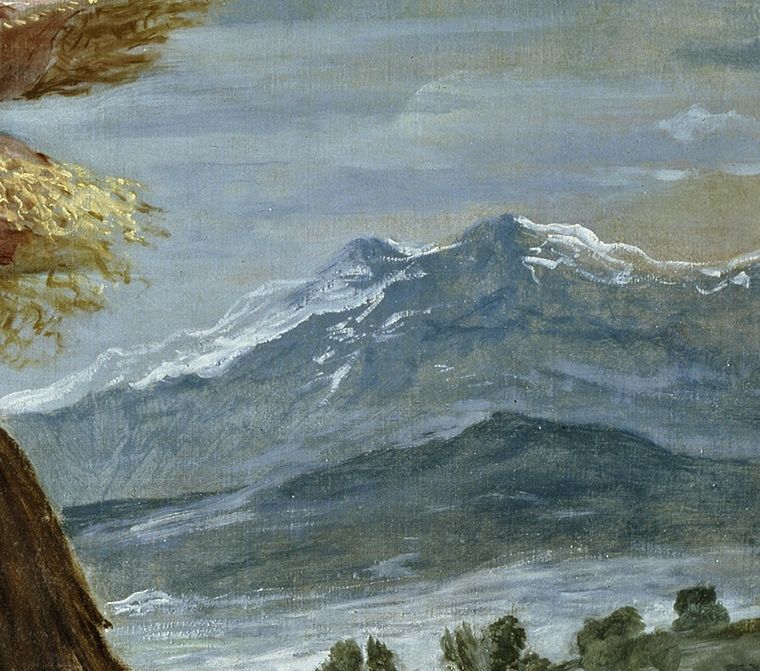
Mountains beyond the rider
Snowy ridges appear behind the horse and rider. The Prado identifies the landscape with the mountains outside Madrid, bringing a recognisable setting into the royal image. [2]
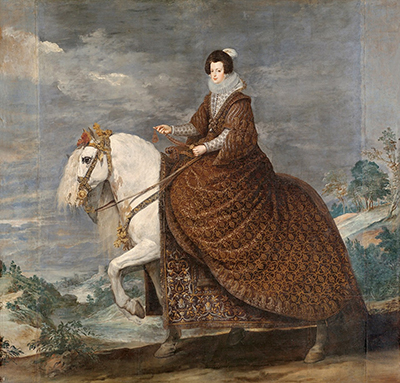
Isabel of Bourbon on Horseback. The queen’s mounted portrait gives context for the prince’s place among the royal portraits in the Hall of Realms. View Isabel of Bourbon on Horseback.
A recognisable landscape outside Madrid
The mountains are more than a general suggestion of Spain. In its Espacios Barrocos educational resource, the Prado identifies the sierra del Hoyo on the left and part of the Guadarrama range on the right, including La Maliciosa and Cabeza de Hierro. The museum also draws attention to the fresh vegetation and the atmosphere of spring. These are specific features of the country around Madrid, brought into the ceremonial portrait with a landscape painter's attention. [2]
They matter to the experience of looking. The distance is cool and pale compared with the brown mass of the horse. White touches across the high ground give the mountains a broken, luminous edge. The sky contains several kinds of cloud and changing patches of light. It never settles into a flat blue backdrop. Against that shifting expanse, the dark hat and the bright costume hold the rider in view.
Try following the landscape past the horse rather than stopping at its outline. Low vegetation, pale stretches of land and the distant ridges lead the eye from the near slope towards the horizon. The world continues around the imposing central figure. That breadth gives the image some of its pleasure: a portrait made to proclaim royal status also offers the air and room of an outdoor scene.
Rich surfaces, economical painting
From a distance, the costume seems to contain an extraordinary amount of ornament. Closer attention to the reproduction reveals how differently its surfaces are described. The face is comparatively quiet and continuous; the clothes break into small lights and darker interruptions. Glittering touches across sleeves and breeches suggest woven gold without requiring every thread to be traced. The horse's mane and tail spread into irregular dark strands that contrast with the smoother, rounded body. [1]
The Prado catalogue praises the abbreviated handling of the picture and cites an early museum catalogue's admiration for its freshness. Such economy is especially effective in an image intended to be seen above eye level. The important relationships must register quickly: the lifted baton, the child's face, the shining clothes, the broad horse and the open distance. Minute finish everywhere would give each part an equal claim on our attention. Here the differences of handling help to organise what we see. [1]
The painting is also more restrained in colour than the splendour of the costume first suggests. Gold and rose gather around the rider, while blue, grey and green extend through the much larger space behind him. Gállego stresses the importance of those cooler landscape colours to the overall effect. The result lets the child's clothing sparkle within a coherent atmosphere. It is possible to enjoy the luxury of the court and still feel the weather around the horse. [1]
A future that did not arrive
The portrait's confidence acquires a different meaning when we know the prince's later history. Baltasar Carlos was born in 1629 and died in Zaragoza in October 1646. He never became the king whose future responsibilities the picture anticipates. That knowledge can make the youthful gravity of his face particularly affecting, but the work was conceived as a hopeful dynastic image. Its spring landscape and vigorous horse belong to that original promise. [1]
Its own later history connects the palace to the museum. The Prado's 1990 catalogue records the painting in the Salón de Reinos through 1701, subsequently in royal palace inventories, and in the Prado from 1819. It survives there as a separate painting whose original neighbours have to be recalled or reconstructed. Remembering the doorway and the portraits of his parents restores the force of its first setting. Looking again at the child's face restores the human scale within it. [1]
Artworks directory
Frequently Asked Questions
No. The Prado painting is the large outdoor equestrian portrait numbered P001180, designed for the Salón de Reinos. The riding-school compositions show a different setting and belong to a separate group of images. The Prado catalogue distinguishes them explicitly. [1]
Its foreshortened body suits the picture's intended position above a doorway, viewed from below. The unusual proportions should be considered alongside that original display. [1]
1634–35 [2]
Discussion
Consider how a small child acquires public authority through the horse, costume and elevated viewpoint.
Reader Insights
How does the horse’s size change the child’s presence?
Which parts of the costume catch light most strongly?
What does the landscape add to the portrait?
Join the Conversation
Share a detail, comparison or question about Prince Baltasar Carlos on Horseback below.
References
- Julián Gállego, “El príncipe Baltasar Carlos, a caballo,” entry 40, in Antonio Domínguez Ortiz, Alfonso E. Pérez Sánchez and Julián Gállego, Velázquez (Madrid: Museo del Prado / Ministerio de Cultura, 1990), pp. 240–244; also entry 36, pp. 221–222, for the Hall of Realms ensemble. Spanish. Read the Prado exhibition catalogue. View source.Splash image: Prince Baltasar Carlos on Horseback, 1634–35. Museo Nacional del Prado. Public-domain reproduction via Wikimedia Commons
- Museo Nacional del Prado, Espacios Barrocos, “Recursos,” section “El príncipe Baltasar Carlos, a caballo.” Spanish; current educational resource, undated. Supplies the date, medium, dimensions and identification of the Madrid mountain landscape. Explore the Prado's Baroque spaces resource. View source.
- National Gallery, London, Diego Velázquez, Saint John the Evangelist on the Island of Patmos, NG6264. Collection record, artist dates and painting date; accessed 28 October 2026. View source.








