


 by Tom Gurney
Tom Gurney BSc (Hons) is an art history expert with over 20 years experience
Published on June 19, 2020 / Updated on October 14, 2023
Email: tomgurney1@gmail.com / Phone: +44 7429 011000
The Lunch: Introduction
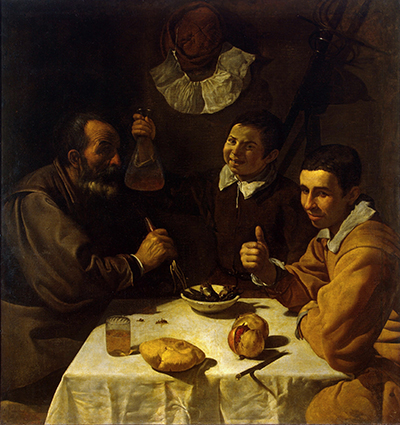
A boy lifts a narrow-necked flask high enough for the light to reach the liquid inside it. At his right, a young man in an ochre coat holds up his thumb. Their hands are at different heights, with a bowl on the table between them and a third diner leaning into the group from the left. Velázquez gives us time to notice the company and the meal in the same glance. The State Hermitage Museum in Saint Petersburg catalogues the painting as Завтрак, published in English as Luncheon, and dates it to around 1617. It is an oil on canvas, 108.5 cm high by 102 cm wide, and its inventory number is ГЭ-389. [1] [2]
At a Glance
Contents
- Three diners around a table
- Bread, glass and the edge of the cloth
- The dark wall and the hanging collar
- The Budapest painting and the group of variants
- Painting from life in Seville
- From Catherine II's collection to Velázquez
Three diners around a table
The older man at the left turns in profile. A narrow band of light comes down across his brow and the bridge of his nose, with another patch catching the grey ends of his beard. His bent arm carries that turn into the foreground. A lit hand grips the long utensil that points down towards the bowl. The boy in the middle raises the flask across the dark opening beside the older man's head. His mouth is open in a smile, and the angular white collar below it draws attention to how far his face has turned towards the light. His arm extends the scene up and to the left even as his face draws the eye back towards the centre. [1] [2]
The man on the right is nearest the front of the table. The angle of his shoulders carries him towards the others, while his eyes seem to meet ours from under the shadow of his brow. One elbow settles on the cloth. The other arm bends inward, leaving the thumb silhouetted against the coat of the boy behind him. The gesture can be read quickly, though the expression takes longer. There is a difference between the broad smile of the boy and the smaller movement at the young man's mouth. A toast or a joke can account for the air of sociability, while the painting gives us very little to go on about what anyone has said. [1] [2]
The Hermitage sees the figures as three ages of life and mentions the suggestion that the man in ochre is a self-portrait. The different ages are easy to register in the three treatments of hair and skin, from the bearded profile to the smooth cheek of the boy. The proposed likeness of the artist remains uncertain. Each face has a different angle to the light and a different relationship to the other two, so that even a viewer who knew none of the suggested identifications could follow the exchange. [1] [2]
Bread, glass and the edge of the cloth
The low edge of the table occupies almost the full width of the painting. The cloth drops in irregular folds and the tabletop opens far enough towards us for each object to have its own space. A tumbler at the left rises in several bands, from the pattern at the rim to the warm colour of the contents. The loaf beside it has a dry, uneven crust. Farther right, the fruit's split skin lets a narrow seam of red show. The bowl sits back in the company of the diners, where the rim flashes against the dark shells. The broad, comparatively unbroken cloth between these things lets the eye move across very small changes of colour and texture. [1] [2]
The Hermitage draws attention to how close the loaf and the projecting handle of the knife appear to the canvas surface. The bread lies where the cloth rolls over the near edge. The dark form of the knife crosses from the lit table towards the hanging linen, so that its angle pulls the eye from the surface to the fold below. The signs of eating are slight and particular. A little of the table is occupied by crumbs, the vessels have been set within reach, and the things the diners have lifted sit in the same light as the things left on the table. [1] [2]
The label for the 2015 Hermitage exhibition at the National Gallery of Victoria proposed a religious reading. It linked the bread and drink to the Eucharist, the pomegranate to the Resurrection and the mussels to Shrovetide and the beginning of Lent. That reading gives each part of an ordinary meal a further association. The painted action also holds together as a scene of company and service. One person holds up the flask and the bowl stays within reach of the man across from him. The prominence of the food makes both readings possible. [2] [3]
The dark wall and the hanging collar
Above the boy is a pale ruff with a brown hat above it. The Hermitage describes the collar as belonging to the old man and explains the practice of setting aside a hat and collar before sitting indoors to eat. The two objects make an arresting shape at first sight. A cap above a collar is the pattern we expect of a clothed head, and the dark centre between them takes a moment to read as empty. A sword hangs diagonally in the darker right-hand part of the wall. The pale ruff and the white collars worn by the younger diners are spread at three heights, which helps the eye gauge a space whose boundaries largely disappear into brown paint. [1] [2] [4]
The Hermitage relates the strong chiaroscuro, or contrast of light and shadow, to Caravaggio. The varying edges show what it does here. The boy's jacket merges with the darkness behind the older man's hand, so that the flask almost seems to hang by itself. At the right, the illuminated sleeve and cuff are closely bounded, with room for a sequence of small shadows in the folds. The picture gives one figure a clear elbow and another an arm we have to follow through darkness. The light is selective enough to isolate the individual gestures and continuous enough to make them look as if they could happen at a single table. [1] [2] [4]
The Budapest painting and the group of variants
The Museum of Fine Arts, Budapest, publishes its canvas as Tavern Scene with Two Men and a Girl, inventory 3820, under Velázquez's name and dated about 1618–19. It is sometimes called The Farmers' Lunch or Peasants at Table. At 96 × 112 cm it is wider than it is high. An older man again leans into the company from the left, and the young man's raised thumb survives on the right. The central figure is a girl who looks down as she pours from a jug. The arc of liquid runs into a stemmed glass. The man in ochre turns towards the pouring, which keeps his profile and gesture within the company. In the Hermitage painting the raised flask brackets the boy's smiling face, and the young man beside him turns far enough to acknowledge a viewer. [2] [4] [5]
The tables are also differently laid. Budapest has a fish on a plate and a tall metal vessel nearer the front. The dark wall is clear of the conspicuous hanging ruff, and the light catches the girl's head covering above the vessel. The same broad pattern of a figure at either end of the table thus leaves room for a different act of service and a different arrangement of the objects. The Hermitage calls Budapest another version. The order in which the variations were devised remains open. Paul Joannides, revisiting the 2015 Grand Palais exhibition, notes that the upright Hermitage composition is often placed first, and favours Carmen Garrido's proposal that a simpler arrangement formerly in the Garrouste collection came earlier. [2] [4] [5] [6]
Painting from life in Seville
A Seville document dated 14 March 1617 records that Velázquez passed his examination as a painter. Francisco Pacheco, one of his examiners and his former teacher, later defended the young artist's bodegones, scenes of kitchens or taverns where painted food and utensils shared the space with figures. Pacheco remembered him using a boy as a model for heads drawn from life in different attitudes, crying or laughing. The Hermitage proposes that the boy in The Lunch was the model described by Pacheco. The account also helps make sense of the deliberate differences in the three faces, whether or not the individual faces can be matched to other pictures. The Seville and bodegones of this period put passing expressions alongside materials a painter could study at length. [1] [7] [8] [9]
In An Old Woman Cooking Eggs, dated 1618, the backlit edges and the changing sheen of the cooking eggs focus attention on the work of the woman who holds a spoon above them. The action in The Lunch has moved to the table, where the varying height of the diners' hands draws the eye across objects already laid out for use. The Berlin Three Musicians also brings three figures close to a laid table, with a boy who draws the viewer towards the group. There, the open mouth of the singer and the instruments give the gathering an audible activity to imagine. In Saint Petersburg the flask, the bowl and the young man's thumb are enough to suggest the exchange. The Berlin canvas has its own group of versions and its own history of attribution. [2] [9] [10]
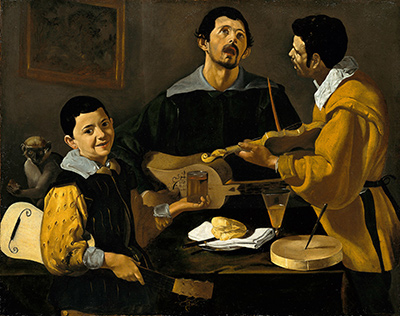
Die drei Musikanten. The Berlin scene distributes movement across a different set of hands and objects around another small table. View Three Musicians.
From Catherine II's collection to Velázquez
The painting is recorded in the collection of Catherine II. The Hermitage's digital entry dates its acquisition between 1763 and 1796, while its printed collection guide says before 1774. The 2015 Melbourne exhibition gave the narrower span of 1763–74. The printed guide reports that it entered the collection as the work of an unidentified Flemish painter and was attributed to Velázquez in 1895. The early classification and its revision are part of the history of the Hermitage canvas. The surviving collection accounts give us an eighteenth-century setting for the work, while its first owner and the circumstances of its commission remain unknown. [1] [3] [4]
Artworks directory
Frequently Asked Questions
Around 1617 [1]
Discussion
Look again at the images and ideas explored in The Lunch. These editorial prompts invite your observations.
Reader Insights
How do the hands and the objects on the table carry your eye between the diners?
What do you notice about the meal when you follow the light from the raised flask?
Join the Conversation
Share a detail, comparison or question about The Lunch below.
References
- State Hermitage Museum, Diego Velázquez, Завтрак (Luncheon), c. 1617, inventory ГЭ-389, digital collection record 32729. Russian. View source.
- State Hermitage Museum, Diego Velázquez, Luncheon, museum-contributed object record and photograph by Vladimir Terebenin, Google Arts & Culture. View source.
- National Gallery of Victoria and State Hermitage Museum, Masterpieces from the Hermitage: The Legacy of Catherine the Great, 2015, exhibition label for Luncheon, inventory ГЭ-389. View source.
- State Hermitage Museum, The State Hermitage: Treasures from the Museum's Collections, vol. II, revised edition, Booth-Clibborn Editions, 2014, The Luncheon, no. 52, pp. 72–73. View source.
- Museum of Fine Arts, Budapest, Axel Vécsey, Diego Velázquez, Tavern Scene with Two Men and a Girl, c. 1618–19, inventory 3820, museum-contributed record and reproduction, Google Arts & Culture. View source.
- Paul Joannides, ‘Diego Velázquez: a decade after the exhibition at the Grand Palais’, Colnaghi Studies Journal, no. 17, 2025, pp. 8–27, fig. 1 and note 4. View source.
- Archivo Histórico Provincial de Sevilla, Carta de examen de Velázquez como pintor, 14 March 1617, Protocolos Notariales, leg. 2484, fols. 85v–86v, transcription hosted by the Instituto Andaluz del Patrimonio Histórico. Spanish. View source.
- Francisco Pacheco, Arte de la pintura, 1649, book III, chapters I and VIII, transcribed in Corpus Velazqueño. Documentos y textos, Ministerio de Educación, Cultura y Deporte, 2000, vol. I, pp. 134–135. Spanish. View source.
- National Galleries of Scotland, Diego Velázquez, An Old Woman Cooking Eggs, 1618, NG 2180, collection record and discussion by John Leighton. View source.
- Gemäldegalerie, Staatliche Museen zu Berlin, Diego Velázquez, Die drei Musikanten (The Three Musicians), 1616–18, 413F, obj:870321, collection record and discussion by Sven Jakstat. German and English. View source.







