



 by Tom Gurney
Tom Gurney BSc (Hons) is an art history expert with over 20 years experience
Published on June 19, 2020 / Updated on October 14, 2023
Email: tomgurney1@gmail.com / Phone: +44 7429 011000
An Old Woman Cooking Eggs: Introduction
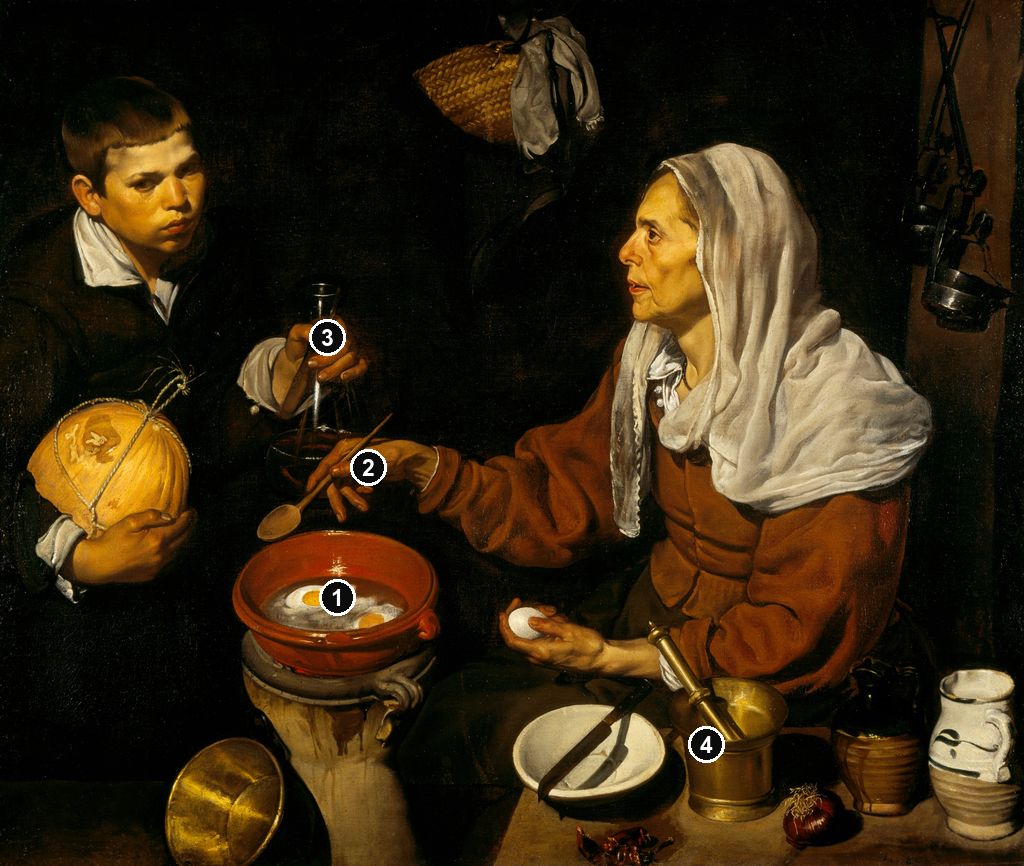
Two eggs are already in the pan. A woman holds a third low beside it, with her thumb resting on the shell. Her other hand keeps a wooden spoon poised just above the rim of the pan. A boy stands across from her with a round melon and a glass flask. To see which of them is about to do something, you have to look twice. The woman’s face has turned away from the eggs, while both her hands are still occupied with cooking. The boy has lifted the flask by its neck, but its mouth is vertical and there is no sign of a pour.
Diego Velázquez painted An Old Woman Cooking Eggs in Seville in 1618. The National Galleries of Scotland holds the work as NG 2180. It is an oil painting on canvas measuring 100.5 × 119.5 cm, large enough for the faces and the bowl of the spoon to hold attention independently. Old Woman Frying Eggs is the established alternative title. The Scottish gallery describes hot oil in the pan. In the Prado’s 1990 Velázquez catalogue, Julián Gállego records the arguments for the broader title Cooking Eggs, including Jonathan Brown’s suggestion of water or broth, and considers poaching possible. The painted liquid shows us what is happening to the eggs more readily than it reveals what they are cooking in. [1] [2]
At a Glance
Contents
- Where the work takes place
- How the eggs appear to set
- Glass, metal, cloth and clay
- Annotated details
- What the figures are looking at
- What Pacheco admired about the bodegón
- Three other encounters with everyday work
- From a private collection to Edinburgh
- Recording the painted surface
- Two vessels from the Sevillian kitchen
- The painting on loan before Edinburgh
- What Parliament was asked to buy
Where the work takes place
The opening of the pan is low and left of centre. Its red curved rim is distinct against the dark and gives a clear position to an object nearly halfway between the two people. Its handle projects towards the woman’s egg hand. Underneath it, a portable stove occupies a thin column of the picture and runs down almost to the edge. There is just enough light at the seam below the pan to separate its underside from the support. On the right is another working surface. Its corner comes forward beneath a white bowl and a mortar, close enough to the picture edge to give the objects a feeling of being within reach.
Notice how differently the two supports are described. The stove rises up so that we can follow its side as well as look down into the pan. The tabletop enters the picture as a patch of light and then runs sideways, crowded with objects that overlap. The eye can measure the relation of a knife to a bowl from the shadow it casts. There are few such clues to the size or shape of the room. A basket above the figures pushes far enough forward to catch the light, and some metal implements on the right hang against a strip of brown. The distance between those two points remains indistinct. We have a place to set things down and a place to put them away, with the visible space concentrated around the immediate work.
The woman’s right sleeve reaches into the centre, a bank of rust-coloured folds that narrows to a wrist. The cuff and hand carry the eye out across the dark. The boy’s light cuff does much the same from the other side, with the flask’s upright neck where the two directions nearly meet. Look at the amount of bare background Velázquez has left in this area. The flask’s mouth is a narrow ellipse against it. The wooden handle crosses its lower shadow. The painting needs that interval so that a spectator can see which hand supports which object and how much room there is for either action to continue.
The composition also changes when you follow it vertically. The boy’s round face, white collar and melon descend in steps along the left. Opposite them, the broad pale wrapping on the woman’s head and shoulders gives way to her russet bodice, the dark folds in her lap and the lit underside of her hand. Her intact egg sits just above the bowl on the table, a second small white oval poised between the two great concentrations of light. The compact figures feel substantial because their hands, clothes and belongings continue down through the picture into the area where the cooking is being done.
Old Woman Frying Eggs (by Diego Velázquez) c. 1618 · History of Painting · Watch on YouTube
How the eggs appear to set
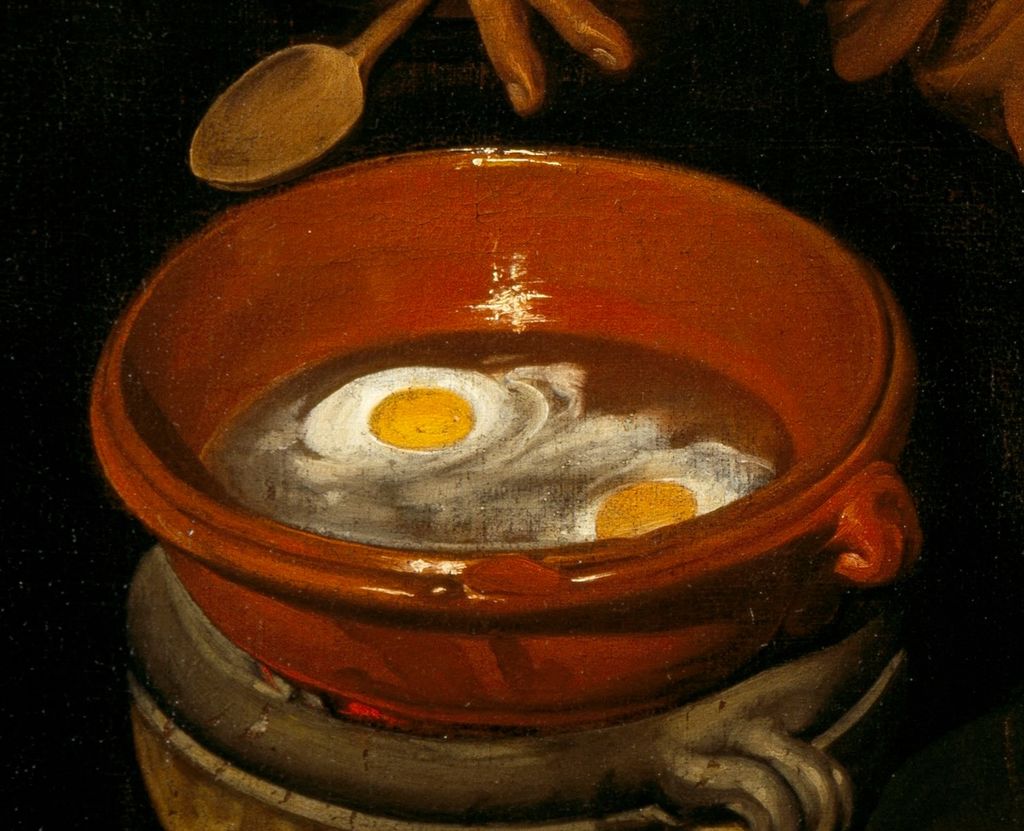
Start at the far side of the pan. A flash of pale colour runs down the inner red wall, breaking into smaller flecks as it approaches the liquid. Low in the pan, the first yolk sits almost fully encircled by white. The white is strong and even close to the yolk, with a thinner margin through which the darker tone underneath still seems to show. There are smaller grey-white streaks further out, as though the edges have only just begun to turn. The second yolk is partly lost behind the near rim. You can complete its outline mentally because you have already seen the first.
The whites describe a process with a direction. A band can be opaque at one edge, translucent at the next and broken into several soft marks where it appears to join the surrounding liquid. The parts of the eggs seem to be at slightly different stages of cooking at the same time. The firm white of the shell in the woman’s left hand provides a nearby measure. It reads as a small solid body under pressure from fingers. At much the same scale, the lighter marks inside the pan seem to have volume while remaining attached to something fluid. [1] [3]
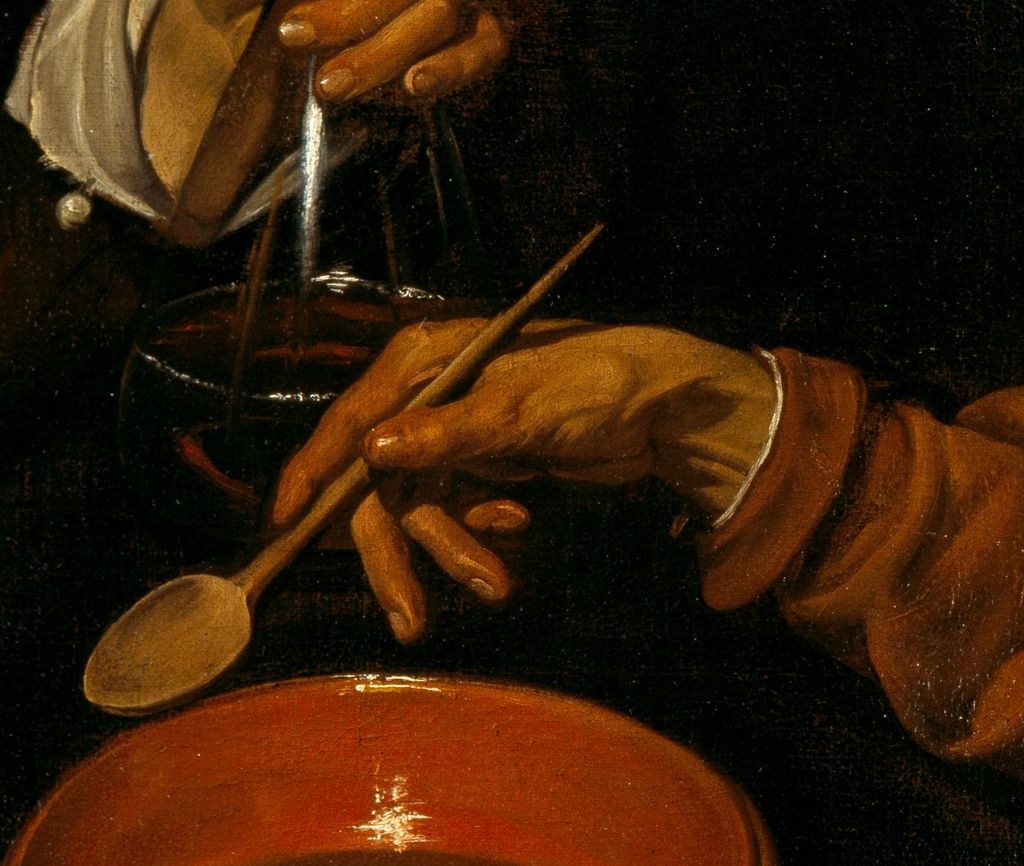
There is time for the eye to make the comparison because of the placing of the spoon. The dark marks that describe the handle are fine and the bowl of the utensil is subdued, so that the spoon’s movement towards the pan remains legible without taking over the light from the food. Its bowl tilts a little towards us. One can see the small gap beneath it, enough for the cook to be about to dip or lift. The surface of the eggs suggests that the heat has been at work for a while. The suspended tool gives duration to that change, as if the work will carry on in a moment.
The red pan itself offers another contrast. On its rim the reflection has a fairly definite border. Down the outer wall, reflected light broadens and a deep band of red recedes into shade. A bright interrupted line tracks the upper curve again in the darker lower part of the vessel. The glaze is legible through the different widths and strengths of these marks. Velázquez has given the container a persistent form within which the softer shapes can spread.
Glass, metal, cloth and clay
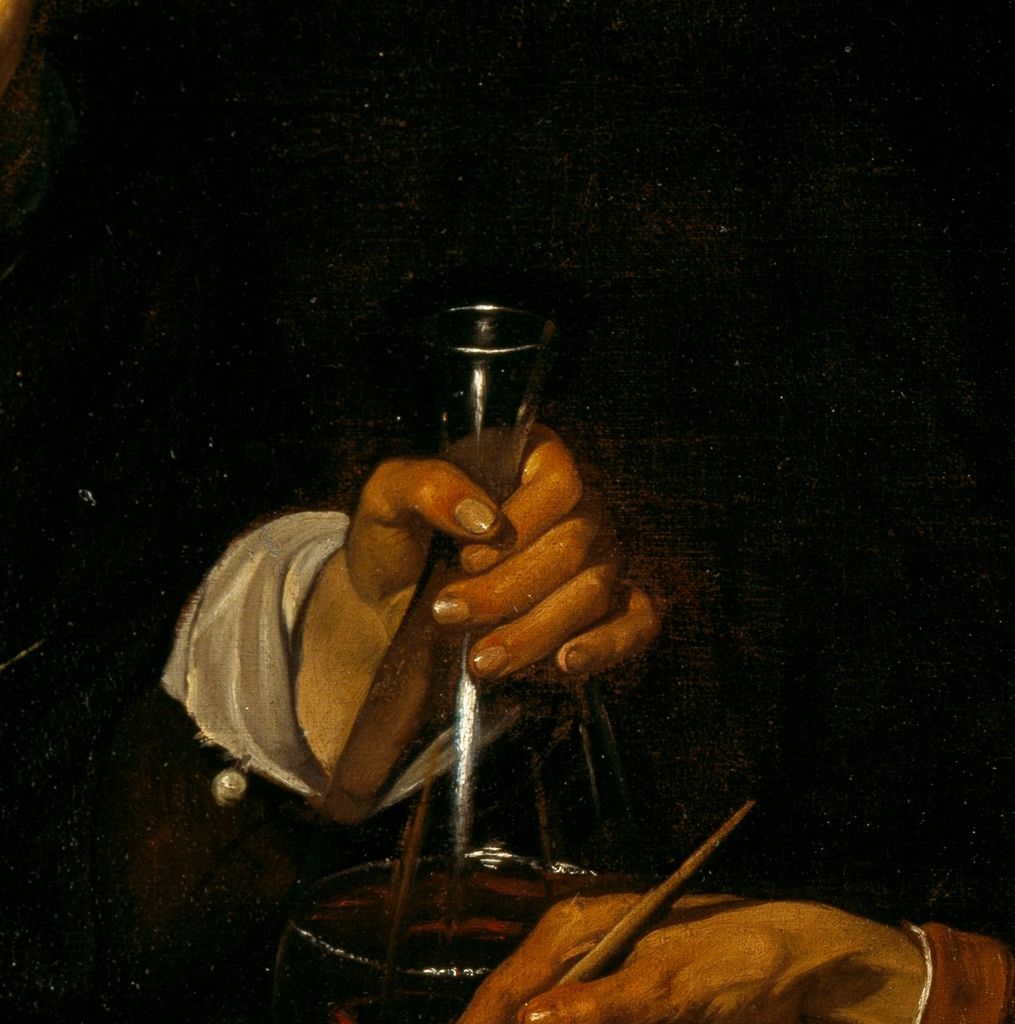
Little of the boy’s flask would be visible if you covered its lights. At the neck the rim catches a small horizontal shine. Below his fingers the light travels down a much longer narrow strip before dispersing into the swelling dark part of the vessel. A faint curve at the bottom makes the body of the flask readable. The fingers remain distinct where they wrap around the glass, and the absence of anything like an even white outline allows the background to show through. Compare the melon. Long softer strokes move over its ribs and the taut string has a continuous presence across the skin. The boy has to support that weight from underneath. The difference between the two objects is visible in his hands as well as in the paint.
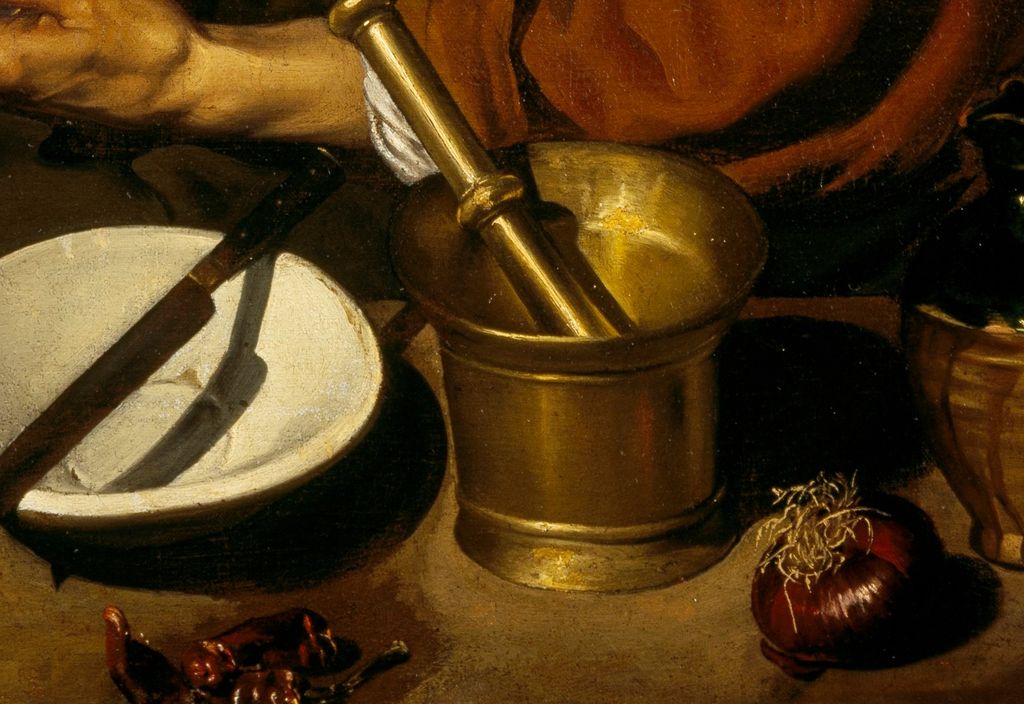
The mortar at the lower right has a sharper upper rim than the melon and a broader glow than the flask. The pestle lies diagonally across it, with a pale edge and a darker middle giving shape to the rounded shaft. Further left, a metal vessel near the bottom catches oblique stripes of light inside its bowl. It is placed at an angle and partly cut off. One reflection seems to widen abruptly as it approaches the curve, so that a small part of the visible interior conveys the shape of the whole. A second useful edge is on the right, where a dark hanging implement catches just enough light to show the front of its rim and the black inside.
By the mortar stand two vessels that show what colour alone can do for depth. The left one rises from a warm ribbed lower body into a top so dark that its outline is easy to miss. The next jug wears a pale upper band with a dark sweeping decoration. The painted stroke curves with the belly of the pitcher, so that the pattern describes the volume of the pot as well as part of its design. Any attempt to imagine the surface of the table without its objects would have to reckon with how much those vessels reveal about the angle of the light and the space at the far side.
The woman’s headcloth does a different kind of work. A narrow strip of light follows the line that comes down beside her face. Across her crown and shoulder the broad strokes trace successive folds with pale crests and grey or brownish hollows. There are small dark marks along the edge that help the fabric look worn and stitched. Compare that wide distribution of light with the narrow rim of the white bowl. The knife across it appears convincingly separate from its cast shadow. The shadow curves across the hollow beneath the blade. A viewer can read the bowl’s depth almost as quickly from that change as from the outline of the rim. Around it the brightness of the table gives the papery skin and wiry roots of an onion their own brief turn in the light. [1] [3]
Annotated Details from Old Woman Frying Eggs
Look at the light on the pan, the bottle and the utensils ranged along the foreground.
Details from OLD WOMAN FRYING EGGS
The eggs in the pan
The egg whites have begun to set in the shallow earthenware pan. The broken highlights on the surface distinguish the liquid from the glazed rim. [1] [2]
The spoon held above the pan
The woman holds the wooden spoon at an angle to the pan. The light traces her knuckles and the handle, and the bowl of the spoon emerges against the dark ground. [1] [2]
This work in Velázquez’s career
An Old Woman Cooking Eggs (current article)
1618 [1]The Spinners
1655–60 CatalogueWhat the figures are looking at
The woman looks across the pan at about the level of the boy’s collar or lower face. Her cheek and the ridge of her nose come forward under the fabric, her lips part slightly, and a dark mark at the lower lid gives direction to the eye. The boy is seen in a three-quarter turn. His brow is lowered and his cheek on the lit side seems full against the thin bright fall of his collar. His look appears to travel diagonally into the foreground. Their proximity encourages you to expect a returned glance, yet their eyes are difficult to connect.
The cooking supplies a more dependable relationship. There are two hands occupied with holding and two with preparing. The boy’s right arm cradles the melon against his body. His other hand makes the neck of the flask available in the space that the woman’s spoon is entering. From the sequence of objects we can imagine an offer or a request. How long the boy has been there, what prompted the woman’s turn and whether either has spoken are left open. The Frick Collection, which exhibited the painting in 2014–15, made this uncertainty part of its account of the figures’ momentary interruption. [3]
The ages of the two are important to the way the exchange looks. Age is concentrated in quite different parts of the two faces. The boy’s temple is smooth where the brow turns into shadow. In the older face, light narrows at the mouth and returns lower down in the little folds where the chin and neck meet. The adult’s hands show tendons running through the changes of direction from wrist to knuckle. The boy’s fingers make an unbroken, firm curve around the neck of the flask. The grips are specific to the tasks. The same boy’s other hand spreads to balance the melon, and the older woman can keep the egg steady with her fingertips alone.
Gállego considered whether the work might represent Taste, alongside The Waterseller of Seville, and expressed reservations about his own suggestion. The ordinary anticipation of a meal offers a more immediate experience of the theme. The bulk of the melon, the changing egg whites and the clustered vessels bring food within reach. The impulse to name a sense is understandable when the painter evokes so many physical sensations through the eye. An allegorical identification would require more than the striking presence of food. [2]
What Pacheco admired about the bodegón
Velázquez was still a teenager in 1618. The archive in Seville preserves the contract of apprenticeship between his father, Juan Rodríguez, and the painter Francisco Pacheco. The agreement was formalised in September 1611 for a term of six years. The certificate of examination records Velázquez’s qualification as a master of the Seville painters’ guild in March 1617. The IAPH’s early-life chronology also records his marriage to Pacheco’s daughter Juana in 1618. These records put the picture close to a change in his working life. He had recently acquired the standing to practise independently and remained part of the household circle in which he had learned. [4] [5] [6]
The term bodegón can refer to still life in Spanish. In the discussion of these early works it also covers pictures that combine rooms used for food or drink, groups of objects and people occupied with daily tasks. John Leighton of the National Galleries of Scotland traces the term to bodega, meaning a cellar or inn in this context. Names such as kitchen scene help identify what a viewer will see. The recurring objects also tell us something about the way a painter could assemble a scene. The painted vessels need to sit at a particular angle to take the light, the cook has to be placed where her hands will show, and the plate has to remain partly empty if the knife’s shadow is to appear. [1]
Pacheco defended such painting in his Arte de la pintura, published in 1649. In Book III, Chapter VIII, he asks whether bodegones deserve esteem and answers that they do if painted as his son-in-law paints them. He joins them to portraiture in his account of how Velázquez came to practise the “verdadera imitación del natural”, or true imitation of nature. Pacheco goes on to describe a small picture of his own that he painted in Madrid in 1625 to please a friend, with two figures painted from life, flowers, fruit and other things. The example makes his admiration practical. He presents Velázquez’s kitchen and tavern pictures as work that other painters could learn from, and includes himself among them. Pacheco had also been one of the examiners who certified his pupil. The esteem that he claims for this work comes from a painter in a position to speak about both the standards of the profession and the achievements of a member of his family. [2] [5] [7]
The record of training includes people other than the painters. Pacheco describes the young Velázquez engaging a country boy to pose in different ways, including laughing and crying, and making drawings of his head and those of other people he could study. The account shows that working from life could involve deliberate changes of pose and expression. It supplies no name for the boy in the Edinburgh painting. Suggestions that this is Pacheco’s young model, or that the woman is the painter’s mother-in-law María del Páramo, remain conjectural. The suggestion about the woman depends in part on identifying the likeness in a separate painted group attributed to Pacheco. A similarity between two painted faces can be valuable evidence of a repeated figure type even where the person’s identity remains uncertain. [2] [8]
Painters in seventeenth-century Spain could disagree about the standing of kitchen painting. Gállego places Pacheco’s defence beside the painter and theorist Vicencio Carducho’s objection in his 1633 Diálogos de la pintura to the lowly ideas of bodegones. The disagreement helps explain how much depends on the things a viewer considers worthy of attention. In this picture a woman who knows how to handle a pan and a boy holding two awkward objects provide the demands on the painter’s skill. Their bodies occupy a greater share of the canvas than they would in a kitchen used as a small episode in a larger story. [2]
Three other encounters with everyday work
In the Dublin Kitchen Maid with the Supper at Emmaus, dated about 1617–18 by the National Gallery of Ireland, the figure’s pause opens onto a second scene. The woman stands by a counter where a light jug, metal basin and other vessels are close to the viewer. At the upper left there is a small view of Christ with the disciples at Emmaus. The gallery reads the woman’s stillness as listening, and connects the prominence of the everyday foreground to Flemish painting. Compare the edge of the Dublin counter with the area beyond the boy’s flask in Edinburgh. The Dublin painting redirects attention from a working figure to something the figure can hear. The Edinburgh dark leaves the cause of the woman’s turn much harder to tell. [9]
The vessels themselves can carry over from one arrangement to another. In a technical study of the Chicago Kitchen Scene, Gridley McKim-Smith and his co-authors noted the recurrence of the hanging basket, copper pot and decorated pitcher in the Edinburgh canvas. They used imaging of the Chicago picture to distinguish successive decisions about the placement of objects. In one instance the artist left more of the base of an upright white pitcher visible by shortening another vessel, clarifying where the pitcher touches the table. The Edinburgh knife and bowl show the same care over which part of a support needs to be visible. The same repertoire of observed objects could serve different arrangements. [8]
In London’s Christ in the House of Martha and Mary, probably painted in 1618, a young woman works a pestle in a mortar while an older woman raises a finger near her shoulder. The National Gallery discusses the difficulty of establishing how the biblical episode in the upper right relates to the foreground. Compare the working hands. The pestle in Edinburgh is idle in its mortar, one of many things near the woman’s elbow. In London the pestle has to be gripped to do its work, and the tilted mortar allows us to follow the direction of the pressure. The two pictures make the same kind of utensil either the focus of a gesture or something that awaits its turn. [10]
In The Waterseller of Seville at Apsley House, the small transparent vessel is even more consequential. The older seller and a boy bring their hands together at a glass, and a third figure drinks in the shade. Look at the difference between the droplets visible on the large jar in the foreground and the narrow lights on the glass at the point of exchange. Water is present both as a hint of dampness on an opaque vessel and as a drink that can be handed to someone else. At the Edinburgh stove the earthenware contains the most significant visual change, and the boy’s flask has only approached the place where things are happening. In both pictures the work determines where the hands meet the light. The seller’s task draws them almost to the same point. The cook’s keeps their occupations distinct. [11]

The Waterseller of Seville. The large jar in The Waterseller gives another example of how Velázquez painted coarse earthenware and changes in reflected light. View The Waterseller of Seville.
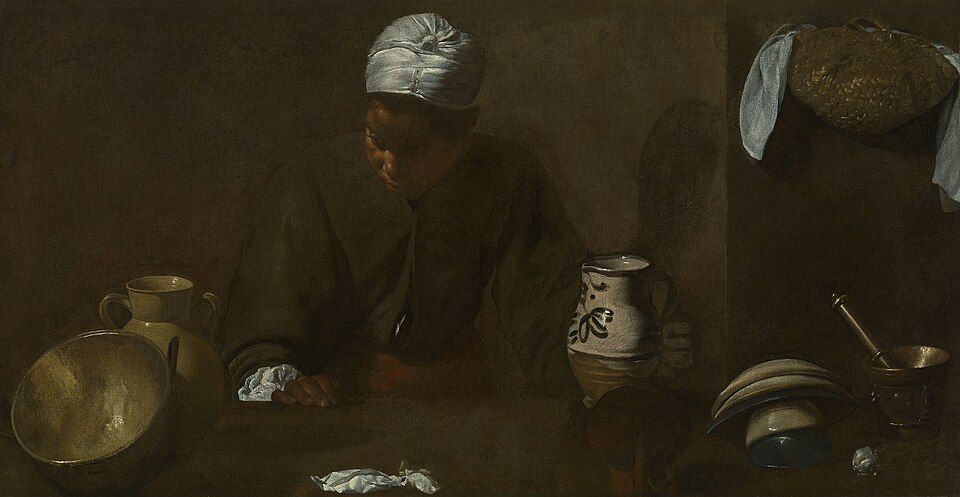
Diego Velázquez, Kitchen Scene, Art Institute of Chicago, 1935.380. Look for the jug, basket and other vessels in the separate Chicago kitchen painting discussed in the technical study. Image source. Public domain. Resized for display.
From a private collection to Edinburgh
An inventory drawn up in 1698 after the death of the Antwerp-born collector Nicolás de Omazur in Seville describes a canvas showing an old woman frying two eggs and a boy with a melon in his hand. The combination is distinctive enough for Ignacio Cano to associate the entry with the Edinburgh painting. The description does not name the artist and gives a rough height for the canvas, so it offers a credible early trace of the composition. It leaves both the original owner and the route out of Spain uncertain. [7] [12]
Cano identifies the painting in the record of a Christie’s sale in London in May 1813. It was entered under Murillo’s name and the catalogue was corrected to describe it as an early Velázquez. Gállego records a separate suggestion that David Wilkie acquired it in Seville. The 1813 sale gives a dated point in the provenance and makes the Wilkie suggestion harder to sustain. The history in Britain then runs through Sir Charles Robinson and the Cook collection at Richmond. The picture was among the works that Sir Francis Cook and the collection’s trustees were willing to sell in 1955. By then the Gallery in Edinburgh wanted to acquire it for the public. [2] [13] [12]
The deal came before the House of Commons that July. The price was £57,000, of which the Treasury grant accounted for £25,000 and the National Art Collections Fund offered £5,000. The Scottish gallery’s trustees were to meet the remainder from their own resources. William Ross, the member for Kilmarnock, asked whether people outside Edinburgh would have an opportunity to see a painting whose purchase they were helping to fund. He remarked that he would have preferred The Toilet of Venus. The Joint Under-Secretary for Scotland, J. Nixon Browne, defended the purchase in part for the inspiration he believed it could offer to young painters. The Gallery had yet to acquire a Velázquez. [1] [13]
The debate makes an unexpected echo of Pacheco’s defence. The public claim of a picture showing someone cooking eggs needed to be explained in terms that went beyond the name of the artist. By 2014 the Edinburgh canvas was selected to represent the collection in Masterpieces from the Scottish National Gallery at the Frick. Its handling of a domestic task was precisely what the New York museum put before visitors. Where the parliamentary exchange had assessed the importance of the subject against another Velázquez, the Frick discussed how much the physical rendering and the obscurity of the encounter depend on one another. [13] [3]
Recording the painted surface
Factum Foundation spent 4 and 5 February 2020 recording the painting in Edinburgh. The team used a Lucida 3D Scanner to capture shallow relief at the surface and panoramic photography to record colour. A colour image can show the change from a dark stroke to a pale one. A relief record maps the corresponding small changes in the height of the surface. As a viewer changes position in front of the original, the painted gleam on the pitcher stays in place, while raking light can make actual ridges or depressions in the dried paint more apparent. The two types of recording address different parts of that experience. [14]
Factum’s report follows the data beyond capture. It shows colour checks against the original and the fabrication of a facsimile in which the colour image was printed over a reproduced relief. A photograph can bring the reflections and sharp shadows close to a distant viewer. A facsimile made this way attempts to give those marks a topography as well as a colour. The project’s account describes how the surviving surface was recorded in 2020. Its close-up record gives future viewers a point of comparison for changes at the surface. [14]
The scale of the original gives the hand and spoon a distinct presence even after the viewer has noticed all the crockery. From a little distance, follow the woman’s brightly lit shoulder out to the hand above the stove. Then look again at the boy’s fingers. One figure holds everything steady while the other is partway through a task. Between their hands the spoon has a little way left to travel, and what is bright at the edge of an egg white is already changing shape.
Two vessels from the Sevillian kitchen
The two earthenware vessels behind the mortar have close counterparts in another Sevillian kitchen scene. The 2025 ceramics study published by the Museo Nacional del Prado, CSIC and the Sociedad Española de Cerámica y Vidrio sets the Edinburgh picture beside Pícaro de cocina, a painting in the Prado by Velázquez’s contemporary Francisco López Caro. The comparison is particularly useful because the boy in López Caro’s painting has picked up the small vessel that the study identifies as an alcuza, a green-glazed container for oil. A white jug with simple brush decoration in manganese stands apart from it. Velázquez sets the corresponding pair close together at the back of the table. [15]
The study looks at details a potter would have had to decide on. Where does the glaze stop and leave the clay exposed? How does the handle join the body? What sort of foot supports the white jug? The authors see features typical of Triana, Seville’s pottery district, in the López Caro vessels. The foot and the handle join are particularly instructive because they are parts of the pot that a description of its decoration could easily pass over. Here they give the painted crockery a more specific place in the history of manufacture. The white jug can be compared with another vessel through the way it was made to stand and be handled, as well as through the brushwork visible on its body. [15]
The likeness is close enough for the study to raise the possibility that the same two vessels appear in both works. Some features are easier to see in López Caro, where the white jug is further forward and the two vessels are farther apart. The comparison supports reading the Edinburgh pair as familiar Sevillian forms. The identity of the individual pots remains open, and the term alcuza describes what that kind of vessel was used for. The contents of the cooking pan are a separate question. [15]
The painting on loan before Edinburgh
The exhibition catalogue issued for the Spanish Old Masters show of 1913–14 records a public life for the painting while it was in private hands. It lists appearances at Burlington House in 1873, the New Gallery in 1895, the Guildhall in 1901 and the National Loan Exhibition at the Grafton Galleries in 1909. At the last of these, it was exhibited as catalogue number 32, on loan from Sir Frederick Cook. The organisers hoped the exhibition would draw attention to the National Gallery and raise money for its acquisitions. The painting could help make the case for public collecting decades before it became the object of an appeal for an acquisition grant of its own. [16] [17]
The 1909 catalogue placed it directly after The Water-Carrier of Seville, lent by the Duke of Wellington. Readers could compare two early works by Velázquez in consecutive entries even though they belonged to different collections. The catalogue reproduced a passage in which the Spanish art historian Aureliano de Beruete preferred the more spare grouping in The Water-Carrier. His comparison also supplied a chronology. He judged the kitchen painting somewhat earlier, on the evidence of how the painter arranged the figures and how young the boy appeared. The exhibition offered visitors a chance to test that judgement with two paintings they would ordinarily have had to seek out in different places. [16]
At the 1913–14 show, Cook’s loan appeared as An Old Woman Frying Eggs: The Omelette, with a date range of 1618–20. The title gave the cook a more definite intention than the gallery’s title does today. The entry retained that reading while bringing together assessments from earlier publications, including Carl Justi’s praise of the economy with which Velázquez described surfaces. A reader could therefore encounter two claims at once. The catalogue gave a quite specific account of the work under way, while Justi’s account asked the reader to notice how much of the scene a few strokes could convey. [17] [18]
What Parliament was asked to buy
In April 1955, a written answer to Walter Elliot, the MP for Kelvingrove, put the sale on a parliamentary timetable. Edinburgh’s trustees had learned in March that the Cook trustees and Sir Francis Cook were prepared to sell. The government’s case for Exchequer help began with the rarity of Velázquez paintings still in private ownership and the wish to keep this one in Britain. By July, when the Commons considered the grant under Class VIII, the question had narrowed geographically. The purchase would give Scotland a Velázquez of its own, in a gallery whose Spanish holdings already included El Greco, Zurbarán and Goya. Nixon Browne told the House that this was the gallery’s first special Exchequer grant. [19] [20]
For Emrys Hughes, the member for South Ayrshire, the eggs were a way to talk about who would benefit from that expenditure. He joked that foreign visitors might mistake the painted kitchen for evidence that Scottish pensioners could still afford eggs. Behind the joke lay two concrete alternatives. He proposed sending the Velázquez paintings already in London on tour to Edinburgh and across Scotland, and asked whether the money might better support promising artists at the Edinburgh and Glasgow art schools. The same constituency of young artists figured in the minister’s defence. Hughes wanted their work bought. Nixon Browne argued that having the painting in Scotland could help educate and inspire them. [20]
The minister’s brief assigned the picture to 1620–22, immediately before Velázquez settled in Madrid. That was the date range used to present the purchase to Parliament. The National Galleries of Scotland dates the canvas to 1618, earlier even than the beginning of that range. The Commons agreed to the resolution. In March 1956 the purchase returned to debate when the Treasury sought funds for an El Greco for the National Gallery in London. The Financial Secretary cited the Scottish grant as a recent precedent, in a discussion about rising prices and the scale of the sums public galleries needed to secure individual paintings. [18] [20] [21]
Artworks directory
Frequently Asked Questions
1618 [1]
Oil on canvas [1]
National Galleries of Scotland, NG 2180 [1]
Discussion
Look again at the images and ideas explored in An Old Woman Cooking Eggs. These editorial prompts invite your observations.
Reader Insights
Which changes in edge or reflection tell you whether you are looking at glass, earthenware or metal?
Compare the boy’s gaze with the woman’s. How does their attention affect the way the kitchen scene unfolds?
Join the Conversation
Share a detail, comparison or question about An Old Woman Cooking Eggs below.
References
- National Galleries of Scotland, Diego Velázquez, An Old Woman Cooking Eggs, NG 2180, current collection record and John Leighton’s account from 100 Masterpieces: National Galleries of Scotland, 2015. View source.
- Julián Gállego, “Vieja friendo huevos”, catalogue no. 4 in Antonio Domínguez Ortiz, Alfonso E. Pérez Sánchez and Julián Gállego, Velázquez, Museo del Prado and Ministerio de Cultura, 1990, pp. 74–78. Includes Francisco Pacheco’s discussion of the bodegón from Arte de la pintura, Book III, Chapter VIII. Spanish. View source.
- The Frick Collection, Masterpieces from the Scottish National Gallery, 5 November 2014–1 February 2015, archived press release, especially pp. 2–3 on An Old Woman Cooking Eggs. View source.
- Archivo Histórico Provincial de Sevilla, Contrato de aprendizaje de Diego Velázquez, Protocolos notariales de Sevilla, 2458P, fols. 353r–354v, September 1611. Spanish. View source.
- Archivo Histórico Provincial de Sevilla, Carta de examen para pintor de imaginería de Diego Velázquez, 14 March 1617, with transcription and archival commentary. Spanish. View source.
- Instituto Andaluz del Patrimonio Histórico, Biografía de Velázquez, Velázquez en Sevilla, early career chronology. Spanish. View source.
- Ministerio de Educación, Cultura y Deporte, Corpus Velazqueño. Documentos y textos, 2000, vol. I, pp. 134–135 on Francisco Pacheco’s Arte de la pintura, and pp. 552–553, document 517, on the Omazur inventories. Spanish. View source.
- Gridley McKim-Smith, Inge Fiedler, Rhona Macbeth, Richard Newman and Frank Zuccari, “Velázquez: Painting from Life”, Metropolitan Museum Journal 40, 2005, pp. 79–91, especially pp. 79–82 on the Chicago Kitchen Scene and note 32 on Pacheco’s account of drawing from life. View source.
- National Gallery of Ireland, Diego Velázquez, Kitchen Maid with the Supper at Emmaus, NGI.4538. View source.
- The National Gallery, London, Diego Velázquez, Christ in the House of Martha and Mary, NG1375. View source.
- English Heritage, Apsley House Collection Highlights, entry for Diego Velázquez’s The Waterseller of Seville, The Wellington Collection. View source.
- Ignacio Cano, “Apuntes para la historia del coleccionismo de la obra de Velázquez en Sevilla”, in Benito Navarrete Prieto (coord.), En torno a Santa Rufina. Velázquez de lo íntimo a lo cortesano, Fundación Focus-Abengoa, 2008, pp. 144–153, especially pp. 144–146 and notes 3–5. Spanish. View source.
- House of Commons, Hansard, “Air Supplementary Estimate, 1955–56”, 18 July 1955, debate on the grant for the National Gallery of Scotland acquisition. View source.
- Factum Foundation, “Velázquez’s An Old Woman Cooking Eggs”, project account of the recording of 4–5 February 2020 and subsequent facsimile. View source.
- M.ª Ángeles Villegas Broncano (scientific ed.), La cerámica en la pintura del Museo Nacional del Prado, CSIC, Museo Nacional del Prado and Sociedad Española de Cerámica y Vidrio, 2025, §2.1, pp. 24–25 and figs. 2.1–2.2. View source.
- A Catalogue of the Pictures and Drawings in the National Loan Exhibition, Grafton Galleries, London, 1909–10, prefatory note and entries 31–32, pp. 43–46. View source.
- Catalogue of the Exhibition of Spanish Old Masters, Grafton Galleries, London, October 1913–January 1914, no. 47, pp. 44–46 and pl. XXI. View source.
- National Galleries of Scotland, An Old Woman Cooking Eggs, NG 2180, current collection record. View source.
- House of Commons, Hansard, “National Gallery (Velasquez Acquisition)”, written answer, 26 April 1955, vol. 540, col. 55W. View source.
- House of Commons, Hansard, “Class VIII”, 18 July 1955, Scottish National Gallery grant, Fourteenth Resolution. View source.
- House of Commons, Hansard, “National Gallery”, 19 March 1956, debate on the El Greco grant. View source.






