


 by Tom Gurney
Tom Gurney BSc (Hons) is an art history expert with over 20 years experience
Published on June 19, 2020 / Updated on October 14, 2023
Email: tomgurney1@gmail.com / Phone: +44 7429 011000
Dwarf with a Dog: Introduction
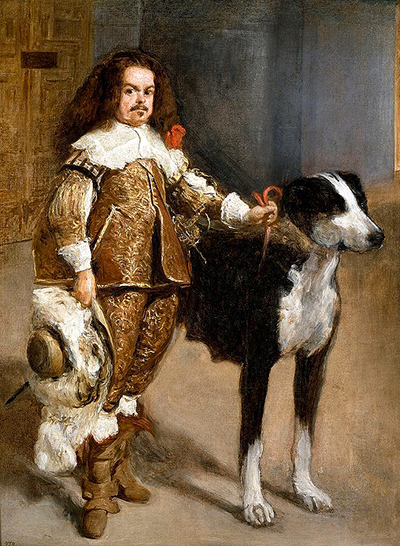
At the centre of the painting, a red cord loops above a man’s knuckles. A few inches to the right, a black-and-white dog turns its head towards the edge of the canvas. The man meets our gaze while the dog looks out of the picture. They stand so close that the man’s cuff and the dog’s dark coat nearly run together. The Museo Nacional del Prado holds this oil on canvas as Enano con un perro (Dwarf with a Dog), P001203. It measures 142 × 107 cm and is generally dated to around 1645. Long attributed to Diego Velázquez, the portrait is now placed in his circle. The Prado also uses the term seguidor de, meaning follower of Velázquez. The man’s name remains unknown. [1] [2] [3] [4]
At a Glance
- CollectionMuseo Nacional del Prado, P001203 [1]
- PaintedAround 1645 [1] [3]
- AttributionFollower of Diego Velázquez in the Prado’s collection index [1]
Contents
- Two figures on the same floor
- What the man holds
- Why the name Antonio el Inglés survives
- How the attribution changed
- A different court portrait in Boston
- What the Royal Museum put on the list
- Two ways to pose with a hunting dog
- A dog raised to the height of a hand
Two figures on the same floor
The man has one boot close to the lower edge and the other a little farther back. The dog stands beside him with its forelegs close to the front of the picture. Their shadows fall across the same bare floor, giving the pair a shared footing. From the front paws, the eye can follow the dog’s white markings up its chest, disappearing into shadow under the jaw and reappearing in the stripe down the head. Its head comes almost to the height of the man’s collar. Only the front part of the animal is clearly described. Behind the chest and forelegs, its dark body runs into a broad patch of shadow below the man’s arm. [2] [3]
The dog has a large black ear, a blunt grey-white muzzle and a small dark eye set back from the illuminated stripe. That profile shows the length of the head, but the dark around the eye makes its exact line of sight harder to follow than the man’s. His face is turned enough for us to see the light across his forehead and one cheek, with a sharper dark accent at the moustache. His eyes turn back towards us. The dog’s muzzle carries the eye outward. The next bright accent to its left is the white cuff and the turn of red at the lead, which draws us back to the man’s hand. [2] [3]
There is a vertical division in the dark background behind the head and shoulders, where a warm brown area on the left gives way to a cooler grey beyond it. Pedro de Madrazo, writing in 1872, described a door at the back on the left. Even if we read the upright as part of a doorway, it tells us little about the room or its occupants. Most of the upper right of the portrait is empty wall. This gives the man’s head a clear silhouette and leaves open space above the dog’s head. Look down towards the floor and the two figures compete for nearly the full width of the canvas. Their different outlines become especially clear when the eye moves from that open patch of wall to the legs below. [2] [3] [5]
What the man holds
The hand at our left hangs beside the thigh and grips the brim of a hat. Its light feathers continue down towards the knee, where they overlap the brown clothes and partly obscure the outline of the leg. The other hand is raised and extended just far enough to hold the lead beside the dog’s neck. The hat gives weight to the hanging arm. The loop of the lead creates a small opening of colour against the dog’s dark coat, so a much smaller object can command attention near the middle of the picture. [2] [3] [5]
Light catches the raised-looking ornament of the brown doublet, especially along its front edges and on the sleeve nearest the viewer. The lighter marks follow the bent elbow and the fall of the fabric. In the breeches, the marks become less distinct as the surface turns away. Broad pale passages pick out the collar, the cuffs and the edges of the boot tops. A thin dark diagonal emerges below the hat at the left, where part of the sword is visible. The sword, hat and dress are all details of a formal presentation. We can see how elaborately the man was represented even though the occasion and his position in the household remain uncertain. [2] [3] [5]
Javier Portús’s catalogue entry for the Prado exhibition Portrait of Spain draws on the costume historian Carmen Bernis to relate the clothes to French fashions from the reign of Louis XIII. The period of that fashion helps locate the portrait in time. It also illustrates the hazard of reading a sitter’s nationality from his dress. Madrazo called it as readily English as Flemish. Both accounts attend to the way the man is dressed, but they put that evidence to different uses. [3] [5]
Why the name Antonio el Inglés survives
A royal inventory of 1772, quoted by Madrazo, describes a figure holding a hat in his right hand and putting his left by a dog. Those two gestures make the entry recognisable. It locates the work in the king’s private rooms at Madrid’s New Royal Palace. By 1821, the Prado catalogue lists Un Enano, con un perro under Velázquez. In 1872 Madrazo suggested Don Antonio el Inglés, the Englishman, and printed a question mark after the name. He pointed to the long hair, dress and appearance of the man as reasons for considering it. The question mark matters because the name went on to have a life of its own. [2] [5] [6]
The archivist José Moreno Villa checked the palace accounts. In 1613 Antonio received cloth for collars. A clothing entry for Tomás Pinto in 1617 refers to Pinto as Antonio’s former tutor, and a later payment record explicitly describes the Antonio he had served as English. Moreno Villa concluded that Antonio was already dead by 1617, decades before the painting’s usual dating. The 1986 Prado exhibition catalogue also discussed an inventory entry for a portrait of Antonio with a dog and traced it to a separate, lost work by Juan Pantoja de la Cruz. A sitter with the same kind of animal can occur in more than one picture even within the same collection. [2] [7]
An etching dated 1869 and attributed to Bartolomé Maura by Italy’s Istituto Centrale per la Grafica shows how the composition circulated. The institute identifies the print with the old name and records it as part of a series made after works then regarded as paintings by Velázquez. A single reproductive print could carry both a familiar subject name and a familiar painter’s name from the museum to readers who had never seen the canvas. The print and Madrazo’s catalogue are evidence for the portrait’s nineteenth-century reputation. The clothing accounts are evidence for the earlier man’s life. [5] [7] [8]
How the attribution changed
The bare setting and the freely handled pale paint are features that belong with the pictorial language of Velázquez’s court portraits. Compare Pablo de Valladolid, where the shape of a cloak and the gap under an extended arm establish the figure’s pose against an almost unbroken field. In Dwarf with a Dog, the floor and wall are easier to distinguish, but depth still depends on a few marks. It comes through in the offset between the boots, the shadows and the overlap of sleeve, hand and dog. The sense of contact is strongest around the lead. Below it, the dark of the dog’s body is surprisingly difficult to trace against the rest of the picture. [2] [3] [9]
The construction of space was among the details Juan Allende-Salazar questioned in 1925 when he proposed Juan Carreño de Miranda. Kurt Gerstenberg suggested Juan Bautista Martínez del Mazo. José López-Rey argued for an anonymous painter working in the tradition of Velázquez. The 1986 Prado exhibition catalogue used discípulo, or disciple, and described the connection in terms of the spare background and the light, loose handling of paint. The Prado’s later listing as a follower leaves the painter unnamed. [1] [2] [3]
The Mazo comparison rests partly on the dog. Portús points to the animal at the lower right of Mazo’s The Stag Hunt at Aranjuez, another Prado canvas, P002571. There, too, the front half of a large dog is the part put on view. The resemblance is conspicuous enough for Portús to suggest a connection between the works and a possible date in the late 1630s or early 1640s for the portrait. That is an argument from a painted motif, alongside the evidence from dress, and leaves room for the conventional approximate date. It also shows why a detail can matter to an attribution without settling it. One painter could reuse a motif, or a second painter with access to the picture could adapt it. [1] [3]
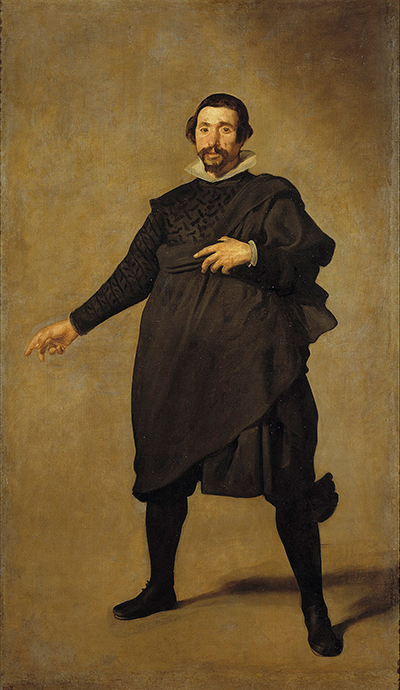
Pablo de Valladolid. Use the firm stance and spare setting in this documented Prado portrait to compare how a court performer occupies the canvas. View Pablo de Valladolid.
A different court portrait in Boston
The Museum of Fine Arts, Boston, calls its Velázquez of 1632 Don Baltasar Carlos and an Attendant, 01.104. Older references call it Don Baltasar Carlos with a Dwarf. The prince stands by a crimson curtain with a baton and a sword. The attendant in the foreground holds an apple and a rattle, objects the Boston museum has compared with the orb and sceptre. The relationship between the two people is worked out in their different positions, clothes and objects. The Prado portrait gives its one human figure the full-length pose, the sword and the outward look. The dog changes the scale of the composition, and the lead makes their proximity one of the clearest facts about the scene. [2] [10]
For another use of a dog in a court painting, look at the right foreground of Las Meninas. Nicolás Pertusato touches the reclining animal with his foot. The dog’s long, low shape anchors that end of a crowded room. In Dwarf with a Dog the dog stands, so its chest and head rise into the bands of the picture occupied by the man’s hands and clothes. Look back to the lead and the branching paths the portrait offers. One follows the white patches over the dog’s head and down its chest. The other follows the cuff and folds of the sleeve back to the face. The face is still looking towards us when we arrive. [2] [9] [11]
What the Royal Museum put on the list
In the inventory made on the death of Ferdinand VII in 1833–34, the Royal Museum entered the painting now catalogued by the Prado as P001203 immediately after a portrait of Philip IV. Number 219 identifies the king as a hunter. Number 220 describes a man with dwarfism and specifies that the dog beside him is large. Both entries give Velázquez as the painter. The Prado today catalogues P001203 as the work of a follower of Velázquez, and the sitter’s name remains uncertain. The consecutive entries show how differently the early museum described two full-length figures accompanied by dogs. The king’s name and activity were enough to pick out his picture. In the next entry the animal supplied the distinguishing detail. [12] [13] [14]
The transcribed inventory explains how the list was constructed. It had columns for subject, painter, height and width in feet and inches, support, frame and valuations. The transcription generally specifies the support only where it differs from canvas. At number 220 the recorded height is 5 feet 7 inches and the width 4 feet 4 inches, in the historical units of the document. The recorded figure for the painting is 20,000, half the figure entered for the hunting portrait of Philip IV. Another purported Velázquez in the same sequence, number 196, is described as a man with dwarfism seated on the ground and is also valued at 20,000. A clerk could distinguish the two unnamed figures economically by writing down a posture for one and a conspicuous animal for the other. [14]
The heading for this part of the inventory is the second room, assigned to the older Spanish schools. Alongside the portraits sit records of a battle scene, a Virgin and Child and a fruit still life. That grouping belongs to the Royal Museum. The list gives the two portraits a documented point of proximity in their museum history, while leaving their seventeenth-century relationship open. It also records something that a modern breed label would miss. For the compiler, the animal’s size was the feature worth keeping when the description was reduced to a single line. [14]
Two ways to pose with a hunting dog
The Museo de Historia de Madrid places Velázquez’s portraits of Philip IV, the Cardinal-Infante Ferdinand and Prince Baltasar Carlos in the setting for which they were made, the Torre de la Parada. The lodge stood in the royal hunting grounds of El Pardo, and its decoration included views of hunts and an image of a stag’s head. All three portraits equip their sitters with firearms and dogs in the open landscape. The repeated equipment links king, brother and heir to a shared pursuit. Madrid’s museum notes that training in the hunt began in childhood and was understood as preparation for the physical and mental demands of warfare. In the portrait of Baltasar Carlos, the gun consequently gives the young prince an adult activity to enact. [15]
The gun and animal divide the lower part of Philip IV’s portrait between them. The barrel runs down diagonally while the dog, at the other side of the king, sits upright at his feet. The dog in Baltasar Carlos’s portrait lies along the ground, its broad body taking up a stretch of the foreground, with the head of another dog appearing at the edge. The same commission thus allowed different ways of placing the animal beside a standing figure. In P001203 the upright dog comes much farther up the sitter’s figure. Their clearest connection is a line actually held in the hand. In the hunting portraits, the landscape and the firearms explain what the animals are there for. In the follower’s painting the lead connects two bodies, and the setting leaves the occasion open. [12] [15]
Madrid’s museum also reproduces a hunting portrait of Baltasar Carlos by Velázquez’s workshop in which the prince stands indoors. A balcony opens onto a landscape, and the firearm carries the hunting theme into the room. That comparison makes it possible to ask what the follower’s painter chose to depict without assigning the sitter a place in the hunt. An interior could serve for a hunting portrait when there was equipment to identify the activity. The hand that holds the cord in P001203 establishes the man’s immediate charge of the animal during the pose. Who owned it and what part it played in his life remain unknown. [12] [15]
A dog raised to the height of a hand
A different way of bringing an animal up beside a sitter appears in Velázquez’s 1659 portrait of Felipe Próspero, now in Vienna. The little dog occupies a red velvet chair. At the Metropolitan Museum of Art, the catalogue for Goya and the Altamira Family reads the chair as a reminder of the young prince’s claim to the throne and describes the animal as his pet spaniel. The dog lies where an adult sitter might rest a hand or an arm. From the chair it can look out towards the viewer, almost directly so, and its light coat forms a small patch of brightness set apart from the broad expanse of the child’s pale gown. The red upholstery supplies a clear boundary between them. [16]
The two pictures give the dogs comparable prominence by different means. The prince’s dog needs furniture to reach the level of his hand; the standing animal in P001203 reaches the man’s hand from the floor. Felipe Próspero puts his hand on the chair back, while the man with the large dog closes his hand around the lead. The chair mediates the relationship in one case, the cord in the other. The Vienna portrait can accommodate a named child, a documented dynastic role and an identifiable kind of domestic companion in the same composition. In P001203 the closest evidence concerns the pose itself. The man is shown holding the dog beside him, and the animal is large enough for that action to occupy the middle of the picture. [12] [16]
Artworks directory
Frequently Asked Questions
Museo Nacional del Prado, P001203 [1]
Follower of Diego Velázquez in the Prado’s collection index [1]
Discussion
Look again at the images and ideas explored in Dwarf with a Dog. These editorial prompts invite your observations.
Reader Insights
How do the man’s gaze and the dog’s profile send your eye in different directions?
What would make a repeated motif strong evidence of authorship?
Join the Conversation
Share a detail, comparison or question about Dwarf with a Dog below.
References
- Museo Nacional del Prado, Enano con un perro, P001203, exact collection record, English collection index (Buffon with a Dog, circa 1645, Follower of Velázquez), and Memoria de actividades 2021, p. 397, Gabinete Técnico works list, P1203, listed as seguidor de Velázquez. Spanish. View object record. View collection index. View source 1. View source 2. View source 3.
- Fundación Amigos del Museo del Prado, Monstruos, enanos y bufones en la Corte de los Austrias, 1986, cat. 29, pp. 100–102, Retrato de enano con un perro, Prado no. 1203. Spanish. View catalogue entry. View publisher record. View source 1. View source 2.
- Javier Portús, Portrait of Spain: Masterpieces from the Prado, Queensland Art Gallery and Art Exhibitions Australia, 2012, p. 108, catalogue entry for Dwarf with a Dog, including comparison with Mazo’s The Stag Hunt at Aranjuez, Prado P002571. View transcribed entry. View exhibition record. View source 1. View source 2.
- José Ignacio de Arana, “Alteraciones de la morfología corporal en la pintura española de los siglos XVI y XVII”, Cuadernos de Historia de la Pediatría Española, no. 14, 2017, p. 21, fig. 6, reproduction and approximate date of Enano con un perro. Spanish. View source.
- Pedro de Madrazo, Catálogo descriptivo é histórico del Museo del Prado de Madrid, 1872, no. 1097, pp. 631–632, with the 1772 inventory description. Spanish. View source.
- Real Museo del Prado, Catálogo de los cuadros que existen colocados en el Real Museo del Prado, 1821, no. 231. Spanish. View source.
- José Moreno Villa, Locos, enanos, negros y niños palaciegos, La Casa de España en México, 1939, pp. 63–64 and 82–84, with accounts for Don Antonio and Tomás Pinto. Spanish. View source.
- Istituto Centrale per la Grafica, Enano con un perro, etching catalogued as attributed to Bartolomé Maura y Montaner, S-FN8304, dated 1869. Italian, with Spanish title. View object record. View source.
- Museo Nacional del Prado, Velázquez, exhibition catalogue, Madrid, 1990, cat. 57, pp. 338–341, Pablo de Valladolid, and cat. 73, pp. 420–429, Las Meninas. Spanish. View source.
- Museum of Fine Arts, Boston, Don Baltasar Carlos and an Attendant, 1632, 01.104, and the museum’s earlier title and interpretive text on its Google Arts & Culture record. View collection index. View earlier record. View source 1. View source 2.
- Museo Nacional del Prado, Las meninas en pictogramas, illustrated museum guide, p. 17, with Nicolás Pertusato and the dog. Spanish. View source.
- Museo Nacional del Prado, Enano con un perro, exact object record P001203. View source.
- Museo Nacional del Prado, English collection index, Buffon with a Dog, circa 1645, follower of Velázquez. View source.
- Archivo de Palacio, Sección Histórica, Testamentarías, leg. 17, Inventario de las pinturas del Museo hecho a la muerte del rey Fernando VII, 1833–34, Prado-hosted transcription, pp. 2 and 14–18, especially nos. 196 and 219–220. View source.
- Museo de Historia de Madrid, La Torre de la Parada, pp. 54–60, especially figs. 75–78. View source.
- Metropolitan Museum of Art, Goya and the Altamira Family, The Metropolitan Museum of Art Bulletin, vol. 71, no. 4, spring 2014, pp. 36–37, fig. 47, Velázquez’s Felipe Próspero, Prince of Asturias, Kunsthistorisches Museum GG 319. View source.







