


 by Tom Gurney
Tom Gurney BSc (Hons) is an art history expert with over 20 years experience
Published on June 19, 2020 / Updated on October 14, 2023
Email: tomgurney1@gmail.com / Phone: +44 7429 011000
Prints after Velázquez: Introduction
The open doorway in Francisco de Goya’s print of Las Meninas is a patch of light just wide enough to frame a man on a stair. Near the front, the Infanta’s dress makes a much broader light shape. Between them Goya had to suggest a long, dim room, with people and pictures just visible in the shadows. The original canvas is over three metres high. Goya’s copper plate was about forty centimetres high, and every transition between the pale dress and the dark end of the room had to be made with ink on paper. The surviving proofs show several attempts at getting those transitions right. [1] [2] [3]
A print described as “after Velázquez” credits him with the painted composition or likeness and identifies another artist as the printmaker. Goya was one of several artists who put those pictures on paper. For a modern reproduction of a painting in colour, start with the Velázquez paintings guide to identify the composition and see how it is framed. If you are looking for a historical print, search with both artists’ names and the title. For Las Meninas alone, that search leads to materially different works by Goya and Pierre Audouin. [1] [2] [4]
At a Glance
- Goya’s seriesA Madrid notice advertised nine etchings in July 1778. [5]
- AudouinLas Meninas after Velázquez, 1799 [4]
- VillafrancaEngraved portrait of Philip IV, 1657 [6]
Contents
- What buyers could see in 1778
- Two impressions of Goya’s Aesop
- How Goya worked the shadows
- Audouin and Villafranca
- Finding the right print
What buyers could see in 1778
On 28 July 1778, the Gazeta de Madrid advertised nine etchings drawn and etched by Goya from paintings in the Royal Palace. It named the subjects and told readers where to buy them. The five equestrian prints showed Philip III, Philip IV, Margaret of Austria, Isabel of Bourbon and the Count-Duke of Olivares. The four smaller prints showed the standing figures of Menippus and Aesop and two seated men from the court, identified in the Fundación Goya catalogue as Sebastián de Morra and Diego de Acedo, known as El Primo. The notice priced the equestrian prints at six reales each and the others at three. Two Madrid booksellers offered the sheets together or individually. [5] [7]
A buyer could therefore put a king on horseback alongside a writer in worn clothes or collect several royal portraits as a group. The advertisement described the palace originals as life-size, a reminder of how far apart the painted and printed encounters were. In the equestrian portrait of Olivares, the diagonals of the horse and rider and the turn of the rider’s head assert his presence across a large canvas. A sheet that could be handled or laid next to another made it easier to compare his pose with that of a king. Those choices belonged to the purchaser. The selection itself still set the limits of what could be seen. [5] [7] [8]
The first nine subjects were followed by a second announcement in December for the equestrian portrait of Prince Baltasar Carlos and The Triumph of Bacchus, also known as Los Borrachos. Goya worked on other plates over a longer period. The set of subjects known to scholarship is larger than the group advertised in 1778. Preparatory work also extended beyond surviving prints. For instance, a study attributed to Goya in Hamburg follows Velázquez’s Waterseller of Seville, for which no etching by Goya is known. The evidence for drawing from a painting and the evidence for circulating its image are different. [2] [7] [9]
Two impressions of Goya’s Aesop
In Velázquez’s Aesop, the figure stands almost alone against an unarticulated background, with a book tucked against his body. In Goya’s etching, the field of the print is filled by a long coat, a broad face and that book. Thin strokes and changes in their density distinguish the folds in the clothing. The book’s exposed edges give the eye a place to settle in the middle of the figure. The background still matters, since Aesop’s silhouette has to hold together against it, but Goya can concentrate the smallest distinctions around a single person. [10] [11] [12]
The National Museum of Western Art in Tokyo catalogues G.2018-0024 as an etching on heavy laid paper, dated 1778, with a plate measuring 29.7 × 21.5 cm and a sheet measuring 42.8 × 30.3 cm. Its catalogue gives the reference Harris 13, III-1/3. The Museum of Fine Arts, Boston, holds another impression, 51.1715, described as a working proof in etching and drypoint with manuscript additions. It records a similar platemark of 30 × 21.5 cm on a smaller sheet. In Boston the artists’ names were worked in drypoint, and the handwritten inscription was added in black and brown ink. A reproduction cropped to the figure can hide such differences even when it shows the image clearly. [11] [12]
An impression is a particular sheet pulled from the plate. A state describes the plate at a particular stage, after or before changes such as another pass of etching or the addition of lettering. An edition refers to a group of impressions issued or printed together. Some changes are made directly on an individual sheet. The handwritten addition on the Boston Aesop belongs to that impression, so a comparison with Tokyo needs to distinguish the mark made in metal from the mark made on paper. [11] [12]
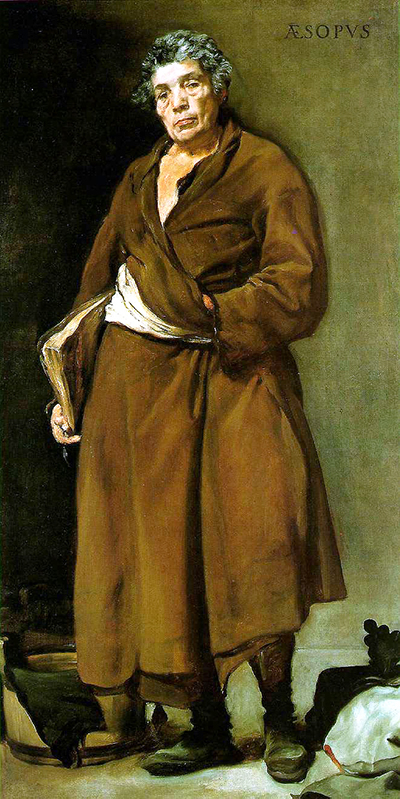
Aesop. The Prado canvas shows the coat, book and figure translated into line and tone in Goya’s print. View Aesop.
Further reading
Trace Goya’s early etchings after Velázquez alongside the drawings and print series he made later.
Goya’s Graphic Imagination. Mark McDonald. The Metropolitan Museum of Art, 2021
How Goya worked the shadows
The Cardinal-Infante Ferdinand as a hunter offers a case where the landscape demanded considerable work even in a single-figure portrait. The New York Public Library records an impression under Un infante de España and credits Goya as etcher. In the Fundación Goya’s account of the plate, early work on the sky and landscape involved adding horizontal lines and strengthening the scrub around the sitter. Later work included aquatint and roulette. A proof held by the Biblioteca Nacional de España has aquatint but predates the title cut into the plate. Its manuscript caption shows how a sheet might carry the name of the subject before lettering became part of the image that the press could repeat. [13] [14]
In an etching, acid bites lines exposed through a protective ground. Denser or intersecting lines can make a shadow, as when a set of strokes crosses a second set at an angle. Aquatint allows for a more continuous-looking tone by letting acid bite around small particles, creating a textured field that takes ink. A toothed roulette can add patterns of small marks, while a burnisher can smooth areas of the plate so that they print lighter. These distinctions matter in the shadows of Las Meninas, where powdery half-tones, parallel marks and darker passages all contribute to the appearance of the room. [1] [2] [7] [14]
In the original painting the pale opening at the back and the light on the Infanta are separated by a succession of dim shapes. Goya had to preserve enough difference between the ceiling, wall, pictures and figures to give the doorway its distance. The Fundación Goya notes how much of the background he retained despite difficulties in distinguishing the walls from the ceiling. It singles out the painter at the left as a figure that nearly merges into the dark. The Met catalogue puts more emphasis on the compression of the middle distance, while praising the delicacy of the Infanta. In both readings, the living figures and the architecture pose distinct problems for the plate. [1] [2] [3]
The second-state proof at the Biblioteca Nacional de España, INVENT/45537, has a platemark of 40.5 × 32.5 cm. The catalogue describes drypoint on a sleeve at the right, before the addition of roulette and aquatint, and blended black pencil retouching on the paper. A different sheet reproduced by the Met shows the third state in black on the front and the fourth state in red on the back. Comparing the faces of that one sheet involves changes in both the plate and the ink. The date is approximate. The Fundación Goya uses about 1778–85, while the Met catalogue captions the illustrated proof about 1778. [1] [2] [15]
The Fundación Goya reports damage to the plate during work with aquatint and a burnisher, and gives its whereabouts as unknown. Goya’s Las Meninas was never issued for sale. The surviving proofs lack engraved lettering. Goya also left his plate after Velázquez’s Don Juan de Austria unpublished, although proofs survive from it too. The prints prepared for sale could carry lettering identifying Goya, Velázquez and the Royal Palace for buyers. The proof of a subject as famous as Las Meninas thus tells us something different from the July advertisement. It records the decisions Goya was still making when work on the plate stopped. [1] [5] [7]
Audouin and Villafranca
A later Las Meninas passed through an additional pair of hands. Antonio Martínez made a black-pencil drawing after Velázquez for the company established to engrave paintings from the royal palaces. The Real Academia de Bellas Artes de San Fernando’s sheet, DG-0156, retains traces of a grid, evidence of how the image could be transferred at a controlled scale. Pierre Audouin worked from that intermediary. The Academy catalogues the copper matrix, M-2749, at 58 × 45 cm and describes etching and burin work. Goya’s plate was about 17.5 cm shorter. The Met dates its Audouin impression, 2014.240, to 1799 and catalogues it as an engraving measuring 51 × 40.5 cm. That last figure is the museum’s dimension for the object in its collection. [1] [4] [16] [17]
Look at the tall canvas at the left in the Audouin engraving. Its straight edges and the bands of closely spaced lines behind it set off the figure of Velázquez. The folds around the Infanta and her attendants can be followed as distinct contours within the larger pool of light. In the later Goya proof, many of the same forms emerge from a darker, more continuous field. At this scale, the difference affects how the eye travels through the room. The separation of shapes in the Audouin makes it easy to move from the painter to the foreground group, while in Goya the distant opening can pull attention across an expanse in which the forms are harder to distinguish. [1] [2] [4]
A much earlier royal likeness shows another use for engraving. In 1657 Pedro de Villafranca signed the portrait of Philip IV for Francisco de los Santos’s book on El Escorial. The Biblioteca Nacional de España’s example, IH/2948/42, is a burin engraving with a platemark of 26.3 × 17.7 cm. Philip’s likeness sits inside an oval with lettering, surrounded by putti and royal emblems. A view of the monastery occupies the space at the foot. The National Gallery and Mark McDonald identify Velázquez’s late London portrait as the model and McDonald observes that the engraved head faces in the opposite direction. The Biblioteca Nacional exhibition catalogue names Villafranca’s own painted likeness, which McDonald describes as itself drawing on the London type for the upper body and head. The white collar, decorations and face thus belong to a line of related likenesses, while the setting makes the little portrait legible as the opening to a book about a royal foundation. [6] [18] [19]
Finding the right print
For a historical print, check what the catalogue measures, since a sheet, a printed image and a copper plate can have three different sizes. Check the date against the description too. A catalogue may give the date of the first issue for the design and identify the particular sheet as a later printing. For Aesop, add Tokyo’s G.2018-0024 or Boston’s 51.1715 to your search to see a specified impression. For Las Meninas, choose between Goya’s working proofs and Audouin’s engraving using the printmaker’s name as well as the title. The New York Public Library’s collection of prints after Velázquez provides a wider starting point for locating subjects. If the aim is to choose a modern art print for display, compare the reproduction with the corresponding painting and check how much of the composition the advertised image includes. The enormous space above the figures in Las Meninas is one detail that can disappear when a reproduction is cropped around its famous faces. [1] [3] [4] [11] [12] [13] [20]
Artworks directory
Frequently Asked Questions
On 28 July 1778, the Gazeta de Madrid advertised nine etchings drawn and etched by Goya from paintings in the Royal Palace. It named the subjects and told readers where to buy them. The five equestrian prints showed Philip III, Philip IV, Margaret of Austria, Isabel of Bourbon and the Count-Duke of Olivares. [5] [7]
In Velázquez’s Aesop , the figure stands almost alone against an unarticulated background, with a book tucked against his body. In Goya’s etching, the field of the print is filled by a long coat, a broad face and that book. Thin strokes and changes in their density distinguish the folds in the clothing. [10] [11] [12]
The Cardinal-Infante Ferdinand as a hunter offers a case where the landscape demanded considerable work even in a single-figure portrait. The New York Public Library records an impression under Un infante de España and credits Goya as etcher. In the Fundación Goya’s account of the plate, early work on the sky and landscape involved adding horizontal lines and strengthening the scrub around the sitter. [13] [14]
A later Las Meninas passed through an additional pair of hands. Antonio Martínez made a black-pencil drawing after Velázquez for the company established to engrave paintings from the royal palaces. The Real Academia de Bellas Artes de San Fernando’s sheet, DG-0156, retains traces of a grid, evidence of how the image could be transferred at a controlled scale. [1] [4] [16] [17]
Discussion
Look again at the images and ideas explored in Prints after Velázquez. These editorial prompts invite your observations.
Reader Insights
What disappears when the shadowed room in Las Meninas is translated into lines and tones on paper?
How can two impressions help you tell which changes were made to the plate?
Join the Conversation
Share a detail, comparison or question about Prints after Velázquez below.
References
- Fundación Goya en Aragón, Francisco de Goya after Velázquez, Las Meninas, inv. 225, Spanish series record. View source.
- Colta Ives and Susan Alyson Stein, Goya in The Metropolitan Museum of Art, Metropolitan Museum of Art, 1995, pp. 12–14, fig. 3 and checklist entry for Las Meninas, Harris 17.I.3–4. View source.
- Julián Gállego, Velázquez, Museo del Prado, Madrid, 1990, cat. 73, pp. 420–429, Las Meninas, P001174, Spanish. View source.
- The Metropolitan Museum of Art, Pierre Audouin after Velázquez, Las Meninas, 1799, 2014.240. View source.
- Gazeta de Madrid, no. 30, 28 July 1778, p. 300, notice for nine etchings by Goya after Velázquez, Spanish. View source.
- Biblioteca Nacional de España, Pedro de Villafranca, Retrato de Felipe IV, 1657, IH/2948/42, in El gabinete de Ceán Bermúdez, cat. 44, pp. 82–83, Spanish. View source.
- Fundación Goya en Aragón, Francisco de Goya after Velázquez, Felipe III. Rey de España, Spanish series history. View source.
- Antonio Domínguez Ortiz, Alfonso E. Pérez Sánchez and Julián Gállego, Velázquez, Museo del Prado, Madrid, 1990, cat. 42, pp. 254–258, Retrato ecuestre del conde duque de Olivares, P001181, Spanish. View source.
- Paula Fayos Pérez, Goya’s Caprichos in Nineteenth-Century France. Politics of the Grotesque, CEEH, 2024, appendix I, p. 305, “Copies after Velázquez”. View source.
- Antonio Domínguez Ortiz, Alfonso E. Pérez Sánchez and Julián Gállego, Velázquez, Museo del Prado, Madrid, 1990, cat. 49, p. 299, Esopo, P001206, Spanish. View source.
- The National Museum of Western Art, Francisco de Goya, Aesop after Velázquez, 1778, G.2018-0024. View source.
- Museum of Fine Arts, Boston, Francisco de Goya after Velázquez, Aesop, the Fabulist, 1778, working proof, 51.1715. View source.
- The New York Public Library, Wallach Division of Art, Prints and Photographs, Francisco de Goya after Velázquez, Un infante de España, dated 1778 by the library, UUID 58f68690-c61d-012f-84cd-58d385a7bc34. View source.
- Fundación Goya en Aragón, Francisco de Goya after Velázquez, El infante Don Fernando, Spanish catalogue of the plate, proofs and editions. View source.
- Biblioteca Nacional de España, Francisco de Goya, Las meninas o La familia de Felipe IV, INVENT/45537, second state, in Ceán Bermúdez, historiador del arte y coleccionista, 2016, cat. 9.64, p. 461, Spanish. View source.
- Real Academia de Bellas Artes de San Fernando, Antonio Martínez after Velázquez, Las Meninas, DG-0156, 1789–97, preparatory drawing, Spanish. View source.
- Real Academia de Bellas Artes de San Fernando, Calcografía Nacional. Catálogo general, vol. I, Las Meninas, cat. 2135, Pierre Audouin after Antonio Martínez and Velázquez, matrix M-2749 and associated impression R-2749, Spanish. View source.
- National Gallery, Diego Velázquez, Philip IV of Spain, NG745. View source.
- Mark McDonald, Pedro de Villafranca: Printmaker at the Court of Philip IV, CEEH, 2025, pp. 51 and 60, fig. 16 and reference to cat. 49b. View source.
- The New York Public Library, Wallach Division of Art, Prints and Photographs, Reproductive prints after Diego Velázquez, collection index. View source.







