


 by Tom Gurney
Tom Gurney BSc (Hons) is an art history expert with over 20 years experience
Published on June 19, 2020 / Updated on October 14, 2023
Email: tomgurney1@gmail.com / Phone: +44 7429 011000
The Immaculate Conception: Introduction
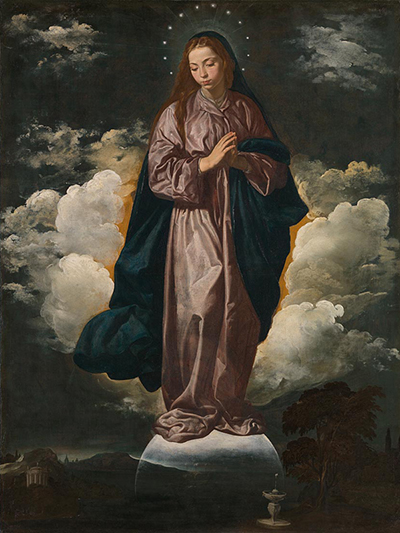
The hem of Mary’s tunic bunches into folds on the bright edge of the moon. Underneath, the curve becomes transparent enough for the dark land to show through. Looking up from this precarious footing, there is a body with weight and balance inside the clothes, a pair of hands meeting in prayer and a face inclined towards the ground. Velázquez gives the young woman the physical presence of someone standing close by. The small fountain below her and the twelve stars above make it impossible to place her at any ordinary distance. [1] [2]
The National Gallery in London dates The Immaculate Conception to 1618–19, when Velázquez was working in Seville. The oil on canvas measures 135 × 101.6 centimetres and is catalogued as NG6424. It was made as a companion to Saint John the Evangelist on the Island of Patmos. In the other canvas the woman appears as a remote point of light. Here she fills most of the picture. [1] [3]
At a Glance
- CollectionThe National Gallery, London, NG6424 [1]
- Painted1618–19 [1]
- CompanionSaint John the Evangelist on the Island of Patmos [3]
The two Carmelite paintings
The National Gallery dates the paired oil paintings to the same early period.
The earliest known record places the canvases together in the chapter house at Seville.
The gallery bought the companion painting after the pair had been on loan.
The Immaculate Conception joins Saint John
1974 [1]The National Gallery acquired NG6424 with support from the Art Fund and an anonymous gift.
Contents
- A figure with weight
- The woman in Revelation and the meaning of the title
- A landscape made of Marian emblems
- Looking from Saint John to Mary
- What the paint reveals
- From the Carmelite convent to London
A figure with weight
Mary’s head tilts to the viewer’s left. Her prayerful hands meet slightly to the right, their fingers held at a slant. These small departures from the vertical matter in a composition with a single upright figure. The gaze leads down past the shoulder, while the bright forearm leads back across the chest towards the fingertips. Below them, a light fold descends from the waist and pulls diagonally over a knee. The broader, darker folds on the other side continue almost to the base of the figure, where both ends of the tunic gather on the moon. You can follow the pose through the fabric, though most of the body is covered. [1] [2]
The mantle has its own movement. At the viewer’s right it passes behind the hands and broadens below the elbow in a dark blue sweep. On the left it drops almost the length of the body before curling into a thick fold against the cloud. Its outline is especially readable where it touches the banks of white. Higher up, the brown of the hair and the blue of the mantle move into a much darker part of the sky. The little stars keep the area above her forehead open and legible. A sliver of warm yellow, visible particularly around the sides of the lower figure, separates the mantle from the light cloud in a different way. [1] [2]
The shadows at the neck make the lowered chin easy to locate. Along the fingers and the upper forearm, light catches one form after another in quick succession. The large folds take that same light over longer distances. Near the bottom a ridge turns into a dark recess, then another lighter fold comes forward. The succession gives the cloth the appearance of relief, an effect the National Gallery associates with the sculptural character of the figure. The clouds have modelling of their own, though their pale bulges break up into loose edges. Against them the tunic looks all the more substantial. [1] [2]
The woman in Revelation and the meaning of the title
In Catholic teaching, the Immaculate Conception is Mary’s preservation by God from original sin from the first instant of her own existence. The Annunciation concerns the later conception of Jesus, announced to Mary by the angel Gabriel. Velázquez paints a young Mary already old enough to pray. Her age makes sense in a devotional image that gives visible form to a belief about the beginning of her life. [1] [4]
The sun, moon and stars come from the twelfth chapter of Revelation. A woman appears in the sky clothed with the sun, with the moon beneath her feet and twelve stars crowning her. She is about to give birth, and a dragon waits to seize her child. The woman later receives wings to escape. The biblical image can represent the people of God, as the notes to the New American Bible explain. The Marian reading, which Velázquez’s teacher Francisco Pacheco discussed in his treatise on painting, gives those signs to the mother of Christ. Velázquez brings the moon, stars and surrounding light into this separate canvas. The dragon belongs to the episode shown to John. [1] [3] [5] [6]
Pacheco’s Arte de la pintura, published in 1649, describes a girl of twelve or thirteen with loose hair, a blue mantle and a white tunic. He favoured depicting her with her hands joined and without the child in her arms. His moon offered firm footing on the convex side, with the bright crescent at the top and the tips directed downwards. At Mary’s feet, Velázquez’s bright upper arc picks out the place where the folds settle, while the lower part of the disc almost dissolves. Above Mary, the individual stars are separated by open sky. The moon takes its shape from a continuous passage of light, while the crown relies on small, widely spaced points. [1] [2] [6]
The treatise appeared about thirty years after the picture, and the colours offer a particularly good reason to keep the dates in view. The Gallery identifies the tunic’s present pink as a faded red, a different choice from the white Pacheco eventually recommended. Nozomi Yamada points out that Pacheco himself used red tunics in three paintings of the subject made around 1620. This particular difference is between a later prescription and earlier pictures by both painters. [1] [6] [7]
A landscape made of Marian emblems
The bright clouds leave the land to a very narrow portion of the canvas. At the left there is a small building by a rise in the terrain. At the right a fountain catches the light in front of dark trees. In between, the horizon survives in a few faint changes of tone. The National Gallery identifies a garden, fountain, temple and ship in this lower zone and associates them with a litany to the Virgin. A litany is a prayer structured as a series of invocations. Here its imagery is placed at different distances within a landscape. The proximity of the fountain makes it clearer than the objects further off, while the subdued tones keep the scene below the moon in shadow. [1] [2]
Pacheco later advised painters to place earthly attributes in the landscape and allow heavenly ones among the clouds. In some of his own paintings of the subject, he brought the apparition close to home by giving it recognisable Sevillian landmarks, as Yamada observes. Velázquez’s terrain, with its receding trees and water, resembles an inhabited place. Yamada identifies no comparable landmark. The little temple and fountain give the landscape something of the familiarity of a built place. Their scale, seen under the transparent moon, makes Mary’s footing seem far above it. [2] [6] [7]
For a Sevillian viewer around 1618 the subject was part of a public religious debate. The art historian Juan Isaac Calvo Portela traces how celebrations and processions made support for the doctrine visible in the city. Printed sermons also carried its images. One example he examines, published in Seville in 1616, records a sermon preached at a celebration in the city’s principal Carmelite convent and carries a woodcut of the subject. In the following year Paul V issued a measure in favour of the belief. The National Gallery suggests that the two paintings may have been intended to promote the recent celebrations. The 1854 definition of the doctrine as Catholic dogma came more than two centuries later. [1] [3] [4] [8]
In the 1616 woodcut, the temple, fountain and enclosed garden are scattered beside Mary, within the same undefined space she occupies. A great serpent-like creature lies directly below the crescent. In the oil painting, the half-hidden emblems share the terrain beneath the apparition. The fountain in particular has a place in a landscape that stretches well beyond it. Those differences show how painters and printmakers working in the same city could put familiar signs to different uses. [1] [2] [8]
Looking from Saint John to Mary
In Saint John the Evangelist on the Island of Patmos, the writer’s book forms a pale diagonal across his lap. His pen hand is raised a little way above it. A dark tree rises behind him on the right, giving the upper left of the picture room for the small vision towards which he turns. His bare feet extend across a dark patch of foreground. In The Immaculate Conception, a long fall of cloth makes where the feet press down more important than their anatomy. The landscape sits much lower, and the clouds which hold a small image in John’s sky billow to either side of Mary’s full-length figure. [2] [3]
The similar height of the canvases makes this change in scale particularly telling. John’s open book gives the eye a place to pause between his lifted face and the ground. In Mary’s picture the pause is at the joining of the hands, about halfway from the stars to the crescent. John’s light tunic and once red mantle reverse something of the warm and cool balance of Mary’s tunic and blue cloak. Light comes strongly from the upper left in both, defining fingers, cheek and folds. The direction of the two figures’ gazes gives that shared lighting a different effect. In one picture attention rises from a seated body towards a bright patch in the distance. In the other, the figure’s lowered eyes bring attention from the upper part of the sky down towards the land. [1] [2] [3]
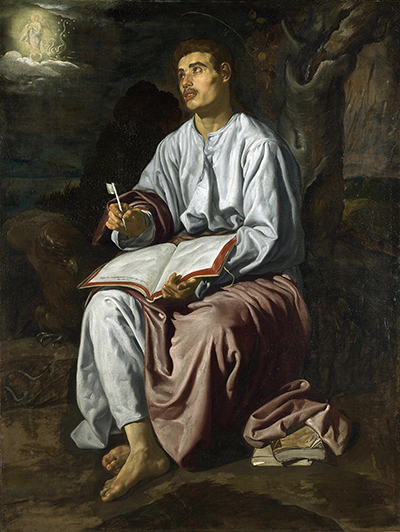
Saint John on Patmos. The companion canvas gives the vision a different scale and places the Evangelist in the foreground. View Saint John on Patmos.
What the paint reveals
There is a change beneath the tunic which helps explain its strong downward course. The National Gallery reports that an X-ray shows an earlier passage of blue mantle sweeping across Mary’s lower legs. Velázquez covered it. In the visible painting the long pink folds reach almost uninterrupted to the moon, and the blue gathers to either side. The Gallery proposes that the revision helped make the legs easier to read beneath the cloth. That is a change the painter made during execution. The Gallery attributes the loss of intensity in the tunic’s red to fading over time. [1]
Larry Keith and Dawson Carr also examined the role of the ground, the prepared layer beneath the paint. They found thick dark paint modelling Mary’s face and neck, while the original colour of large portions of her loose hair came chiefly from the brown ground itself. Within a small area, Velázquez could build up a shadow with a substantial layer of paint and use the brown he had started with for the colour of an adjacent form. The findings for John are specific to his canvas. His jaw and neck have thick applied brown shadows, while at the mouth and below the eyebrows the exposed ground itself did some of the work. In the mouth that ground has become paler, a change visible in the published close-up. Keith and Carr also found that the same brown ground provided much of the basic colour of John’s dark foreground. [2]
From the Carmelite convent to London
The first known record puts the two paintings together in 1800 in the chapter house of the Convent of the Shod Carmelites in Seville. Their related subjects, dates and formats explain why the National Gallery regards them as a joint commission. The identity of the patron and the seventeenth-century arrangement remain open. The room named in the record tells us where the works were found together nearly two centuries after they were made. [1] [3]
Both canvases passed through the hands of Manuel López Cepero, who sold them in 1809 to Bartholomew Frere, then British minister in Seville. Frere’s descendants lent them to the National Gallery in 1946. The Gallery bought Saint John in 1956 and acquired The Immaculate Conception in 1974 with the aid of the Art Fund and an anonymous gift. In a collection where the pictures can be seen together, the two scales of the vision are still apparent. Look for the bright edge of the cloud carrying the tiny figure above John, then for the narrow brightness of the moon at the hem of Mary’s tunic. Each passage gives a point of contact between something with volume and something that seems to be made of light. [1] [2] [3]
Artworks directory
Frequently Asked Questions
The National Gallery, London, NG6424 [1]
1618–19 [1]
Saint John the Evangelist on the Island of Patmos [3]
Discussion
Look again at the images and ideas explored in The Immaculate Conception. These editorial prompts invite your observations.
Reader Insights
How does the moon affect the way you read Mary’s position above the landscape?
What changes when you look from this canvas to its companion on Patmos?
Join the Conversation
Share a detail, comparison or question about The Immaculate Conception below.
References
- The National Gallery, Diego Velázquez, The Immaculate Conception, NG6424, collection entry, series commentary and provenance extract from the Gallery’s annual report for July 1973 to December 1975,. View source.
- Larry Keith and Dawson W. Carr, ‘Velázquez’s “Christ after the Flagellation”: Technique in Context’, National Gallery Technical Bulletin 30 (2009), pp. 52–55, plates 2–4, and p. 70, notes 3–4,. View source.
- The National Gallery, Diego Velázquez, Saint John the Evangelist on the Island of Patmos, NG6264, collection entry and ‘Two Paintings for the Shod Carmelites, Seville’ series commentary,. View source.
- The Holy See, Catechism of the Catholic Church, §§ 484–493,. View source.
- United States Conference of Catholic Bishops, Revelation 12:1–6 and 12:14 with chapter notes, New American Bible, Revised Edition,. View source.
- Francisco Pacheco, Arte de la pintura (Seville, 1649), book III, chapter XI, section on the Immaculate Conception (Spanish transcription),. View source.
- Nozomi Yamada, ‘Diferencias pictóricas entre la Inmaculada Concepción de Velázquez y la de Pacheco’, Hokkaido University, Research Journal of the Graduate School of Letters 13 (2013), pp. 83–97 (Spanish),. View source.
- Juan Isaac Calvo Portela, ‘Algunas entalladuras sevillanas de la Inmaculada Concepción de la década de 1610’, Boletín del Museo e Instituto Camón Aznar 111 (2013), especially pp. 35–40 and 47–49 (Spanish),. View source.







