


 by Tom Gurney
Tom Gurney BSc (Hons) is an art history expert with over 20 years experience
Published on June 19, 2020 / Updated on October 14, 2023
Email: tomgurney1@gmail.com / Phone: +44 7429 011000
Diego Velázquez Paintings: Introduction
At the centre of The Surrender of Breda, a commander has taken off his hat. He leans towards the Dutch commander, one hand on his shoulder, while the key to the city hangs between them. In another painting at the Prado, a girl in a silver dress accepts a small red vessel from a kneeling attendant in Las Meninas. The key and the vessel are small enough to miss. Each gives a large painting a point of contact between people whose positions at that moment are unequal. In the paintings Diego Velázquez made over four decades, a gesture could carry the weight of a military victory, disclose how a royal room was ordered or turn the serving of a glass of water into an event. [1]
His early pictures bring people and the objects they handle almost within reach. At court, an audience might first meet a painting across the length of a room, or from below, among portraits and battle scenes of comparable size. Some pictures made for rooms in royal palaces were paired or hung in groups. Others, now apart, can still be read together through shared subjects or evidence of how they were made. A close look at those relationships helps explain why familiar titles can belong to different canvases, and why the same painter could make a large painting that opens like a room and a little one that feels as expansive as a view out of doors.
At a Glance
- Early kitchen paintingOld Woman Frying Eggs, 1618, National Galleries of Scotland [2]
- Royal commissionsThe Hall of Realms at the Buen Retiro included The Surrender of Breda [1]
- VersionsRelated kitchen compositions survive in Dublin, Chicago and Houston [3] [4] [5]
Contents
- The Seville kitchens and their sacred stories
- The king’s likeness and the painters who repeated it
- Gods and working bodies, from Madrid to Rome
- How the paintings worked in royal rooms
- Intimate pictures and small views
- Rome portraits and a mirror in London
- The late court and the shape of the picture
- How to compare versions, pairs and attributions
- Artworks directory
- Two portraits linked by their cloth
- A raised glass in a painting of a philosopher
- A head study for a painting lost in a fire
The Seville kitchens and their sacred stories
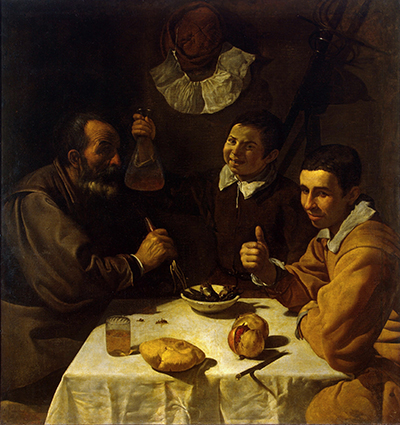
In An Old Woman Cooking Eggs, dated 1618 and now in the Scottish National Gallery, the eggs sit in a shallow earthenware dish. Light catches the white as it spreads in the liquid. The old woman has a spoon poised above the dish, and a boy holds a flask and a melon. A knife laid diagonally across a bowl makes the edge of the table easier to judge. The boy’s face, higher and further back, has fewer sharp edges than the objects below. A single illumination separates glazed ceramic, metal, glass and skin, while the darkness around the figures leaves the size of the room largely to us. [2]
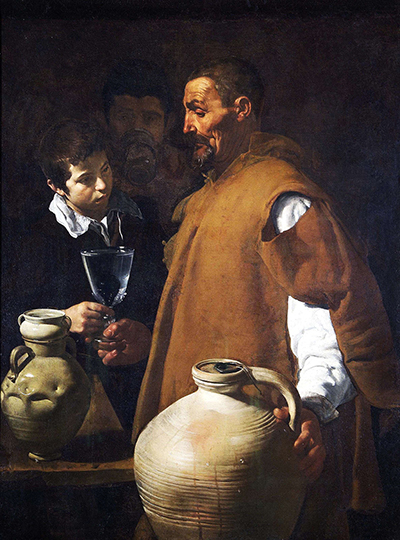
The term bodegón, with its roots in words for places where food and drink were kept or served, describes a kind of picture that includes still-life objects and often the people who prepare or serve them. In The Waterseller of Seville, at Apsley House, the shoulder of a clay jar fills so much of the foreground that the people seem gathered around it. The little glass is legible through a few narrow highlights. The older man’s fingers support it, the boy’s receive it and a partly obscured figure drinks behind them. Although the utensils in the Scottish painting could almost be examined one by one, here one object matters because it is passing between people. Velázquez gives us time to study the jar and the glass even as the water is about to change hands. [2] [6]
Christ in the House of Martha and Mary, in London, brings a more explicit narrative into the kitchen. Fish, eggs, a pitcher and the pestle the young woman is holding establish what she has been doing. The older woman gestures just behind her, while Christ addresses a seated woman in a small rectangle at upper right. The National Gallery allows several possibilities for what that rectangle represents, including a picture, an opening and a reflection. Follow the older woman’s finger, then look at the young woman’s face. The gesture gives us a route to the other scene, while the young woman’s eyes turn out towards the viewer. Even if the geometry of the rectangle remains unsettled, the painting holds together as an inquiry into who is listening, who is working and where we direct our attention. [7]
Three paintings of a kitchen worker
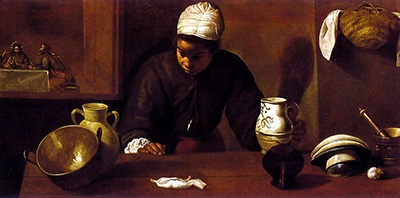
The Dublin Kitchen Maid with the Supper at Emmaus (NGI.4538, about 1617–18) puts the sacred episode at upper left. It is a particularly wide, low canvas. The woman and the utensils take up most of it. She braces herself at the table, her attention apparently drawn away from the things immediately in front of her. The small scene beyond her has been identified as the recognition of Christ at Emmaus. When that corner is read beside her posture, the quiet of the foreground can feel like someone pausing to hear what is going on out of sight. The National Gallery of Ireland discusses the relation between the two spaces as an interpretation of its particular picture. [3]
The Art Institute of Chicago’s Kitchen Scene (1935.380, dated 1618–20 by the museum) has a related figure and array of things, with no visible Emmaus episode. Look at the brass vessel, the mortar and pestle and the crumpled wrapping for spices. They make the young woman’s work specific. The Art Institute identifies her as a young African woman and raises the possibility that an enslaved woman modelled for the picture. The Museum of Fine Arts, Houston’s Kitchen Maid (55.100, about 1620) is vertically oriented, giving even more of the canvas to the figure. Houston’s conservation announcement in 2018 described a change from in the style of Velázquez to attributed to him. Its online object record now lists him as the artist. Those labels document stages in one museum’s assessment of its own canvas. [4] [5] [8]
All three were brought together for the Metropolitan Museum of Art’s 2023 exhibition on Juan de Pareja. The grouping gave visitors a way to study variation in Velázquez’s early work alongside evidence for enslaved labour and the presence of Black people in seventeenth-century Spain. The records leave the woman’s name unknown. When looking through reproductions, use the collection and inventory number first, then the position of the figure, the format and the presence or absence of the supper scene. The handling of one of these canvases and the history of its ownership or cleaning are evidence about that object alone. [3] [4] [5] [9]
Devotional paintings intended to be seen together
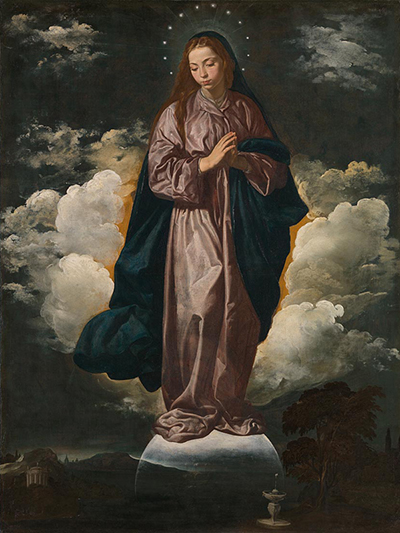
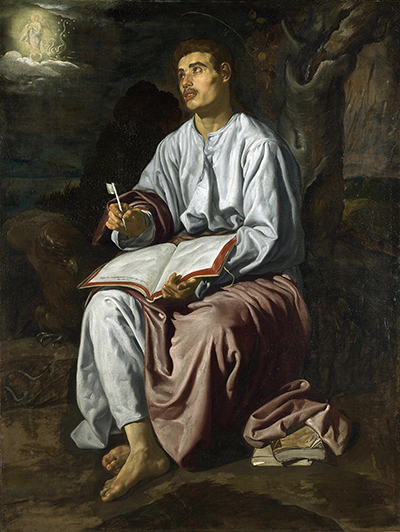
The National Gallery’s Immaculate Conception and Saint John the Evangelist on the Island of Patmos show how much a pendant, or companion picture, can affect the way a painting is read. The latter shows John looking towards a small vision of a woman in the sky. The other canvas fills its height with the Virgin and gives her an expanse of light that the tiny vision can only suggest. Seeing the two together allows the viewer to move from the effort of looking in John’s shadowed landscape to a far clearer view of the apparition’s subject. Both paintings are connected with the Carmelite house in Seville. The National Gallery discusses them as a pair, and Larry Keith and Dawson Carr’s technical study provides a way to compare their preparations with those found in other works from the Seville years. [10] [11] [12]
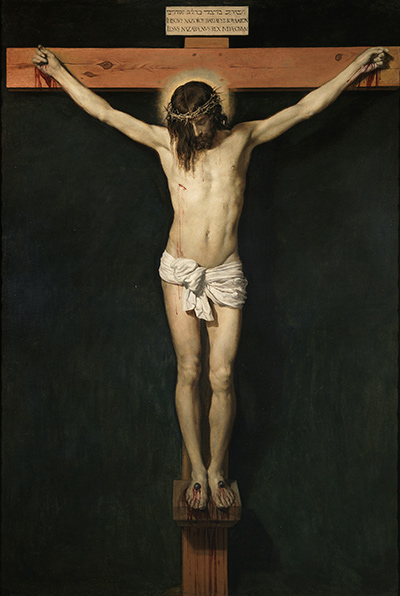
Each of the London paintings supplies something its companion leaves in shadow or at a distance. Christ’s suffering presented another kind of relationship with the viewer. In the Prado’s Christ Crucified the pale body and the wood of the cross appear against a dark field. Christ’s bowed head and the hair that falls across his face draw attention inwards. The work’s early provenance is associated with the Madrid convent of San Plácido. Christ Contemplated by the Christian Soul, in London, builds an earthly encounter around the injured body. An angel and a kneeling child direct us to Christ. In the first picture the viewer faces the cross alone, while in the second there is already someone in the painting doing what a devotional viewer might do. [1] [13]
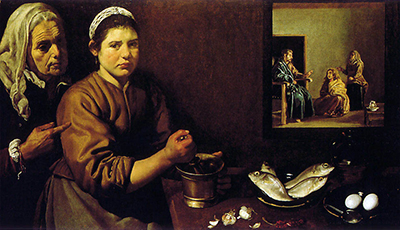
Kitchen Scene with Christ in the House of Martha and Mary. The objects and figures at the worktable introduce the interplay of ordinary tasks and sacred narrative in the early work. View Christ in the House of Martha and Mary.
The king’s likeness and the painters who repeated it
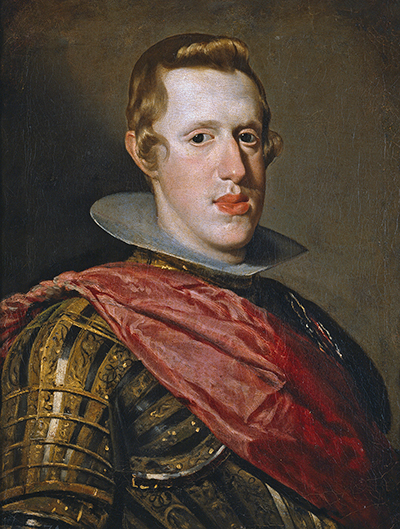
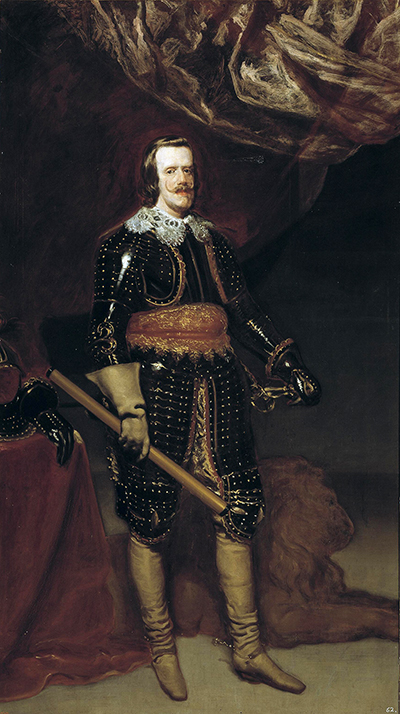
Philip IV’s order of 6 October 1623 brought Velázquez into the royal service. Court portraits circulated beyond the room where the monarch sat. They could go to a relative, enter the household of a minister or stand for authority in a room the king rarely visited. A painter who was expected to supply more than one likeness could return to a successful design. Royal images give us some of the clearest surviving evidence of what was involved. [14] [15]
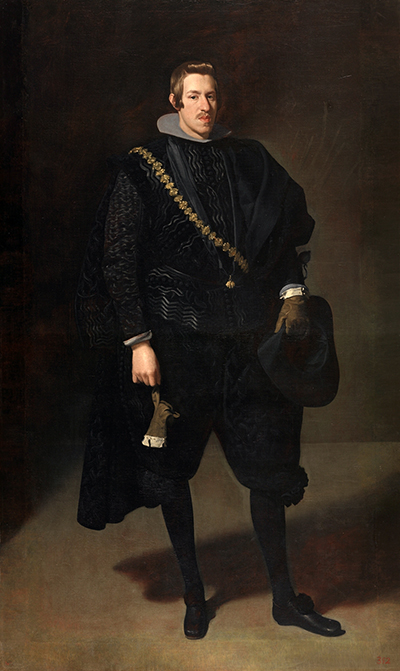
Set the Metropolitan Museum of Art’s early full-length Philip IV beside the early standing Philip in the Prado. A slim young man in dark clothes stands in a nearly bare space, with small details of costume and bearing doing much of the work of identification. The two visible compositions differ. An X-radiograph, however, reveals an earlier likeness underneath the Prado picture. When Met conservator Michael Gallagher compared that underlying image with the New York canvas, traces of the hands and other individual features matched closely enough to indicate that a tracing or transfer drawing had been used. He also compared the head with the bust at the Meadows Museum, another close match. A painting in one city can therefore preserve a stage of a composition that the artist revised in another. In Gallagher’s comparison the very precision of the match supplies evidence for the use of a model, while the handling and the other physical evidence have to be weighed when assessing who painted each canvas. [15]
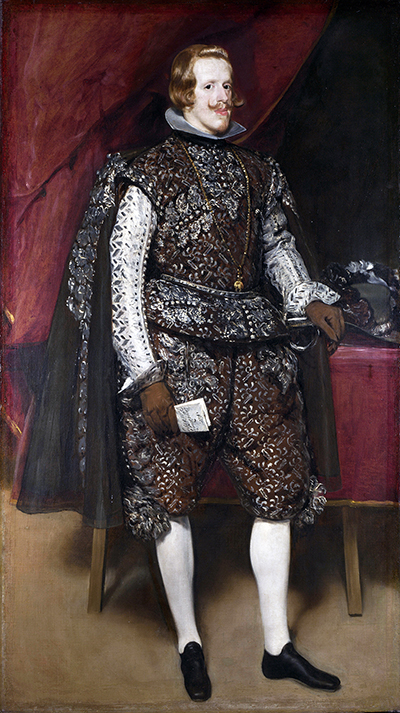
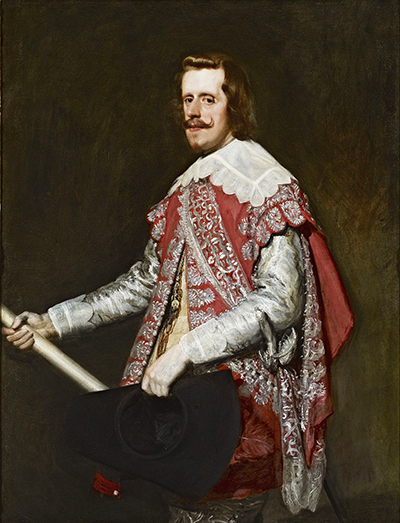
In London’s Philip IV of Spain in Brown and Silver, about 1631–32, short strokes catch the raised embroidery down the king’s chest and sleeves. The silver also breaks up the large vertical figure, and the paper the king holds lets his hand emerge from its darker surroundings. The National Gallery connects the unusual splendour of the costume with clothing Philip wore for the 1632 ceremony in which the Cortes of Castile swore allegiance to Baltasar Carlos. This offers a plausible occasion for such a likeness. It takes a different kind of paint to describe the king’s much plainer dark clothing in the National Gallery’s late bust, NG745. Keep the moustache, collar and distance from the frame in mind when comparing the two. What a full-length painting can say through the span and fall of a costume, the late portrait must say within reach of the king’s eyes. [16] [17]
Three likenesses of the Count-Duke of Olivares
The São Paulo Olivares at MASP is a full-length standing likeness from the first years at court. The well-spaced hands, the sizeable blank around the body and the white collar give Olivares the severe visibility of a man at an audience. The Hermitage portrait, ГЭ-300, is a separate, closely framed likeness of the same minister, dated about 1638 by the museum. The face and chest fill much more of the available area, and the museum identifies the insignia on the black garment with the Order of Alcántara. In the Prado Count-Duke of Olivares on Horseback, the rider looks back at us over his shoulder and the horse turns across rising ground beneath him. Smoke and distant activity put the rider in the thick of a military landscape. The three images differ enough in scale, posture and setting to be recognised before reading the labels. The common name describes the sitter, and the museum and format distinguish the paintings. [18] [19] [1]
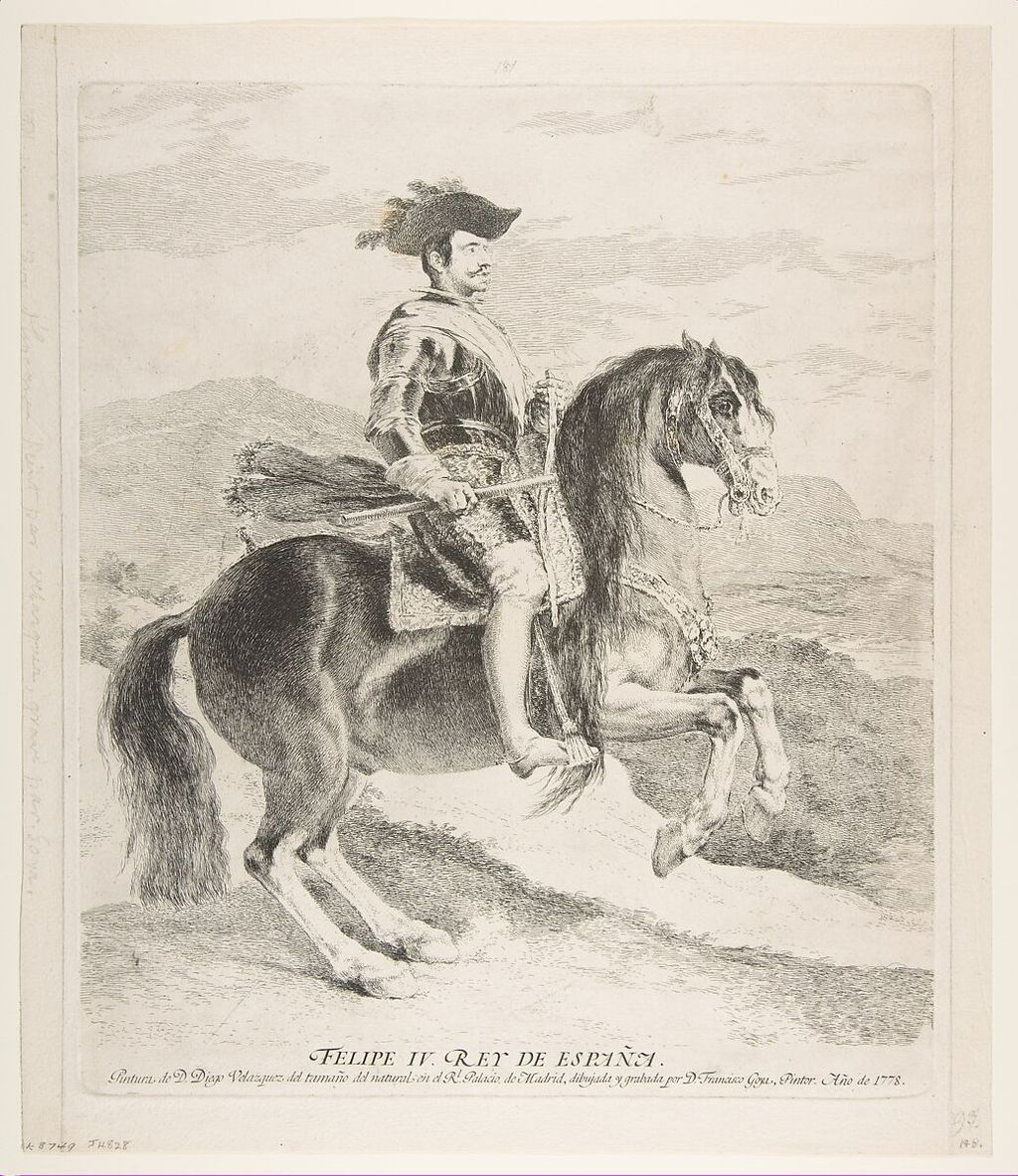
Francisco de Goya, Philip IV on Horseback, after Velázquez, 1778. This Met impression shows how the mounted likeness moved from a royal canvas to a print on paper. Image source. CC0 / Public domain. Resized for display.
Diego Velazquez: A collection of 133 paintings (HD) · LearnFromMasters · Watch on YouTube
Gods and working bodies, from Madrid to Rome
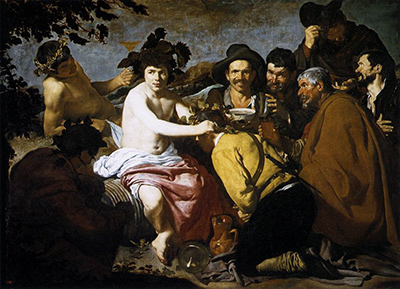
In The Triumph of Bacchus, also called Los borrachos, the light-skinned god crowns a kneeling man. Then the painting passes into a group of drinkers in clothes and hats that could belong to contemporary Spain. One holds a cup and meets our eye. Look at the change of pace from the downward attention of Bacchus to the faces looking out from the right side. The men respond as a group and as individuals. The scene has room for the ceremony, a cup passed around and an invitation directed outside the picture. The Prado dates the work to 1628–29, just before the first Italian journey. [1] [20]
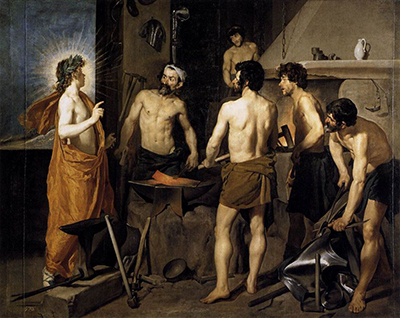
In Apollo in the Forge of Vulcan, painted in Rome in 1630, a god enters a group of men at work. Apollo’s orange drapery and bright crown draw the eye first. Then Vulcan’s posture and the line of faces and suspended tools distribute our attention across the room. In Ovid, the sun discloses Venus’s affair with Mars. Velázquez shows the arrival of the news and the interruption it produces. At the centre, unfinished metalwork and an arm put momentarily out of use do as much as the open mouths to register the effect. The forge floor also has a breadth and interval that are harder to find in the early Seville kitchens. We can see between the workers as well as look at their faces. [1]
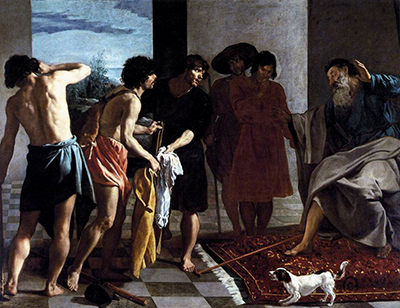
The technical studies sharpen that comparison. Keith and Carr describe the pale grey preparation in Apollo, after discussing the brown ground and coarse canvas in Joseph’s Bloody Coat, the biblical scene traditionally dated to his first Italian journey. They relate the lighter, cooler ground to his ability to work across a wide tonal range with thin paint, sometimes using initial translucent brown washes to warm particular areas. This affects how we see a passage in half shadow. Some of its colour can come from below the surface, through a thin application, instead of being established entirely in the uppermost mark. In the workshops painted in Seville and Rome, shadow can bind successive objects into a single field. The materials and paint thickness through which Velázquez arrived at that effect changed. [12]
One of the most striking continuities between the forge and the kitchens is the way that a hand can make a pause visible. In Martha and Mary the hand encloses a tool and still appears engaged in its immediate task. In Apollo the halted movement spreads through several men, one body turning as an arm remains raised. Joseph’s Bloody Coat offers a further comparison in a scriptural setting. The coat displayed to Jacob is another object that changes the mood of a whole room. It concentrates the story in a piece of cloth shown to somebody who must make sense of what he sees. [7] [1] [12]
Browse the paintings







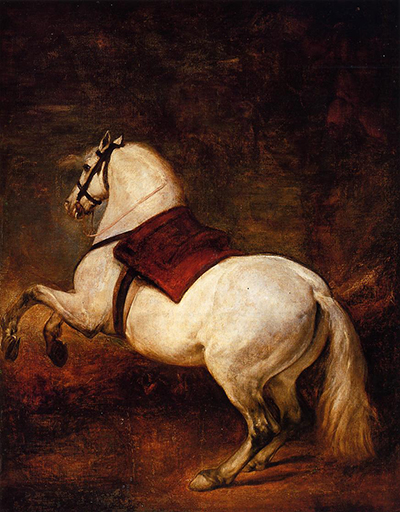
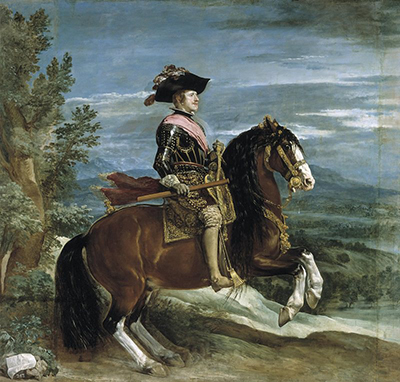
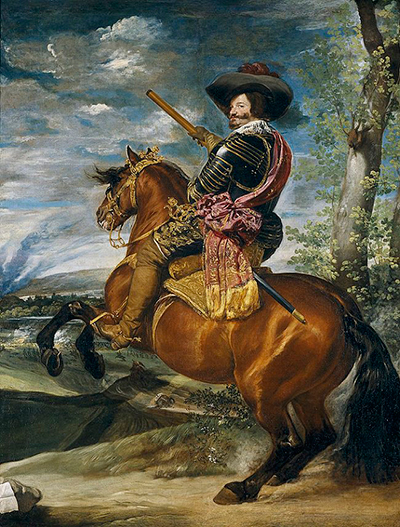
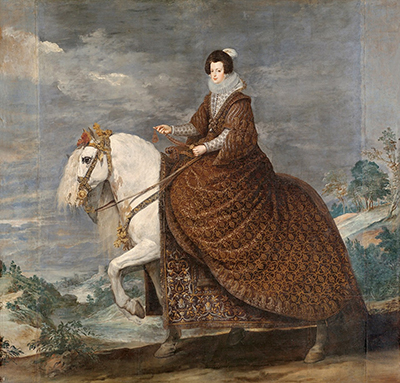
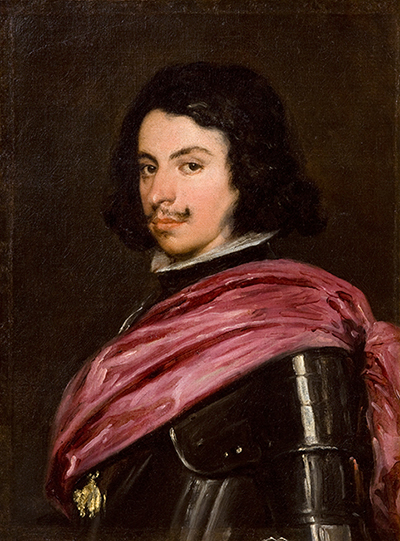
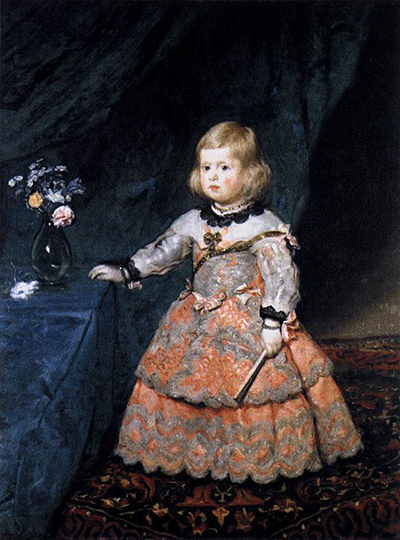
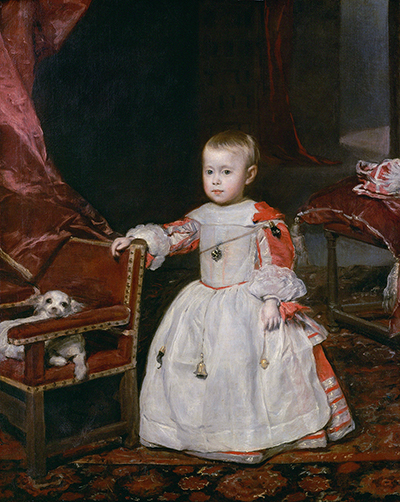
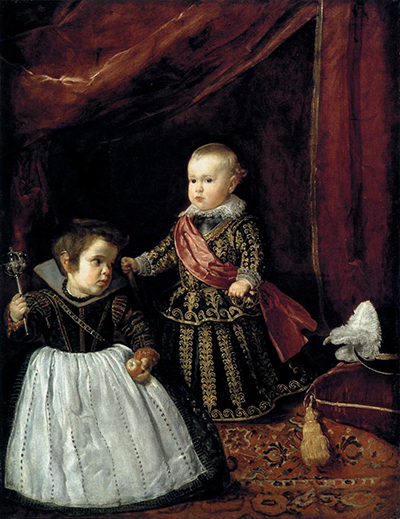
 Diego Velazquez.jpg)
 Diego Velazquez.jpg)
 Diego Velazquez.jpg)
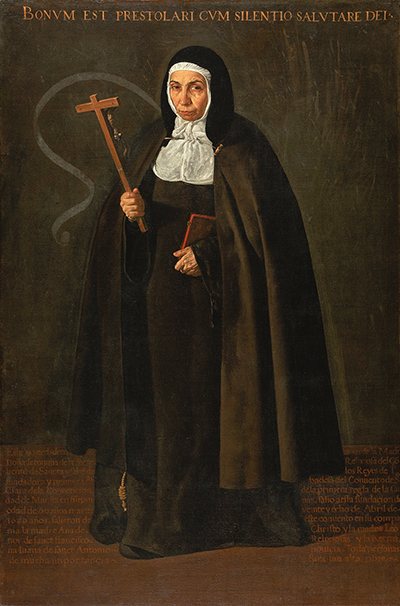
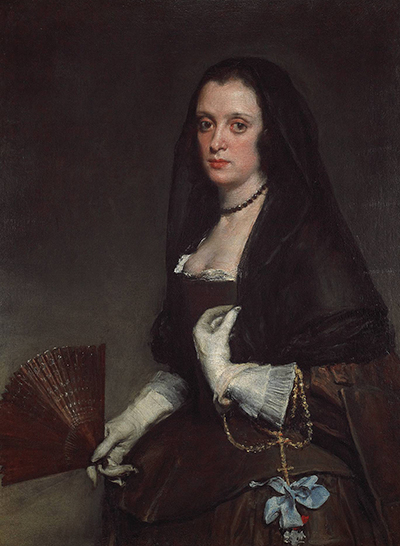
 Diego Velazquez.jpg)
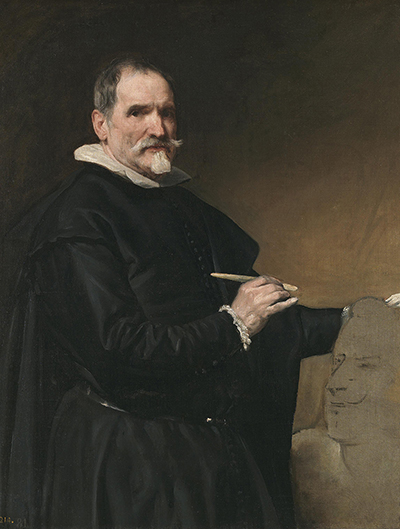
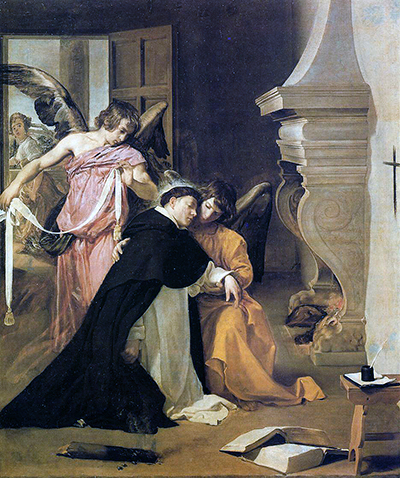
 Diego Velazquez.jpg)
How the paintings worked in royal rooms
The Hall of Realms and the space below a horse
The Surrender of Breda records the capitulation of 1625. Velázquez painted it about 1635 for the Salón de Reinos, or Hall of Realms, at the Buen Retiro Palace. It belonged to a larger display of military victories, royal portraits and Zurbarán’s paintings of the labours of Hercules. The painting could be seen as one account of victory among several. Within that setting, the rigid group of upright lances at the right gives the Spanish forces height and cohesion. The two commanders break the pattern by leaning into each other’s space. A viewer can read the military hierarchy from a distance and revisit the contact between Spinola’s hand and Justin of Nassau’s shoulder after approaching. [1] [20] [21]
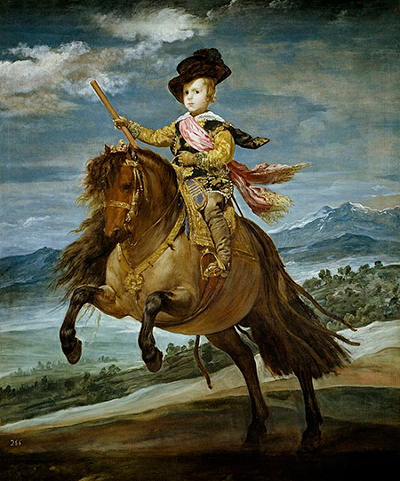
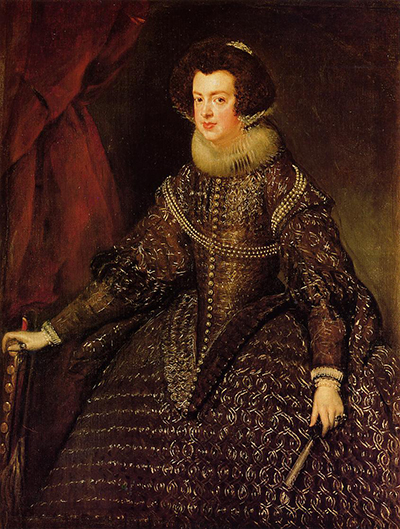
The five great equestrian portraits of the royal family belonged to the same hall. In the Prado’s Philip IV, the dark masses of horse and rider gather against an open landscape. In Isabel of Bourbon’s portrait, the long, dense fabric of the gown crosses the broad profile of the mount. These are parts of a display in which the scales and attitudes of the horses respond to the people portrayed elsewhere in the room. The height at which a portrait hangs also affects the way those bodies appear. In Prince Baltasar Carlos on Horseback, intended for a high position above a door, the pony’s chest swells towards us as its legs swing away. The picture looks most intelligible if we imagine looking up from below. On a screen the eye can travel straight into the pictured space and the animal’s belly can seem unusually large. The placement explains why that projection would be an advantage. [1] [21]
The frames and supports could change in response to the building. The account of the 2025 conservation of Isabel of Bourbon on Horseback explains that Velázquez added side strips to fit the display. The extension reached over side doors, so that a piece of the painted area could move when a door opened. Pieces of canvas were subsequently sewn back into the painting. Even the edges of the portrait can therefore tell us about its first audience. Those strips are part of the first installation’s history. In The Spinners and Mercury and Argus, the Prado now conceals extensions added after the artist’s lifetime. [22] [23] [24]
Two riding-school paintings make a different comparison. One, in a private collection, presents the prince in a courtly training ground, bringing Olivares into the picture. The Wallace Collection canvas, P6, has a related composition without the minister and is catalogued by the Wallace as the work of Velázquez’s studio, about 1640–45. Research around the 2019 treatment of the Wallace painting renewed discussion of the relationship. The Wallace and the Centro de Estudios Europa Hispánica distinguish the private painting, accepted as by Velázquez and dated about 1636, from the studio picture. The Prado’s prince rides out against an open landscape. The painted architecture and the adults in the riding-school scenes open questions about how a prince learned to perform his rank. The Hall of Realms horse shows what it looked like to perform it alone. [1] [25] [26]
A hunting lodge with kings, philosophers and a god
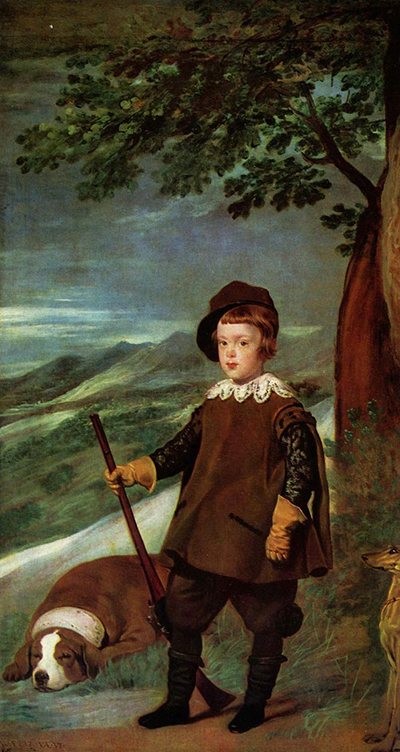
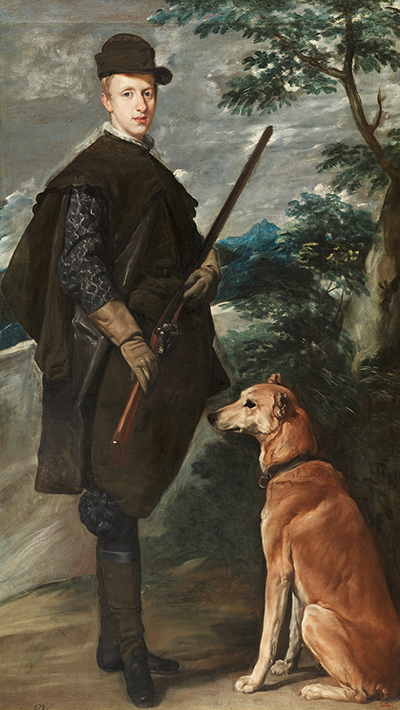
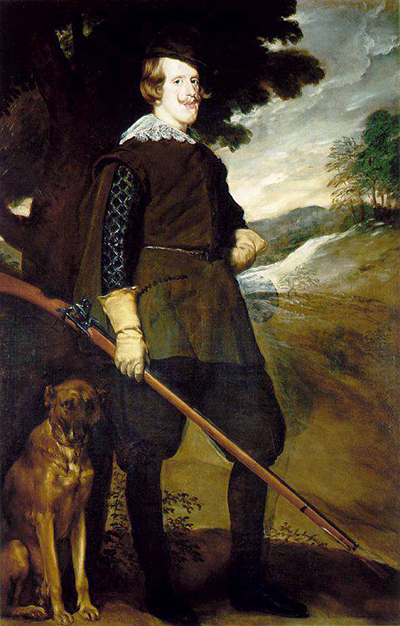
The Torre de la Parada, a royal hunting lodge, gives another reason to look at Velázquez’s paintings in groups. There is a recurring grammar in the hunting portraits of Philip IV, his brother the Cardinal-Infante Ferdinand and the prince. Each stands with a gun in country that leaves generous space around the silhouette. The dogs give a different scale to the figures and bring our eye down from the faces towards the earth. Compare, in particular, the length of the gun and its relation to the young Baltasar Carlos’s hands. The prince’s hunting clothes and companion convey something of dynastic training through the equipment and company of the hunt. The adults have a fuller command of the available space. [1]
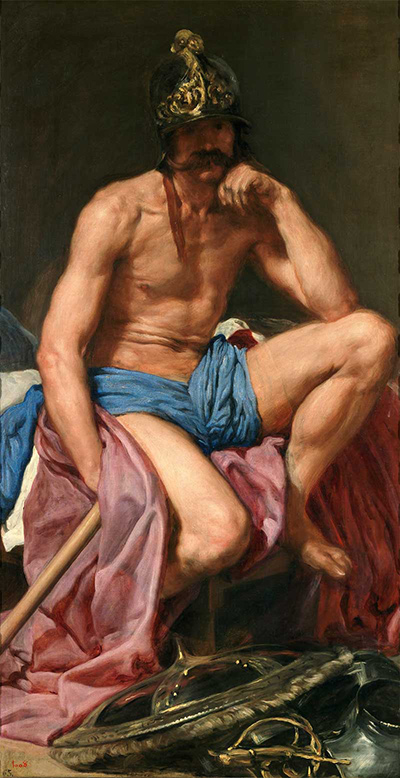
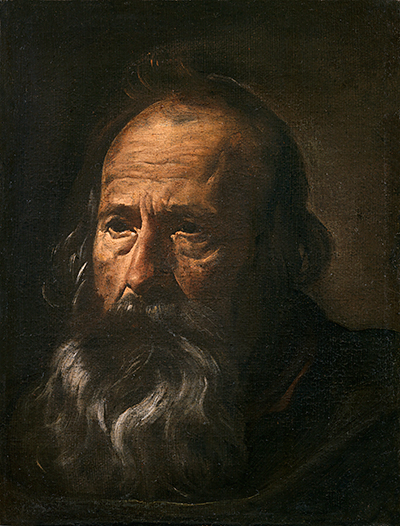
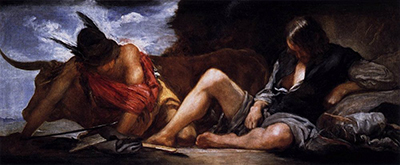
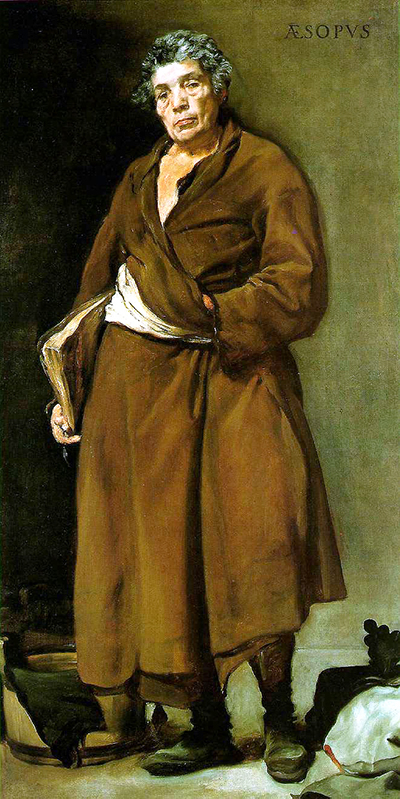
The Prado’s catalogue also discusses Aesop, Menippus and Mars in connection with the hunting lodge. Aesop faces forward with a book and his heavy clothes form an almost continuous mass. Menippus gives us a glance over his shoulder, with discarded or loosely arranged books near the floor. The two philosophical figures gain something from being viewed as a possible pair. Their enveloping clothes have different outlines and the books have different roles. One figure holds a text up where we can register its weight. The other already seems to be turning away from the things at his feet. Mars sits with his chin on his hand, with a helmet on his head and armour on the floor. He is close enough to see the pale, slack folds of the flesh above his leaning arm. Displayed in the orbit of the hunt and of royal likenesses, the resting body offers a striking use of the very equipment that made figures of authority so recognisable. [1]
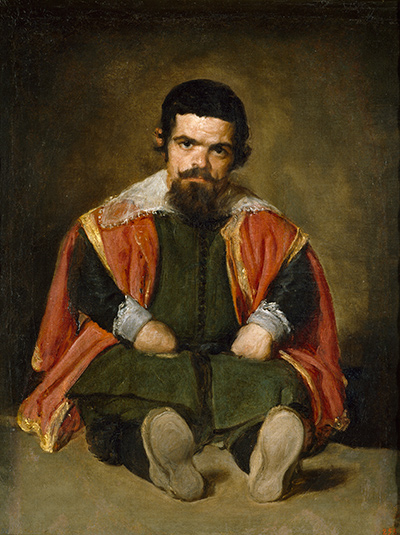
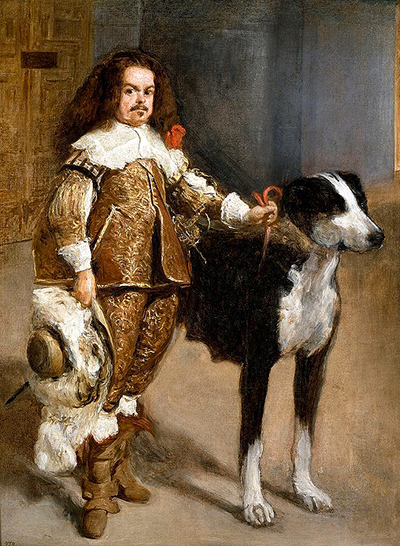
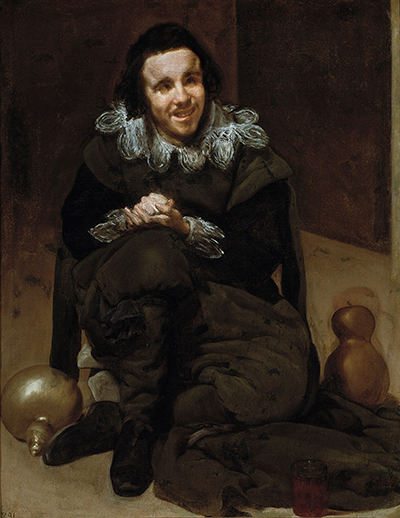
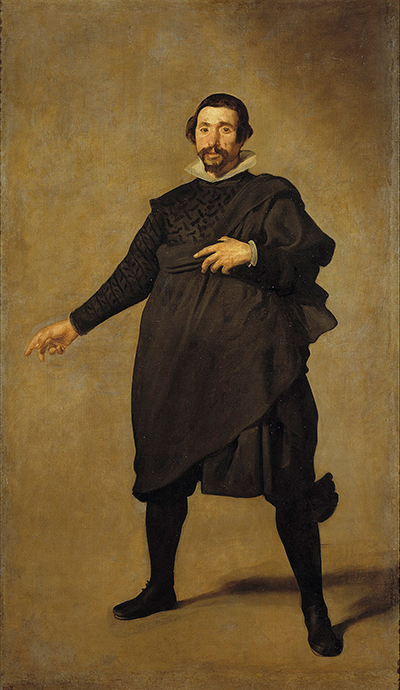
Paintings associated with court entertainments also ask us to look at how a sitter supplies a sense of scale. In the Prado’s picture traditionally called The Boy from Vallecas, a figure sits outdoors where low plants and the distant land make different measures of his body. In Calabacillas an interior and the gourds at floor level keep the space close. In P001202, presented by the Prado as El bufón el Primo and formerly familiar as Sebastián de Morra, the sitter’s forward gaze and his position against a bare background carry much of the picture. Proposed historical identifications have shifted. Even when an earlier name makes a collection history easier to follow, an accession number gives a steadier basis for comparing pose, costume and placement. A sustained look also restores individuality to people whose service at court has often been allowed to stand in for the whole of their lives. [1] [27]
Velázquez and his artistic context on film
Explore Baroque painting, Spanish portraiture and horses in art with TheHistoryOfArt.
Further reading
For a closer look at the evidence and paintings:
Velázquez. Antonio Domínguez Ortiz, Alfonso E. Pérez Sánchez and Julián Gállego. The Metropolitan Museum of Art, 1989
Use the catalogue entries and comparative illustrations to look across different periods and genres. Read the catalogue at The Met.
Intimate pictures and small views
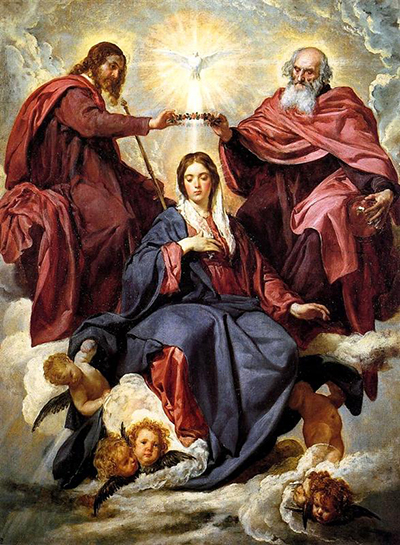
Scale can tell us something about the distance at which a picture invites attention. In The Coronation of the Virgin, made for the queen’s oratory in the Alcázar according to the Prado catalogue, the figures gather into a compact shape around the Virgin. She lowers her eyes and brings her hand to her chest. Above her sit the figures of the Father and the Son, and the dove and the crown appear in a small concentration of light. Pink, blue and violet move from the edges of the dress into the surrounding clouds. The picture draws its different figures towards one central axis. The setting suggests a more private kind of attention than the broad survey invited by the display in the Hall of Realms. [1]
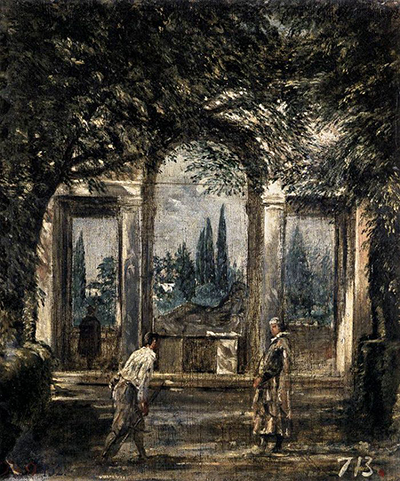
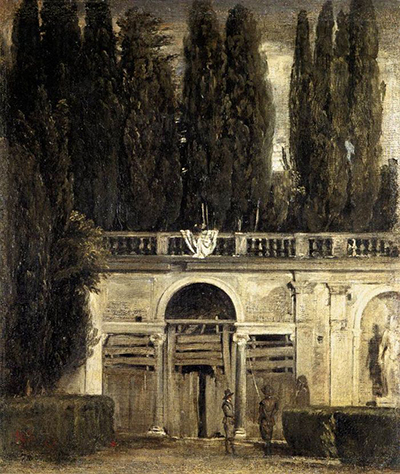
The two views of the Villa Medici in the Prado make the small canvas expansive in a different way. In the view of the grotto façade, P001210 (catalogue entry 64), boards fill the central opening in a grotto façade. Dark cypresses rise behind the masonry. A length of pale fabric lies over the balustrade, giving a slender strip of white above the boards. In the view with the open arch, P001211 (entry 65), a similar architectural form frames an open view. The reclining sculpture under the arch and the lightly indicated figures in the foreground give the eye a way of passing from cool shade towards the distance. The two paintings share the arch flanked by lower openings, often called a serliana. One uses the architecture to stop the eye against material surfaces, and the other uses it to let us through. [1] [20]
Their lightly laid paint has helped keep the dates under discussion. Julián Gállego, writing in the 1990 Prado catalogue, favoured the first Italian visit, citing Pacheco’s account of Velázquez’s stay at the villa and the handling of the landscape in Joseph’s Bloody Coat. Other scholars argued for the second trip, partly through evidence of repairs to the grotto around the middle of the century. The Prado’s Jerez exhibition listed both views around 1630. The purchase of four small landscapes from Velázquez in 1634 is a suggestive archival lead, and the catalogue discusses the possibility of identifying these pictures with two of those purchases. The architectural match, brushwork and documents weigh differently. The short date on a wall label conveys a considered judgement about the evidence, with the longer catalogue showing how it was reached. [1] [20]
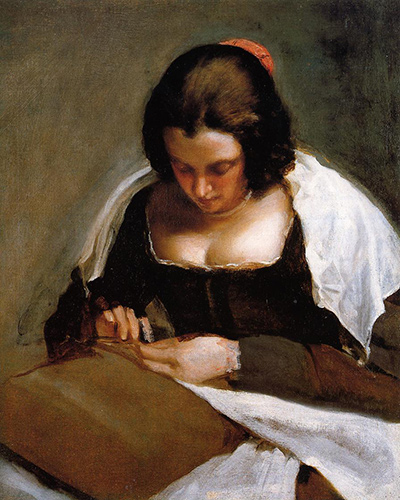
In Washington’s The Needlewoman, the unfinished figure turns her face towards the work in her lap. Face, head covering and a few larger areas of colour come into focus, with the hands and fabric more sparingly defined. In a finished picture like Old Woman Cooking Eggs we follow the edge of the spoon towards a particular action. Here, the inclined head and the proximity of the hands establish the act at an earlier stage of the painting. The state of the work offers a glimpse of how much could be established with a small number of marks. It leaves us room to wonder what the painter might have kept at that level of definition. [1] [28]
Two other pictures complicate the idea that thickness and finish simply increase with the importance of a commission. In the Prado portrait traditionally identified as Juan Martínez Montañés, the sculptor’s head appears above the lightly painted royal likeness he is modelling. The studio becomes a place where the king can be present in clay even when the sitter we see is the person making him. The unworked or lightly worked parts of the picture still tell us about the work under way. In Orihuela’s Temptation of Saint Thomas Aquinas, associated with the Colegio de Santo Domingo, Velázquez gives the reclining saint a more sharply defined head at the intersection of large diagonals. The woman at the doorway and the books and writing implements are lightly stated in comparison with the main group. Both paintings show how the distribution of attention can be gauged through the amount of definition given to a passage. The basis for the sitter’s identification in the first picture is weaker than for the subject of the second. [1] [29]
Rome portraits and a mirror in London
Accounts of Velázquez’s time in Rome bring together paintings made in quite different relationships with their sitters. The Portrait of Pope Innocent X remains in the Doria Pamphilj collection. The paper in the pope’s hand, the strip of light along his nose and the white folds beneath the red cape divide the painting’s red field. Turn from the face to the back of the chair. Scarlet fabric, the bright fittings of the chair and the dark red background are surfaces with different reactions to the light, even where they lie within a narrow range of colour. The Doria Pamphilj proposes that Velázquez painted the portrait between late 1649 and January 1650. Its present setting in the family collection preserves a relationship between likeness, sitter and family that most of the portraits sent out from the Spanish court have lost. [30]
The Portrait of Juan de Pareja, painted in Rome in 1650 and now at the Met, opens a different account of the workshop. Pareja’s shoulder cuts across the canvas and his head turns to meet the viewer. The collar shows hardly more than a few strokes at its left edge, and the dark drapery around the body gives the face a great deal of room. Pareja was enslaved by Velázquez when he sat for the portrait. The notarial document exhibited by the Met was signed in Rome in 1650 and set out his release four years later. The Met brought the portrait together with some of Pareja’s own paintings, among them The Calling of Saint Matthew of 1661. At the left of that large work he depicts himself with a paper bearing his name. The image supplies a second encounter with the man seen in Velázquez’s portrait, this time through choices he made as the painter. [9] [31]
The National Gallery dates the Rokeby Venus broadly to 1647–51. The date range leaves open whether it was made before or during the second trip to Italy. A body turns across the length of the bed and a face appears, indistinctly, in the mirror held by Cupid. The sheet tracks the curve of the woman’s back. The mirror gives the eye a second place to go after it follows that curve. The reflected face is smaller, greyer and harder to read than the body. There is a peculiar intimacy in this distribution of attention. We see as much of the turn of the shoulder as the painter chooses to show, and the device which might supply the rest draws us into an uncertain exchange of looks. In Las Meninas, the mirror is smaller in relation to the picture and completely alters the rank of the people we can see. Here, it draws us back again and again to a face on the far side of a visible figure. [32] [1]
The late court and the shape of the picture
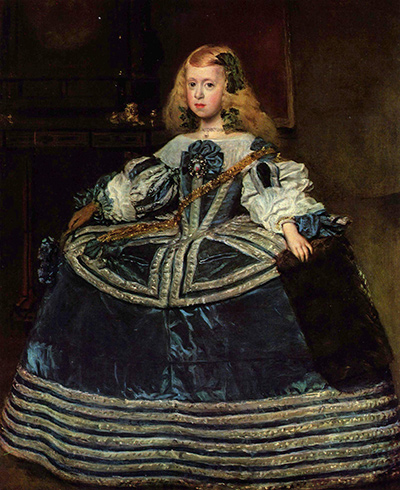
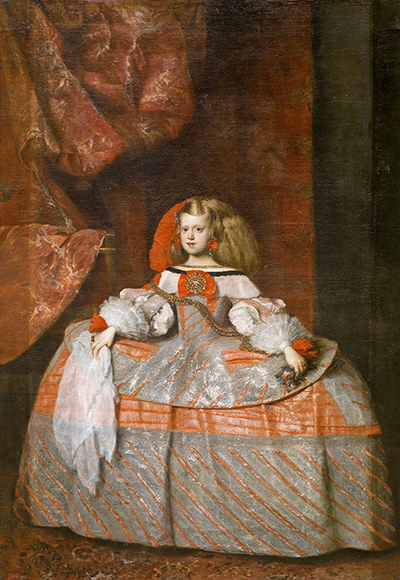
The late portraits in Vienna show what can still be made out when a handful of separate strokes are allowed to do the work of an elaborate costume. In the Kunsthistorisches Museum’s Infanta Margarita Teresa in a Blue Dress, GG 2130, fine bright marks catch on the blue sleeves and skirt. At the proper distance they read as part of a single surface spreading out from a very small waist. In the portrait of Felipe Próspero, GG 319, the prince stands with a hand on a chair and a light-coloured dog is curled nearby. The small dog establishes the scale of the piece of furniture and gives the child an intimate presence among the emblems of his position. The two portraits describe children who had dynastic roles and whose images were seen beyond Spain. In the Prado’s exhibition on Velázquez and the family of Philip IV, they formed part of a group through which viewers could follow a generation of the royal family. [33] [34]
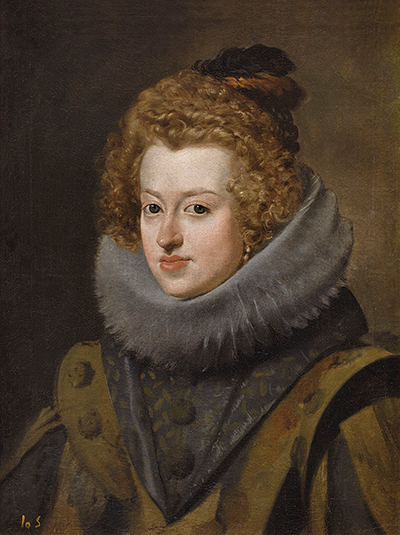
The earlier Vienna standing portrait of Isabel of Bourbon, GG 2129, illustrates a further reason to read a label carefully. The painted costume almost surrounds the smaller patches of light at the face and hands. A 2026 Spanish state loan schedule records the authorship as Velázquez and workshop. The Hall of Realms portrait shows her on a horse and has its own production history. The Vienna record gives a visitor a precise instance where more than one hand is acknowledged within a single painting. A picture described as the work of the painter’s studio, such as the Wallace Riding School, has a different attribution. [35] [1] [25]
Two brightly lit rooms at the back of a painting
In Las Meninas, dated 1656, the Infanta is easy to find. The painter beside the turned canvas, the dog, the open door and the small mirror reflect or redirect attention in more than one direction. The foreground figures stand in patches of daylight. Above them, the height of the room gives their heads a great deal of space and makes the lit doorway at the far end especially noticeable. The Prado identifies the two small mirrored faces as Philip IV and Mariana of Austria. The position of the royal couple in relation to the rest of the scene, and precisely what is reflected, have long been subjects of debate. Across the picture the painted figures attend to different things, while the mirror and the figures who face out make us think about the part of the room we would occupy. The 1666 Alcázar inventory establishes a royal context from which to begin considering that unusually complicated point of view. [1] [27]
In The Spinners, light again draws us into a space behind figures at work. First, a wheel turns in near darkness, its spokes an indistinct sweep. At the right another worker leans into her task. Between them, we can see figures on a brighter, raised floor and the fragments of a scene associated with Titian’s Rape of Europa, the subject also copied by Rubens. The 1664 inventory of Pedro de Arce lists a Fable of Arachne by Velázquez. That record, discussed in the Prado catalogue, gives weight to identifying the myth of the weaving contest with the rear scene. Look at the difficulty of locating the exact boundary between the standing figures and the textile behind them. Part of the picture’s fascination is that the rear room feels both spatially present and full of depicted figures, made from thread. [1]
Many reproductions show extra space above the rear chamber. The Prado installed a frame in 2021 that conceals eighteenth-century additions to the canvas, allowing visitors to see the proportions of the original composition while the later material stays in place. In the more tightly framed view, the foreground figures and the lit space behind them have a more immediate relationship. This is a case where two reproductions can show different outlines of the same physical painting. The broader version records a stage in the history of its support and display. [1] [23]
A similar adjustment makes Mercury and Argus easier to compare with Velázquez’s other late compositions. The Prado’s 1990 catalogue identifies it as the surviving painting from a group of mythologies for the Alcázar’s Hall of Mirrors and gives the usual approximate date of 1659. An alert figure advances low in the landscape towards a sleeping guard. Argus’s massive arm and the weight of his forward-leaning body make the scene slacken at the right, while Mercury’s hat and the motion of his body keep it alive at the left. The Prado traced the eighteenth-century bands at top and bottom to the painting’s adaptation for the new royal palace. In 2022 it used a new frame to mask them. The long format suits the short interval before the attack, in which a figure lies at rest and another has nearly reached him. In Apollo, several upright bodies help the news travel. In Mercury and Argus, very little rises from the earth to disclose what is about to happen. [1] [24]
How to compare versions, pairs and attributions
Start with the collection, title and accession number. A name such as Philip IV, Isabel of Bourbon or Kitchen Maid can lead to several paintings. An accession points to a particular surface whose dimensions, origin and condition can be checked. A pair such as Saint John and the Immaculate Conception has two distinct subjects conceived in relation to one another. The royal horse portraits formed part of a larger group designed for a particular court setting. The individual canvases have their own histories even where the historical ensemble gives them a shared purpose. [10] [11] [21]
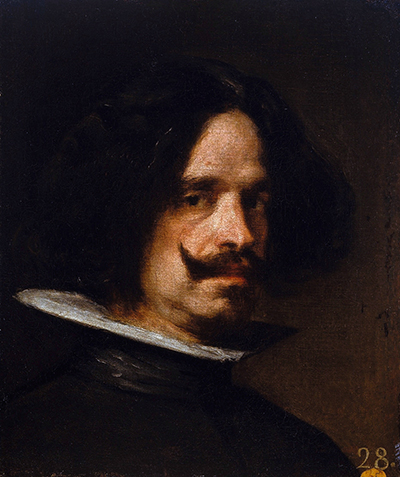
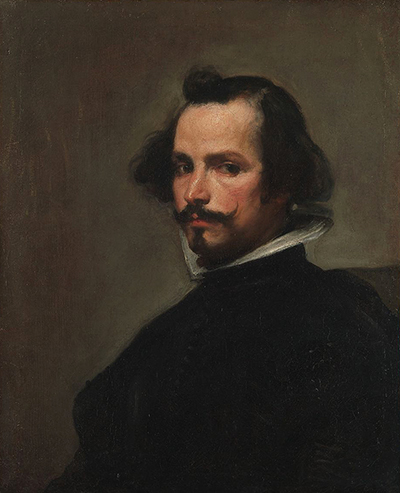
A version repeats or varies a composition. An autograph replica is a repetition by the named artist, which can use a tracing or other transfer aid. Workshop or studio of identifies a work made in the artist’s circle of production, with the attribution applied to the object as a whole. Artist and workshop allows for participation from both. Attributed to and possibly by express the institution’s judgement that the link remains open to question. The Met catalogues its Portrait of a Man, 89.15.29, as possibly by Velázquez. Its ground and canvas weave are close to those of the Portrait of Juan de Pareja, and the museum considers the underdrawing consistent with Velázquez’s work. It still allows the possibility that Juan Bautista Martínez del Mazo painted it. The same museum’s Portrait of a Man, Possibly a Self-Portrait, 49.7.42, poses a different question. In that record Velázquez is the painter, and the uncertainty concerns the sitter. The museum proposes a connection with a figure in The Surrender of Breda. Condition, visible amendments, resemblance to related works and surviving documents can all bear on an attribution. The label is the best place to see how far the museum is prepared to go after weighing them. [15] [25] [35] [36] [37]
For an introduction by collection, begin with the Prado’s palace paintings. Read Breda beside the royal riders, then look at the occupied rooms in Las Meninas and The Spinners. In London, the National Gallery offers early kitchens and devotions, contrasting royal portraits and the Rokeby Venus. Apsley House and the Scottish National Gallery bring the humble objects of the Seville years into exceptional focus. The related canvases in Dublin, Chicago and Houston make a case study in repeated subject and changing format. Vienna adds the late court children, while the Doria Pamphilj and the Met give two distinct encounters with the portraits painted in Rome. For any of these groups, look for one thing in common first. The way a face sits above a collar or a hand is suspended over an object can be enough to see what Velázquez chose to do differently. [20] [27] [34]
Two portraits linked by their cloth
The red coat in the Frick Collection’s King Philip IV of Spain belongs to a painting made while the king was on campaign in 1644. The court’s accounts describe work to turn a room in Velázquez’s lodging in Fraga into a studio. They also record two boxes. One was commissioned in June for a portrait of a court entertainer called El Primo. The other was made in July to send the king’s likeness to Madrid. Both boxes cost sixteen reales. The entries locate two commissions in the same place within a few weeks of one another, but they give a modern reader little to go on when looking for the sitter called El Primo among the surviving paintings. [38]
A comparison of the cloth supplied another clue. The king’s portrait and the Prado painting of a seated man in red, long known as Sebastián de Morra, both use an unusually open weave for this point in Velázquez’s career. Pablo Pérez d’Ors, Richard Johnson and Don Johnson compared radiographs of the two paintings. They mapped small changes in thread density across the original cloth, paying particular attention to the vertical threads. A sequence of tighter and looser bands appeared in both maps. Two rolls may have much the same average number of threads, but a shared pattern of variation across the weave makes a stronger case that these pieces came from the same roll. In the Prado portrait, the team traced the cloth that survived in the centre so that later additions around the edges would stay out of the comparison. [38]
The find supports the proposal that the seated man in red was the sitter painted at Fraga. The Prado presents the work as El bufón el Primo and describes Sebastián de Morra as the traditional identification. The same museum discusses the seated man with a large open book as a different picture, Bufón con libros, whose sitter is uncertain. The cloth connects the king’s canvas with the canvas of the man in red. The accounts supply the nickname, while the history of the portraits and the wording of other inventories still matter when trying to attach a personal name to it. [38] [39]
The Fraga portrait also has a relative of a different sort. In Dulwich Picture Gallery’s version, the king again holds a staff across his body and his plumed hat low, leaving most of the patterned coat in view. Dulwich catalogues its canvas as a workshop copy and names Juan Bautista Martínez del Mazo as a possible painter. The two kings preserve a design that could circulate in more than one painting. The relation between the king and El Primo remained invisible from the front until their cloth was compared. [38] [40]
A raised glass in a painting of a philosopher
In the Musée des Beaux-Arts in Rouen, a smiling man directs our eye downwards towards a globe. The museum identifies him as Democritus and discusses the painting in the context of early seventeenth-century portrayals of ancient philosophers. The gesture started out with a different direction and gave the figure something different to do. The museum points to two early versions that show the man raising a glass. When Velázquez revised the Rouen picture, the glass gave way to the globe and books, and the lowered hand made the new objects the point of his address. The smile could serve both subjects. In one it draws the viewer into a drink, while in the other it invites the viewer to consider what the philosopher finds amusing about the world. [41] [42]
One of the related pictures is Man With a Wine Glass at the Toledo Museum of Art in Ohio. Toledo’s label reads Attributed to Diego Velázquez and dates the canvas to about 1630. Rouen’s plans for a 2005 exhibition identify the other version as a painting in the Zorn Museum in Sweden. They also placed the proposed comparison beside Velázquez’s Aesop and a Democritus by Jusepe de Ribera. These two comparisons operate on different scales. Toledo preserves the gesture that helps explain a specific revision to the Rouen canvas. Ribera’s philosopher and Velázquez’s fabulist show why ordinary dress, a lived-in face and just a few objects would have made sense in an image of an ancient thinker. [42] [43]
A head study for a painting lost in a fire
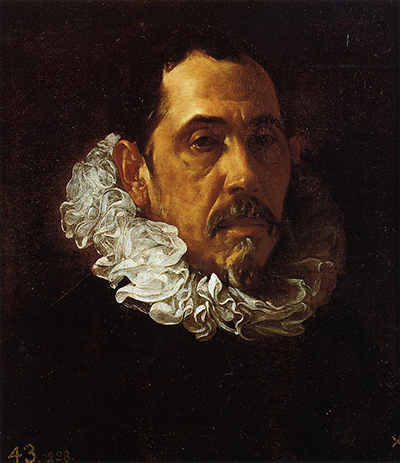
In a small study of Philip III, the face is carefully modelled and the ruff is loosely laid in against darkness. The king looks up and away. Velázquez arrived at the Madrid court after Philip III’s death, so the attitude had to be worked out using an existing likeness. William B. Jordan proposed that this was a study for The Expulsion of the Moriscos, the large history painting Velázquez made for Philip IV’s competition of 1627. An inventory from 1636 and Antonio Palomino’s later account describe that composition, which was lost in the Alcázar fire of 1734. The Prado accepted the attribution to Velázquez and supported the proposed connection to the lost painting. The different degrees of finish make sense for a study that isolates the lighting and angle of a face intended for a larger scene. [44]
A copy made around 1820 by Carmen Barrantes Manuel de Aragón records how differently later owners could have seen this same object. It shows the likeness as an enlarged half-length portrait. A radiograph taken before the 1988 restoration confirmed that strips of cloth had been added around the edges. The enlargement came with overpainting that elaborated the ruff, hair and costume. Prado researchers Jaime García-Máiquez and María Dolores Gayo examined the uneven tension traces left by tacking the cloth to a stretcher. They suggested that the small original may have been painted on an offcut previously stretched for another purpose. The nineteenth-century copy supplies a record of the expanded format. The smaller canvas, with so much of its painted attention concentrated around the king’s mouth, chin and eyes, makes it possible to see why the Prado’s researchers read it as preparation for a figure in a much larger picture. [44]
Artworks directory
Frequently Asked Questions
In An Old Woman Cooking Eggs , dated 1618 and now in the Scottish National Gallery, the eggs sit in a shallow earthenware dish. Light catches the white as it spreads in the liquid. The old woman has a spoon poised above the dish, and a boy holds a flask and a melon. [2]
Scale can tell us something about the distance at which a picture invites attention. In The Coronation of the Virgin , made for the queen’s oratory in the Alcázar according to the Prado catalogue, the figures gather into a compact shape around the Virgin. She lowers her eyes and brings her hand to her chest. [1]
Accounts of Velázquez’s time in Rome bring together paintings made in quite different relationships with their sitters. The Portrait of Pope Innocent X remains in the Doria Pamphilj collection. The paper in the pope’s hand, the strip of light along his nose and the white folds beneath the red cape divide the painting’s red field. [30]
Discussion
Look again at the images and ideas explored in Diego Velázquez Paintings. These editorial prompts invite your observations.
Reader Insights
What changes when you compare two royal portraits from different stages of Velázquez’s career?
Which details make the two Villa Medici views feel like a pair, and which make them feel separate?
Join the Conversation
Share a detail, comparison or question about Diego Velázquez Paintings below.
References
- Julián Gállego, entries in Antonio Domínguez Ortiz, Alfonso E. Pérez Sánchez and Julián Gállego, Velázquez, Museo del Prado and Ministerio de Cultura, Madrid, 1990. Entries 1–4 on the Seville interiors, 21, 23, 25 and 28 on mythologies and devotional work, 35–45 and 48–54 on the Buen Retiro, hunting portraits, court figures and related works, and 59, 61–62, 64–65, 73 and 76 on the Coronation, Needlewoman, Spinners, Villa Medici views, Las Meninas and Mercury and Argus. Digitised exhibition catalogue, in Spanish. View source.
- National Galleries of Scotland, An Old Woman Cooking Eggs, NG 2180, object record and collection commentary. View source.
- National Gallery of Ireland, Kitchen Maid with the Supper at Emmaus, NGI.4538, object record. View source.
- Art Institute of Chicago, Kitchen Scene, 1935.380, museum collection data, object ID 21934. View source.
- Museum of Fine Arts, Houston, Kitchen Maid, 55.100, object record. View source.
- The Wellington Collection, The Waterseller of Seville, Apsley House, collection commentary and painting image. View source.
- National Gallery, London, Kitchen Scene with Christ in the House of Martha and Mary, NG1375, object record, including ‘In-depth’. View source.
- Kerry Ingram, Museum of Fine Arts, Houston, ‘Rediscovering a Velázquez: The Attribution of “Kitchen Maid”’, conservation and attribution announcement. View source.
- Metropolitan Museum of Art, Juan de Pareja, Afro-Hispanic Painter, 2023 exhibition announcement, sections on the kitchen paintings, the Rome years and Pareja’s independent career. View source.
- National Gallery, London, The Immaculate Conception, NG6424, object record and discussion of its companion painting. View source.
- National Gallery, London, Saint John the Evangelist on the Island of Patmos, NG6264, object record and discussion of its companion painting. View source.
- Larry Keith and Dawson W. Carr, ‘Velázquez’s “Christ after the Flagellation”: Technique in Context’, National Gallery Technical Bulletin 30 (2009), pp. 52–71, especially the comparisons with the early grounds, Joseph’s Bloody Coat and Apollo, pp. 63–69. View source.
- National Gallery, London, Christ contemplated by the Christian Soul, NG1148, object record including subject and dating discussion. View source.
- Instituto Andaluz del Patrimonio Histórico, Pintor del rey, transcription of the royal appointment and pay documents of October 1623, sourced to Varia Velazqueña, vol. II, pp. 222–23, in Spanish. View source.
- Michael Gallagher, ‘Velázquez’s Philip IV in the Metropolitan Museum’, Metropolitan Museum Journal 45 (2010), pp. 187–98, especially pp. 193–97 and figs. 8–11. View source.
- National Gallery, London, Philip IV of Spain in Brown and Silver, NG1129, object record. View source.
- National Gallery, London, Philip IV of Spain, NG745, object record. View source.
- Museu de Arte de São Paulo Assis Chateaubriand, Retrato do conde-duque de Olivares, MASP.00171, object record and collection catalogue essays, in Portuguese. View source.
- State Hermitage Museum, Портрет графа-герцога Оливарес (Portrait of the Count-Duke of Olivares), ГЭ-300, digital collection record 32647, in Russian. View source.
- Museo Nacional del Prado, Didactic Exhibition: The Prado in Jerez, catalogue checklist, nos. 10–14. View source.
- Museo Nacional del Prado, Espacios Barrocos, ‘Recursos’, section ‘El príncipe Baltasar Carlos, a caballo’ and Hall of Realms resources, in Spanish. View source.
- Fundación Iberdrola España, Taller Restauración Museo Prado, section ‘Retrato Ecuestre de Isabel Borbón de Velázquez – 2025’, project partner’s report on María Álvarez Garcillán’s treatment and on the installation, in Spanish. View source.
- Museo Nacional del Prado, Memoria de actividades 2021, ‘Ejecución, instalación y presentación’, pp. 98–99, account of the framing of Las hilanderas, in Spanish. View source.
- Museo Nacional del Prado, Memoria de actividades 2022, pp. 296–97, ‘Presentación de Mercurio y Argos, reenmarcado’, P001175, in Spanish. View source.
- The Wallace Collection, Prince Baltasar Carlos in the Riding School, P6, object record and attribution discussion. View source.
- Centro de Estudios Europa Hispánica, ‘Balthasar Carlos at The Wallace Collection’, research and conservation project summary. View source.
- Museo Nacional del Prado, ‘Reencuentros. Parada V. Una Corte a nuestro encuentro’, sections on the court portraits, Las Meninas and Las hilanderas, in Spanish. View source.
- National Gallery of Art, Washington, The Needlewoman, 1937.1.81, object record, including the discussion of its unfinished state. View source.
- Museo Diocesano de Arte Sacro de Orihuela, La Tentación de Santo Tomás de Aquino, cat. 1, object record, in Spanish. View source.
- Galleria Doria Pamphilj, Portrait of Pope Innocent X Pamphilj, FC 289, collection record and discussion of the dedicated chamber. View source.
- Metropolitan Museum of Art, Juan de Pareja (ca. 1608–1670), 1971.86, object record. View source.
- National Gallery, London, The Toilet of Venus (‘The Rokeby Venus’), NG2057, object record, including the sections on the mirror, dating and provenance. View source.
- Boletín Oficial del Estado, Orden ECD/1613/2013, 13 August 2013, exhibition loan schedule for Velázquez. Últimos Retratos, paintings GG 319 and GG 2130 from the Kunsthistorisches Museum, in Spanish with English object titles. View source.
- Museo Nacional del Prado, closing announcement for Velázquez y la familia de Felipe IV, exhibition grouping and Vienna loans, in Spanish. View source.
- Boletín Oficial del Estado, Orden CLT/868/2026, 11 August 2026, exhibition loan schedule for Mariana de Austria, item 3, Kunsthistorisches Museum, GG 2129, in Spanish with English object title. View source.
- Metropolitan Museum of Art, Portrait of a Man, 89.15.29, object record and authorship discussion, including comparative examination of the weave, ground and underdrawing. View source.
- Metropolitan Museum of Art, Portrait of a Man, Possibly a Self-Portrait, 49.7.42, object record and discussion of the relationship with The Surrender of Breda. View source.
- Pablo Pérez d’Ors, Richard Johnson and Don Johnson, “Velázquez in Fraga: a new hypothesis about the portraits of El Primo and Philip IV”, The Burlington Magazine 154 (September 2012), pp. 620–25, figs. 9–13. View source.
- Museo Nacional del Prado, “Reencuentros. Parada V. Una Corte a nuestro encuentro”, section “El otro palacio”. View source.
- Dulwich Picture Gallery, Philip IV, King of Spain, DPG249, collection record and attribution. View source.
- Musée des Beaux-Arts de Rouen, Democritus, 822.1.16, collection record and discussion of the painting’s earlier state. View source.
- Ville de Rouen, council deliberation 3-6, 28 January 2005, exhibition proposal for Velázquez – Ribera: Curieux philosophes. View source.
- Toledo Museum of Art, Man With a Wine Glass, 1926.85, collection record and attribution. View source.
- Museo Nacional del Prado, Velázquez: Portrait of Philip III (2017), Miguel Falomir’s foreword, William B. Jordan’s essay on the lost Expulsion of the Moriscos, and Jaime García-Máiquez and M.ª Dolores Gayo’s technical study, especially figs. 39–42. View source.
