


 by Tom Gurney
Tom Gurney BSc (Hons) is an art history expert with over 20 years experience
Published on June 19, 2020 / Updated on October 14, 2023
Email: tomgurney1@gmail.com / Phone: +44 7429 011000
Coronation of the Virgin: Introduction
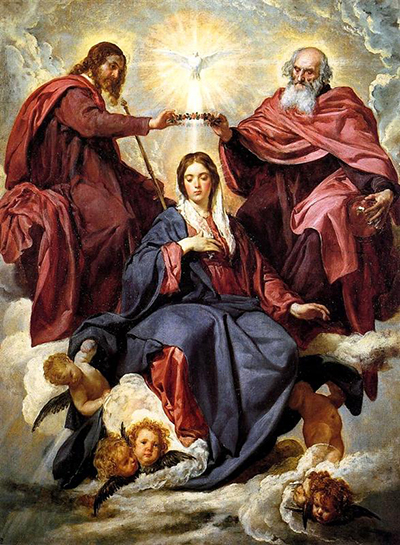
Two hands hold a garland of flowers above Mary’s head. Christ reaches in from the left with his arm almost level. God the Father supports the other end from the right, his fingers turned upwards. A few red buds and dark leaves cross the palest part of the sky. Beneath them, Mary rests the fingers of one hand against her breast. The crown is close enough for the ceremony to feel imminent, but a strip of light still separates it from her hair. That interval gives the viewer time to see each of the three gestures. [1] [2]
Diego Velázquez’s Coronation of the Virgin is an oil painting on canvas in the Museo Nacional del Prado, Madrid, inventory P001168. Gabriele Finaldi’s Prado catalogue entry gives its dimensions as 178.5 × 134.5 centimetres and argues for a date around 1635–36. At almost the height of a standing adult, the canvas gives Mary and the figures above her a substantial presence. Yet their seated poses, inclined heads and carefully spaced hands make the exchange feel close. Velázquez made the painting for the setting in which it is first described, the oratory in the apartments of Queen Isabel de Borbón in Madrid’s royal Alcázar. [1] [2]
At a Glance
- Date proposed by Gabriele FinaldiAbout 1635–36 [2]
- MediumOil on canvas [1] [2]
- CollectionMuseo Nacional del Prado, P001168 [1] [2]
Contents
- How the figures share the space
- Mary’s crown and hand
- Annotated details
- El Greco and the arrangement of heaven
- Mary in the Seville paintings
- The queen’s oratory at the Alcázar
- From the palace fire to the Prado
- What the queen’s inventory records
- A royal request for paintings from Naples
- Two earlier Coronations and their settings
How the figures share the space
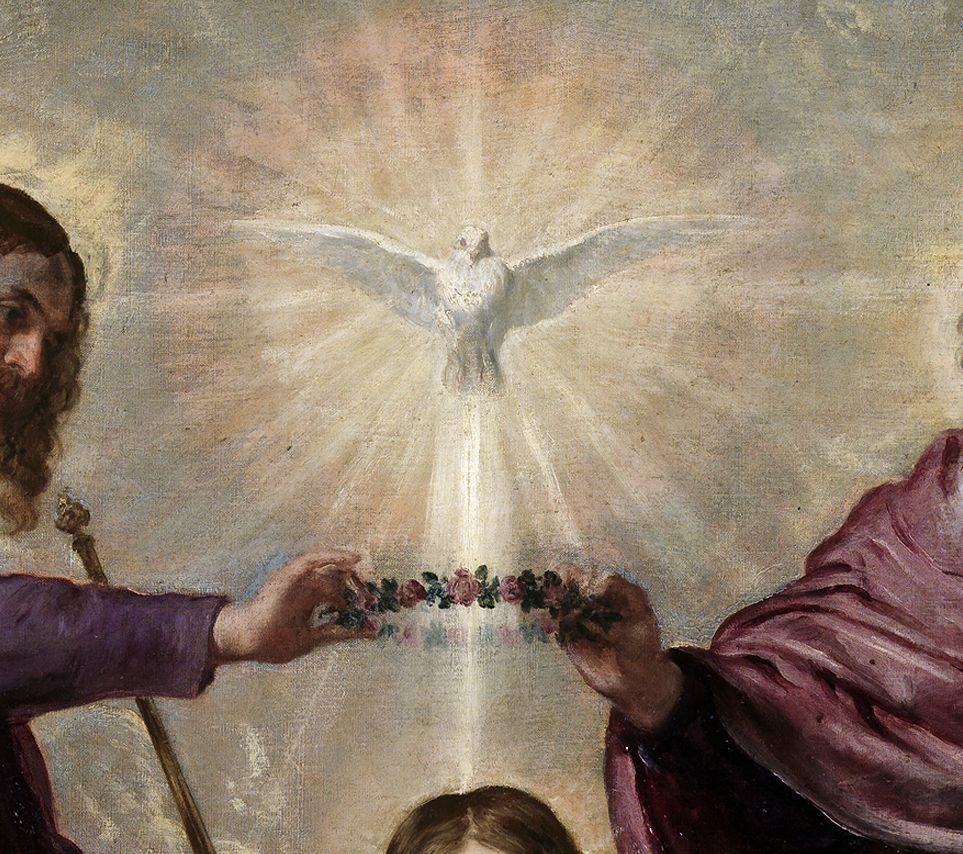
The Holy Spirit appears as a white dove, its wings spread in the light above the garland. A nearly vertical shaft reaches down through the flowers and widens behind Mary’s head. Christ and the Father sit higher and farther back. Their bodies turn inwards along opposite diagonals, almost enclosing the space that the light opens between them. The painter can leave much of the upper centre unoccupied because the dove’s outstretched wings and the horizontal wreath mark two clear stages on the way down to Mary.
There is a difference between the two men’s participation in the act. Christ’s chin inclines towards the centre, his face in shadow below the brow, while his forearm carries the line of his attention directly to the flowers. A slim sceptre rises beside his body and angles towards his shoulder. Across from him the Father’s raised hand appears just beyond a broad sweep of crimson drapery. His other hand gathers around a transparent orb. One attribute makes a thin, straight accent against the lighter centre. The other nearly disappears into the shadow at the edge. On the far right you can follow the Father’s finger joints even where the globe itself is difficult to make out. [1] [2]
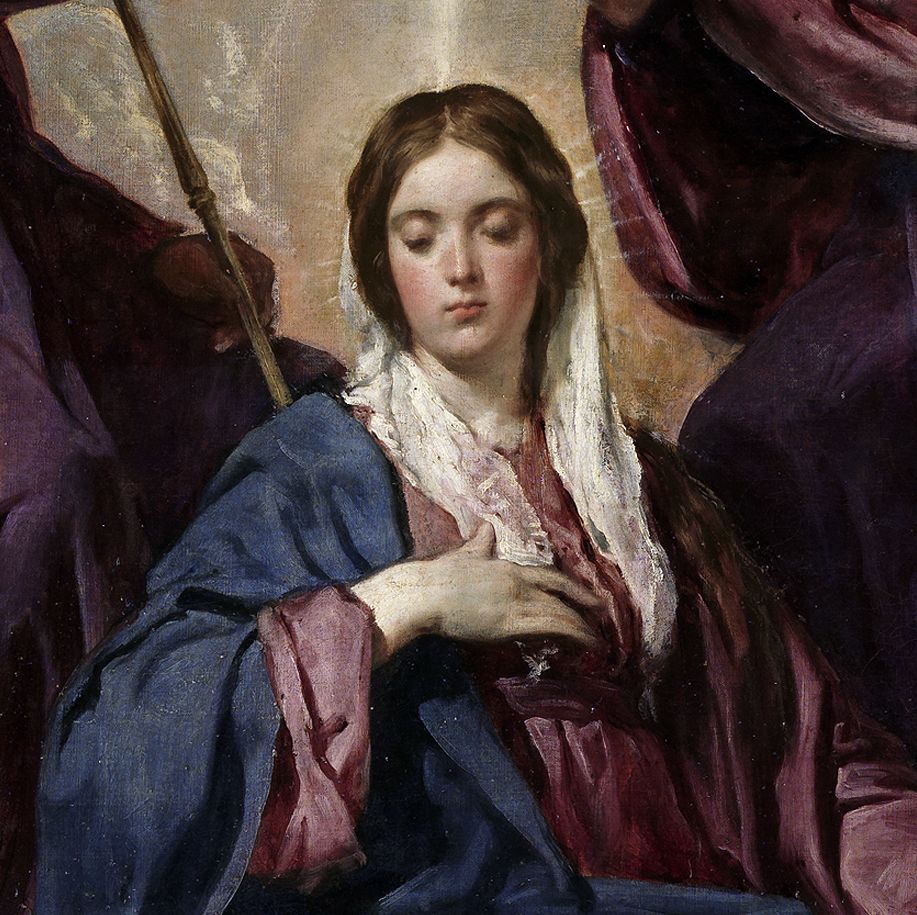
Mary’s head is lower than either of theirs, almost level with the dark opening between their robes. The face comes forward in the light, and both the tilt of her head and the direction of her eyes take attention down to her hand. Velázquez allows the long fall of the white veil to separate the hand and sleeve from the surrounding reds. Her free arm, extended to the right and slightly downward, has its own patch of light along the fingers. That hand opens a little interval against the Father’s robes. The body between the two hands is turned just enough for the sweep of the blue mantle to have a clear direction of its own. [1]
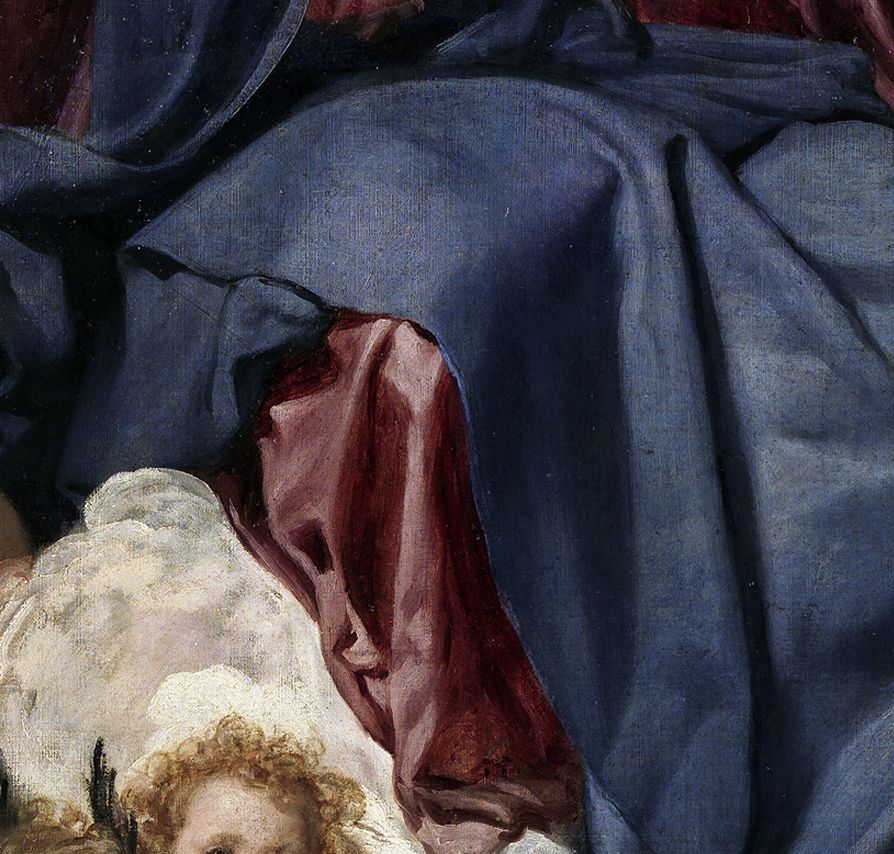
The blue is easiest to see as a single shape from a distance. Across Mary’s lap it makes a broad shelf. Lower down, the fold at the right rolls inward and sweeps left towards the clouds. A piece of rose-coloured dress breaks through the blue at the lower left, catching enough light to show the difference between a long hanging fold and a ridge of bunched fabric. Across the upper half, the violet and crimson of the two figures’ clothing are close in tone. Their sleeves, cloaks and bent knees remain distinct through changes in the direction of the folds and through accents of pale pink. Velázquez uses the warm colours to join the figures and the cool mantle to bring Mary forward within the group. [1]
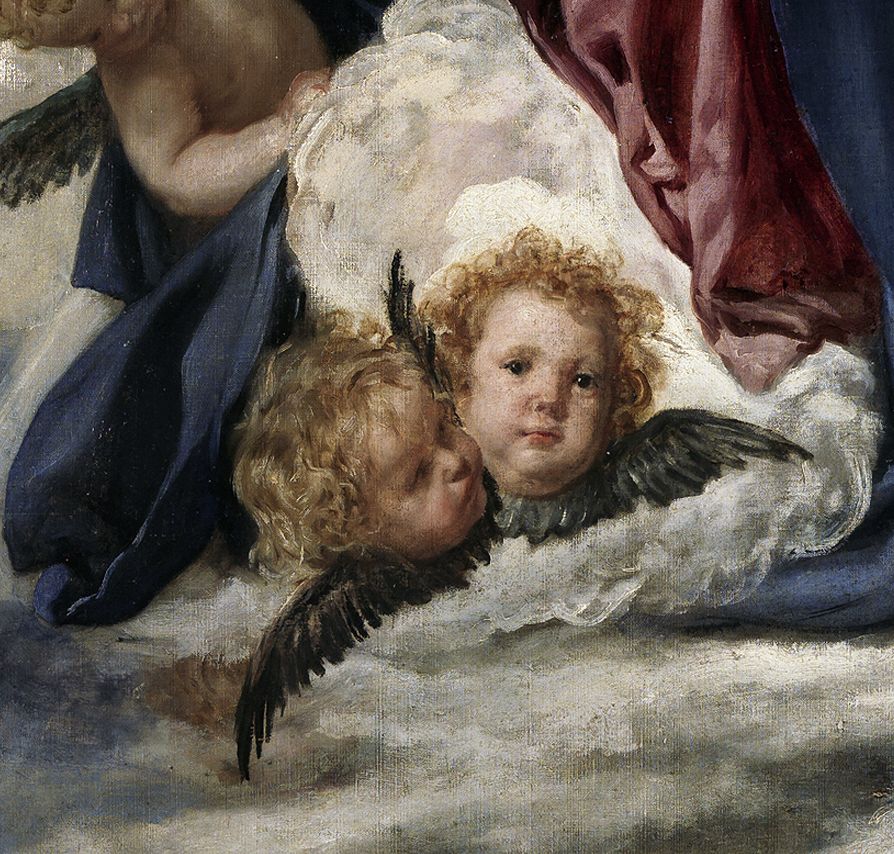
Look below the mantle and you can see how much work it takes to make a seated body appear to rest on air. At the left a little angel dips forward with a wing pointing down. On the right a second figure arches back under a lifted edge of the blue fabric. The dark underside of the mantle partly swallows that figure’s head and shoulders, while the light finds its torso. Below both are pairs of winged heads, close enough to the clouds for an outline to disappear into the surrounding whiteness. They give the bottom half of the scene movement, so that the stillness of the three seated figures seems deliberate. [1] [2]
Julián Gállego remarked on how Velázquez varied his handling between the thick-looking folds and the more freely rendered heads and hands. Follow the edge of the Father’s pink cloak where it loops over dark purple, then look at the fingers supporting the crown. The cloth takes shape through relatively large changes of tone across its ridges. At the wreath, a few small marks give the meeting of hand, leaf and flower. The figures below have yet another rhythm. In one pair of cherubs, a face turns into its companion’s hair, and a sweep of dark wing shows the direction of the movement before the contours of the faces become clear. [1]
Mary’s crown and hand
The three persons of the Trinity occupy three sides of the space around Mary’s head. Their action gives her the central position while also showing where the honour comes from. The flowers are an unusually delicate form of royal insignia to set beside a sceptre and a globe. To locate the crown, the eye goes to the point where Father and Son meet. To see its flowers, it has to come back from the brightness of the dove. The white rays and the small coloured wreath make two different ways of marking the same moment. [1] [2]
In Catholic tradition the Coronation is associated with Mary’s Assumption, her entrance body and soul into heavenly glory. The scenes can be distinguished by their actions. An Assumption can show Mary rising from earth into heaven. Here she is already seated among the clouds, while the Trinity bestows the crown. Pius XII’s 1954 encyclical Ad Caeli Reginam traces the longstanding use of royal imagery for Mary and the significance attached to her as the mother of Christ. Lumen gentium, issued by the Second Vatican Council in 1964, describes her exaltation as Queen alongside her Son and distinguishes Marian devotion from the adoration accorded to God. These later accounts articulate the tradition within which the relative positions and gestures of Velázquez’s figures can be understood. The evidence for how the work was used in the Alcázar comes from the history of the oratory. [2] [3] [4] [5]
Mary’s right hand has drawn attention for another reason. Gállego saw the expanse of warm colour swelling out around the two divine figures, then tapering down around the Virgin as the outline of a heart. He connected that visual resemblance with Mary’s fingertips touching her breast and proposed a possible allusion to early devotion to the Heart of Mary. Finaldi pointed to a different visual context for the gesture. In Alessandro Turchi’s Annunciation, painted for the series associated with the same oratory, Mary also brings a hand to her chest. The comparison gives the viewer two things to look for, the overall contour across Velázquez’s canvas and the much smaller action that could connect Mary at the Annunciation with Mary receiving a crown. Gállego’s devotional reading and Finaldi’s proposed echo are both interpretations. [1] [2]
This work in Velázquez’s career
Coronation of the Virgin (current article)
c. 1635–36 (Finaldi) [2]The Surrender of Breda
c. 1635 CatalogueLas Meninas
1656 CatalogueEl Greco and the arrangement of heaven
Gállego’s Prado entry reproduces El Greco’s Coronation of the Virgin in the same museum. The two paintings share the essential arrangement. Christ and the Father extend their arms from either side. The dove occupies the centre above, and Mary sits immediately below the crown. Look at what happens outside that arrangement. In El Greco a great curved sweep of cloud opens like a bowl, with angels above the shoulders of the principal figures. The pale figure of the Father stands out against that dark, turning cloud, and the whole group seems gathered into an opening in the sky. In Velázquez the two men occupy much more of the picture’s width. The bulk of their robes brings the eye straight to their bodies, then the lit hands draw it in from either side. [1]
Mary’s hands provide another way to compare the paintings. In the El Greco reproduced by the Prado, they are held together in front of her breast. The gesture reinforces the upright narrowing of the cloud around her. Velázquez draws one hand away from the centre, so that it continues the direction of her sleeve into the lower right. The other follows the edge of the bodice. That distribution gives the cloth around her lap room to unfold, then carries the eye down to the angels handling the mantle. The compositional resemblance helps explain how readily viewers identify the actors. The different use of weight and gesture explains why the ceremony feels different in each painting. The resemblance alone leaves open exactly which of several treatments of the theme Velázquez knew or used. [1] [2]
Annotated Details from Coronation of the Virgin
Follow the gestures above Mary and the folds and faces that hold the group together below.
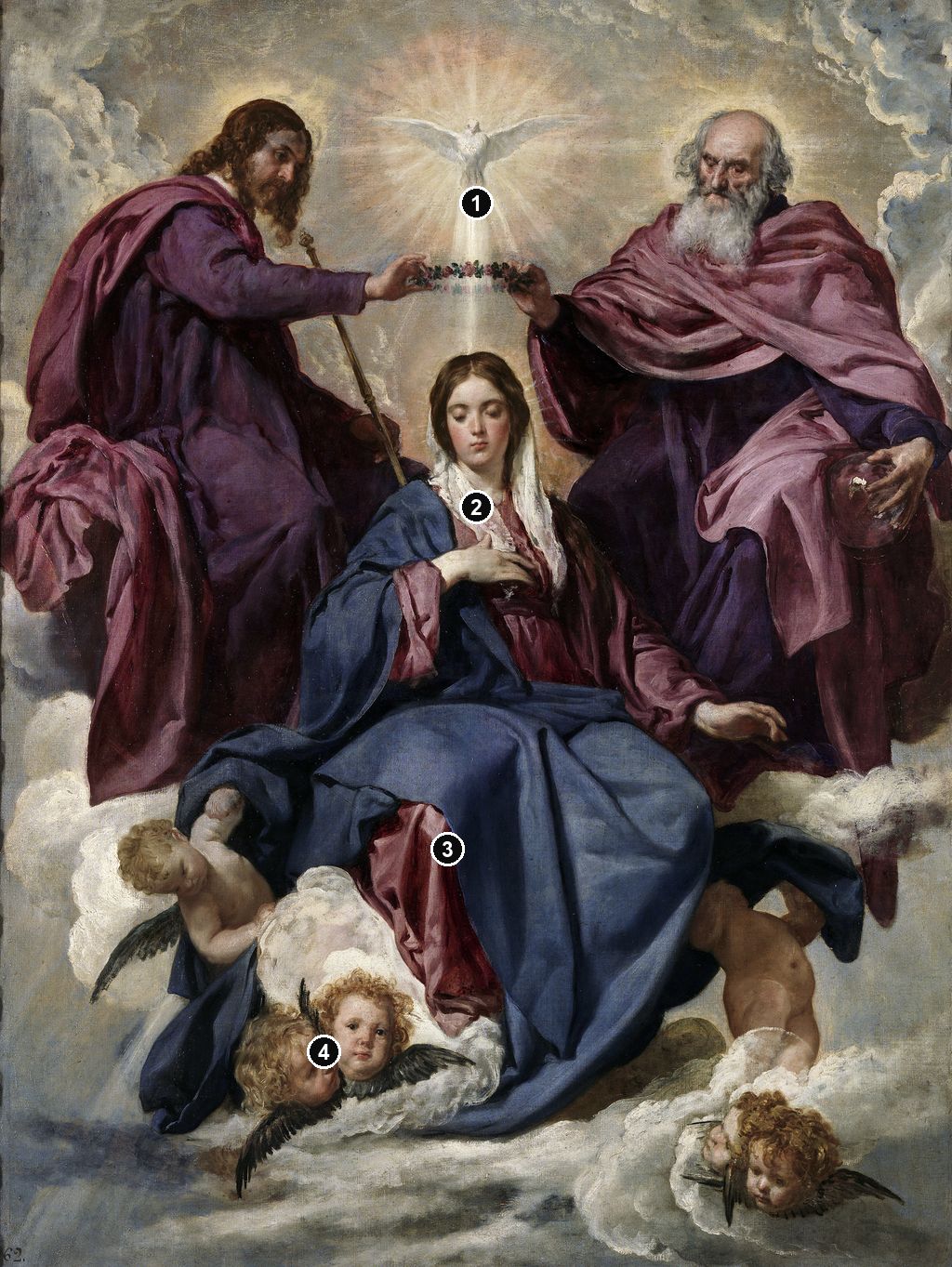
Details from CORONATION OF THE VIRGIN
The dove above the crown
The dove opens its wings against a pale burst of light. Below it, two hands hold the crown level across the axis of the picture. [1] [2]
Mary’s bowed head and hand
The bowed head and open hand point down the centre of the composition. The blue mantle turns out broadly around the small upright shape of the face. [1] [2]
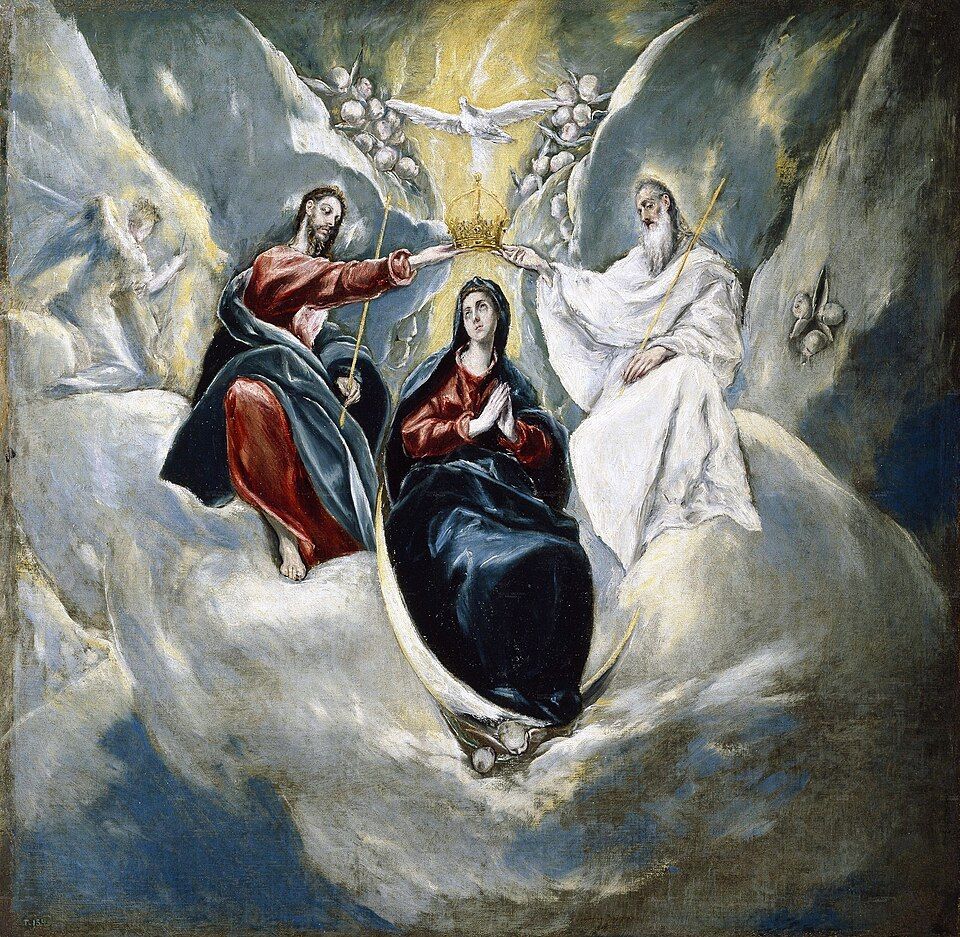
El Greco and workshop, The Coronation of the Virgin, Museo del Prado. Compare the Virgin’s joined hands and the upright arrangement of clouds with Velázquez’s later composition. Image source. Public domain. Resized for display.
Mary in the Seville paintings
In the early Immaculate Conception in the National Gallery, London, Mary also lowers her gaze. Look at the space around her feet. She stands over a translucent moon above a dark landscape, and twelve stars circle her head. The stars and moon belong to the imagery of the Woman of the Apocalypse in Revelation 12, which Catholic artists applied to the Virgin. The Immaculate Conception concerns Mary’s own conception free from original sin. The Madrid painting represents a later moment in Marian tradition, and its flowers are an object being held out to her. One picture gives Mary’s figure the marks of a heavenly vision. The other gives the viewer a ceremony in which separate figures perform related actions. [3] [4] [6] [7]
The National Gallery dates the London Immaculate Conception to 1618–19 and treats Saint John the Evangelist on the Island of Patmos as its companion. In the latter painting, John looks up from his book towards a tiny figure in a break in the clouds. In the former, a woman fills most of the canvas, and the landscape below her occupies a narrow band. The two sizes of the apparition invite a viewer to shift position in imagination from John, seeing it at a distance, to the much closer view across the matching canvas. In Madrid, the beholder is already close to the celestial group. Velázquez has to suggest distance and rank within it, through the elevated hands, the light and the layers of cloud. [1] [6]
The earliest record the National Gallery gives for its two canvases is from 1800, in the chapter house of the Shod Carmelite convent in Seville. Their shared design supports the relationship, while the person who commissioned them and their exact first installation remain uncertain. The Madrid work belongs to a different documented ensemble. Isabel’s inventory groups it with nine paintings of Marian feasts sent from Rome. Looking at the London pair makes it easier to see how much of the meaning of a devotional painting can come from another picture nearby. In the oratory series, the neighbouring subjects could have included an Immaculate Conception, but the London painting is a separate work with its own history. [2] [5] [6]
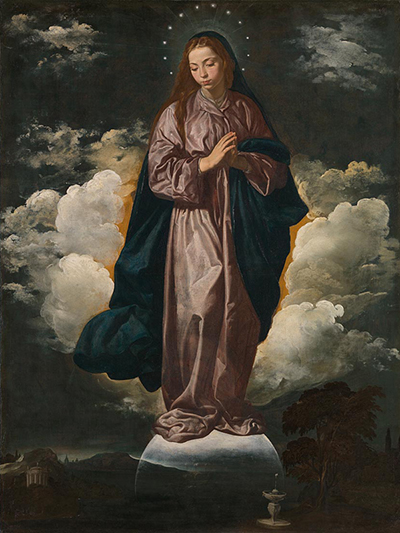
The Immaculate Conception. Compare the Virgin’s position and the use of light in the earlier Seville picture. View The Immaculate Conception.
The queen’s oratory at the Alcázar
Isabel de Borbón, also known as Elisabeth of France, was Philip IV’s first wife. Her household had an oratory in the royal Alcázar. Work on a larger one began after the decision to expand it in 1634. Gloria Martínez Leiva’s reconstruction describes a rectangular chamber with windows facing the palace entrance square. Finaldi’s account places it on the first floor by the Galería del Cierzo. It was a private royal space in the sense that it belonged to the queen’s apartments, though the expansion made room for her ladies to attend devotions or ceremonies. Its decoration included mural painting by Angelo Nardi and an altarpiece built by Martín Ferrer to a design by Juan Gómez de Mora. Finaldi also records a large crucifixion by Federico Barocci among the paintings assembled there. [2] [5]
That collection gives the size of Velázquez’s canvas a practical explanation. The inventory made after Isabel’s death groups ten paintings with gilded frames. It specifies the nine feasts sent from Rome by Cardinal Gaspar de Borja y Velasco, and names Velázquez as the painter of the tenth, the Coronation with the Trinity. Finaldi identifies the imported group as the work of Alessandro Turchi. The surviving Birth of the Virgin, Visitation, Annunciation and Assumption indicate how many different kinds of scene the series encompassed. Finaldi proposed that Velázquez adapted his scale to the existing pictures. From within the larger ensemble the Coronation could be read as the culmination of Mary’s story, while a viewer looking at it individually could still follow the gestures and the faces at close range. [2] [5] [8]
Martínez Leiva cites a historical account of the palace custom of offering prayers before the Virgin of the Expectation for the queen’s safe delivery in childbirth. This devotion was directed to an image of the pregnant Virgin kept in the oratory. It shows how a Marian ensemble could participate in practices that mattered to the royal family and household. The reconstruction proposes positions for the paintings, with the Coronation near the head of the room. The ensemble in the inventory is documentary evidence, while the proposed wall arrangement and route through the room are a modern reconstruction. Even without settling a particular wall, the context changes what we see in the painting. Mary’s quiet action belongs in a room with other depictions of her life that could be revisited during prayer. [2] [5]
Why the date has changed
Antonio Palomino, writing in 1724, placed the Coronation in the period when Velázquez painted The Surrender of Breda and remembered it as being in the oratory of the queen’s apartments. The 1990 Prado catalogue reviewed a range of proposals. The museum had previously favoured around 1641–42, while some writers had put the picture late enough in Velázquez’s career to associate it with Philip’s second wife, Mariana of Austria. The early attribution to Isabel’s oratory and the later, more specific evidence about its furnishings weigh in favour of Isabel. [1] [2] [5]
Finaldi’s published 1635–36 dating joins several kinds of evidence. The Turchi group had reached Madrid by 1635. The oratory was probably ready for use in 1636. The association with Breda places it around the same period in Palomino’s account, and Finaldi cites Carmen Garrido’s judgement that the execution resembles Velázquez’s practice around 1635. Taken together, these make a strong case for the earlier date. The inventory records the painter and the intended setting is well supported, while the identity of the person who ordered the work remains open. Finaldi discusses a possible commission from Borja or from Isabel herself. Philip might also have ordered the painting as a gift for his wife. [1] [2] [5]
The likely proximity in date to Breda helps bring out the range of Velázquez’s work for the court. One immense picture presents the meeting of two commanders for the Hall of Realms. The oratory picture gives the eye a small span of poised fingers and flowers within a group of figures seated among clouds. The court painter had to make gestures legible in both settings, and the number of witnesses, the scale of the work and the distance from which it would be seen called for different solutions. His early London pair, with its less certain first setting, shows why the royal oratory is a particular piece of evidence about this painting’s audience. [1] [2] [6]
From the palace fire to the Prado
The old Alcázar caught fire on Christmas Eve 1734. Velázquez’s Coronation survived and was deposited at the convent of San Gil el Real. Finaldi records that the 1735 listing of works saved from the fire attributed it to Alonso Cano. Its return to Velázquez’s name can be traced through subsequent records. The 1990 catalogue lists it in inventories of the new Royal Palace in 1772 and 1794 and notes that Antonio Ponz saw it there as a work by Velázquez. The route through the convent and the new palace records the displacement of the canvas from the devotional ensemble with which it began. [1] [2] [9]
Before the painting entered the museum it became available in another form. The company formed to make prints after the royal pictures commissioned Manuel de la Cruz to draw it. Jean Massard made an engraving dated 1795 from that drawing. The inscription names Velázquez and locates the painting in the Royal Palace. In the print the figures are still legible through the brightness around the dove, the broad dark shapes of the robes and the repeated curves at the foot of the group. Fine parallel lines follow the turn of Mary’s mantle over her knee. On the Father’s robe similar lines describe folds that Velázquez distinguishes in part through changes from dark red to pink. That shift in medium draws attention to how easily the eye follows the layout, even when the colours that first catch it have gone. [10] [11]
The canvas entered the Prado in 1819 from the royal collection. In the museum inventory compiled after the death of Ferdinand VII in 1833 it appears as item 25, under Velázquez’s name, in the first room of the royal museum’s gallery. The next entry is a painting of the Immaculate Conception by Murillo. The early inventory and the print both tell us how people encountered the picture in the generations after its rescue, as a work from the royal collections with an identifiable author. Today it rewards starting at the centre and then moving outward. Find the little garland first, follow the light down to the face, and then see how far around the edge the blue cloth travels before it meets the clouds. From that distance the eye can return to the actual subject, a crown still held level in mid-air. [1] [11] [12]
What the queen’s inventory records
The entry for the Coronation in Isabel de Borbón’s posthumous inventory has two levels of description. Its heading puts ten paintings under Cardinal Gaspar de Borja’s name. The fuller entry specifies nine pictures of Marian feasts that he sent from Rome, then identifies the remaining picture by its subject and its painter, Velázquez. The appraisers valued each of the nine at fifty ducats and the Coronation at a thousand reales, with the amounts reckoned in vellón. These are estate valuations. They show that the tenth picture could belong to the group and still be treated separately when the paintings were appraised. The heading makes Borja’s possible involvement with the Coronation worth considering, while the detailed entry leaves the identity of the person who gave Velázquez the order open. [13]
The inventory also gives a single height and width for the group in varas, alongside a description of the gilded frames. That common measurement shows how the appraisers recorded the ensemble. It supplies neither a separate measurement of the bare canvas nor a precise fit to a particular wall. A different kind of record survives for the room’s decoration. On 25 September 1635, Julio Cesare Semini received 350 reales for drawing and colouring the plan and elevation of the queen’s oratory. Martínez Leiva provisionally associates that payment with the surviving drawing in the Biblioteca Nacional de España. The payment establishes that a drawing was produced for the building project, while the identification of the surviving sheet and its use to place individual paintings remain matters of interpretation. [13]
A royal request for paintings from Naples
At the Buen Retiro, another Madrid palace, a request preserved with the correspondence of the Countess of Olivares shows what could be decided before the artists began. In correspondence from 1634 the countess enlisted her brother, the Count of Monterrey and viceroy of Naples, to help furnish the royal rooms. The memorandum for the oratory lists paintings alongside textiles, silverware and liturgical furnishings. It asks for twelve pictures in four groups by size. The first two groups, of two and four paintings respectively, were to share a height of seven feet, with widths of thirteen and sixteen feet. A shared height would have let the six pictures line up while accommodating spaces of two different widths. The memorandum leaves their subjects unspecified. [14]
Mercedes Simal López proposes that those first six entries correspond to the cycle of the life of Saint John the Baptist made in Naples around 1634–35 by Artemisia Gentileschi, Massimo Stanzione and Paolo Finoglia. Five paintings survive, among them Gentileschi’s Birth of Saint John the Baptist. Matching a set of surviving works to the dimensions, number and timing of the request gives substance to that identification. Its first hanging is harder to establish because the surviving fragments of the Buen Retiro’s 1661 inventory leave the oratory installation uncertain. A later record brings one canvas into sharper focus. Gentileschi’s painting still carries the number 471, which Simal López matches to the entry naming her and the subject in the Buen Retiro inventory of 1716. The mark ties that object to a particular recorded stage in its history. At the Alcázar the evidence runs in the other direction. The estate entry identifies the subject and painter and groups the work with its companions. A request like the Buen Retiro memorandum would answer a different question by showing what was specified before the paintings arrived. [13] [14]
Two earlier Coronations and their settings
In the central panel of the San Pier Maggiore altarpiece, painted in 1370–71 by Jacopo di Cione and his workshop, a crowned Christ and Mary sit together against a blue and gold cloth on a marble throne. The star at the top of Mary’s crown gives a precise point to Christ’s gesture. The architectural setting continues down to a bank of angel musicians, while separate panels on either side carry rows of saints. The Trinity appears in the central pinnacle of the altarpiece, above a tier of scenes from Christ’s life. A viewer following the structure upwards would therefore pass from the act of crowning in the main tier to the Trinity higher in the same ensemble. In Velázquez’s canvas the persons of the Trinity can be taken in together with the coronation itself. The Florentine example shows how much of the subject’s meaning could also be distributed across the structure that held the painting. [15] [16]
Jan Baegert’s Coronation of the Virgin, painted about 1520, gives a closer comparison for the shared action of Father and Son. The National Gallery identifies the oak panel as a probable outer shutter scene from the high altarpiece at Liesborn. Christ and the Father reach in on either side of the kneeling Mary under the dove. Behind them two angels hold up the red textile that backs the throne, while another pair plays a lute and a flute. The cloth gives the group a flat field and the fictive stone arch bounds it on three sides. The sharp marks incised into the gold leaf of Mary’s crown make its inner rim legible as a solid object. In Madrid, a painted garland held across a patch of open sky occupies the same place in the action. Baegert’s framing places the heavenly group within a bay of the altarpiece, whereas in Madrid clouds continue to the edges of the canvas. [15] [17]
The Liesborn panel probably appeared among scenes largely devoted to Christ’s Passion when the shutters were closed. The San Pier Maggiore panel sat at the centre of a fixed arrangement with saints beside it. Each setting changes what the eye can take in next. The first places Mary’s crowning among episodes of suffering and deliverance, and the second gives it the company of the assembled saints. The queen’s inventory supports a third context for Velázquez, one in which Marian feast pictures could furnish the narrative around the crowning. The comparisons clarify the choices visible in the surviving objects. The evidence for the Madrid canvas’s neighbours comes from the Alcázar papers, and its precise position among them remains open. [13] [15] [17]
Artworks directory
Frequently Asked Questions
About 1635–36 [2]
There is a difference between the two men’s participation in the act. Christ’s chin inclines towards the centre, his face in shadow below the brow, while his forearm carries the line of his attention directly to the flowers. A slim sceptre rises beside his body and angles towards his shoulder. [1] [2]
Discussion
Look again at the images and ideas explored in Coronation of the Virgin. These editorial prompts invite your observations.
Reader Insights
Trace the gestures from the two hands holding the crown to Mary’s own hand. Where does your eye pause?
How do the red and blue folds connect the faces at the bottom of the painting to the figures above?
Join the Conversation
Share a detail, comparison or question about Coronation of the Virgin below.
References
- Julián Gállego, La coronación de la Virgen, catalogue no. 59, in Antonio Domínguez Ortiz, Alfonso E. Pérez Sánchez and Julián Gállego, Velázquez, Museo del Prado and Ministerio de Cultura, 1990, pp. 348–350. Includes a reproduction of El Greco’s painting in the Prado. Spanish. View source.
- Gabriele Finaldi, La Coronación de la Virgen, extract from Fábulas de Velázquez. Mitología e Historia Sagrada en el Siglo de Oro, Museo Nacional del Prado, 2007, p. 325, reproduced in Vestir el Prado. Includes the passage from Antonio Palomino, El Parnaso español pintoresco laureado, 1724, 1986 edition, p. 171. Spanish. View source.
- Pius XII, Ad Caeli Reginam, 11 October 1954, especially §§ 32–35. English. View source.
- Second Vatican Council, Lumen gentium, 21 November 1964, especially §§ 56, 59 and 66. English. View source.
- Gloria Martínez Leiva, “El Oratorio de la reina en el Alcázar de Madrid. Una propuesta de reconstrucción”, 6 February 2018. Includes transcriptions from the inventory made after Isabel de Borbón’s death and Mateo Frasso’s account of the royal oratory. Spanish. View source.
- The National Gallery, London, Diego Velázquez, The Immaculate Conception, NG6424, object record and “Two Paintings for the Shod Carmelites, Seville”, with companion painting NG6264. View source.
- United States Conference of Catholic Bishops, Revelation, chapter 12, especially vv. 1–6, New American Bible, Revised Edition. View source.
- Susana Calvo Capilla, “Cuadros para un oratorio”, Rinconete, Centro Virtual Cervantes, 10 February 2009. Includes Alessandro Turchi’s Birth of the Virgin, Prado inventory 3864. Spanish. View source.
- Patrimonio Nacional, Royal Palace of Madrid, section on the old Alcázar and the Christmas Eve fire of 1734. View source.
- Real Academia de Bellas Artes de San Fernando, Calcografía Nacional, Manuel de la Cruz after Diego Velázquez, Coronación de la Virgen, DG-0155. Drawing for Massard’s print, in black pencil and wash. Spanish. View source.
- Real Academia de Bellas Artes de San Fernando, Calcografía Nacional, Jean Baptiste Raphael Urbain Massard after Velázquez and Manuel de la Cruz, La Coronación de María, 1795, E-1633-b. Spanish. View source.
- Archivo de Palacio, Inventario de las pinturas del Museo hecho a la muerte del Rey Fernando VII, 1833–1834, Sección Histórica, Testamentarías, leg. 17, p. 5, no. 25, transcription hosted by the Museo del Prado. Spanish. View source.
- Gloria Martínez Leiva, “El Oratorio de la reina en el Alcázar de Madrid. Una propuesta de reconstrucción”, 6 February 2018. Includes the estate inventory transcription and the account of Semini’s payment. View source.
- Mercedes Simal López, “Nuevas noticias sobre las pinturas para el Real Palacio del Buen Retiro realizadas en Italia (1633–1642)”, Archivo Español de Arte, 84, no. 335 (2011), pp. 245–260, especially pp. 253–259. View source.
- Julián Gállego, “La coronación de la Virgen”, catalogue no. 59 in Velázquez, Museo del Prado and Ministerio de Cultura, 1990, pp. 348–350, with reproduction. View source.
- National Gallery, London, Jacopo di Cione and workshop, The Coronation of the Virgin: Central Main Tier Panel, NG569.1, object record. View source.
- National Gallery, London, Jan Baegert (Master of Cappenberg), The Coronation of the Virgin, NG263, object record. View source.








