


 by Tom Gurney
Tom Gurney BSc (Hons) is an art history expert with over 20 years experience
Published on June 19, 2020 / Updated on October 14, 2023
Email: tomgurney1@gmail.com / Phone: +44 7429 011000
Don Luis de Góngora y Argote: Introduction
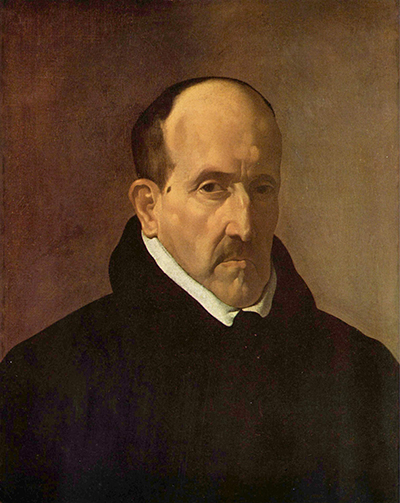
The brightest line in Diego Velázquez’s portrait of Luis de Góngora is the strip of white beneath his jaw. It slopes towards the throat and almost disappears behind the chin before a shorter edge rises on the other side. The black clothes occupy much of the canvas. They give the face its setting, and the little turn in the collar helps us see how the head sits above the body. Góngora’s eyes look towards us under brows that sit at slightly different heights. The face has turned just far enough for one ear to catch the light while the other falls beyond the far contour. [1] [2]
Velázquez painted the portrait in 1622. The oil on canvas measures approximately 50 by 41 centimetres and is in the Museum of Fine Arts, Boston, accession 32.79. Góngora, a celebrated Córdoba-born poet and royal chaplain, was around sixty when Velázquez painted him. The painter was in his early twenties and had come to Madrid from Seville. The painting brings the two men together at very different points in their careers. Góngora’s work was already being passed from reader to reader in manuscript. Velázquez was finding out how a portrait might establish his own name in the capital. [1] [2] [3]
At a Glance
Contents
- How Velázquez builds the face
- A laurel wreath beneath the paint
- Góngora in Madrid
- The Boston painting and the Madrid versions
How Velázquez builds the face
The highest and broadest area of light is the bare forehead. It has a different texture from the smaller lights below it. The nearer cheek is a patchwork of warm and cool tones. A touch above the brow, a lighter plane alongside the nose and the flesh below the eye take light in different ways, even across a very small area. The nose descends into a deeper shadow beside the nostril, and the greying moustache draws across the colour of the lips. Look at the small interval between mouth and chin. There is enough light there to give the lower face weight, while the darker passage beside it brings the jaw round towards the collar. [1] [2]
Velázquez gives the viewer several kinds of edge. The collar cuts clearly across the near side of the neck. The upper curve of the skull is easy to follow, but the hair at the temple and the high edge of the black garment are much harder to separate from the brown background. The surround is itself uneven, darkest on the left and warmer on the right. One shoulder is picked out against that lighter field. Both extend to the sides of the canvas, where the crop makes the sitter seem close even though the slight turn of his body keeps the pose from being square to us. [1] [2]
The dark brow and downward turn at the corners of the mouth have often been read as signs of a stern or proud man. The Prado’s 1990 catalogue records a particularly forceful tradition of reading the expression. It also draws attention to something more accessible in the paint, the abrupt transitions between the planes of the face. Seen up close, the brow above the eye on our left is wider and catches more light than its counterpart. The shaded eye on the other side still has a clear dark centre. The directness of the encounter depends on our ability to read both eyes across that change in light. [1] [2]
A laurel wreath beneath the paint
By the time the portrait was finished, Góngora’s uncovered head was the most conspicuous shape in the upper half of the painting. It had originally been surrounded by leaves. X-radiography and infrared reflectography of the Boston canvas make out the outline of a laurel wreath, including the edges and veins of individual leaves. Examination of a minute paint sample from this area identified a buried green layer containing lead-tin yellow and azurite. No dirt or varnish separated that layer from the paint over it in the sample, which suggests the design was covered at an early stage. The researchers also identified a small change to the outline of the sitter’s left shoulder. Their analysis found that the ground, the layer that prepares the canvas to receive paint, resembled that of other works from Velázquez’s Seville years, including the Kitchen Scene in Chicago. This connects the portrait’s physical make-up with his earlier work even though he painted it in Madrid. [4]
Laurel was a familiar distinction for poets. Francisco Pacheco, Velázquez’s teacher and father-in-law, used wreaths in some portraits of poets associated with his Libro de descripción de verdaderos retratos de ilustres y memorables varones. The surviving manuscript, now in the Biblioteca Lázaro Galdiano, brings together images and written accounts of notable people. Its opening date of 1599 belongs to a project that continued into the following century. If Pacheco asked for the painting to help him prepare an image for that project, the wreath would have had an immediate purpose. That possible destination comes from the formal parallels and the relationship between the painters. Pacheco’s account of the sitting leaves the purpose open. [2] [3] [4] [5]
The removal changed how the sitter meets the viewer. Leaves would have extended the outline of the head into the space above it and given him a traditional mark of poetic distinction. In the finished painting, the empty ground allows the contour of a bald scalp to make its own impression. Below, the wide spread of the shoulders and plain clothes retain the dignity of a formal bust. Comparison with the later Aesop at the Prado shows how differently Velázquez could present a literary figure. That tall canvas supplies a name in painted letters, a book and a full-length figure. The head of Góngora has to carry the likeness of a living individual in a field small enough to be taken in at a glance. [1] [4] [6]
Góngora in Madrid
Góngora held a cathedral office in Córdoba and became a royal chaplain in 1617. His long poems Fábula de Polifemo y Galatea and Soledades were already circulating in manuscript before he took up the court appointment. Both prompted debate over the freedoms a poet could take with the order and sound of Spanish, the density of learned allusion and the work demanded of a reader. Manuscript collections also preserve satirical verse, romances and shorter poems in a variety of metres. This was the writer whose face readers and collectors would later recognise in versions of Velázquez’s portrait. [2] [7] [8]
Pacheco’s Arte de la pintura, published in 1649, is the early account by someone who took part in arranging the portrait. He says that Velázquez left Seville for Madrid in April 1622, eager to see El Escorial. He names the Alcázar brothers and Juan de Fonseca among those who welcomed the painter, says Velázquez made the portrait at his request and recalls the praise it received in Madrid. The passage gives a month for the departure. It leaves the dates and place of the sittings, who first owned the canvas and any payment unrecorded. The visit also included an attempt to gain access to the king and queen for portraits. Pacheco says that the opportunity did not come on that trip. [3]
Pacheco presents the portrait near the beginning of a story about the painter’s rise. His claim that it was much praised is testimony from a teacher with a stake in his pupil’s reputation. It is also a reminder of the work a portrait could do when shown to the right people. In Pacheco’s account, the next year’s breakthrough followed a separate sequence. Fonseca called Velázquez back to Madrid on the Count-Duke of Olivares’s orders, sat for him, and had his likeness seen at the palace before Velázquez painted Philip IV. The Seville chapter follows the formation that preceded those encounters, and the account of Velázquez at the Spanish court traces the position that followed. [2] [3]
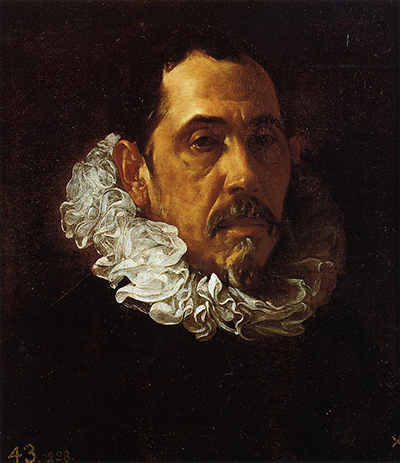
Portrait traditionally identified as Francisco Pacheco. The Prado portrait traditionally identified as Pacheco gives a visual reference for the teacher who recorded the Góngora sitting. View Portrait Traditionally Identified as Francisco Pacheco.
The Boston painting and the Madrid versions
The painting at the Prado, Luis de Góngora, P001223, repeats the turn of the head and the white collar. Its larger field gives the head more space, particularly above the sitter, and shows more of the dark garment beneath. The Prado lists the work as anonymous and dates it after 1622. Its 1990 exhibition catalogue recorded the earlier classification as a workshop work. A technical comparison published in 2005 mentions a slight adjustment of the shoulder in the Prado painting. Boston’s much more extensive revisions, particularly the former wreath, give scholars a reason to see that canvas as a work in which Velázquez developed the image. A painter working from its finished arrangement would have seen a bare head. [2] [4] [9]
The Museo Lázaro Galdiano’s Retrato de Luis de Góngora y Argote, inv. 02147, has a separate history. José Lázaro bought it in 1913 from the dealer Miguel Borondo. The museum’s former director José Camón Aznar championed this canvas as the original. The museum’s own account gives precedence to the more broadly accepted identification of the Boston painting, while the Spanish collections catalogue raises the possibility that the Lázaro picture may be a later replica by the painter. The precise relationship remains a question of attribution. Both Madrid paintings show how closely a version could preserve the design even as its handling of an eye, a cheek or a turn of cloth changes the experience of looking. [2] [4] [10] [11]
The Lázaro Galdiano canvas has its own evidence of revision. During the treatment begun in 2008, X-rays showed that the white collar had first been painted larger. Conservators also removed discoloured varnish and treated losses, recovering subtleties in the flesh tones and the surrounding brown. The collar change is evidence of a painter adjusting a version as work progressed. The study treats authorship by Velázquez as a serious possibility and leaves the order of the two canvases open. [12]
A portrait of Góngora appears in the 1660 inventory taken after Velázquez’s death. The 1990 Prado catalogue connects it provisionally with Boston and proposes that it passed from Pacheco to Velázquez. The inventory gives the sitter’s name, leaving no dimensions or other details by which to identify this canvas among surviving versions. The ownership record is firmer in the twentieth century. It identifies Boston’s painting with the one owned by the Marqués de la Vega-Inclán, shown by Tomás Harris Ltd in London in 1931 and acquired for Boston in 1932. [2] [13]
The likeness subsequently reached readers in print. In the portrait engraved by Jean de Courbes for José Pellicer’s 1630 commentary on Góngora, the painted design appears in reverse. A related likeness appears in the Chacón manuscript of the poet’s works. The transfer to another medium explains something about the economy of the canvas. With the head turned, the nearer ear exposed and a short bright line of collar separating jaw from costume, its arrangement was distinct enough to survive the change from paint to engraved line. The Boston canvas rewards a slower look at the features that are harder to transfer, especially the small shifts of tone by which the cheek and brow turn into shadow. [2] [8] [14]
Artworks directory
Frequently Asked Questions
Discussion
Look again at the images and ideas explored in Don Luis de Góngora y Argote. These editorial prompts invite your observations.
Reader Insights
What happens to the face when you start by looking at the white collar?
What can the changes beneath the paint tell us about how Velázquez worked?
Join the Conversation
Share a detail, comparison or question about Don Luis de Góngora y Argote below.
References
- Museum of Fine Arts, Boston, Luis de Góngora y Argote, Diego Rodríguez de Silva y Velázquez, 1622, oil on canvas, 32.79, object 32443. Museum’s record and image on Google Arts & Culture. View source.
- Julián Gállego and Museo Nacional del Prado, Velázquez, Madrid, 1990, cat. 12, pp. 110–113 including plates of the Boston, Prado and Lázaro Galdiano paintings. Spanish. View source.
- Francisco Pacheco, Arte de la pintura, Seville, 1649, Book I, chapter VIII, pp. 101–103. Spanish transcription by Santiago Arroyo Esteban, Universidad Complutense de Madrid. View source.
- Gridley McKim-Smith, Inge Fiedler, Rhona Macbeth, Richard Newman and Frank Zuccari, ‘Velázquez: Painting from Life’, Metropolitan Museum Journal 40, 2005, pp. 83–86, figs. 5–7 and 9–10, with Appendix. View source.
- Museo Lázaro Galdiano, Francisco Pacheco, Libro de descripción de verdaderos retratos, de illustres y memorables varones, manuscript 15654, Seville, 1599–1644. Spanish. View source.
- Museo Nacional del Prado, Velázquez subversivo, ‘Esopo’, pp. 44–46, on the painting P001206 and its Torre de la Parada setting. Spanish. View source.
- Biblioteca Nacional de España, notice on the digitised Góngora manuscript known as codex W, on its verse forms and contents. Spanish. View source.
- Luis F. Martínez Montiel, ‘Imágenes para Góngora: del tímpano al iris’, in Góngora: la estrella inextinguible, Biblioteca Nacional de España, 2012, pp. 225–227, on the painted likeness and related prints and manuscripts. Spanish. View source.
- Museo Nacional del Prado, Masks Schommer, 2014, exhibition item 21, Luis de Góngora, anonymous, after 1622, linked collection object P001223. View source.
- Museo Lázaro Galdiano, ‘José Lázaro, coleccionista de Velázquez’, section ‘Retrato de Luis de Góngora’, inv. 2.147. Spanish. View source.
- Museo Lázaro Galdiano and CER.ES, Retrato de Luis de Góngora y Argote, inv. 02147, collection record 125583. Spanish. View source.
- Lourdes Núñez Casares et al., ‘La tecnología unida a la restauración para el estudio de Retrato del poeta D. Luis de Góngora y Argote’, Revista PH 72, 2009, pp. 110–125, particularly pp. 121–124 and fig. 12 for the Lázaro Galdiano canvas. Spanish. View source.
- Archivo Histórico de Protocolos, Madrid, inventory of the estate of Velázquez and Juana Pacheco, begun 11 August 1660, prot. 8137, fols. 693–709, Velázquez Digital, doc. 540, entry 178 in the Spanish transcription. View source.
- Biblioteca Nacional de España, José Pellicer de Ossau y Tovar, Lecciones solemnes a las obras de Don Luis de Gongora y Argote, Madrid, 1630, R/25619, in the library’s guide to censored books. Spanish. View source.







