


 by Tom Gurney
Tom Gurney BSc (Hons) is an art history expert with over 20 years experience
Published on June 19, 2020 / Updated on October 14, 2023
Email: tomgurney1@gmail.com / Phone: +44 7429 011000
Study for the Portrait of Cardinal Gaspar de Borja y Velasco: Introduction
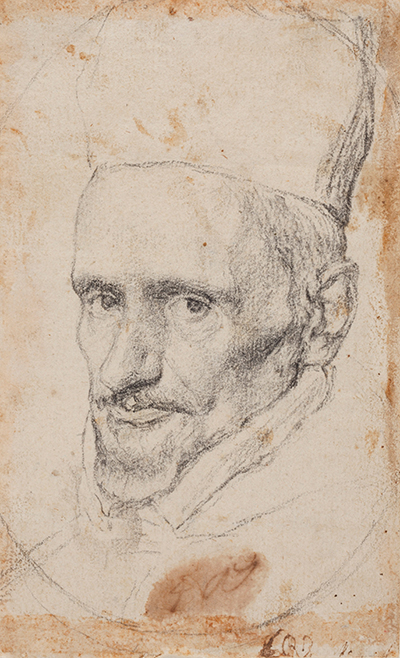
The edge of the cardinal’s cap is strongest above the ear. A dark bundle of pencil strokes rises beside the pale paper, then thins as it turns across the top. Below it, the brows and eyes occupy a narrow band of shadow. The nose points towards the left side of the sheet, while the pupils bring the cardinal’s gaze back towards us. The face takes up the better part of a drawing small enough to hold in one hand. The Real Academia de Bellas Artes de San Fernando in Madrid catalogues the study as a work by Diego Velázquez of about 1643–45. It is drawn in black pencil on pale buff laid paper, measures 188 × 116 mm and bears the inventory number D-2211. [1] [2]
At a Glance
- CollectionReal Academia de Bellas Artes de San Fernando, D-2211 [1]
- DatedAround 1643–45 [1] [2]
- MediumBlack pencil on laid paper [1] [2]
Contents
- Where the pencil bears down
- The commission and the sitting
- Two inscriptions and a later copy
- The cardinal in paint
Where the pencil bears down
Follow the lower edge of the cap across the forehead. The line descends slightly towards the ear and gives the broad, comparatively light area of skin a definite upper boundary. Then follow the outer edge of the forehead down towards the far eye. Here the line has to slow and turn in very little space. The darkening at the brow is abrupt enough to put the eye back in its socket. On the nearer side, short marks accumulate above the eye and soften across the temple. The different treatment of the two sides makes the forehead feel as though it curves away from the light. The brightest part of it is largely the colour of the paper. [2]
The nose projects because a narrow patch of light runs down beside much darker marks. A firmer touch locates the nostril and the base of the nose. From there the marks spread out again, under the cheekbone and into the line of the beard. Look at the deep slant of shadow running forward from the ear. Its edge has some of the force of an outline even though it falls inside the face. The outer rim of the ear takes sharper marks at the points where its folds overlap. The cheek itself is built up with smaller changes of tone. Across a few centimetres, a dark mark can indicate a boundary, a deep fold or the shadow cast by a projecting bone. [2]
Below the chin, several lines run obliquely towards the collar and the shoulder swings out to the right. Their weight drops away and the contours become intermittent. A small concentration of pencil near the base of the neck gives the folds a point of attachment. Elsewhere, broad areas of the garment are open paper. The collar still tells us how the head and neck sit above the body. Higher up, the brows, mouth and cheeks each demand subdivisions of light and shade. That unequal distribution of work makes the drawing particularly informative as a portrait study. Velázquez had already worked out the sitter’s turn and expression, while the handling of the cap and garments left considerable scope for a painter. [2]
The commission and the sitting
Gaspar de Borja y Velasco represented the Spanish Crown in Rome and later became Archbishop of Toledo. The painter Juan Carreño de Miranda recalled the Toledo commission in 1658, when witnesses were called for Velázquez’s admission to the Order of Santiago. In the account transcribed by Ascensión Ciruelos Gonzalo, Carreño said the cardinal asked Velázquez to paint his portrait and later sent him gifts after the painter declined payment. The inquiry concerned Velázquez’s standing and occupation, which helps explain why the witness remembered the terms of the exchange. Borja’s nomination for Toledo in 1643 and his death in 1645 provide the bounds for Ciruelos’s dating of the commission. [2]
Ciruelos reads the Academy study as drawn from life. She also reports a proposal that it was made in about 1630, when both men were in Rome during Velázquez’s first Italian journey. Carreño described the commission for the painted portrait, giving firmer grounds for dating that event than for locating the sitting for the sheet. The particular arrangement of features in the surviving likenesses matters here. The turn of the head, the glance and the shadow below the cheek recur together, while the documentary evidence independently establishes a commission from Borja. A later copy bears a written identification linking the drawing and the portrait tradition. Each strand contributes something different to the identification. [1] [2] [3]
Two inscriptions and a later copy
The Biblioteca Nacional de España preserves Retrato de Gaspar Borja y Velasco, DIB/15/28/51, in black pencil on buff paper, 295 × 188 mm. The copy gives the head substantially more blank paper around it. The lines describing the shoulders just below the face are still faint, and the dark flank of the cap remains much clearer than its top. At the bottom of the sheet Valentín Carderera identified it as a facsimile of Velázquez’s study for a painting owned by Juan Agustín Ceán Bermúdez. Ciruelos also identifies Carderera’s hand on a label from the Academy drawing’s former mount, naming Borja and Velázquez. Both identifications therefore come from one nineteenth-century scholar and collector. Carderera owned the library’s drawing. The library records its traditional association with Vicente López, and Ciruelos considers Carderera himself a possible draughtsman. [2] [3]
The Academy’s record also notes an ink inscription, read as ‘4 Rs’ by Miguel Velasco Aguirre in his 1941 catalogue. This is a separate mark on the drawing, distinct from Carderera’s label on the mount. The sheet’s route into the collection has to be reconstructed from another kind of record. In a 1931 interview, Luis Menéndez Pidal recalled finding it in a small chest among drawings he associated with the Procaccini–Maratti collection. The Academy’s accounts document the purchase of two boxes of drawings and nine volumes from Andrea Procaccini’s widow, Rosalía O’Moore, in 1775. The surviving receipt describes the purchase in groups. Menéndez Pidal’s identification of the chest is the basis for linking D-2211 to it. [1] [2] [4]
The cardinal in paint
The National Trust catalogues the canvas at Kingston Lacy, NT 1257143, as after Velázquez. It is a 457 × 381 mm oil painting on canvas laid down on panel. The cap has a full silhouette against the dark background, with red-brown colour continuing down through the clothes. The flat pale area below the cap in the drawing becomes a forehead lit against the darker temple. And the abbreviated turn below the ear becomes a high, light collar set against a heavier garment. The National Trust traces its acquisition by William John Bankes in Spain to about 1814. The canvas shows how the face could hold its own in a painted bust with fully developed costume and background. The dimensions and arrangement of Velázquez’s painted original remain open questions. [2] [5]
The canvas once owned by Ceán Bermúdez is Städel Museum 1045, a larger oil on canvas acquired by the Frankfurt museum in 1867 and currently listed under Velázquez’s workshop. A 2026 technical study compared it with the version in the sacristy of Toledo Cathedral, reproduced as fig. 1a in the study. The researchers found matching methods in the underlying design and the construction of the flesh. They argue that the two paintings were made by the same hand, proposing Francisco de Burgos Mantilla as their possible painter. Their case includes evidence of a transferred design and modelling built up in grey tones and glazes. The comparison concerns these two canvases. How their shared design reached the painter is a further question. [2] [6] [7]
The Borja sheet gives a surviving example of what a drawn likeness could preserve. There is documentary evidence for other uses of portrait drawings in Velázquez’s career. In letters of 1626 discussed by Ciruelos, Giovanni Battista Pamphilj reported sending a drawn likeness of the Count-Duke of Olivares to Cardinal Francesco Barberini in Rome so that the design could be approved for a painting. The letters even follow its journey in a metal cylinder. Such records widen the history of Velázquez’s drawings beyond the few sheets that can be examined today. For Borja, the paper survives and the identity of the painter’s finished canvas is unresolved. The light left on the forehead and the compressed shadow below the cheek are still available at the scale at which Velázquez drew them. [2] [7]
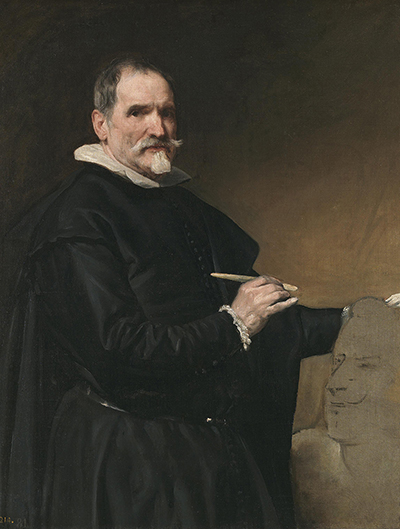
Portrait of Juan Martínez Montañés (traditional identification). Compare a different problem of relating a drawn or painted likeness to the sitter’s work and to a name handed down in catalogues. View Portrait of Juan Martínez Montañés.
Artworks directory
Frequently Asked Questions
Real Academia de Bellas Artes de San Fernando, D-2211 [1]
Follow the lower edge of the cap across the forehead. The line descends slightly towards the ear and gives the broad, comparatively light area of skin a definite upper boundary. Then follow the outer edge of the forehead down towards the far eye. [2]
Discussion
Look again at the images and ideas explored in Study for the Portrait of Cardinal Gaspar de Borja y Velasco. These editorial prompts invite your observations.
Reader Insights
Where does stronger pencil pressure help define the face?
What kinds of evidence can connect this sheet to a painted portrait?
Join the Conversation
Share a detail, comparison or question about Study for the Portrait of Cardinal Gaspar de Borja y Velasco below.
References
- Real Academia de Bellas Artes de San Fernando, Estudio para el retrato del cardenal Gaspar de Borja y Velasco, D-2211, collection record (Spanish). View source.
- Ascensión Ciruelos Gonzalo, ‘El retrato del cardenal Gaspar de Borja y Velasco por Diego Velázquez’, in José María Luzón Nogué, ed., Velázquez en Italia. Entre Luigi Amidani y Juan de Córdoba, Real Academia de Bellas Artes de San Fernando, 2022, pp. 152–162, cat. 18 and figs. 42–43 (Spanish). View source.
- Biblioteca Nacional de España, Retrato de Gaspar Borja y Velasco, DIB/15/28/51, catalogue record (Spanish). View source.
- Real Academia de Bellas Artes de San Fernando, Dos estudios de la Virgen y dos perfiles de caricatura, D-0807b, with transcription of the 1775 purchase receipt, Cuentas L.217/3, fol. 103 (Spanish). View source.
- National Trust, Cardinal Gaspar de Borja y Velasco (1582–1645), after Diego Velázquez, Kingston Lacy, NT 1257143, collection record. View source.
- Städel Museum, Portrait of Cardinal Gaspar de Borja y Velasco, 1045, collection record. View source.
- Miguel Angel Herrero-Cortell, Isidro Puig Sanchis and María Antonia Argelich Gutiérrez, ‘Copiando a Velázquez. Análisis técnico y atribución a Francisco de Burgos Mantilla de dos retratos de Gaspar de Borja’, Philostrato. Revista de Historia y Arte, no. 19, 2026, pp. 45–75 (Spanish). View source.







