


 by Tom Gurney
Tom Gurney BSc (Hons) is an art history expert with over 20 years experience
Published on June 19, 2020 / Updated on October 14, 2023
Email: tomgurney1@gmail.com / Phone: +44 7429 011000
Kitchen Maid: Introduction
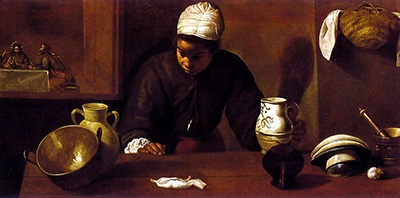
A woman bends over a kitchen table, one hand set against the wood and the other at the handle of a jug. Her head turns slightly, and her eyes are lowered. The metal basin on the left catches enough light to show both its depth and the uneven shine of its interior. The figure, the jug and the basin recur in three paintings from Diego Velázquez’s early career. In the widest of the three, held in Dublin, a far smaller table is visible beyond the kitchen. The supper taking place there gives the woman’s pause a possible cause. In the Chicago and Houston canvases the pause is still there, and the wall offers no visible view of the supper. [1] [2] [3] [4]
At a Glance
- DublinNational Gallery of Ireland, NGI.4538 [1]
- ChicagoArt Institute of Chicago, 1935.380 [2]
- HoustonMuseum of Fine Arts, Houston, 55.100 [3]
Contents
- Three canvases, three formats
- What can we see of Emmaus?
- What conservation changed
- The person at the table
- An earlier kitchen at Emmaus
- What the face tells us
- The dates on the labels
- A later scene of work around a meal
Three canvases, three formats
The National Gallery of Ireland catalogues Kitchen Maid with the Supper at Emmaus (NGI.4538) as an oil on canvas of about 1617–18 by Velázquez. At 55 × 118 cm, it is a little more than twice as wide as it is high. The Art Institute of Chicago catalogues Kitchen Scene (1935.380) as a Velázquez of 1618–20. Its canvas is almost the same height at 55.9 cm, but 104.2 cm wide. The Museum of Fine Arts, Houston lists Kitchen Maid (55.100), about 1620, under Velázquez in its current collection record. At 86.4 × 73 cm, it is the only upright canvas of the three. The dates are the respective museums’ estimates, with some overlap. [1] [2] [3]
In Dublin, the maid’s head rises almost to the top of the canvas. There is room on either side for whole groups of objects. At left the yellowish two-handled vessel stands behind the tilted metal basin. At right, the white patterned jug rises above a dark inverted vessel, with stacked dishes, a mortar and a garlic bulb nearby. A hanging basket and its draped cloth occupy the upper right. Between the sets of utensils lies a stretch of tabletop with a small pale scrap. There is enough room around it to make that empty area of wood feel like a place where someone still has work to do. [1] [4]
Chicago retains the sideways spread. The bowl at the left almost touches the edge, and at the right the pestle rises diagonally beneath the hanging basket. The turned head and the tilted bowl face roughly the same way. Above the bowl there is a broad area of muted wall where the Dublin version gives us faces and a tablecloth. With that space quiet, the white head covering and bright cuff carry the eye towards the maid, and the jug’s painted decoration draws it across to her other hand. The Chicago museum identifies the pale, crumpled scrap on the table as a paper wrapper for spices. [2] [4]
Houston gives the figure a different kind of presence. There is a taller stretch of wall above her and a deeper band of tabletop below. The yellow vessel and the wash of light on the metal basin enter at the left edge. At the right, the patterned jug stands close to the boundary of the canvas, and only part of the stacked dishes appears. A piece of pale cloth at the top right hints at the hanging arrangement that can be seen more fully in Dublin and Chicago. The table’s front edge runs across the Houston canvas beneath the scrap of paper, letting the viewer see more of the support on which the utensils rest. The upright shape limits how far the eye can range sideways and gives more prominence to the distance from that edge to the maid’s face. [3] [4]
What can we see of Emmaus?
The scene in Dublin is at the upper left, in a rectangular opening above the metal basin. A pale cloth catches the light along the front of a second table. Across it, one can make out Christ facing forwards and a bearded companion turning towards him on the right. Another figure would ordinarily complete the group, and the composition gives much less to see at the far left. The narrative is recognisable even though the view is partial. Luke tells how two disciples encounter the risen Christ on the road to Emmaus without recognising him. They invite him to stay, and at table they recognise him as he breaks the bread. The Gospel’s account names no kitchen maid. Her position close to the viewer is the painting’s way into the story. [1] [4] [5] [6]
The Dublin gallery reads the rectangle as a kitchen window and the woman’s pause as an act of listening. Her face is angled into the foreground and her hand remains on the tabletop. The viewer can look over her shoulder into the other space while she remains rooted in the kitchen. The two tables give different kinds of information. The near one has room to describe the turn of a rim and the weight of a pitcher. At the far one, a face and an answering gesture are enough to indicate an encounter. The gallery relates this distribution to sixteenth-century Flemish pictures that gave everyday activity the foreground and a sacred event a smaller place behind it. [1] [4]
One interpretation recorded by the Dublin gallery sees the maid’s attention as a spiritual awakening. Its suggestion of early ownership by Archbishop Pedro de Castro y Quiñones, who promoted the baptism of Africans in Seville, is a proposal. The gallery’s provenance records the painting in Sir Otto Beit’s collection by 1913 and its gift by Sir Alfred and Lady Beit in 1987. The relation between those two painted rooms can be examined directly. The earliest ownership and the precise meaning someone might have attached to the scene depend on different evidence. [1]
What conservation changed
For a time there was no visible Emmaus in the Dublin canvas either. In the Prado’s 1990 catalogue, Julián Gállego records that cleaning in 1933 removed overpaint from the Beit painting’s background and revealed the opening and the figures at table. The Galleria Borghese gives the same account in its material for the Dublin loan in 2024. A much later treatment, documented by the National Gallery of Ireland in 2018, used microscopy and ultraviolet and infrared examination. Removing discoloured surface material and old retouching changed the relationships between light and dark and improved the legibility of damaged passages around the head covering, a cloth and the garlic. The uncovering of the supper and this later work on the picture’s surface belong to different moments in the same canvas’s history. [6] [7] [8]
The Chicago painting has its own technical record. Gridley McKim-Smith and colleagues describe shifts in the shapes of pitchers and bowls as the work was painted. In their infrared image of the jugs and stacked plates, the dark inverted pitcher had originally stood high enough to hide the base of the decorated white jug. Lowering its outline left enough of that base visible to show where it meets the tabletop. That small adjustment anchors both jugs to the same surface. The researchers also found distortions in the weave associated with stretching at all four edges, limiting how much of the canvas could have been cut away. [9]
For Houston, the museum announced in 2018 that senior paintings conservator Zahira Bomford had concluded after conservation and research that the painting could be attributed to Velázquez. The announcement records the change from a label saying In the style of Diego Velázquez to one saying Attributed to Diego Velázquez. The collection entry now names him directly as artist. The upright format can be described from the painting as it survives. It leaves the question of any lost canvas open, and neither format nor the recurring objects can settle the order in which all three were made. Gállego records earlier claims for the priority of Chicago and how the cleaning of the Beit picture prompted a reassessment. The dates and attributions on today’s records capture a later stage of that discussion. [1] [2] [3] [4] [6] [10]
Further reading
The 2023 exhibition brought the Dublin, Chicago and Houston paintings together. Its catalogue considers the role of enslaved labour in seventeenth-century Spain.
Juan de Pareja: Afro-Hispanic Painter in the Age of Velázquez. David Pullins and Vanessa K. Valdés, with essays by Luis Méndez Rodríguez and Erin Kathleen Rowe. The Metropolitan Museum of Art, 2023
The person at the table
The Art Institute of Chicago calls its painting a bodegón, using a Spanish term derived from the word for a pantry. Here the genre takes in both the still life and the person who handles the utensils. The museum describes her as a young African woman and raises the possibility of an enslaved model. That proposal belongs to the history of domestic life in Velázquez’s Seville, where slavery was widespread, and the sitter’s identity remains unresolved. In 2023 the Metropolitan Museum of Art brought the three canvases together for the first time in its exhibition on Juan de Pareja. The placement drew attention to Afro-Hispanic presence and to enslaved labour in seventeenth-century Spain. It also offered an occasion to see how much of the painted surface is given to the maid’s figure in each work, something the term still life alone can make easy to overlook. [2] [11]
Velázquez uses a separate kitchen and a separate episode in Christ in the House of Martha and Mary (National Gallery, London, NG1375). There, an older woman gestures beside a cook at a mortar, and Christ appears with Martha and Mary in an inset at the upper right. The London gallery reads it as an opening and records that it has also been taken for a mirror or a picture. In Dublin the opening is on the other side, and the two tables link kitchen labour to a meal at which recognition happens. Chicago and Houston have only the one visible table. There the bright cuff, the grip on the jug and the downward look are enough to hold attention on the woman during a moment for which the picture supplies no explicit explanation. [1] [4] [5] [12]
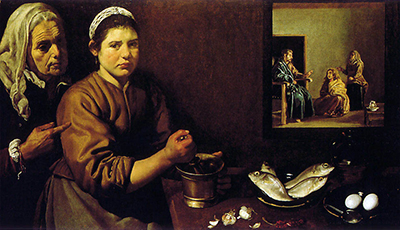
Kitchen Scene with Christ in the House of Martha and Mary. Compare how the two kitchen paintings set the brightly lit objects against the smaller narrative scene. View Christ in the House of Martha and Mary.
An earlier kitchen at Emmaus
In Jacob Matham’s engraving of 1603, a kitchen worker turns towards a boy holding a fish. A basin sits between them, and the table is piled with seafood. Farther back, a servant draws aside a curtain to reveal the Supper at Emmaus. The print gives the viewer two things to discover: a small episode of recognition at the back and an active chain of work at the front. The boy brings a fish, the woman prepares it and the servant at the curtain opens the view into the other room. It is an unusually close comparison for the Dublin painting because the two works give the same Gospel episode to the background of a kitchen. Urte Krass proposes the engraving as a likely source for Velázquez. That relationship is inferred from the compositions. [13] [14]
Joachim Beuckelaer’s earlier Kitchen Scene with Christ at Emmaus, now at the Mauritshuis, makes the foreground abundant in a different way. Fruit, vegetables, nuts, poultry and a large cut of meat occupy a panel more than a metre high. The display suggests a meal substantial enough to account for the scale and equipment of the kitchen. In Dublin, the gleaming interior of the basin is empty and the inverted crockery presents its undersides. The garlic offers scarcely a hint of a menu. Putting the works together brings out how little Velázquez tells us about what the kitchen is producing. The utensils mark the stages of work that might take place there, and the woman is the one person available to perform them. [14] [15] [16]
The difference matters even after the sacred episode drops out of view. In the Chicago and Houston paintings the equipment suggests a meal without showing its preparation in progress. Compare the woman’s grip on the jug with the boy’s lifted fish in Matham’s print. The fish is visibly on its way from one person to another. The painted jug remains upright, and there is no visible recipient for whatever it might hold. A serving vessel thus helps create a pause in all three compositions. Dublin gives that interval a possible meaning through the supper in the next room. In Chicago and Houston the viewer has to read the interval through the action at the kitchen table itself. [13] [16] [17]
The engraving also supplies a caption below the image. It tells the reader that Jesus is recognised in the breaking of the bread, directing attention towards the small scene at the back. Krass connects the foreground fish to a later episode in the same chapter of Luke, when the risen Christ eats fish in Jerusalem. The engraving can therefore be read as holding two meals in view at once. Velázquez gives the foreground utensils no equally explicit link to a second episode. [13] [14]
What the face tells us
Krass approaches the Dublin woman’s downward look through the sequence of events in Luke. Recognition comes in two stages. The disciples see and converse with their travelling companion without knowing him. Only at the table do they understand whom they have been looking at. The maid’s face could belong to either side of that change in understanding. Her lowered eyes can suggest absorption in a task, attention to something out of sight or thought prompted by something she has heard. The viewer can recognise what is happening beyond the kitchen while the figure nearest to us remains harder to read. [14] [16]
The names attached to the picture have sometimes made that uncertainty harder to see. Krass traces the use of the historical Spanish label La mulata, a racial designation that assigned the figure a particular ancestry. In his 1913 account of the Dublin picture, Aureliano de Beruete y Moret described her in terms of her work. Krass suggests that the racial title entered use around the painting’s emergence into public view in the early twentieth century. The evidence for it belongs to the history of describing the canvas. The ancestry, legal status and beliefs of any person who might have posed remain undocumented. [14]
The dates on the labels
The 2023 Met checklist calls the Dublin work Kitchen Maid with the Supper at Emmaus and dates it to about 1617. It gives both other loans the title Kitchen Maid and dates both to about 1618. Chicago had published its canvas as The Kitchen Scene, 1618–20, in its museum journal, while Houston’s collection entry dates its work to about 1620. The common title in the Met checklist makes the two loans easy to group, but searching for it alone can obscure the Chicago record. The dates are estimates attached to individual cataloguing decisions. The Met’s two identical dates leave the relationship in time between Chicago and Houston open. [16] [17] [18] [19]
The Dublin gallery’s exhibition history also puts that comparison in perspective. Its picture had already travelled to the Art Institute of Chicago in 1992 with a touring selection from the Irish collection. That entry documents the loan and its venue. Whether the museum’s own Kitchen Scene was then displayed alongside it is a separate question. The 2023 exhibition record explicitly groups all three works, giving us a documented occasion when viewers could compare the Dublin, Chicago and Houston paintings together. [16] [17]
A later scene of work around a meal
The Met checklist places Bartolomé Esteban Murillo’s Three Boys, painted about 1670, immediately after the kitchen pictures. In Murillo’s scene, a standing boy extends his hand while one of the seated boys shields a pie. The other reaches towards the standing boy’s pocket. A small jug in the foreground helps explain what might have happened just before this exchange. Dulwich Picture Gallery notes that the standing boy may have supplied water and could be asking for payment or a share of the pie. His shoes and jacket also distinguish him from the barefoot seated pair. [17] [20]
An older title recorded by Dulwich treated the standing boy as the object of charity. The possible exchange over water gives his extended hand a different purpose and makes the hand reaching towards his pocket harder to overlook. Beside the kitchen pictures, the Murillo brings out how much a viewer can infer from the position of a hand without knowing the figure’s story. His three boys supply one another with visible motives for moving and looking. Velázquez’s maid has no companion at her own table to answer her gesture. The jug under her hand places her within the work of serving a meal, while her attention remains her own. [16] [17] [20]
Artworks directory
Frequently Asked Questions
The National Gallery of Ireland catalogues Kitchen Maid with the Supper at Emmaus (NGI.4538) as an oil on canvas of about 1617–18 by Velázquez. At 55 × 118 cm, it is a little more than twice as wide as it is high. The Art Institute of Chicago catalogues Kitchen Scene (1935.380) as a Velázquez of 1618–20. [1] [2] [3]
The National Gallery of Ireland catalogues Kitchen Maid with the Supper at Emmaus (NGI.4538) as an oil on canvas of about 1617–18 by Velázquez. At 55 × 118 cm, it is a little more than twice as wide as it is high. The Art Institute of Chicago catalogues Kitchen Scene (1935.380) as a Velázquez of 1618–20. [1] [2] [3]
For a time there was no visible Emmaus in the Dublin canvas either. In the Prado’s 1990 catalogue, Julián Gállego records that cleaning in 1933 removed overpaint from the Beit painting’s background and revealed the opening and the figures at table. The Galleria Borghese gives the same account in its material for the Dublin loan in 2024. [6] [7] [8]
Discussion
Look again at the images and ideas explored in Kitchen Maid. These editorial prompts invite your observations.
Reader Insights
How does the visible scene at Emmaus change where your attention goes in the Dublin painting?
Compare the arrangement of vessels in the three versions. Which change has the strongest effect on how you see the maid?
Join the Conversation
Share a detail, comparison or question about Kitchen Maid below.
References
- National Gallery of Ireland, Diego Velázquez, Kitchen Maid with the Supper at Emmaus, NGI.4538, collection record, description and provenance. View source.
- Art Institute of Chicago, Diego Velázquez, Kitchen Scene, 1935.380, museum collection data and label, object 21934. View source.
- Museum of Fine Arts, Houston, Diego Velázquez, Kitchen Maid, 55.100, collection record. View source.
- The Metropolitan Museum of Art, Juan de Pareja, Afro-Hispanic Painter, 2023, illustrated checklist showing the three works. View source.
- Gospel of Luke, 24:13–35, in the text published by the United States Conference of Catholic Bishops. View source.
- Julián Gállego, catalogue no. 1 in Antonio Domínguez Ortiz, Alfonso E. Pérez Sánchez and Julián Gállego, Velázquez, Museo del Prado and Ministerio de Cultura, Madrid, 1990, pp. 58–61. Spanish. View source.
- Galleria Borghese, A Velázquez in the Museum, 2024 exhibition account for the loan from Dublin. View source.
- National Gallery of Ireland, Annual Report 2018, pp. 58–59, conservation account and images of NGI.4538. View source.
- Gridley McKim-Smith, Inge Fiedler, Rhona Macbeth, Richard Newman and Frank Zuccari, ‘Velázquez: Painting from Life’, Metropolitan Museum Journal 40, 2005, pp. 79–91, especially pp. 79–82 and fig. 3 for Chicago 1935.380. View source.
- Kerry Ingram, ‘Rediscovering a Velázquez: The Attribution of “Kitchen Maid”’, Museum of Fine Arts, Houston, on the 2018 attribution announcement. View source.
- The Metropolitan Museum of Art, ‘First Major Exhibition on Afro-Hispanic Painter Juan de Pareja, the Subject of Diego Velázquez’s Iconic Portrait, to Open at The Met’, 2023, exhibition context and account of the three loans. View source.
- The National Gallery, London, Diego Velázquez, Kitchen Scene with Christ in the House of Martha and Mary, NG1375, collection entry and in-depth description. View source.
- Allen Memorial Art Museum, Oberlin College, Jacob Matham after Pieter Aertsen, A Kitchen Scene with Supper at Emmaus, 1603, engraving, 2012.13. View source.
- Urte Krass, ‘Mulata, Morisco, African Slave? Thoughts on an Elusive Protagonist in a Painting by Velázquez’, 21: Inquiries into Art, History, and the Visual 2, no. 4 (2021), pp. 3–34, especially pp. 5–11, 17–19 and 31–32. View source.
- Mauritshuis, Joachim Beuckelaer, Kitchen Scene with Christ at Emmaus, c. 1560–65, inv. 965, collection record. View source.
- National Gallery of Ireland, Velázquez, Kitchen Maid with the Supper at Emmaus, NGI.4538, collection record and exhibition history. View source.
- The Metropolitan Museum of Art, Juan de Pareja, Afro-Hispanic Painter, 2023, illustrated exhibition checklist, three kitchen paintings and Murillo’s Three Boys. View source.
- Frank Zuccari, Zahira Véliz and Inge Fiedler, ‘Saint John in the Wilderness: Observations on Technique, Style, and Authorship’, Art Institute of Chicago Museum Studies 31, no. 2 (2005), p. 32, fig. 3, The Kitchen Scene, 1935.380. View source.
- Museum of Fine Arts, Houston, Velázquez, Kitchen Maid, 55.100, collection record. View source.
- Dulwich Picture Gallery, Bartolomé Esteban Murillo, Three Boys, c. 1670, DPG222, collection record and interpretation. View source.







