


 by Tom Gurney
Tom Gurney BSc (Hons) is an art history expert with over 20 years experience
Published on June 19, 2020 / Updated on October 14, 2023
Email: tomgurney1@gmail.com / Phone: +44 7429 011000
Diego Velázquez Drawings: Introduction
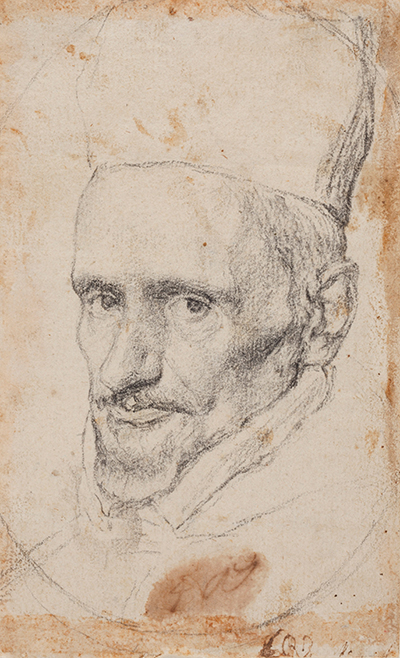
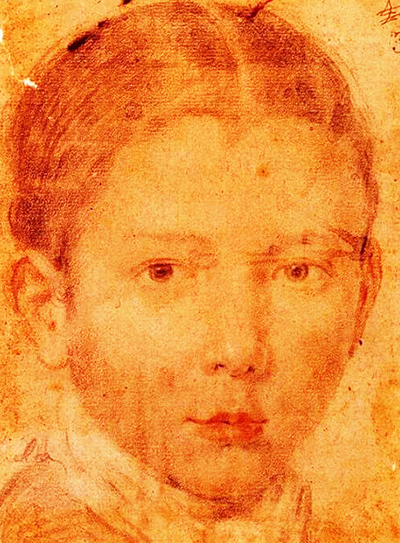
Cardinal Gaspar de Borja turns his eyes towards us while his nose and chin point to the left. A patch of dark pencil above his cheekbone gives depth to the eye socket. The paper itself supplies much of the light on his forehead. Below the face, a few broad strokes stand for the collar and shoulders. This is one of the most securely identified drawings by Diego Velázquez, and it is small enough to hold in one hand. The Real Academia de Bellas Artes de San Fernando in Madrid catalogues the study as black pencil on pale laid paper, 188 × 116 mm, and dates it to 1643–45. [1] [2]
The sheet offers an unusually good starting point for a painter whose surviving drawings are few and whose authorship is disputed in several cases. At the Biblioteca Nacional de España, two young women’s heads show how a similar drawing medium could lead to different kinds of study. An Academy sheet still carries a grid that could have helped transfer a figure at another scale. In London, a horse and rider on a British Museum sheet invite comparison with court paintings, while the National Gallery’s Christ after the Flagellation preserves early drawing marks in the paint itself. Each puts a different part of Velázquez’s work within reach. [3] [4] [5] [6]
At a Glance
- Documented studyCardinal Gaspar de Borja y Velasco, Academia D-2211 [1] [2]
- Two related sheetsYoung women’s studies in the Biblioteca Nacional de España [3]
- Lost sheetThe Gijón guardian angel study survives in reproduction [7]
Contents
- How Velázquez drew the Cardinal Borja
- Two young women’s heads in Madrid
- Two cloaked figures and the question of Breda
- Horses on paper and in the Hall of Realms
- The lost angel study and the lines on the canvas
- What collectors and photographs preserved
- Browse the drawings
- What Velázquez learned from Pacheco’s portraits
- A small mark on drawings by different artists
- A disputed view of Granada
How Velázquez drew the Cardinal Borja
Look first at the space between the cardinal’s brows and mouth. Pencil has accumulated around the eyes, in the recess beside the nose and at the junction between the lips. Their placement gives the expression its concentration. The edge of the cap is drawn firmly, yet its surface is left largely open. To the right, the ear almost disappears into a shadow that also does the work of separating the jaw from the neck. The likeness depends as much on the placement of a dark patch as on the accuracy of an outline. [1] [2]
Ascensión Ciruelos Gonzalo, writing for the Academy’s 2022 exhibition Velázquez en Italia, treats the Borja drawing as a study made directly from life. Its small format is part of what makes it so revealing. A likeness has been established with very little space for elaboration. The differing angles of the nose, ear, eyes and cap carry the turn of the head. The drawn shoulder gives us enough of the body to tell how the head sits, then attention comes back to the face. For a painter preparing a portrait, the sheet could preserve the harder things to recover from memory after a sitting, including the fall of a cheek and the way the near eye looks out from under the brow. [2]
The date has a documentary basis, with some room for interpretation. In 1658, when witnesses were asked about Velázquez for his admission to the Order of Santiago, the painter Juan Carreño de Miranda recalled that Borja commissioned a portrait while he was Archbishop of Toledo. According to Carreño, Velázquez declined money and the cardinal responded with gifts. Ciruelos uses the testimony to place the painting in the last years of Borja’s life, between his nomination for Toledo in 1643 and his death in 1645. She also records the suggestion that the drawing could have been made during Velázquez’s first Italian journey, when Borja was in Rome. The testimony concerns the portrait commission, leaving the timing of the sitting for the drawing open to discussion. [1] [2]
Painted versions complicate the picture further. The National Trust catalogues the one at Kingston Lacy in Dorset as after Velázquez. In it the cardinal’s gaze and turn of the head recall the sheet, with the sitter’s clothes and dark background fully worked out in paint. Ciruelos also discusses a version now in Frankfurt that belonged to the historian and collector Juan Agustín Ceán Bermúdez. He understood it to be by Velázquez, an authorship Ciruelos says has since been rejected. The recurrence of the likeness helps establish the importance of the drawing to the portrait tradition. Each canvas has its own history and needs its own evidence of authorship. [2] [8]
The Academy also knows of a copy of the drawing itself, preserved at the Biblioteca Nacional de España as DIB/15/28/51. Its traditional attribution is to Vicente López, though Ciruelos raises the possibility that Valentín Carderera drew it. Carderera wrote the inscription identifying the library drawing as a facsimile and also wrote a label on the former mount of the Academy’s sheet. These notes help explain how the two became associated. The change in size gives another way to tell them apart. The library’s copy is 295 × 188 mm, more than ten centimetres taller than the original. [2]
Two young women’s heads in Madrid
Two drawings at the Biblioteca Nacional de España share the title Cabeza de muchacha. The first, Bust of a Young Woman, is Dib/16/40/21, or B. 492. It includes the shoulders and part of the upper body. A light interval separates the forehead from the outer hair on one side. The dark hair directs the eye down towards the loose strokes below the throat, where several lines remain visible around the shoulder. The breadth of the drawing lets us follow the movement from a closely observed face into a freely indicated body. [3]
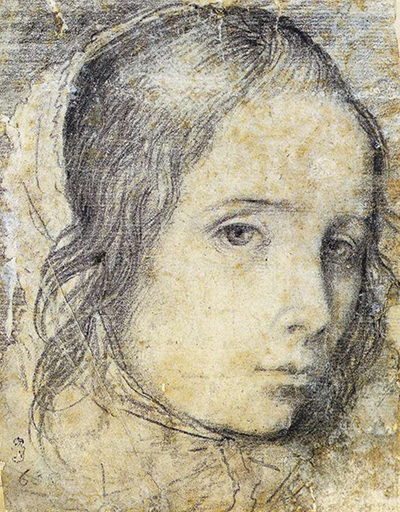
The second, Head of a Young Woman, is Dib/16/40/22, or B. 493. The face turns farther to the viewer’s right, and the tighter framing lets the head nearly fill the sheet. The dark area of hair at the back contrasts with the slight marks at the jaw and neck. Small changes in tone across the cheek matter more here because so little of the clothing is visible. Compare the intervals between eye, nose and mouth in the two sheets. The similar scale of those features in reproductions can make the works seem closely interchangeable, until you follow each head into the different spaces around it. [3]
Isabel Clara García-Toraño Martínez and María Represa Martín, both writing from the library, place the drawings around 1620–22, before Velázquez’s move to court, and see the influence of his teacher Francisco Pacheco in their handling. They describe both sheets as black pencil with touches of white chalk on yellowish laid paper. Where the dark medium closes down the light around the eyes and hair, a pale accent can lift a small area of the face from the warm colour of the sheet. Reproductions are useful for seeing the arrangement of tones, though differences in photography and screen contrast can make it hard to tell a white chalk accent from a patch of exposed paper. [3]
The two sheets have separate collector histories, associated in the library study with Carderera and Madrazo. The study also rejects the identification of the sitter as Juana Pacheco, Velázquez’s wife, and records no established connection between either sheet and a painting. The quiet attention given to the faces has encouraged suggestions that someone close to the painter sat for them. The sitter’s name remains open. Accession numbers and the extent of the shoulders are more dependable guides to these two objects than a familiar name attached to a picture of an unnamed face. [3]
Pacheco on drawing from life
In Arte de la pintura, Francisco Pacheco remembered Velázquez in his youth drawing a boy whom he employed as a model. As quoted in the Academy catalogue, Pacheco describes numerous heads made with charcoal and highlights on blue paper, along with studies from other models. He connects these exercises to the younger artist’s ability to achieve a likeness. This is testimony from Velázquez’s teacher about a practice he had reason to know. It also describes a different combination of paper and medium from the one recorded for the library sheets. The broad history of practice gives the drawings a context, while the physical evidence of each sheet lets it be studied on its own terms. [2] [3]
The colour of the support makes a practical difference. On a coloured paper that acts as a middle tone, the draughtsman can work down towards shadow with charcoal and up towards light with a pale medium. On Borja’s light paper, a piece of the forehead can be kept bright simply by letting the sheet show. Spanish catalogue records often use lápiz negro, rendered here as black pencil. That record identifies the drawing medium as catalogued. It leaves room for distinctions of material and manufacture that a photograph alone cannot resolve. [1] [2] [3]
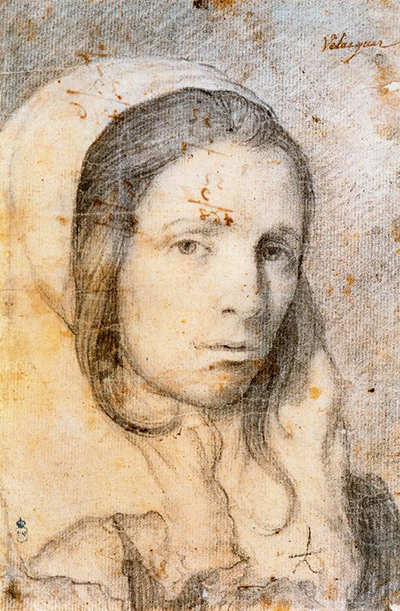
Cabeza de muchacha (the bust-length study). The larger of the two Biblioteca Nacional young-woman studies leaves more room for the shoulders and headdress. View Bust of a Young Woman.
Two cloaked figures and the question of Breda
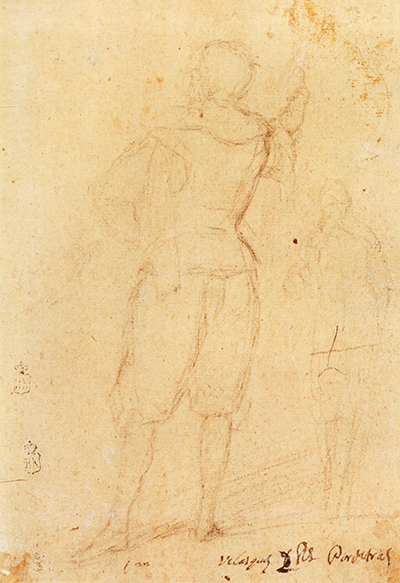
A man in profile faces right on Academy sheet D-2212. Its squared surface distinguishes it from the Borja drawing and the young women’s heads. The Academy describes the medium as black pencil, with the grid also drawn in pencil, on pale laid paper. A grid gives the person using it a set of coordinates. Copy the edge of a cloak from one square into the corresponding square on a larger surface, and the figure can grow in scale without losing the angle of its shoulder or the relation of head to body. That is a possible use of the grid. The sheet’s catalogue history leaves the maker and destination of any transfer open. [4]
The Academy measures this sheet at 236 × 130 mm and records it as a gift from Ferdinand VII by royal order of 18 February 1818, from the chapel sacristy at the Duke of Arco’s estate. An ink inscription reads “Belazquez”. An old royal inventory entry, linked to the sheet by the twentieth-century cataloguer Miguel Velasco Aguirre, describes a cloaked man warming himself. Several scholars accepted Velázquez’s authorship over the years. The Academy also records that José López-Rey and Jonathan Brown rejected it, and the collection labels the drawing attributed to Velázquez. [4]
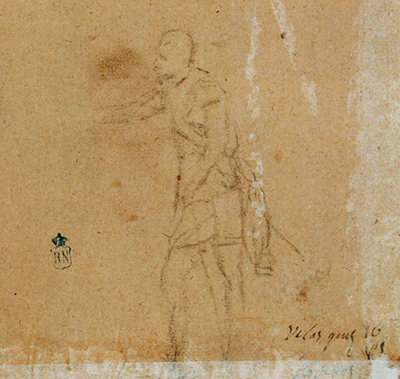
The other Academy sheet, D-2213, is substantially larger, at 393 × 227 mm. It is in black pencil on laid paper tinted light ochre. It came to the Academy in 1836 from the Valparaíso monastery, from the collection assembled by Juan Guerrero, and had been mounted in the second Valparaíso volume. The Academy’s entry traces a different argument over authorship. Elías Tormo tentatively proposed Juan Carreño de Miranda. Alfonso E. Pérez Sánchez accepted Velázquez in 1967 and later recorded both possibilities. The name in pencil at the lower right is itself recorded as a later annotation associated with Madrazo. [9]
The two sheets can be considered alongside The Surrender of Breda, painted in the mid-1630s for the Hall of Realms at the Buen Retiro Palace. It shows Ambrogio Spinola receiving the keys of Breda from Justin of Nassau after the surrender of 1625. See how much of that central encounter depends on the disposition of shoulders and limbs. Spinola’s arm extends towards the man approaching him, and the people behind them establish the narrow space in which the exchange takes place. A study of a cloaked figure can help us notice how much a shift in stance or a fall of fabric changes the bearing of a figure at that scale. The Academy’s descriptive titles leave the figures unnamed. Reading one of the sheets as a study of Spinola requires a closer match and stronger evidence of the sequence than similarity of costume or subject. [4] [9] [10]
A comparison with a different object shows what a closer correspondence can look like. The Metropolitan Museum of Art has an oil portrait of around 1635, Portrait of a Man, Possibly a Self-Portrait (49.7.42), that it considers a probable study for a head in Breda. In the large painting, that face peers out from the Spanish group towards the viewer. Comparing the eyes and the angle of the head with the New York canvas gives a specific point of contact. This is a suggested link between two paintings. The Met also leaves open whether the face is Velázquez’s own, a separate question from whether the portrait served as a study. [10] [11]
Horses on paper and in the Hall of Realms
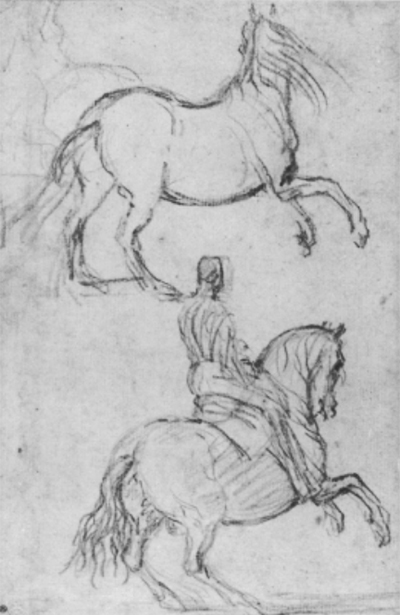
The British Museum drawing Studies of a Horse and Man on Horseback sets two views on the same sheet. The rider appears with the more developed horse below, and a second horse is sketched more lightly above. The Spanish government’s loan schedule for the Prado’s 2013 exhibition of British Museum drawings identifies the sheet as 1850,1014.101. It describes two studies of rearing horses, one with a rider, and gives a date of about 1625–35, black pencil and dimensions of 247 × 164 mm. The attribution is explicitly qualified. [5] [12]
Try following each horse from its chest down to the forelegs and then up towards its head. The longer you look, the more the pose depends on the angle and position of each part. Adding a rider changes what has to be resolved. There is a second body above the moving animal, with a different centre of gravity and its own relation to the direction of the horse’s head. Having both versions on a single page makes it easier to follow those questions. Royal commissions such as Philip IV on Horseback offer a comparison for the rearing pose. The 2013 record supplies no specific commission for this sheet. [5] [10] [12]
The Academy preserves another horse study, D-2214, that uses black pencil on pale paper and shows the head and foreleg of the horse in Isabel of Bourbon on Horseback. It catalogues the draughtsman as anonymous and the sheet as a copy after Velázquez, though earlier scholarship records an attribution to him. The underlying composition and the artist responsible for the surviving drawing are two different facts. A useful comparison here is with the crop. By isolating the horse’s head and front leg, the copy allows sustained attention to a fragment that in the Prado canvas competes with the queen’s figure, the elaborate fabric and the full body of the horse. [10] [13]
The lost angel study and the lines on the canvas
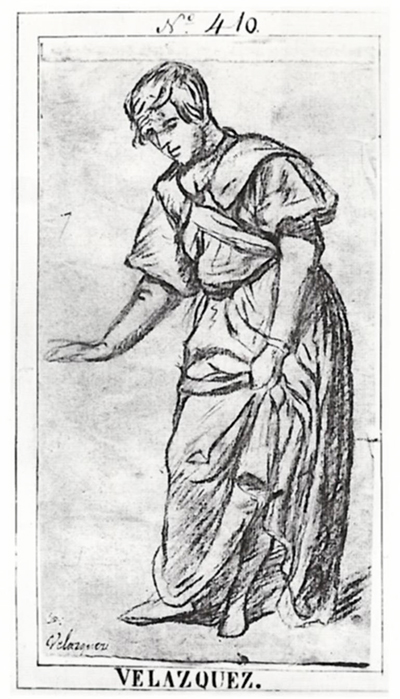
In the National Gallery’s Christ after the Flagellation contemplated by the Christian Soul, a guardian angel bends over a kneeling child and extends a hand towards Christ. The child represents the Christian soul. The gesture guides the child’s attention across a stretch of unoccupied floor. There was a drawing of the angel in the Instituto de Jovellanos in Gijón. In 1908 Albert F. Calvert and C. Gasquoine Hartley reported that the historian Aureliano de Beruete was inclined to accept it as a study for the London painting. A history of the Gijón collection reproduces the study as no. 410 in José Moreno Villa’s 1926 catalogue. The Instituto’s drawings were destroyed in 1936, during the Spanish Civil War. [12] [14] [7]
In the old reproduction it is possible to follow the inclination of the upper body and the line of the outstretched arm. Set beside the painting, the pose makes it easy to understand why it was connected with the angel. A reproduction can preserve the arrangement and relative strength of lines. With the sheet gone, questions about the paper, the material of individual strokes and the age or hand of an inscription are much harder to resolve. The drawing’s image and the oil painting are two kinds of surviving evidence, with separate histories and very different degrees of access to their physical surfaces. [14] [7]
The canvas, probably painted in 1628–29 according to the National Gallery, carries its own evidence of drawn preparations. Conservator Larry Keith and curator Dawson W. Carr identified a brown-black painted sketch beneath parts of the finished work. Some marks around Christ’s eye, nostril and chin can be seen where the flesh paint is thin, including in the close detail the authors publish. The lines have too little contrast with the dark ground to register in infrared images. The same marks that elude the camera remain visible in ordinary light because so little paint lies over them. The column suggests a different possibility. Straight edges of paint ending just short of one another leave the ground showing, which could indicate a chalk or charcoal guide subsequently brushed away. This remains an inference from the edges, whereas the brushed lines in the face survive visibly. [6] [14]
X-radiography and examination of the painting also revealed changes to the position of Christ’s loincloth, the tilt of the child’s head and the bundle of garments in the foreground. Such changes in a painting are known as pentimenti, traces of an earlier decision altered as work progressed. The tilt of the child’s head matters because it directs the gaze towards the body on the floor. A change that takes up little room on the canvas can alter how the figures appear to relate. Keith and Carr find evidence of substantial planning in the whole design, even as individual decisions changed in the painting process. A study on paper, an early line brushed onto canvas and a changed shape under the finished paint can all belong to the making of one picture. [6]
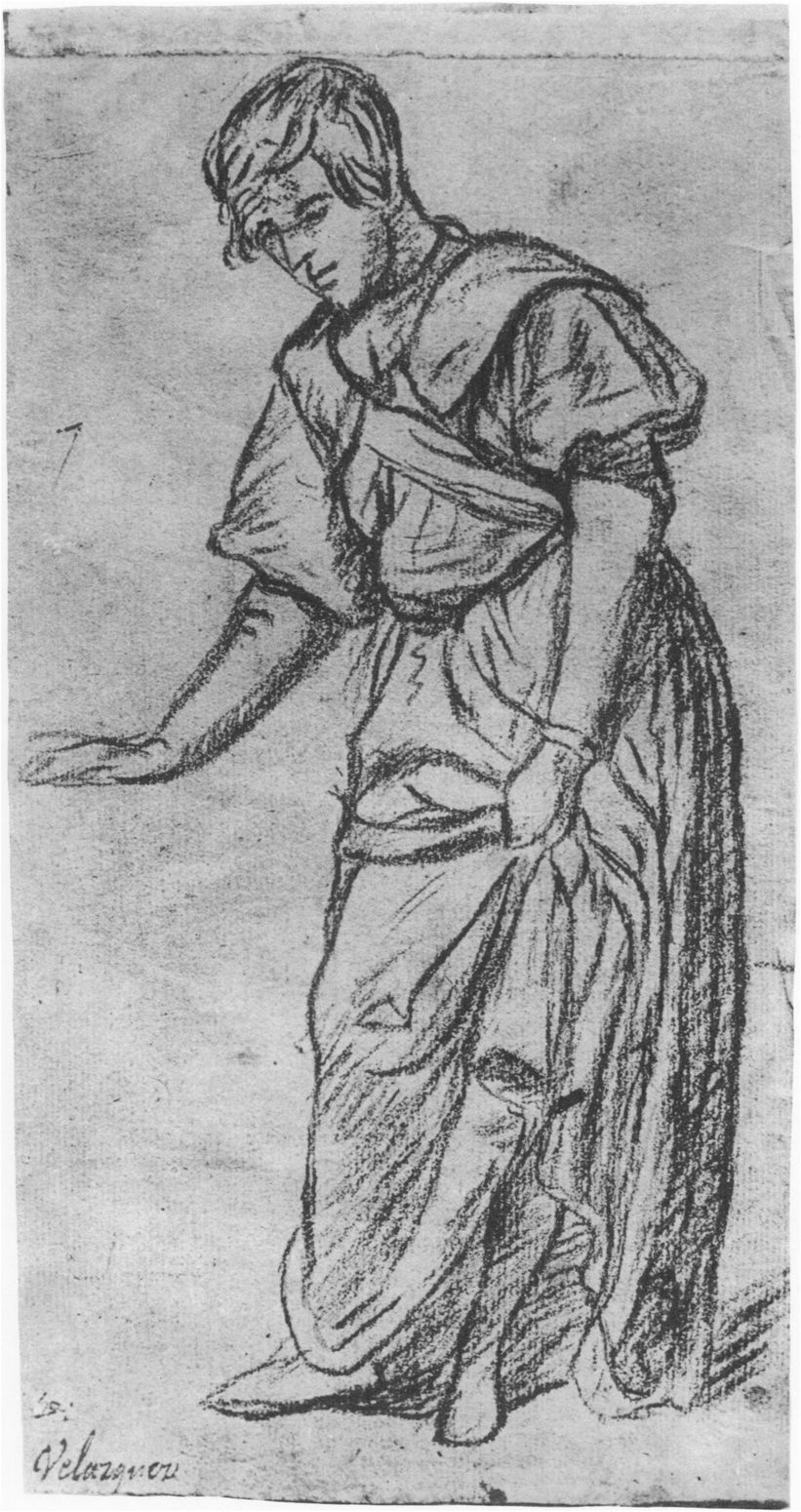
Early reproduction of the lost Guardian Angel study formerly kept at the Instituto de Jovellanos, Gijón. The drawing’s pose can still be compared with the painted angel through this record. Image source. Public domain. Resized for display.
What collectors and photographs preserved
Some drawings survive through albums, royal gifts or the attention of individual collectors. The cloak studies show two such paths within one institution, from the Duke of Arco’s estate and from the Valparaíso albums respectively. The Borja sheet has a less straightforward recorded history. In 1931 Luis Menéndez Pidal recalled finding it among drawings he associated with the Procaccini–Maratti collection. The Academy preserves this account, and the association is based on his report. Cards, mounts and inscriptions provide further clues, as they do in the case of Carderera’s labels on the Borja study and its copy. [1] [2] [4] [9]
Other drawings enter the account through correspondence. Ciruelos follows a commission made by Cardinal Francesco Barberini during his visit to Spain in 1626. Giovanni Battista Pamphilj, the future Innocent X, reported sending a drawn likeness of the Count-Duke of Olivares to Rome for approval. It travelled in a metal cylinder and arrived intact despite damage to its container. That history gives the drawing a practical purpose before any painted portrait could be delivered. Ciruelos also cites Pacheco on the hours Velázquez spent drawing in the Sistine Chapel and Raphael’s rooms, to which Barberini helped give him access. Written evidence of these activities is richer than the surviving record of individual sheets from them. [2]
Gijón offers a particularly well documented example of how originals and records can part company. Six drawings then associated with Velázquez were lent from the Instituto de Jovellanos for the Prado’s 1899 commemoration. Photographs taken around this exhibition and the later work of Moreno Villa preserved images of sheets whose original surfaces were lost in the Civil War. For some drawings a scholar can still examine a pose and compare it with a painting. For others, a catalogue entry or an old description may be all that can be followed. The surviving body of work reflects these different histories of collection, documentation and loss. [7]
Browse the drawings
| Drawing | Collection and status |
|---|---|
| Study for the Portrait of Cardinal Gaspar de Borja y Velasco | Real Academia de Bellas Artes de San Fernando, Madrid, D-2211. Catalogued as Velázquez and preparatory for the Borja portrait. [1] |
| Bust of a Young Woman | Biblioteca Nacional de España, Madrid, Dib/16/40/21 (B. 492). The bust-length study published by library staff. [3] |
| Head of a Young Woman | Biblioteca Nacional de España, Madrid, Dib/16/40/22 (B. 493). The closer view, with the head turned farther right. [3] |
| Study of a Man in Profile with a Cloak | Real Academia, D-2212. The squared sheet, attributed to Velázquez. [4] |
| Study of a Man with a Cloak | Real Academia, D-2213. The larger sheet from Valparaíso, attributed to Velázquez. [9] |
| Studies of a Horse and Man on Horseback | British Museum, London, 1850,1014.101. Attributed to Velázquez in the 2013 Prado exhibition loan record. [5] |
| Head and Foreleg of Isabel of Bourbon’s Horse | Real Academia, D-2214. Anonymous copy after Velázquez. [13] |
| Study for the Guardian Angel | Formerly Instituto de Jovellanos, Gijón, Moreno Villa cat. 410. The original was lost in 1936. A reproduction preserves the pose for comparison with the National Gallery painting. [12] [14] [7] |
Drawing catalogue
What Velázquez learned from Pacheco’s portraits
The oblique strokes behind the sitter in the larger of the library’s two heads are worth following out to the edge of the paper. They are most conspicuous around the pale headdress, where they give its curve enough definition to emerge from the surrounding sheet. Benito Navarrete Prieto compares this background with one in a drawing by Pacheco traditionally identified as a portrait of the poet and playwright Juan de la Cueva. In Pacheco’s drawing, the shaded field sets off the contours of the head and clothing. Velázquez takes a similar arrangement and lets the definition vary along the edge. The cloth is clear where it catches the light against the diagonal strokes, then dissolves into much looser marks below. The comparison gives us a specific way to see the teacher’s practice carried into the younger artist’s work. [15] [16]
Pacheco’s portrait is linked to the Libro de retratos, his collection of likenesses and written accounts of notable men. The surviving manuscript at the Fundación Lázaro Galdiano contains 56 portraits. Pacheco drew them on separate pieces of paper, which were then pasted onto pages bearing accounts of the subjects. The Biblioteca Nacional’s drawing of the man generally identified as Cueva has its own history of mounting. It was cut around the silhouette and attached to a second support, then to a third. Its catalogue also records touches of lead white that have darkened through oxidation. Mounting changes what a viewer can see of the edges, while changes in a drawing material can alter the apparent distribution of light. Those details complicate a side-by-side comparison even when the drawings can be seen clearly in reproduction. [16] [17]
The published descriptions of Velázquez’s bust offer another reason to look carefully at how the tones were made. Navarrete Prieto records small touches of black wash in addition to the pencil. Isabel Clara García-Toraño Martínez and María Represa Martín describe slight white chalk highlights in their survey of both heads. The descriptions account for different parts of the tonal range. Wash can carry a shadow across an area as a thin film, while pencil leaves individual strokes wherever the sheet shows through. White chalk can raise a passage above the tone of the support. These observations come from catalogue and collection scholarship, and the reproductions show the overall effect more readily than they reveal exactly where each material begins and ends. [15] [18]
A small mark on drawings by different artists
Near the lower right corner of the bust is a small pencil mark that Navarrete Prieto describes as resembling a lambda. He also records García-Toraño’s observation of a much fainter possible counterpart near the bottom of the smaller head. In 2021, Elena María Santiago Páez and Beatriz Hidalgo Caldas examined similar marks across the Biblioteca Nacional’s drawings. They illustrated an example on a drawing by the Florentine artist Cigoli from the Madrazo collection, and noted a similar sign on sheets associated with Carderera, Madrazo and other collectors. Some readers had seen something closer to a pound sign than a Greek letter. The two descriptions give a sense of how difficult these small marks can be to read, even before anyone tries to attach an owner’s name to them. [15] [19]
El Greco’s Saint John the Evangelist makes the comparison especially useful. The library identifies it as a preparatory study for the high altarpiece of Santo Domingo el Antiguo in Toledo, an early commission after his arrival in Spain. It passed through the Castellano collection. In the 2021 catalogue, the entry for the drawing records a black-pencil mark similar to the one on Velázquez’s smaller head, as well as a separate attribution in brown ink that may be in the hand of the painter and collector Francisco de Solís. The two marks therefore have distinct evidentiary value. The wording in brown ink tells us who someone thought had drawn Saint John. The recurring pencil sign invites a comparison with the history of other sheets, including works that reached the library from different collections. Its origin remains open. [19] [20]
The larger Velázquez sheet itself carries an old ink inscription of his surname in its upper right corner. Navarrete Prieto describes the handwriting as seventeenth-century. Read together, the name and the mark give two routes into the drawing’s history. The position and script of the name bear on the history of its attribution. The sign near the opposite edge connects the bust with a much broader group of drawings for which the histories of ownership are still being pieced together. The smaller sheet’s documented Madrazo provenance and the larger sheet’s documented Carderera provenance remain the firmer evidence for their later paths into the library. [15] [19]
A disputed view of Granada
An 1893 exhibition catalogue listed a view of Granada from the Biblioteca Nacional as a drawing made from life by Velázquez. The attribution is also visible in later scholarship on the architecture of the city. Alfredo Ureña Uceda reproduces the sheet and describes it as pen and light sepia wash on a wide piece of yellowish laid paper, 185 × 310 mm, from the Carderera collection. The church’s great east end stands above much smaller roofs. Quick pen lines separate the buildings, while the wash helps distinguish the larger mass of the cathedral from the fabric of the city around it. The view has been placed near the church of San José in the Albaicín, with the Callejón del Gato proposed as a likely viewpoint. [21] [22]
The cathedral gives the drawing a subject and a possible standpoint. The draughtsman’s name remains disputed. Navarrete Prieto records a competing attribution to Alonso Cano, the Granada-born artist who later designed the cathedral’s façade. Ureña discusses the view in relation to Velázquez’s journey to Italy, placing it on the route towards Málaga before he embarked. That reading of the itinerary depends on first accepting the attribution. The view can still be read against the topography and the long construction of the cathedral while the case for either artist is considered. Its lively pen line and wash also show why it needs different comparisons from the small pencil heads in the same collection. [15] [22]
Artworks directory
Frequently Asked Questions
Two drawings at the Biblioteca Nacional de España share the title Cabeza de muchacha . The first, Bust of a Young Woman , is Dib/16/40/21, or B. 492. It includes the shoulders and part of the upper body. [3]
A man in profile faces right on Academy sheet D-2212. Its squared surface distinguishes it from the Borja drawing and the young women’s heads. The Academy describes the medium as black pencil, with the grid also drawn in pencil, on pale laid paper. [4]
The British Museum drawing Studies of a Horse and Man on Horseback sets two views on the same sheet. The rider appears with the more developed horse below, and a second horse is sketched more lightly above. The Spanish government’s loan schedule for the Prado’s 2013 exhibition of British Museum drawings identifies the sheet as 1850,1014.101. [5] [12]
Discussion
Look again at the images and ideas explored in Diego Velázquez Drawings. These editorial prompts invite your observations.
Reader Insights
What can you learn from a squared drawing that you cannot learn from its painted counterpart?
Which features of the two cloaked figures would you compare with the men in The Surrender of Breda?
Join the Conversation
Share a detail, comparison or question about Diego Velázquez Drawings below.
References
- Real Academia de Bellas Artes de San Fernando, Estudio para el retrato del cardenal Gaspar de Borja y Velasco, D-2211, Spanish collection record. View source.
- Ascensión Ciruelos Gonzalo, “El retrato del cardenal Gaspar de Borja y Velasco por Diego Velázquez”, in José María Luzón Nogué, ed., Velázquez en Italia. Entre Luigi Amidani y Juan de Córdoba, Real Academia de Bellas Artes de San Fernando, 2022, pp. 152–162, cat. 18 and figs. 42–43, Spanish. View source.
- Isabel Clara García-Toraño Martínez and María Represa Martín, “El fondo de dibujos de la Biblioteca Nacional de España”, Actas XIII Congreso Internacional de Historia del Papel en la Península Ibérica, 2019, pp. 125–154, at pp. 137–138, figs. 28–29, Spanish. View source.
- Real Academia de Bellas Artes de San Fernando, Estudio de hombre de perfil con capa hacia la derecha, D-2212, Spanish collection record. View source.
- Boletín Oficial del Estado, Orden ECD/259/2013, 4 February 2013, guarantee for loans to the Museo Nacional del Prado exhibition El Trazo Español en el British Museum. Dibujos del Renacimiento a Goya, appendix item 10, British Museum 1850,1014.101, Spanish. View source.
- Larry Keith and Dawson W. Carr, “Velázquez’s Christ after the Flagellation: Technique in Context”, National Gallery Technical Bulletin, vol. 30, 2009, pp. 52–70, especially pp. 58–61, plates 14–17, figs. 2–3 and p. 70, n. 14. View source.
- Francisco Crabifosse Cuesta, Difusión y evocación de la colección de dibujos del Instituto de Jovellanos, Museo Casa Natal de Jovellanos and Muséu del Pueblu d’Asturies, 2020, pp. 86–89, 120–123 and 126–131, including a reproduction of José Moreno Villa’s Dibujos del Instituto de Gijón. Catálogo, 1926, cat. 410, Spanish. View source.
- National Trust, Cardinal Gaspar de Borja y Velasco (1582–1645), after Diego Velázquez, Kingston Lacy, NT 1257143. View source.
- Real Academia de Bellas Artes de San Fernando, Estudio de hombre con capa, D-2213, Spanish collection record. View source.
- Antonio Domínguez Ortiz, Alfonso E. Pérez Sánchez and Julián Gállego, Velázquez, Museo del Prado exhibition catalogue, Madrid, 1990, cat. 35 (Las lanzas o La rendición de Breda, Prado P001172) and cats. 38–39 (equestrian portraits of Philip IV and Isabel of Bourbon), Spanish. View source.
- The Metropolitan Museum of Art, Portrait of a Man, Possibly a Self-Portrait, 49.7.42, collection record. View source.
- Albert F. Calvert and C. Gasquoine Hartley, Velazquez: An Account of His Life and Works, London, 1908, pp. 218–219, historical descriptions of British Museum 50-10-14-101 and Beruete’s view of the Gijón study. View source.
- Real Academia de Bellas Artes de San Fernando, Estudio de la cabeza y mano delantera del caballo de Isabel de Borbón, D-2214, Spanish collection record. View source.
- National Gallery, Christ after the Flagellation contemplated by the Christian Soul, NG1148, collection record and in-depth entry. View source.
- Benito Navarrete Prieto, ‘Cabeza de niña’ and ‘Cabeza de muchacha’, in Biblioteca Nacional de España. 300 años haciendo historia, Biblioteca Nacional de España and Acción Cultural Española, 2011, pp. 104–107. View source.
- Biblioteca Nacional de España, Retrato del poeta y dramaturgo Juan de la Cueva, DIB/15/30/3, catalogue metadata in the Biblioteca Digital del Patrimonio Iberoamericano. View source.
- Fundación Lázaro Galdiano, Francisco Pacheco’s Libro de descripción de verdaderos retratos, de ilustres y memorables varones, manuscript M 3-8-2, collection entry. View source.
- Isabel Clara García-Toraño Martínez and María Represa Martín, ‘El fondo de dibujos de la Biblioteca Nacional de España’, Actas XIII Congreso Internacional de Historia del Papel en la Península Ibérica, 2019, pp. 137–138, figs. 28–29. View source.
- Elena María Santiago Páez and Beatriz Hidalgo Caldas, ‘Procedencias de los dibujos españoles e italianos del siglo XVI conservados en la Biblioteca Nacional de España. Algunas aportaciones’, pp. 35–36, fig. 16 and nn. 127–128, and Benito Navarrete Prieto, catalogue no. 24, in Benito Navarrete Prieto and Gonzalo Redín Michaus, eds., Dibujos españoles e italianos del siglo XVI en la Biblioteca Nacional de España, 2021. View source.
- Biblioteca Nacional de España, El Greco’s San Juan Evangelista, DIB/16/39/12, collection record. View source.
- Exposición Histórico-Europea, catalogue of Sala XVIII, Biblioteca Nacional, 1893, no. 63, digitised by the Museo Arqueológico Nacional. View source.
- Alfredo Ureña Uceda, ‘La catedral de Granada y su imagen. Fortuna crítica de su representación gráfica desde el siglo XVI al XIX’, Cuadernos de Arte e Iconografía, vol. 8, no. 16, 1999, pp. 285–286 and fig. 16 on p. 306. View source.







