


 by Tom Gurney
Tom Gurney BSc (Hons) is an art history expert with over 20 years experience
Published on June 19, 2020 / Updated on October 14, 2023
Email: tomgurney1@gmail.com / Phone: +44 7429 011000
Prince Baltasar Carlos as a Hunter: Introduction
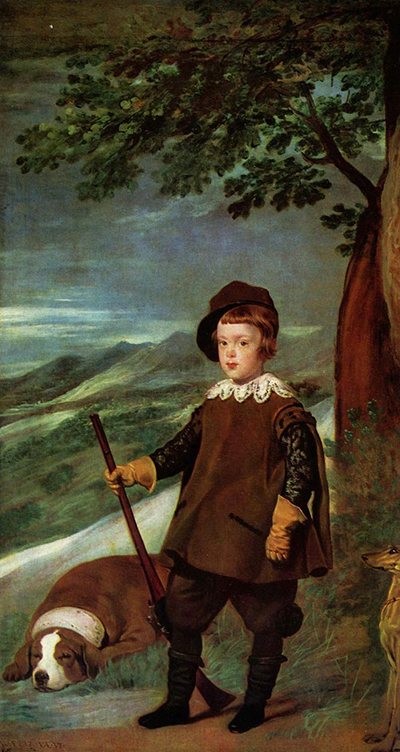
A cinnamon-and-white dog lies with its muzzle flat on the ground. Just above it, a boy holds the barrel of a hunting gun in an amber-coloured glove. Across the painting, another dog’s dark nose and alert eye appear at the edge beside the boy’s free hand. Velázquez gives the two animals quite different ways of occupying the foreground. Between them, the young Baltasar Carlos holds a pose whose steadiness is reinforced by the firm planting of his boots. [1]
Diego Velázquez painted the portrait in oil on canvas in 1635–36 for the Torre de la Parada, the royal hunting lodge in the wooded country of El Pardo outside Madrid. The Museo Nacional del Prado lists it in English as Prince Baltasar Carlos in Hunting Dress, P001189. Its 1990 exhibition catalogue records the canvas at 191 by 103 centimetres. Baltasar Carlos was the son and heir of Philip IV and Isabel of Bourbon, and the canvas belonged with hunting portraits of the king and of the king’s brother, the Cardinal-Infante Ferdinand. [1] [2] [3]
At a Glance
- CollectionMuseo Nacional del Prado, P001189 [2]
- Painted1635–36 [2]
- Original settingTorre de la Parada [1]
Baltasar Carlos in three settings
Baltasar Carlos with an attendant
1632 [12]The Boston canvas records an earlier likeness of the prince.
The mounted prince for the Hall of Realms
Around 1635 [9]The portrait was made to be seen from below above a doorway.
Gállego reads the inscription as giving the prince’s age as six.
Goya’s drawing after the portrait
Around 1778–79 [13]Goya studied the figure in red chalk on a sheet now in Hamburg.
Contents
- The boy under the tree
- How old is Baltasar Carlos?
- The dogs and the edge of the canvas
- The other hunters at the Torre de la Parada
- Other portraits of the heir
- Goya’s drawing of the hunter
The boy under the tree
The tree rises close to the right edge, its boughs fanning out overhead. Almost half the painting is above the prince’s cap. A bright band of cloud and distant blue-grey ridges make an opening on the left, opposite the heavy brown of the trunk. The Prado identifies the setting as the Monte del Pardo with the Sierra de Guadarrama beyond. From the branches down to the grass around his feet, the open country has as much room in this likeness as the boy and his equipment. Dark slopes cross the blue at a slight angle, while the mottled foliage overhead breaks that movement into smaller marks. [1] [3]
The cap sits at an angle that exposes the brief straight line of his fringe. Its soft dark shape brings out the outline of his cheek, and the scalloped lace collar catches the light again below his chin. Gállego describes a green cloth coat and breeches, Flemish lace and a finer fabric visible beneath the outer garment. Short, close-set strokes lend the doublet sleeves a silvery sheen, especially where his bent arm passes into the light near the glove. The long cuff widens there, and shadow gathers at the fingers where they close around the barrel. The upright body is almost square to us. The separated feet and the diagonal gun give it some play without disturbing the composure. [1]
His outstretched hand grips the upper part of the gun, which slopes back towards the boot and leaves his face and collar clear. The other hand hangs beneath the dark fold of his coat. Its fingers show as a series of small folds and warm highlights against the fabric. The two gloves are easy to pick out at a distance, which helps the viewer read how the boy stands before picking out the gun’s fittings or the texture of his sleeves. His gaze appears directed beyond the viewer’s left. For a child posed with a weapon and dogs, the slight turn of the eyes is almost the only suggestion of a movement about to happen. [1]
How old is Baltasar Carlos?
There is a short inscription at the lower left, low enough to seem to belong to the foreground earth. Gállego expands the abbreviated Latin as ANNO AETATIS SUAE VI and interprets it as giving the prince’s age as six. The distinction matters because the inscription gives an age formula, and the calendar dates come from applying it to his birth on 17 October 1629. On Gállego’s reading the painting would fall between the sixth and seventh birthdays, in October 1635 and October 1636. The Prado’s catalogue range is 1635–36. The fullness of the cheeks and the breadth of the brow convey youth, while the more precise dating rests on the inscription and its interpretation. [1] [2]
The prince’s age also changes the meaning of the pose. At court, hunting was understood as preparation for duties that would eventually call for physical endurance, judgement and familiarity with arms. The picture makes him recognisable as a child and clothes him for the activity in which his father and uncle had also been painted. There is a difference between holding the gun for the portrait and using it in the field. The gun’s angle brings a line of control into the picture, while the boy’s long coat and fitted equipment let the viewer see how much of adult court life he is already expected to inhabit. He died in Zaragoza in October 1646, shortly before his seventeenth birthday. [1] [4]
The dogs and the edge of the canvas
Gállego identifies the broad animal at the viewer’s left as a partridge dog. Its white blaze follows the turn of the head to the ground. The spotted collar forms a light band above the patch of dark ear. Even at rest the dog takes up a considerable part of the lower left, and its broad back crosses behind the gun to draw the eye into the distance between the boy and the hills. The other animal is a golden greyhound. Its sharp profile is silhouetted against the ground and the trunk. The picture edge passes through the animal, while the visible forepaws help establish the same ground that carries Baltasar’s boots. Its raised head has almost the effect of a glance into the canvas from outside. [1]
The shape of the painting changed. Mario Criado Pérez’s study of Velázquez’s formats, discussing Carmen Garrido’s technical examination and reproducing the radiograph, describes a seam at the top where a strip was added. He interprets it as a change during the making of the portrait, after the figure had been painted. The study also reports trimming at the right. The two changes help explain the proportions we see today, with room to extend the canopy above the head and very little space beside the standing boy. The surviving seam and the shortened right edge give firmer evidence for an alteration than for its exact date or the original width. [5]
A related painting at Ickworth in Suffolk shows a partridge dog and two Spanish greyhounds. Gállego treated the Ickworth picture as a copy and used it to suggest the Prado canvas might originally have been as wide as the king’s, with more of one greyhound and the head of another. The National Trust instead presents the painting it owns as an earlier version by Velázquez. Its three dogs show that a wider version of the design existed. How closely that version matches every element of the Prado canvas before its alteration remains open. [1] [6]
The other hunters at the Torre de la Parada
The royal group consists of the prince, Philip IV as a Hunter (P001184) and the Cardinal-Infante Ferdinand as a Hunter (P001186). The 1990 catalogue records all three at 191 centimetres high, with the king occupying a wider canvas. In each painting, the gun, dog and full-length figure are readable immediately. Philip’s gun gives the pose a broad diagonal, and his presence fills the picture well above the watchful dog. The standing Ferdinand has a tall, narrow outline, with the dog close to his feet. Baltasar Carlos leaves appreciably more room between his cap and the upper edge. His two dogs occupy separate patches of the ground, emphasising how small he is even within the tall format. The shared height and recurring motifs help the three figures read as family portraits while preserving visible differences of age and bearing. Ferdinand’s departure from Madrid for Barcelona in April 1632 complicates any assumption that the three portraits were painted at the same time. [1] [7]
Svetlana Alpers’s transcriptions of the lodge inventories show the three pictures together. The 1701 inventory lists them under the seventh room, among pictures of royal hunts. In 1747 they appear together in the room identified as the King’s Gallery, under entries 32, 33 and 35. The latter describes the prince in a gilt frame and gives him a narrower format than the king or uncle. The same gallery also held pictures of animals and mythological subjects. These records establish their shared display in the lodge long after the commission. The room numbers and the sequence of entries leave the exact arrangement of the 1630s open. The Prado’s 1990 catalogue follows the prince’s canvas into Madrid’s Royal Palace inventories in 1772 and 1794 and records it at the Prado from 1818. [1] [8]
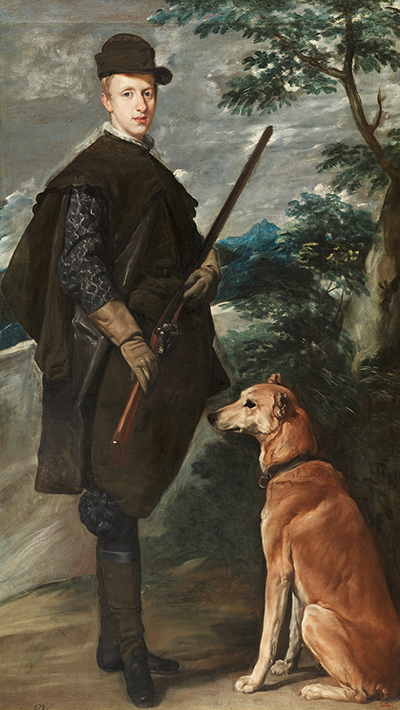
Cardinal-Infante Ferdinand of Austria as a Hunter. The cardinal-infante’s standing portrait gives a companion format against which to read the young prince’s height and pose. View Cardinal-Infante Ferdinand of Austria as a Hunter.
Other portraits of the heir
In Prince Baltasar Carlos on Horseback, Prado P001180, the child directs a horse whose raised forelegs and rounded body take up much of the canvas. The hand that grasps the hunting gun here carries a baton in the mounted portrait. The rider’s pink sash streams to the right while the baton projects into the sky at left. Those clear outlines help make him legible at a height suited to the Hall of Realms in the Buen Retiro palace, where his portrait was displayed high between those of his parents. As a hunter his place is on the same ground as the dogs, with pale grasses brushing up beside his boots. In each picture a large area of sky gives the child’s head room, but the differing vantage points make his presence felt in very different ways. [1] [9]
The riding-school paintings introduce participants and spectators. The Wallace Collection dates its Prince Baltasar Carlos in the Riding School (P6) to about 1640–45 and catalogues it as studio of Velázquez. It shows the boy receiving a lance from his riding master in a tiltyard at the Buen Retiro, watched from a gallery in the background. A related private-collection composition attributed to Velázquez and dated around 1636 prominently includes the Count-Duke of Olivares. Still earlier is the Museum of Fine Arts, Boston’s Don Baltasar Carlos and an Attendant (01.104), dated 1632 and also known historically by a title referring to the attendant as a dwarf. The painting in Boston shows the heir alongside a member of his household. Between that early likeness, the public-facing mounted image and the training scene in the tiltyard, the Torre portrait gives a particularly clear sense of the prince’s small stature, through the size of familiar things around him. At the foot of the trunk, the greyhound’s bright eye is nearly level with his hanging glove. [1] [10] [11] [12]
Goya’s drawing of the hunter
In about 1778–79, Francisco de Goya drew the figure at a small scale, on a sheet now in the Hamburger Kunsthalle. The paper is only 26.8 centimetres high. Red pencil over an initial black outline gave Goya a means of translating the density of the prince’s costume. His marks press closer together in the figure than in the open landscape. The greyhound still emerges at the edge of the scene, evidence that the compressed composition was visible by the time Goya studied the painting, in the period when the Royal Palace inventories place it in Madrid. [1] [13]
The Fundación Goya en Aragón connects the sheet to Goya’s drawings after Velázquez of Philip IV and the Cardinal-Infante as hunters. An impression of an engraving made from the drawing of Baltasar Carlos has yet to be identified. On the sheet itself the different densities of red marks separate coat from ground and bring the boy forward much as the distribution of colour does in the painting. Even at this scale, the little turn of his cap, the slope of the gun and the resting dog have enough space around them to be read as distinct shapes. [13]
Artworks directory
Frequently Asked Questions
Museo Nacional del Prado, P001189 [2]
1635–36 [2]
Torre de la Parada [1]
Discussion
Look again at the images and ideas explored in Prince Baltasar Carlos as a Hunter. These editorial prompts invite your observations.
Reader Insights
How do the two dogs change the apparent scale of the prince and the space around him?
What can the inscription tell us about his age, and what remains uncertain about when it was painted?
Join the Conversation
Share a detail, comparison or question about Prince Baltasar Carlos as a Hunter below.
References
- Julián Gállego, El príncipe Baltasar Carlos, cazador, catalogue no. 45, in Antonio Domínguez Ortiz, Alfonso E. Pérez Sánchez and Julián Gállego, Velázquez, Museo del Prado and Ministerio de Cultura, 1990, pp. 276–280. See also nos. 40, 43 and 44 for the equestrian prince and the hunting companions. Spanish. View source.
- Museo Nacional del Prado, Explore the Collection, English index entry for Prince Baltasar Carlos in Hunting Dress, listed as oil on canvas, 1635–36. English. View source.
- Museo Nacional del Prado, From the Prado to the Landscape, stop 6, Prince Baltasar Carlos in Hunting Dress. English. View source.
- Museo de Historia de Madrid, La Torre de la Parada, pp. 54–58, on hunting and princely education. Spanish. View source.
- Mario Criado Pérez, La medida original. El problema de los formatos en la pintura de Velázquez, Universidad de Salamanca, 2011, pp. 104–106, with radiograph and discussion of Carmen Garrido’s technical study. Spanish. View source.
- National Trust, Prince Baltasar Carlos, Aged Six, as a Hunter, Ickworth, NT 851780, in the National Trust’s paintings guide. English. View source.
- Diego de Aedo y Gallart, Viaje del Infante Cardenal D. Fernando de Austria, Antwerp, 1635, title-page itinerary recorded by the University of Vienna’s Tieck database. Spanish. View source.
- Svetlana Alpers, The Decoration of the Torre de la Parada, Corpus Rubenianum Ludwig Burchard, part IX, Phaidon, 1971, pp. 28–29, 293–294, 306 and 319–320, 338–339. The appendices reproduce the 1701 and 1747 inventories and give English translations. View source.
- Museo Nacional del Prado, Espacios Barrocos, “Recursos”, El príncipe Baltasar Carlos, a caballo, P001180. Spanish. View source.
- The Wallace Collection, Prince Baltasar Carlos in the Riding School, P6. English. View source.
- Centro de Estudios Europa Hispánica, Balthasar Carlos at The Wallace Collection, report on the conservation project and the comparison with the private-collection picture. English. View source.
- Museum of Fine Arts, Boston, European Paintings collection index, Don Baltasar Carlos and an Attendant, 01.104. English. View source.
- Fundación Goya en Aragón, Prince Balthasar Charles, hunter, Goya’s drawing of c. 1778–79 in the Hamburger Kunsthalle. English. View source.







