


 by Tom Gurney
Tom Gurney BSc (Hons) is an art history expert with over 20 years experience
Published on June 19, 2020 / Updated on October 14, 2023
Email: tomgurney1@gmail.com / Phone: +44 7429 011000
Mars Resting: Introduction
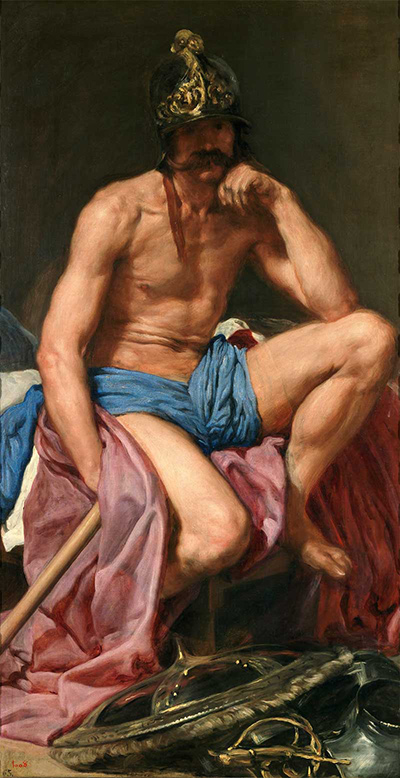
A curl of gold catches the light above a man's eyes. It belongs to his helmet, whose brim makes his face harder to read the longer you look. Below it, a moustache turns up at the ends and the weight of his head settles into the knuckles of his left hand. His elbow is braced on a raised thigh. At his feet an elaborate shield tilts towards us, available to be picked up. The loose hand on the other side of his body gives no sign that he is about to reach for it. [1]
Diego Velázquez painted Mars Resting, catalogued as Mars by the Museo Nacional del Prado, in oil on canvas. The painting is 179 centimetres tall and 95 wide and is held by the Prado in Madrid as P001208. The museum's collection catalogue dates it to about 1638. Mars is the Roman god of war, known as Ares in Greek mythology. Velázquez gives him the equipment to announce that identity, and gives the person wearing it a posture anyone who has sat down under a weight of gear could recognise. [1] [2]
At a Glance
- Date given by the PradoAbout 1638 [2]
- MediumOil on canvas [1]
- CollectionMuseo Nacional del Prado, P001208 [1] [2]
Contents
- Helmet, skin and cloth
- War gear within reach
- Two precedents in sculpture
- What happened before Mars sat down?
- A god at the king's hunting lodge
- From the Torre de la Parada to the Prado
- What the lodge inventories can tell us
- A wedding feast in the eighth room
- A royal hunt and a god at leisure
- Rebuilding the lodge in a museum
Helmet, skin and cloth
Follow the left arm, on the right side of the painting, down from the mouth to the elbow. The line is a short descent that ends almost at the outer edge of the canvas. The thigh leads back across the blue cloth at his hips. His other shoulder and arm form a longer slope, towards the point where the red cloth spills down beside his seat. It takes a moment to work out how the limbs connect because the diagonals take the eye across the figure before bringing it down to the floor. A body at rest can make a remarkably busy arrangement.
The tall, narrow format matters here. The shield and the knot of blue cloth come close to filling the width available at their respective heights. At the top, the helmet is surrounded by brown shadow. There is little visible architecture to tell us where we stand. The cloth under Mars suggests a seat or the edge of a bed, but its folds do more to show the weight and position of the man than to define his surroundings. The patch of darkness beneath the legs is just enough to make the fabric and the objects in the foreground seem to occupy different levels. [1]
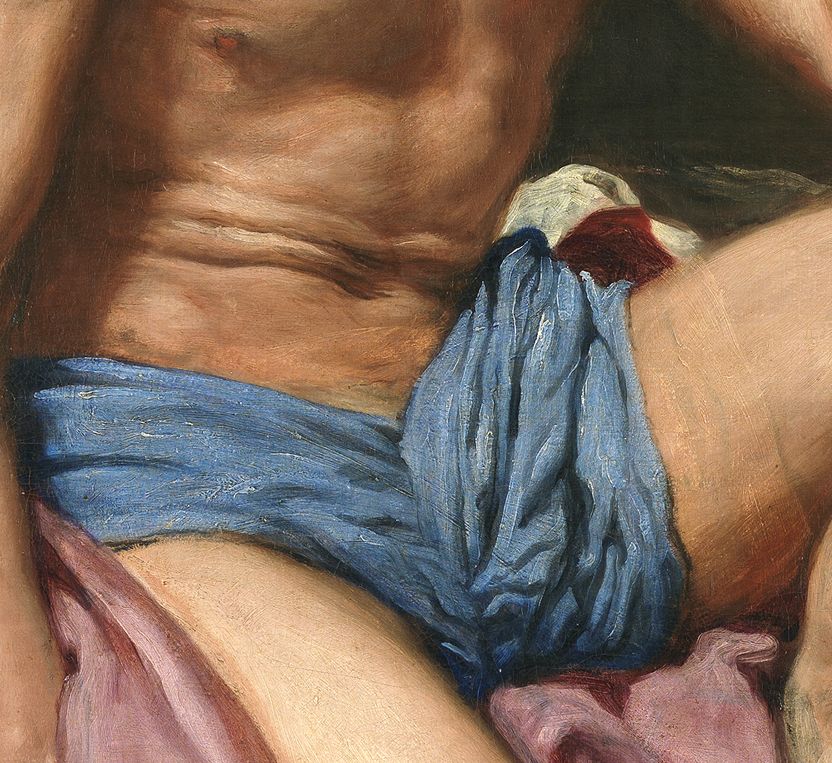
Colour sharpens the difference between those levels. Blue lies against the warm browns and pinks of his belly and left thigh, gathered in a bunch with colder light running over the ridges. The red cloth falls in broader folds, turning towards pink and violet where it catches the light and almost merging with the shadow where it drops away beneath the seat. The fabrics help us see how he arrived at this pose. One is bunched around a limb that has moved. The other spreads and hangs where his weight pins it. Through those small effects of pressure and gravity, the body feels heavy enough to tire. [1]
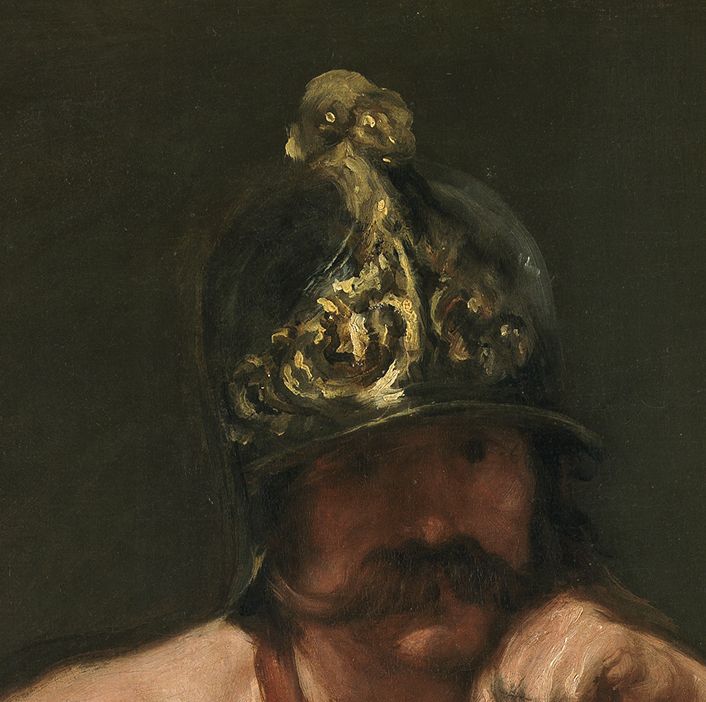
Light falls more freely on the shoulder, the forearm and the knees than on the face. A soft turn from light to dark rounds the chest. Shorter, sharper marks describe the knuckles against it. Compare both with the helmet, where irregular streaks of yellow and cream pick up isolated pieces of ornament. Seen close, they are discrete touches with dark spaces between them. Seen together, they give a bright curve to an object otherwise so dark that the crown nearly joins the space behind it. The glitter pulls the eye towards an expression the brim keeps in reserve. A moment in the pose feels legible well before the man's mood does. [1]
War gear within reach
The painting makes the viewer notice which pieces of equipment Mars is using. The helmet stays on. His right hand rests near a long, plain shaft that cuts across the red folds and runs out towards the lower left. Julián Gállego's Prado catalogue reads it as a wooden mace or baton. Its diagonal leads away from the centre, whereas the shield leads back towards it. Velázquez presents the shield at an angle that gives its rim a long shallow arc. Half-lit fittings, a sword hilt with a conspicuous guard and a piece of armour crowd into the last inches of the picture. Some of their edges run out of the frame. Look first at the pale knee above, then down to the rim. Both have a rounded edge, but the hardness of the metal comes across because its gleam changes so abruptly. [1]
This is nearly the height of a standing portrait, though the god bends into a space an upright man would occupy quite differently. The helmet, which could crown a figure standing to attention, appears all the more elaborate above the tilted head. The rest of the gear has migrated almost to the viewer's feet. Gállego compared the emphatic equipment with that in Velázquez's separate Prado painting The Buffoon Juan de Austria. The comparison helps explain what makes Mars look faintly theatrical. A few recognisable objects can establish a part even when the person dressed for it sits with the ease of someone between appearances. [1]
Gállego also associated the moustache with the soldiers in The Surrender of Breda. Try the comparison at the level of faces as well as weapons. In Breda, there are many men to look at and one public action, the surrender, to which those faces belong. The dense upright lances over the Spanish troops make a collective show of military presence. In Mars, military presence comes down to what one man wears and what he has on the floor. The moustache brings the god close to a recognisable seventeenth-century military type. The name Mars and the single, almost life-size figure keep the encounter within mythology. [1]

The Surrender of Breda (Las Lanzas). The armour and military faces in Breda provide a comparison with the seated god’s helmet, moustache and discarded weapons. View The Surrender of Breda.
Two precedents in sculpture
One comparison often made is with the Ludovisi Ares, the ancient marble now at the Palazzo Altemps in Rome. Its seated figure is bare and armed. He clasps his hands at a raised knee, with a shield beside him, and an Eros plays at his feet. The presence of Eros makes the place of love in an image of the war god visible. The sculpture also makes something clear about any comparison with Velázquez. A man can be quiet without looking slack. The Ares's clasped hands and forward foot give the marble an underlying tension. Velázquez raises the arm to the face, spreads the limbs and lets one foot drop from its support. The two works set out from the same broad subject and give the suspended action a different physical character. [1] [3]
Gállego proposed an analogy for the hand at the face in Michelangelo's funerary portrait of Lorenzo de' Medici, Duke of Urbino, in the New Sacristy of San Lorenzo in Florence. The figure, often called Il Pensieroso, has his face partly darkened by his helmet and his hand lifted towards his mouth. The Musei del Bargello describes him as a leader in reflection, facing Michelangelo's more active conception of Giuliano, Duke of Nemours, across the chapel. Lorenzo's inwardness is built into a formal arrangement honouring the dead. Velázquez brings a comparable bent arm and shaded brow down to the level of bare flesh, a sag in the seat and weapons within reach. In the painting the gesture may register thought, fatigue or the sheer relief of putting one's weight on something. [1] [4]
Velázquez had a documented connection to the Roman sculpture later in his career. The Musée des Moulages at the Université Lumière Lyon 2 records that the Ares was among the works he arranged to have cast for Philip IV in 1650. That commission places the marble within his responsibilities as a royal agent in Rome. On the Prado's dating it comes more than a decade after Mars, leaving open how the painter arrived at the earlier pose. The comparison helps us see what his version gives particular weight to, from the compressed skin above the waist to the effort of propping up the head. [1] [2] [3] [4]
Annotated Details from Mars Resting
Look from the helmet to the cloth and down to the weapons at Mars’s feet.
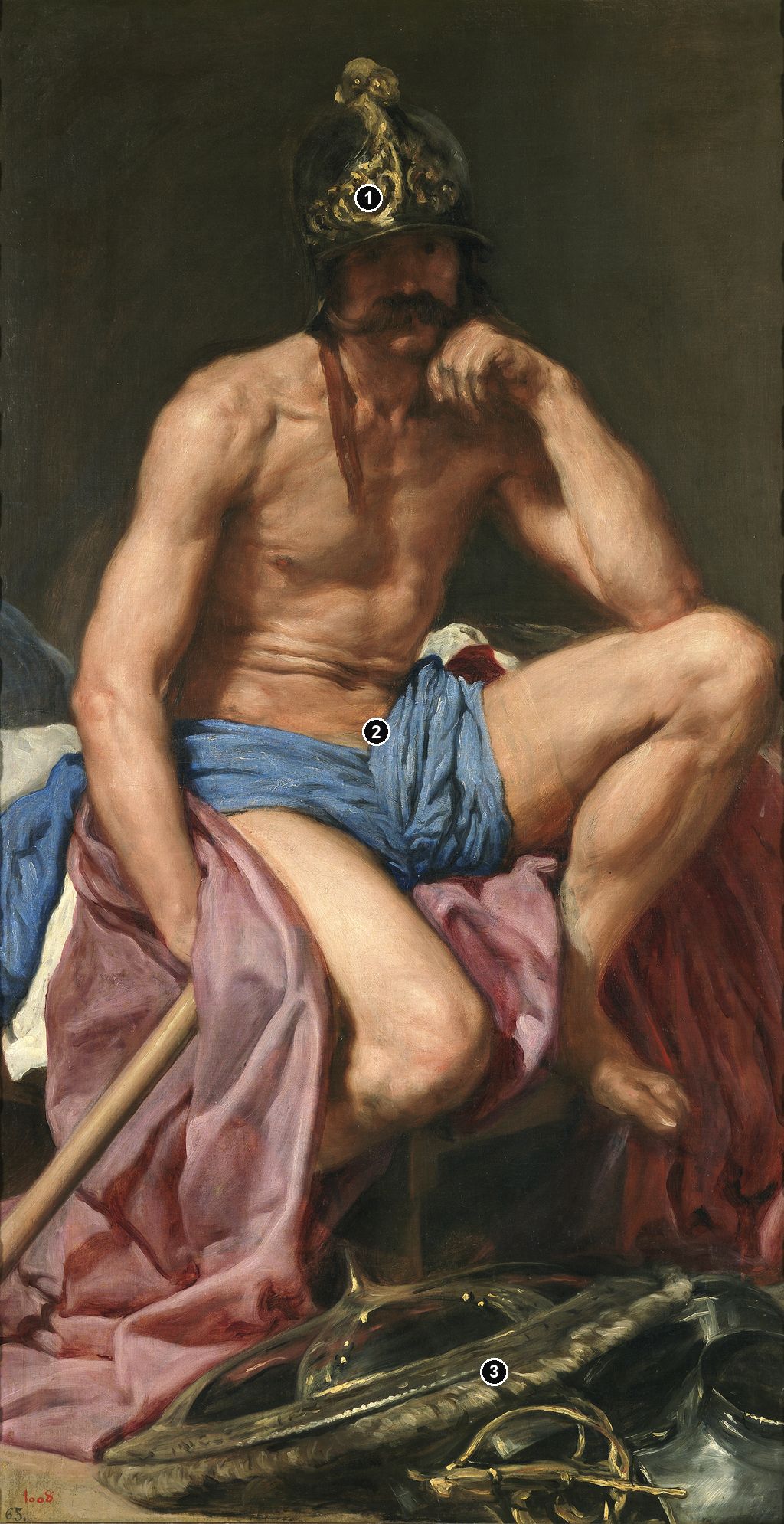
Details from MARS RESTING
The ornament on the helmet
Short flecks of cream and yellow pick out the helmet. Its dark brim shades most of the face. [1]
Blue cloth at the hip
The blue cloth bunches into tight ridges, where cool light catches the folds next to the warm flesh. [1]
The shield and sword guard
The shield’s shallow curve leads into the cluster of metal pieces. Small sharp highlights distinguish the sword guard from the red cloth above. [1]
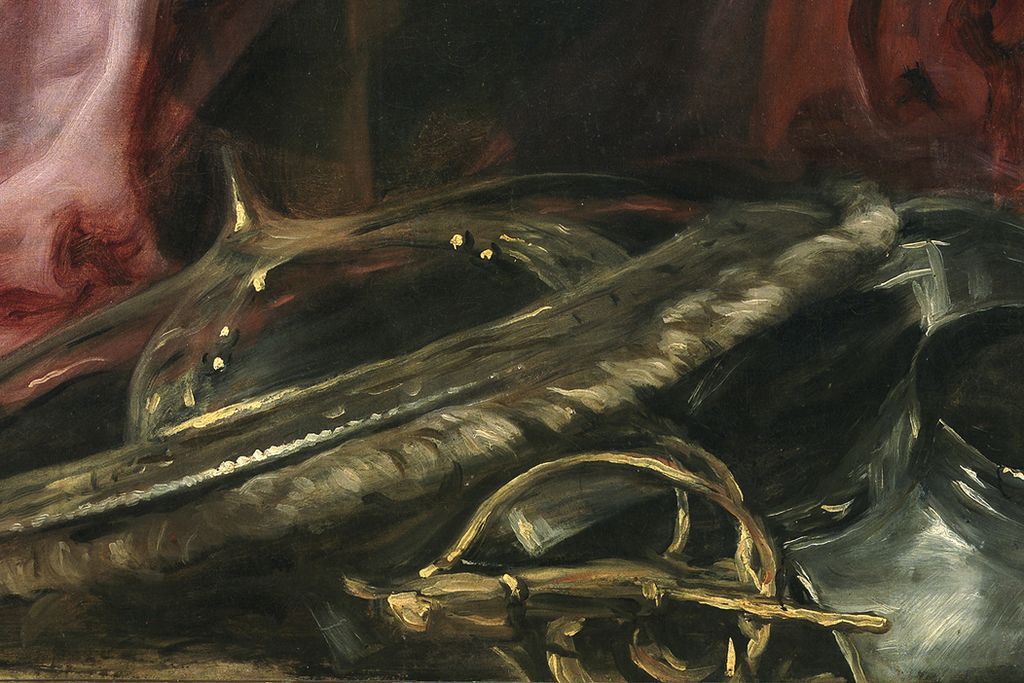
Prado P001208 via Wikimedia Commons, public domain. Numbered labels and detail crops added.
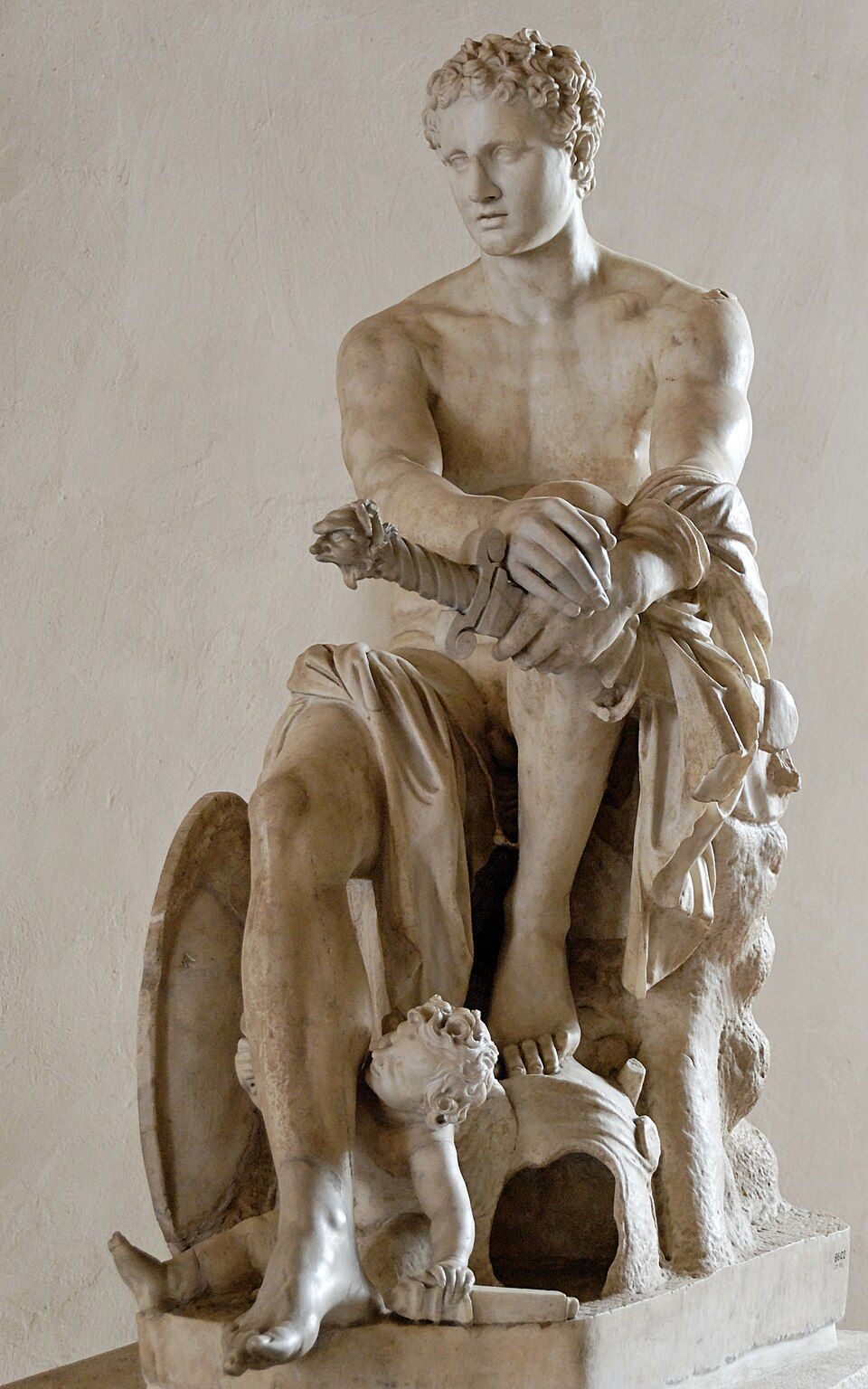
The Ludovisi Ares, Museo Nazionale Romano, Palazzo Altemps, inv. 8602. Compare the raised knee, the shield and the unarmoured torso with Velázquez’s seated Mars. Photograph by Marie-Lan Nguyen. Image source. Public domain. Resized for display.
What happened before Mars sat down?
In Ovid's Metamorphoses, the sun sees Venus and Mars together and tells Venus's husband, Vulcan. The smith makes a fine metal net and sets it over their bed. When the lovers return, it catches them in their embrace. Vulcan calls in the gods, who laugh at the sight. The story gives the sight of Mars at rest a possible setting. It also makes embarrassment imaginable in the god whose face the helmet shades. [5]
Velázquez chose the moment when the news reaches Vulcan for Apollo in the Forge of Vulcan, which he painted in Rome in 1630. Jerónimo de Villanueva bought the canvas from Velázquez in 1634 and it entered the royal collection. The radiant Apollo has just arrived. Vulcan turns, and the assistants are caught at different points in the act of stopping work. Each glance or interrupted movement helps carry the news further into the room. Mars and Venus are absent, yet even the half-finished metal on the anvil has a role because the men must suspend what they are doing to listen. [5] [6]
Put the two canvases side by side in your mind. In the forge, attention passes from one person to another and the light gives us space to follow those exchanges. In Mars, you have one face, almost in shadow, with the weapons already set down. Jonathan Brown, whose reading Gállego discusses, proposed that the seated god could be the lover after the exposure, still too stunned to dress. That reading ties the red-covered seat to the bed in the story and gives the stillness the force of an aftermath. The canvas leaves the net, Venus and the other gods out of sight. The helmet is the one piece of armour he wears. The relationship between the two paintings is secure at the level of subject. A staged sequel is one way to imagine the interval between them. [1] [5] [6]
In the later Mercury and Argus, painted for the Hall of Mirrors of the Madrid Alcázar around 1659, the decisive action is still to come. Mercury creeps towards the sleeping guard with a blade held low. Velázquez uses a broad, low composition to bring both figures close to the ground and allows the disguise and the weapon to carry much of the story. Mars's blade stays on the floor. For all his equipment, the next move in that painting is left to the viewer's imagination. [1] [7]
A god at the king's hunting lodge
The Torre de la Parada stood in the hunting grounds of El Pardo near Madrid. Building work in the mid-1630s expanded the site, and a letter of November 1636 from the Cardinal-Infante Ferdinand to his brother Philip IV reports that Peter Paul Rubens was already at work on paintings for it. The decoration brought together hunting scenes, mythologies by Rubens and his collaborators, animal paintings and portraits. Among the Velázquez works associated with the lodge are the hunting portraits of Philip IV, Ferdinand and Philip's son, Prince Baltasar Carlos in Hunting Dress. In the prince's portrait a gun and dogs define the occasion under an open sky. In Mars the helmet and sword still describe a role, though the man and his objects fill a dark, shallow space. [1] [8]
An early eighteenth-century lodge inventory groups Mars, Aesop and Menippus together in its eighth room. It names Velázquez as their painter, describes the canvases as the same size and values them equally, at fifty doubloons each. The list places the god beside two figures from classical literature and philosophy, a grouping documented some six decades after the lodge was decorated. The man's posture in Mars invites us to ask how his equipment sits with him. His neighbours offer much the same question through objects you would handle in peacetime. [8] [9]
Aesop faces forward holding a thick book, its weight apparent even where it nearly blends into his heavy clothes. The name above him identifies the fabulist, while the creased sash and coarse garment set him at some distance from courtly notions of distinction. Menippus, the Cynic philosopher, turns his head over his shoulder. A few fingers show where he gathers his cape, the rest of his body almost fully wrapped up. Books and a roll of paper occupy his foreground, as the shield and armour occupy the foreground in Mars. It is possible to see the books on the ground as a joke about the standing of book learning in the eyes of a Cynic. They also show how differently Velázquez could place objects that conventionally signalled what a person was. Aesop carries his book, Menippus turns away from his and Mars, covered only by a cloth and a helmet, leaves most of his military identity within arm's reach. [1] [9]
This variety had room to breathe in a royal hunting lodge. The items recorded for the same eighth room include a large treatment of the marriage of Thetis and Peleus and paintings of animals mounted above openings. The juxtaposition makes a solemn or a witty encounter equally imaginable. Gállego discusses the tradition of treating classical culture with irony in Spain and records a sharper proposal that the picture comments on Spanish military fortunes. One version relates it to the defeat at Rocroi in 1643. That connection is hard to sustain as a response to a particular event if the Prado's current date of about 1638 is accepted. The dating itself has varied. The 1990 catalogue discusses an estimate of 1640–42 alongside a number of earlier and later proposals, and the Gemäldegalerie's 2016 press kit dates the work after 1641. The argument for a specific political event depends on both the date we give the canvas and the feeling we read into the pose. The equipment and the way Mars wears it can suggest a loss of military grandeur without pointing to a single battle. [1] [2] [8] [9] [10]
Velázquez Rediscovered · The Met · Watch on YouTube
This work in Velázquez’s career
The Surrender of Breda
c. 1635 CatalogueMars Resting (current article)
c. 1638 [2]The Spinners
1655–60 CatalogueFrom the Torre de la Parada to the Prado
By 1772 the painting was recorded in the Royal Palace in Madrid. Gállego's catalogue records that Ferdinand VII transferred it to the Real Academia de Bellas Artes de San Fernando in 1816 and that it passed to the Prado in 1827. By 1875 it could also be examined in a much smaller format. That is the date on Miguel Pineda Montón's etching and aquatint after the painting, an impression of which is held by the Wellcome Collection. The plate measures 26.6 by 13.8 centimetres. That scale preserves the notably narrow proportions while making the god and his trappings available as an image someone could hold. [1] [11]
At the Prado the scale makes a different encounter possible. From a distance the silhouette, the colour at the hips and the gold on the head come across quickly. Closer up, the most elaborate pieces of armour divide into scattered highlights, and subdued changes of warm and cool tone begin to explain how firmly the body is leaning. One of the smallest details still does as much as the largest. Mars can let much of his armour go, but a single dark rim, pressed low over his face, governs how much of him we see. [1] [2]
What the lodge inventories can tell us
The early Torre de la Parada inventory groups Mars with Aesop and Menippus. A later annotation alongside that entry sends the reader in two directions. It says the philosophers were taken to the palace of El Pardo and points to entry 118 in the third downstairs room of the lodge for Mars. The account of the 42 paintings removed to El Pardo in July 1714, reproduced in the palace's 1747 inventory, lists both philosophers as full-length figures and appraises them at 3,000 reales each. They appear among pictures of animals and fables. One window-piece in the list shows a fox and a stork, a subject familiar from the tradition of fables associated with Aesop. The later catalogue thus supplies a different setting in which to imagine the two readers and thinkers. [12]
The trail for Mars is harder to follow. The 1747 lodge entry that the annotator points to describes a painting of Mars in a gilded frame, three and three-quarter varas wide and two and a quarter high. At roughly 84 centimetres to the vara, that describes a broad picture more than three metres across. Velázquez's canvas is upright and less than a metre wide. The subject seems to have been enough for the annotator to make the connection. The recorded proportions give us good reason to treat that link as doubtful. The entry in the eighth room remains evidence of the Velázquez's presence at the lodge around the turn of the eighteenth century. The later cross-reference leaves its precise whereabouts in 1747 open. [12]
For the commission itself, there is a different sort of document. On 16 October 1636, Velázquez asked the king for money to help him serve on the occasion of the painting ordered for the Torre. Svetlana Alpers discusses the uncertainty around the scope of that assignment, including whether he produced new pictures or adapted work he had already done. The letter gives us his involvement while the decoration was under way. The eighth-room entry identifies Mars many decades later. It is plausible that the painting was made for the lodge, but the two records leave room for a canvas made independently to have joined the collection later. [13]
A wedding feast in the eighth room
The wedding scene recorded in the eighth room can be followed from design to finished canvas. Rubens's oil sketch, now in the Art Institute of Chicago, is just 42.6 centimetres wide. Jacob Jordaens executed the large version, now in the Prado. In the sketch, a white tablecloth opens up a bright space between the bodies, and the guests' gestures lead the eye across the table. The occasion is the marriage of Peleus and Thetis, but the commotion comes from the golden apple cast among the company by Discord. The rivalry it sets off will lead to the Judgement of Paris. The finished painting gives a whole gathering of gods something to look at, reach for or react to. In the same room as such an expansive scene, the concentration of Mars on one seated figure would have been especially marked. [12] [13] [14]
The position of the wedding scene in the inventory also shows how loosely a story could be distributed across the lodge. Alpers traced three pictures involving Orpheus to different rooms. His music, Eurydice's death and the attempt to lead her back from the underworld were episodes a viewer might connect in memory while moving through the building. An encounter with the solitary Mars in this collection could work in much the same way. A viewer familiar with the god's affairs could supply a story, while the eighth-room list records a cohabitation of subjects that includes philosophers, a divine wedding, a fox and a rabbit. [12] [13]
A royal hunt and a god at leisure
In Philip IV hunting Wild Boar (La Tela Real), now in London's National Gallery, the canvas enclosure from which the work takes its name holds the hunt and its spectators in a single wide field of view. Philip is on horseback, facing a charging boar, while the queen and her companions watch from carriages. In the foreground a man loads a mule, and a boy turns towards the viewer. The Gallery records that the picture hung at the lodge alongside three other court hunts of the same size by Pieter Snayers, now lost. Its provenance gives a lodge commission as probable. The scale and range of incidents let us see royal hunting as an organised spectacle with a place for the people who make it possible. [15]
Alpers reads the resting god in light of a court culture that saw hunting as preparation for war. The parallel gives the setting interpretive force. A court could admire a king's readiness in the painted hunt and encounter a god who had put his equipment down elsewhere in the building. The relationship can hold even if the works came together after they were painted. It depends on what the lodge contained and what a viewer might have brought to the encounter. The wide field of the hunt shows how many people and arrangements go into an occasion for martial prowess. The single body in Mars lets us picture what it feels like when the occasion has passed. [13] [15]
Rebuilding the lodge in a museum
In 2024 the Museo de Belas Artes da Coruña and the University of A Coruña's VideaLAB opened a virtual reconstruction of the Torre. The project grew out of two Rubens sketches in the museum's own collection, Daedalus and the Minotaur and Psyche. To model the building, the team brought a painted view dating from around 1637 into conversation with royal records that describe rooms, the dimensions of pictures, and features such as doors and windows. Those details matter in an interior where paintings could occupy the spaces over openings as well as the main walls. [16]
The museum presents its architectural reconstruction and distribution of pictures as proposals. A records clerk could list a fox over a door without telling us precisely how the paintings on either side were spaced. A digital model must settle such questions to make a room that visitors can move through. It can show what it would feel like to turn from a broad composition full of figures to a single tall painting, and how much of a room might be occupied by pictures at several heights. Mars today is often encountered as an image in isolation. The reconstruction restores a sense of how different that experience could be in a room filled with paintings. [12] [16]
Artworks directory
Frequently Asked Questions
About 1638 [2]
Oil on canvas [1]
The tall, narrow format matters here. The shield and the knot of blue cloth come close to filling the width available at their respective heights. At the top, the helmet is surrounded by brown shadow. [1]
Discussion
Look again at the images and ideas explored in Mars Resting. These editorial prompts invite your observations.
Reader Insights
Compare the helmet, face and discarded equipment. What does each one lead you to expect about the sitter?
How does the pose change your reading of the painting when you think of it alongside other works made for a royal hunting lodge?
Join the Conversation
Share a detail, comparison or question about Mars Resting below.
References
- Julián Gállego, “Marte,” in Velázquez, Museo del Prado and Ministerio de Cultura, 1990, cat. 51, pp. 310–315, and Alfonso E. Pérez Sánchez, introductory essay, pp. 38–40 (Spanish). View source.
- Museo Nacional del Prado, Explore the Collection, Velázquez works filter, Mars, c. 1638. Yale University Press, figure record for Mars, fig. 69. View source 1. View source 2.
- Museo Nazionale Romano, “The Boncompagni Ludovisi Collection,” Palazzo Altemps, Statue of Ares, and Sapienza University of Rome, Mirror LAB, “Il catalogo,” Ares Ludovisi, Palazzo Altemps, inv. 8602 (Italian), and Lina Roy, Musée des Moulages, Université Lumière Lyon 2, “L’invincible Arès Ludovisi” (French). View source 1. View source 2. View source 3.
- Musei del Bargello, “Michelangelo: the Bloom of Renaissance Art,” the New Sacristy and the tomb of Lorenzo, Duke of Urbino. View source.
- Ovid, Metamorphoses, IV.167–189, “Leuconoë's story: Mars and Venus,” translated from Latin by A. S. Kline, 2000. View source.
- Julián Gállego, “La fragua de Vulcano,” in Velázquez, Museo del Prado and Ministerio de Cultura, 1990, cat. 23, pp. 158–162 (Spanish). View source.
- Julián Gállego, “Mercurio y Argos,” in Velázquez, Museo del Prado and Ministerio de Cultura, 1990, cat. 76, pp. 436–439 (Spanish). View source.
- Svetlana Alpers, The Decoration of the Torre de la Parada, Corpus Rubenianum Ludwig Burchard, part IX, 1971, pp. 26–33 and Appendix II, entries 95–97, pp. 295 and 307–308 (Spanish inventory with English translation). View source.
- Julián Gállego, “Esopo” and “Menipo,” in Velázquez, Museo del Prado and Ministerio de Cultura, 1990, cats. 49–50, pp. 298–309 (Spanish). View source.
- Staatliche Museen zu Berlin, Gemäldegalerie | El Siglo de Oro. The Age of Velázquez, 1 July 2016, press kit, caption for Mars (detail), dated after 1641. View source.
- Wellcome Collection, Mars (Ares). Etching by M. Pineda, 1875, after D. Velázquez, 2498608i. View source.
- Svetlana Alpers, The Decoration of the Torre de la Parada, Corpus Rubenianum Ludwig Burchard, part IX, 1971, Appendix II, Torre inventories of 1700 and 1747, entries 94–101 and 118, and El Pardo inventory of 1747, preliminary note four, entries 19–21. View source.
- Svetlana Alpers, The Decoration of the Torre de la Parada, 1971, pp. 29–30, discussion of the arrangement of the mythologies and of Mars in the context of the hunt, and figs. 162–163 in the list of illustrations. View source.
- Art Institute of Chicago, Old Masters at the Art Institute of Chicago, Museum Studies 32, no. 2, fig. 9, Peter Paul Rubens, The Wedding of Peleus and Thetis, 1636, 1947.108. View source.
- National Gallery, London, Philip IV hunting Wild Boar (La Tela Real), NG197, collection record and provenance. View source.
- Museo de Belas Artes da Coruña and VideaLAB, Torre de la Parada. Un espacio pictórico para Rubens, virtual exhibition opened 1 February 2024, research and reconstruction notes. View source.







