


 by Tom Gurney
Tom Gurney BSc (Hons) is an art history expert with over 20 years experience
Published on June 19, 2020 / Updated on October 14, 2023
Email: tomgurney1@gmail.com / Phone: +44 7429 011000
Portrait of Francesco I d’Este: Introduction
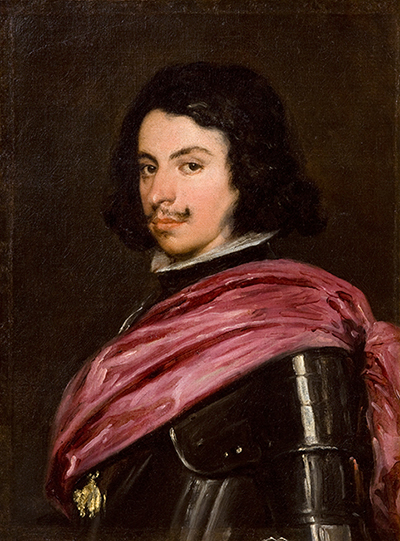
A sweep of rose-coloured cloth crosses dark armour, from the heavy fold on the shoulder to a small gold pendant near the bottom of the canvas. Above it, a young man turns his face towards us. Diego Velázquez painted Francesco I d’Este, Duke of Modena and Reggio, during his visit to Philip IV’s court in Madrid. The Galleria Estense in Modena holds the oil on canvas, which measures 68 × 51 cm and is inventory no. 472. The gallery’s essay on the painting and the Italian national catalogue date it to 1638. The Francesco II sometimes named in connection with this image was the sitter’s grandson, a later duke of Modena. [1] [2] [3]
At a Glance
Contents
- The turn of the head
- Armour, sash and the Golden Fleece
- Francesco at Philip IV’s court
- Two armoured portraits of Philip IV
- From Madrid to Modena
The turn of the head
The sitter’s breastplate turns towards the left edge of the picture, leaving the arm on our right prominent. The head turns back towards us. We can see both eyes and the pinched shadow beside the bridge of the nose, while the broadest light falls on the cheek at our right. The eyes turn a little further than the head. Their nearer edges catch the light, and the dark brows make their direction readable even from a distance. A small moustache follows the upper lip and curls upwards at one end. The white collar rises to meet the jaw, forming a sloping edge that makes the turn of the neck easier to follow. [1] [2]
There is a strip of brown above the crown of the head, wider than the space between the far edge of the armour and the right side of the canvas. Dark waves of hair pass into the background in places, then reappear as a mass beside the cheek and collar. The slight haze around the outer silhouette makes the face seem more distinct. Below, the sash and arm are cut off by the frame. The eye can move outwards into the relatively open space beside the head and then return by way of the shoulder. Velázquez gives us little information about a room, so the distances we can judge are those between the face, the front of the armour and the edges of the canvas. [1] [2]
Armour, sash and the Golden Fleece
Look down the arm on our right. An upright band of pale paint breaks where one plate overlaps another. Another thin light follows the curved rim of the breastplate. The little points farther down the metal mark fittings, while broader glints give a sense of how the armour curves away. Most of the dark metal is very close in tone to the background. The succession of interrupted highlights makes the arm look solid and jointed, even where the outline nearly vanishes. The national catalogue describes parade armour and a general’s sash. The costume sets Francesco before us as a commander. [1] [2]
The cloth catches the light in longer strokes. On the shoulder, ridges of rose and pale pink run close together before spreading diagonally down the chest. A deep red crease widens towards the lower left and gives the fabric thickness. The gold pendant emerges below that crease. Up close, it is made of touches of yellow against the black armour. Seen from farther away, it takes on the shape of the small hanging fleece, the badge of the order Philip IV conferred on Francesco. Federico Fischetti, writing for the Gallerie Estensi, compares those economical yellow touches with the badge in Titian’s equestrian Charles V at Mühlberg of 1548. The two works use small concentrations of yellow to make an insignia legible amid large areas of armour. [1] [2]
The Gallerie Estensi reports that radiography revealed an earlier painting on the canvas, which was abraded before Velázquez used the support for this portrait. Fischetti describes a restricted palette that includes carbon black, green earth, lead white and madder lake. The warmth of the face and the brilliance of the sash occupy quite different parts of the small canvas. The flesh changes gradually from the warm cheek to the shadow at the temple. Along the sash, light paint meets dark red in abrupt streaks. Those different transitions give the two passages their respective textures. The radiograph supplies evidence about the support, while these effects can be seen in ordinary light. [1]
Francesco at Philip IV’s court
When Francesco travelled to Spain in 1638, France and Spain were at war. The position of Modena between Spanish interests in northern and southern Italy gave the duchy diplomatic weight. Francesco sought a closer alliance, financial support and advancement for his house. His envoy Fulvio Testi was in Madrid by January preparing the visit with the Count-Duke of Olivares. On 24 September Olivares met Francesco outside Madrid. They entered the city on horseback and went to the royal Alcázar, where Philip received him. Francesco lodged at the new Buen Retiro palace and stood as godfather to the infant María Teresa on 7 October. The ceremonial honours gave visible expression to a political relationship the duke had come to strengthen. [2] [4] [5]
On 24 October Philip conferred the Golden Fleece on both Francesco and his own son, Baltasar Carlos. The date comes from the record of the order and contemporary accounts cited by historian Mercedes Simal López. The national catalogue proposes that Francesco sat to Velázquez between the investiture and the end of October. The Metropolitan Museum of Art also places the likeness late in the visit, taking the ceremony as the starting point of its proposed interval. The badge places the duke in the guise of a newly honoured knight. The dates of any individual sessions and the order in which the different passages were painted remain uncertain. [2] [4] [5]
There was also a project for an equestrian portrait of Francesco in his capacity as commander of the fleets. In March 1639 Testi wrote to the duke that Velázquez was at work on his portrait. Simal López discusses that letter in connection with the equestrian commission. The national catalogue records Tomaso Montanari’s suggestion that the Modena picture served as a study for it. The Metropolitan Museum also allows that possibility. Simal López argues for a separate purpose on the evidence of the size, pose, finish and bare head. The painting we have brings the face, collar, armour and new badge together on a compact scale. A mounted figure would have offered further means of showing command, including reins, a baton and the disposition of horse and rider. The exact relationship between the projects remains open. [2] [4] [5]
Two armoured portraits of Philip IV
In the Prado’s early Philip IV in Armour, P001183, painted around 1628, the plates and sash sit close beneath the face, much as they do in the duke’s portrait. Both paintings use a pale collar to mark the division between the head and the weight of the armour. Philip’s red is concentrated in a narrower band, leaving more of the chest free for the details of the metal. Francesco’s sash spreads over the armour and sets up a long diagonal against the turn of his face. The early Philip survives as a bust cut down from a larger canvas. The comparison is between the pictures as they appear today. The resemblance shows how a form used for presenting the king could also present a visiting duke. The duke’s pendant gives that form a specific link to the honours of 1638. [1] [2] [6]
The Prado’s Philip IV in Armour, with a Lion at His Feet, P001219, is later and much taller. The museum attributes it to Velázquez and his workshop and dates the portrait to about 1652. In its visible state, Philip stands with his baton, his armour extending nearly to his boots. The lion lies below, in the dark space beside his legs. This is a full-length royal likeness, which was displayed at El Escorial. Its repeated glints carry the eye down the standing figure and give the king a place to stand. Francesco’s lower edge cuts across the breastplate and brings the face much nearer to the point at which the dress fills the frame. The two canvases use dark armour and a sash on different scales, for an established Spanish monarch in one case and an Italian ruler honoured at his court in the other. [2] [6] [7]
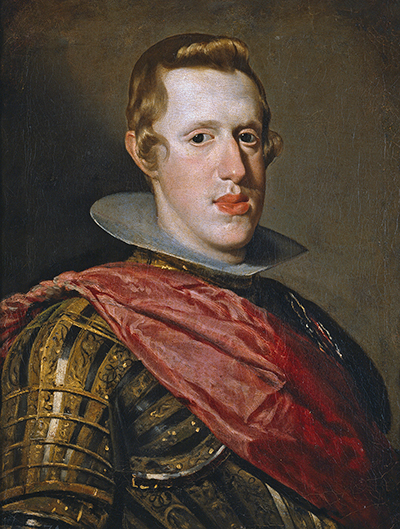
Philip IV in Armour. The armoured portrait of Philip IV offers a different use of a bright sash and dark metal in a closely framed likeness. View Philip IV in Armour.
From Madrid to Modena
The national catalogue places the first documentation of the portrait in Modena in 1663. It considers a period in Spain possible, in connection with the larger portrait project. Simal López suggests that Francesco could have brought the canvas back himself. Her account points to the customs exemption the duke enjoyed on his return journey, which helps explain why the journey offers so little evidence about what he carried. The 1663 record gives a fixed point in Modena, five years after Francesco’s death. The date and means of the painting’s arrival remain uncertain. [2] [4] [5]
The painting later passed into the collection of Count Cassoli Lorenzetti. In 1843 Duke Francesco IV bought it back with the intention of giving it to the Academy of Fine Arts, according to the national catalogue. An 1866 inventory listed it as no. 692, and the current Galleria Estense inventory number is 472. The gallery lent it to the Metropolitan Museum of Art for a focused exhibition in 2013, during the closure of the museum in Modena following the 2012 earthquake. The painting is one of two markedly different portraits of Francesco I now in the Galleria Estense. Bernini’s marble bust, dated 1651, sends the duke’s gaze into the distance above a broad sweep of carved fabric. In Velázquez’s canvas the fold brings the eye around to the shoulder and up to the face, where Francesco looks out to meet it. [1] [2] [5] [8]
Artworks directory
Frequently Asked Questions
Oil on canvas [2]
Discussion
Look again at the images and ideas explored in Portrait of Francesco I d’Este. These editorial prompts invite your observations.
Reader Insights
How does the rose-coloured sash lead your eye from armour to face?
What does the evidence from the Madrid visit establish about the portrait?
Join the Conversation
Share a detail, comparison or question about Portrait of Francesco I d’Este below.
References
- Federico Fischetti, “Velázquez e il ritratto di Francesco I d’Este (1638)”, Gallerie Estensi, with the full portrait and a comparison of details with Titian. Italian. Read the gallery essay. View source.
- Galleria Estense, “Ritratto del duca Francesco I d’Este”, Catalogo generale dei Beni Culturali, record 0800675922, Galleria Estense inventory 472. Italian. View the national catalogue record. View source.
- Federico Fischetti, “6 settembre, compleanno di Francesco I d’Este”, Gallerie Estensi, on the duke and his successors. Italian. Read the gallery essay. View source.
- Mercedes Simal López, “La estancia en Madrid de Francesco I d’Este en 1638”, especially pp. 197–199, 201, 212–214, 218–219 and 224–231, and nn. 118–128 on the investiture, portraits and Testi correspondence. Spanish. Read the study. View source.
- The Metropolitan Museum of Art, Velázquez’s Portrait of Duke Francesco I d’Este: A Masterpiece from the Galleria Estense, Modena, 2013, exhibition overview and press release, especially pp. 2–3. View the exhibition record · Read the release. View source 1. View source 2.
- Julián Gállego, “Felipe IV” and “Felipe IV, armado, con un león a los pies”, in Velázquez, Museo del Prado and Ministerio de Cultura, Madrid, 1990, cats. 15 and 72, pp. 122–123 and 418–419, Prado P001183 and P001219. Spanish. View the early portrait entry · View the later portrait entry. View source 1. View source 2.
- Museo Nacional del Prado, Philip IV in Armour, with a Lion at His Feet, P001219, and the essay for Juan Carreño de Miranda’s Charles II in Armour, P007101, which compares the paintings and dates the Philip IV portrait to about 1652. View the Philip IV record · Read the comparative essay. View source 1. View source 2.
- Gallerie Estensi, “Il blog delle Meraviglie – seconda puntata”, illustrated entry on the ducal collection, including Gian Lorenzo Bernini’s marble Ritratto di Francesco I d’Este, 1651. Italian. Read the gallery essay. View source.







