


 by Tom Gurney
Tom Gurney BSc (Hons) is an art history expert with over 20 years experience
Published on June 19, 2020 / Updated on October 14, 2023
Email: tomgurney1@gmail.com / Phone: +44 7429 011000
Queen Mariana of Austria: Introduction
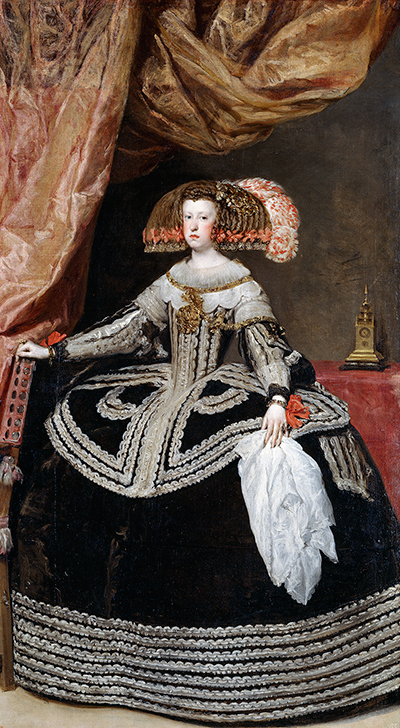
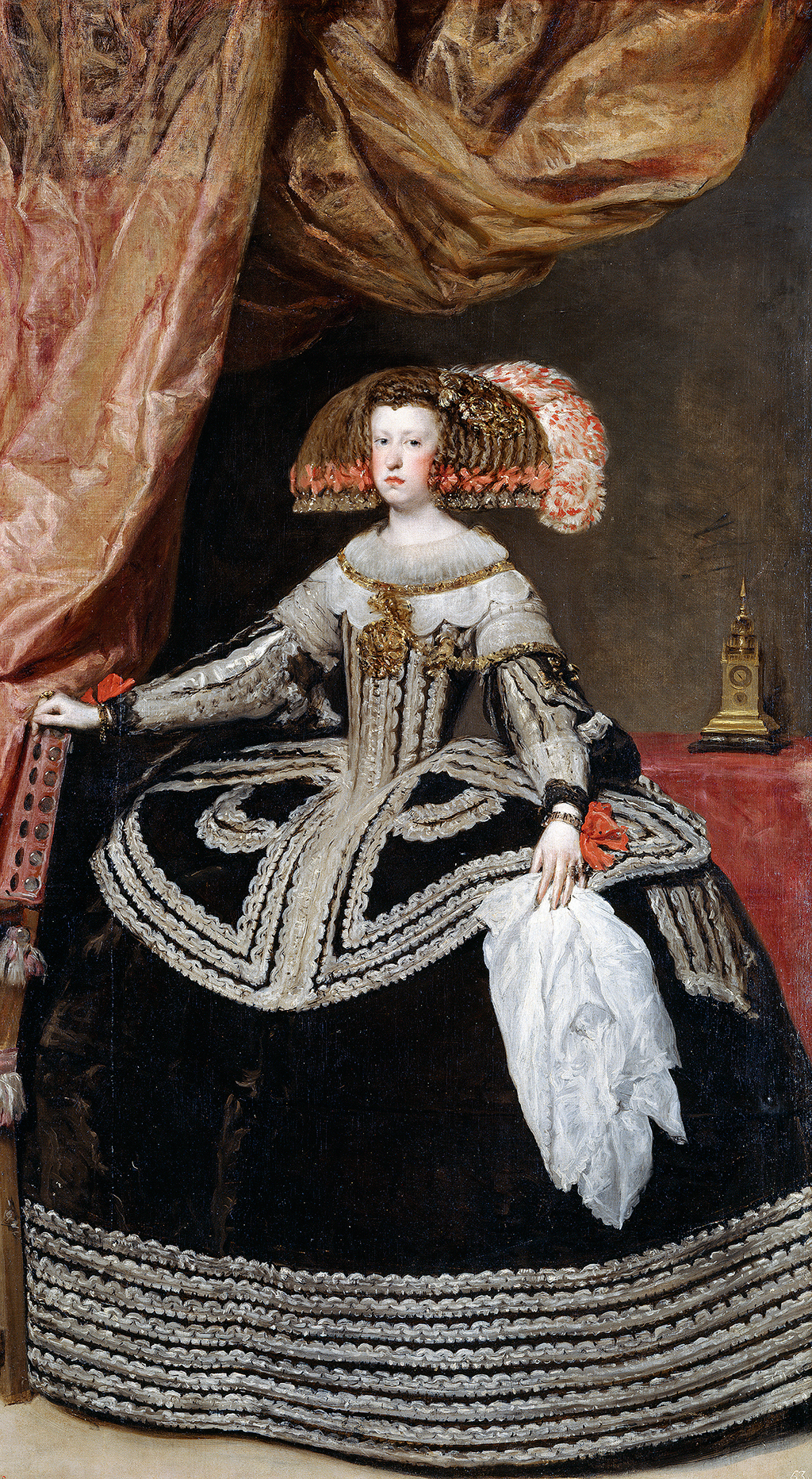
Mariana of Austria touches the back of a chair with one hand while a white handkerchief spills from the other. Between the two gestures, her black and silver skirt sweeps almost the full width of the canvas. A small gilded clock stands behind her, at the right, and a red curtain gathers in heavy folds well above her head. Velázquez painted this full-length portrait in oil on canvas in about 1652–53. It belongs to the Museo Nacional del Prado in Madrid, where its inventory number is P001191. The Norton Simon Museum recorded its dimensions as 234.2 × 132 cm when the Prado lent it for exhibition in 2024–25. [1] [2]
At a Glance
- CollectionMuseo Nacional del Prado, P001191 [2]
- PaintedAround 1652–53 [1] [2]
- FormatFull-length oil on canvas [1] [2]
Mariana’s portrait from court to El Escorial
The Prado canvas shows the queen in court dress. Its visible canopy belongs to a later addition.
Mariana and Philip appear together in the small mirror at the back of the room.
Loan to the Norton Simon Museum
2024–25 [2]The exhibition dossier documents the Prado canvas at 234.2 × 132 cm.
Contents
- The queen's dress and the space around her
- A Habsburg likeness
- How the canvas acquired its canopy
- The workshop versions in Paris and Vienna
- Mariana in the mirror and in mourning
The queen's dress and the space around her
The silver edging makes it possible to follow the shape of this dress through areas that otherwise recede into shadow. Three courses of trim meet low at the front of the overskirt, turn sharply and rise back towards the hips. A separate series runs almost horizontally along the hem. That low sweep gives the floor a visible edge and suggests how far the skirt projects around the standing figure. The dress owes its width to the guardainfante, a rigid support worn beneath it. Velázquez makes its shape legible through the behaviour of the trim and the way the heavy fabric holds its curve above the narrow strip of floor. [1] [2]
Above the skirt, the fitted bodice draws the silver bands towards the centre and the sleeves send them out again. On the viewer’s left, cloth creases along the arm as it reaches for the chair. The queen’s fingers occupy only a small part of the top rail. They are enough to establish the chair’s position beside her, and the diagonal of the sleeve makes the distance from shoulder to furniture palpable. On the other side the sleeve falls more abruptly. The wrist and fingertips extend that downward line into the soft white cloth, whose folds overlap each other and gather into uneven points. Close up, the black of the skirt shows through some of the thinner passages of the handkerchief. Its translucency gives the eye a way to distinguish this small piece of fabric from the heavy material beneath it. [1]
Look back from the handkerchief to the plumes above Mariana’s left temple. The feathers repeat the downward curl of the handkerchief on a smaller scale, and orange-red marks run in and out of the pale feathering. Red bows are visible in the wide arrangement of curls and at each wrist. Below the chin, the light fabric at the neckline opens a pale interval between the face and the dense decoration on the bodice. Darker touches define the lids and the slightly parted line of the lips. At a distance the eyes and mouth hold their positions even as the bright points scattered across the jewellery and costume merge into broader patterns. [1]
The room comes into focus at either side of the figure. Under the descending curtain at the left, the chair’s upholstered back and the row of bright studs turn a narrow patch of red into a solid object. The clock sits on a red-covered table farther back. Its tiered case has just enough light on it to register as a complete object, even though it occupies a fraction of the space given to the skirt. The gold on the case also echoes the smaller gold touches on the queen’s bodice and wrist. Julián Gállego read the clock as an emblem of punctuality and attention to royal obligations. On the canvas it also sets a modest unit of scale beside the dress and marks a point where the shallow space around the queen recedes. [1] [3]
A Habsburg likeness
Mariana was the daughter of Emperor Ferdinand III and María of Austria, Queen of Hungary, Philip IV’s sister. Her mother was the subject of a much earlier Velázquez portrait, Prado P001187, which concentrates on the head and ruff. Mariana had been intended to marry her cousin, Prince Baltasar Carlos, the son of Philip and his first wife, Isabel of Bourbon. The prince died in 1646. Mariana married her widowed uncle Philip IV in 1649, joining the Spanish and Austrian branches of the Habsburg family. They had their first child, the Infanta Margarita Teresa, in 1651. [1] [3]
Velázquez was in Italy when Mariana arrived in Spain and returned to Madrid in 1651. The Prado’s 1990 exhibition catalogue dates the portrait to 1652–53, as did the Norton Simon loan dossier. Peter Cherry gives 1651–52 in his study of the portrait and its workshop versions. A portrait was already under discussion in 1651, when Ferdinand thanked Philip for having one made, and there was an order to send him a portrait in December 1652. The letters establish the demand for his daughter’s likeness. Dating Velázquez’s work on the surviving canvas also depends on evidence from the painting and the relationship between the versions. [1] [2] [3]
The standing pose with one hand on a chair belongs to an established Habsburg portrait tradition. The back of the chair gives Mariana an action that can be held in stillness. It also supplies a familiar object against which to gauge the height and breadth of the figure. In July 1650 Ferdinand had asked specifically for a full-length portrait so that he could see how his daughter had grown. In the finished picture, dress, stance and furniture mediate precisely that information. The skirt obscures the feet and the shape of the lower body, while the chair and the strip of floor allow the viewer to place Mariana in a room and estimate her stature. [3]
How the canvas acquired its canopy
In its present form the picture leaves enough space above the queen for a second sweep of curtain across the top. Part of that space was added. The Prado’s 1990 catalogue records that cleaning brought to light a strip at the viewer’s left, attributed to Velázquez, on which he painted the queen’s right hand. It also identifies a probable increase in height above the figure. The Museu Picasso’s 2008 exhibition material describes an addition of approximately 20 cm at the top to align the portrait with the companion painting of Philip IV. Cherry suggests that the style of the upper curtain in both works may point to Juan Bautista Martínez del Mazo. The shorter versions in Paris and Vienna preserve the composition without that upper extension. In the Louvre canvas, the curtain descends from the left edge and the head sits closer to the upper boundary. [1] [3] [4] [5]
The enlargement makes sense when the queen’s canvas is seen alongside Philip IV in Armour, with a Lion at His Feet, Prado P001219, which the Prado attributes to Velázquez and his workshop. Cherry cites Francisco de los Santos’s description of the portraits together in the Quadra de Mediodía at El Escorial in 1667, in company with likenesses of their children Margarita and Carlos. The Prado records the pair at one end of the reception hall that Juan Carreño de Miranda was charged with redecorating in 1681. Across the pair, the raised drapery establishes a common level over two very different silhouettes. The queen’s wide skirt and the king’s armour and lion take up the lower parts of the canvases in different proportions. The earliest documented display leaves the first intended setting open. The 1990 catalogue records Mariana’s canvas at El Escorial in 1700 and in the inventories of 1746, 1771 and 1794. It entered the Prado in 1845. [1] [3] [6]
There is a second portrait physically underneath the queen. Cherry, drawing on Prado conservator Carmen Garrido’s radiographs, describes an earlier likeness of Philip IV beneath Mariana’s head. The king had been painted facing the other way. The canvas therefore preserves two distinct uses of the same surface before its later enlargement. A published X-ray detail of P001191 also helps explain the softness of Mariana’s face. The technical team at the National Gallery, London, observed thin paint and visible canvas weave in this passage when they compared it with Mazo’s treatment of the face in his 1666 portrait. The glitter of the dress and the muted modelling of the face are both part of the painting’s handling, and they reward different viewing distances. [3] [7]
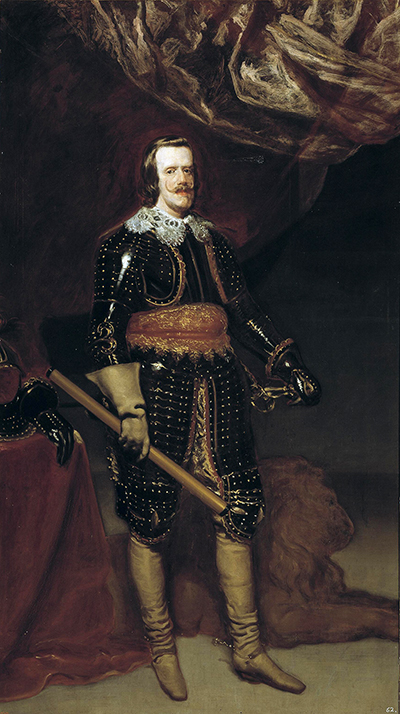
Philip IV in Armour, with a Lion at His Feet. The armoured portrait of Philip IV was documented with Mariana’s likeness at El Escorial. View Philip IV in Armour, with a Lion at His Feet.
The workshop versions in Paris and Vienna
The Louvre’s La reine Marie-Anne d’Autriche, RF 1941 31, is catalogued as a work of Velázquez’s studio, dated 1652. At 209 × 125 cm, it shows the same standing pose, black and silver dress, handkerchief and chair in a shorter field. The Louvre traces it through the Buen Retiro and cites the 1701 inventory there, which listed it as by Velázquez. It entered the Prado in 1827 and went to the Louvre in an exchange in 1941. The Prado’s 1990 catalogue identified this canvas as the replica sent to Vienna in 1653. The Louvre’s present provenance begins at the Buen Retiro, where it places the canvas as early as 1653. Cherry treats it as a painting made for use in Spain. [1] [3] [5]
The Kunsthistorisches Museum’s full-length workshop version, GG 6308, keeps the chair and handkerchief as well. Cherry compared photographs of all three portraits and found enough alignment to suggest that the workshop used full-size tracings to transfer the design. Even where the outer shapes register closely, the painters had choices to make. Cherry describes the Vienna handling as thinner and more economical, with fine lines to call out edges. In Paris the motifs of the silver trim follow the same course as in Madrid but their pattern is abbreviated. For a family member viewing the likeness at another court, the pose and the distinctive arrangement of the dress and hair would have remained immediately recognisable. [3] [5]
A report in February 1653 records the dispatch of a portrait of Mariana with others of Philip IV and the Infanta María Teresa to Archduke Leopold Wilhelm in Brussels. An order in December of that year concerns a portrait for Ferdinand in Vienna. Leopold Wilhelm returned to Vienna in 1656, and a portrait of Mariana is recorded in his 1659 inventory. Cherry leaves open which of those two shipments accounts for GG 6308. The documents show how copies could serve parallel branches of the family, even where the route of an individual picture remains uncertain. [3]
Another Mariana in Vienna, GG 2131, shows how readily the same sitter could be presented in a different way. Its three-quarter-length format brings the figure closer. She holds a fan, and the picture opens onto a garden and includes a pet monkey. Cherry supports an attribution to Mazo and dates it to about 1655. The setting and gesture belong to a separate portrait design from the standing figure beside a chair in GG 6308. [3]
The treatment could also change with the purpose of the portrait. The Prado’s Mariana de Austria in Prayer, P001222, is attributed to Velázquez’s workshop and dated about 1655. The elaborate hair and costume recall the official likeness, but the queen kneels and a prayer desk conceals much of the dress. In the Real Academia de Bellas Artes de San Fernando’s workshop portrait, inventory 0633, the likeness is reduced to a bust. The Academy relates it to the full-length Prado painting and points out its close similarity to the Thyssen-Bornemisza portrait, 416 (1935.15), whose museum records a history of disagreement over the attribution. The bust at the Meadows Museum, MM.78.01, concentrates attention on the face, with the dress lightly indicated and a differently arranged wig. Cherry proposes that this canvas served as a model for portraits in a smaller format, including ones in the Academy and Thyssen collections. Both busts retain the jewellery and the spread of the hair. There is room to pair the Academy’s version with a corresponding bust of the king, 0634, without requiring the space or furnishings of the El Escorial pair. [3] [8] [9] [10]
Mariana in the mirror and in mourning
In Las Meninas, Prado P001174, Velázquez gives Mariana very little paint and a great deal of distance. She appears with Philip IV in the small mirror on the back wall, above and beyond their daughter Margarita and the attendants. The lit doorway offers depth through a larger opening nearby, while the obscure pictures high on the wall give viewers a set of dark rectangles against which to distinguish the mirror. Someone meeting Mariana’s eyes in the full-length portrait can follow the dress all the way down to the floor. In Las Meninas, the viewer searches a distant patch of light and identifies her through her position beside Philip and the group gathered in front. The Prado discusses the possibility that Velázquez shows himself painting the royal couple, one of several interpretations of their place in the scene. [1] [11]
After Philip’s death in 1665, Mariana became regent for their young son Charles II. In Juan Bautista Martínez del Mazo’s Queen Mariana of Spain in Mourning, National Gallery NG2926, she wears a white wimple and black widow’s habit and sits in a chair. The white object in her right hand is a petition, where Mazo signed and dated the work in 1666. A door at the left opens onto an attendant group with the young king. The National Gallery’s examination found that Mazo used thicker and more opaque paint in the face than Velázquez had in P001191. The effect of a softly modelled likeness could be reached by different means. [7] [12]
Set the white cloth in the Prado portrait beside the white paper in Mazo’s. Mariana’s fingers in the earlier painting let the cloth fall freely against the broad curve of the skirt. In the later portrait the flat sheet projects from her seated figure and makes the business of a regent visible. Mazo gives the child king his own space behind her. Velázquez gives the young consort the entire foreground and measures her presence through the things she touches. [1] [12]
Artworks directory
Frequently Asked Questions
Museo Nacional del Prado, P001191 [2]
Discussion
Look again at the images and ideas explored in Queen Mariana of Austria. These editorial prompts invite your observations.
Reader Insights
How does the silver trim reveal the shape of the skirt against the dark paint?
What does the added canopy change about the space above the queen?
Join the Conversation
Share a detail, comparison or question about Queen Mariana of Austria below.
References
- Julián Gállego, Velázquez, Museo del Prado exhibition catalogue (1990), no. 71, “La reina Mariana de Austria”, pp. 408–417, and no. 22, “Doña María de Austria, reina de Hungría”, Prado 1187 (in Spanish). Exhibition catalogue. View source.
- Norton Simon Museum, Mariana: Velázquez’s Portrait of a Queen from the Museo Nacional del Prado, 2024–25 loan exhibition dossier for Prado P001191. Exhibition dossier. View source.
- Peter Cherry, “Velázquez and the Making of Queen Mariana de Austria”, Librosdelacorte.es 28 (2024), pp. 430–466, especially pp. 430–450 and figs. 1–5, 7. Article. View source.
- Museu Picasso, Barcelona, “Mariana de Austria”, Forgetting Velázquez. Las Meninas, exhibition microsite (2008). Exhibition entry. View source.
- Musée du Louvre, workshop of Diego Velázquez, La reine Marie-Anne d’Autriche (1634–1696), RF 1941 31 (in French). Collection record. View source.
- Museo Nacional del Prado, Juan Carreño de Miranda, Charles II in Armour, P007101. Object essay on the royal reception hall at El Escorial and the earlier pair P001219 and P001191. Collection record. View source.
- Paul Ackroyd, Dawson Carr and Marika Spring, “Mazo’s Queen Mariana of Spain in Mourning”, National Gallery Technical Bulletin 26 (2005), pp. 43–55, especially pp. 52–53 and fig. 5. Technical study. View source.
- Museo Nacional del Prado, workshop of Diego Velázquez, Mariana de Austria in Prayer, P001222, with object essay by Ángel Aterido. Collection record. View source.
- Real Academia de Bellas Artes de San Fernando, workshop of Diego Velázquez, Mariana de Austria, inv. 0633, with companion portrait 0634 (in Spanish). Collection record. View source.
- Museo Nacional Thyssen-Bornemisza, Portrait of Mariana of Austria, Queen of Spain, 416 (1935.15), with object essay by Mar Borobia. Collection record. View source.
- Museo Nacional del Prado, “Reencuentros. Parada V. Una Corte a nuestro encuentro”, on Las Meninas, P001174 (in Spanish). Museum essay. View source.
- The National Gallery, London, Juan Bautista Martínez del Mazo, Queen Mariana of Spain in Mourning, NG2926. Collection record. View source.







