



 by Tom Gurney
Tom Gurney BSc (Hons) is an art history expert with over 20 years experience
Published on June 19, 2020 / Updated on October 14, 2023
Email: tomgurney1@gmail.com / Phone: +44 7429 011000
Las Meninas: Introduction
María Agustina Sarmiento kneels and offers a girl a small red earthenware cup on a silver tray. The girl’s hand reaches towards it, but her face has turned away from the server. Look above them and you find somebody else looking out of the picture, a painter with a brush lifted in front of him. Already, in a few inches of the canvas, Diego Velázquez has given us one action we can follow and another we have to infer. We can see the drink being offered. Who or what has drawn the two faces towards us? [1] [2]
Velázquez painted Las Meninas, also known as The Family of Philip IV, in 1656. The large oil on canvas belongs to the Museo Nacional del Prado in Madrid, where it is numbered P001174. The Prado gives its dimensions as 320.5 × 281.5 centimetres in its Palencia exhibition catalogue. A child receiving water, an attendant at a door and a dog lying on the floor all belong to an interior big enough for us to imagine standing in. Two figures who would ordinarily command such a room, King Philip IV and Queen Mariana of Austria, appear in a mirror that you could overlook on a first pass. [1] [2] [3] [4]
At a Glance
- ArtistDiego Velázquez [1]
- Date1656 [1] [2]
- MediumOil on canvas [1] [2]
- CollectionMuseo Nacional del Prado, P001174 [1] [4]
Contents
- The Infanta and her maids of honour
- Mari Bárbola, Nicolás Pertusato and the mastiff
- A conversation in shadow and a figure on the stairs
- Velázquez at his easel
- The room in the Royal Alcázar
- What is reflected in the mirror?
- Annotated details
- Brushwork, revisions and the restoration
- From palace inventory to public gallery
- Picasso’s Las Meninas
- Looking at the original in Madrid
- What the red cup was made to do
- The portraits of Margarita that went to Vienna
The Infanta and her maids of honour
Start with Margarita Teresa, the five-year-old daughter of Philip and Mariana. The two young women attending her are the meninas. The title borrows a Portuguese word for a girl that had come to designate a young maid of honour at the Spanish court. María Agustina Sarmiento is the attendant kneeling to Margarita’s right, at our left. Isabel de Velasco is on the other side. The titles can blur the distinction between a young court attendant and a household servant in the modern sense. These were positions in a royal household, occupied by young women of noble families, and the girls’ proximity to the princess is part of their work. [2] [3]
Margarita’s dress takes up more room than her body. Its guardainfante, a structure beneath the skirts, gives the fabric a broad, almost architectural form. The outside edge comes down firmly on either side, while the lower folds seem to buckle and turn with the changing direction of the light. The contour sweeps away to meet the attendant’s skirt on one side and leaves a dark interval on the other. A small child thus occupies the centre without having to stand taller than anyone else. The scarlet detail at her bodice and the tiny glints along her sleeves give the eye places to return to after taking in the whole pale expanse. [2] [3]
María Agustina’s attention stays close to the service she is offering. Look at how the pale sleeve narrows towards her wrist, and how the dark edge of the tray carries the red vessel the few remaining inches to the princess. Velázquez gives the hand, tray and cup separate silhouettes. Those distinctions make it possible to read the gesture from across a gallery, although a viewer could easily miss the little object that has prompted it. The upright red of the vessel is so distinct against the dark behind it that the cup calls attention to the gap between the two hands. It gives the exchange a precise point of contact. [2] [3]
From Isabel’s side the encounter reads differently. Her lighter bodice tips towards the central group and the spread of her skirt turns diagonally back into the room. The Prado guide describes her as inclining slightly, as if making a curtsey. Notice the turn of her upper body and the difference in height between her hands. The movement is legible in the weight of the dress and the red at her wrist even before we decide what prompted it. It might be an acknowledgement of someone beyond the group. The painting gives the two attendants distinct tasks and rhythms, although each gesture also helps present the child to us. [2] [3]
Light makes Margarita the easiest figure to find. Hair, forehead and dress form a bright succession uninterrupted by the shadow that separates several of the adults from the wall. In that bright place she is served, supervised and watched. Her posture joins constraint and sudden attention in the same body. Her formal dress keeps its broad frontal shape while her face and one hand register different demands. The effect is available to someone who knows nothing of Habsburg protocol, and the identity of the attendants helps explain why such tiny movements have a roomful of people to give them weight.
The Kunsthistorisches Museum in Vienna holds a portrait of Margarita in a white dress that it dates to around 1656. There the child’s likeness can command attention on its own. In Madrid Velázquez can keep a recognisably formal silhouette while making what happens around it the very substance of the portrait. Look at the court dress in the Vienna portrait, then at the interruption that a tray and a bent knee introduce into the silhouette in Las Meninas. The distinction gives a better sense of the individual character available to a painter working with conventions about how a royal child should appear. [2] [5]
Mari Bárbola, Nicolás Pertusato and the mastiff
To Isabel’s right stands Mari Bárbola, a court attendant from Germany. Nicolás Pertusato, also known as Nicolasito, is at the right edge, one foot against the dog. The Prado identifies both as people with dwarfism who served in the royal household. Pertusato, whom the museum describes as being about twenty, is easily mistaken for a child at first glance. The two have markedly different stances. Mari Bárbola stands squarely, her hands close to her body and her face raised. Pertusato twists across his own silhouette, head dipping as his leg extends towards the mastiff. [2] [3]
Mari Bárbola’s face is worth looking at after you have grown accustomed to Margarita’s. Against the dark behind her head, the forehead and cheek catch a warm light. Pale accents on her collar and dress draw the eye down to where one hand gathers against her body. Isabel seems to be moving, Margarita attends to something from among a range of competing demands, and Mari Bárbola has an unusually steady outward gaze. The portrait gives her a force of presence that her place to the side and the darkness of her clothes might at first seem to withhold.
Pertusato is the one person whose body intersects the very edge of the painted room. Follow the long slant from his shoulders through the red cloth and down the lifted leg. It goes underneath the more vertical arrangement of faces and bodices, pulling attention down to the floor. There the dog has weight and length, with its forelegs extended and its head still low. The mild pressure of the foot, coupled with the animal’s apparent indifference, lets us imagine an action continuing for a second or two after the instant Velázquez has chosen. On the other side, Agustina’s arm and Margarita’s fingers are held in readiness for an action of their own. [2] [3]
The dog occupies the nearest stretch of floor at the right. Its broad body provides a low counterpart to the easel at the left. Studying how it is assembled from brown, black and ochre marks also reveals how few strokes are needed to give a foreleg weight or to indicate the direction of the fur. The nearer front paw seems to stretch towards the space we occupy. The face stays small, low and quiet. No visible reaction to Pertusato’s foot disturbs the strong horizontal shape.
A conversation in shadow and a figure on the stairs
Behind Isabel and Mari Bárbola you can find two adults standing close enough to talk. Marcela de Ulloa wears a pale widow’s head covering and dark mantle. She supervised the girls of the household. To her right stands a man usually identified by his role as a guardadamas, an attendant responsible for protecting the women and girls, whose name remains uncertain. The white around Marcela’s head can look like a religious habit. Here it is part of her widow’s dress. The angle of her face and the lift of her hand suggest an exchange with the man, who seems to face more nearly towards the foreground. [2] [3]
Neither figure is as sharply outlined as the people in front. Look at the guard’s shoulder against the right-hand wall and you may have to wait for your eyes to settle before his outline comes into focus. Marcela’s cloth gives her a clearer edge, but the white is cooler and dimmer than the light on Margarita and Isabel. The difference helps place her several steps back. It also changes how much we know about the interaction. The front group gives us the cup and the dog as tangible points of contact. Further in, a hand appears briefly beside a dark shape, and the suggestion of a private word is enough.
In the pool of light beyond them stands José Nieto Velázquez, identified by the Prado catalogue as a palace official who had charge of the queen’s tapestries before serving as an aposentador, an officer responsible for rooms and their use. He shares a surname with the painter. The 1990 catalogue records no known kinship. One of his feet is on a higher step than the other, and his extended arm reaches towards the side of the opening. The catalogue suggests he may be holding back a curtain. The brushwork gives us his short pause with greater clarity than his next step. [2] [3]
A doorway in a painting can operate as a frame and as a way through the wall. This one does both. The regular square panels of the open door, sometimes hard to discern in a small reproduction, give the edge a thickness and texture. The light on the treads takes the eye past that edge into another place. Nieto’s body cuts against a lit surface more sharply than the guard’s body cuts against the near wall. At the same time, the doorframe and the nearer people partially screen him. We can see a man standing in a far opening with striking clarity and still have trouble saying whether he is on his way in or out.
The opening is where we get the most definite intervals along the floor. In the main room there is an uninterrupted stretch of warm colour with few marks to measure the distances. The stair edges set a scale and a rhythm at the far end. From them the eye can come back to the intervals between Pertusato’s shoe, the dog’s paws and the skirts. The longer you spend with these details, the more the ground under the company looks like a surface you could cross.
Annotated Details from Las Meninas
Follow the painter, the mirror, the doorway and the offer of the cup.
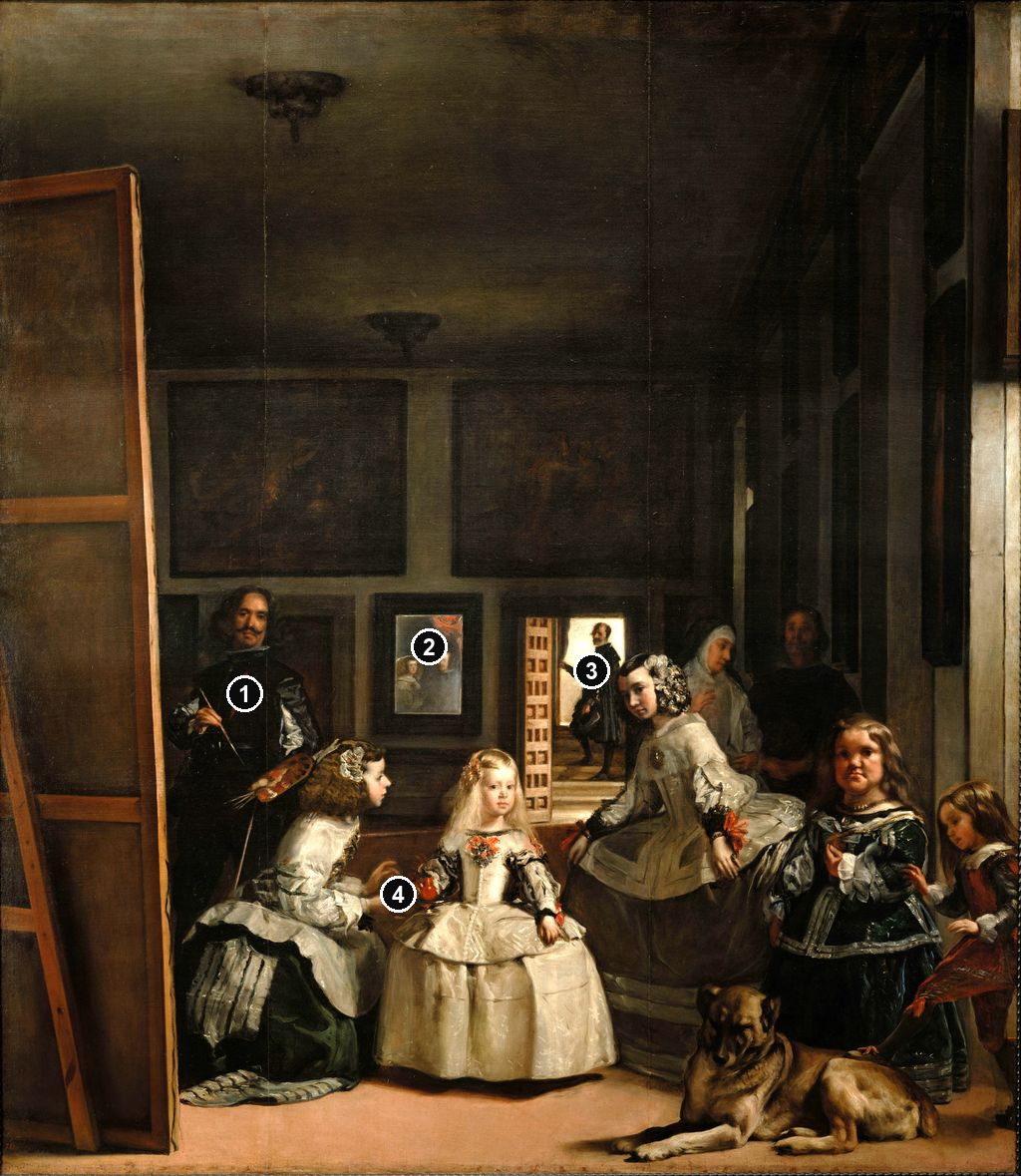
Details from LAS MENINAS
Each number opens a detail from the full painting.
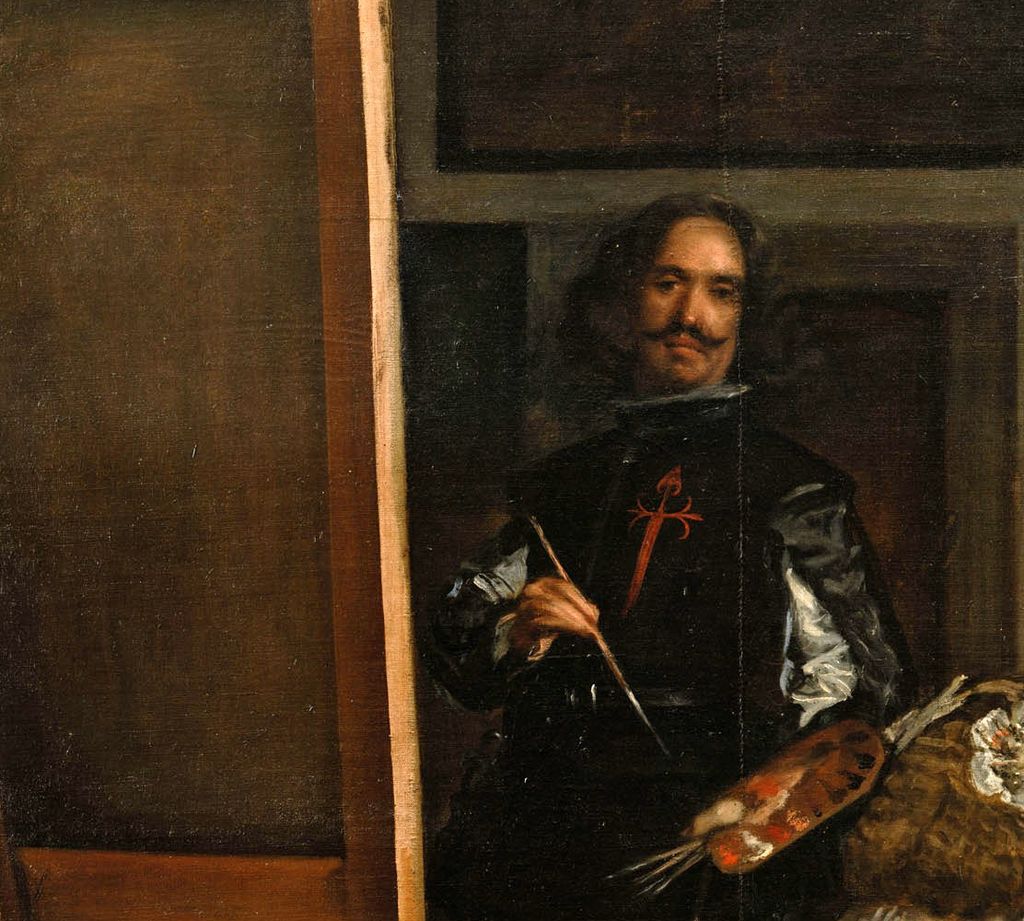
The painter and his canvas
The black costume nearly merges with the room. The illuminated face, raised brush and palette let us read the painter’s pause beside the dark back of the canvas. [1] [3]
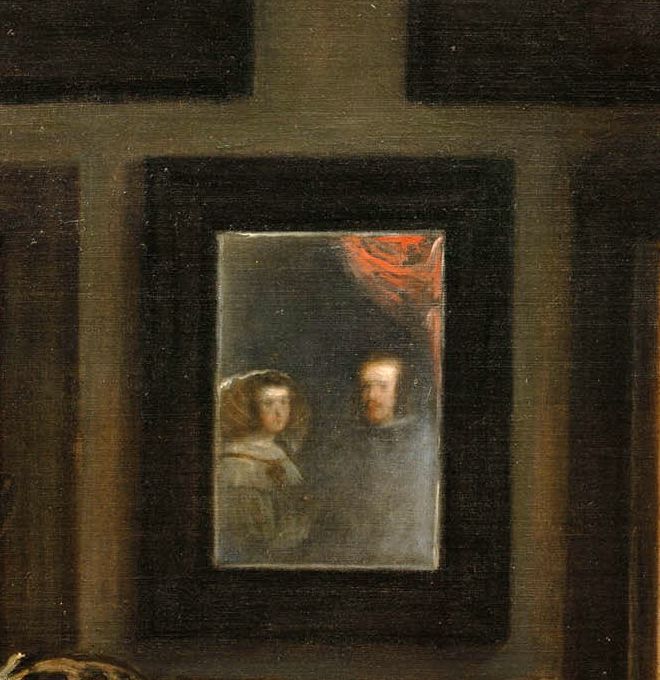
The royal reflection
The two heads of Philip IV and Mariana of Austria occupy a small patch of light. The bright frame and the red fabric above the heads make the mirror easier to find among the larger pictures on the rear wall. [1] [3] [8]
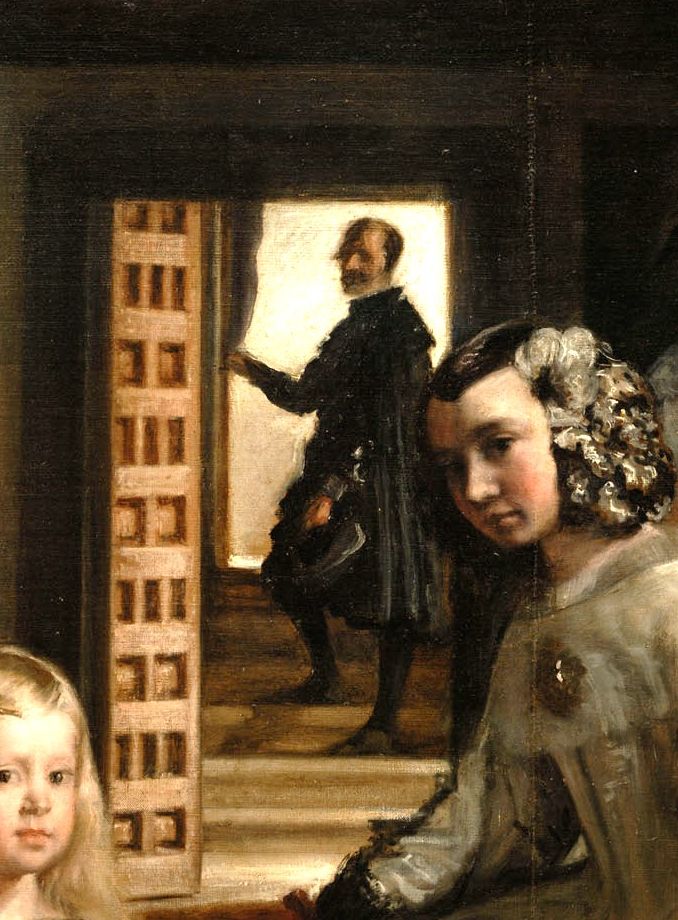
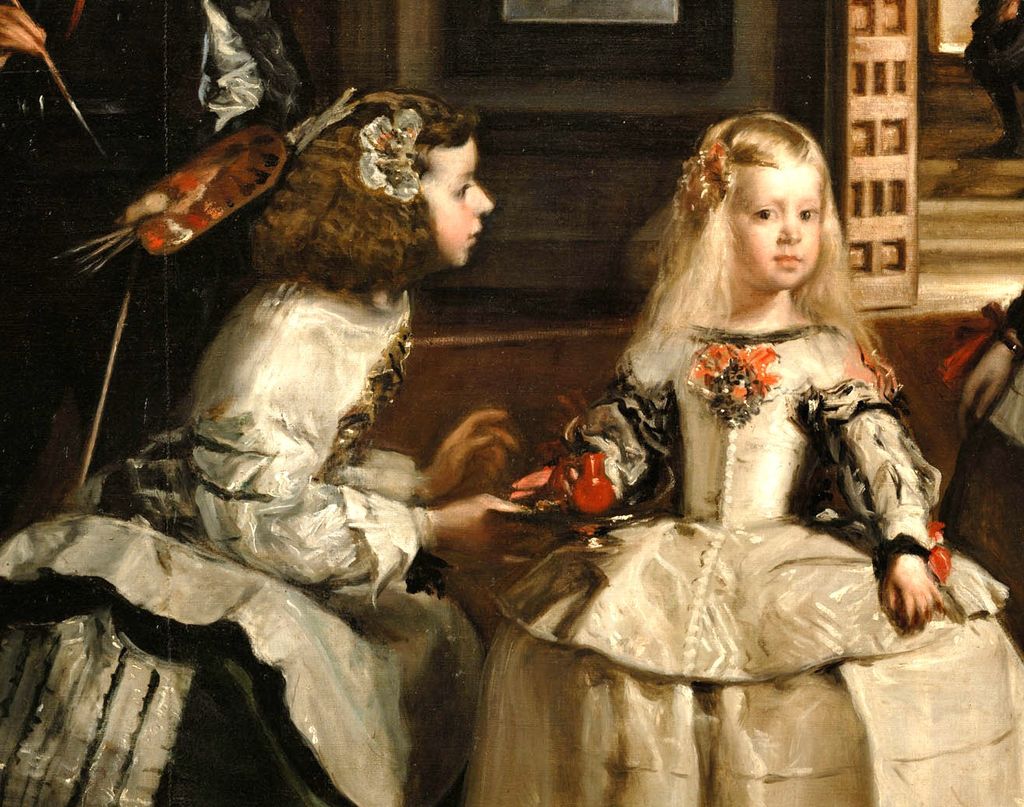
Detail images from the Museo Nacional del Prado painting. Public-domain image source
Velázquez at his easel
Much of the left side is occupied by the brown back of a canvas that rises far above the painter’s head. The diagonal prop and the crosspieces show us something substantial, with a structure and a weight. It stands at an angle to the scene. At its right edge, Velázquez holds a brush in his right hand and supports a palette, other brushes and a long mahlstick with his left. A mahlstick can steady the working hand while it is held just above the painted surface. The implements make the occupation explicit and direct attention to the interval when the brush is poised away from its work. [2]
The painter’s head is just to the left of the two bright rectangles at the rear. His dark hair and suit blend with the tones behind him, making the whites at his sleeves, the red cross and the uncovered face do most of the work of bringing him forward. Compare his brush hand with Agustina’s hand beneath the tray. Both have a task. It is the suspension of the painter’s gesture, alongside the precision of hers, that makes it feel as though they could be responding to something at the same instant.
The canvas inside the painting also keeps the room from becoming fully available to us. It hides the left wall and much of the area immediately around the painter. We have to move our attention around it, as if trying to get a better look from one place in the room. Moving in front of the actual painting cannot give us a view of the painted canvas’s front. The arrangement makes a real habit of seeing, looking around an obstacle, do work inside a medium where the obstacle will always stay in place.
Julián Gállego recalls Charles de Tolnay’s reading of the gesture as a representation of artistic invention. The painter takes in or conceives his subject before applying the brush. The moment was one way to turn the public image of a skilled worker into a claim about the judgement that skilled work requires. Consider what a full brushstroke might have done to the scene. The painter’s gaze would have had more reason to travel back to the area of canvas under his hand, and his actions would have appeared to belong entirely to the left of the room. Raising and holding the brush allows him to attend to a space that the viewer cannot see. [2]
The red cross of Santiago
On the front of the black doublet is the red cross of the Order of Santiago. The order’s inquiry into Velázquez survives in the Archivo Histórico Nacional, with the date 1659. The file describes him as an aposentador of the palace and an assistant in the royal chamber. His admission came three years after the accepted date of the painting. Antonio Palomino later reported the tradition that the king had the cross painted after Velázquez’s death. The story that Philip painted it with his own hand is a further claim. The documentary chronology gives a reason to think the emblem was added to the picture after 1656. The name of the person who applied it remains uncertain. [2] [3] [6]
The inquiry gives the red mark a meaning a modern viewer might miss. In Gállego’s account, witnesses represented Velázquez as a man who painted in the service of the king, rather than a tradesman keeping an open shop. The distinction was material to the artist’s claim to social standing. On the surface of the painting, however, the honour sits inches from the tools of the trade. Velázquez shows the brush and palette in the same light as his court dress. That proximity gives the question of painting’s status a concrete form. The badge may belong to a later state of the canvas, while the artist’s decision to give himself a place among the royal household belongs to its composition. [2] [6]
Paintings high on the back wall
Two dark canvases hang above the mirror and door. In a small image you may see little beyond their frames and some dim patches of colour. They have been identified as copies by Juan Bautista Martínez del Mazo, Velázquez’s son-in-law and pupil, of mythological compositions from the decorative programme associated with Rubens for Philip IV’s hunting lodge, the Torre de la Parada. One shows Minerva punishing Arachne, the mortal who challenged her at weaving. The other represents the musical contest of Apollo and Pan, also known as The Judgement of Midas, after a painting executed by Jacob Jordaens. The National Trust distinguishes Rubens’s design for the Arachne subject from the lost finished painting, whose executor it gives as unknown. [2] [7]
Gállego reads the myths in relation to the high status claimed for the arts. Gods confront challengers in skills that require judgement as well as practice. From there one can return to the man beside the easel and ask what rank the picture gives invention. The scale and low visibility of the paintings also set a limit to what the subject matter can explain. A viewer standing before Las Meninas can readily tell that the room has works of art on display. Recognising these particular myths takes information and attention, and their presence can support different readings of artistic skill, rivalry and punishment. [2] [7]
Arachne also appears in The Spinners, where the story lies beyond a foreground of women working with fibre. It is worth comparing the distances at which Velázquez lets the two pictures yield their myths. In The Spinners a bright rear area beckons behind the working figures. In Las Meninas the back wall is dim, and its two works are overshadowed in our attention by a few inches of reflected colour and a lit doorway. The comparison helps explain how Velázquez can give painting a place in the daily work of a household and make its more learned associations available to a viewer who has time to look. [2]

The Spinners or The Fable of Arachne. The bright rear opening in The Spinners provides a second example of how Velázquez made a distant scene compete with figures close to the viewer. View The Spinners.
The room in the Royal Alcázar
The Prado identifies the setting as the Cuarto del Príncipe of the Royal Alcázar in Madrid, a room in the former apartments of Prince Baltasar Carlos that Velázquez used as a studio. The Alcázar stood where the Royal Palace stands today. This was a working room within a palace that also had formal galleries, offices and private apartments. The difference matters because the room represented in the painting and the room where it was first recorded hanging served different purposes. The inventory puts the painting in the king’s summer office, elsewhere in the building. [1] [2] [3] [8] [9]
The tall right wall is the best place to begin reading the architecture. Its windows and picture frames succeed one another as the wall approaches the rear. Follow their edges back. Lines in the room that would be parallel in reality narrow towards a small area in the opening beside José Nieto, around his bent arm. The convergence belongs to the geometry of linear perspective. The picture feels measurable at this point even though much of what could be measured, including the left wall and the unmarked foreground floor, is unavailable. [10]
A second system gives the room depth. The edge of a sleeve can be bright and sharp near the foreground and less definite on someone farther in. Dark objects high on the wall and in shadow are held together by close tones, while a hard edge can re-emerge in backlight. The change in colour, contrast and definition, often called aerial perspective, works here at the scale of a room. Try tracking the white across the bodies. The ridges in Margarita’s skirt are clear across a large surface. On Marcela de Ulloa’s headdress, narrower changes in light describe a form partly lost to the room. You can tell there is air between those two people before you count how many steps it might take to reach the second one. [1] [2] [3]
The foreground light enters primarily from the right, from a window largely outside the field of view. The Prado guide identifies another window and the open door as further contributors. At the near window, broad light sweeps across pale dresses and the floor. Around the opening in the distance, a more concentrated light catches the stair and outlines Nieto’s black clothes. Notice how little of the foreground light appears to touch the rear wall above it. The two bright areas have distance between them precisely because the foreground light falls off. If the whole room were uniformly legible, we would have clearer inventories of the objects and a much weaker sensation of depth. [1] [2] [3]
There is more empty height than most small reproductions suggest. The heads are gathered low enough for the upper wall to become a large passage of paint in its own right. A pair of dark ceiling fixtures mark different distances overhead, and the wall meets the ceiling in a line that gathers towards the rear. The group below feels less posed partly because the architecture has enough room to continue on its own. Crop down to the heads and bright dresses and the court party will still make sense as a group. Open the view back out and its scale changes. The painter and figures become occupants of a room whose dark volume can seem greater than the number of people in it.
The depth also depends on what cuts across what. The easel blocks a great portion of the left, Agustina’s dress overlaps the edge of the space around it, and Isabel comes partly across the view into the doorway. These overlaps allow the figures to have their own places, rather than simply varying in size as they approach the distance. They also make the scene feel contingent on where somebody stands. A step to one side in an actual room would bring a different set of shapes into view. On the canvas Velázquez fixes the overlaps so we can read each figure against its neighbour, from the small patch of shadow between the dog and Isabel’s skirt to Isabel’s pale sleeve against the dark near the door.
A reconstruction can test which details agree with a plausible room. In a study published in 2017, architect Luis Ramón-Laca built a virtual model of the prince’s former gallery. His analysis found considerable agreement among the receding lines on the right-hand wall and proposed that a large studio mirror could help account for how the image was produced. This is a proposal about a possible tool used by the painter. The small mirror represented on the back wall is a separate object. A reconstruction has to supply positions and dimensions for objects only partly visible in the painting. Its result can demonstrate a possible method of making the picture without establishing that Velázquez used that method. [10]
Further reading
For a closer look at the evidence and paintings:
Collected Writings on Velázquez. Jonathan Brown. Centro de Estudios Europa Hispánica, 2008. English edition
Two essays examine the painting’s meaning, the figures it depicts and its place in the study of Velázquez. See the book at CEEH.
Las Meninas: Is This The Best Painting In History? · Nerdwriter1 · Watch on YouTube
What is reflected in the mirror?
On the rear wall a heavy dark frame surrounds a thin band of light. Within it are two soft faces and shoulders with a reddish shape above them. The framed object shares the dark rectangles of the wall, yet seems to hold light in a different way. The mythological paintings immediately above seem to go on absorbing the light falling on the wall. The mirror contains an image whose tones lift it clear of that surface, as though it were returning light from elsewhere. [1] [2] [3]
Stand back mentally from the tiny separate features and compare the mirror with its neighbour. The adjacent doorway has a hard side, square recesses and steps that can hold a foot. The mirror has a bounded surface that catches something outside its own frame. One gives our eye a way further into the architecture. The other gives us people whose position we cannot fix by relating their feet to the floor. Both are on the same wall, but one directs our attention beyond it and the other brings us back towards the studio.
The king and queen in the foreground
The Prado’s educational guide presents the mirror as reflecting Philip and Mariana from an unseen point in front of the painted company. On that reading the royal pair stand on the side where the viewer looks in. Javier Portús’s Prado catalogue account, adapted in a later digital exhibition, understands the figures as interrupting their activity on the arrival of the monarchs. You can see why that is a compelling way to join the looks and gestures together. Margarita has turned her face while her hand continues towards the cup, and the painter has raised his eyes without setting aside his brush. The royal presence then helps account for the momentary disruption without requiring Velázquez to paint two more bodies in front of the entire assembly. [1] [3]
Within that broad reading are several possible moments. The couple might have just come upon a scene already under way. If they were posing for a portrait, the change could instead have begun with the arrival of Margarita and her attendants. Both scenarios give the painter a reason to look out, but they give the princess a different part in the story. Palomino’s report that members of the royal family took pleasure in visiting the studio makes the familiarity of such an encounter historically plausible. It leaves the exact sequence of a particular visit open. [2]
A person in the museum does not have to align precisely with the glass to feel the effect of the outward looks. We complete a connection between the living viewer and the picture when we meet those looks, and the thought that the royal couple might stand near our own position gives the encounter an added charge. The small reflection sets a limit to the invitation. The faces we see there are painted identities, present regardless of who steps in front of the picture.
A reflection of the painted royal portrait
There is another long-standing explanation. Palomino described the artist making the subject of the hidden canvas known by means of the mirror. Art historian Julia Vázquez reads his account as a proposal that it reflects the painted likenesses of the king and queen from the front of the large canvas. In this version the glass discloses something that is already within the room but faces away from us. The larger the back of the canvas seems, the more striking it is that a small image at the other end of the room might be all that tells us what is on it. [8]
The position of the vanishing point supplies a useful clue. It is near Nieto rather than in the mirror itself. Imagine the wall mirror flat and flush with the back wall. A viewer on the line through the centre of the mirror would see a different part of the room reflected from a viewer to one side. Under the spatial reconstruction discussed by Vázquez, just because the reflection sits near the middle of the canvas does not mean that what it reflects is directly before the actual painting. Geometry can make the hidden face of the easel canvas an intelligible source of the small image. Its exact position and angle and the placement of the mirror affect the result. [8] [10]
Nor does the fact that these figures look out force their eyes to meet precisely at one point. María Agustina is intent on the child, Pertusato leans towards the dog, and the guard’s face is hard to read. Margarita’s and Mari Bárbola’s looks have different emphases in the setting, independent of any attempt to draw lines from their eyes. A study of perspective can test the architecture and a proposed beam of reflected light. It has less to say about who was speaking a moment ago or whether each face turned in response to the same event.
The different kinds of evidence together make the mirror more interesting than a pictorial riddle to be solved. Consider the red fabric above the reflected heads. It could be part of the staging around living royal sitters, or part of the composition of their painted portrait, as a canopy is in other royal pictures. The reflection joins these fragments so economically that it gives us neither a fully recognisable garment nor a definite corner of the room by which to orient the two people. Both main readings leave something wonderfully exact in view and something consequential outside it. [2] [8]
Two other framed images by Velázquez
In the Rokeby Venus, Cupid holds up a mirror so that the face of a woman seen from behind becomes partly visible. You can follow the shape of her body on one side of the surface and try to complete the deliberately blurred likeness on the other. In Las Meninas both the artist’s canvas and the monarchs are withheld from direct inspection. The similar softness of the reflections supports two different kinds of looking. In the nude we move between body and face. In the court scene we move between the people reacting in front, the obscure image behind them and the unseen place that may supply it. [11]
An earlier work makes the comparison more precise. In Christ in the House of Martha and Mary, probably painted in 1618, a kitchen takes up most of the foreground. At the upper right a small rectangle shows Christ with Martha and Mary. The National Gallery reads that view as an opening but records that it has also been understood as a picture or a reflection. Here the figures in the small image are legible enough to identify the story. The uncertainty concerns how that story and the visible kitchen share one painted surface. In Las Meninas both the open door and the mirror have names and identifiable occupants. The route the eye takes between them is much more secure than the route it can trace beyond the boundaries of the scene. [12]
This work in Velázquez’s career
The Surrender of Breda
c. 1635 CatalogueThe Rokeby Venus
1647–51 [11]The Spinners
1655–60 CatalogueLas Meninas (current article)
1656 [1]Brushwork, revisions and the restoration
Walk your eye along the hem of Margarita’s skirt after looking at her from across the room. The marks that have been holding together as silk come apart into irregular lengths of pale paint. At the wrist, a few bright strands against dark cloth suggest the edge of a cuff. Here a bright mark can belong to a form, pick out an edge and record the fall of light at the same time. The pale strokes on the hem gain their force from the near browns and greys underneath. Seen in isolation, many would hardly seem to describe anything. Seen together, they give the fabric enough sheen and weight for a viewer to read its different surfaces. [3]
A corresponding economy shapes the room. Take the dark space between the heads of Isabel and the guard. The brush has left enough of a boundary to tell where one figure gives way to another part of the room, picking out a little more of one edge and taking away definition from the next. That calibration also explains why a sharp stroke in the far doorway can coexist with a much more elusive mark nearer us. Local light makes the farther figure temporarily easier to distinguish. Velázquez can take away detail without removing information about where a person stands. [3]
The ease of the visible paint has often encouraged the idea of a scene laid down in one sweep. Examination gives a more complicated picture. In the Prado’s Pinceladas de ciencia en Las Meninas, the authors illustrate changes along Nicolás Pertusato’s extended leg and near the Infanta’s reaching hand. A change of position can matter even on the scale of these small joints. How far the leg extends governs the strength of its diagonal towards the dog. The spacing of the fingers alters the distance left to travel before the cup is taken. These are places where adjustments affect how promptly we read an action. [13]
A review by Prado specialists Carmen Garrido, María Teresa Dávila and Rocío Dávila describes the museum’s wider programme of X-radiography, infrared reflectography and examination of artists’ materials and supports. The methods answer different questions. X-radiography may distinguish features within successive layers of paint, depending on what the layers contain. The resulting image superimposes information, which can complicate the reading of any one stage. Infrared examination can reveal some preparatory marks under a surface that looks fully painted. The Prado’s science guide reports a few lines in connection with pictures on the right wall and the absence of an extensive underlying drawing visible with that method. The examination tells us about the marks it can reveal in the object. Velázquez’s planning may also have involved decisions or marks beyond the reach of the method. [13] [14]
In 1984 the Prado invited John Brealey of the Metropolitan Museum of Art to direct the cleaning. Prado restorer María Teresa Dávila later recalled how the work was shared. Brealey carried out the cleaning, and Dávila, Rocío Dávila and Clara Quintanilla undertook retouching. Enrique Quintana contributed to the report after an injury prevented him from working on the canvas. The Prado’s science account describes the yellowing of old varnish and illustrates the difference in appearance with a detail of the painter’s head. [13] [15]
Removing or reducing discoloured surface coatings can change the relationship between colours a viewer sees, particularly when the painter has made the passage from one dark tone to the next so gradual. Gállego’s catalogue entry reflects on how the cleaning made the painting’s juxtapositions of quiet tones more apparent. Met conservator Charlotte Hale, writing about Brealey, records the hostility he initially met from parts of the Spanish press, followed by official recognition of his work. Public concern about the cleaning is itself part of the painting’s history in the museum. By the 1980s the appearance of a canvas made for a royal household had become a matter of public attachment and debate. [2] [15] [16]
From palace inventory to public gallery
The first known inventory entry for the picture places it in the Alcázar in 1666, ten years after its date. The Prado catalogue traces it through further Alcázar inventories in 1686 and 1700. It survived the fire that destroyed the palace in 1734, and appears in the inventories of the new palace in 1772, 1794 and 1814. In 1819 it entered the Prado. That sequence establishes the route of the object while leaving the origin of the subject open. Gállego notes the absence of evidence settling whether the proposal for the picture came from the king or from the painter. [2] [3] [9]
The 1666 site of display has implications for how the picture works. Julia Vázquez traces the king’s summer office through palace records and notes that the large group portrait hung among works by artists from across Europe, in rooms associated with the private use of Philip and Mariana, where the furnishings also included mirrors. For those viewers, the royal faces in the painted mirror would have been immediately recognisable. They could look at a room they knew in another part of the same building. A painter whose responsibilities involved the rooms and their contents had placed himself within that intimate territory. This is part of Vázquez’s interpretation of the installation, and the inventory provides the setting in which to consider it. [8]
Palomino devoted unusual space to the picture in his 1724 account of Velázquez. He named or described the people in it and recorded Luca Giordano’s description of the work as the “theology of painting”. The phrase survives as a remark attributed to Giordano. The account of familiar palace visitors and the praise for the artist’s ingenuity belong together. To early admirers the scene’s accessible subject was compatible with a remarkably ambitious demonstration of what a painting could do. In the nineteenth century the Prado cataloguer Luis Eusebi wrote about the softened tones, luminous opening and two kinds of perspective. The effect of real space was part of its early public reception, before photography became a ready shorthand for such likeness. [1] [2] [8]
The name under which visitors know it today dates from that public life. The Prado’s 1990 catalogue traces the title Las Meninas to the museum catalogue of 1843. The Family of Philip IV preserves the older emphasis on the royal household. The two names draw a viewer’s attention to different people. The older one directs attention to the king whose likeness is a few brushstrokes at the back. The 1734 inventory calls the subject Philip IV’s family. Earlier descriptions had identified it with the Infanta. The more familiar name points to the two attendants who bring a young girl within reach of our observation. A reader who begins with one title and returns to the other can notice how fully the roles of principal figures and attendants depend on each other. [2] [8]
A portrait with a story
The princess belonged to a family whose portraits circulated beyond the palace. Her parents’ survival in the image as reflected figures is unusual in that context. The Vienna portrait conveys her likeness as a precious and portable thing. Las Meninas sets that likeness within her day-to-day company, reaches past the formal pose and asks what it is like to be seen among the people who bring the royal household into being. Palomino’s account makes a place within the portrait for these people and what they are doing. The question of who merits individual attention becomes inseparable from the question of how an event unfolds. [5] [8]
Portús argues that the range of simultaneous actions brings the group portrait closer to history painting, a genre built around meaningful events. In one sense nothing extraordinary happens in the room. People wait, a dog lies down, a brush is lifted. Look more closely, and each of these legible actions offers a piece of an encounter between the reigning couple, their daughter and the artist engaged in making royal images. A formal portrait might give a royal child just the amount of company necessary to indicate her standing. Here there is time to look at the attendants and the palace room in their own right. Even the man on the steps is free to be occupied with something beyond the room. [1] [8]
Mazo, Goya and the difficulty of copying a room
At Kingston Lacy in Dorset the National Trust holds a smaller painting after Las Meninas, which it catalogues as the work of Juan Bautista Martínez del Mazo, made between 1656 and his death in 1667. It has been identified in the past with a reported preparatory sketch owned by Gaspar Melchor de Jovellanos. Both the Prado’s 1990 catalogue and the National Trust’s current entry treat the Kingston Lacy picture as a copy after the Prado original. The copy makes one change that is easy to miss. Julia Vázquez points out that Mazo retained the mirror and omitted the reflected royal pair. You can still make sense of the person at the easel, the attending figures and the room. It is harder to imagine what has caused the company to look out, or to know what to make of the large canvas’s hidden face. Mazo’s departures tell us how a painter close to Velázquez reworked the picture. They give us no direct access to Velázquez’s first plans. [2] [7] [8]
Mazo took up several of the original’s devices in another work, The Family of the Artist, now in Vienna. A group of children and adults occupies the foreground and another interior opens behind them. There, as Julia Vázquez observes, a painter is at work on a portrait of a royal child. The view is from behind the working figure, allowing us to see the portrait he is making. A painted likeness of Philip IV hangs in the room. The two works share the idea of a household inhabiting a space full of pictures, but Mazo lets us locate and recognise the royal images in a much more direct way. His two approaches, a close copy and a family group of his own, show how the organisation of Las Meninas could be studied feature by feature by somebody who knew the court and the work of painting for it. [7] [8]
A later experiment moves the design into black ink on paper. Around 1778 Francisco de Goya etched a version of the painting as part of his study of Velázquez’s work in the royal collections. Several proofs survive. The Fundación Goya en Aragón records that the plate was damaged in the course of work involving aquatint and burnishing, and the print was never published for sale. Compare how much is asked of the textures in a print of this scale. In the painting the outlines of the painter’s black sleeves can approach the value of the wall yet remain distinct from it through a difference in colour or a brief sidelight. In the print an equivalent distinction depends on the behaviour of lines and fields of tone. The image of Goya’s work helps explain why the ceiling and the receding upper wall, so easily taken for granted in the oil painting, were a considerable part of the problem. [17]
A mirror in the museum
Michel Foucault began The Order of Things with an extended reading of Las Meninas. He was interested in the positions assigned to painter, model and viewer, and in the shifts between what the image enables us to see and what its figures seem to be seeing. The painting itself has had a display history that sharpens that reading. In the old Sala de las Meninas, a real mirror was installed opposite the painting. A 1977 photograph reproduced by Julia Vázquez documents the display. An actual visitor could encounter a reflection in the same gallery as the painter’s depicted one. That installation and the king’s summer office offer two very different circumstances in which to meet the same outward-looking faces. [8]
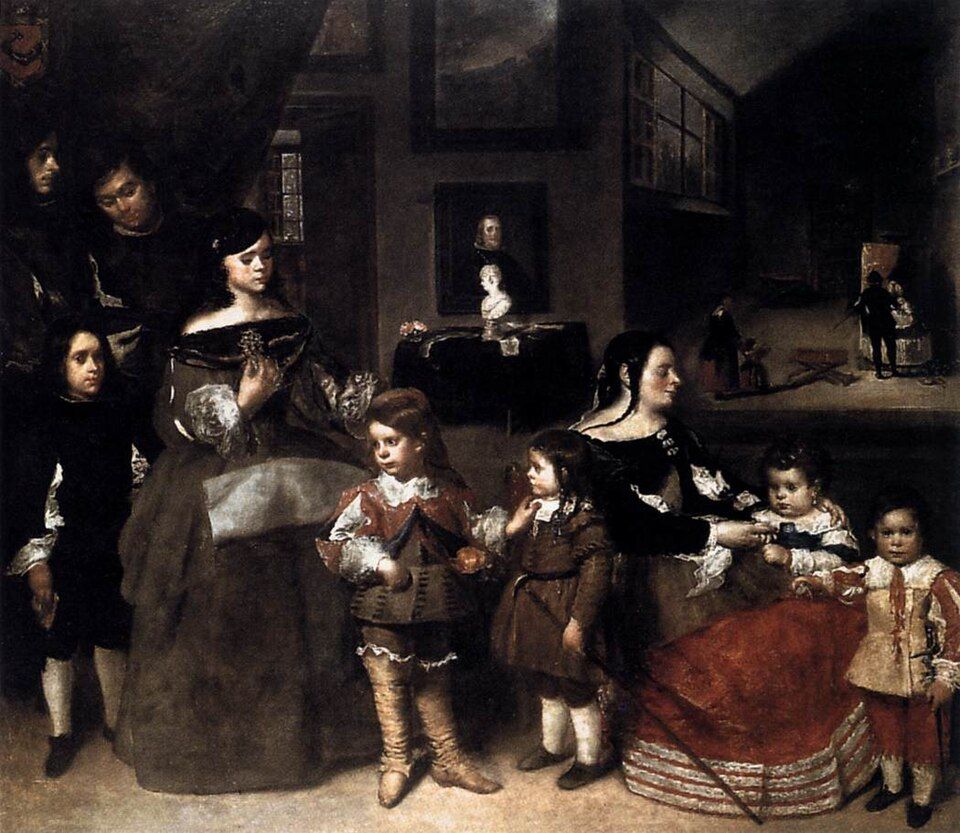
Juan Bautista Martínez del Mazo, The Artist’s Family, around 1664–65, Kunsthistorisches Museum, GG 320. Compare the foreground group and the glimpse into a working room behind it. Image source. Public domain. Resized for display.
Picasso’s Las Meninas
Pablo Picasso began his series based on the painting in Cannes in August 1957. The Museu Picasso in Barcelona records a surviving preliminary sketch from 16 August and a first large painted version dated the next day. In this first group composition the proportions have shifted from Velázquez’s tall format to a wide canvas. Picasso makes Velázquez himself nearly the height of the picture and gives him two palettes. The people are still traceable across the lower part of the composition, but the vertical scale of the painter and the reach of his equipment give the place of making a very different emphasis. [18] [19] [20]
The first variation is largely monochromatic. Within it the casing of the door, the small mirror and the painter’s upright figure register as related arrangements of black, white and grey. The dark figure on the stairs can be recognised with very little description. In later works some figures take the canvas to themselves. María Agustina Sarmiento, previously part of an exchange of three nearby hands, becomes the subject of repeated paintings in which the act of offering the drink can be considered apart from the painter and the dog. Picasso’s sequence allows a motif present for a moment in Velázquez to be pulled out, rearranged and returned to. [18] [19] [20]
The series numbers 58 works in the Museu Picasso’s chronology, of which 45 rework the Velázquez directly. The others comprise nine pictures of the pigeons, three landscapes and a portrait of Jacqueline. That grouping places the views from Picasso’s own studio alongside his sustained study of a painted studio three centuries earlier. In 1968 Picasso gave the series to the Museu Picasso in memory of his friend and the museum’s founder, Jaume Sabartés. The survival of the series as a group makes the different acts of attention easy to compare. The August group composition may make you look first at the painter. An isolated attendant can take you back to the fall of a sleeve or the handful of red at the centre of Velázquez’s painting. [18] [19] [20]
Looking at the original in Madrid
The Prado’s visitor map places Las Meninas in room 12. At a distance, see how early you register the positions of Margarita and Nieto, and see how long it takes for the mirror to resolve into two people. Then, from closer in, attend to a small area such as the join between the tray and the girl’s hand, or the bright edges of the stair. The stair can make you feel the full depth of a room while a shadow nearly erases the adult standing a few feet behind the foreground. Each step closer to the picture gives you a different balance between what the marks do on the surface and what they describe. [3] [21]
As you return to the child and the cup, notice what is left in motion. The hand has reached towards the water, the person offering it still has the weight of the tray, and Margarita’s attention has gone somewhere else. The fixed shapes of furniture, dress and architecture allow those few inches of unfinished action to stay visible across the full size of the painting.
What the red cup was made to do
The cup that María Agustina offers Margarita belongs to a family of earthenware vessels known as búcaros. In his study of ceramics in the Prado's paintings, Alfonso Pleguezuelo describes this one as a plain, single-handled little jug. The quality for which such vessels were prized could be difficult to show in paint. They could cool drinking water and give it a distinctive taste or scent. Davide Domenici’s study of early modern accounts of these vessels explains how water that entered the porous surface could evaporate and carry its fragrance into the air. The slight gloss Velázquez gives the red clay is all the eye gets of an object chosen partly for what it did when filled. [22] [23]
The silver tray puts that unornamented surface in company with a material that answers the light differently. Pleguezuelo compares the presentation with an earlier portrait by Alonso Sánchez Coello, in which a member of the household offers the Duchess of Béjar a tiny two-handled vessel on an elaborate set of dishes. The clay takes pride of place in both paintings. Another comparison comes from Pedro de Camprobín’s still life of peaches and plums in the Prado. Pleguezuelo picks out small points of shine on its red earthenware vessel that suggest moisture in the clay. The still life gives the viewer time to examine a vessel among fruit and glass. Velázquez gives the cup just enough definition for us to follow its passage from one person to another. [22]
Was Margarita’s cup made in Portugal or across the Atlantic? Byron Ellsworth Hamann argues for Tonalá, near Guadalajara in present-day Mexico. He compares the painted cup’s deep red and sheen with surviving pieces and with descriptions written by Lorenzo Magalotti late in the seventeenth century. Magalotti distinguished the shinier finishes of several American wares from the generally duller surfaces of the Portuguese examples he knew. Hamann also found inventories that distinguished vessels from Guadalajara, Chile, Natá and Estremoz. The Met's large covered jar from Tonalá, made around 1675–1700 and finished with burnishing, white paint and silver leaf, gives an idea of the variety that the term búcaro could accommodate. Hamann’s identification rests on comparisons of appearance and descriptions, since the clay represented by a patch of paint cannot be sampled. [24] [25]
Following the material beyond the painting brings people and places into view that court portraits rarely show. Hamann found a contract dated 1693 for taking eight crates of Tonalá ceramics from Guadalajara to Veracruz for shipment. The document belongs to a later transaction and gives one example of how such pottery reached an Atlantic port. Hamann also asks what the tray owes to the large flow of American silver into Europe. The trade records give a context for the silver at court, while the particular metal Velázquez represented has no known source. The attendant’s hands are in plain view. Hamann’s research draws attention to the labour in mining and transport, and in Tonalá’s pottery workshops, that could put such materials within a court attendant’s reach. [24]
Early modern accounts also describe people eating fragments of this kind of pottery. Domenici discusses the evidence for the practice, known as bucarophagy, including Marie-Catherine d’Aulnoy’s account of trying the clay herself in her account of a visit to a household in Madrid. Her account comes from later in the century. In the picture the jug still has its shape, it is being served on a tray, and Margarita's mouth is nowhere near it. We can follow the offer of water even as the history of the material broadens our sense of why small vessels like this were valued. [22] [23] [25]
The portraits of Margarita that went to Vienna
Margarita was less than a year old when her grandfather, Emperor Ferdinand III, asked Philip IV to send her likeness to Vienna. Javier Portús traces the request to May 1652 and the emperor’s thanks for the portrait to 8 October 1654. Gudrun Swoboda associates the letter with the Vienna portrait of Margarita in pink. The correspondence lets us follow a portrait through a request, a wait and an acknowledgement from its recipient. Ferdinand’s daughter Mariana lived at the Spanish court after her marriage to Philip. Through a painted likeness he could see how his granddaughter was growing up at a distance. [26] [27]
In the pink portrait, Margarita places one hand at the edge of a table and holds a fan in the other. The fan hangs down against her skirt. Swoboda sets this arrangement beside Velázquez’s portrait of Margarita’s older half-sister María Teresa, also in Vienna. Each girl rests a hand on a piece of furniture and lowers the other against her dress. Both stand before heavy curtains. The recurrence of the pose across their difference in age makes visible how a painter could describe a particular face and bearing within a recognisable image of rank. Return to the level of Margarita’s hands in Las Meninas. The room supplies a person where the pink portrait supplies a table. Instead of resting on a stable surface, her nearer hand takes its position from the servant’s moving tray. [27]
By 1659 the portrait in blue went to Vienna with a portrait of Margarita’s younger brother Felipe Próspero, who had been born after Las Meninas was painted. The two pictures went to Leopold I, who had succeeded Ferdinand and would marry Margarita in 1666. Swoboda reads the sending of the pair against the changed prospects of the dynasty. There was now a young prince, and the young princess who would marry Leopold. This later shipment gives the siblings distinct places in a developing family and political arrangement. Swoboda places the portraits in pink and white before the plans for Margarita’s marriage had taken concrete form. The emperor’s earlier request and the later dispatch show how much the circumstances behind a series of similar-looking portraits could change over a few years. [27] [28]
To see how much each painting asks of the setting, compare one piece of furniture. Antonio Palomino, writing in 1724, singled out an ebony clock with bronze figures in the blue portrait. Its table is behind the sitter, while a gloved hand and a large fur muff occupy the space at her sides. The clock helps furnish the room and remains subordinate to the girl who was meant to be recognised in Vienna. In Las Meninas, the court’s furnishings are also working things that people use, reach past or stand beside. Its largest piece of equipment, Velázquez’s big canvas, puts the painter’s work before us even as it conceals the image he is making. The portraits sent to Vienna establish what Velázquez could make available to distant viewers. Their documented purpose gives us a way to see how unusual it was for the Madrid group to devote so much space to the work of attending to Margarita and to the act of painting itself. [27] [29]
Artworks directory
Frequently Asked Questions
Yes. Velázquez painted Margarita Teresa in the Prado group in 1656 and made the separate blue-dress portrait for the court in Vienna in 1659. [2] [4]
Diego Velázquez [1]
Discussion
Look again at the images and ideas explored in Las Meninas. These editorial prompts invite your observations.
Reader Insights
Look from the mirror to the open door. How do the two patches of light give you different information about the room?
Follow where Margarita, María Agustina and the painter are looking. What sequence of events would account for their different directions of attention?
Join the Conversation
Share a detail, comparison or question about Las Meninas below.
References
- Javier Portús Pérez, Las Meninas, adapted from Velázquez y la familia de Felipe IV (1650–1680), Museo Nacional del Prado, 2013, catalogue no. 16, pp. 126–129, in the G20 Digital Museum Culture Corridor catalogue, pp. 166–167. English adaptation of the Spanish catalogue entry. View source.
- Julián Gállego, Las meninas o La familia de Felipe IV, catalogue no. 73, in Antonio Domínguez Ortiz, Alfonso E. Pérez Sánchez and Julián Gállego, Velázquez, Museo del Prado and Ministerio de Cultura, 1990, pp. 420–429. Spanish. View source.
- Museo Nacional del Prado, Área de Educación, Las meninas en pictogramas, especially pp. 29–34. Spanish. View source.
- Museo Nacional del Prado, El Museo del Prado en Palencia, entry 2, Las Meninas or The Family of Philip IV, P-1174. Spanish and English. View source.
- Kunsthistorisches Museum Wien, Weiß, section on Velázquez’s Infantin Margarita (1651–1673) in weißem Kleid, c. 1656, Gemäldegalerie 3691. German. View source.
- Archivo Histórico Nacional, Silva Velázquez, Diego de, inquiry for the Order of Santiago, 1659, Consejo de Órdenes, OM-CABALLEROS_SANTIAGO, Exp. 7778. Spanish. View source.
- National Trust, Las meninas (The Handmaidens of the Infanta Margarita in the Household of Philip IV) (after Velázquez), catalogued as Juan Bautista Martínez del Mazo, Kingston Lacy, NT 1257140. View source.
- Julia Vázquez, “Les Suivants”, Velázquez, Painter & Curator, Brill, 2025, especially pp. 196–213 and 217–220. Includes passages from Antonio Palomino’s El Parnaso español pintoresco laureado of 1724. View source.
- Patrimonio Nacional, Royal Palace of Madrid, history of the palace and the Alcázar fire. View source.
- Luis Ramón-Laca, “Modos de representación del espacio en Las meninas”, Locus Amoenus 15, 2017, pp. 91–103, especially figs. 1 and 2 and the discussion of the viewpoint on pp. 93–97. Spanish with English abstract. View source.
- The National Gallery, London, Diego Velázquez, The Toilet of Venus (‘The Rokeby Venus’), NG2057. View source.
- The National Gallery, London, Diego Velázquez, Christ in the House of Martha and Mary, NG1375. View source.
- Fernando Ignacio de Prada Pérez de Azpeitia and José Antonio Martínez Pons, Pinceladas de ciencia en Las Meninas, Museo Nacional del Prado, especially figs. 5, 6, 9 and 27 and the associated sections on infrared examination, X-radiography, pigments and varnish. Spanish. View source.
- Carmen Garrido, María Teresa Dávila and Rocío Dávila, “General remarks on the painting technique of Velazquez and restoration carried out at the Museo del Prado”, Studies in Conservation 37, 1992, pp. 46–53. View source.
- María Teresa Dávila Álvarez, “We Restored Practically the Entire Velázquez Collection”, Voices of the Prado, interview recorded 29 November 2017. English transcript. View source.
- Charlotte Hale, “Dating Velázquez’s The Supper at Emmaus”, Metropolitan Museum Journal 40, 2005, opening discussion of John Brealey and the Prado. View source.
- Fundación Goya en Aragón, Francisco de Goya, Las Meninas, inventory 225, in Copies of Velázquez (prints and drawings, 1778–1785). English catalogue entry. View source.
- Museu Picasso, Barcelona, “La cronología de ‘Las Meninas’ de Picasso”, including preparatory drawing MPB 113.292 and the first group painting MPB 70.433. Spanish. View source.
- Museu Picasso, Barcelona, Pablo Picasso, Las Meninas, 17 August 1957, MPB 70.433. View source.
- Museu Picasso, Barcelona, “The inhabitants of the museum: ‘Las Meninas’”, 18 November 2015, especially the gift and the variations on María Agustina Sarmiento. View source.
- Museo Nacional del Prado, visitor map, entry for Las Meninas, room 12. View source.
- Alfonso Pleguezuelo Hernández, chapter II, section 2.2.3.2.1, in M.ª Ángeles Villegas Broncano (scientific ed.), La cerámica en la pintura del Museo Nacional del Prado, CSIC, Museo Nacional del Prado and Sociedad Española de Cerámica y Vidrio, 2025, pp. 59–63, especially figs. 2.38 and 2.39. Spanish. View source.
- Davide Domenici, “Tasting Clay, Testing Clay. Medicinal Earths, Bucarophagy and Experiential Knowledge in Lorenzo Legati’s Museo Cospiano (1677)”, Cromohs 22, 2019, pp. 1–16, especially pp. 4–5. View source.
- Byron Ellsworth Hamann, “The Mirrors of Las Meninas: Cochineal, Silver, and Clay”, The Art Bulletin 92, nos. 1–2, 2010, pp. 6–35, especially pp. 15–18 and 24–26. View source.
- The Metropolitan Museum of Art, Covered jar, Tonalá, Mexico, c. 1675–1700, 2015.45.1a, b. View source.
- Javier Portús Pérez, “Diego Velázquez, 1650–1660: retrato y cultura cortesana”, in Velázquez y la familia de Felipe IV (1650–1680), Museo Nacional del Prado, 2013, pp. 17–59, especially the discussion of family likenesses, p. 23 of the linked PDF, and note 76. Spanish. View source.
- Gudrun Swoboda, “On the Vienna Portraits of the Infanta Margarita by Velázquez and J. B. Martínez del Mazo”, in Velázquez, Kunsthistorisches Museum, 2014, catalogue nos. 37–41, English text pp. 319–323. View source.
- Cäcilia Bischoff, Kunsthistorisches Museum Wien, Infanta Margarita Teresa in a Blue Dress, 1659, GG 2130, excerpt from Masterpieces of the Picture Gallery, 2010, reproduced on Google Arts & Culture. View source.
- Antonio Palomino, El Parnaso español pintoresco laureado, 1724, life of Velázquez, chapter X, pp. 348–350, transcribed by Universidad Complutense de Madrid, Arte y palabra. Spanish. View source.






