


 by Tom Gurney
Tom Gurney BSc (Hons) is an art history expert with over 20 years experience
Published on June 19, 2020 / Updated on October 14, 2023
Email: tomgurney1@gmail.com / Phone: +44 7429 011000
Philip IV on Horseback: Introduction
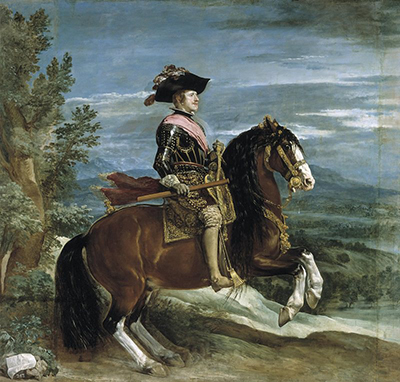
Philip IV’s right hand hangs close to his thigh, holding a commander’s baton across the saddle. His other hand gathers the reins near the horse’s neck. The horse has both forelegs in the air. Its chest rises sharply, but the king’s back stays upright and his gaze holds to the right, in the direction of the horse’s head. A crimson sash streams left behind his waist. As the horse bears its weight on its hind legs, the rider’s hands give almost nothing away. [1]
Velázquez painted Philip IV on Horseback around 1635 for the Hall of Realms at the Buen Retiro Palace in Madrid. It is an oil on canvas about three metres high, now in the Museo Nacional del Prado as P001178. The king shared one end of the hall with portraits of his wife, Isabel of Bourbon, and their son, Baltasar Carlos. In 2025 the Prado presented the restored painting. Work on the canvas brought renewed attention to a detail in its lower left corner, where a cut in the picture preserves evidence of how the portrait once fitted around a palace door. [1] [2] [3]
At a Glance
- CollectionMuseo Nacional del Prado, P001178 [2]
- PaintedAround 1635 [2]
- RestorationPresented by the Prado in 2025 [3]
Philip IV’s mounted portraits and the Hall of Realms
A mounted likeness for the Alcázar
1625 [4]The earlier commission put a royal likeness opposite Titian’s emperor.
The retained corner seam and strips preserve evidence of the palace installation.
Baltasar Carlos above the doorway
Around 1635 [8]The mounted heir completed the grouping with both parents.
The restored portrait presented at the Prado
2025 [3]María Álvarez Garcillán treated fragile paint and the discoloured surface.
Contents
- A horse rising and a rider quite still
- From the horse’s white muzzle to the distant hills
- Facing the doorway in the Hall of Realms
- What a cut in the canvas can tell us
- The raised baton of Olivares
- From the palace to the museum and the print
A horse rising and a rider quite still
The horse is a bay with a dark mane and tail. Follow the black curve from the ears down the neck and see how it gathers into the chest. The hind legs angle under the rump, with the nearer white leg carrying the eye down to the ground. The lifted forelegs are folded, their two pale shapes separated by enough shadow to make the bend of each leg intelligible. Velázquez puts a broad white marking on the horse’s face and catches the wetness around the mouth. Between the pale muzzle and the gold of the bridle, the closed profile of the head gives way to small, irregular touches. You can read the pose from across a room and still find the animal working at the bit when you come closer. [1] [3]
The near leg of the king follows an almost continuous line from the knee to the stirrup. His left arm folds in close to his body. The catalogue describes a slight movement of the left hand and the spur engaging at the horse’s side. What reaches the eye first is the smallness of that movement beside the lifted bulk of the animal. Velázquez sets the king’s glove and baton against his lap, where they catch the light and make a long, quite clear line. The baton lifts only a little towards the right. You can follow it with your eye without being directed out towards a target. The baton identifies a general, while the reins and the firm weight in the stirrup show what Philip is doing at this instant. [1]
The armour has fine lines of gold that turn at the joints. Look at the sleeve from the shoulder down to the elbow. Where the arm bends, the short glints come closer together, and the sleeve becomes a series of overlapping plates. The crimson sash crosses the breast and returns as a rush of cloth to the left of the saddle. The dark hat has an outspread brim, with lighter feathers curling away from it. Beneath the brim there is a thin line of light along the nose and a small break in the profile at the moustache. On a canvas built around a large animal, the narrow strip of flesh that gives Philip’s expression occupies very little space. The background immediately around it is quiet enough to keep the face plainly legible. [1]
The Prado’s 1990 catalogue records changes to the king’s head, torso and leg and to the horse’s hind legs and tail. These observations matter particularly here because the present arrangement can look inevitable. The position of the king’s foot, the way his leg divides the flank from the neck, and the shaded spread of the tail all help establish where weight falls. The 2025 treatment account also describes the surface as a mixture of dry strokes and marks richer in binding medium. Look at the armour and at the foliage on the left in turn. Both resolve into much larger, clearer forms at a distance, although the rigid glints of the armour and the loose interruptions of the leaves ask for very different kinds of attention up close. [1] [3]
From the horse’s white muzzle to the distant hills
The near ground runs down towards the right. It is light enough immediately below the forelegs to call attention to the gap underneath them. The rise of the horse meets that falling slope, and beyond both there are parallel stretches of green, grey and blue. Some of the more distant folds of land are barely separable from one another. Then the horizon grows paler and gives way to a mass of clouds. Even towards the tree on the left, where the browns and greens are denser, there are openings between branches that let the sky through. The far distance reaches almost to the edge of the horse in the interval below its jaw. This gives the muzzle and its fine detail a very different effect from a white shape against an opaque background. [1]
Julián Gállego associated the hills with El Pardo. The 2025 account likens the landscape to the foothills towards the Guadarrama, around Hoyo. Those comparisons put the picture in recognisable country around Madrid. The terrain works over a much wider stretch of the canvas than an identifying landmark would. Along the foreground, leg, tail and tree carry weight and cast the eye down. Above the hills the cloud bands extend far to the right, making the mounted king look close and the open country behind him seem to continue beyond the frame. [1] [3]
The restoration account relates the portrait to Titian’s Emperor Charles V at Mühlberg, painted in 1548 and also in the Prado. Titian’s armoured emperor rides with a lance and faces right, with dark trees giving way to an open landscape. Velázquez gives Philip a shorter baton and carries the cloud bands almost the full width of the picture. There is also documentary evidence for a more explicit pairing elsewhere. In 1626 the visitor Cassiano dal Pozzo saw an earlier mounted Philip IV by Velázquez opposite the Titian in the New Room of Madrid’s Alcázar. Julia Vázquez discusses the records for that earlier painting, whose final whereabouts remain uncertain. The Buen Retiro portrait belongs to a family display with a different set of companions. Its open country and right-facing profile take part in a tradition that Philip and Velázquez had already worked with. [3] [4]
Facing the doorway in the Hall of Realms
The Salón de Reinos was a long room used for occasions including court audiences and theatre. Its painted decoration placed twelve military victories and ten scenes of the Labours of Hercules along the long walls, with the shields of the monarchy’s kingdoms high above. Velázquez’s The Surrender of Breda was one of the military pictures. Its generals are seen meeting on foot and its opposing groups extend from one side of the canvas to the other. The royal portraits used the shorter end walls. At one end were Philip III and Margaret of Austria, the king’s parents. At the other, the mounted Philip and Isabel of Bourbon flanked the doorway above which hung Prince Baltasar Carlos on Horseback. [1] [5] [6]
Philip’s horse faces right and Isabel’s light-coloured mount faces left. Seen as a pair, their profiles turn inward. The king’s horse has both forelegs above the ground, while the queen’s horse lifts one foreleg in a measured step. Isabel’s long, intricately patterned costume spreads over much of her mount, where the king’s armour and streaming sash leave a greater expanse of his horse visible. Velázquez and his collaborators gave each adult portrait its own silhouette and tempo. At the scale of the room, the door between them would have let the curves of the horses’ necks approach the centre of the arrangement without running into each other. [1] [3] [7]
The placement of the paintings relative to the doorway is better established than the exact arrangement of the hall in its earliest years. A reconstruction published by the Prado with an architectural proposal based on José Álvarez Lopera’s work shows the younger family together at the end of the long room. The 2025 conservation account places Philip III and Margaret beside the throne at the eastern end and the younger family opposite them. Mercedes Simal López records differences between the reconstructions of Jonathan Brown and J. H. Elliott and Álvarez Lopera, down to where the upper balcony railing would have been interrupted. She also questions whether the side doors implied by some reconstructions were present at the outset. These details affect how a visitor approached the portraits and how much room the installation allowed for the canvases. [3] [5] [7]
The prince’s canvas is just over two metres tall, smaller than the king’s, and the horse in it comes towards the spectator at an angle. Its broad underside and the strong foreshortening of its body make sense when you imagine looking up above a doorway. The child holds his baton at a more conspicuous slant than his father’s. In both portraits, one hand carries the sign of command and the other manages the horse. Philip keeps his body and mount close to a lateral view. The angle of Baltasar Carlos’s horse makes him seem to ride out at the room below. Even a visitor who passed through the doorway before turning round would have had two kinds of movement to read, across the wall in the large pictures and out from it in the prince’s. [1] [7] [8]
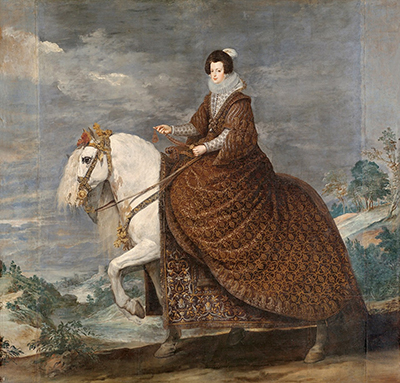
Isabel of Bourbon on Horseback. The queen’s horse and landscape give a companion comparison from the Hall of Realms. View Isabel of Bourbon on Horseback.
What a cut in the canvas can tell us
Look at the lower left, near the foot of the tree. There is a folded white piece of paper painted on the ground, with space for a name and no visible signature. Above it the tree and its lower growth help enclose the scene. In the 1990 catalogue Gállego notes that much of the tree lies on an added strip. The 2025 conservation account gives a fuller reconstruction of what happened. Velázquez widened the initial canvas with strips on both sides, extending its width by more than sixty centimetres to fit the palace scheme. The added canvas reached across a small side door. A piece of the lower left corner was cut away and attached to the door, so it could swing with the door. When the door was shut, the pieces would meet and continue the picture. [1] [3]
The cut helps explain how a portrait of this size could occupy a wall that was also in use. It fixes a physical relationship between canvas and door opening. The conservation account places the changes within the fitting out of the hall, while Simal López has proposed an eighteenth-century date for the opening of the lateral doors and the consequent cuts. The portrait still has the side strips, and the section carried on the door was reunited with it when the painting was relined for its transfer to the Royal Palace. Those changes supplied a single rectangle for a new setting. They also left evidence of a display in which part of the painting had literally moved. [3] [5]
The treatment presented in 2025 was carried out by María Álvarez Garcillán. She removed old material at the join, secured vulnerable paint and reduced the yellowed varnish. Later retouching that covered original paint was removed. The join in the corner is still discernible. The effects of the treatment can be understood in relation to the rest of the picture as well. The soft separation of the distant planes depends on small colour differences, and a yellowed layer across the whole surface can make those differences harder to read. [3]
The raised baton of Olivares
In The Count-Duke of Olivares on Horseback, also in the Prado, a dark hat, a sash, armour and a baton recur. The bay turns towards the left. Its hindquarters are close to us and its raised forelegs reach away. The count-duke twists in the saddle and brings his face back into view over his shoulder. His baton crosses the sky at a steep angle. Precisely where the royal image gives us the unbroken line of a back in profile, the minister’s portrait makes us register the turn of an armoured body. Below the lifted legs, little troops and plumes of smoke open another line of sight far beyond the horse. Philip’s counterpart to that passage is an expanse of unoccupied landscape. [1] [9]
Luis Ribot dates the Prado’s Olivares portrait to around 1636 and discusses it as an assertion of the king’s chief minister’s authority, while leaving the approximate date and proposed military occasion in tension. The count-duke had a central role at the Buen Retiro. The five portraits documented on the end walls depict the royal family across three generations. The catalogue traces the Olivares canvas through the minister’s family and later owners before its acquisition by Charles III in 1769. The shared emblems tell us how Velázquez could portray both men as commanders, down to the lift of each horse and the scale of its forequarters. The difference of provenance matters when two such paintings turn up in the same collection or are reproduced together. [1] [6] [9]
From the palace to the museum and the print
Philip’s portrait is recorded at the Buen Retiro in the seventeenth century and entered the Prado in 1819. Manuel Gago Rodríguez’s examination of the early museum’s catalogue places the two royal couples in pairs in the second room and infers that the prince’s picture hung apart from his parents. In 1834 an inventory lists the king’s portrait in the second room of the old Spanish schools as item 243. By then, the position of a portrait in the museum could still give it a royal companion, even as its larger setting increasingly told a history of Spanish painting. [1] [2] [6]
Goya had already made the image available on a different scale. The Metropolitan Museum of Art’s impression of his 1778 etching has a plate under forty centimetres high. The printed rider keeps the identifiable shape of the hat, the upright posture and the close grip above the horse’s neck. Goya makes the transitions between ground and sky with lines of different densities. He leaves out the tall tree and the painted piece of paper. Below the image he adds a printed inscription identifying the sitter, crediting Velázquez and locating the original in the royal palace in Madrid. A reduced painted copy in the Wallace Collection in London offers another history of the design. The Wallace records it as the pendant to their copy of the mounted Olivares, a pairing the collection tentatively connects with the two large portraits being brought together under Charles III. Such afterlives can preserve how a rider and horse look while changing how the viewer makes sense of their company. At the Buen Retiro the companion who answered Philip across a doorway was Isabel, and looking up between them brought the next generation into view. [3] [6] [10] [11]
Artworks directory
Frequently Asked Questions
Museo Nacional del Prado, P001178 [2]
Around 1635 [2]
The near ground runs down towards the right. It is light enough immediately below the forelegs to call attention to the gap underneath them. The rise of the horse meets that falling slope, and beyond both there are parallel stretches of green, grey and blue. [1]
Discussion
Look again at the images and ideas explored in Philip IV on Horseback. These editorial prompts invite your observations.
Reader Insights
Where do you see the contrast between the horse’s movement and the king’s posture most clearly?
How does knowing about the door change the way you look at the lower left corner?
Join the Conversation
Share a detail, comparison or question about Philip IV on Horseback below.
References
- Julián Gállego, “Felipe IV, a caballo”, in Velázquez, Museo del Prado and Ministerio de Cultura, 1990, cat. 38, pp. 230–235, Prado P001178. See also cats. 36, 39, 40 and 42 for the related pictures. Spanish. View source.
- Real Academia de Bellas Artes de San Fernando and Fundación Ramón Areces, “Felipe IV, a caballo”, Poder, patrimonio y cultura en España, P001178, with the inventory of 1834, item 243, fol. 409 recto. Spanish. View source.
- Fundación Iberdrola España, “El retrato ecuestre de Felipe IV de Velázquez recupera su esplendor original, gracias a la colaboración entre la Fundación Iberdrola España y el Museo del Prado”, 9 October 2025, sections on the treatment, display and origins of the canvas. Spanish. View source.
- Julia Vázquez, Velázquez, Painter & Curator, Brill, 2025, ch. 1, fig. 1.1 and pp. 34–38, “Velázquez’s Equestrian Portrait of Philip IV”. View source.
- Mercedes Simal López, “El Real Sitio del Buen Retiro y sus colecciones durante el reinado de Felipe IV”, in La Corte de Felipe IV (1621–1665): Reconfiguración de la Monarquía católica, vol. 3, part 4, pp. 2476–2487, section on the Salón de Reinos. Spanish. View source.
- Manuel Gago Rodríguez, “La dispersión de la serie pictórica del Salón de Reinos y su fortuna museográfica durante los primeros años del Real Museo de Pinturas (1635–1838)”, Philostrato. Revista de Historia y Arte 14, 2023, pp. 23–46, especially pp. 24–27 and 34–35. Spanish. View source.
- David Chipperfield Architects and b720 Fermín Vázquez Arquitectos, Museo Nacional del Prado, 1204SDR, proposal panel 3, “Salón de Reinos”, after José Álvarez Lopera, with reconstructed interior and wall key. Spanish. View source.
- Museo Nacional del Prado, “El príncipe Baltasar Carlos, a caballo”, Espacios Barrocos, Recursos, Prado P001180. Spanish. View source.
- Luis Ribot, “The Count-Duke of Olivares. Displaying the Power of a Royal Favourite”, A Military Stroll through the Museo del Prado, pp. 84–89, Prado P001181. Spanish and English. View source.
- The Metropolitan Museum of Art, Francisco de Goya after Diego Velázquez, Philip IV on horseback, after Velázquez, 1778, accession 31.31.12. View source.
- The Wallace Collection, after Diego Velázquez, Philip IV on Horseback, P106, catalogue description and note on the pendant P109. View source.







