



 by Tom Gurney
Tom Gurney BSc (Hons) is an art history expert with over 20 years experience
Published on June 19, 2020 / Updated on October 14, 2023
Email: tomgurney1@gmail.com / Phone: +44 7429 011000
Rokeby Venus: Introduction
The light runs along the calf and across the hip of a woman lying on her side, then narrows again as her back rises towards the shoulder. The dark fabric beneath her comes up at almost the same angle. By the time her body has led our eyes to her head, all we can see of it is a sweep of dark hair and a little pale skin. A winged boy holds up a mirror. There, well to the left of the head on the canvas, is the face that Diego Velázquez has kept from direct view. He gives it the faintest of outlines. [1] [2]
The National Gallery in London calls the painting The Toilet of Venus (‘The Rokeby Venus’) and dates it to 1647–51. The oil on canvas measures 122.5 × 177 centimetres and is numbered NG2057. Venus is the Roman goddess of love and beauty, and the boy attending her is Cupid, her son. The word toilet here means the business of dressing or attending to one's appearance. Rokeby is the name of the English country house where the painting spent much of the nineteenth century. Both titles tell us something about the experience of the picture. One directs our attention to a private gesture within it. The other preserves the memory of a private room outside it. [1]
At a Glance
- Date given by the National Gallery1647–51 [1]
- MediumOil on canvas [1]
- CollectionNational Gallery, London, NG2057 [1]
Contents
- How the bed gives the body its shape
- Cupid's hands and the ribbon
- What the mirror shows
- Annotated details
- Venice, Rubens and the figure seen from behind
- A rare Spanish nude
- Guerra Coronel, Haro and the date
- Two ways to hang a reclining nude
- From Rokeby Park to the National Gallery
- Mary Richardson, the damaged canvas and its repair
- What a visitor saw in Godoy’s cabinet
- Correggio’s two Venuses and the work of Cupid
- From paint samples to a wartime exhibition
How the bed gives the body its shape
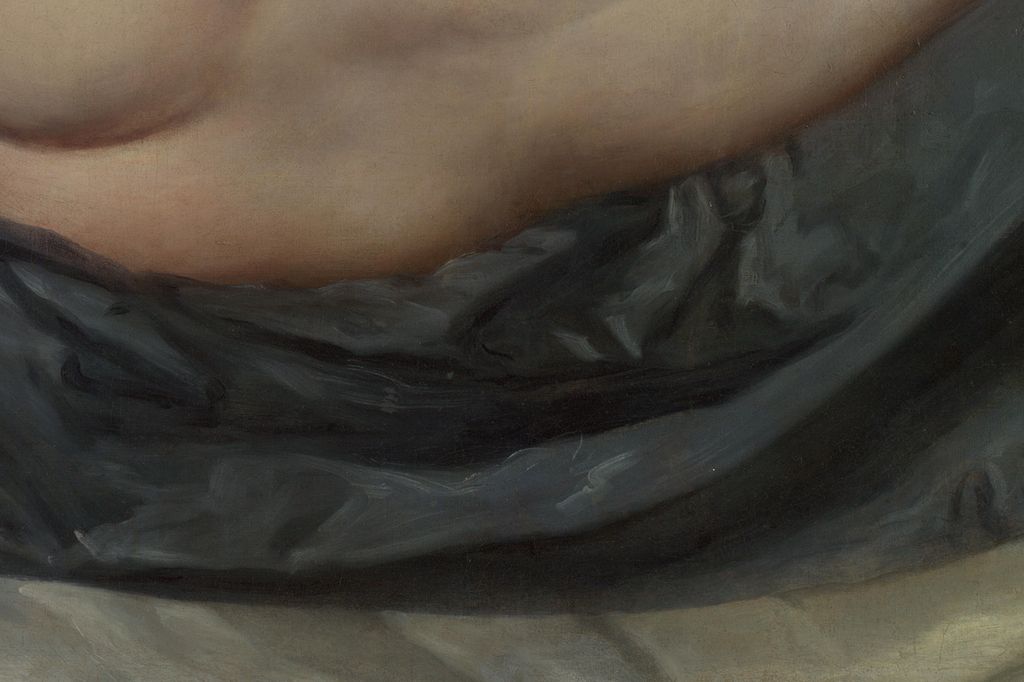
Start with the fabric below the figure. At the lower left, white cloth spills down from the bed and falls out of sight at the bottom edge. Above it, a length of much darker fabric runs under Venus. It creases where it takes her weight, then rises steeply to the right. Her arm rests along that high end. The lift of the head and shoulder seems entirely natural once we have seen how the bedding is built up. The bedstead, its height from the floor and even the scale of the room hardly enter into what we see. Velázquez tells us what her body is doing through two layers of cloth. [1] [2]
Follow the light on the other side of the figure, from the neck down. The upper edge of the shoulder is clear where pale skin meets darkness. The line softens as the back descends and turns into the broad brightness of the hip. The back is modelled in long transitions. One plane catches a little light and a neighbouring one moves away from it, with only a slight change in colour. The curve of the hip is more sharply marked where it meets the leg tucked beneath it. By the time the eye reaches the legs, the distinction between a clean edge and a line lost in shadow is doing much of the work of explaining how the limbs are placed. The far foot almost disappears below the near leg. [1] [2]
The canvas is wide enough to accommodate this long turn without forcing a show of symmetry. The near foot comes close to one edge and the supported arm to the other. The great horizontal of the reclining figure accordingly has room to dip and rise. Imagine standing in front of the full-sized painting and looking first at the shoulder, then at the little dark opening under the knee. That shift asks the eye to take in almost the entire length of the figure. In a small reproduction the body reads at a glance as a single bright shape. At the scale of the canvas the curves are far enough apart for each to gather its own weight. [1] [2]
Velázquez changes his handling when he moves from skin to fabric. Compare the turn at the hip with the white sheet at the bottom. On the hip, the highlight enlarges gradually, and you may have trouble saying where it begins. On the sheet, one streak of light seems to stop abruptly as a fold changes direction. The dark satin has passages of sheen and almost black creases. The National Gallery notes that its colour was once more purple than the grey we see now. That difference would have mattered most in the broad runs where satin separates pale flesh and white linen. We can still follow those sweeping folds, with the qualification that their colour relationship to the red curtain has changed over time. [1]
In an article on the technique of Velázquez, Larry Keith and Dawson W. Carr point to the relative loss of definition towards Venus's feet. Their observation is worth testing against the light and the dark of the bed. The outer length of the lower leg stands out against the satin, while the finish at the tip of the foot is loose. The far leg is partly folded underneath, and a few strokes suggest where the far foot emerges against the bedding. Velázquez gives enough clarity to keep us from losing the pose altogether. The softer handling also helps us pass over the left end of the figure towards the broad back and the small changes of direction at the shoulder. [3]
The curtain at the back hangs close enough to Cupid to set off his pale wing. Its folds run down to a slanting edge behind the mirror and leave the right side of the background dark. The colour gives a sense of enclosure before we can tell anything about the walls. It also makes the brown of Venus's hair do two jobs. The hair tells us where her head turns, and its dark mass joins the space behind her just where we might have expected a clearer profile. A landscape could have carried the eye out and over the body. Here the nearest layers of cloth and the steep division of the background give the eye a path back towards the two figures. [1] [2]
Cupid's hands and the ribbon
Cupid is on the bed with Venus. Look at the sharply bent near leg, the little exposure of the white sheet under the knee and the glimmer of the other leg further back. The body turns just enough for the wing to sit against the curtain while the leading arm reaches across the dark frame. The folds at his knee help to settle him on the same surface as the adult figure. His wings identify a god, but the way he holds his balance is a little study in human effort. He has to steady a large object while kneeling on a soft surface. [1] [2]
The usual place for a portrait painter to spend time would be around the child's eyes and mouth. Here the National Gallery draws attention to the sketchier handling of the face and rear leg. The near arm is given a much clearer light. Set the edge of that forearm alongside the light on the wing, where bright strokes separate the feather tips, and the reason for that choice becomes easier to see. The eye passes from the designation of Cupid as a winged child to the place where he acts, where both hands come together at the frame. His lowered head gives the impression of attending to his hold. Its position keeps his gaze from competing with the reflected one. [1] [2]
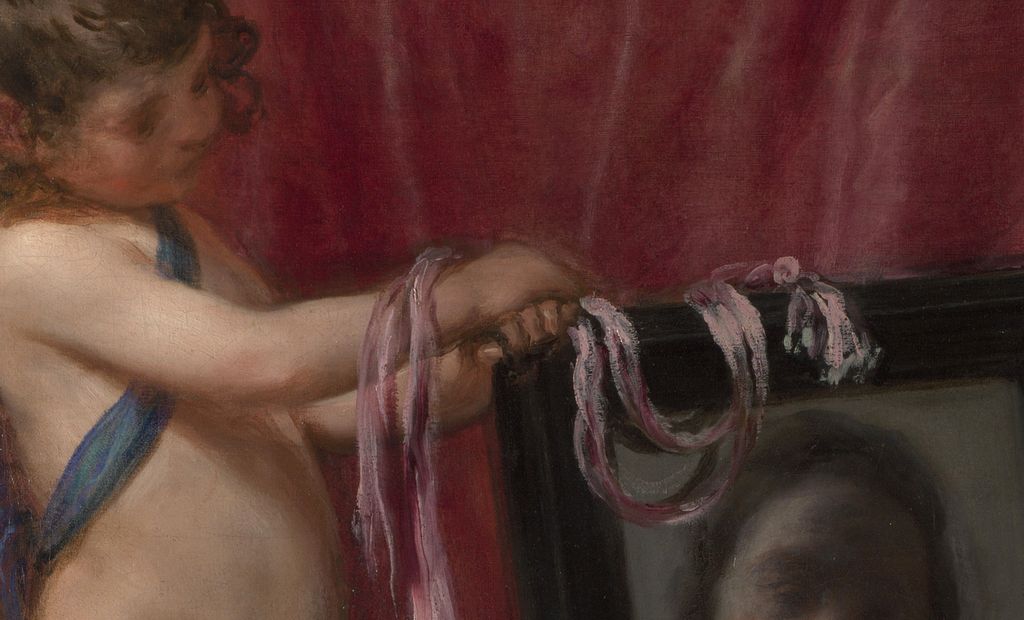
Several lengths of pink ribbon are gathered on the top rail of the mirror, some looping across the black, others dropping past Cupid's wrist. The straight rail makes every small turn of ribbon legible. Without it, the pale pink strokes would have little to distinguish them from marks in the curtain. The broad strip of dark colour also gives the painter somewhere to place the boy's hands, whose small overlapping shapes would be hard to read against the busy white below. From a step back, the rail joins the boy's reach, the slack ribbon and the rectangle containing the face. [1] [2]
The Gallery sees a possible practical function for the ribbons as a way of suspending the mirror and also considers whether the loops recall Cupid's blindfold or the bonds of lovers. In the Prado's 1990 catalogue Julián Gállego puts more emphasis on the downward head and the close, crossed wrists. To him they suggested a captive, and the loop over the wrists made an emblem out of the pose. In his reading Love has submitted to Beauty. Both accounts begin with a thing we can see, a ribbon loose enough to hang but arranged where it might loosely bind. Looking at the hands beside it helps explain the attraction and the limits of the emblematic reading. Most of the ribbon trails free, and even with Cupid's hands occupied he can support the mirror. Holding this posture for Venus supplies a reason for him to lower his head quite apart from what the ribbon might mean. [1] [2]
What the mirror shows
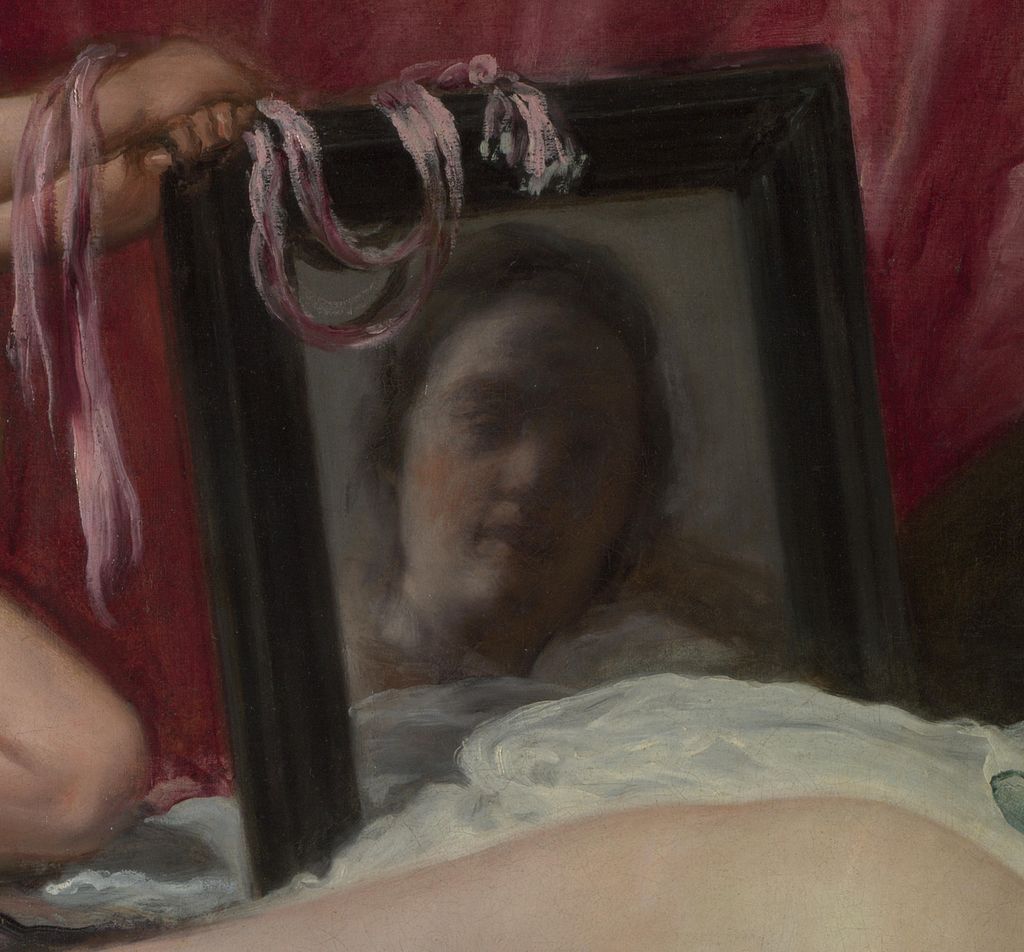
The frame is conspicuously solid. Its black sides slant a little, its top partly catches the ribbons, and its bottom disappears into the bedding. Inside it the boundaries almost dissolve. The eye finds a forehead, a band of shadow and a small warmer passage at the cheek. We can align that patch of light roughly with the angle at which the head on the right might turn. The farther we go, the less the reflection helps. A face seems to look out, but the soft marks in the glass do very little to settle the direction of the eyes. The picture offers the kind of information that makes a likeness possible and leaves out much of the information that would make it recognisable. [1] [2]
A small revision to the painted head makes a difference to how we use the mirror. The National Gallery reports that Velázquez first painted Venus with her head slightly more in profile, showing the nose. He revised it. Compare what we now have, with only the side and back of the head visible, with the effect a definite profile would create. The slightest protruding nose would sketch a line of sight in the real space of the bed. It would also give us a feature against which to test the reflected face. With that feature painted away, it is much harder to move back and forth between the two images and reassure ourselves that they belong to the same person. The reason for the revision remains a matter of interpretation. [1]
If she is looking at herself, why can we see her face from our side of the bed? In an ordinary flat mirror the place from which we look determines which part of a room appears. Consider the reflected eye as a particular point. If you see someone else's eye in the glass, the light can travel back along the same path, and that person could look towards your eye by way of the same patch of mirror. That gives a reason to feel that Venus is meeting us. It leaves open the question of whether she is actually doing so. Her eyes would have to give a clearer indication of her attention, and the picture would have to furnish more information about where the glass is aimed and where we are standing. [4]
In a study published in 2003, Marco Bertamini, Richard Latto and Alice Spooner used paintings including the Rokeby Venus to explore how readily viewers assign their own view of a mirror to the person depicted. They called the tendency the Venus effect. They also pointed out how difficult it can be to judge optical accuracy in a painting when the orientation of the mirror and the layout of the scene are only partly given. Here the mirror's lower edge is hidden and the bed has very few straight edges to establish a position in the room. One can feel a sustained, reciprocal glance at a face that is technically difficult to read. The perception study helps explain why that impression comes so readily without deciding what Velázquez had in mind. [4]
The reflected head takes up a striking proportion of the glass, especially given how much bedding lies between mirror and head on the right. Try looking only at the mirror for a moment. It looks a little like a framed portrait whose lower margin Venus is about to slip behind. Return to the whole canvas and what seemed like a second, separate picture belongs again to a boy's gesture in a bedroom. The figure is offered to us in two scales and at two levels of detail. That change in the way we can see her has more consequence for the painting than whether we could reproduce the set-up exactly. [1] [2] [5]
In Las Meninas another dark frame isolates two faces, those of Philip IV and Queen Mariana. The painted room is deep and populous. The light in the mirror helps us think about people outside the directly visible group and how their presence might organise a room. In the Rokeby Venus, the subject is on the bed in front of us. Only her face is at issue. In Madrid one can trace the sequence from the foreground people to the open doorway and the wall on which the mirror hangs. In London the hands supporting the frame belong to the very act we watch, and the pause while they hold it there sets the time of the scene. A comparison of the two paintings shows how precisely Velázquez could adapt the same kind of object to the kind of attention each scene needs. [2] [5] [6]
Annotated Details from Rokeby Venus
Look at the mirror, Cupid’s hands and the two layers of cloth beneath Venus.
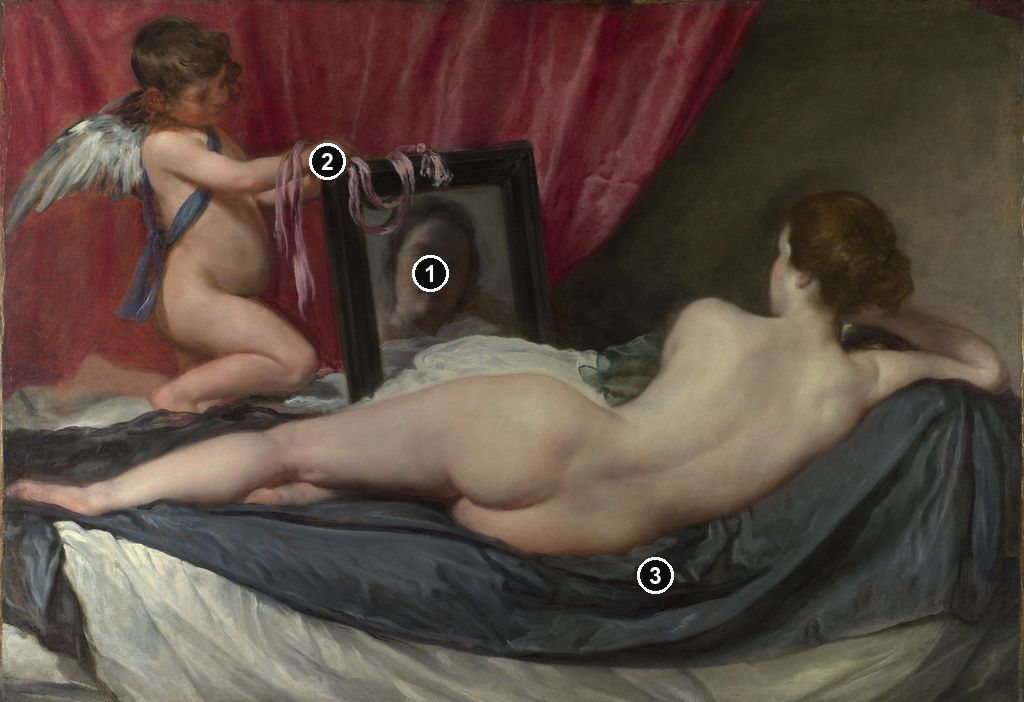
Details from ROKEBY VENUS
The face in the mirror
The face emerges through soft tonal changes inside the emphatic dark frame. It is less clearly defined than the shape of the turned head elsewhere in the painting. [1] [4]

Las Meninas or The Family of Philip IV. The framed mirror in Las Meninas carries a separate problem of viewpoint. Compare what each mirror lets the viewer see. View Las Meninas.
This work in Velázquez’s career
The Rokeby Venus (current article)
1647–51 [1]Las Meninas
1656 CatalogueVenice, Rubens and the figure seen from behind
Velázquez brings two established kinds of Venus together. In one, the goddess sits up to inspect her appearance, and a mirror is held before her. In the other, a nude reclines at length across the picture, often in a landscape. Giorgione and Titian helped establish the reclining type, while versions of the toilet associated with Titian circulated in European collections. Gállego also places Tintoretto, Veronese and Rubens in the wider history of the toilet motif. Those names tell us what belonged to an available language of painting. A particular pose or arrangement matters more for comparison than a list of masters that Velázquez could have studied. [1] [2]
Titian's Venus with a Mirror, now at the National Gallery of Art in Washington, shows the upright type clearly. A cupid raises a framed mirror and another leans forward with a garland. Venus and the mirror are easily accommodated within a vertical composition because her torso almost fills the centre and her head is high. Fur and red fabric surround her at the waist, and one hand comes up to the breast. We can see much of the face directly, and part of it again in the glass. In Velázquez, the long expanse of the back means that the mirror and the head can sit at quite different places across a broad canvas. The distance between them makes the reflection an event in the viewer's search for the face, while Titian gives us the opportunity to compare two views that are much closer together. [2] [7]
Rubens's Venus in Front of the Mirror in the Princely Collections of Liechtenstein makes yet another arrangement. The goddess sits with her back turned, the head raised and long hair falling along one side. Cupid holds the mirror and a figure attends to her hair. A trace of the profile remains available beside the much clearer apparition in the mirror. Numerous distinct gestures gather around the goddess's head. Velázquez takes away the attendant's activity and keeps the boy's head down. The hair is gathered rather than falling across the skin, and the face in the glass is loose enough to keep an identity open. The resemblance in the back view helps to expose just how much he changes in deciding that nothing more should happen in this room. [2] [8]
A different comparison begins at the shoulder of the Roman Sleeping Hermaphrodite once in the Borghese collection, now at the Louvre. The mattress and pillow, made by Gian Lorenzo Bernini in 1620, set off the antique figure as cloth does in the painted composition. From the back, a long curve across the hip and shoulders presents a coherent image of a sleeper. Walking around the sculpture reveals a different view. Velázquez had a cast made of the sculpture, which is why it has figured among the possible precedents for his painting. The contrast between moving around a marble and standing in front of a painted bed is part of what makes the comparison productive. The mirror can admit a view unavailable on our first approach to the canvas, while it lets the painted figure keep her place. [2] [9]
Charles de Tolnay proposed that one of Michelangelo's nude youths on the Sistine Chapel ceiling might have mattered to Velázquez's design. Gállego records the suggestion alongside that of the Borghese sculpture and leaves weight to the painter's ability to absorb different kinds of example. There are resemblances across a whole family of bodies seen from unfamiliar angles. A precedent may account for part of a turn or offer a way to think about the position of an arm. It takes quite a different kind of evidence to say that it was the direct source of the pose. The bed, the child and the strange little face put questions to the viewer that a similarity of contour by itself cannot explain. [2]
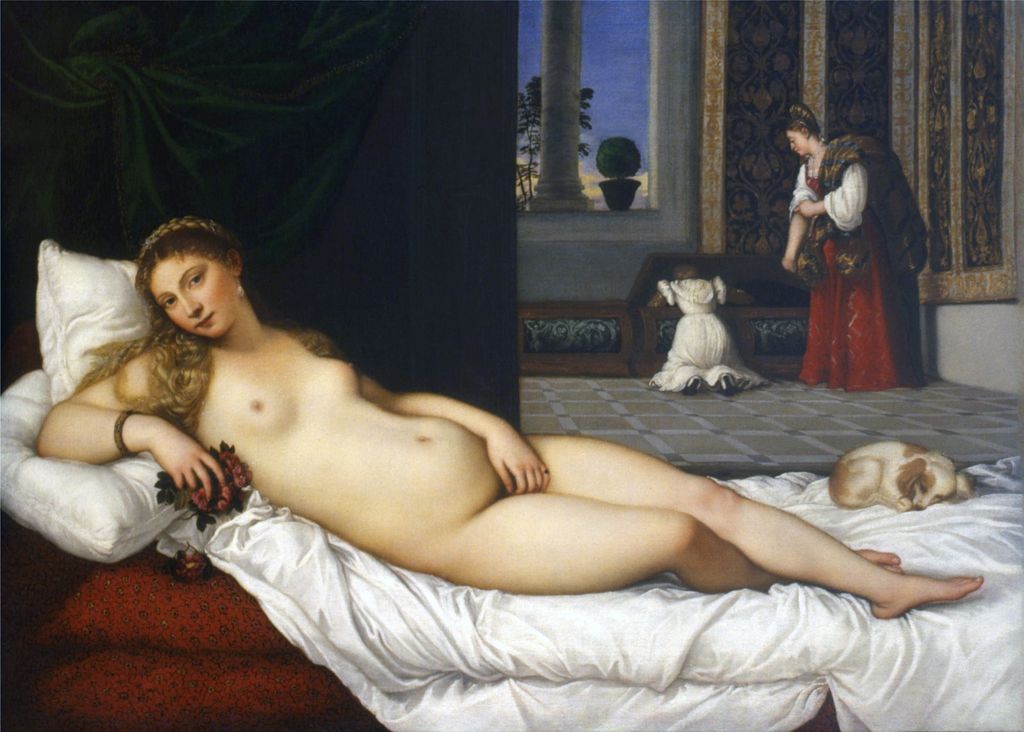
Titian, Venus of Urbino, Uffizi Gallery. Compare how the bed and near edge of the canvas organise the reclining figure. Titian shows Venus from the front. Velázquez paints her from behind. Image source. Public domain. Resized for display.
A rare Spanish nude
The Rokeby Venus is the only surviving female nude by Velázquez. Royal and aristocratic collections in seventeenth-century Spain included substantial mythological paintings with nudes, often the work of artists from outside Spain. The ecclesiastical disapproval that made overtly sensual pictures unusual coexisted with a courtly appetite for Titian and Rubens. A useful question to ask before treating a nude as unknown or forbidden is who was able to see it and where. An image kept among paintings in apartments accessible to invited viewers had a different audience from an altarpiece or a picture in a modern public collection. [1] [2] [5]
Julia Vázquez traces the development of spaces for viewing the genre at the Alcázar palace. In vaulted rooms opening towards the Garden of the Emperors, paintings containing female nudes were brought together from the mid-1630s. The rooms became known as the Vaults of Titian. The installation made it possible to attend to a group of paintings as a genre across their various subjects. In that setting a collector or painter could be interested in how the form of a body was repeated, how it was displayed and what made a Venetian nude distinctive. That possibility helps explain why a Spanish painter in Philip IV's service could know the type intimately without first being in Italy. The evidence of those rooms establishes a court context for the Rokeby Venus. Its own known seventeenth-century history leads to different rooms and owners. [2] [5]
The existence of other pictures once attributed to Velázquez or recorded under mythological titles also qualifies the exceptional status of surviving work. The Prado catalogue mentions Venus and Adonis and Cupid and Psyche among mythologies painted for the Hall of Mirrors in the Alcázar that are now lost. Gállego discusses a separate Venus recorded among the painter's possessions at his death. These records make it possible to consider a wider interest across the painter's career. They give us no surviving female figure against which to match the one on the bed. The more useful comparison among his extant mythologies is with Apollo in the Forge of Vulcan, where bare bodies inhabit another recognisable material setting. There clothes, tools and poses let us understand what hands do in a workshop. Here the winged boy's balance and the contours of the bedding make a mythological encounter feel close enough to happen within reach. [2] [5] [10]
Guerra Coronel, Haro and the date
The records of the painting's earliest years carry more certainty about the kind of picture it was than about the circumstances of its creation. An entry in the 1651 estate inventory of Domingo Guerra Coronel, a painter who also dealt in art, probably refers to it. The estate description calls it a naked woman and gives no artist. Julia Vázquez connects that description with creditor records from the same year that name Velázquez, although the measurements in one of them are problematic. The estate sale in September 1652 records the sale of a nude by Velázquez to an employee of the Marquis of Heliche. Taken together, the entries make a case for a passage from Guerra Coronel's possession into a major collection through a sale. No surviving commission emerges from that sequence. [1] [5]
A Haro household inventory gives the more recognisable description that underlies the painting's traditional provenance. It specifies the figure from behind, the boy and the mirror, and names Velázquez. Even with words that identify the picture well, the order in which to place the documents calls for care. The 1990 Prado catalogue used the date attached to the Haro inventory to put the canvas in that collection by June 1651. The National Gallery reproduces an older version of its provenance that also starts with the Haro entry, while its updated account points first to Guerra Coronel. Vázquez's account of the sale puts the transaction in 1652. One can follow the likely route into Haro's hands without making the date at the head of a household inventory do more work than the other evidence permits. [1] [2] [5]
Gaspar Méndez de Haro was seventh Marquis of Carpio and of Heliche and had access to Philip IV's collection. His ownership once made him a natural candidate as commissioner. The earlier entries make it harder to move straight from early ownership to a personal request from Haro. They also place the canvas very close to the years of Velázquez's second Italian journey. Gállego discusses the possibility of an Italian execution followed by shipment, as well as a Spanish date before the trip. Julia Vázquez favours Italy around 1651. The Gallery maintains its 1647–51 range and leaves the place open. The Venetian paintings available in Madrid, the classical sculpture studied in Rome and the inventory descriptions all matter, but they answer different questions about what he knew and where the work had reached. [1] [2] [5]
The titles in those early records help to explain why the search for a named model has so little to go on. The clerk had to describe a canvas well enough to value, identify or transfer it. The appearance of the picture, the position of the nude, a boy and a mirror answered that need. We can recognise Venus with the benefit of the tradition of winged cupids and the toilet scenes, and so keep myth and likeness apart as the records do. The name of a woman who may have posed is a separate matter. Neither the documentary trail nor the small, obscure reflection supplies it. [1] [2] [5]
Two ways to hang a reclining nude
Haro displayed the painting with a sixteenth-century Venetian nude showing a nymph from the front, in a landscape. The National Gallery places the pair in a large room with other mythological pictures and copies from the royal collection. Paintings can become companions through a collector's arrangement long after one or both was made. There is no need to recover a joint commission to understand the effect of this pairing. A viewer who passed from one canvas to the other could compare the lie of the figure across the bed or the landscape, the front and the back, and how an image that withheld the face could require as much active looking as an image made around a frontal body. This comparison would have been available to someone who knew very little about the circumstances of Velázquez's work. [1] [5]
The resemblance may even affect what seems most new. In a room of nudes collected with reference to the great examples at court, the absence of landscape in the Rokeby Venus would be immediately striking. Cloth has to connect the hips to the edge of the picture and supply a sense of depth that a view outdoors could distribute across hills, trees or patches of sky. Both panels of space, the tight area behind the curtain and the sliver visible in the mirror, keep attention near the two figures. For a collector interested in looking at a succession of bodies, Velázquez makes the perspective from which each becomes available an especially visible part of the arrangement. [1] [2] [5]
Haro's daughter Catalina Méndez de Haro inherited the Velázquez in 1687. Her marriage to the tenth Duke of Alba brought it into the Alba collection, where it stayed for more than a century. Its next important setting was the collection of Manuel Godoy, the minister favoured by Charles IV. The Gallery links the transfer to the king's order and places the painting in a private inner cabinet with Correggio's Venus with Mercury and Cupid and Goya's Nude Maja and Clothed Maja. Because the exact timing of the Alba and Godoy transfers is reported differently in the accounts of these works, the encounter in the cabinet tells us more securely about the painting's reception than a precise date for the sale. [1] [11] [12]
Goya's Nude Maja, now in the Prado, makes an illuminating neighbour. She lies on a couch with white bedding and lifts her arms behind her head. Her face is part of the initial view of the body, and her eyes meet the beholder without an object to mediate between them. The Clothed Maja gives the cabinet another variation on the same pose by the same painter. At Haro's, the Velázquez had a companion in another reclining body, placed in a different setting and turned so a different side could be seen. In Godoy's cabinet, it belonged to a broader comparison between kinds of exposure, as well as to a room to which relatively few people had access. The relationships among the works follow from their documented display together. A direct line from Velázquez's painting to Goya's design remains a separate proposition. [1] [12]
From Rokeby Park to the National Gallery
The painting reached England in 1813. The National Gallery's catalogue records its purchase on behalf of the dealer William Buchanan and its subsequent sale to John Bacon Sawrey Morritt. At Rokeby Park it acquired the name that now follows it almost everywhere. The records of two exhibitions show that access to the work was already changing before its permanent acquisition for a public collection. It appeared in the Manchester Art Treasures Exhibition in 1857, then at the Royal Academy in 1890. A painting that still belonged to a private collection could consequently be seen and written about by visitors who would never have called at the country house. [1]
The family sold the painting in 1905. The dealers Agnew's exhibited it, and the recently founded National Art Collections Fund raised money to acquire it. The Fund presented the work to the National Gallery in 1906. The success was early in the history of the organisation now known as Art Fund. Public subscription had a particular consequence for a work once displayed with other nudes in rooms open to select visitors. Access to the painting could now be understood as a benefit to the public, and its future was something strangers to the owner had organised and paid to secure. [1] [13]
The nickname persisted alongside the Gallery's title. The Toilet of Venus situates the picture within art's treatment of a goddess, including the Venetian and Flemish comparisons. Rokeby Venus recalls a place in the migration of Spanish pictures into British collections. The original painting's 2024 loan to the Walker Art Gallery in Liverpool for National Treasures offers one further stage in that story. A picture famous through its permanent home in London again had a temporary life elsewhere in Britain, and its portable identity was the one acquired at a house in County Durham. [1]
Mary Richardson, the damaged canvas and its repair
On 10 March 1914 Mary Richardson, a militant campaigner for women's suffrage, slashed the painting at the National Gallery. Her immediate political context was the arrest of Emmeline Pankhurst. Richardson used a highly valued image of a woman's body to draw attention to the government's treatment of a living woman. In a later account she also objected to the way male visitors looked at the nude. The immediate reason and the later recollection belong to different moments. Together they help explain how a public gallery could become the site of a dispute both about political rights and about looking at a painting. [5] [14]
In the early photographs several tears run across the figure's back and hips, areas where continuously graded paint gives the body its apparent volume. Contemporary newspaper descriptions spoke about the event in the language of injuries to a person. A photograph of the tears helps explain why this analogy came so readily. The pale body remains intelligible and some cuts seem to follow it, even though the thing physically damaged is a painted canvas. The treatment included repair and relining, the addition of a supporting canvas behind the original. It enabled the work to return to view, with the changes to its condition accessible through photographs and technical records. [5] [15]
The archive shows two kinds of work set in motion by the attack. The National Gallery's conservation dossier documents examinations and treatments specific to NG2057. At the National Portrait Gallery, the records show the institutional response to the threat of further attacks. The Portrait Gallery's account describes a period of closure to the general public with students still admitted and a reopening on 25 March. Its staff then had to consider where works were hung, what glass protected them and which rooms could be watched. The aim was to reduce the vulnerability of the works while keeping public visits possible. [14] [15]
In 2022 the National Gallery's artist in residence, Ali Cherri, made the painting one of the subjects of If you prick us, do we not bleed?. His response began in the archive, with photographs and newspaper accounts that treated damage to art as a kind of bodily injury. In his installation after Velázquez, a carved wooden figure lay in a display case with a marble head, a mirror and velvet. The painted face is blurred in the seventeenth-century work. In Cherri’s case a conspicuous glass eye catches the visitor’s attention. The case does some of the work the curtain does in the painting, setting limits to what can come into view. It also brings the history of protection into the foreground. A visitor is invited to think about how a display can make the consequences of an attack either visible or hard to see. [16] [17]
Another protest in November 2023 broke the protective glazing. The National Gallery reported minor damage to the painting's surface and returned the work to display on 1 December after conservation treatment and the fitting of new glazing. That distinction matters in thinking about the history of the object. The large tears across the painted figure belong to 1914. The broken glass belongs to the later incident, along with the minor surface damage the Gallery reported. The painted mirror has a glass surface we can only imagine. The protective glazing through which we see it is a different object with its own history. [5] [18]
What a visitor saw in Godoy’s cabinet
On 12 November 1800 the medallist Pedro González de Sepúlveda visited Manuel Godoy’s house with three companions. A chaplain attached to the household arranged their access. Sepúlveda describes an inner room containing several Venuses, singles out the famous Velázquez and says the Duchess of Alba had given it to Godoy. In the same passage he mentions a companion he attributes to Luca Giordano and a nude by Goya whose drawing and colour he criticises. Here is a visitor making distinctions among pictures gathered under a single subject. Even the word Venus covers works he identifies quite differently, including Goya’s nude, for whom he supplies no mythological name. [19]
The date of the visit matters. In January 1799 the Alba list still records the Velázquez, describing the bed, the turned back, Cupid and the mirror, and noting a gilt frame. Isadora Rose-de Viejo places the gift between that list and the November 1800 visit. The National Gallery’s older Spanish School catalogue gives a sale after the duchess’s death in 1802. Sepúlveda’s diary supplies evidence of the painting’s presence with Godoy during her lifetime, and the gift is his account of how it arrived. His attribution of the companion is also testimony from a visitor. It cannot securely identify the Venetian nude the National Gallery records as the painting’s earlier companion in Haro’s collection. [19] [20] [21]
Sepúlveda returned in April 1807. He had asked Godoy himself for access, but the steward objected to the number of guests he brought. In this account he names both the Velázquez and Correggio’s School of Love among the pictures he saw. Frédéric Quilliet’s catalogue, dated 1 January 1808, puts both in its highest division, the Grande Gallerie. Quilliet describes the Velázquez as a belle esquisse, a beautiful sketch, and praises the Correggio for its rarity and excellence. The phrase about Velázquez is a judgement of handling by an early viewer. It gives the history of the picture’s reception a precise detail without settling whether Quilliet considered the work unfinished. The catalogue groups and ranks pictures. The positions of the two canvases on the wall remain uncertain. [22] [23]
Correggio’s two Venuses and the work of Cupid
In Correggio’s School of Love, Mercury’s lowered head and Cupid’s raised hands draw the eye to the sheet they share. It sits low within a tall canvas. Above the lesson Venus turns her face towards us and raises Cupid’s bow. Her wing is at about the height of her face, so that the mark of divinity belongs to the adult figure who presides over the scene. Small changes of direction connect the figures. Cupid bends towards the sheet, Mercury attends to the child, and Venus can look beyond them. In the Velázquez, the boy’s hands also support a rectangle, but the object he attends to gives the adult figure a face for the viewer to study. The sheet in the Correggio makes Cupid a pupil. The mirror in the Velázquez gives him the practical responsibility of holding the image steady. [21] [24]
The National Gallery identifies Correggio’s painting as one of two designed to be seen together. An inventory of 1589 records both in a ground-floor bedroom in Mantua. Its companion, now in the Louvre, shows Venus and Cupid asleep while a satyr raises a blue cloth. Look at the space under that cloth. The satyr’s head and arms bear down from above, while the sleeping figures spread below him. Venus’s arm thrown back above her head and the child’s tucked body give the group two different kinds of repose. The satyr can see the bodies because he is uncovering them, and the viewer gets the same opportunity without either sleeper stirring. Velázquez gives the equivalent work of disclosure to a child whose effort is visible. What he reveals is limited to what the glass can hold. [21] [24] [25]
The two Correggios entered Charles I’s collection and took separate routes after its dispersal. The sleeper passed to Cardinal Mazarin and then to Louis XIV. The lesson went to Spain and eventually to Godoy. So the canvas Sepúlveda saw already had a history of being read with another Venus. The surviving pair shows how an artist could give the same two mythological figures different kinds of attention to demand from the beholder. The later cabinet brought the alert mother and her reading child into company with Velázquez’s goddess and her working mirror-bearer. The older comparison depended on waking and sleeping. The Spanish grouping made it possible to compare two kinds of wakefulness, one divided between a lesson and the beholder and the other concentrated on the act of looking. [22] [24] [25]
The canvases in the Correggio pair were originally the same size, according to the National Gallery, although the figures in the lesson were always smaller and the canvas itself has since been cut down. The Gallery also reports that X-rays show Correggio changing the direction of Venus’s head. She originally looked down at Cupid. Turning her outwards opens the group to a viewer while the other two figures remain occupied. The revision helps explain why the finished lesson can feel at once self-contained and addressed to someone outside it. [24]
From paint samples to a wartime exhibition
The damage in 1914 gave the chemist Arthur Pillans Laurie access to tiny paint samples. With the director’s agreement he examined the damaged areas chemically and under a microscope. The National Portrait Gallery’s research directory calls this the earliest recorded scientific examination at the National Gallery. The trustees considered publication of Laurie’s notes undesirable. In 1920 he published his findings in the Journal of the Imperial Arts League, identifying azurite mixed with smalt in a passage the directory calls the blue sash, where Prussian blue had been alleged. That result belongs to Laurie’s examination of a specific passage. It gives an example of how material evidence entered a debate over the picture’s authorship, with a sample small enough for the argument to depend on knowing precisely where it came from. [26]
The Gallery’s online conservation finding aid, NG4/2057, describes a file covering 1914 to September 2002. It lists treatment and examination reports alongside photographs made with visible light, near infrared and X-rays, as well as microscope images and annotated material. Those records offer different scales of evidence. A microscope image can record a minute feature of the paint, whereas an X-radiograph can register differences in the materials across a much larger area of the canvas. The finding aid lists extracts from the 1947 Exhibition of Cleaned Pictures catalogue. Their presence identifies a document held with the painting’s records. The public description gives no corresponding treatment date or exhibition entry for the Venus. A separate published record places Helmut Ruhemann’s treatment of the painting in 1965–66. [27] [28]
There is a firmer trail for how the public saw the painting during and immediately after the war. The Gallery’s 1943 press-cuttings index lists the Venus in its Picture of the Month series. The scheme brought individual works back to London temporarily from storage at Manod, making one picture the focus of a visit while the collection was dispersed. The Gallery’s Spanish School catalogue records the Venus as no. 6 in the 1945–46 National Art Collections Fund exhibition and as no. 30 in the Arts Council’s 1947 Exhibition of Spanish Paintings. Within four years the same canvas could be encountered as the focus of a wartime visit, as a work secured through public subscription and as an example of Spanish painting assembled for comparison. [21] [29] [30]
Artworks directory
Frequently Asked Questions
1647–51 [1]
Oil on canvas [1]
National Gallery, London, NG2057 [1]
Discussion
Look again at the images and ideas explored in Rokeby Venus. These editorial prompts invite your observations.
Reader Insights
What does the blurred reflection allow you to see, and which details does the dark frame make you look for?
Follow the edge of the blue-grey fabric. Where does it guide you towards the figure, and where does it lead away?
Join the Conversation
Share a detail, comparison or question about Rokeby Venus below.
References
- The National Gallery, London, Diego Velázquez, The Toilet of Venus (‘The Rokeby Venus’), NG2057. See the current overview, object details, exhibition history and the separately labelled extract from the 1988 Spanish School catalogue for later provenance. View source.
- Julián Gállego, La Venus del espejo, catalogue no. 63, in Antonio Domínguez Ortiz, Alfonso E. Pérez Sánchez and Julián Gállego, Velázquez, Museo del Prado and Ministerio de Cultura, 1990, pp. 368–372. Spanish. View source.
- Larry Keith and Dawson W. Carr, “Velázquez’s Christ after the Flagellation: Technique in Context”, National Gallery Technical Bulletin 30, 2009, p. 64 for the comparison with NG2057. View source.
- Marco Bertamini, Richard Latto and Alice Spooner, “The Venus effect: people's understanding of mirror reflections in paintings”, Perception 32, 2003, pp. 593–600, especially pp. 593–596. View source.
- Julia Vázquez, “Recto/Verso”, Velázquez, Painter & Curator, Brill, 2025, especially pp. 97–99 and 120–125. View source.
- Museo Nacional del Prado, El Museo del Prado en Palencia, catalogue entry 2, Diego Velázquez, Las Meninas or The Family of Philip IV, P-1174. Spanish and English. View source.
- National Gallery of Art, Washington, Titian, Venus with a Mirror, c. 1555, 1937.1.34. View source.
- Liechtenstein, The Princely Collections, Vaduz–Vienna, Peter Paul Rubens, Venus in Front of the Mirror, GE 120. View source.
- Musée du Louvre, Hermaphrodite endormi, Ma 231 and Ma 231.1, object record and multiple views. French. View source.
- Julián Gállego, La fragua de Vulcano, catalogue no. 23, in Velázquez, Museo del Prado and Ministerio de Cultura, 1990, pp. 158–162, especially the colour plate on p. 159, P001171. Spanish. View source.
- The National Gallery, London, Correggio, Venus with Mercury and Cupid (‘The School of Love’), NG10, including the Godoy provenance. View source.
- Fundación Goya en Aragón, Francisco de Goya, The Nude Maja (La maja desnuda), object 582, Museo Nacional del Prado, with the collection history and related works. View source.
- The National Gallery, London, The National Gallery and Art Fund, institutional history of the 1906 presentation. View source.
- National Portrait Gallery, London, Suffragette Action, drawing on the Gallery archives, with letters from J. D. Milner, Charles Holmes and the Triplex Safety Glass Company. View source.
- The National Gallery Archive, Conservation dossier for Diego Velázquez, The Toilet of Venus (‘The Rokeby Venus’), NG4/2057, file description. View source.
- The National Gallery, London, 2021 National Gallery Artist in Residence: Ali Cherri: If you prick us, do we not bleed?, exhibition press release, March 2022. View source.
- Ali Cherri, interview with Juliet Rix, “You cannot un-write violence. I am interested in these hidden wounds”, Studio International, 5 April 2022, with views of the installation after Velázquez. View source.
- The National Gallery, London, statement on the 1 December 2023 return to display of The Rokeby Venus, quoted by The Art Newspaper, 4 December 2023. View source.
- Pedro González de Sepúlveda, diary for 12 November 1800, Casa de la Moneda, Madrid, ms. 27-3-2, book 9, ff. 186v–187, transcription published by Isadora Rose-de Viejo as document D.8. View source.
- Isadora Rose-de Viejo, Catálogo actualizado de la colección de Manuel Godoy, 2021 version, entry CA 664, pp. 31–32, including the transcription of the 1799 Alba entry. View source.
- The National Gallery, London, Diego Velázquez, The Toilet of Venus (‘The Rokeby Venus’), NG2057, object image, current overview and extract from the 1988 Spanish School catalogue. View source.
- Pedro González de Sepúlveda, diary for 28 April 1807, Casa de la Moneda, Madrid, ms. T. 21-2-24, f. 112, transcription published by Isadora Rose-de Viejo as document D.9. View source.
- Frédéric Quilliet, catalogue of Godoy’s paintings dated 1 January 1808, Archivo Histórico Nacional, Estado, L. 3227, no. 1, dedication and Grande Gallerie ff. 1 and 3, transcription published by Isadora Rose-de Viejo as document D.1. View source.
- The National Gallery, London, Correggio, Venus with Mercury and Cupid (‘The School of Love’), NG10, object image, discussion of the pair and provenance. View source.
- Musée du Louvre, Correggio, Vénus, Satyre et l’Amour endormi, INV 42, object images and provenance. View source.
- National Portrait Gallery, London, British Picture Restorers, 1600–1950, entry for Arthur Pillans Laurie, citing National Gallery trustees’ minutes NG1/8 and Laurie’s 1920 article. View source.
- The National Gallery Archive, conservation dossier for NG2057, NG4/2057, finding aid. View source.
- National Portrait Gallery, London, British Picture Restorers, 1600–1950, entry for Helmut Ruhemann, citing the National Gallery’s 1965–66 report, pp. 71–73. View source.
- The National Gallery Archive, press cuttings, March–December 1943, NG24/1943/12, finding aid. View source.
- The National Gallery, London, The Gallery in Wartime, account of the Picture of the Month scheme. View source.






