


 by Tom Gurney
Tom Gurney BSc (Hons) is an art history expert with over 20 years experience
Published on June 19, 2020 / Updated on October 14, 2023
Email: tomgurney1@gmail.com / Phone: +44 7429 011000
Bust of a Young Woman: Introduction
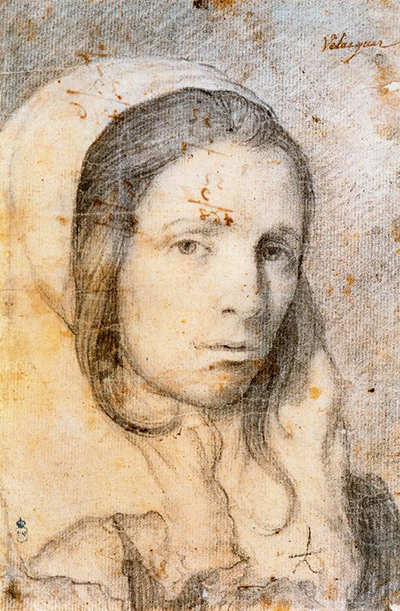
A young woman looks out from beneath a pale headdress. The dark hair makes a close border around her forehead and falls in narrow bands to either side of her face. Lower down, the drawing opens out. The folds at her neck are suggested by a few irregular strokes, and the shoulder on the left of the image runs almost into the edge of the sheet. Diego Velázquez gives the eyes and mouth enough definition to hold our gaze, while leaving much of the clothing to be inferred. [1] [2]
The Biblioteca Nacional de España in Madrid holds the drawing as Cabeza de muchacha, DIB/16/40/21, no. 492 in Ángel M. de Barcia’s catalogue. The library’s online catalogue gives 1620 and 200 × 134 mm. Its 300th-anniversary exhibition catalogue gives the date as about 1620–22 and the width as 135 mm. Both place the drawing in Velázquez’s early Seville period. The English title Bust of a Young Woman is useful because the library also holds a smaller drawing called Cabeza de muchacha. The fuller view of the shoulders and upper body distinguishes this sheet at a glance. [1] [2] [3]
At a Glance
- CollectionBiblioteca Nacional de España, DIB/16/40/21 [3]
- DatedAround 1620–22 [1] [3]
- MediumBlack pencil on buff laid paper [1] [2] [3]
Contents
- How the face emerges from the paper
- The second young woman’s head
- The collector and the name in ink
- Was it a study for a painting?
How the face emerges from the paper
Start at the upper edge of the hair, where short dark strokes gather into a rounded shape. A wide light area beyond it belongs to the headdress, with shaded background making its upper curve visible. At the temple these tones change places. A narrow shadow at the edge of the face gives way to a light cheek, then the dark hair returns below it. Velázquez can suggest the whole turn of the head through these changes of tone. The outer edge of the headdress needs only a faint boundary because the dark band around the face does much of the work of directing the eye. [1] [2]
The near eye is built out of a few dark accents under its brow. The far eye sits close to the narrow strip of light along the face at the right. The nose is clearest near its base, where the nostril and the adjoining shadow give it shape. Then a short dark line between the lips and a much softer shadow underneath establish a mouth that is seen slightly from one side. These are small, closely spaced marks. The longer strokes below the chin, where cloth bunches at the throat and drops towards the shoulders, are more widely spaced and easier to follow individually. At the bottom edge, a patch of dark shading at the right helps to give the loosely indicated body weight. [1] [2]
The library catalogues the drawing as black pencil on buff laid paper. In their study of the library’s drawings, Isabel Clara García-Toraño Martínez and María Represa Martín also describe light touches of white chalk. Benito Navarrete Prieto’s exhibition catalogue entry records touches of black wash on this sheet. The printed image lets us follow the distribution of light and dark, but a light area can be exposed paper, a pale mark or a combination of both. The published descriptions give us a sounder basis for naming the materials than the colour of any one patch in a reproduction. The warm tone visible through the modelling also helps explain how gently the cheek can turn into shadow. [1] [2] [3]
The second young woman’s head
The Head of a Young Woman is DIB/16/40/22, Barcia 493. In that smaller sheet the crown of the head rises almost to the upper edge and the face sits closer to the right-hand border. There is very little space below the chin. That difference in framing is easy to miss when the two reproductions are presented at the same height. In the bust, the pale arc of the headdress and the broader spread of the shoulders keep pulling our attention away from the features and back again. In the head study, the eye goes from the face into the hair and back with hardly any distance to travel. [1] [2] [4]
The strokes in the companion sheet make a different impression as well. Individual lines in the swept hair are easy to pick out, and several loose strokes gather at the neck. In the bust, the darker strip of hair along the cheek meets the broad pale area of the headdress, and the light passages carry part of the shape of the figure well beyond the face. The BNE staff paper records white chalk in both drawings. The tightly framed head lets us see light chiefly against the surrounding dark hair and around the facial features. The bust gives it a much larger field, including the headdress and folds of cloth. This is a comparison of the visible tones. Individual white chalk marks are harder to locate in reproduction. [1] [2]
The faces are close enough in type to have prompted suggestions of a family resemblance. Navarrete Prieto gives weight to the different proportions of the mouths, eyes and noses and favours two models. The BNE staff paper sets aside the proposed identification with Velázquez’s wife, Juana Pacheco, and places both sheets before the artist’s move to court. Their similarity of technique and approximate date makes the drawings natural companions for study. The occasion on which either figure was drawn and the names of the two sitters remain unknown. [1] [2] [4]
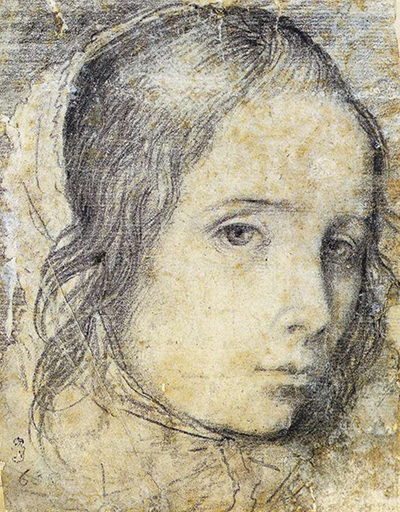
Cabeza de muchacha (the close head study). The smaller Biblioteca Nacional drawing concentrates its marks around the turned head. View Head of a Young Woman.
The collector and the name in ink
The 300th-anniversary exhibition catalogue traces the bust to Valentín Carderera and the smaller head to the Madrazo collection. Carderera’s drawings and prints were acquired by the Spanish state in 1867 and formed the basis for the library’s new print room. In the upper right of the bust, Navarrete Prieto records the name “Velazquez” in old ink handwriting. The online record also notes a second inscription of the name on the reverse, along with numbers in brown ink. These annotations help trace the history of the drawing’s attribution. Navarrete Prieto’s entry also describes a small mark shaped like a lambda at the lower right, an observation made by García-Toraño. Its meaning is a separate matter from the documented Carderera provenance. Today the library includes the two sheets among the few drawings it confidently assigns to Velázquez. Its record for the bust traces the attribution back to Barcia’s 1906 catalogue and also notes that Gridley McKim-Smith listed it as probable in 1980. [1] [3] [5]
Was it a study for a painting?
Francisco Pacheco, Velázquez’s teacher, described the young artist using drawing to study the changing expressions of a face. The exhibition catalogue invokes that account when discussing the library’s two drawings. Pacheco’s recollection gives us a reason to consider the bust as an exercise in observing a face, especially the way the eyes and lips give the turn of the head an individual character. His well-known description of charcoal and highlights on blue paper refers to a practice he remembered from Velázquez’s youth. The BNE staff paper describes yellowish laid paper for the two surviving sheets. It remains an open question whether Velázquez drew this woman for practice, as a likeness in its own right or with another work in mind. [1] [2]
The young woman in Christ in the House of Martha and Mary, an oil on canvas probably painted in 1618, offers a comparison from Velázquez’s early years in Seville. A broad light band also sets off her face. In the painting, the grip on the mortar and the visible weight of her sleeve tie the turn of her head to an interrupted task. On paper, the figure’s hands and surroundings are outside the composition. The face, shoulders and loose folds of the headdress are enough to suggest her presence. Navarrete Prieto records that José López-Rey compared the figure in the London painting with the smaller head, B. 493. The BNE staff paper reports no established link between either drawing and any painting. Looking from the kitchen scene back to B. 492 brings out how much Velázquez has managed to retain by drawing just the upper part of the figure. [1] [2] [6]
The much later Needlewoman, which the National Gallery of Art in Washington dates to about 1640–50, offers another point of comparison. Here the woman’s concentration becomes visible through the dip of her head and the line from her eyes to the fabric on her lap. In the bust, the outward glance has to carry the figure’s attention on its own. Light falls on the cloth on the shoulders in both works, but the sweep of the cloth in the oil painting leads down to the hands. In the drawing, it wraps around the head and turns us back towards the eyes. [2] [7]
Artworks directory
Frequently Asked Questions
Biblioteca Nacional de España, DIB/16/40/21 [3]
Discussion
Look again at the images and ideas explored in Bust of a Young Woman. These editorial prompts invite your observations.
Reader Insights
What changes in the marks as your eye moves from face to shoulders?
How does the larger sheet change the way the figure meets your gaze?
Join the Conversation
Share a detail, comparison or question about Bust of a Young Woman below.
References
- Benito Navarrete Prieto, “Cabeza de niña” and “Cabeza de muchacha”, in Biblioteca Nacional de España: 300 años haciendo historia, pp. 104–107, especially pp. 106–107, DIB/16/40/21. Spanish. View catalogue entries. View source.
- Isabel Clara García-Toraño Martínez and María Represa Martín, “El fondo de dibujos de la Biblioteca Nacional de España”, Actas XIII Congreso Internacional de Historia del Papel en la Península Ibérica, 2019, pp. 137–138, figs. 28–29. Spanish. View source.
- Biblioteca Nacional de España, Cabeza de muchacha, DIB/16/40/21, B. 492, catalogue metadata distributed through Biblioteca Digital del Patrimonio Iberoamericano, result 31. Spanish. View catalogue results. View source.
- Biblioteca Nacional de España, Cabeza de muchacha, DIB/16/40/22, collection feature on both drawings, with the object data for the smaller sheet. Spanish. View collection feature. View source.
- Biblioteca Nacional de España, Departamento de Bellas Artes y Cartografía, history of the print room and the Carderera acquisition. Spanish. View source.
- National Gallery, London, Christ in the House of Martha and Mary, NG1375, collection and interpretive record. View object record. View source.
- National Gallery of Art, Washington, The Needlewoman, 1937.1.81, collection record. View object record. View source.







