



 by Tom Gurney
Tom Gurney BSc (Hons) is an art history expert with over 20 years experience
Published on June 19, 2020 / Updated on October 14, 2023
Email: tomgurney1@gmail.com / Phone: +44 7429 011000
The Spinners: Introduction
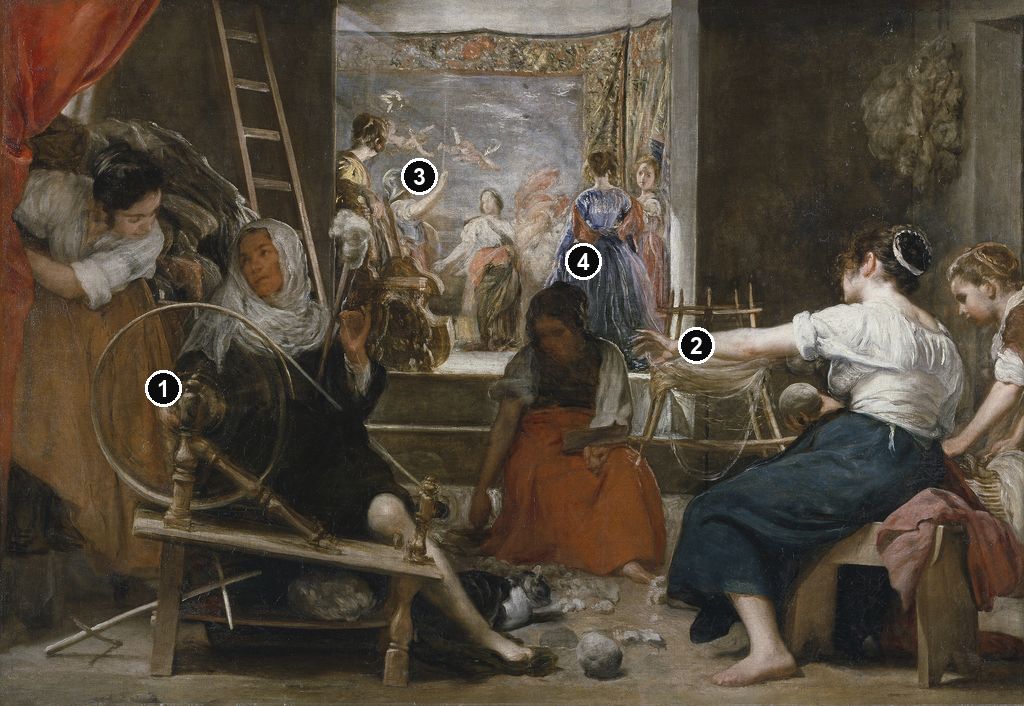
The wheel at the left of Diego Velázquez’s The Spinners seems to turn while the woman beside it looks up. Its rim is an almost continuous line of light. Towards the hub, the hand and the moving parts of the wheel are harder to tell apart. Across the room another woman stretches a bare arm over a wooden frame. The thread scarcely shows, but the distance between her hands tells us what she is doing. Then the eye goes up a short flight of steps and finds a woman in a helmet raising her arm before a tapestry. However long we spend following the work in the foreground, this small encounter at the back can make us start the picture all over again. [1] [2]
The Spinners, also called The Fable of Arachne and known in Spanish as Las hilanderas, is an oil on canvas in the Museo Nacional del Prado, Madrid, P001173. Usually dated to about 1655–60, it belongs to the period of Velázquez’s late work at the Spanish court. The Prado’s 1990 catalogue gives the field painted by Velázquez as 167 × 252 centimetres and the expanded canvas, with later additions, as 220 × 289 centimetres. The Prado’s display masks the added strips, so the shape a visitor sees is wider in proportion to its height than some familiar reproductions suggest. [1] [3] [4]
At a Glance
- CollectionMuseo Nacional del Prado, P001173 [1] [3]
- MediumOil on canvas [1]
- SupportThe painted core measures 167 × 252 cm. The later enlarged canvas measures 220 × 289 cm. [1] [3]
Contents
- At the wheel
- The steps and the tapestry
- Annotated details
- Arachne’s contest in Ovid
- Are Arachne and Minerva shown twice?
- Titian’s Europa in a woven picture
- The standing of a manual art
- An early owner and a changing title
- The added canvas and the Prado’s frame
- Velázquez’s rooms within rooms
- What Titian told Philip II about Europa
- Europa on a sheet of paper and a smaller canvas
- The wall where Mercurio y Argos usually hung
At the wheel
At the far left a woman draws back a red curtain. Her shoulder, head and bent arm make a close group, and her face tilts towards the seated figure. Behind her is a dark mass of drapery. The woman at the wheel wears a pale scarf, painted so that the cloth seems to gather loosely around her neck. Much of her body is a single dark field. Where the light picks out her knee and shin, a leg shoots across the lower part of the picture and gives that dark form a direction. Her face turns up towards the person at the curtain. Yet the work has its own rhythm. The hands and the ear turned towards a speaker seem able to do two different things at once. [1] [2]
The machine is more solid than the nearly empty circle it contains. Its wooden support tilts down across the foreground, catching the light along its long edge. Below that edge are upright legs and thin rods. A stationary length of wood throws the speed of the circle above it into relief. Velázquez could have drawn a wheel with each of its parts available for inspection and depended on the pose to suggest that it was turning. Here we recognise its mechanism from the stable parts, which gives the rapidly moving ones room to dissolve. The effect depends on how much can be left out before a familiar form stops being recognisable. [1]
Follow the wheel across the floor and you come to a striped cat and several small irregular heaps. A ball of yarn lies forward of the seated woman’s foot. There is something at rest beside almost every sign of motion. The ball stays put while a different stretch of yarn passes between working hands. The cat has a head and shoulders we can see almost in profile, low enough that its back falls into the dark under the wheel. It supplies a level from which to read the bench, the women and the steps. In a painting so concerned with the reach and turn of adult bodies, the cat makes it easy to imagine the floor a few inches below them. [1] [2]
On the right the woman in white has turned far enough for us to follow the folds around her shoulder, from the gathered sleeve across the broad back to the darker skirt beneath it. A band around the wrist marks the end of one pale passage and the beginning of a hand with its fingers spread. Her other hand cradles a ball close to her waist. It is possible to start with the turned head and read her as a seated figure who happens to be working. The picture also works backwards, from the fingers to the tension of the upper arm and from the arm to the turn of the whole body. To her right a woman leans over the rim of a basket almost cut off by the edge. A flash of pink over the seat marks an abrupt change from the dark blue of the central skirt. A bare foot presses into the space below. Several actions are fitted into the right edge without interrupting the long line made by the extended arm. [1] [2]
Between the two seated spinners another worker dips forward. The dark face is closer in value to the lower part of the recess than to the pale sleeve alongside it. Her orange skirt makes a large, readily legible shape even where the activity of the hands is less sharply described. The woman in white at the right has almost the opposite distribution of emphasis. The arm tells us a great deal, and the dark skirt gives its movement weight. Both figures belong to the same workplace. The painter varies the amount and kind of detail that allows us to see them at work. [1]
There is a difference between spinning, winding and weaving that matters to the composition. Spinning makes a thread out of fibre. Winding gathers yarn into a usable form. Weaving crosses threads on a loom to build a fabric. The wheel, the frame with its loops and the partly obscured basket make it possible to read several stages of preparation in the front room. The bright room shows cloth already bearing an image. The intervening work of building that image at a loom is supplied by the story and by our sense of what all the handling of yarn could lead to. [1] [2] [5]
The steps and the tapestry
The recess opens off centre and starts at the other side of a few shallow steps. The tilted ladder to the left of it offers a conspicuous line upwards, just where the wheel takes up much of the space below. The ladder’s rungs and the edges of the steps have a firmness that the action on either side of them often lacks. They mark a way into the picture for the eye, although the figures and equipment in front of the steps take away the possibility of an easy walk straight through. The eye can be on the landing while the foreground still feels full of bodies one would have to go around. [1] [2]
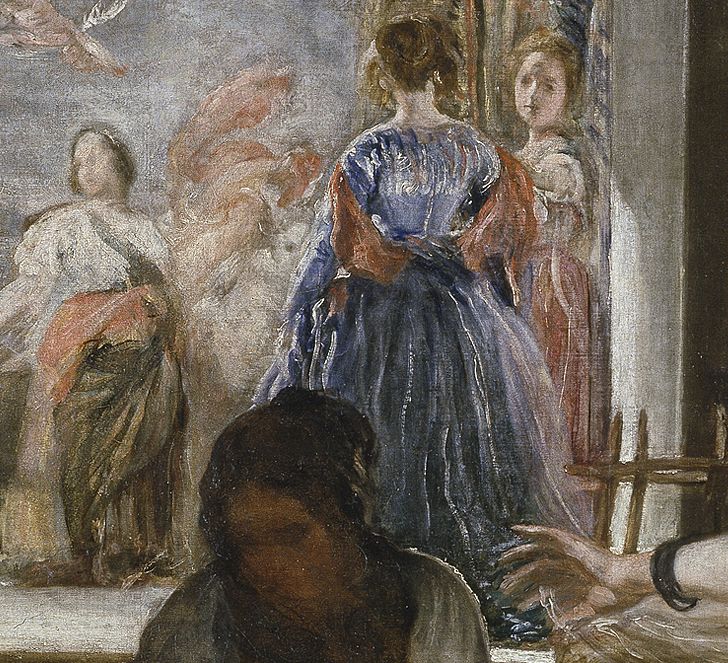
The steps also separate two ways of being seen. The women at the front mostly show faces in profile, in partial shadow or turned away. At the back, the light opens out around a group dressed in finer clothes. The figure in blue towards the right stands with her back almost squarely to us. Her skirt rises straight from the landing and her accents of rusty red are higher in the picture than the red and blue that animate the women working below. Farther right, a face looks out. The Prado catalogue notes that this look helps connect the scene with someone outside the picture. It differs from the exchanges among the workers. The glance gives an impression that someone in the picture has already noticed where we stand. [1]
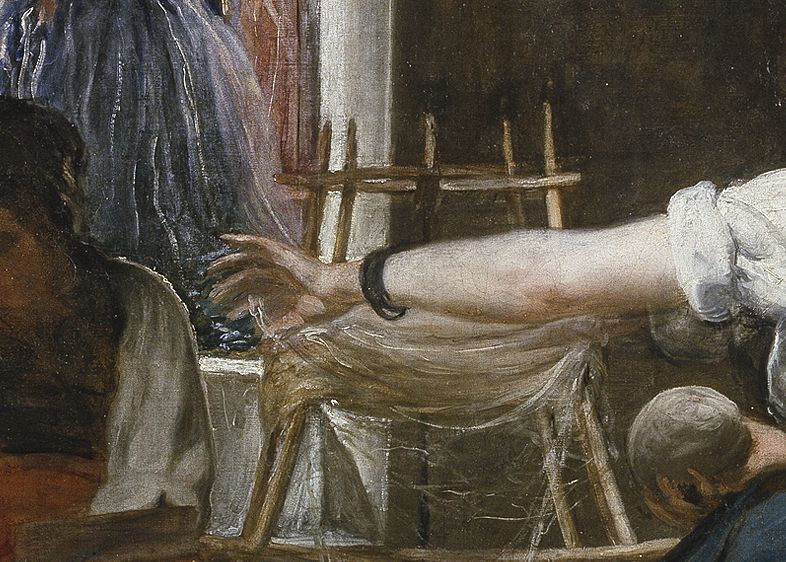
At the left side of the lit group, a woman shown largely from the side seems to look in towards the action. In front of the tapestry a profile in a helmet is clearly marked, with an arm lifting towards the figure beside her. The other figure holds an arm low and out from the body. Their gestures can be followed across a small distance, even though the hanging is busy with shapes that can be mistaken for parts of the people standing near it. A little higher up, lighter strokes against the blue-grey of the tapestry resolve into airborne figures. The upper and right borders help locate those strokes on the hanging. Light strikes the textiles, sleeves and bodies in the recess so evenly that the distinction has to be worked out again at their edges. [1] [2]
A bowed line along the top of the tapestry, a patterned border and a turn where the hanging meets the right wall make it unmistakably a made and hung object. It is easy to miss what those edges do once attention goes to the helmet and the raised arm. The folds of the nearby dresses, some with a similar range of reds and greys, nearly continue the fabric’s colours in front of it. The bow at the top restores a sense of the cloth’s weight. There is a distant shore and open air within this surface, yet its visible edge has to bear the weight of a drape pinned up in a room. [1] [4] [6]
This work in Velázquez’s career
The Rokeby Venus
1647–51 CatalogueThe Spinners (current article)
1655–60 PradoLas Meninas
1656 CatalogueArachne’s contest in Ovid
In Book VI of Ovid’s Metamorphoses, word of Arachne’s skill has spread throughout Lydia. Her father dyes wool and she has grown famous through what she can do. The nymphs come to watch her make things. Ovid follows her fingers as she works wool into a thread or forms a ball of yarn, giving these actions the sort of sustained attention that a description of her finished designs alone could never supply. Her skill seems to point to Pallas Minerva, the goddess whom the Greeks call Athena, as her teacher. Arachne disputes the claim and challenges her to a contest. [5]
Minerva initially appears as an old woman. She advises Arachne to ask the goddess to forgive her and be content with a reputation among mortals. Arachne dismisses the advice and the goddess reveals herself. Then they work, each at a loom. The poem describes the crossing of the yarns and the work of preparing and tightening them before it tells us what the women have made. At this point the difference in rank gives neither contestant a different procedure. Both have to bring an image into being by passing threads through other threads. [5]
Minerva sets her own dispute with Neptune over Athens at the centre of her tapestry. Around it she places episodes in which people who presume to rival the gods suffer for it. An olive border recalls the gift she offers Athens. Arachne begins with Europa and the bull and proceeds through the forms the gods assume to deceive and assault mortals. The gods’ ingenuity is visible here in its consequences for the people they pursue. The flower and ivy border completes a work in which neither Minerva nor Envy can find a fault. Ovid gives no formal awarding of a prize. He has Minerva destroy the work and strike its maker. When Arachne attempts to hang herself, the goddess lets her live and transforms her into a spider. The punishment prolongs the action in which Arachne excelled, allowing her to go on making webs. [5]
Velázquez gives us enough to recall the ending without portraying a spider or a shredded hanging. The tapestry looks whole, and in the Prado’s reading Minerva’s raised arm signals the threat of punishment. The poem can tell us immediately that the hand at the loom and the woman on the point of being transformed belong to the same person. A painting permitting several actions to be visible at once has to suggest such a relationship in other ways. The different heights of the rooms, the difference between work clothes and a helmet, and the change from yarn to a finished image are means of putting different moments side by side. [1] [2] [5]
Annotated Details from The Spinners
The numbered overview shows the painted core. Follow the foreground work into the brighter scene behind it.
Details from THE SPINNERS
The motion of the wheel
The curved rim stands out more clearly than the interior of the wheel. Broken strokes make it difficult to fix the moving parts in one position. [1] [2]
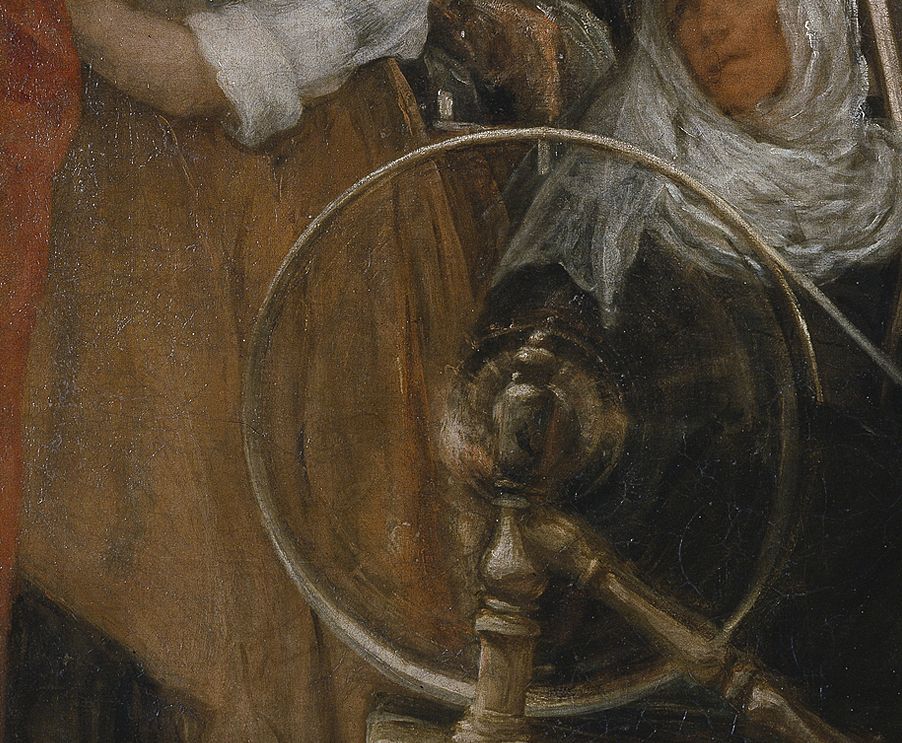
The strand drawn to the right
The worker’s outstretched forearm crosses the pale yarn. Look for the slender lines leading away from her hand into the darker gap between figures. [1] [2]
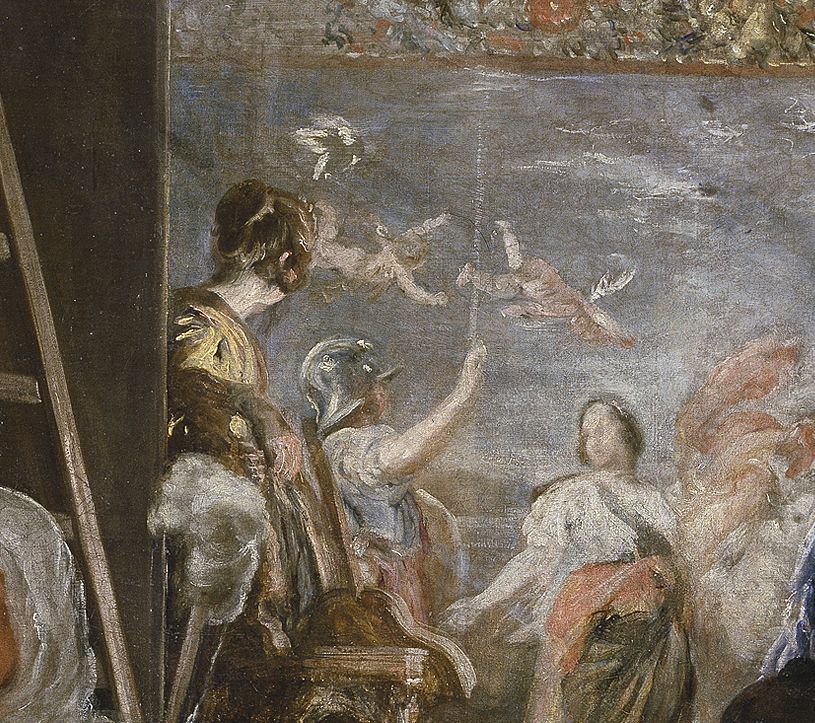
Are Arachne and Minerva shown twice?
The Prado’s visual guide reads the left spinner as Minerva in disguise and the young woman in white as Arachne. The pair appear again in the recess, with Minerva visibly armed and reaching up. On this reading the two rooms hold successive stages of the fable, with the present-day appearance of the women’s work bringing the first stage close to a Spanish viewer. The older appearance and head covering of the left spinner fit the narrative of disguise. Her exposed, strikingly lit leg can make a viewer look twice at the supposed age of the woman above it. The bright area is real evidence of how Velázquez has painted the figure. Its use as a deliberate clue to divine identity is an interpretation. [1] [2] [5]
Other readings allow more independence to the workshop. Julián Gállego’s Prado catalogue entry discusses the division between the helmeted woman, the figure beside her, and the figures that indisputably belong to the hanging. It considers whether the mythic participants might themselves be part of what the three better-dressed figures are looking at, a position associated in the catalogue with Enriqueta Harris. In a more radical reconsideration, Lorenzo Martín del Burgo suggests that the spinner at the wheel is Penelope, using older representations of Penelope and her attendants to challenge the usual identification. He treats the head covering as evidence of a different identity. The proposal makes the scarcity of unambiguous personal attributes among the workers particularly apparent. The title found in the early inventory, the helmet and the quotation of the Europa image keep the Arachne story central to the Prado’s account. The figures’ precise status inside the scene is harder to establish. [1] [2] [3] [7]
One way to test the doubled-figure reading is to follow the changes of direction. The main spinner at the left turns towards the curtain, so the painting does not present the women as opponents exchanging looks across the floor. It puts their labour in the same visual field. In the recess the two commonly identified as Minerva and Arachne seem oriented towards each other and are defined in part by opposing gestures. The motion below is dispersed among five people. Above, a confrontation can dominate the impression of a group of the same apparent number. The painter uses the differences in how the rooms work to make the second an answer to the first, with or without a match between individual women. [1] [2]
Titian’s Europa in a woven picture
The tapestry contains the strongest visual clue to what is happening. Above and between the women at the back are flying figures and a sweep of ruddy drapery. Near the lower right of the visible scene is a fragment of the bull and Europa. Compare it with Titian’s The Rape of Europa, painted in 1559–62 for Philip II and now in the Isabella Stewart Gardner Museum in Boston. In Titian’s painting Europa holds on to a horn of the white bull while the other arm raises a length of red fabric. The little figures on shore are far behind her. Above, the airborne cupids cross the sky on a diagonal. The waves make the bull’s progress feel well under way. The red fabric that calls attention to Europa also measures her distance from people in a position to help her. [1] [6]
The scene begins in Book II of the Metamorphoses, where Jupiter adopts a form gentle enough to tempt Europa to climb onto his back. He then carries her out to sea. In Book VI the episode leads Arachne’s series of images exposing abuses by the gods. Velázquez lets the red, the floating figures and a glimpse of the abducted woman do the work of calling up that first scene. He sets his mythological encounter in front of the image, so that one glimpse of it can prompt a viewer to recall the whole story and understand what has brought on Minerva’s anger. The room need not disclose every strand of the woven narrative. Its partial view gives a viewer something specific to identify and something larger to recover from memory. [1] [5] [6]
Titian’s canvas was still in Spain in Velázquez’s day. The Gardner Museum traces it to rooms in the Alcázar where it could be seen with other mythological works Titian had made for Philip II. He called such paintings poesie, or painted poems. His images gave individual crises from long tales the scale and presence of large pictures. In The Spinners, the painting that had once taken Ovid as a source has itself become the source for a work of art within a painting. Arachne’s tapestry comes out of Roman poetry. The design Velázquez allows us to recognise belongs to a named painter whose pictures had been seen together at court. [4] [6]
Peter Paul Rubens made an oil copy after Titian’s Europa while in Madrid in 1628–29. That canvas is in the Prado. Its existence means that the same arrangement had been studied and painted in at least two forms available to Velázquez. The copy made by Rubens is another independent oil painting. The version in The Spinners appears at a new scale behind people who break up its outlines and whose actions give it a different purpose. Gállego illustrates Rubens’s copy alongside his account of the Velázquez. The visual kinship is secure enough to follow without choosing which canvas supplied Velázquez with a particular brushstroke. [1] [4] [6]
There are two distinct Rubens connections. His large copy translates Titian’s Europa into another oil painting. His surviving small sketch of Pallas and Arachne, in Richmond, Virginia, belongs to the later programme for Philip IV’s hunting lodge, the Torre de la Parada. Julia Vázquez discusses Svetlana Alpers’s proposal that the sketch’s design lies behind the confrontation in the rear of The Spinners. Rubens also made a separate design of Europa for the hunting lodge. Vázquez reads Velázquez’s choice to put a Titian-like Europa inside a scene indebted to Rubens’s Arachne as an act of rearrangement. In that account the precedents serve different parts of the finished painting. The two raised arms and a section of fabric are places to look for the decision to bring the works of different masters together. [4]
In 2021 the Prado brought back Titian’s original on loan for Pasiones mitológicas, alongside the other paintings made for Philip II. The Spinners moved into the exhibition. In Room 15 A the museum placed a full-size photograph of the Velázquez in the structure that normally showed the painting itself, and mounted a complementary display of copies and homages around the Rubens canvas. Someone seeing both displays could move between Titian’s image at the scale it had for Philip II and the Velázquez that made one part of it small and distant. The arrangement also gave the copy by Rubens room to be considered as a painting in its own right, as well as one route by which a design passed between artists. [3] [6]
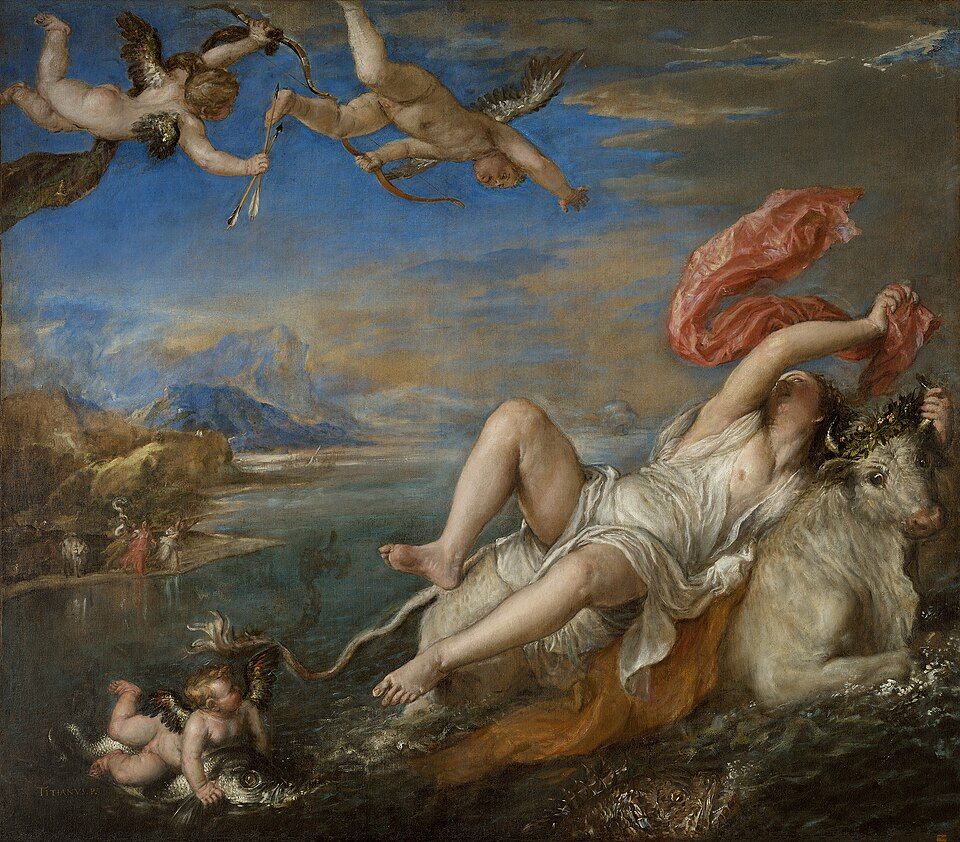
Titian, The Rape of Europa, 1559–62, Isabella Stewart Gardner Museum, P26e1. The bull, flying figures and sweep of red provide points of comparison with the tapestry behind the spinners. Image source. Public domain. Resized for display.
The standing of a manual art
Gállego also records Diego Angulo Íñiguez’s comparison between the two seated spinners and figures painted by Michelangelo on the Sistine ceiling. The catalogue illustrates the nudes beside the Persian Sibyl. Compare the torsion of the bodies, especially the way turning at the waist pushes a knee away from the direction of the upper body. The analogy asks us to look through the mass of skirt or scarf to the figure underneath. Its interest lies in what the comparison reveals about the new use of those poses. A turn of the torso can organise a figure above a viewer in a chapel and can make sense in a woman reaching for yarn at the edge of a workbench. The similarity has often been interpreted as a quotation. The specific act of taking up a model is harder to document than the forms that can be compared. [1]
There is an old argument that the painting asks the viewer to distinguish art from ordinary labour. Gállego discusses Charles de Tolnay’s reading of the bright room as the realm of the idea and the dark room as the realm of manual work. In that reading, the painting makes a claim for the standing of painting among the liberal arts. Light does give the myth and the tapestry precedence each time the eye passes up the steps. Equally, the deftness with which Velázquez gives the wheel a turn makes the worker’s dexterity hard to treat as mere preparation. Ovid already takes pleasure in Arachne’s movements before her design makes her a threat to Minerva. [1] [5]
The disagreement matters at the level of looking. Velázquez gives the woman at the right the largest patch of white in the foreground, using its folds to make one working shoulder impress itself on the eye. He also gives the whole hanging at the back enough weight for us to register it as cloth before we see what is depicted on it. Physical effort and invention are present at both levels. The rear room can suggest that an object made by hand has acquired the authority to tell a story its makers or spectators may find difficult. The scene of preparation makes it possible to imagine that object before that image had taken shape. [1] [2] [5]
Anton Raphael Mengs, as quoted in the 1990 Prado catalogue from a letter printed by Antonio Ponz in 1776, praised the late work as though it had been made by the artist’s will alone. It is a striking reaction to a picture so full of hands. A distant painted gesture can look as fleeting as a real one, and the picture can seem to have arrived at the result without effort. If the wheel’s blurred interior makes us forget how many decisions went into establishing its speed, the thread pulled out in front of the woman in white reminds us of the sustained attention an object can require in order to look effortless. [1]
An early owner and a changing title
The earliest record usually identified with the painting is the 1664 inventory of the possessions of Pedro de Arce, who held a royal household office as a montero de Espinosa. María Luisa Caturla brought attention to the entry in the twentieth century. The inventory assigned the work to Velázquez and described its subject as the fable of Arachne. Gállego regarded Arce as the likely patron. Fernando Marías’s examination of the inventories places the picture among a range of costly goods owned by Arce and questions the move from possession to commission. On the usual identification, the document establishes that Arce owned the painting by 1664. How Arce acquired it and whether he was the first owner remain open. [1] [3] [8]
About 1657, Gállego’s proposed date, puts the work very close to Las Meninas. The broader late date used by recent publications leaves room for a more complicated relationship. Marías notes that a mid-1640s date has also been proposed on stylistic grounds. He cautions against dating the painting too tightly by its absence from a previous list of Arce’s possessions. A later date for acquisition can still be compatible with an earlier date for painting. For the same reason, the use of models that a court painter could study in the royal collections helps explain the work’s intellectual setting while leaving its intended destination unclear. [1] [4] [6] [8]
The picture is also recorded in the collection of the dukes of Medinaceli and then in the Spanish royal collection. The 1990 catalogue traces it through Buen Retiro and the new Royal Palace before its entry into the Prado in 1819, the year the museum opened. Marías found reason to put the transition out of the Medinaceli collection later than the traditional account. The differing routes matter because the picture was once thought to have been enlarged after suffering damage in the Alcázar fire of 1734. The Prado’s more recent display account associates the enlargement with adapting the painting for the new palace. The fire story depends on a placement that Marías questions. [1] [3] [8]
The names used in catalogues show how differently the canvas can be approached. Well into the twentieth century the Prado catalogued it as a spinning and winding room and sales space associated with the Santa Isabel tapestry works in Madrid. That description drew attention to the five working figures and acknowledged that there was something mythological on the tapestry. It made a particular local workshop the subject. In the twentieth century Angulo traced the Arachne connection and Caturla’s inventory brought evidence that a painting of that subject by Velázquez had been recorded a few years after his death. The name The Spinners preserves what a person can see quickly. The Fable of Arachne supplies a reason to spend longer in the recessed room. [1] [2] [8]
The added canvas and the Prado’s frame
The expanded canvas extends the painting around its perimeter, above all at the top. The Prado’s 2021 report puts the upper addition at more than 40 centimetres and dates the enlargement to the second half of the eighteenth century. In the expanded view, the high arch is prominent and the brightly lit figures sit farther below the top of the picture. Comparing the formats shows why the episode can feel farther away even though it remains the same size. The distance between the red curtain and the top of the hanging establishes a compact arrangement in the smaller field. Add the arch and the small painted company takes its place at the lower end of a much larger piece of architecture. The new space above has considerable presence even though so little action takes place in it. [1] [3] [4]
The two formats belong to different historical stages of the object. The 1664 inventory gave the dimensions in varas, units of length whose use in the documents has been interpreted differently. Marías shows that reading the old measures involves deciding how to understand quantities that were only approximately specified, and he questions whether they are sufficient to reconstruct each historical change. The Prado’s display relies on study of the physical painting as well as its inventory history. The larger dimensions describe the whole support as it survives. The smaller dimensions refer to the composition inside the later perimeter. They describe different things even when printed next to the same title and accession number. [1] [3] [8]
The Prado situates its first modern presentation of the original field in the work that followed technical examination and the 1984–85 restoration. María Teresa Dávila Álvarez recalls carrying out the treatment with her sister Rocío, who also worked with her on The Surrender of Breda. The museum showed The Spinners with the additions concealed in 1986 and did so again in the 2007 exhibition Fábulas de Velázquez. A further system was installed in 2011 and used for the exhibition Metapintura. When the painting came back to the gallery, the existing structure proved awkward to handle. The condition of the canvas and the practicalities of reaching it were as much a concern as the view from the gallery. [3] [9]
In July 2021 the museum presented a new masking panel in Room 15 A. The frame conceals the extensions and leaves them attached to the picture. The structure, developed by Marta Hernández and the architect Myriam Rubio, is lighter and gives conservators prompt access to the work. The object encompasses everything that survives on the support, including the later work. The visible field lets visitors consider how the height and width Velázquez worked with determine the balance between the two groups. In that field the lit room comes up close to the top edge and the ladder, red curtain and drape read as parts of one arrangement across the width. [1] [3]
Velázquez’s rooms within rooms
In Christ in the House of Martha and Mary, probably painted in 1618, a young woman pounds ingredients in a mortar. An older woman points beside her and a scene from the Gospel appears at the upper right. The National Gallery describes the way that small biblical scene has been variously understood as a view through an opening, a picture or a reflection. The shared device is the shift between a task we can recognise and a small scene we have to examine in order to place it. In the later painting the intervening steps put the separation into three-dimensional terms. The hanging at the far end gives the same questions about the status of an image and the people beside it a third place to arise. [1] [10]
Las Meninas furnishes a comparison from the same period. In that painting a small luminous rectangle at the back contains Philip IV and Mariana of Austria. The king’s face enters a room already occupied by the people who attend his daughter and the artist who paints for him. In The Spinners, the brightest area at the back contains a fabric image whose maker has challenged a deity and whose design recalls paintings once collected by that king’s family. The mirror and the tapestry each allow a distant piece of the picture to revise the apparent subject of the much larger canvas. Compare the way a standing figure shows in the lit doorway in Las Meninas with the women silhouetted against the hanging here. In both pictures we quickly sense the distance across a room and then spend longer deciding what that distance has allowed Velázquez to put inside it. [1] [2] [4]
The dark space at the front of The Spinners rewards a last look after the myth becomes clear. At the wheel, the turn of the head brings the woman into company with another person. Down by the hub, a slight change in the paint holds the activity of the hand just beyond the point where its position can be fixed. Farther back, a length of red cloth lifted by Europa helps us pick out part of a picture that other figures partly hide. These two things, a wheel in motion and a picture in a hanging, ask the eye to finish what it has been given. The closeness of the workers keeps us there long enough to see how much of the story takes place in those small acts of recognition.
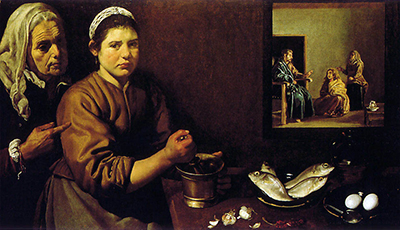
Kitchen Scene with Christ in the House of Martha and Mary. Compare the smaller, brighter passage behind the foreground figures in another painting that asks the viewer to divide their attention between two spaces. View Christ in the House of Martha and Mary.
What Titian told Philip II about Europa
On 19 June 1559 Titian told Philip II that he had begun two further pictures. In one, Europa would be carried off by the bull. In the other, Actaeon would be torn apart by his own dogs. The two subjects appear in the same letter while Diana and Actaeon and Diana and Callisto were nearing completion. The sequence was still taking shape. Titian was already working on a second episode about Actaeon, set after the encounter with Diana that Philip was about to receive. The National Gallery’s Death of Actaeon is associated with that second project. It may still have been in Titian’s possession when he died, whereas Europa had reached Philip by the summer of 1562. [11] [12]
The king’s reply of 22 October 1561 brings the practical business of delivering the pictures into view. Philip was waiting for a Magdalene and asked Titian to see to the packing himself and hand the picture to the royal secretary García Hernández in Venice. He wanted the same arrangements for Europa and Christ in the Garden when they were ready. A painting lost in transit was already on Titian’s mind. In August he had asked for a trusted person to collect the Magdalene, recalling what he had heard about the loss of an earlier picture of Christ. The letters put the transport of a painting among the things an artist working at a distance had to negotiate with his patron. [11]
On 26 April 1562 Titian wrote that Christ in the Garden and Europa were complete and that he was sending both. He used the word soggello, or seal, for the two pictures together, presenting them as the culmination of many commissions for Philip. The company Europa kept in that letter is striking. A scene of prayer and a scene of abduction could travel from the same Venetian studio under the same arrangements. By the time we encounter Europa in The Spinners, the picture has acquired another companion, Arachne herself. The correspondence lets us see how much the role of the image changes with the works and figures placed around it. [11]
Europa on a sheet of paper and a smaller canvas
In Boston, a version of The Rape of Europa measures just 33.7 by 40 centimetres. Pencil, red chalk and watercolour carry the design on paper. The red scarf registers strongly against the muted colour around it. In this version there is room for the shore, the action in the water and the figures in the sky, all within a sheet a reader could take in at arm’s length. That is a different kind of compression from the one in The Spinners. The sheet reduces a whole design, while Velázquez makes us recover a design from what can be seen around the people in front of it. [13]
The small sheet also preserves a disagreement about the route the design took. An inscription on the back names Rubens and identifies Titian’s painting as the source. A label written by Bernard Berenson names Van Dyck and points to the Titian acquired by Isabella Stewart Gardner. The museum retains the traditional attribution to Van Dyck and gives two possible models for the drawing, Titian’s painting and Rubens’s copy. The two surviving notes record how people understood the sheet at different times. Even with so much of the design visible, the identity of the hand that put it on paper and the identity of the picture that hand followed are separate questions. [13]
A smaller oil Europa in the Wallace Collection tells a different story about what a reduction could be. Its canvas is 57.5 by 71.5 centimetres. When it came up for sale in 1857, the agent for the fourth Marquess of Hertford rated it above the large painting. Hertford agreed to buy it and described it as a study. The Wallace Collection now describes it as a reduced copy after Titian and dates it tentatively to the eighteenth century. The shift from study to copy reverses the implied order of work. A study might help a painter arrive at a composition. On the museum’s account, the composition was already there for the painter of this canvas to follow. [14]
The wall where Mercurio y Argos usually hung
The Prado’s 2021 exhibition gave the public another way to compare what happened to a design after it left Titian’s studio. In Room 15 A the museum used the wall normally occupied by Velázquez’s Mercurio y Argos for two paintings it identifies as copies by Juan Bautista Martínez del Mazo, Velázquez’s son-in-law. A separate display, Encuentros, had taken Mercurio y Argos to Room 9 and freed the longest wall in Room 15 A. Rubens’s copy hung opposite. These were Diana and Actaeon and Diana and Callisto, the two pictures that were approaching completion when Titian first reported work on Europa. The Titian originals were available in the temporary exhibition. The two Mazo canvases in the permanent galleries extended the opportunity to compare originals and copies beyond the single case of Europa. [11] [12] [15]
Because Mazo’s copies could be seen together, they repeated a pairing that the correspondence had already established in the sixteenth century. There were different things to carry from one gallery to the other. With the two Dianas, a viewer could remember how a whole scene had been laid out and see how the same arrangement read in another painter’s hands. When looking from Rubens or Titian to Velázquez, the comparison began with working out how much of the older design the new scene actually let one see. [11] [15]
That temporary arrangement gave a room in the permanent collection a subject of its own. In the exhibition, the reunited Titian paintings made it possible to consider a project that Philip had received in successive deliveries. In Room 15 A, Mazo’s pair and the Rubens showed how paintings from that project became material for later artists. Velázquez gave the design of Europa yet another setting and made its survival as a recognisable image part of the drama on the landing. [11] [15]
Artworks directory
Frequently Asked Questions
Oil on canvas [1]
The recess opens off centre and starts at the other side of a few shallow steps. The tilted ladder to the left of it offers a conspicuous line upwards, just where the wheel takes up much of the space below. The ladder’s rungs and the edges of the steps have a firmness that the action on either side of them often lacks. [1] [2]
In Book VI of Ovid’s Metamorphoses , word of Arachne’s skill has spread throughout Lydia. Her father dyes wool and she has grown famous through what she can do. The nymphs come to watch her make things. [5]
The Prado’s visual guide reads the left spinner as Minerva in disguise and the young woman in white as Arachne. The pair appear again in the recess, with Minerva visibly armed and reaching up. On this reading the two rooms hold successive stages of the fable, with the present-day appearance of the women’s work bringing the first stage close to a Spanish viewer. [1] [2] [5]
Discussion
Look again at the images and ideas explored in The Spinners. These editorial prompts invite your observations.
Reader Insights
Follow the wheel, the worker’s outstretched arm and the steps. What directs your attention from one space to the next?
Where does the tapestry behind the figures become hardest to distinguish from the figures in front of it?
Join the Conversation
Share a detail, comparison or question about The Spinners below.
References
- Julián Gállego, Las hilanderas o La fábula de Aracne, catalogue no. 62, in Antonio Domínguez Ortiz, Alfonso E. Pérez Sánchez and Julián Gállego, Velázquez, Museo del Prado and Ministerio de Cultura, 1990, pp. 360–367. Spanish. View source.
- Museo Nacional del Prado, Área de Educación, Visual Guide to the Prado Museum, “Works of art”, The Spinners and Las Meninas, PDF pp. 37–38. English version. View source.
- Museo Nacional del Prado, Memoria de actividades 2021, “Presentación singular de colecciones”, “Las poesías de Tiziano: copias y homenajes”, “Ejecución, instalación y presentación del nuevo panel de enmascaramiento para ‘Las hilanderas’ de Velázquez” and “Exposiciones en el edificio de Jerónimos”, pp. 92–93, 95, 99–100 and 144. Spanish. View source.
- Julia Vázquez, “Velázquez, Painter and Curator”, Velázquez, Painter & Curator, Brill, 2025, pp. 187–191, especially figs. 5.4–5.6. View source.
- Ovid, Metamorphoses, VI.1–145 and II.833–875, translated by A. S. Kline, 2000. English translation of Latin. Book VI · Book II. View source 1. View source 2.
- Isabella Stewart Gardner Museum, Titian, The Rape of Europa, 1559–62, P26e1, including provenance, and Titian: Women, Myth & Power Gallery Guide, sections “Technique” and “The poesie”, figs. 1–2. Object record · Exhibition guide. View source 1. View source 2.
- Lorenzo Martín del Burgo, “De nuevo sobre el significado iconográfico de ‘Las hilanderas’ de Velázquez: ¿Fábula de Aracne o Penélope hilando?”, Arbor 182, no. 717, 2006, pp. 17–25. Spanish. View source.
- Fernando Marías, “Don Pedro de Arce ¿coleccionista o regatón?, y las Hilanderas de Velázquez”, Archivo Español de Arte 76, no. 304, 2003, pp. 418–425. Spanish. View source.
- María Teresa Dávila Álvarez, “We Restored Practically the Entire Velázquez Collection”, Voices of the Prado, interview recorded 29 November 2017. English transcript. View source.
- The National Gallery, London, Diego Velázquez, Kitchen Scene with Christ in the House of Martha and Mary, NG1375. View source.
- Titian and Philip II, selected correspondence, including letters of 19 June 1559, 17 August and 22 October 1561, and 26 April 1562, in Titian: Love, Desire, Death, ed. Matthias Wivel, National Gallery, London, 2020. View source.
- National Gallery, London, National Gallery Technical Bulletin 36, catalogue entry 8, Titian, The Death of Actaeon, NG6420. View source.
- Isabella Stewart Gardner Museum, The Rape of Europa, traditionally attributed to Anthony van Dyck, P26e13, including inscriptions, commentary and bibliography. View source.
- Wallace Collection, The Rape of Europa, after Titian, P5, object record and description. View source.
- Museo Nacional del Prado, Memoria de actividades 2021, “Las poesías de Tiziano: copias y homenajes”, printed p. 95. View source.







