


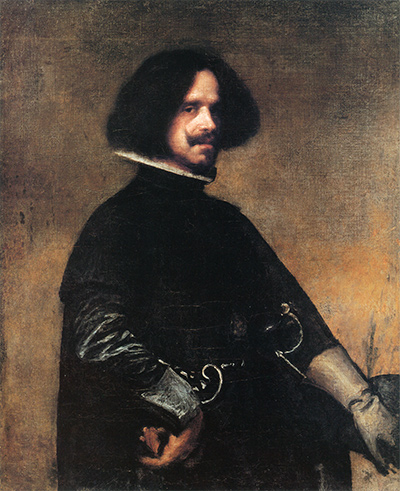
 by Tom Gurney
Tom Gurney BSc (Hons) is an art history expert with over 20 years experience
Published on June 19, 2020 / Updated on October 14, 2023
Email: tomgurney1@gmail.com / Phone: +44 7429 011000
Diego Velázquez: Introduction
A young attendant kneels beside a princess and offers her a small red cup. Across the room, a man on a staircase has paused with one foot higher than the other. Between these two actions, a painter looks out from behind a canvas. The room in Las Meninas is large enough for each person to be doing something different, yet from where we stand their gestures and glances seem connected. Diego Velázquez gives us enough space to follow these connections and enough uncertainty to keep us looking. [1] [2]
The Spanish painter lived from 1599 to 1660 and spent much of his working life in the service of Philip IV. The celebrated group belongs to his final years. To see what he brought to that room, it helps to begin with a pan of eggs in Seville, then follow him to Madrid, to Italy twice and back to the Spanish court. In an early painting, light settles on one thing at a time. Years later it can tell us how far a person stands from a door, or make a portrait seem to change as we walk towards it. The attention to ordinary gestures, from lifting a spoon to holding a cup, runs through the whole career. [3] [4]
At a Glance
- Life1599–1660 [3]
- Early trainingFrancisco Pacheco’s workshop in Seville [3] [5]
- Royal serviceAppointed to Philip IV’s service in 1623 [6]
- Late workPainted Las Meninas in 1656 [1]
Velázquez’s connections
- Francisco Pacheco Pacheco’s workshop gave Velázquez his training in Seville. Pacheco later defended the young painter’s kitchen scenes. [3] [8]
- Philip IV The royal appointment in 1623 put Velázquez in the king’s service, and portraits register their long working relationship. [6] [40]
- Peter Paul Rubens Rubens and Velázquez met in Madrid. Rubens’s copy after Titian also helps place the tapestry imagery of The Spinners in a chain of artistic exchange. [15] [37]
- Titian Titian’s Europa offers a specific comparison for the brightly lit tapestry in The Spinners. [37]
- Gian Lorenzo Bernini Bernini and Velázquez both portrayed Innocent X. Their two likenesses offer a comparison between the effects of marble and paint. [31] [33]
- Juan de Pareja Velázquez painted Pareja in Rome before manumission took effect. Pareja went on to make works in his own right. [32] [34]
- Pablo Picasso Picasso’s 1957 series takes individual figures and the whole composition as subjects for reinvention. [43] [44]
Diego Velázquez in context
Venetian Renaissance
16th century [46]Baroque painting
17th century [47]Francisco Pacheco
1564–1644 [48]Caravaggio
1571–1610 [49]Peter Paul Rubens
1577–1640 [50]The Waterseller of Seville
c. 1620 [10]The Surrender of Breda
c. 1635 [23]The Rokeby Venus
1647–51 [36]Portrait of Pope Innocent X
c. 1650 [31]Juan de Pareja
1650 [32]The Spinners
1655–60 [38]Las Meninas
1656 [1]Essential works

An Old Woman Cooking Eggs
1618 · Sharp light and distinct surfaces give a kitchen scene the weight of a history painting. [4]

The Waterseller of Seville
c. 1620 · Three figures and a simple offer of water are held in a web of touch, light and unspoken attention. [10]

The Surrender of Breda
c. 1635 · A royal commission turns on the moment two commanders meet. [23]

The Rokeby Venus
1647–51 · A reclining figure, an indistinct mirror face and the tilted frame draw a viewer into the composition. [36]

Portrait of Pope Innocent X
c. 1650 · Small differences across reds and whites give force to a seated likeness. [31]

Juan de Pareja
1650 · The sitter’s turning body and direct look make this Rome portrait an arresting encounter. [32]

The Spinners
1655–60 · An illuminated story of artistic rivalry unfolds beyond a group of textile workers. [38]

Las Meninas
1656 · A group at court, a mirror and a figure in a doorway make the act of looking part of the painting. [1]
Contents
- Seville and the life of a kitchen
- Madrid and the first journey to Italy
- The mature court and the return to Rome
- The final court pictures
- Where to find Velázquez’s paintings
- A painting between two windows
- How a canvas changed rooms
- From the royal collection to the printed page
- The cup in the museum inventory
Seville and the life of a kitchen
Velázquez grew up in Seville, a centre of trade with the Americas and a city where convents, churches and religious orders offered painters work. He trained with Francisco Pacheco, passed his painters’ guild examination in 1617 and married Pacheco’s daughter Juana the following year. The examination records a qualification to practise the trade. The works he made around these years show how broadly he understood that trade, from painting sacred figures for a religious house to building a picture around the contents of a kitchen table. [3] [5] [7]
A shallow pan and an enormous jar
In An Old Woman Cooking Eggs, dated 1618 by the National Galleries of Scotland, the cook has an egg in one hand and a wooden spoon in the other. Two yolks hold their shape as the whites spread through the hot liquid. The light at the pan’s edge is thin and bright. Move towards the front of the table and watch how it changes when it hits the knife, glazed jug and pale mortar. The knife’s blade shows up as a narrow edge and a shadow, while the mortar receives light over much of its bowl. Velázquez makes the objects feel different without needing to give them much space. [4] [8]
The boy on the left brings a melon and a flask. The cook holds her spoon over the pan. Her face has lifted towards the boy, whose gaze goes past her. Their faces and hands are separated by darkness, with the rim of the dish set between them. The ingredients suggest a sequence, from the eggs already in the pan to the one still in its shell, while the figures seem to have paused. That difference in pace gives the scene something to hold our attention after we recognise what she is cooking. [4] [8]
Pictures of kitchens, eating and drinking in which everyday objects play an important part are often called bodegones in accounts of Spanish painting. The subject could appear humble in a hierarchy that placed stories from Scripture and history above scenes of daily life. Pacheco defended the kind of painting his son-in-law was doing. In his treatise, as quoted by Julián Gállego in the Prado’s 1990 exhibition catalogue, he connects these kitchen subjects and early portraits to the close study of nature. That is apparent in the way the light describes how each thing would feel in the hand. [8]
At Apsley House in London, The Waterseller of Seville sets a round earthenware jar so close to the front that its base runs out of the picture. Little highlights sit on the surface like drops of water. Above the jar an older man supports a glass that a boy takes near the stem, with another drinker barely visible behind them. Here a single thing passes from hand to hand, and the faint rim of the glass shows where their fingers converge. The bowl in Edinburgh holds the cook’s attention and draws the boy towards her. The glass in London brings two people together while their eyes still seem to look past each other. [9]
The painting’s setting tells us little about the route the seller took through the city or the people who bought from him. Its first documented owner, Juan de Fonseca, had the picture by 1623. It later entered the Spanish royal collection and reached Britain after the recovery of paintings from Joseph Bonaparte’s baggage following the Battle of Vitoria in 1813. A subject drawn from the streets of Seville thus came to be seen among works from the Spanish royal collection at the Duke of Wellington’s London house. [9] [10]
A kitchen next to a sacred story
In the National Gallery’s Christ in the House of Martha and Mary, probably from 1618, another young woman works at a table. She grips a pestle above a mortar. Fish, eggs and a red pepper lie in front of her, while a woman behind her points. A smaller scene above the table shows Christ with Martha and Mary. A small opening into another room is one way the National Gallery reads the inset. Viewers have also understood it as a reflection or a picture hanging on the wall. The meal being made is close enough almost to touch, while it takes a moment to work out where the figures in the Gospel scene belong. [11]
The contrast between work and attention runs through both parts of the painting. In the Gospel story Martha complains that she has been left with the work of serving while Mary listens to Christ. In the kitchen, the figure with the pestle has been given so much space that we spend much of our own time attending to her. Compare the older woman’s gesture with that of the cook in Edinburgh. There the spoon points down into the heated dish. Here a finger leads our eye from the work at the table towards a person who may have thoughts of her own about the lesson. [8] [11]
On other canvases Velázquez tackled religious painting directly. The National Gallery’s Immaculate Conception and Saint John the Evangelist on the Island of Patmos were probably made as a pair for the Shod Carmelites in Seville. John lifts his gaze from his book towards a small figure within a burst of light. The Virgin in the companion painting is seen on a different scale, standing with clasped hands above a low landscape. Her blue mantle and luminous outline give body to the figure whose appearance is so distant in John’s vision. [12] [13]
Seeing the pair together brings out the way one painted figure can set the distance from which we see another. The position of the little vision above John’s head makes us tilt our attention up with him. In the companion canvas, facing the Virgin directly allows us to spend time with her expression and clothing. The shift in scale within the kitchen scene has a different effect. It leaves the work of the kitchen very near us and the biblical exchange further away. Both examples show Velázquez already using relative distance to affect how a story unfolds. [11] [12] [13]
An Old Woman Cooking Eggs. The lit eggs and earthenware show how Velázquez gave ordinary materials a central role in his Seville paintings. View An Old Woman Cooking Eggs.
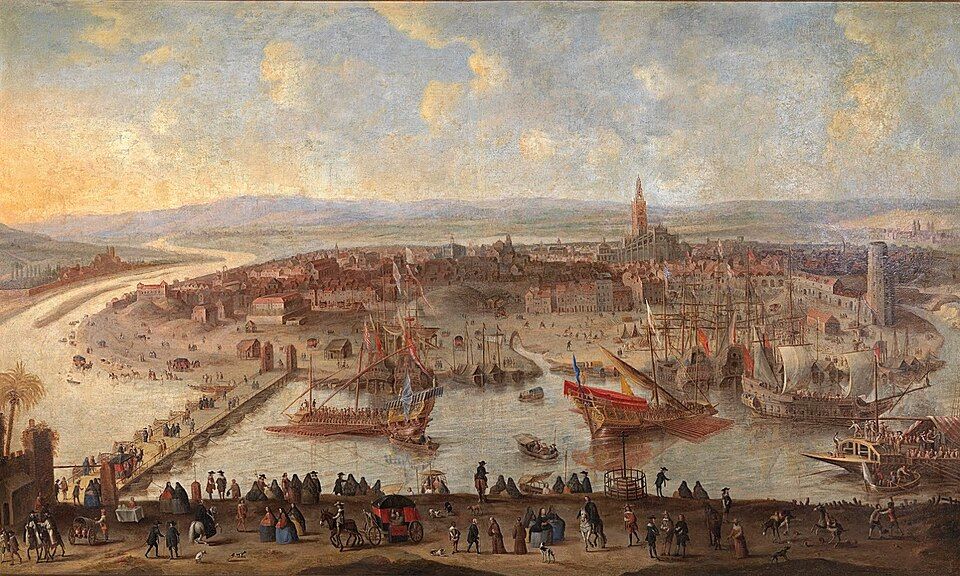
Anonymous, View of Seville, about 1660. The Guadalquivir waterfront shows the city towards the end of Velázquez’s lifetime, decades after his apprenticeship. Image source. Public domain. Resized for display.
Diego Velazquez - National Gallery Documentary · Robert Moyse · Watch on YouTube
Four stages of Velázquez’s career
Training in Seville
The painter’s apprenticeship, qualification and early pictures put figures, utensils and devotional subjects on the same close footing. [3]
Royal patronage and the first Italian trip
The king’s service gave Velázquez a new audience. His first visit to Italy widened the repertoire of figures and stories that he brought back to Madrid. [14]
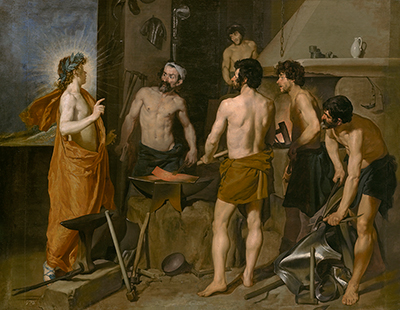
From the Buen Retiro to Rome
A large royal commission at Madrid and the portraits painted on a later Italian journey show two very different uses of a painter’s eye. [14]
Royal likenesses and late pictures
Palace responsibilities accompanied a final decade in which the royal household, myth and domestic labour all became subjects of ambitious paintings. [3]
Madrid and the first journey to Italy
In October 1623, an order issued in Philip IV’s name assigned Velázquez a salary of twenty ducats a month for painting in his service. The document gives a firmer foothold for the start of the royal appointment than the stories told later about the young painter’s first sitting with the king. The new position brought a sustained responsibility for royal likenesses. It also put him in contact with a collection rich in Venetian painting and with artists visiting the court, including Peter Paul Rubens. Velázquez left for Italy in 1629. [3] [6] [14] [15]
Giving the king room to stand
Look for the outline of one of Philip’s early portraits before studying the face. In the Met’s full-length portrait in black, probably painted in 1624, the narrow figure is held upright by the long silhouette of the costume and the pale shapes of face and collar. The furniture and the king’s sword supply the surroundings and signs of rank without crowding the body. Standing still becomes part of the royal appearance. A raised arm or an elaborate backdrop would draw attention away from the angle at which his hand rests and the small distance between that hand and the edge of the picture. [16]
Velázquez could handle richer clothes without giving up that restraint. In the National Gallery’s Philip IV in Brown and Silver, the curtain and the bright embroidery announce a more splendid occasion. The silver seems to run down the sleeves and scatter over the front of the garment. From a distance the marks come together into a pattern that follows the body as it turns. Nearer the surface they separate into quick, irregular touches. The collar remains a simple white break against the embroidery, and the small face above it draws the eye back out of the ornament. One detail brings the painter into the room. On the petition in the king’s hand, Velázquez signed himself “Painter to Your Majesty”, in the gallery’s English rendering. The gallery dates the portrait to about 1631–32, just after the first Italian journey. [17]
A god among drinkers
Before the journey, The Triumph of Bacchus had already placed the subject of an ancient god in reach of the painter who made The Waterseller. The Prado’s catalogue records a payment in July 1629 and dates the work to the preceding months. Bacchus, recognisable by his wreath and exposed flesh, lowers a crown onto a kneeling man. The drinkers pressed together at the right come with rumpled clothing and weathered, smiling faces. One of them looks out towards us. His smile suggests that a spectator might join the group as readily as stand apart and admire it. [18]
The god has a formal action to perform, and the drinkers give that action the tone of a gathering. Compare the drinking vessels, cloth and shoulders in the foreground. The pale flesh and light drapery distinguish Bacchus, while the dark, overlapping forms on the right make the group appear to lean in together. Seville’s figure painting remains visible in the half-lit faces and close grouping. What changes is the size of the gathering and the kind of story that can emerge from such familiar appearances. [18]
What happened in a Roman forge
The first journey took Velázquez to Rome. In 1630 he painted Apollo in the Forge of Vulcan and Joseph’s Bloody Coat. Gállego treats the two as companion pieces in his catalogue account. They entered the royal collections subsequently and had different destinations, the forge in the Buen Retiro and the Joseph painting at El Escorial. In 1634 Jerónimo de Villanueva bought the works from the artist for the royal collection. [14] [15] [19]
Apollo arrives with news that Venus has been unfaithful to Vulcan. The story comes down to us in Ovid, but the act of breaking the news is something Velázquez had to make visible. The arriving god turns towards the smiths and raises his hand. The men stop and look up while metal still glows on the anvil. One man faces away from us, so the twist in his back is how we register the interruption. Another opens his mouth. We can follow the news through the different directions and speeds at which bodies seem to react. [19] [20]
Colour establishes an immediate difference between Apollo and his listeners. His orange drapery and the brightness around his head set him off from the workers and their space. At the same time the men now have more room to stand apart than the drinkers around Bacchus. In the gaps, we can see a wall, the working surfaces and how deep into the forge each person stands. The sculptural figures invited comparison with the ancient sculpture and Italian painting available in Rome. The smiths’ interrupted labour supplies the scene with a time and place of its own. [15] [19]
In the Joseph painting, a man is made to believe his son is dead. His sons have brought back a bloody garment as proof, and the father recoils. Stand the two stories next to each other and we see the same problem worked out twice. A message arrives, people stop what they are doing, and the messenger changes the room without having to occupy its centre. Apollo tells the truth. In the biblical scene Velázquez has to make false evidence persuasive enough for us to understand Jacob’s grief. The handful of cloth is as important there as the god’s lifted hand in the forge. [21]
The difference from the Madrid Bacchus reaches down into the first layers of paint. Larry Keith and Dawson W. Carr’s National Gallery technical study describes how the pale grey preparation under the forge opened up a wider range of tones. The half-lit wall and floor can be felt between the brighter bodies. That range lets the scene depend on the spaces between the smiths as much as on the light striking their arms. [22]
The mature court and the return to Rome
Back in Madrid, Velázquez was asked to make pictures for very different rooms. Philip IV’s new Buen Retiro palace needed images that could be read as part of a political programme. The Torre de la Parada, a hunting lodge at El Pardo outside Madrid, brought royal hunters together with ancient writers and gods. These settings help explain why people who share the same painter and even much the same format can seem to belong to different worlds. [23] [24] [25]
A victory seen through two people
The action in The Surrender of Breda centres on a key that can be hard to find on first sight. Look between the commanders. The Dutch governor, Justin of Nassau, leans forwards with the key in his hand. The Spanish commander, Ambrogio Spinola, reaches towards his shoulder. An arm is extended in recognition of the defeated man while the transfer is still underway. The two groups of soldiers have made space for this meeting, and the distant landscape leads us from the gesture back towards the ground contested by the armies. [23]
The surrender took place in 1625. The painting was made about a decade later for the Hall of Realms, the Salón de Reinos, at the Buen Retiro. It stood within a programme of recent victories and dynastic portraits. In that setting, the steadiness of the Spanish ranks and the relative disarray of the men on the other side help communicate the outcome. To the right, the vertical lances repeat with enough variation to look carried by individuals. On the left, figures bunch and turn at different angles. Smoke over the distant country leaves a trace of the siege in a painting whose foreground is given to what happened after it. [23] [24]
The finely described gesture has the air of something a spectator might have witnessed. The Prado catalogue places the picture alongside Calderón’s drama about the surrender and shows how differently Peeter Snayers treated the siege in his panoramic paintings. Snayers’s small figures allow a viewer to follow positions across the landscape. Velázquez brings two bodies forward and uses their brief encounter to stand for events on a much larger scale. Magnanimity belongs to the victor’s image as carefully as the lances and the orderly ranks. [23]
The young Prince Baltasar Carlos on Horseback was also painted for the Hall of Realms. The horse’s raised forelegs and the widening space below the prince give the picture a different tempo from the paused exchange at Breda. The Prado treats the low viewpoint and the horse’s foreshortened body in relation to the painting’s position over a doorway. A lower angle made sense to someone looking up from the floor. Both works were built for viewers moving through a room, who would see an image of command turn from a boy on a horse to a battle handled by adult men. [23] [24]
How a sitter carries authority
The differences between two pictures of the Count-Duke of Olivares show what Velázquez could do with that change of format. In MASP’s Portrait of the Count-Duke of Olivares, dated 1624 by the museum, the sitter’s broad stance, red-covered table and dark clothes have the quiet of an early court interior. The key and spurs visible on his costume refer to his offices. The room around him is plain enough for these small objects to carry meaning. That economy links the portrait with the Met’s early standing king, and a 1624 payment receipt discussed in the Met’s technical study gives the comparison a documentary basis. X-rays of the Prado’s early standing king reveal a related figure underneath the visible version. The closer the resemblance between two pictures, the more the individual work can tell us about the ways Velázquez and his workshop arrived at a royal likeness and repeated it. [16] [26] [27]
In the Prado’s separate Count-Duke of Olivares on Horseback, the horse turns away even as Olivares turns his head towards us. The raised command baton and the long view of the landscape give a sitter once defined by the space next to a table command over imaginary ground. The São Paulo canvas, the mounted Prado portrait and the Hispanic Society’s standing likeness have their own records. The smaller Hermitage Olivares, which the museum dates to about 1638, offers a further comparison at bust length. The man’s face can occupy much more of the surface when there is no need to find room for a horse or to show the trophies of office from head to foot. [26] [28] [29] [30]
A fabulist at a hunting lodge
The image of a prince on horseback was suited to the Hall of Realms. At the Torre de la Parada, Philip looks ready to go out hunting, with a gun, a dog and more practical clothing. The country behind him is part of that picture’s sense of occasion. The recorded decorations of the lodge also included Aesop and Menippus. The pairing places two figures associated with antiquity among subjects drawn from court life and mythology. Gállego’s catalogue compares the pair and discusses the difficulty of reducing all the lodge’s decoration to the subject of the hunt. [25]
Aesop stands in a plain garment with a rumpled band at the waist. One hand disappears into his clothes and the other carries a book. The garment has a breadth and weight that the narrow strip of washed-out cloth at the waist makes more apparent. Below, the objects by his feet make for a more modest setting than the equipment of a royal hunt. Viewers familiar with Aesop’s stories may recognise a name associated with seeing through vanity. Much of the painting’s force comes from something more immediate, the patient and searching attention Velázquez gives this cloth and this face. [25]
Rome, a pope and an artist still enslaved
The second Italian journey, which the University of Teramo traces from the departure context in late 1648 to Rome in 1649, came with responsibilities towards the royal collection. Velázquez was involved in acquiring works and seeking artists for jobs at the Alcázar. While in Rome, he also made portraits with a very different relationship to rank and patronage. Two surviving pictures allow us to see what changes when he sets a face against coloured silks and when he puts one against open shadow. [14] [31] [32]
The Galleria Doria Pamphilj dates Pope Innocent X to about 1650 and suggests that the portrait was probably painted between the end of 1649 and January 1650. Red runs through the picture, from the folds behind the chair to the cap, the sheen of the cape and the warmer colour of the sitter’s face. Look how finely the white fabric below the cape has been drawn out around his wrists. One hand rests at the end of the chair arm. The other holds a sheet of paper. The change from broad red masses to a small pale sheet brings us back to the seated figure. His hands have a task, and his eyes register our presence. [31]
The Doria Pamphilj places the portrait in the context of a papacy moving closer to Habsburg Spain after the Peace of Westphalia. Its display history has given the picture a particular independence. In the nineteenth century the family commissioned a chamber for it. The gallery also allows a comparison with Bernini’s sculpted portrait of the same pope. Bernini had the turn of a head and the shape of a bust with which to register alertness. The painter could let a small change in the colour or edge of the face carry the expression, and could use the hands to give the pope something tangible to hold onto. [31] [33]
The Metropolitan Museum of Art’s Juan de Pareja was also painted in Rome, in 1650. Pareja’s body turns slightly, and the bright edge of the collar carries our eye up from the cloak towards his face. Follow the shoulder where it begins to merge into the dark ground. The edge of the figure is indefinite there, while the eyes and the dark line beneath the nose are clear. Warm colours gather around the cheeks and mouth. The gaze travels the other way, steadily out towards us. [32]
Pareja, an Afro-Hispanic artist, was enslaved by Velázquez when he sat for the portrait. The handsome cloth and direct look give no outward measure of what that legal condition meant for the person depicted. Velázquez signed a document in Rome in 1650 that provided for his manumission four years later. The Met exhibited the archival document in 2023 alongside paintings by Pareja made after he gained his freedom in 1654. Pareja’s own Calling of Saint Matthew places a self-portrait at the far left of a large, coloured scene. That position, at the edge of a room whose figures he could compose himself, invites a different kind of attention from the dark and shallow setting of the earlier portrait. [32] [34]
An outdoor wall and a private mirror
The two small views of the Villa Medici in Rome have long prompted debate about which journey produced them. In one Prado painting, tall cypresses flank a boarded grotto façade. In the other, the open arch is easier to see and there are two figures in the foreground. These are separate views. The first has a strong contrast between the heavy silhouette of the trees and the pale structure. In the second, the figures give the eye a sense of how far it must travel towards the arch. The light seems to have shifted along with the subject, catching sections of the wall and making the greenery spread into the open air. The Prado’s 1990 catalogue sets out the dating debate. Their place in Velázquez’s work is easiest to appreciate by looking from one small surface to the other. [35]
The National Gallery in London dates The Rokeby Venus to 1647–51, a range that spans the second trip. The painting is documented in a Spanish collection in 1651. Its exact place and date of execution remain uncertain, as do the circumstances of its commission. The gallery’s title, The Toilet of Venus, identifies the goddess through the child with wings who kneels beside her, holding a mirror. Behind her runs a sweep of red curtain. In front, white and grey bedding folds and creases under the length of her body. [36]
A long look at the face in the mirror changes the picture’s balance. The heavily modelled body is close to us, while the small painted reflection remains indistinct. The clearest image of Venus is thus the back she has turned towards the viewer. Titian’s reclining nudes offer a comparison for the length of the body and the arrangement of bed and drapery. The reversal makes Velázquez’s picture work differently. We approach the face by way of Cupid’s hands and a small reflective surface. That is a comparatively indirect way to encounter a sitter, even though the figure’s back fills most of the foreground. [36]
Velázquez and his artistic context on film
Explore Baroque painting, Spanish portraiture and horses in art with TheHistoryOfArt.
The final court pictures
Velázquez returned to Madrid in 1651 and became palace chamberlain the following year, taking on duties connected with the royal household. His last decade produced the paintings in which we most readily sense a whole room around the people he has depicted, as well as some of his most concentrated portraits. The larger scenes and the portraits ask for different kinds of looking. One moves our eye from a person to a room and back. The other makes us aware of how much space a head or shoulder can suggest on its own. [3]
The room around the Infanta
In Las Meninas, painted in 1656, light reaches the Infanta Margarita from the right and catches the stiff fabric of her skirt. María Agustina Sarmiento kneels with the cup, and Isabel de Velasco inclines towards the child. Further right, Mari Bárbola steadies the flow of glances with her own level look, while Nicolasito Pertusato sets his foot against the dog. The animal’s weight helps settle the little group. Beyond them, the two adults in shadow are harder to make out and José Nieto appears in the much brighter doorway. [1] [2]
We can estimate the depth from the right wall, with its succession of windows and hung pictures, and from the scale of the man on the stairs. But the brightest patch at the back leads us straight past the shadowed adults. The mirror beside the door returns us to the company in the room by showing Philip IV and Queen Mariana. Their appearances are muted in comparison with the man in the doorway. The mirror draws us in by giving us two people to recognise with very little painted information. [1] [2]
What does the mirror reflect? The royal couple may be standing before the painter, near the place occupied by the viewer, or the mirror may reflect a painted likeness on the unseen side of the large canvas. The back of the canvas prevents us from checking its subject. Gállego’s catalogue entry stresses the uncertainty of the arrangement. It is worth letting the eye move between the figures and the mirror before trying to settle who has come to see whom. The space in which we stand feels implicated because so many of the figures look out towards it. [1]
The large canvas on the left and the skirt at the centre are different sorts of painted surface. The canvas presents a broad shape with very little internal variation. The skirt is alive with small flicks, touches and interruptions. At the centre of the room a few such marks remain easy to read because they sit on the brightest person. The little patch of red near her hand does what it did on the kitchen table nearly four decades earlier. It brings our eye to someone in the act of handling an ordinary thing. The reflections and the title’s promise of royal company draw us across the room, but the small cup brings us back to the Infanta. [1] [2]
The 1666 Alcázar inventory recorded the painting in the king’s summer office. It entered the Prado in 1819. There its size gives a viewer an opportunity that a photograph compresses. From further away, the lit figures stand out as a group and the doorway opens up behind them. At closer range, small strokes within the costume and the highlights on the cup seem much less descriptive by themselves. The distance between those two views belongs to the way the picture works. [1] [2]
The light in a spinning room
The Spinners makes a different passage from work in the foreground to a brighter space behind. A spinning wheel turns on the left. Looking for the individual spokes is the quickest way to appreciate the movement of the wheel, because the paint lets them almost disappear into a blur. The woman at the right leans into her work, her large, illuminated back turned towards us. Between the two, cloth and labour take up nearly all the space at the front of the picture. A step leads the eye towards the figures and tapestry in the smaller, strongly lit room beyond. [37]
The Prado dates the painting to 1655–60. The work was long presented as a view of a tapestry workshop. The Prado catalogue discusses the evidence that changed that reading, including the 1664 inventory of Pedro de Arce, which lists a Fable of Arachne by Velázquez. In Ovid’s story Arachne challenges Minerva to a weaving contest and depicts Jupiter’s seduction of Europa in the guise of a bull. The rear tapestry recalls Titian’s Rape of Europa, a work Rubens copied. The reference to Titian thus forms part of a woven picture inside the painting, in a room reached through a scene of people working with thread. [37] [38]
For a long time the shape of the canvas encouraged viewers to see those two spaces differently. The Prado’s 2021 report describes eighteenth-century additions around the original work, with the largest strip at the top. A new framing installation introduced in 2021 masks the additions. With the upper strip out of sight, the space given to the women and the sightline into the bright room are easier to compare. An older reproduction may show more above the figures than the canvas Velázquez conceived. [37] [39]
Two final kinds of royal likeness
In the National Gallery’s late Philip IV of Spain, now dated by the gallery to about 1656, the king appears at bust length. The gallery emphasises the freely brushed suggestions of buttons, eyes and gold embroidery. The white collar keeps the head apart from the black costume. Above it, the upturned ends of the moustache help fix the face as a recognisable outline, while the area beneath the eyes is softer. A full-length king required attention to the floor, the legs and the space around both arms. The late portrait cuts the figure off before it can make any such use of its surroundings. Much of the weight of the likeness falls on small choices in the face. The gallery records that pupils made copies of this portrait, a reminder of the demand for a likeness that could circulate. [40]
At the Kunsthistorisches Museum in Vienna, Infanta Margarita in a Blue Dress shows the child from Las Meninas in a portrait of 1659. She has a wide, shining skirt again, but the figures who served or stood beside her in the earlier picture are gone. An extended arm makes the interval between her body and the table part of the composition. As in Brown and Silver, the trim holds its shape most clearly from a little distance. The sitter is framed by the width of the dress in a picture small enough to be taken in without having to trace the depth of an entire room. [17] [41]
The Vienna portrait and the National Gallery’s late Philip offer two ways to see what the painter could do under the demands of court likeness. The Infanta’s dress declares her rank before we take in her face. In Philip’s bust, the black cloth and white collar provide a framework more familiar from the early portraits, but now most of the body can stay out of view. Visit the portrait of the young king in New York and the late likeness in London, and the difference is evident in the amount of space given to a face, as much as in the difference in age. [16] [40] [41]
Looking again in Madrid and Barcelona
The Prado preserves major paintings from each stage of Velázquez’s court career, and the appearance of those works reflects the attention of later conservators. María Teresa Dávila Álvarez recalled in the museum’s oral history that John Brealey undertook the cleaning of Las Meninas in 1984. She, her sister Rocío and Clara Quintanilla worked on retouching the picture. Dávila also recalled working with Rocío on The Triumph of Bacchus, Apollo in the Forge of Vulcan, Breda and The Spinners. These were distinct jobs undertaken over time. The testimony gives a sense of the collective work that goes into keeping a group of paintings available to compare. [42]
At the Museu Picasso in Barcelona, the comparison is with a painter who set himself to looking at Las Meninas over a period of months. Between August and December 1957, Picasso turned the whole room into a large grisaille, a painting in shades of grey, and returned repeatedly to particular figures in smaller compositions. The museum tracks Isabel de Velasco through the series, including its last work, a small canvas devoted to her. She is just to one side of the greatest patch of light in Velázquez’s original. Follow the alternation between her inclination towards the Infanta and the way Picasso isolates that figure, and it becomes easier to notice the expressive role of her posture in the room in Madrid. [43] [44]
Where to find Velázquez’s paintings
Madrid’s Museo Nacional del Prado makes it possible to compare a sequence that runs from Bacchus and Apollo through Breda and Aesop to Las Meninas and The Spinners. Look at the raised hands in Apollo and Breda before going back to the cup in Las Meninas. The gestures belong to three different groups of people but in each picture the eye goes first to one person’s action, then to what those nearby make of it. In Edinburgh, An Old Woman Cooking Eggs brings that attention to the smaller space of a kitchen. Apsley House offers the corresponding chance to see how large the earthenware jar in The Waterseller feels beside a person standing in front of the painting. [1] [4] [9] [18] [19] [23] [25] [37]
In London, the National Gallery holds the Seville pictures, two very different portraits of Philip and The Rokeby Venus. In Rome the Galleria Doria Pamphilj lets us see Innocent X in the chamber created for the picture, while the Met in New York holds the portrait of Pareja and an early full-length Philip. Vienna’s late Infanta brings the story back to the child offered the cup in Madrid. Each collection makes its own comparisons possible. London can put two approaches to a mirror in mind, with Venus in front of us and the kitchen inset in Martha and Mary open to interpretation. New York sets a full-length royal presence beside a smaller painting in which the sitter turns and meets our gaze. [11] [16] [17] [31] [32] [36] [40] [41]
The biography follows the records of Velázquez’s training, travel and court appointments in more detail. The paintings guide brings different works and versions into view, and the guide to style and technique looks further into how the paintings were made.
A painting between two windows
In the Alcázar’s Hall of Mirrors, a visitor would have seen pictures alongside furniture and objects that Velázquez helped bring together. Archival research by Juan María Cruz Yábar traces a change of plan for the bronze lions ordered in Italy. They were conceived as supports for lights, with cornucopias above their heads, and adapted to carry tables. The arrival of porphyry vases in Madrid helped prompt the order for table tops of the same stone. Decisions about how to furnish the room could change as objects arrived and found new uses. Velázquez took part in that work as well as painting for the room. [51]
An Alcázar inventory taken in 1686, a generation after Velázquez’s death, gives a clue to the shape of Mercury and Argus. It calls the picture an entreventana, a painting for a space between windows, and puts it alongside a work of the same dimensions showing Apollo flaying a satyr. The two occupied unusually broad, shallow rectangles. The inventory also records two smaller mythological canvases by Velázquez in the room, showing Venus with Adonis and Psyche with Cupid. The paintings had a set of relationships that a visitor could have recognised from their sizes and positions before identifying all four stories. Of the four, only Mercury and Argus survives. [52] [53]
Argus has fallen asleep upright, his head bowed, while Mercury lowers himself towards him. Once your eye reaches the guard, go back to Mercury and follow his arm towards the ground. The low position from which he approaches and the weight of the sleeping figure take up much of the canvas’s width. A viewer looking first for a dramatic encounter might find that the most telling thing in the picture is how long both figures can stay low and still. The format determined by the palace wall gave Velázquez room for the interval between them, the place our eye has to cross before the attack can happen. [52]
How a canvas changed rooms
The fire of 1734 destroyed the Alcázar. When surviving royal paintings were adapted for the replacement palace, the dimensions of Mercury and Argus were changed. A strip of about 25 centimetres went across the top and another of about 10 centimetres across the bottom. In 2022 the Prado gave the painting a frame that conceals both strips. The fabric is still part of the object. The visible picture is once again low enough that Mercury and the sleeping Argus seem to occupy almost the entire height of the scene. Compare the changes to the canvas of The Spinners and the two paintings give different reasons to attend to their upper edges. In one, a stretch of extra height alters a low encounter. In the other, it changes how large the illuminated scene behind the workers feels within the room. [53] [54]
The Coronation of the Virgin followed another route out of the Alcázar. It was made for the oratory in Queen Isabel’s apartments, a place for prayer. After the fire it was deposited at San Gil el Real and was later recorded at the new royal palace in 1772 and 1794. By 1819 it was at the Prado. Follow the hands in the painting, from the two figures holding a crown over Mary down to the hand she brings across her breast. Such small changes of angle can hold attention during a sustained look in an oratory. In the museum they also give the eye a way into a subject it might first recognise only by its title. [55]
From the royal collection to the printed page
Decades before the Prado opened, Francisco de Goya used the royal collection to make a series of etchings after Velázquez. In 1778 he put both Aesop and Menippus on plates about 30 centimetres high. The two men had hung with Velázquez’s Mars in the king’s bedroom at the Torre de la Parada. On paper a reader could bring their likenesses close together, without the furnishings and other pictures of the hunting lodge. The difference between the two poses becomes easy to compare. Aesop stands closely facing us, book in hand, while Menippus looks round over his shoulder. Each print asks for a slightly different kind of attention, just as the two paintings do. [56] [57]
Goya could change what came to the front of a picture. In his etching of the Equestrian Portrait of the Count-Duke of Olivares, distant soldiers and horses are harder to pick out than in the painting. The mount and rider stand more emphatically apart from the fighting below them. In his version of The Triumph of Bacchus, Goya made the god look older and the drinkers more openly inebriated. Look from the etching to the painting and watch how the licence of the gathering changes with the expression of the figure giving out the crown. A reader who met Velázquez through Goya’s sheet would have already met another painter’s interpretation of the occasion. [58] [59]
The cup in the museum inventory
When the Royal Museum opened to the public on 19 November 1819, its first catalogue listed 311 paintings, a selection from the works brought from royal residences. The museum inventory made at the death of Ferdinand VII in 1833 lets us see what had happened to the groupings. In the first room, the list puts Velázquez’s Coronation directly after a scene of boys playing dice by Pedro Núñez de Villavicencio and before a Virgin by Murillo. A painting once set aside for private devotion could now prompt comparisons across painters and subjects on a single visit. [60] [61]
In the second room the same inventory describes Las Meninas by naming the Infanta and the earthenware cup her attendants offer her. The entry adds a judgement about the picture’s beauty and follows it with the measurements and valuation. It is one of the places where a record made to account for royal property gives us a glimpse of how someone looked. The little cup still identifies a canvas almost three metres wide. One can start with it, then look past it to the far wall and the doorway, or see what changes on returning to it after a painting made for a very different wall. [61]
Artworks directory
Frequently Asked Questions
Velázquez grew up in Seville, a centre of trade with the Americas and a city where convents, churches and religious orders offered painters work. He trained with Francisco Pacheco, passed his painters’ guild examination in 1617 and married Pacheco’s daughter Juana the following year. The examination records a qualification to practise the trade. [3] [5] [7]
In October 1623, an order issued in Philip IV’s name assigned Velázquez a salary of twenty ducats a month for painting in his service. The document gives a firmer foothold for the start of the royal appointment than the stories told later about the young painter’s first sitting with the king. The new position brought a sustained responsibility for royal likenesses. [3] [6] [14] [15]
Back in Madrid, Velázquez was asked to make pictures for very different rooms. Philip IV’s new Buen Retiro palace needed images that could be read as part of a political programme. The Torre de la Parada, a hunting lodge at El Pardo outside Madrid, brought royal hunters together with ancient writers and gods. [23] [24] [25]
Velázquez returned to Madrid in 1651 and became palace chamberlain the following year, taking on duties connected with the royal household. His last decade produced the paintings in which we most readily sense a whole room around the people he has depicted, as well as some of his most concentrated portraits. The larger scenes and the portraits ask for different kinds of looking. [3]
Madrid’s Museo Nacional del Prado makes it possible to compare a sequence that runs from Bacchus and Apollo through Breda and Aesop to Las Meninas and The Spinners . Look at the raised hands in Apollo and Breda before going back to the cup in Las Meninas . The gestures belong to three different groups of people but in each picture the eye goes first to one person’s action, then to what those nearby make of it. [1] [4] [9] [18] [19] [23] [25] [37]
In the Alcázar’s Hall of Mirrors, a visitor would have seen pictures alongside furniture and objects that Velázquez helped bring together. Archival research by Juan María Cruz Yábar traces a change of plan for the bronze lions ordered in Italy. They were conceived as supports for lights, with cornucopias above their heads, and adapted to carry tables. [51]
Discussion
Look again at the images and ideas explored in Diego Velázquez. These editorial prompts invite your observations.
Reader Insights
Compare the hands and vessels in Old Woman Frying Eggs and The Waterseller of Seville. Which object makes you stop first in each scene?
Compare an early portrait of Philip IV with a late one. Where does Velázquez rely most on the viewer to complete what the paint suggests?
Join the Conversation
Share a detail, comparison or question about Diego Velázquez below.
References
- Julián Gállego, “Las meninas o La familia de Felipe IV,” Velázquez, Museo del Prado exhibition catalogue (Madrid, 1990), cat. 73, pp. 420–429, P001174 (in Spanish). View source.
- Museo Nacional del Prado, Las meninas en pictogramas, pp. 8–23 and 29–34, room and figures in Las Meninas (in Spanish). View source.
- Instituto Andaluz del Patrimonio Histórico, “Biografía de Velázquez,” introductory text and chronological entries (in Spanish). View source.
- National Galleries of Scotland, An Old Woman Cooking Eggs, 1618, NG 2180, collection entry. View source.
- Instituto Andaluz del Patrimonio Histórico, “Carta de examen de Velázquez como pintor,” transcription of 14 March 1617 (in Spanish). View source.
- Instituto Andaluz del Patrimonio Histórico, “Velázquez pintor del rey,” October 1623 royal appointment and payment documents, including the order of 6 October, transcribed from Archivo General de Palacio and Varia Velazqueña, II, pp. 222–223 (in Spanish). View source.
- Instituto Andaluz del Patrimonio Histórico, “Partida de casamiento de Diego de Silva Velázquez y Juana Pacheco Miranda,” transcription of 23 April 1618 (in Spanish). View source.
- Julián Gállego, “Vieja friendo huevos,” Velázquez, Museo del Prado exhibition catalogue (Madrid, 1990), cat. 4, pp. 74–79, including Pacheco’s remarks from Arte de la pintura, book III, chapter VIII (in Spanish). View source.
- English Heritage, Apsley House Collection Highlights, “The Waterseller of Seville,” Wellington Collection. View source.
- Julián Gállego, “El aguador de Sevilla,” Velázquez, Museo del Prado exhibition catalogue (Madrid, 1990), cat. 3, pp. 68–73 (in Spanish). View source.
- National Gallery, London, Christ in the House of Martha and Mary, probably 1618, NG1375, overview and detailed collection entry. View source.
- National Gallery, London, Saint John the Evangelist on the Island of Patmos, 1618–19, NG6264, collection entry and series note. View source.
- National Gallery, London, The Immaculate Conception, 1618–19, NG6424, collection entry and series note. View source.
- Università degli Studi di Teramo, “I viaggi in Italia di Diego Velázquez,” Digital History and Culture Heritage, entries for both journeys (in Italian). View source.
- Everett Fahy, “Velázquez (1599–1660),” Heilbrunn Timeline of Art History, The Metropolitan Museum of Art, court patronage, Venetian painting and the Roman canvases. View source.
- The Metropolitan Museum of Art, Philip IV (1605–1665), King of Spain, probably 1624, 14.40.639, collection entry. View source.
- National Gallery, London, Philip IV of Spain in Brown and Silver, about 1631–32, NG1129, detailed account, inscription and key facts. View source.
- Julián Gállego, “Los borrachos o El triunfo de Baco,” Velázquez, Museo del Prado exhibition catalogue (Madrid, 1990), cat. 21, pp. 146–153, P001170 (in Spanish). View source.
- Julián Gállego, “La fragua de Vulcano,” Velázquez, Museo del Prado exhibition catalogue (Madrid, 1990), cat. 23, pp. 158–162, P001171 (in Spanish). View source.
- Ovid, Metamorphoses, IV.167–189, the episode of Mars and Venus, A. S. Kline translation (2000), University of Virginia Ovid Collection (translated from Latin). View source.
- Julián Gállego, “La túnica de José,” Velázquez, Museo del Prado exhibition catalogue (Madrid, 1990), cat. 25, p. 168 onwards, Patrimonio Nacional, El Escorial (in Spanish). View source.
- Larry Keith and Dawson W. Carr, “Velázquez’s ‘Christ after the Flagellation’: Technique in Context,” National Gallery Technical Bulletin 30 (2009), pp. 52–71, especially pp. 66–69 and plate 23 on Apollo in the Forge of Vulcan. View source.
- Julián Gállego, “Las lanzas o La rendición de Breda,” Velázquez, Museo del Prado exhibition catalogue (Madrid, 1990), cat. 35, pp. 212–220, P001172 (in Spanish). View source.
- Julián Gállego, Velázquez, Museo del Prado exhibition catalogue (Madrid, 1990), Hall of Realms wall reconstruction in cat. 36, pp. 221–222, and “El príncipe Baltasar Carlos, a caballo,” cat. 40, pp. 240–244, P001180 (in Spanish). View source.
- Julián Gállego, Velázquez, Museo del Prado exhibition catalogue (Madrid, 1990), “Felipe IV, cazador,” cat. 43, p. 265, and “Esopo,” cat. 49, pp. 299–303, P001206 (in Spanish). View source.
- Museu de Arte de São Paulo Assis Chateaubriand, Retrato do conde-duque de Olivares, MASP.00171, object record and catalogue essays (in Portuguese). View source.
- Michael Gallagher, “Velázquez’s Philip IV in the Metropolitan Museum,” Metropolitan Museum Journal 45 (2010), pp. 187–198, especially pp. 187 and 193–197. View source.
- Julián Gállego, “El conde-duque de Olivares, a caballo,” Velázquez, Museo del Prado exhibition catalogue (Madrid, 1990), cat. 42, pp. 254–258, P001181 (in Spanish). View source.
- Hispanic Society Museum & Library, “History of HSML,” Archer and Arabella Huntington collection history, distinct standing Count-Duke of Olivares. View source.
- State Hermitage Museum, Portrait of the Count-Duke of Olivares, about 1638, ГЭ-300, collection entry (in Russian). View source.
- Galleria Doria Pamphilj, Portrait of Pope Innocent X Pamphilj, FC 289, collection commentary, proposed dating and display history. View source.
- The Metropolitan Museum of Art, Juan de Pareja, 1650, 1971.86, collection entry. View source.
- Galleria Doria Pamphilj, Gian Lorenzo Bernini, Portrait of Pope Innocent X Pamphilj, sculpted bust and comparison with the painting. View source.
- The Metropolitan Museum of Art, Juan de Pareja, Afro-Hispanic Painter, 2023 exhibition account, manumission document loan from the Archivio di Stato di Roma and works by Pareja, including The Calling of Saint Matthew, 1661. View source.
- Julián Gállego, two “Vista del jardín de la ‘Villa Medicis’, en Roma” entries, Velázquez, Museo del Prado exhibition catalogue (Madrid, 1990), cats. 64–65, pp. 374–382, P001210 and P001211, respective plates and dating discussion (in Spanish). View source.
- National Gallery, London, The Toilet of Venus (‘The Rokeby Venus’), NG2057, detailed collection entry, dating and 1651 inventory evidence. View source.
- Julián Gállego, “Las hilanderas o La fábula de Aracne,” Velázquez, Museo del Prado exhibition catalogue (Madrid, 1990), cat. 62, pp. 360–365, P001173 (in Spanish). View source.
- Museo Nacional del Prado, Velázquez subversivo, El arte de educar, p. 40, caption and composition discussion for La fábula de Aracne, 1655–60 (in Spanish). View source.
- Museo Nacional del Prado, Memoria de actividades 2021, pp. 91–92, 98–99, new masking frame for P001173 and discussion of the additions (in Spanish). View source.
- National Gallery, London, Philip IV of Spain, about 1656, NG745, late portrait, brushwork and workshop copies, detailed collection entry. View source.
- Kunsthistorisches Museum Wien, Infanta Margarita Teresa in a Blue Dress, 1659, GG 2130, museum collection text and image hosted on Google Arts & Culture. View source.
- María Teresa Dávila Álvarez, “We Restored Practically the Entire Velázquez Collection,” interview recorded 29 November 2017, Voices of the Prado, transcript. View source.
- Museu Picasso, Barcelona, “The inhabitants of the museum: ‘Las Meninas’,” 18 November 2015, especially the Isabel de Velasco comparison and objects MPB 70.433 and 70.490. View source.
- Museu Picasso, Barcelona, “The chronology of ‘Las Meninas’ of Picasso,” August–December 1957 sequence and object captions, especially MPB 113.292, 70.433 and 70.490. View source.
- The Metropolitan Museum of Art, Mannerism: Bronzino and His Contemporaries
- The Metropolitan Museum of Art, Heilbrunn Timeline, Southern Europe 1400–1600
- The Metropolitan Museum of Art, Heilbrunn Timeline, Southern Europe 1600–1800
- Universidad de Sevilla, Francisco Pacheco, Arte de la pintura
- The Metropolitan Museum of Art, Caravaggio and His Followers
- National Gallery of Art, Sir Peter Paul Rubens
- Juan María Cruz Yábar, “The Second Phase of the Hall of Mirrors: the Writing Desks and the Firedogs Ordered by Velazquez to Italy (1649–1660)”, Anales de Historia del Arte 27 (2017). View source.
- Julia Vázquez, Velázquez, Painter and Curator (Brill, 2024), chapter 5, “Mercury and Argus, Reconsidered”, with the entries from the 1686 Alcázar inventory. View source.
- Museo Nacional del Prado, Memoria de actividades 2022, reframing of Mercurio y Argos, P001175. View source.
- Museo Nacional del Prado, Memoria de actividades 2021, pp. 91–92 and 98–99, reframing of Las hilanderas, P001173. View source.
- Julián Gállego, “La coronación de la Virgen”, Velázquez, Museo del Prado exhibition catalogue (1990), cat. 59, P001168, especially the provenance record on p. 348. View source.
- Museo Nacional del Prado, Velázquez subversivo, El arte de educar, discussion of the hanging of Esopo, Menipo and Marte at the Torre de la Parada. View source.
- The Metropolitan Museum of Art, Goya in The Metropolitan Museum of Art, checklist, “Etchings after Velázquez”, Aesopus, 31.31.16, and Moenippus, 31.31.17. View source.
- The Metropolitan Museum of Art, Goya, Gaspar de Guzmán, Count Duke of Olivares on horseback, after Velázquez, 1778, 31.31.15. View source.
- The Metropolitan Museum of Art, Goya, A False Bacchus Crowning Drunkards, 1778, 24.97.1. View source.
- Portal de Archivos Españoles, “Museo del Prado (Madrid, España)”, institutional history and first catalogue. Ministerio de Cultura, “Museo Real”, opening date. View source 1. View source 2.
- Archivo de Palacio, Sección Histórica, Testamentarías, leg. 17, inventory of museum paintings made on the death of Ferdinand VII, Prado transcription, entries 24–26 and 106. View source.