


 by Tom Gurney
Tom Gurney BSc (Hons) is an art history expert with over 20 years experience
Published on June 19, 2020 / Updated on October 14, 2023
Email: tomgurney1@gmail.com / Phone: +44 7429 011000
Portrait Traditionally Identified as Francisco Pacheco: Introduction
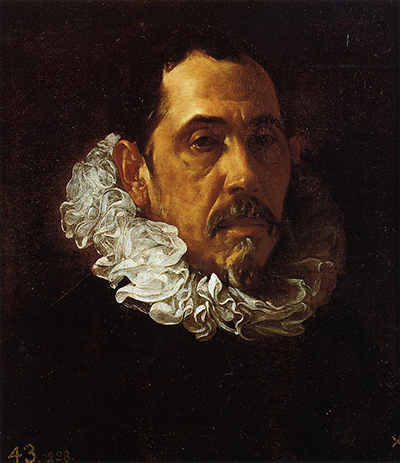
The white ruff rises behind the man's ear, where it breaks into a series of narrow, bright folds. Below the ear the folds widen, turning towards us before bunching together beneath his chin. The collar seems to continue round the far side of the neck, but there its outer edge is almost lost in the brown behind it. The face makes a similar passage into shadow. Velázquez gives us the illuminated forehead and the near cheek in full view, then lets the other cheek come forward only as far as the light will take it. The man appears to turn a little to our right, with his eyes directed back towards the space in front of the painting. [1] [2]
The Museo Nacional del Prado catalogues this portrait as Francisco Pacheco, inventory P001209. It is an oil on canvas of about 1620, published by the museum at 41 × 36 cm and attributed to Diego Velázquez. Pacheco was the artist's teacher and father-in-law. The name on the museum label rests on comparisons with other likenesses, one of which Pacheco described painting himself. The early history of the canvas tells us where it was kept and gives us a way to recognise it in inventories. The earliest identified owner was the Spanish king Philip V, more than a century after the likely sitting. [1] [2] [3]
At a Glance
- CollectionMuseo Nacional del Prado, P001209 [1] [3]
- PaintedAround 1620 [1] [2]
- MediumOil on canvas [1] [2]
Contents
- A face at close quarters
- How the sitter acquired his name
- Pacheco's workshop and books
- A named portrait and a royal inventory
A face at close quarters
There is little room above the head, and the shoulders reach the edges of the canvas. An enlargement can make the work look like a detail taken from a larger composition. On the scale of the actual canvas, a viewer can take in the whole outline and still come close enough to notice where the paint makes small distinctions, such as the difference between the bright ridge of the ear and the reddish shadow just inside it. The man occupies the space with his shoulders slightly angled and his chin held clear of the collar. His coat forms a dark area under the ruff. Its sloping outline is easier to follow on the left, beneath the light cloth, than on the right, where the jacket and the ground nearly meet in tone. [1] [2]
Follow the light down from the forehead and it moves in quite short stages. The brow casts a shadow over the eye socket. A brilliant point near the bridge of the nose is separated from the broader light on the cheek by a steep change in tone. Below, the moustache overhangs a warm edge of lip and the small pointed beard partly conceals the chin. A few grey strokes pick out the hairs where the beard crosses the light. The touches around the eye are finer still. A small glint and the curve of the lower lid make the nearer eye legible within the shadow. The far eye keeps enough definition to hold its place in the face, even though you have to let your eyes adjust to the darker half of the picture to follow its outline. [2]
The ruff lets us see the painter handling different surfaces within the same patch of light. The lit skin runs through golds and reddish browns before reaching the shadow. The cloth beside it has hard white edges, broad grey folds and dark recesses set close together. A loose succession of curves carries the far side away from the brightest part. Even the hairline changes character. The receding edge shows distinctly against the forehead, then the mass of dark hair at the crown meets the background so quietly that the shape of the head depends as much on the forehead as on the outer contour. Those changes in definition bring the head forward in the shallow space. [1] [2]
The Prado places this likeness within a Spanish tradition of bust-length portraits with subdued grounds, dark dress and few clues to the sitter's occupation. The ruff is a clue to the period as well as a prominent item of dress. The museum places the work before the prohibition of this kind of collar in February 1623 and associates the handling of the flesh with work of about 1620. The dating remains approximate. The range of sitters who could wear a black coat and a white ruff was broad. Here the intensity of light at the crests of the linen tells us more about the position of the head than the costume can tell us about the man's profession. [1] [2]
How the sitter acquired his name
Julián Gállego's entry in the Prado's 1990 exhibition catalogue traces the Pacheco identification to Juan Allende-Salazar in 1925. The supporting comparison was with a figure in Velázquez's Adoration of the Magi, dated 1619. The older, kneeling king in that canvas presents his profile towards the child. His brow, nose and pointed beard offer points of contact with the man in the ruff, whose partly turned face allows a view of the same features from a different angle. The king has himself been identified as Pacheco on the hypothesis that Velázquez used members of his family to model the biblical figures. The value of the comparison is in the possible recurrence of a face. The king's name as a model depends on another inference. Gállego also reproduced the male face in a double portrait in the Museo de Bellas Artes de Sevilla, captioned as a probable self-portrait by Pacheco. The suggested identity of that man limits its value as independent evidence. [2] [5]
A more securely identified comparison came from The Last Judgement, a large altarpiece by Pacheco that entered the Musée Goya in Castres in 1996. It had originally been made for the convent of Santa Isabel in Seville. Pacheco describes its arrangement in Arte de la pintura, down to the position of his own head among the figures on the side of the saved. He writes that he placed his face between a young man seen from behind and a woman. He also supplies a reason for the inclusion, following the practice of painters who had put their own likenesses into public works. The text can be used to locate Pacheco's face in the painting independently of any resemblance to the Prado sitter. [6] [7]
Javier Portús used the recovered self-portrait to revisit the identification in 1999. The Prado's account draws attention to the long shape of the face, the open forehead and the projecting nose. These are traits a viewer can compare even across the change from an altarpiece to an individual portrait. Pacheco's figure looks out from among the bodies in the judgement scene. Velázquez's sitter has the canvas to himself and his eyes emerge unevenly from shadow. The two painters had different problems to solve, even if they were studying the same face. The recovered likeness gives the identification a stronger basis than either of the comparisons illustrated in 1990. The attribution to Velázquez is firm. The sitter's name remains a judgement from the resemblance, since the early records of the portrait give no corresponding identification. [1] [2] [6] [7] [4]
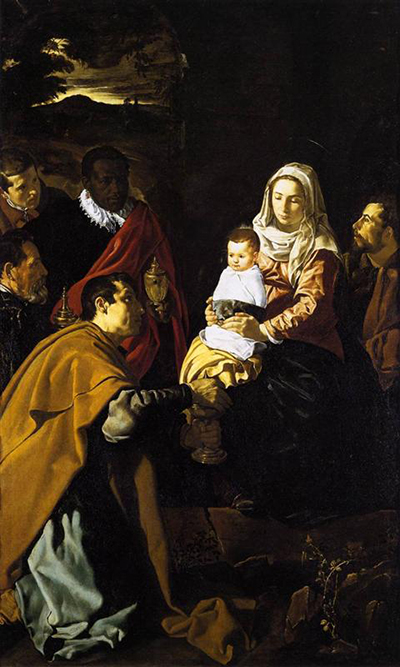
The Adoration of the Magi. The early religious painting offers a comparison for edges, smooth transitions of light and close observation of faces. View The Adoration of the Magi.
Pacheco's workshop and books
The surviving transcription of Velázquez's apprenticeship agreement records a six-year term beginning on 1 December 1610. Velázquez's father placed his son with Pacheco, who undertook to teach him the painter's trade and provide for him in his household, including when he was ill. In April 1618 the parish register for San Miguel records Velázquez's marriage to Juana de Miranda, Pacheco's daughter. One document provides terms for years spent in the painter's shop and home. The other records the point at which the former apprentice became his son-in-law. They explain why Pacheco would have been a readily available model for an early portrait. Other documents show that the men remained connected through work. In July 1623 Velázquez stood as guarantor when Pacheco agreed to paint and gild the altarpiece for Isabel de Montemayor's chapel in San Lorenzo in Seville. [8] [9] [10]
Pacheco was already in the habit of recording likenesses and asking what they could preserve of a life. His Libro de descripción de verdaderos retratos de ilustres y memorables varones, now in the Museo Lázaro Galdiano, pairs drawn heads of writers, artists and churchmen with accounts of their lives or accomplishments. The drawings and the written notices identify people together. In Arte de la pintura, published in Seville in 1649, Pacheco wrote from experience about making paintings and about the claims the art could make for itself. He defended Velázquez's kitchen scenes for the skill with which the painter imitated nature. He also described Velázquez studying a boy in different poses and expressions. Those recollections give the early work in Seville an eyewitness account of sustained practice. The same source records that Velázquez painted Luis de Góngora at Pacheco's request in 1622, giving that portrait a written origin that the smaller Prado work lacks. [7] [11] [12]
A named portrait and a royal inventory
Velázquez's signed and dated portrait of Mother Jerónima de la Fuente shows how differently he could present a sitter in the same period. In that full-length canvas of 1620 the crucifix, book, Franciscan habit and painted inscriptions all contribute to the likeness. Her hands make the objects legible by the ways she holds them. From across a room there is a clear route through the long diagonal of the cross to the side of her face. Close to the canvas, the smaller writing at the foot records the sitter's convent and her departure on the journey to Manila. The Prado bust offers a closer encounter straight away. The furthest thing the eye can follow into its space is a shoulder or the receding edge of the collar, and the two visible eyes keep the viewer near the centre of the face. [2] [13]
The bust has its own writing at the bottom, in numbers associated with its later collection history. The white 43 at the lower left stands out against the coat in the Prado's reproduction. The picture was recorded among Philip V's possessions at the palace of La Granja in the inventory of 1746. Portús records the suggestion that Philip V and Isabel de Farnesio could have bought the picture during their stay in Seville between 1729 and 1733, an opportunity for acquiring it that predates the inventory. The Prado's 1990 catalogue dates the museum's acquisition to 1819. How the painting reached the royal collection and who first saw it remain open questions. In a genre often used to preserve the features of a relative or acquaintance, one of the picture's most telling choices is the short interval between the viewer and the sitter. The face turns enough to show the different shapes of the cheeks, and the gaze seems to settle somewhere near us. [1] [2] [4]
Artworks directory
Frequently Asked Questions
There is little room above the head, and the shoulders reach the edges of the canvas. An enlargement can make the work look like a detail taken from a larger composition. On the scale of the actual canvas, a viewer can take in the whole outline and still come close enough to notice where the paint makes small distinctions, such as the difference between the bright ridge of the ear and the reddish shadow just inside it. [1] [2]
Discussion
Look again at the images and ideas explored in Portrait Traditionally Identified as Francisco Pacheco. These editorial prompts invite your observations.
Reader Insights
What does the shifting light around the ruff tell you about the turn of the head?
How much can comparisons with other portraits tell us about the sitter’s identity?
Join the Conversation
Share a detail, comparison or question about Portrait Traditionally Identified as Francisco Pacheco below.
References
- Museo Nacional del Prado, Francisco Pacheco, P001209, collection record, and Velázquez en el Museo del Prado, module 2, pp. 6–7, exact object and sitter discussion (Spanish). Collection record and museum teaching text. View source 1. View source 2.
- Julián Gállego, Velázquez, Museo del Prado, 1990, cat. 5, Francisco Pacheco (?), inv. 1209, pp. 80–83, including the full plate and comparisons (Spanish). View source.
- Museo Nacional del Prado, gallery list, p. 14, room 12, Francisco Pacheco, P1209, under Velázquez (Spanish). View source.
- Javier Portús, Velázquez y Sevilla, Junta de Andalucía, 1999, cat. 95, p. 204, extract in Velázquez en el Museo del Prado, module 2, p. 7 (Spanish). View source.
- Julián Gállego, Velázquez, Museo del Prado, 1990, cat. 8, La adoración de los Magos, inv. 1166, pp. 94–99 (Spanish). View source.
- Musée Goya, Le Jugement dernier, 96-17-1, Francisco Pacheco, 1611–1614, collection record (French). View source.
- Francisco Pacheco, Arte de la pintura, Seville, 1649, book II, chapter III on The Last Judgement, and the account of Velázquez in the selection transcribed by Santiago Arroyo Esteban (Spanish). Text of the treatise and Universidad Complutense de Madrid selection. View source 1. View source 2.
- Archivo Histórico Provincial de Sevilla, Velázquez's apprenticeship agreement, Pedro del Carpio, Oficio 4, 1611, transcribed by the Instituto Andaluz del Patrimonio Histórico (Spanish). View source.
- Parish archive of San Miguel, Seville, marriage of Diego de Silva Velázquez and Juana de Miranda, 23 April 1618, register 4, fol. 18, transcription hosted by the Instituto Andaluz del Patrimonio Histórico (Spanish). View source.
- Archivo Histórico Provincial de Sevilla, contract for the altarpiece of the chapel of the Conception in San Lorenzo, 7 July 1623, transcription hosted by the Instituto Andaluz del Patrimonio Histórico (Spanish). View source.
- Instituto Andaluz del Patrimonio Histórico, ‘Libro de descripción de verdaderos retratos de ilustres y memorables varones’, Velázquez y Sevilla, on the manuscript now in the Museo Lázaro Galdiano (Spanish). View source.
- Instituto Andaluz del Patrimonio Histórico, ‘Retrato de Luis de Góngora y Argote’, Velázquez y Sevilla, citing Pacheco's account (Spanish). View source.
- Julián Gállego, Velázquez, Museo del Prado, 1990, cat. 6, La venerable madre Jerónima de la Fuente, inv. 2873, pp. 84–88 (Spanish). View source.







