


 by Tom Gurney
Tom Gurney BSc (Hons) is an art history expert with over 20 years experience
Published on June 19, 2020 / Updated on October 14, 2023
Email: tomgurney1@gmail.com / Phone: +44 7429 011000
The Lady with a Fan: Introduction
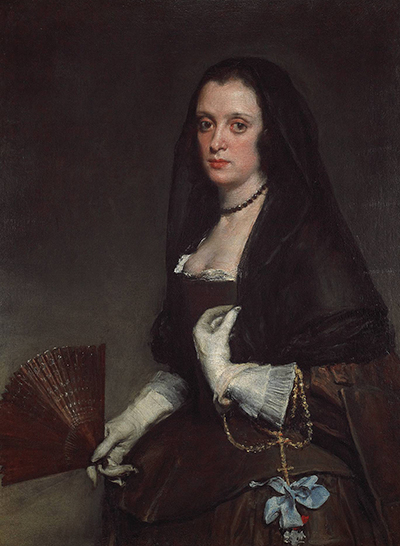
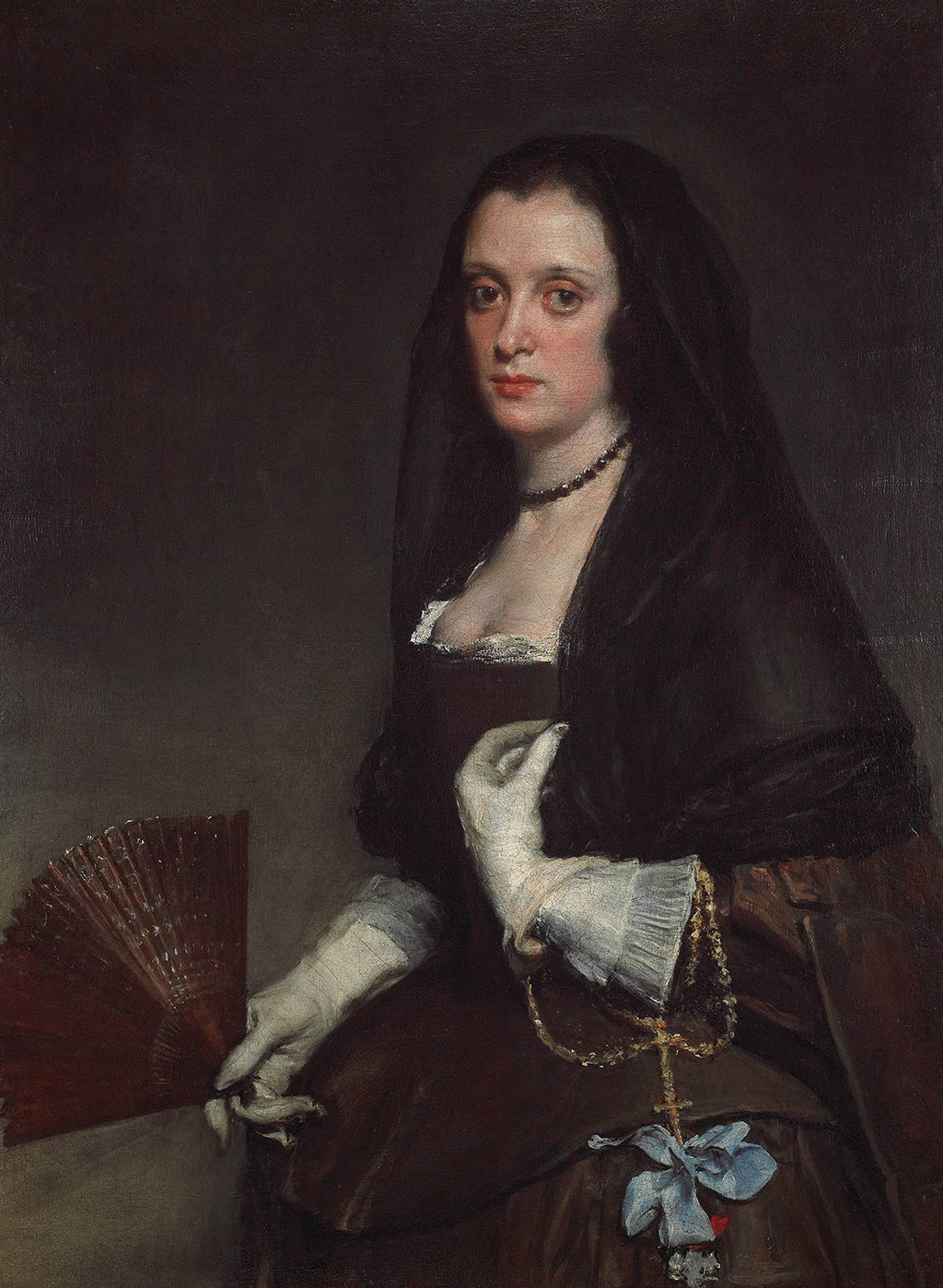
A woman turns her head towards us while her gloved hands remain low against her dress. One hand holds a reddish folding fan, its leaves only partly spread. From the other wrist hangs a rosary, picked out against the fabric by small touches of gold and a bright blue ribbon. The Wallace Collection in London catalogues Diego Velázquez's portrait as The Lady with a Fan, an oil on canvas of about 1640, with a painted image measuring 95 × 70 cm (P88). Zahira Véliz Bomford's study of the picture and its counterpart at Chatsworth dates the pair to about 1638–40 and lists the Wallace canvas at 92.8 × 68.5 cm. The identity of the woman remains open. [1] [2] [3]
At a Glance
Contents
- The face, the veil and the fan
- What the clothes can tell us
- The case for the Duchess of Chevreuse
- The related portrait at Chatsworth
- The painting's recorded owners
The face, the veil and the fan
The woman's body angles towards the left of the canvas, while the turn of her head brings her nearer to facing us. The eyes look out from under finely marked brows. Their slight sideways direction makes the encounter feel less fixed than the pose. A little red at the mouth warms the face, and softer changes of colour make the cheek round away into shadow. Dark hair lies close to the temples, then merges with the veil. The forehead and cheek have a clear shape within this mass of dark paint, and the veil traces an arc around them without enclosing the face completely. [1] [3]
The dark ground makes the contour of the figure vary in clarity. There is just enough difference between veil and background to follow its fall to the right of the head. Where it crosses the shoulder, the dark fabric becomes legible partly through what is visible beneath it. The narrow lines of the necklace and the edge of the low bodice mark a further change of surface. The bare upper chest forms a broad patch of light, which carries the eye down from the face before the smaller lights of the gloves pick it up again. The space around the figure contains no furnishing or architectural detail to give the body a setting. Velázquez uses that space to make the turn of the head and the angle of the shoulder easy to read. [1] [3]
The fan, low on the viewer's left, is turned at an angle. The reddish leaves widen from the gloved grip, and the brown paint makes their spread easy to miss at first against the dark surround. Across from it, individual glints on the rosary break up the quieter area of the dress. The blue ribbon brings another note of colour into that part of the picture. The hands are grouped at much the same level, but they carry different shapes. The fan pushes obliquely into the space at the side of the figure, while the rosary hangs down against her body. Their different directions make the fabric between them seem deeper and give the lower half of the portrait a movement of its own. [1] [3]
What the clothes can tell us
The Wallace Collection describes the clothes as drawing on both French and Spanish fashions. Véliz's close study compares the low neckline, the lace at the wrists and the fan with images of fashionable French women, including prints by Abraham Bosse. She discusses the long, light black veil in relation to the Spanish manto, while noting that veils of this kind were also worn in France. The rosary brings an object of private devotion into the same view as the gloves and fan. It hangs among the ribbons and catches the light like an ornament. On this canvas those things can be studied together, as part of the way the woman presents herself. Their presence leaves her nationality and marital status open. [4] [5]
The neckline in particular has been asked to carry a great deal of the argument. A detail can be unusual in surviving Spanish portraits even if it was familiar in clothes worn in Madrid. Kevin Ingram points to the combination of low bodices of French origin and the Spanish guardainfante, a hooped support for a wide skirt, before the Duchess of Chevreuse arrived in Spain. In that reading, the low neckline shows how a fashion could travel and be adapted. The cropped figure leaves much of the skirt outside the picture. What the eye can follow particularly well is the line across the bodice and the amount of skin it puts in the light. [5] [6]
The case for the Duchess of Chevreuse
Marie de Rohan, Duchess of Chevreuse, took refuge in Spain in 1637 after her conflict with Cardinal Richelieu. A letter of 16 January 1638, cited and translated by Véliz, reports that Velázquez was painting the duchess and describes a French manner and dress. The report places an identifiable sitter in the artist's working life at the Spanish court at a date compatible with estimates for The Lady with a Fan. It gives no fan, rosary or other detail that would distinguish the Wallace painting from another portrait. [1] [2] [5]
Véliz made the case for Chevreuse by putting the letter alongside the costume and comparing the sitter's face with other likenesses associated with the duchess. Among them is a portrait as Diana attributed to Claude Deruet and dated 1627, in which Véliz sees similarities around the eyes, nose and mouth. The earlier image shows the duchess in a mythological role, and a later named engraving by Pierre Daret comes from 1653. Both bring other conventions and stages of her life into the comparison. Ingram sees only a slight resemblance and draws attention to descriptions of the duchess's fair hair. The Wallace Collection gives the Chevreuse proposal more weight than earlier suggestions, while continuing to call the painting The Lady with a Fan. [4] [5] [6]
Francisca, Velázquez's daughter, is another proposed sitter. Ingram traces the suggestion to Aureliano de Beruete in 1898 and discusses the comparison with the figure in The Needlewoman in Washington. The National Gallery of Art's catalogue records that the woman sewing has herself been identified as Francisca partly on the basis of a resemblance to the lady with the fan. Both pictures bring the lit face forward against dark surroundings. The woman in Washington inclines her head and looks down towards the work in her hands, while the woman in London lifts her eyes away from the fan and rosary. The difference in pose changes how we meet the face. The two identifications lack an independently named likeness on which to rest. [1] [6] [7]
The broader proposal that the sitter came from Velázquez's household, sometimes specifying his wife, has depended on the intimate scale and manner of the painting and the absence of a recognised court likeness. Other scholars, including the Wallace cataloguer John Ingamells, considered a courtesan, drawing inferences from pose and dress. Ingram raises a separate possibility. He connects the work to the tradition of the bella donna, in which a model could appear as an elegantly dressed beauty without the picture being intended to identify her. The identity of the model and the role in which she appears are two different questions. The fan, rosary and veil give the figure a recognisable bearing while leaving both questions open. [3] [4] [5] [6]
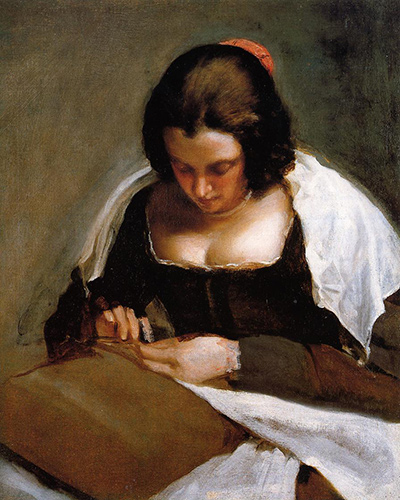
The Needlewoman. Compare the detail given to hands, face and clothing in another portrait whose sitter remains unidentified. View The Needlewoman.
The related portrait at Chatsworth
The Devonshire Collection at Chatsworth has a portrait known as Lady in a Mantilla. The comparable turn of the head is apparent in reproductions, but the balance of light over the body changes. At Chatsworth a broad square lace collar covers the chest and makes a bright pattern beneath the face. Bands on the sleeves bring the fabric into view; at the Wallace the small interruptions of the fan and rosary have to do much of that work. The hands also change positions. The two pictures offer distinct ways to draw attention from the face down towards the arms while keeping the figure turned at much the same angle. [2] [3]
In 2006 the Wallace Collection, Chatsworth and the National Gallery brought the two portraits together for technical examination. Comparing radiographs and infrared images, and overlaying a tracing of the Wallace figure on the Chatsworth image, showed a precise correspondence in the contours of the head, features and torso. Véliz Bomford proposes that a shared drawing may have been used to transfer the design. The studied overlap tells us how closely the two painted figures were constructed, even where the costumes and the gesture make them look different at first sight. The study leaves the name of the model and the circumstances in which the two pictures were made open. [2]
The painting's recorded owners
The Wallace Collection's provenance begins with Lucien Bonaparte, who may have acquired the painting in 1801. Its appearance as lot 141 in his London sale of 16 May 1816 is a dated record. By 1839 it was with Alexandre Aguado, Marqués de las Marismas, and it appeared as lot 140 in his Paris sale on 27 March 1843. The Wallace record then lists Moran acting for Baron James de Rothschild, followed by Laneuville in 1847. Richard Seymour-Conway, 4th Marquess of Hertford, acquired it on 7 December 1847 for 15,000 francs. The collection passed to Sir Richard Wallace and was bequeathed to the British nation by his widow, Lady Wallace, in 1897. [1] [5] [8]
The records for the Chatsworth picture have a different starting point. A seventeenth-century inventory from the Marquess of Carpio's collection describes a woman in a black veil with a collar and a yellow dress striped with black. Véliz connects that description with the Chatsworth canvas. The collar and striped dress are visible there. In the Wallace portrait the open neckline and quieter cloth give the face and hands a different setting. It is the gestures and outlines that tie the two pictures closely together, while the inventory description helps to explain why their histories have to be traced separately. [1] [2] [5]
Artworks directory
Frequently Asked Questions
The Wallace Collection, London, P88 [1]
Around 1640 [1]
Oil on canvas [1]
Discussion
Look again at the images and ideas explored in The Lady with a Fan. These editorial prompts invite your observations.
Reader Insights
How do the fan and rosary affect the way you read the woman’s pose?
What can comparison with the Chatsworth portrait tell us about the making of this work?
Join the Conversation
Share a detail, comparison or question about The Lady with a Fan below.
References
- The Wallace Collection, “The Lady with a Fan”, Diego Velázquez, P88, object 64963, collection record, including “Description” and “Provenance”. English. View source.
- Zahira Véliz Bomford, “Velázquez composes: prototypes, replicas, and transformations”, Colnaghi Studies Journal 3 (2018), pp. 92–111, especially pp. 106–109, figs. 12–14, and notes 31–32. English. View source.
- The Wallace Collection, Portraiture: Fame and Celebrity, teaching resource, pp. 2–8, including the details of the Wallace canvas and the Chatsworth comparison. English. View source.
- The Wallace Collection, “The Lady with a Fan”, collection highlight, including dating and current interpretation of the sitter. English. View source.
- Zahira Véliz, “Signs of Identity in ‘Lady with a Fan’ by Diego Velázquez: Costume and Likeness Reconsidered”, The Art Bulletin 86, no. 1 (2004), pp. 75–95, especially pp. 75, 78–87 and note 27. English. View source.
- Kevin Ingram, “Velázquez, Titian and a ‘lady’ with a fan”, The Burlington Magazine 163 (March 2021), no. 1416, p. 257. English. View source.
- National Gallery of Art, Spanish Paintings of the Fifteenth through Nineteenth Centuries, systematic catalogue, “The Needlewoman”, 1937.1.81, pp. 117–119, discussion of Mayer's identification. English. View source.
- The Wallace Collection, “History of the Collection”, especially the sections on the 4th Marquess of Hertford, Sir Richard Wallace and Lady Wallace. English. View source.







