


 by Tom Gurney
Tom Gurney BSc (Hons) is an art history expert with over 20 years experience
Published on June 19, 2020 / Updated on October 14, 2023
Email: tomgurney1@gmail.com / Phone: +44 7429 011000
Philip IV in Armour, with a Lion at His Feet: Introduction
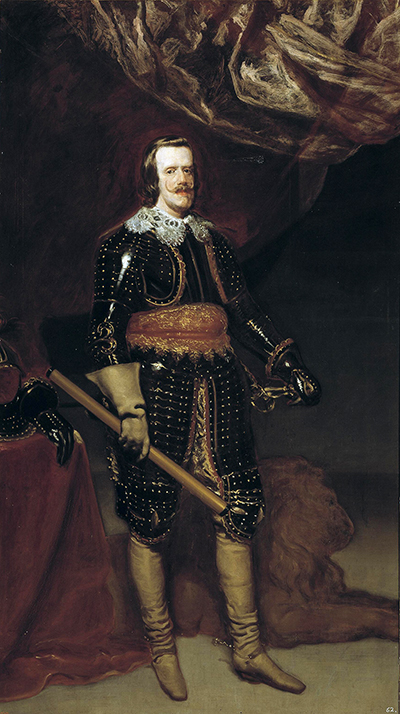
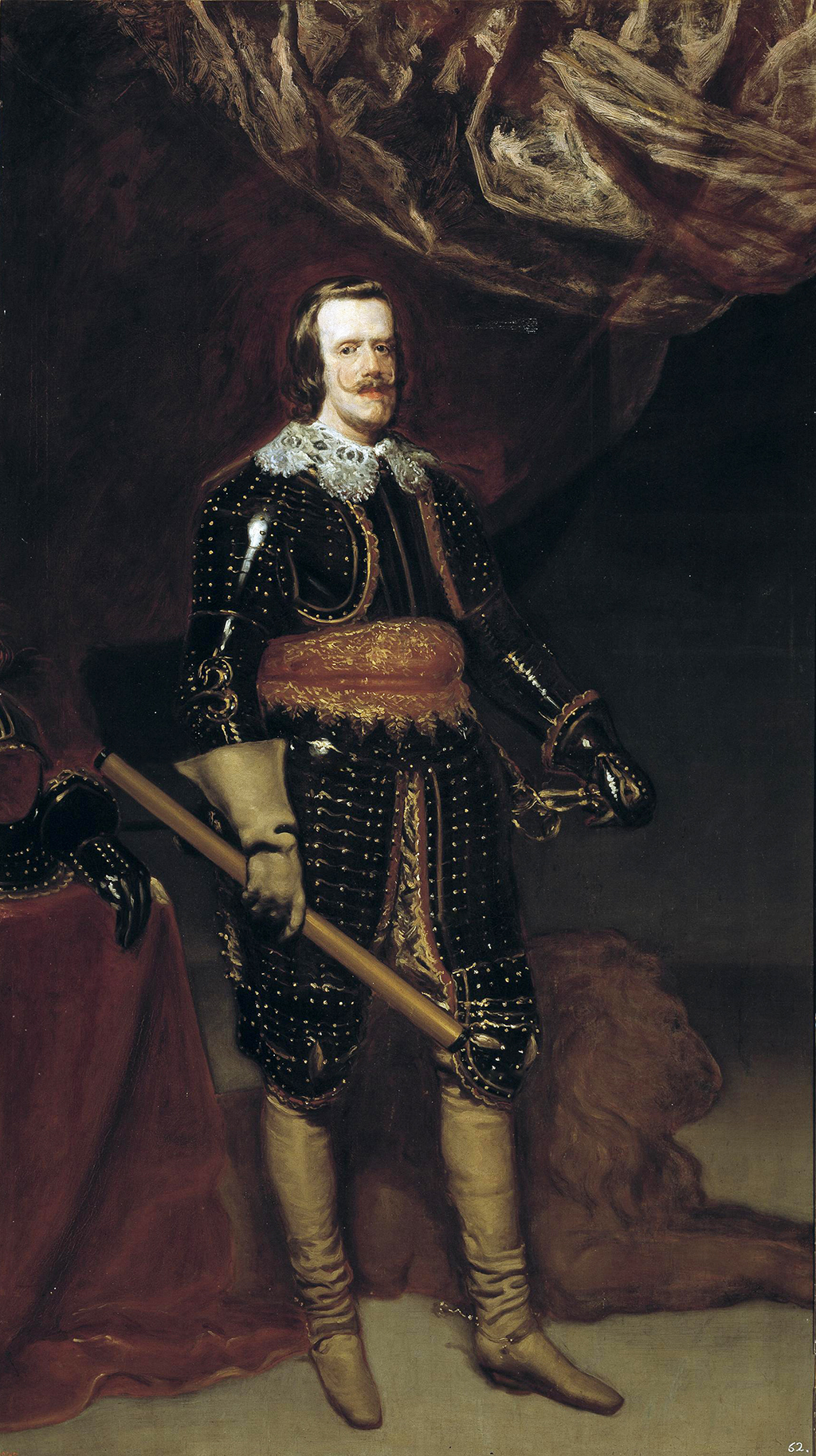
The brightest mark on Philip IV’s armour is a white stroke on the shoulder at the viewer’s left. Below it, rivets catch the light in rows which follow the bend of his arm and pick out the overlapping plates above his knees. The lion is easier to find by looking for the king’s boots. Its mane begins behind the leg at the right, and its muzzle projects into an opening in the dark background. From the face high in the painting to the animal lying low on the floor, the tall canvas gives each its own stretch of shadow. [1]
Philip IV in Armour, with a Lion at His Feet is an oil on canvas in the Museo Nacional del Prado, Madrid, inventory P001219. It measures about 234 × 132 cm. The Prado identifies it as the work of Diego Velázquez and his workshop. The Prado’s essay on Carreño’s portrait of Charles II dates Philip’s portrait to about 1652. Technical examination revealed a younger likeness in a different setting beneath the visible painting. Prado curator Javier Portús dates the changes made for display at El Escorial to around 1665. [1] [2] [3] [4]
At a Glance
- CollectionMuseo Nacional del Prado, P001219 [1] [2]
- AttributionDiego Velázquez and workshop [2]
- Painting and revisionAround 1652, revised around 1665 [2] [4]
The portrait and its El Escorial setting
The Frick portrait shows the king in a campaign setting with a different costume and pose.
The Prado attributes the work to Diego Velázquez and his workshop.
Portús links the updated likeness and changed setting to the royal display.
Contents
- Black armour and the red sash
- What the lion does
- The younger king beneath the painting
- Beside Mariana at El Escorial
- Philip’s armour and baton in other portraits
Black armour and the red sash
Philip’s torso turns slightly towards the right. The near shoulder is rounded and more brightly lit, and a narrow golden line turns back around the edge of the breastplate. The rivets break the mass of black into parts the eye can follow. They curve along the shoulder, gather on the arm and descend in parallel courses on the armour over the thighs. In the space between the streak of white on the shoulder and the strongest glints on the knees, the face and the hands are far apart. The little points of light carry the eye from one to the other. What seems a hard continuous surface at a distance is made up of discrete turns, edges and joints. [1]
The wide sash gives the darker armour two different shapes, above and below the waist. Its lit threads spread into a band of red and gold, with an uneven edge where it passes over the plates. A narrower tail hangs between the thighs. Compare the difference between the sash and the red fabric on the table to the left. The folds on the tablecloth take most of the height from the helmet and spare gauntlet to the floor, where the fabric gathers in a broad fold. The cloth around the waist is crowded into a hand’s breadth. The canopy overhead has room for wide passages of light on each turn of its folds. Fabric marks three different scales within the same portrait, from what the king wears to what furnishes the room around him. [1] [3]
The pale glove on Philip’s right hand bends and creases around the baton, which runs across the lower body on a long diagonal. His left hand, enclosed in a metal gauntlet, rests on the sword hilt. One arm hangs close to his body and the other opens a gap beside the waist. The position of the baton gives the relatively still stance some direction, leading from the table towards the knee on the right. The spurred riding boots and the equipment on the table extend the military language of the portrait all the way to the floor. Portús links the spurs specifically to the period’s association of military command with horsemanship. The white lace collar brings a different scale of detail to the head. Its small openings and irregular fringe interrupt the sharp lines of the armour where it meets the skin. [1] [3]
What the lion does
The lion lies behind the line of the boots with its head raised in profile. Its forequarters sit in the shadow near the king’s left leg and its paws reach towards the right edge. Along the top of the mane the boundary is soft, and around the muzzle a lighter patch of ground makes the outline briefly clear. The animal occupies a wide piece of the floor while the bulk of the king’s body stands in a narrow upright band. As the viewer follows the diagonal of the baton downwards, the lion carries the eye sideways beneath the open area beside the figure. Its colouring is close to the floor and to the tan boots, which helps explain why a viewer may take in the stance before recognising the animal. [1]
Portús reads the lion as a traditional accompaniment to power and an evocation of strength. A comparison within the same group of portraits makes the emblem easier to understand. The Royal Collection’s Philip IV, King of Spain, RCIN 402914, is a separate full-length painting attributed there to Juan Bautista Martínez del Mazo and dated about 1635–38. In that picture a lion is visible in the shadow of the table. The Royal Collection suggests it may stand for Spain’s military strength. In the Prado canvas, the animal, spurs and baton bring the same broad idea of royal command into the foreground, while the lion’s position and restrained colouring allow the figure to hold the centre. [1] [3] [5]
The younger king beneath the painting
The Prado’s 2013 exhibition catalogue describes changes to the king’s head, the curtain and the viewer’s right side of the picture. The earlier head turned farther towards Philip’s left, with shorter hair and younger features. An opening on the right looked past a balustrade into a landscape. The revised painting closes off that view with a darker interior and gives the curtain more space overhead. Portús relates the earlier head and the type of armour to portraits of the late 1630s. The first design can be glimpsed by comparing the Royal Collection picture, in which the figure still stands beside an opening. The two surviving canvases are useful evidence for the design without requiring identical histories of execution. [3] [4] [5]
For the subsequently painted face, Portús points to Velázquez’s mature bust of Philip in the Prado, P001185, which he dates to about 1654. A painter could use the available likeness to bring an older composition up to date. The long fall of the hair beside the cheek and the heavier modelling around the lower face now belong to the same figure as the older design for the armour. Portús connects the reworking to the transfer of the full-length painting into the south room at El Escorial around 1665, after Velázquez’s death in 1660. The visible likeness, the underlying design and the setting therefore have distinct dates. [2] [3] [4]
The 1990 Prado catalogue records how differently historians have read the surface. Francisco Javier Sánchez Cantón singled out the handling of the flesh and armour and understood the painting as an unfinished original. August L. Mayer proposed that Velázquez supplied the design and Mazo painted it. Julián Gállego described the table, armour pieces upon it and lion as sketchily handled. Cherry points to the handling of the drapery in both canvases as a reason to consider Mazo for the changes to the curtains. His proposal rests on style. The technical evidence establishes which parts of Philip’s portrait were revised, while the distribution of work between painters remains uncertain. [1] [2] [3] [4] [6]
Beside Mariana at El Escorial
Francisco de los Santos’s 1667 description of El Escorial documents the monarch in the Quadra de Mediodía, the south reception room of the palace, with his second wife, Mariana of Austria. Bonaventura Bassegoda’s reconstruction of the room identifies the pair as Prado P001219 and P001191 and puts them together at the west end. On the opposite side he places portraits of their children Carlos and Margarita. The pair of parents remained together in the documented 1681 arrangement, when Juan Carreño de Miranda’s Charles II in Armour formed part of the new display. In the Carreño portrait, the lion takes a different form as a bronze support for the table, and the gallery opens to a view of warships. The Prado identifies Philip’s portrait as its closest precedent in scale and style. [2] [7] [6]
The large curtain above Mariana was extended to help align her portrait with Philip’s. The enlarged paintings have closely matching proportions, with their heads set well below the upper edge. That distance matters when they are seen together. Both figures stand within a shallow interior and have large folds suspended at a common height. Below them the shapes diverge. The queen’s skirt carries silver bands outwards towards the chair and table. Philip’s flashes of reflected light stay close to the body, and when the baton and lion extend the shape sideways they do so low down. The changes to the settings gave these different silhouettes a shared frame for a particular room. The Prado’s 1990 catalogue traces Philip’s canvas through the El Escorial inventories of 1700, 1746, 1771 and 1794 and records its arrival at the museum in 1845. [1] [4] [7] [6]
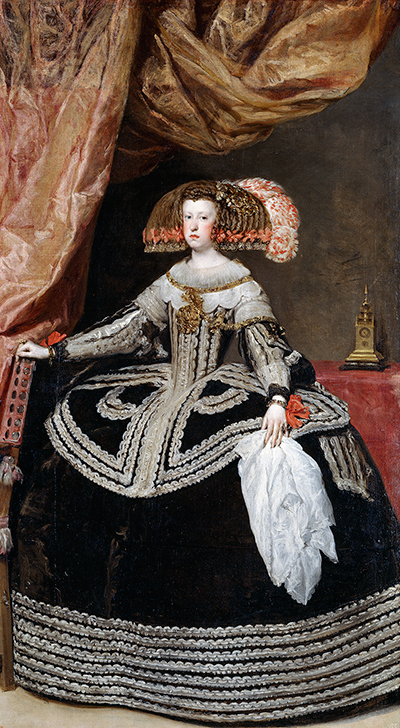
Queen Mariana of Austria. The full-length queen was documented as a companion at El Escorial. View Queen Mariana of Austria.
Philip’s armour and baton in other portraits
The separate Prado Philip IV in Armour, P001183, presents the younger king in a canvas just 57 × 44 cm. A red sash crosses the breastplate diagonally and leaves a gilded shoulder exposed, where several overlapping plates fill much of the space below the face. The catalogue treats the surviving bust as a fragment of a larger canvas. In its current form the sash runs out of the image at the lower edge. In the later, full-length portrait the sash wraps around the waist and stops within the figure’s outline, while the baton supplies the strongest diagonal and reaches across the thigh armour. Both paintings give a large area of darkness to the metal, but the small canvas brings its ornament close to the face and the tall composition draws the eye down the body. [1] [8]
Velázquez brought a command baton into a different setting in his King Philip IV of Spain, the original painted at Fraga in 1644 and now in The Frick Collection, New York. Philip wears a crimson campaign coat with silver ornament and holds a hat in his left hand. The Frick documents the circumstances of the sitting during the campaign to recover Lérida and the portrait’s display at a thanksgiving service in Madrid. At Fraga the pale baton stands out against a dark ground where it projects from the red coat. In the El Escorial painting one end of the baton also enters the dark, while the other comes to rest visually among the repeated lines of the armoured thighs. The Frick composition concentrates on the man and his campaign dress. At El Escorial, the boots, the floor, the lion and the depth of the canopy establish what it would be like to stand in the king’s presence. [1] [9]
In Philip IV on Horseback, Prado P001178, the baton rides just above the horse’s neck. The horse rises onto its hind legs and carries the king above an extensive view of land and sky. The painting belonged to the series of mounted royal portraits in the Salón de Reinos at the Buen Retiro. The lion portrait makes the link between command and riding with a much smaller detail, the spurs on Philip’s boots. It gives the full height of the canvas to a king whose feet are on the floor. In the south room at El Escorial that standing figure could meet the full-length portrait of the queen at the same scale. [1] [3] [7] [10]
Artworks directory
Frequently Asked Questions
Diego Velázquez and workshop [2]
Philip’s torso turns slightly towards the right. The near shoulder is rounded and more brightly lit, and a narrow golden line turns back around the edge of the breastplate. The rivets break the mass of black into parts the eye can follow. [1]
The lion lies behind the line of the boots with its head raised in profile. Its forequarters sit in the shadow near the king’s left leg and its paws reach towards the right edge. Along the top of the mane the boundary is soft, and around the muzzle a lighter patch of ground makes the outline briefly clear. [1]
Discussion
Look again at the images and ideas explored in Philip IV in Armour, with a Lion at His Feet. These editorial prompts invite your observations.
Reader Insights
What brings the lion into view against the shadows around the king’s boots?
How do the curtains in this painting and in Mariana’s portrait affect the space above each figure?
Join the Conversation
Share a detail, comparison or question about Philip IV in Armour, with a Lion at His Feet below.
References
- Julián Gállego, “Felipe IV, armado, con un león a los pies”, in Velázquez, Museo del Prado and Ministerio de Cultura, 1990, cat. 72, pp. 418–419, text and colour plate, Prado P001219. Spanish. Exhibition catalogue. View source.
- Museo Nacional del Prado, Philip IV in Armour, with a Lion at His Feet, P001219. See the museum’s attribution and comparison in its related record for Juan Carreño de Miranda, Charles II in Armour, P007101. Philip IV record · Charles II record. View source 1. View source 2.
- Javier Portús Pérez, in Velázquez y la familia de Felipe IV, 1650–1680, Museo Nacional del Prado, 2013, pp. 110 and 113, as excerpted by Antonio López Romero, “Nuevos lienzos de Miguel Pineda inspirados en Velázquez y Murillo”, Farua 20, 2017, pp. 102–103, fig. 6 and nn. 21–23, with the dimensions of P001219. Spanish. Article and catalogue excerpts. View source.
- Javier Portús Pérez, “Velázquez y el último retrato de Felipe IV (a propósito del cuadro del Museo de Bellas Artes de Bilbao)”, Museo de Bellas Artes de Bilbao, 2015, PDF pp. 8–9, fig. 6 and n. 15. Spanish. Research article. View source.
- Royal Collection Trust, attributed to Juan Bautista Martínez del Mazo, Philip IV, King of Spain (1605–65), RCIN 402914, about 1635–38. Illustrated collection entry. View source.
- Peter Cherry, “Velázquez and the Making of Queen Mariana de Austria”, Librosdelacorte.es 28, 2024, pp. 430–466, especially p. 431 and nn. 2–4 on the enlarged Prado version, P001191, and its pendant P001219. Research article. View source.
- Bonaventura Bassegoda, “La decoración pictórica de El Escorial en el reinado de Carlos II”, in José Luis Colomer, ed., Arte y diplomacia de la monarquía hispánica en el siglo XVII, Madrid, 2003, pp. 35–59, especially pp. 37–39 and plans 1–2, entries PQ-67-1, PQ-67-2, PQ-81-1 and PQ-81-2. Spanish. Study and plans. View source.
- Julián Gállego, “Felipe IV”, in Velázquez, Museo del Prado and Ministerio de Cultura, 1990, cat. 15, pp. 122–123, text and colour plate, Prado P001183. Spanish. Exhibition catalogue. View source.
- The Frick Collection, King Philip IV of Spain, 1644, 1911.1.123, and The King at War: Velázquez’s Portrait of Philip IV, 2010, pp. 4–6. Illustrated Frick collection entry · Research dossier. View source 1. View source 2.
- Museo Nacional del Prado, “Reencuentros. Parada V. Una Corte a nuestro encuentro”, section on Philip IV on Horseback, P001178, and the Salón de Reinos. Spanish. Museum essay. View source.







