


 by Tom Gurney
Tom Gurney BSc (Hons) is an art history expert with over 20 years experience
Published on June 19, 2020 / Updated on October 14, 2023
Email: tomgurney1@gmail.com / Phone: +44 7429 011000
A Sibyl, Traditionally Associated with Juana Pacheco: Introduction
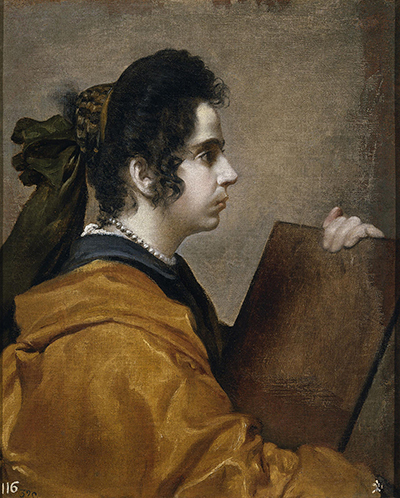
A woman's fingers curl over the top of a brown board. They catch the same light as her cheek, yet her eye is raised above the board and directed towards the right edge of the canvas. Diego Velázquez gives us a close view of her face without bringing us into her line of sight. The Museo Nacional del Prado calls the painting Sibila (A Sibyl) and dates it to about 1632. An oil on canvas measuring 62 × 50 cm, it is held in Madrid under inventory number P001197. The woman has long been associated with Juana Pacheco, the painter's wife, whose name appears as Juana de Miranda in the record of their marriage. The identification is a proposal. [1] [2] [3]
At a Glance
Contents
- A face in profile
- What might the board mean?
- How Juana's name became attached to the painting
- Around the first Italian journey
A face in profile
The face takes shape against a close, grey-brown ground. The bridge and tip of the nose are easy to follow against it, as is the short succession of turns from the upper lip to the chin. Further back, the face comes together through smaller changes of colour. Cool light falls beneath the eye, then warms towards the lower cheek. A curl descending in front of the ear breaks the boundary between hair and skin. Several dark marks around the eye gather into a narrow focus, an effect that depends on the uninterrupted space to the right. The eye has room to look into even though the frame soon brings that space to an end. [2]
The edge of the hair has a different rhythm. The front rises high and breaks into small curls against the ground. Behind it there is a band of patterned fabric, then a green bow with folds that spread out towards the other side of the canvas. One dark length of ribbon drops towards the shoulder. The pearls trace the turn of the neck, visible almost to the nape, and are set off by a dark collar. From there the yellow mantle occupies much of the lower half of the painting. A diagonal fold runs over the shoulder and then the sleeve gathers nearer the wrist. The shifting yellows make volume over the upper arm, where a broad, quiet area of cloth gives way to narrow highlights among the deeper folds. These changes tell us how the fabric lies across the body even where the canvas cuts it off. [2]
The board makes the figure's stillness more complicated. Its top edge slopes down towards the right, and its left edge falls sharply across the space in front of the woman. Together the lines establish how it is tilted. Velázquez picks out the rounded joints of the fingers in pale paint and lets the fingertips lie just over the brown surface. The lower sleeve runs across the foreground and takes the other hand out of sight. Our view supplies enough information to understand how the board is steadied, while what she is about to do with it remains open. Her mouth is closed. Her gaze passes above the part of the surface we can see. [2]
What might the board mean?
A sibyl was a prophetess of the ancient world. In Christian art, sibyls could appear beside biblical prophets because their words were read as anticipating Christ. In Michelangelo's Sistine Chapel ceiling, the sibyls and prophets sit on monumental thrones. A closer-scale comparison in paint is Domenichino's Cumaean Sibyl, made in Rome in 1622 and now in the Capitoline Museums. She is associated with a scroll that carries a Greek inscription. In Domenichino's painting there are words to connect the figure with prophecy. In the Prado painting the brown surface shows no legible inscription, so our interpretation depends on the kind of object it might be and on the way the woman holds it. [2] [4] [5]
The Prado's 1990 catalogue records three readings of that object, a canvas, a tablet and, in an anonymous La Granja inventory dated 1786, a palette. The catalogue also raises the possibility that the figure represents History, Painting or the arts of design. These proposals turn on a small area of paint. A tablet suits the way a painter might show a prophetess with the means to record her words. A canvas or a palette would bring the same figure closer to the activity of painting. The oblique view permits us to see a corner and a flat surface, while leaving the object's full shape and use uncertain. The little we see of the action is compatible with A Sibyl, a title that leaves the particular prophetess unspecified. [1] [2]
There is a second canvas by Velázquez in which a woman faces right in strict profile with a rectangular object. The Meadows Museum in Dallas catalogues it as Female Figure (Sibyl with Tabula Rasa), dated 1649–51 (MM.74.01). Its double title makes room for both an observable figure and a possible role. Across the two pictures one can see how readily a board acquires significance when it is set close to a woman's face. The Dallas figure brings a second hand up near the object. The 1990 catalogue interprets her raised hand as holding a pen and entertains the possibility that she is Clio, the muse of History. In the Prado painting the fingers we can see are occupied with holding the board. The recurrence of the pose leaves open whether the two women were painted from the same model or given the same role. [2] [6]
How Juana's name became attached to the painting
Juana de Miranda was the daughter of the painter Francisco Pacheco. The register of San Miguel in Seville records her marriage to Velázquez on 23 April 1618. Pacheco later wrote in Arte de la pintura that he had taught Velázquez for five years before marrying him to his daughter. He valued the distinction of having been the painter's teacher so highly that he defended his claim to it in print. Those sources place Juana within the household that shaped Velázquez's early career. They give no account of a sitting for this work. [2] [3] [7]
The earliest occurrence of the painting traced in the Prado's 1990 catalogue is in a 1746 inventory at La Granja de San Ildefonso, in the collection of Queen Isabel de Farnesio. A 1774 inventory presented the identification with the painter's wife as something people said about the painting. By 1872, the Prado cataloguer Pedro de Madrazo was willing to describe it as Juana's portrait and put her age at about twenty-five. The 1990 catalogue traces the return of a question mark to the Prado catalogues from 1933. Madrazo's account shows how far the proposal had travelled from the guarded language of the royal inventory. The picture had reached the Royal Palace in Madrid before 1814 and appears in Prado catalogues from the 1840s. Its eighteenth-century ownership gives the story of the painting a firm beginning, well over a century after the museum's proposed date for its making. The original commission, if there was one, remains undocumented in the catalogue's account. [1] [2]
Proposed comparisons help to explain why the name stuck. Madrazo saw a resemblance to a figure he took to be Juana in Juan Bautista Martínez del Mazo's Family of the Artist, a group scene now in Vienna. Mazo married Juana and Velázquez's daughter Francisca, and the Kunsthistorisches Museum dates the work to about 1664–65, after Juana's death in 1660. For the comparison to identify the woman in the Prado, it would first require a securely named figure in the Vienna painting. A different argument came from a painted lady in Berlin, where the name Juana de Miranda was formerly visible on the reverse. That name belongs to a different canvas. The Berlin museum now calls its picture Portrait of a Lady (probably the Countess of Monterrey), with the identity still qualified. A third work, the small Head of a Girl in the Museo Lázaro Galdiano, was also exhibited as Juana in the early twentieth century. Its museum's catalogue discusses continuing questions about its authorship as well as its subject. Each comparison carries an identification of its own that would have to be established before it could help name the Prado's woman. [2] [8] [9] [10]
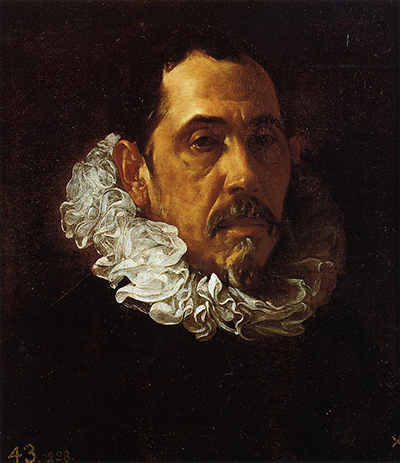
Portrait traditionally identified as Francisco Pacheco. The separate Prado portrait traditionally identified as Francisco Pacheco illustrates how identification through a related likeness can remain provisional. View Portrait Traditionally Identified as Francisco Pacheco.
Around the first Italian journey
The date matters to the family reading. The Prado's present dating of about 1632 would bring the work after Velázquez's first Italian journey. The 1990 catalogue reviews a proposal by José Camón Aznar for around 1630, during the trip, based on similarities in handling and colour with paintings of the Roman period. Such a date would make a sitting from life by Juana less plausible, since she remained in Madrid. An early-1630s date has room for the visual relationship with Italian painting that the catalogue sees in the warm yellow drapery, the broad folds and the formal profile. The stylistic comparison leaves the location and circumstances of the sitting unresolved. [1] [2] [11]
Seen from close by, the bright forehead and the fingers at the edge of the board are separated by a field of unoccupied ground. That interval is enough to give the look a direction and to keep its object out of reach. With the sibyl interpretation in mind, the pause can suggest attention to something beyond the canvas. With the portrait tradition in mind, those same patches of light describe a particular face and an unforced way of holding a flat object. Velázquez makes both readings possible through the placement of the head and hand. The colour carries between them before any name or story supplies a further connection. [2]
Artworks directory
Frequently Asked Questions
Museo Nacional del Prado, P001197 [1]
Around 1632 [1]
Oil on canvas [2]
The face takes shape against a close, grey-brown ground. The bridge and tip of the nose are easy to follow against it, as is the short succession of turns from the upper lip to the chin. Further back, the face comes together through smaller changes of colour. [2]
Discussion
Look again at the images and ideas explored in A Sibyl, Traditionally Associated with Juana Pacheco. These editorial prompts invite your observations.
Reader Insights
How do the woman’s hand and raised gaze change the way you read the board?
What can the painting itself tell you about the figure’s role?
Join the Conversation
Share a detail, comparison or question about A Sibyl, Traditionally Associated with Juana Pacheco below.
References
- Museo Nacional del Prado, Memoria de actividades 2024, “Exposiciones temporales”, entry for El arte que conecta, Museo Provincial de Lugo, Sibila, circa 1632, cat. P001197, PDF page 572. Spanish. View source.
- Museo Nacional del Prado, Velázquez, exhibition catalogue, Madrid, 1990, no. 34, “Una sibila”, pp. 208–211, including the colour plate on p. 208 and the comparison with the Meadows Museum painting under no. 26, pp. 174–177. Spanish. View source.
- Instituto Andaluz del Patrimonio Histórico, “Partida de casamiento de Diego de Silva Velázquez y Juana Pacheco”, transcription of the 23 April 1618 entry, San Miguel parish archive, Seville, fourth book of marriages, fol. 18, from Varia Velazqueña, vol. II, p. 218. Spanish. View source.
- Vatican Museums, “Sibyls and Prophets”, Sistine Chapel, ceiling, collection commentary. English. View source.
- Musei Capitolini, “Sibilla Cumana”, Domenichino, 1622, Pinacoteca Capitolina, collection commentary. Italian. View source.
- Meadows Museum, SMU, “Female Figure (Sibyl with Tabula Rasa)”, Diego Rodríguez de Silva y Velázquez, 1649–51, MM.74.01, collection record. English. View source.
- Francisco Pacheco, Arte de la pintura, Seville, 1649, p. 101, “Inicio y llegada a la corte de Felipe IV”, Universidad Complutense de Madrid transcription. Spanish. View source.
- Kunsthistorisches Museum, “Familie des Künstlers”, Juan Bautista Martínez del Mazo, circa 1664–65, Gemäldegalerie 320, collection record. German. View source.
- Staatliche Museen zu Berlin, “Bildnis einer Dame (wahrscheinlich Condesa de Monterrey)”, Diego Velázquez, Gemäldegalerie, obj-869165, collection record and attribution of the sitter. German and English. View source.
- Museo Lázaro Galdiano, “Cabeza de muchacha”, inv. 1535, collection record, especially “Clasificación razonada”. Spanish. View source.
- Francisco Pacheco, Arte de la pintura, Seville, 1649, “El primer viaje a Italia”, Universidad Complutense de Madrid transcription. Spanish. View source.







