


 by Tom Gurney
Tom Gurney BSc (Hons) is an art history expert with over 20 years experience
Published on June 19, 2020 / Updated on October 14, 2023
Email: tomgurney1@gmail.com / Phone: +44 7429 011000
Saint Anthony Abbot and Saint Paul the First Hermit: Introduction
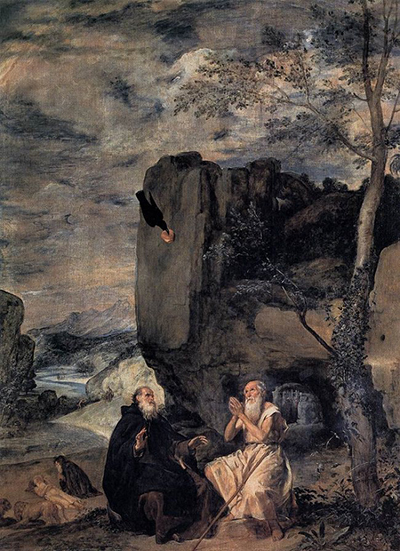
A raven descends past the edge of a cliff with a round loaf in its beak. Far below it, at the foot of the rock, two old men look up. Paul presses his palms together, while Anthony’s hands remain apart. The bird is small enough to miss at first, but once you see what the men are looking at, there are other things to find. A figure waits beside a cave door, almost hidden behind Paul. Across the painting, near the lower left, the same two men appear again, and one of them is dead. [1]
Velázquez painted Saint Anthony Abbot and Saint Paul the First Hermit around 1633–34. The oil on canvas is in the Museo Nacional del Prado in Madrid, where it is catalogued as P001169. It measures 261 × 192.5 centimetres in Miguel Hermoso Cuesta’s study of the painting. The picture tells the story of a visit between two early Christian hermits in the Egyptian wilderness. Anthony’s search, the shared meal and Paul’s burial all take place inside a single landscape. [1] [2]
At a Glance
- CollectionMuseo Nacional del Prado, P001169 [1]
- PaintedAround 1633–34 [1] [2]
- StoryJerome’s Life of Paul the First Hermit [3]
The hermitages and the royal collection
The proposed first setting was the oratory of San Pablo at the Buen Retiro.
This is the most securely documented site on the estate.
The painting enters the Prado
1819 [1]The catalogue traces the work through the Royal Palace inventories before its move to the museum.
Contents
- The bird above the two saints
- Anthony’s route through the valley
- The burial at the lower left
- A wilderness for the Buen Retiro
- Looking up from the ground
The bird above the two saints
At the bottom of the picture, Anthony’s dark cloak spreads into a broad mass with a few ridges of brown where the cloth turns. His white beard, the light on his forehead and the fingers emerging from his sleeves give you the direction of his attention. Paul sits a little higher, in a pale garment that catches the light from the shoulder down to the lap. One fold climbs in a diagonal over his knee, while a slender staff crosses the cloth in the opposite direction. His bare arms converge at his raised hands. The space between the men is small enough for Anthony’s extended hand to come almost level with Paul’s knee, though their faces both turn towards the space above them. [1]
Look up from the two heads and the distance to the raven seems considerable. Its tail breaks the outline of the rock, while the head and bread fall against the comparatively even tone of the cliff face. Its dark wing makes one short point upwards. The orange-brown loaf is even smaller, with a pale curve underscoring its roundness. The rock gives the loaf a clear surface to register against, and the raven’s steep diagonal keeps the descent legible across an area otherwise dominated by verticals. High on the right, the trunk of the tree divides into a canopy that spreads across the sky. The bird brings that large upper part of the painting into relation with the handful of gestures at ground level. [1]
Jerome’s late-fourth-century Life of Paul the First Hermit explains why the loaf matters. Paul tells his visitor that the bird usually brings him half a loaf. This time it brings a whole one, enough for both men. Jerome goes on to say that each saint insists the other should break the bread, until they settle the matter by pulling it apart together. The Prado’s 1990 catalogue connects the picture with the later retelling in Jacobus de Voragine’s Golden Legend, whose chapter on Paul names Jerome at the outset. The single round loaf in Velázquez is especially easy to relate to Jerome’s account. The English version of the medieval text printed by William Caxton describes two loaves at the arrival. The painting catches the delivery while the men’s hands are still empty. [1] [3] [4]
Anthony’s route through the valley
The broad cliff conceals much of the ground behind it. At the left, a gap between the rock faces opens on to cold blue water and low ridges. A strip of pale sloping ground comes nearer, widening as it passes the dark shrubs. Two incidents in Anthony’s outward journey occupy this corridor at different depths. The Prado catalogue identifies the tiny figure of a centaur at the far end of the valley and a faun, or satyr, nearer the foreground. In Jerome, the centaur points out the way, and the satyr asks Anthony to pray for him and his kind. A she-wolf eventually leads Anthony to the vicinity of Paul’s cave. The 1990 catalogue tentatively identifies a mark by the river as the wolf, while Juan María Cruz Yábar regards that episode as omitted. The two figures on the nearer slope, one much smaller and lighter than the other, are easier to pick out than the forms by the water. [1] [3] [5]
The next stage of the journey is on the other side of the painting. Just behind Paul’s shoulder, pale upright strokes mark the door set into the shadow of the grotto. The catalogue identifies Anthony asking for admission there. Jerome describes him tracing the wolf to the cave, feeling his way inside and finding the entrance barred by Paul. Anthony pleads until Paul lets him in. Velázquez makes this small episode visible through a narrow interval between Paul’s head and the trunk at the right. The pale marks take a moment to resolve into anything built, a delay that suits the story of a dwelling discovered by degrees. [1] [3]
The landscape brings five appearances of Anthony within view. He encounters the centaur and the satyr, waits at the cave, sees the raven and finally kneels beside Paul’s body. Those incidents take the eye from the distant left to the right of the cliff, down to the two large figures and back to the left. You can also come upon them by starting with Anthony’s cloak in the foreground. Once you know its dark shape, the smaller figure bent over Paul’s body becomes easier to recognise, and the journey can be reconstructed in either direction from there. [1] [3]
The burial at the lower left
Jerome says that Paul sends Anthony away to fetch a cloak given to him by Bishop Athanasius. On the way back Anthony sees Paul ascending among heavenly company. At the cave the body is still in the posture of prayer. The burial takes place outside, where two lions dig a grave for the friend Anthony has come back to bury. In the painting, Paul’s pale clothing spreads close to the earth. Anthony’s back forms a dark arc beside him, and the tawny body of a lion blends into the soil near the edge of the picture. The catalogue identifies a second lion, of which only the head shows. [1] [3]
The distance from the large Anthony to the smaller one can be covered by moving your eye a little to the left. The change in the bend of his body is more striking than the distance. Under the raven his head tilts back and his fingers open. Beside Paul’s body the heavy folds fall forwards, following his inclination towards the ground. The upright Paul, whose lit beard and forearms stand out against the dark cave, has a counterpart in the pale figure whose outline almost merges with the ground. The two moments are painted close enough for one to alter how you read the other. [1]
A wilderness for the Buen Retiro
Philip IV’s Buen Retiro estate in Madrid included several small chapels called hermitages. San Pablo was completed in the early months of 1633, and payments from that spring record work on its altarpiece. That dedication gives the picture a plausible original home. The painter and writer Antonio Palomino also placed Velázquez’s picture in the oratory of San Pablo. The proposed first setting thus rests on the chapel’s dedication, the history of its decoration and Palomino’s testimony. The exact date of installation remains uncertain. [1] [2] [5]
The clearest evidence for an actual position on the estate comes from the 1701 royal inventory, transcribed by Cruz Yábar. It places the picture over the altar table in the oratory of San Antonio, with a carved and gilded frame and a valuation of 300 doubloons. That hermitage was dedicated to Anthony of Padua, a different saint from the abbot shown here. The 1990 Prado catalogue also reports a mention of the picture at San Antonio in 1637, an earlier notice which is harder to reconcile with the proposed later transfer. The inventory establishes where it stood by 1701. The Prado catalogue traces it afterwards through the Royal Palace inventories and records its arrival at the museum in 1819. [1] [2] [5]
The gardens could host festivities and performances as well as religious observances. In the painting, the sheltered foreground and the glimpses up the valley leave the two men almost entirely alone. The grounds of the royal estate provided a setting in which to contemplate that withdrawal. Their own chapels and gardens belonged to a different kind of place, with tended enclosures, buildings and court visitors. [1] [2] [5]
Looking up from the ground
In Velázquez’s much earlier Saint John the Evangelist on the Island of Patmos, the seated writer also looks up from a dark foreground towards a little event high in the canvas. His open book is broad and bright. The glow about the woman in the sky is smaller, and the sea and mountains recede behind him. The woman becomes a full-length figure in the companion Immaculate Conception, where a narrow band of terrain lies far below her. The pair shifts the scale of its central figure between separate canvases. In the hermits’ picture, the shift happens within a single canvas. A dark-clad man whose fingers you can make out becomes a figure no bigger than a few strokes as he passes into the valley. [1] [6] [7]
The height of the later painting makes room for the rock and the broad sky, which the branch tips break up into irregular patches. At the bottom there is scarcely a clear strip of earth before the canvas ends. Paul’s hem, Anthony’s dark cloak and the tufted growth at the right give the scene a place to settle. From there the tilted faces send the eye upwards again. The story has its greatest reach when you can hold the bright loaf, the two faces and the darker little scene at the left in view together. [1]
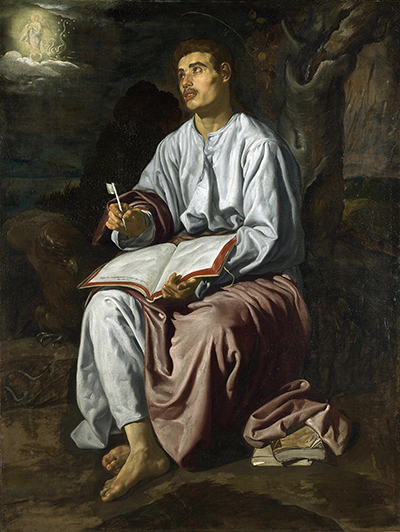
Saint John on Patmos. The earlier canvas uses a landscape to make a sacred encounter legible at a different scale. View Saint John on Patmos.
Artworks directory
Frequently Asked Questions
Museo Nacional del Prado, P001169 [1]
At the bottom of the picture, Anthony’s dark cloak spreads into a broad mass with a few ridges of brown where the cloth turns. His white beard, the light on his forehead and the fingers emerging from his sleeves give you the direction of his attention. Paul sits a little higher, in a pale garment that catches the light from the shoulder down to the lap. [1]
Discussion
Look again at the images and ideas explored in Saint Anthony Abbot and Saint Paul the First Hermit. These editorial prompts invite your observations.
Reader Insights
Which path do you take through the landscape before noticing the repeated figures?
Does recognising the loaf change the way you read the two men’s gestures?
Join the Conversation
Share a detail, comparison or question about Saint Anthony Abbot and Saint Paul the First Hermit below.
References
- Julián Gállego, ‘San Antonio Abad y San Pablo, primer ermitaño’, in Velázquez, Museo del Prado exhibition catalogue (1990), no. 47, pp. 284–290, with full and detail plates,. View source.
- Miguel Hermoso Cuesta, ‘La Tebaida Palatina. San Antonio Abad y san Pablo Ermitaño de Velázquez’, Atlante. Revue d’études romanes 15 (2021), especially §§ 15–19 and fig. 8,. View source.
- Jerome, The Life of Paulus the First Hermit, especially §§ 1 and 7–16, translated by W. H. Fremantle in Nicene and Post-Nicene Fathers, second series, vol. 6,. View source.
- Jacobus de Voragine, ‘The Life of S. Paul the First Hermit’, The Golden Legend, vol. 2, William Caxton’s English version, edited by F. S. Ellis,. View source.
- Juan María Cruz Yábar, ‘Las ermitas del Buen Retiro en el siglo XVII. Arquitectura, decoración y función’, especially pp. 68–73 and the quotation of the royal inventory on p. 71,. View source.
- The National Gallery, Diego Velázquez, Saint John the Evangelist on the Island of Patmos, NG6264, collection entry and image,. View source.
- The National Gallery, Diego Velázquez, The Immaculate Conception, NG6424, collection entry and image,. View source.







