



 by Tom Gurney
Tom Gurney BSc (Hons) is an art history expert with over 20 years experience
Published on June 19, 2020 / Updated on October 14, 2023
Email: tomgurney1@gmail.com / Phone: +44 7429 011000
Diego Velázquez Biography: Introduction
On 6 October 1623, Philip IV put Diego Velázquez on the royal payroll. The painter would receive twenty ducats a month to do the work the king assigned him. Later that October, the official drawing up the papers asked whether Velázquez should also be paid for individual pictures. A previous painter had been employed on different terms, and the royal order had left the point open. The distinction was important. Velázquez was now a member of the king’s household as well as a painter whose work had a price. Over the next thirty-seven years, he would make pictures for that household, acquire art for its rooms and eventually become responsible for preparing the places in which the king lived and travelled. [1] [2]
Diego Rodríguez de Silva y Velázquez was born in Seville in 1599 and died in Madrid in 1660. His surviving pictures record much of the distance he travelled. In a kitchen painted the year he married, an older woman cooks eggs in a shallow earthenware dish. In Rome three decades later, Pope Innocent X sits before him in red and white, holding a document that bears the painter’s name. In Las Meninas, Velázquez appears at work in a room of the royal palace. Between those pictures lie a six-year apprenticeship, two journeys to Italy, a workshop sustained in part by enslaved labour and a long series of appointments that brought the painter into the daily life of the Spanish crown. [2] [3] [4] [5]
At a Glance
- Baptism6 June 1599, San Pedro, Seville [6]
- MarriageJuana de Miranda, 23 April 1618 [7]
- ItalyTwo journeys in the service of Philip IV [8] [9]
- Death1660, Madrid [2] [3]
Velázquez’s life and royal service
Contents
- A family in Seville
- What Pacheco’s workshop made possible
- A painter on the king’s payroll
- The first journey to Italy, 1629–31
- The Buen Retiro, hunting lodge and royal likenesses
- The second journey to Italy, 1648–51
- Juan de Pareja in the workshop and in Rome
- Palace rooms, royal children and the Order of Santiago
- The frontier ceremony and death in Madrid
- Juana Pacheco manages the family’s affairs
- Two estates in one inventory
- The books in the Casa del Tesoro
A family in Seville
The parish of San Pedro records Velázquez’s baptism on 6 June 1599. The date is often printed as his birthday, although the entry records the sacrament. It names his parents as Juan Rodríguez de Silva and Jerónima Velázquez. His paternal family came from Portugal, and his grandfather Diego had left Porto for Seville. The Andalusian heritage institute places the family’s early home in the Calle de la Gorgoja, now Calle Padre Luis María Llop. Later records for Diego’s siblings place the family in the parish of San Vicente. The surname by which the painter is best known came from his mother’s family. [3] [6]
Seville was a centre of Spain’s trade with the Americas. Merchants from abroad, prosperous religious foundations and networks of artists and artisans gave the city a substantial market for pictures. Its prosperity also depended on forced labour, including the labour of enslaved people in homes and workshops. Both sides of that economy matter to a life that began with a carefully negotiated apprenticeship and later involved Velázquez’s legal ownership of another artist, Juan de Pareja. The records for the two arrangements use different terms and establish very different kinds of power. [2] [10]
A tradition places the boy in the workshop of Francisco de Herrera the Elder around 1609. The Instituto Andaluz del Patrimonio Histórico qualifies the story in its biographical narrative, and the surviving Pacheco agreement provides the first secure date for his training. The agreement says that six years of service had begun on 1 December 1610. Juan Rodríguez granted the deed on 17 September 1611 and Francisco Pacheco on 27 September. The body of the surviving transcription gives September in full, although the heading on the heritage institute’s transcription page says November. Dates of 1610 and 1611 can therefore refer to different events in the same apprenticeship. [3] [11]
The deed gives an unusually concrete picture of what the arrangement meant. Pacheco agreed to teach the boy all he knew of the trade and to provide food, clothes, shoes, a place to sleep and short-term care if he fell ill. His father would pay for care after fifteen days of illness. The apprentice owed service in the house and was expected to make up days lost through absence or illness. At the end of the term, Pacheco was to provide a complete new outfit, down to stockings, shirts and a hat. Becoming a painter involved joining another household and submitting to its timetable. The new clothes would mark the end of years in which the master had undertaken to maintain the pupil as well as to teach him. [11]
On 14 March 1617, Pacheco and Juan de Uceda examined Velázquez for the painters’ guild. The certificate records his right to exercise the profession. He could take commissions, open a workshop and employ assistants or apprentices. The Andalusian chronology records a named apprentice of his own, Diego Melgar, by 1620. Velázquez’s much later pursuit of a knighthood would bring the trade status implied by these documents into question. In Seville, at seventeen, the certificate was a means of making an independent living. [2] [3] [12]
Velázquez married Pacheco’s daughter Juana on 23 April 1618. In the marriage entry she is called Juana de Miranda, and the union was recorded in the parish of San Miguel. Two daughters followed, Francisca in 1619 and Ignacia in 1621. Francisca later married Juan Bautista Martínez del Mazo, a painter who worked in Velázquez’s circle and who would carry on working for the crown. The apprenticeship agreement, marriage register and later workshop relationship show how closely the painter’s working and family lives could overlap. [2] [3] [7]
Four stages of Velázquez’s career
Seville apprenticeship and qualification
The guild record and marriage entry document Velázquez’s first professional and family ties in Seville. [11] [12] [7]


From a royal appointment to Rome
The October 1623 appointments fix Velázquez’s place in Philip IV’s household. His first Italian journey took him to Rome and Naples. [1] [8]




What Pacheco’s workshop made possible
Pacheco’s Arte de la pintura, published in 1649, is both a practical treatise and a defence of the standing of painting. Its account of Velázquez is the testimony of a man who trained him, became his father-in-law and took an active interest in his success. Pacheco defended his son-in-law’s kitchen pictures on the grounds that study of humble subjects could lead to exceptional imitation of nature. He also reports that the young painter had a boy pose repeatedly, studying different movements and expressions. Pacheco sets out what he valued in a painter whom he had watched work. His praise tells us how deliberately he wanted readers to take a kitchen scene as seriously as other demonstrations of skill. [2] [13]
In Old Woman Cooking Eggs, dated 1618, a pair of eggs is turning opaque in a low dish. A boy alongside the cook holds a melon and a flask. Pottery, a spoon, a knife and the outline of the woman’s fingers emerge from deep shadow. Looking from the gleaming vessel to the beaten surface of the mortar, we can see what repeated study might have meant in practice. Each thing requires a different edge and a different kind of highlight. The figures inhabit the same world of firm outlines and directional light. A subject familiar from daily life gave the young painter a demanding test of how many different surfaces he could make persuasive in one room. [4]
The kitchen works are often called bodegones, a term used for Spanish paintings that make food, vessels or the handling of provisions conspicuous. In the Waterseller of Seville, now at Apsley House, a glass passes between an older man and a boy. The large earthenware jar catches individual drops of water, while the fingers at the stem of the glass are gathered into a small, quiet gesture. The concentration on an exchange between people already suggests something of the mature portraitist. In a kitchen scene at the National Gallery of Ireland, a small view of Christ and his disciples at Emmaus complicates what looks at first like an isolated scene of work. These paintings differ in setting and purpose, and together they show how much a local audience could find in what a workshop could observe directly. [14] [15]
Religious commissions made equally exacting demands. The National Gallery in London holds Saint John the Evangelist on the Island of Patmos and The Immaculate Conception, both dated 1618–19. They were documented in Seville’s Shod Carmelite convent by 1800. Their original destination inside the convent and the identity of their commissioner remain uncertain. In Saint John, light catches the saint and the pages of his book, while the woman he sees appears in a luminous opening much farther away. The division between the ordinary world and a sacred event takes a different form from the little Emmaus scene, but both depend on the painter’s ability to give things seen close at hand a different weight from things seen at a distance. There is more on the relationship between the city, the workshop and these pictures in Seville and the bodegones. [15] [16]
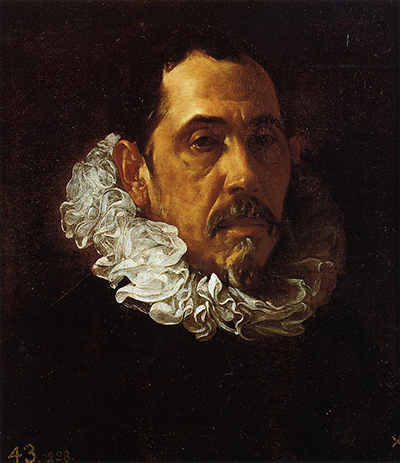
Portrait traditionally identified as Francisco Pacheco. The Prado likeness traditionally identified as Pacheco introduces Velázquez’s teacher in the chapter on his Seville training. View Portrait Traditionally Identified as Francisco Pacheco.
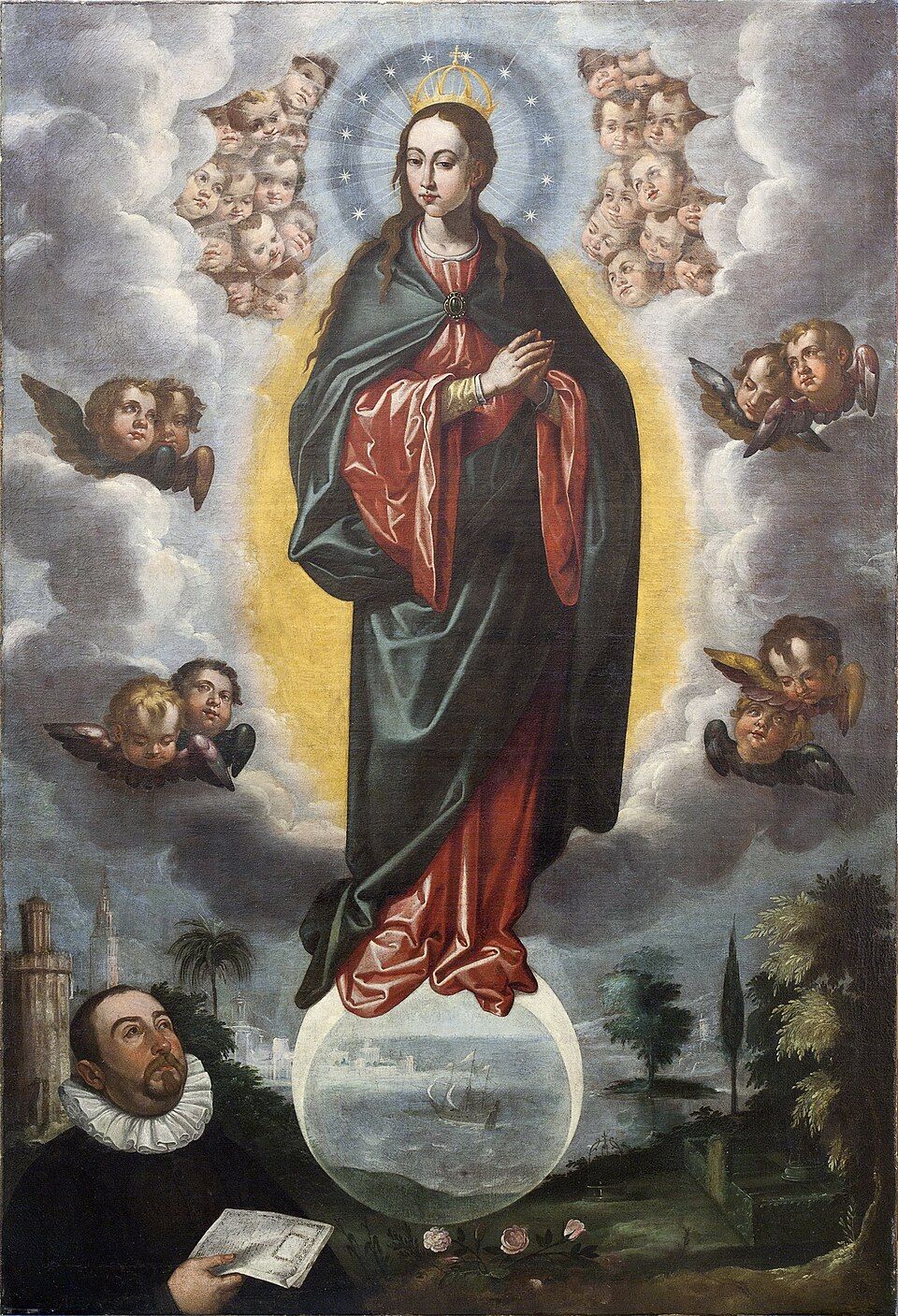
Francisco Pacheco, The Immaculate Conception with Miguel del Cid, 1619, Seville Cathedral. The painting shows the kind of devotional commission Velázquez encountered during his years around Pacheco’s workshop. Image source. Public domain. Resized for display.
A painter on the king’s payroll
Philip IV succeeded his father in 1621. His adviser Gaspar de Guzmán, the Count-Duke of Olivares, had connections with Seville, as did the royal chaplain Juan de Fonseca. Velázquez first went to Madrid in 1622. Pacheco reports that the artist painted the poet Luis de Góngora at his request and visited El Escorial, where a student of painting could encounter Italian works in the royal collection. When Velázquez returned in 1623, Fonseca helped prepare the way. According to Pacheco, Fonseca sat for him, and the portrait was taken to the palace and seen there before the young artist was asked to paint the king. The route into royal employment began with people who could put a picture in front of the right viewers. [2] [13]
Pacheco dates the first royal likeness to 30 August 1623 and describes the favourable reaction of the king and his circle. The appointment document, written a few weeks later, establishes the separate date when that reception became salaried service. The 6 October order names the paymaster of the Alcázar, Casa de Campo and El Pardo as the official through whom the salary would be paid. On 28 October Pedro de Hoff Huerta addressed the question of payment for individual works, and the king’s recorded response gives his assent to the draft presented to him. The memorandum of 30 October spells out why the distinction required clarification. In 1617 Bartolomé González had been engaged at sixteen ducats a month under terms that excluded separate payment for pictures. [1] [13]
The relationship between the first sitting and the surviving portraits is less straightforward than the hiring date. The Metropolitan Museum of Art identifies its full-length Philip IV, probably from 1624, as Velázquez’s own replica of an initial portrait type. Don García Pérez de Araciel paid the artist for it on 4 December 1624. The original version at the Prado was subsequently altered by Velázquez, giving the New York picture unusual value as a record of the earlier design. Pacheco’s account of a royal sitting, the receipt for the replica and what can be seen in the two canvases establish different parts of the story. Together they show the speed with which a successful likeness could become a repeatable image. [13] [17]
In the Met painting the king wears black. His hand holds paper, his slender figure casts a shadow and a plain surface surrounds him. The restrained format makes the smallest signs of rank and office consequential. An official portrait could travel far from Madrid, and a copy was often the means by which it did so. A viewer who had never seen the king in person could nevertheless see how he wished to present his position. The payment for the Met replica is a rare way to put a purchaser and a date to that circulation. It also gives a standard against which to judge more difficult cases in which a later repeat has lost its early records. [17]
In 1627 Velázquez won a competition to paint the expulsion of the Moriscos from Spain. The subject celebrated an act of Philip III’s reign and required the painter to work on a much larger political narrative than the single figures by which he was becoming known. The canvas was subsequently lost. His position as ujier de cámara, an usher of the royal chamber, belongs to the same year. This early household post helps explain why later appointments appear beside the paintings when his career is traced through the archives. A court painter could increase his standing through pictures and exercise that standing through duties shared with other royal officers. [2] [3] [18]
Peter Paul Rubens was in Madrid on diplomatic business in 1628–29. He had access to the Spanish royal collection and copied Titian. Velázquez could watch an established European painter study the same pictures that had become available to him through his court appointment. Pacheco reports contact between the two artists. The encounter matters even though the degree to which Rubens prompted the next journey is hard to establish. Titian and other Venetian painters offered ways of modulating form through colour, while Rubens showed what a living painter could do with that inheritance. Velázquez’s Triumph of Bacchus, made around this time, places a pale, partly undressed god among men whose weathered faces belong to the everyday world. It gives a sense of the questions he was taking with him to Italy. [2] [13] [19]
Diego Velázquez- Painting Takes Power · Best Documentary · Watch on YouTube
The first journey to Italy, 1629–31
Velázquez left Spain from Barcelona in 1629 with the king’s permission and letters of recommendation. He travelled with Ambrogio Spinola’s party as far as Genoa and went on through northern Italy. The accounts place him in Venice, where he could study the painting of Titian and Tintoretto in the city that had produced it, and then in Rome, where he had access to works by Michelangelo and Raphael and to collections of ancient sculpture. Pacheco records embarkation on Saint Lawrence’s day, 10 August, and describes the escort supplied by the Spanish ambassador in Venice during the war over the succession of Mantua. In Venice Velázquez drew and copied from Tintoretto, while in Rome he was able to study the Vatican’s paintings with unusual freedom. The journey put Velázquez in a position to look at ceiling painting, sculpture, and great altar and wall paintings in the spaces for which they had been made. [2] [13] [8]
The precise dates and sequence of stops vary across accounts. The Prado catalogue situates the visit to Naples near the end of 1630, while the University of Teramo places it in 1631. Naples was also a place where royal duties could interrupt the itinerary. Pacheco records that Velázquez painted Philip IV’s sister María there, on her way to join her husband, the king of Hungary. Her portrait could return to Spain when she went on to her new court. The accounts also link Velázquez to the Spanish painter Jusepe de Ribera in Naples, though the Prado’s biographical essay treats the meeting on this first voyage as probable. Treating the journey as stretching from the departure of 1629 to the resumption of work in Spain by 1631 leaves room for the differences in how its final stages are dated. [2] [13] [8]
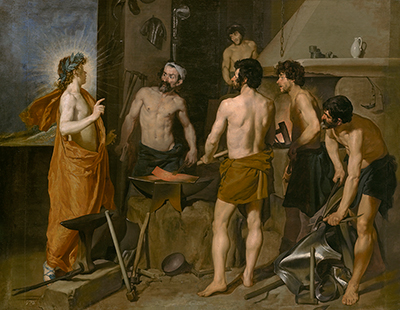
Two large paintings make the work of this visit tangible. In Apollo in the Forge of Vulcan, painted in Rome in 1630, Vulcan and his workers turn towards a visitor who has interrupted their work. Their changing positions create a sequence from the upright god to the figures turning or bending around the anvil. Joseph’s Bloody Coat, now at El Escorial, makes the reception of unwelcome news the subject of another large group. Jacob’s sons bring him a bloodied garment and invite him to draw a false conclusion about Joseph. The two pictures offered occasions for working out what happens to a group of bodies when a few words or an object suddenly change the situation. They are associated by date and subsequent royal acquisition, while their original status as an intended pair remains open. [2] [13]
The Prado’s 1990 catalogue records Apollo as made without a royal commission. The royal official Jerónimo de Villanueva bought it from Velázquez in 1634 as part of an acquisition for the crown. It marks a moment when permission and support to travel could yield a picture through which the painter tested his own interests before the work entered royal service. Technical study has also found a light grey preparation beneath the visible paint, distinct from the reddish or brown grounds documented in several early paintings. With a lighter starting surface, the paler bodies and the recesses of the forge can interact without a simple division between highlights and heavy shadow. Here the change has evidence in the fabric of the picture as well as in an account of what the painter had the opportunity to see abroad. [2] [20]
The Buen Retiro, hunting lodge and royal likenesses
The first years back in Spain brought important religious pictures alongside portraits. Christ Crucified, associated with the Benedictine convent of San Plácido in Madrid, shows the four nails that Pacheco recommended, while the softly modelled body emerges into clear light against a nearly black ground. The Prado catalogue dates it to around 1632. The convent provenance matters more than the stories later told about why it might have been ordered. The picture shows a painter back in Spain using an approach to sacred imagery he had learnt in Seville alongside his developing command of the illuminated body. [2]
The work to which Velázquez returned expanded beyond individual portraits. The Hall of Realms at the Buen Retiro was a large ceremonial setting devoted to the monarchy. Paintings of recent military victories shared the hall with portraits of the royal family on horseback, scenes from the labours of Hercules and emblems identifying realms of the monarchy. Many painters took part. The programme gave Velázquez an opportunity to make views of recognisable rulers and commanders speak to one another across a single room. The scale of the work depended on the palace building and on collaboration alongside the work at his own easel. [2]
The Surrender of Breda, completed in the mid-1630s, depicts the surrender of the Dutch-held city to Spinola in 1625. Velázquez had travelled with the commander four years after the siege, but there is no basis for treating the picture as his eyewitness account of the event. He places the key between Spinola and Justinus of Nassau and gives each commander surrounding figures who respond differently to the meeting. Spears stand densely together on one side, smoke drifts in the landscape, and the distance opens down towards the site of the action. In the Hall of Realms, the painting had a specific job to do as one victory among many. The way Spinola meets the defeated commander also allowed for sustained attention to a person whom the programme required him to overcome. [2]
The equestrian portrait of Prince Baltasar Carlos belonged to the same ensemble. The young prince carries a baton and handles a horse whose lifted forelegs become especially prominent when the image is viewed from below. The Prado catalogue reconstructs a high position above a doorway, which helps explain the strong foreshortening. His parents and grandparents had their own equestrian portraits in the hall. Installed as a family rather than viewed one by one at a museum, the images gave the child a place in an expected succession. Baltasar Carlos died in 1646, aged sixteen, and that expectation was never fulfilled. [2]
The hunting portraits of the king, his brother the Cardinal-Infante Don Fernando, and the prince belonged to a separate setting, the Torre de la Parada. In these works dogs, guns and a landscape replace the broad display of horses, batons and court dress. A hunting lodge gave a more specific audience a different kind of royal self-presentation. The location changes what the portraits can tell us about the artist’s work. He was capable of making likenesses for a spectacular hall where the dynasty was read in public and, at the same time, adjusting pose and surroundings to make figures recognisable in the setting of a court pursuit. [2]
Olivares, who had helped open the way to court, appears in portraits made for different settings. The early standing portrait in São Paulo dresses him largely in black and makes the hand, chain and signs of office particularly conspicuous. In the Prado equestrian portrait he is seen in armour with a baton, his horse pivoting above a battlefield. The chain and baton direct attention to different sources of power. The man with a hand resting on a table could be understood through the offices he held. The mounted figure presides over a view of military action. [2] [21]
In April 1636 Diego and Juana both appear in the appraisal of the possessions of Juan de Larrea. A notarial document gives their contributions separately. Juana valued household goods, and Diego appraised paintings. Both signed. When Juana appears again in the record of their estate, the inventory tells us about the objects they lived with. The earlier appraisal shows her using her knowledge of such goods in a transaction involving other Madrid specialists. [22]
Official portraits could also be made on the move. In 1644 Velázquez accompanied Philip on a campaign connected with the Catalan revolt. The Frick Collection’s portrait places him in campaign dress at Fraga. The brilliant red fabric and silver braid would make little sense as a change of fashion alone. The painting was displayed in Madrid while the king was away, and a sermon accompanied an early display. It was a way for those in the capital to see an image of their absent ruler as commander. The record of the campaign helps us understand the immediate work the picture had to perform. Behind the outspread brush marks of the embroidery were practical arrangements for an artist and king to meet and a canvas to be sent back to Madrid. [23]
By this period Velázquez was doing work beyond portraiture. Research in the royal household records places his wardrobe appointment in 1636 and an appointment as ayuda de cámara, an attendant in the king’s chamber, in 1643. The Andalusian chronology separately records the designation ayuda de cámara con oficio in 1646. By 1648 he is documented among those supervising the royal building works. Such titles can sound like honours in a biography. They also brought identifiable responsibilities, involving the king’s rooms, his belongings and the personnel needed to look after them. Appointment histories differ in part because service, formal designation and the exercise of an office could occur at different points. [3] [18]
The painter’s family relationships remained part of that work. Francisca and Mazo married in 1633. Mazo made versions of Velázquez’s pictures and pursued his own career in royal service. When Francisca died in 1653, his work with Velázquez continued. [24] At the Kunsthistorisches Museum, a comparison of Margarita’s pink-dress portrait and a version probably by Mazo draws particular attention to the low carpeted platform underneath the child. Copying preserved this slight detail of court furniture along with the recognisable face and dress. A studio could reproduce an image for another patron or destination and carry forward knowledge of the setting that had helped give it meaning. The routines behind such pictures are explored in Velázquez at the Spanish court. [2] [25]
Velázquez and his artistic context on film
Explore Baroque painting, Spanish portraiture and horses in art with TheHistoryOfArt.
Further reading
For a closer look at the evidence and paintings:
Velázquez. Antonio Domínguez Ortiz, Alfonso E. Pérez Sánchez and Julián Gállego. The Metropolitan Museum of Art, 1989
The catalogue’s essays follow Velázquez from Seville to Madrid and set his work alongside the events of Philip IV’s reign. Read the catalogue at The Met.
The second journey to Italy, 1648–51
When Velázquez travelled to Italy again, he was an experienced royal painter who had supervised work at court. The party of the Duke of Maqueda and Nájera left Madrid in October 1648. Its diplomatic purpose was to meet Mariana of Austria, Philip IV’s future wife. The Prado account places the party’s embarkation from Málaga in January 1649. Velázquez went on to pursue the king’s collecting commission, buying pictures and seeking sculpture and painters for the royal interiors. Sources that put the start in 1648 or 1649 may therefore be dating different legs of the journey. He was in Rome in 1649 and back in Spain in 1651. [2] [8]
In Venice he acquired works by Veronese and Tintoretto. Palomino’s later biography names a group of ceiling paintings attributed to Tintoretto and mentions two large pictures by Veronese that Velázquez reportedly passed over because the paint might suffer on the voyage. [26]
Royal collecting did not consist solely in buying available paintings, as the survival of contracts in the Archivio di Stato di Roma makes clear. A contract dated 13 December 1649, overseen by his representative Juan de Córdoba Herrera, arranged for bronze copies of three ancient sculptures, including the Germanicus from the Villa Montalto. The copies were intended for the Octagonal Room of the Alcázar. In January 1650 he commissioned twelve bronze lions from Matteo Bonuccelli to support six porphyry table tops for the Hall of Mirrors. The commission joined a particular material and piece of furniture to a particular room. The contract of 26 April 1650 links Velázquez directly with Orazio Albrizio and identifies three sculptures in the Vatican’s Belvedere to be copied in plaster. An artist commissioning such objects needed to identify models, find people able to reproduce them and arrange for the results to be sent to Spain. [8] [9]
He also sought painters to execute fresco decoration for the Alcázar. Pietro da Cortona did not come to Spain. The Bolognese painters Angelo Michele Colonna and Agostino Mitelli later did. The search shows that the king’s agent was trying to move skills as well as finished objects. Time spent studying important interiors on the first trip gave way on the second to a practical responsibility for what Madrid could acquire and how it might use it. The trajectory and the two itineraries are explored in Velázquez’s Italian journeys. [2] [8]
Rome also offered a new setting for Velázquez’s own work as a portraitist. His sitter Giovanni Battista Pamphilj had served as papal nuncio in Madrid and was now Pope Innocent X. The painting at the Galleria Doria Pamphilj keeps the seated format of earlier papal portraits and makes extraordinary use of a restricted range of colour. Reds shift across cloth, cap and chair, set against the white of the linen. The hands give the figure both authority and a sense of immediacy. One holds the sheet with the artist’s name. The gallery situates the portrait in the context of renewed papal ties with Habsburg Spain after the Peace of Westphalia. Its dating, between late 1649 and early 1650, is earlier than the August 1650 date discussed in the Universidad Complutense’s bibliography of sources. The Prado curator Javier Portús places its making in August or September and discusses it alongside other portraits from the papal circle, including those of Camillo Massimo, Camillo Astalli and Ferdinando Brandani. Their offices and dress make the Roman commissions a counterpart to the painter’s earlier work at the Spanish court. The sitter’s identity and the place of execution are secure, while the time of year and the order of the sittings remain disputed. [2] [5] [8] [27] [28]
Juan de Pareja in the workshop and in Rome
The second journey was also a turning point for Juan de Pareja. He was of African descent, born in southern Spain, and had been enslaved by Velázquez for years by the time they travelled to Rome. He appears as a witness in surviving legal records connected with the family from the 1630s. The Metropolitan Museum of Art places his experience in a wider history of enslaved labour in Spanish artisan workshops. The extent of his day-to-day responsibilities as a member of Velázquez’s household and studio is hard to reconstruct. The documents show that he carried out work on which the household depended and that it could compel his labour. [10] [29] [30]
In 1650 Velázquez painted the portrait of Pareja now in the Met. The body turns away from us and the face looks back. Against the subdued colour of the coat and background, the light lace collar makes the turn of the head especially clear. There is an intimate distance between painter and sitter, but it is a portrait made under conditions in which one man legally owned the other. Antonio Palomino, writing decades later, reports that the work attracted attention when exhibited at the Pantheon on the feast of Saint Joseph, 19 March. His account relays the recollection of the Flemish painter Andrés Smidt, whom he says was in Rome at the time. It made the sitter recognisable to an audience and enhanced Velázquez’s reputation. The exhibition and his entry into Roman artistic circles in 1650 gave him standing among painters who had little reason to know his early work in Seville. Pareja’s visibility, meanwhile, still depended on decisions that Velázquez could make on his behalf. [2] [27] [29] [31] [26]
Velázquez signed the Donatio Libertatis, the deed of manumission, in Rome on 23 November 1650. The document required further service for four years, so Pareja’s freedom took effect in 1654. The distinction changes the story of their return in 1651. Pareja travelled back to Spain still bound under the terms of the deed. The Met showed the original document from the Rome state archive in 2023, in an exhibition that brought the painting from Rome into conversation with works by Pareja himself. A date on a portrait can tell us when an artist saw a face or was seen by another painter. In this case it takes a second object, made for legal purposes, to establish when the person pictured could act on his own behalf as a free man. [10] [29] [30] [31]
Pareja went on to make portraits and large religious pictures. His Calling of Saint Matthew, dated 1661 and now at the Prado, includes a self-portrait at the left edge. Pareja stands upright and looks out of a gathering that includes figures in grand, contemporary clothes. The artist has given himself a position in the painting from which he can meet the viewer. The change since Rome involves more than posture or costume. In 1650 Velázquez chose how to show him. In the altarpiece-scale work of 1661, Pareja controlled the design and his own place in it. The 2023 exhibition also brought together his Flight into Egypt, Baptism of Christ and Portrait of José Ratés, evidence of a career with different scales, subjects and patrons. [10] [30]
While Velázquez remained in Italy, letters from the Spanish court pressed for his return. Enriqueta Harris traced the exchange in the papers of the Duke of the Infantado, the Spanish ambassador in Rome. The correspondence runs from February 1650 through July 1651. It shows the court’s concern both for the completion of the work it had commissioned and for the painter’s return to his post. A letter sent from Madrid on 23 June 1651 announced that he had arrived. On 8 July the papal nuncio reported that Velázquez had brought back paintings and a likeness of the pope that had pleased Philip. The two letters put the painter back at court and give a glimpse of the kinds of work arriving after him. [32] [33]
Palace rooms, royal children and the Order of Santiago
On 16 February 1652 Philip IV granted Velázquez the office of aposentador mayor de palacio, succeeding Pedro de Torres. He swore his oath before the Count of Montalbán on 8 March. [18] [34] [35] Preparing accommodation for the monarch was one aspect of the office. Its responsibilities also extended to the custody and movement of furnishings and the supervision of rooms and their equipment. The surviving household records track the work year after year. In October 1655, for instance, the royal controller asked for regular accounts of the money advanced for such things as floor mats and firewood. The request gives an idea of how much routine paperwork and spending came with preparing even a single season at the palace. [36] Julia Vázquez’s study compares the post with that of other holders, many of whom had extensive prior service in the royal household. The appointment helps explain why some of the painter’s most consequential later work was done through the placement of pictures and objects in royal interiors. [18] [34]
The display at El Escorial is one example. The Prado catalogue associates Velázquez with the installation there in 1656 of major pictures from the royal collection, among them paintings acquired through Italy and through the dispersal of Charles I’s collection. A room set aside for art depends upon relations of scale, height and subject between the things it contains. The work of matching pictures to rooms was a way of using the artist’s knowledge on a scale larger than an individual canvas. The same care for distribution and for what people could see is relevant to Las Meninas, although the picture itself has a different purpose from the installation of a gallery. [2] [34]
In Las Meninas, dated 1656, Velázquez depicts himself at the side of a large canvas. The Infanta Margarita stands among attendants, the king and queen appear in a small mirror and a man pauses in the back doorway. The room was part of the Alcázar. The position of the painter tells us something unusual about how he chose to represent his career. He places himself among the people who keep a royal household functioning. Their activities are as important to the plausibility of the scene as the likenesses of the royal family. The forward light on the child and the lit doorway turn a room of familiar dimensions into something spectators have to work out as they look. [2]
Other surviving works give different views of the final decade. The National Gallery dates The Toilet of Venus, often called the Rokeby Venus, to 1647–51, and leaves its place of execution open. The nude lies with her back towards us and a figure of Cupid holds up a mirror. The opportunity to study classical sculpture and to buy Venetian works is part of the context for this picture, alongside Velázquez’s earlier access to the Spanish royal collection. Neither fact locates the painting on a particular journey. The Spinners is first documented in Pedro de Arce’s 1664 inventory, four years after the painter’s death. It records a mythological title and a private owner, while the exact date of painting and the first commission remain open. [37] Its passage from figures at work in a dark room to a more distant mythological encounter recalls compositions of the Seville years in which the viewer needs time to discover a second scene. Even while palace duties took more of his time, Velázquez could set the familiar business of a workshop against a classical subject on a single canvas. [2] [38]
A comparison with the late Vienna portraits shows how far the effect of his brushwork had changed. In 1659 he painted Margarita in blue and her younger brother Felipe Próspero. The pictures went to Emperor Leopold I. Leopold would later marry Margarita. Seen up close, the blue dress resolves into short marks and patches whose edges fail to trace every fold. At a greater distance the same marks become glints on a garment with weight and space around it. These paintings travelled to another Habsburg court as evidence of the appearance and progress of royal children. Velázquez gave their distant viewers an impression of physical presence that depends on standing far enough back. [39]
In a letter of 1653, Philip referred to the painter’s slowness and to his own reluctance to watch himself grow old in portraits. The later likeness in the National Gallery shows the king in black, his face and the chain of the Golden Fleece picked out with economical strokes. As in the early standing portrait in New York, the collar and dark clothing establish continuity with the public figure. Age is registered in the falling skin and changes of tone around the eyes. The late type was copied and supplied to other viewers, and an engraving after the likeness helped circulate the royal image in print. The man who had worried about seeing himself grow old could still use a portrait made in his later years to represent him. [2] [40]
Court service brought a final rise in rank. The Archivo Histórico Nacional preserves the pruebas, or proofs, for Velázquez’s qualification as a knight of the Order of Santiago, catalogued in 1659. The file identifies him by his palace offices as well as by his Sevillian origin. Palomino places the king’s offer of a military order’s habit in 1658. The decision of the order followed difficulties over the evidence for the painter’s family’s nobility and the intervention of the king and papacy. Palomino dates the ceremony at the convent of Corpus Christi to 28 November, which belongs to the 1659 outcome recorded in the Prado chronology and the archival file. A cross of Santiago is visible on the painter’s chest in Las Meninas. The picture is dated three years before the honour, and the date of the award alone cannot establish whose hand added the cross. [2] [41] [26]
The question of rank takes us back to the guild certificate. As a young man, Velázquez had needed to prove himself capable of looking after a shop and making pictures for a living. For the admission proceedings, the status of painting as a paid trade could be an obstacle. The witnesses and applicants had to work within rules that treated livelihood and ancestry as signs of social standing. Pacheco had already argued for the dignity of making paintings. The evidence of Velázquez’s knighthood shows how differently that standing could be understood by a professional painter, a king who valued his service and an order charged with deciding who could enter its ranks. [2] [12] [13] [41]
The frontier ceremony and death in Madrid
In June 1660, Velázquez’s palace duties took him to the Bidasoa, the river that separates France and Spain. The marriage of the Infanta María Teresa, Philip’s daughter, to Louis XIV sealed the peace agreed between the crowns. On the Isle of Pheasants, temporary structures and their decoration helped provide a setting in which the Spanish and French courts could meet. Velázquez was involved in preparing the accommodation and the Spanish ceremonial setting in his capacity as aposentador. Palomino describes Velázquez arranging furnishings for the Spanish quarters as the court travelled and working across a series of sites on the frontier. A pavilion standing on a frontier had to serve a much wider audience and a more delicate purpose than a room within the Alcázar. Its furnishings, access and disposition were part of how two monarchies negotiated their visible relationship. [2] [3] [26]
Velázquez fell ill after his return to Madrid and died there on 6 August 1660. He was buried at San Juan in Madrid. Palomino describes the ceremonies and the red insignia on the mantle in which he was buried. Juana died a week later. The estate inventory began on 11 August, between the two deaths. Gaspar de Fuensalida and Mazo appear as Velázquez’s executors. The inventory records books on subjects including architecture, mathematics, history and poetry, evidence of the kinds of reading available in the household at the end of his life. An investigation into his administration led to the seizure of property and ultimately cleared him, according to the documentary account discussed in the Prado catalogue. The records of succession in the household show how quickly the duties he had held had to be covered. Francisco de Rojas succeeded him as aposentador, and documents record the transfer of responsibility for furniture and keys. [2] [18] [34] [42] [26] [43]
The pictures that remained had different prospects of survival. The Surrender of Breda and Las Meninas stayed in royal possession and entered the Prado in 1819. The Metropolitan Museum’s early Philip IV, made for a courtier, preserved the design before Velázquez altered the corresponding portrait for the king. The Met’s 2023 exhibition offered a different pairing. It brought Velázquez’s portrait of Pareja together with The Calling of Saint Matthew, which Pareja had painted more than a decade later. The life behind the pictures can be traced through each of those histories. A view of Velázquez from the court alone would leave out much of the learning, labour, travel and exchange that made the court paintings possible. [2] [10] [17] [29]
Juana Pacheco manages the family’s affairs
In 1645 María del Páramo, Francisco Pacheco’s widow, made her will in Madrid. She named her daughter Juana as her sole heir and entrusted the execution of the will to Juana, Velázquez and their son-in-law Juan Bautista Martínez del Mazo. María also named Juana to succeed her in the right to occupy houses in Seville that belonged to the Hospital del Amor de Dios. The right came with a lease measured in lifetimes. It could pass through the family even though the hospital still owned the buildings. In a will drawn up in 1639, Pacheco set down how much he had spent repairing and improving them, and those improvements would later give the family grounds to ask for a longer lease. Velázquez’s rise in Madrid had left him and Juana with business to conduct in the city where he had trained. [44] [45]
After María’s death in October 1647, husband and wife appointed Carlos de Santa María y Camargo to act for them in Seville. The deed names two tenants on the Calle del Puerco and authorises him to collect the rent already owing as well as future payments. Separately it authorises him to seek an extension of the lease on the hospital’s houses near the Alameda. The document records both spouses’ signatures and names Juan de Pareja among the witnesses. His appearance here places him in the household’s dealings with a Madrid notary several years before Velázquez painted his portrait in Rome. [44] [45]
By July 1649, with Velázquez in Italy, Juana faced a problem with the authority he had given her before he left. She could act on his behalf but needed the power to appoint people to represent them in Seville. She petitioned a Madrid magistrate, who granted her the necessary authority on 30 July subject to a guarantee that she would account for her dealings. Mazo stood as her guarantor the following day. On 3 August Juana signed two deeds. One empowered Juan de Villalobos to collect money, arrange leases and pursue claims. In the other she appointed her cousin Pedro Manuel Pacheco to serve as chaplain of two foundations established by women of her family. He was to say or arrange the appointed masses and receive the revenues attached to the position. Family property sustained religious observances as well as providing income. [44] [45]
Juana was still conducting transactions for Velázquez after his return. On 2 August 1651 she signed over to Matías Pastor de Morales a claim for 188,796 maravedís. Vicente Ferrer, the king’s maestro de cámara, had authorised Velázquez to collect the sum from Madrid’s sales-tax revenue in connection with his salary as a chamber attendant. The transfer document records that Pastor paid Juana the amount of the claim, taking over the right to collect it. A position in the royal household produced income that could involve a separate set of arrangements before it reached the family. The document shows Juana handling one such arrangement herself, in a transaction between people whose painting, office-holding and finances often brought them into contact. [44] [45]
Two estates in one inventory
The first page of the estate inventory lists eleven chairs upholstered in Russia leather, four matching stools and a walnut table. It is a short list for 11 August 1660, the day the work began. When the inventory resumed on the seventeenth, the scribes described furniture and the contents of cupboards in a vaulted room of the Casa del Tesoro, including marble-topped tables, silver vessels and two bronze compasses. Juana had died on the thirteenth. On the eighteenth, the magistrate authorised the executors’ request to continue with one inventory for both spouses to save costs. The change explains why much of the document gives evidence about a shared household, with individual ownership often hard to establish. The closing entry leaves room for further goods to be added if they came to light. [46]
In a lower room the clerk found a bed of the kind made in Seville, a small Crucifixion with its size and frame recorded, and two matching panels showing fables whose subjects he left unnamed. A mirror with painted birds and a small writing cabinet of ivory and tortoiseshell appear a few entries later. The descriptions often give more attention to materials and furnishings than to the subjects or makers of the pictures. Even when two panels were evidently recognisable as a set, the clerk could describe them well enough for the purposes of the inventory without specifying what stories they showed. In the vaulted room the inventory lists a white plaster head of an old man and a plaster torso without arms, head or feet. Later entries include a life-size wooden mannequin and an equestrian sketch of a prince. Casts, a model and a sketch convey the presence of equipment and work in progress among objects that also served for devotion and furnishing. [46]
The books in the Casa del Tesoro
The clerks returned to the vaulted room to list books, many by an abbreviated title or author’s name. They recorded architecture by Palladio and Serlio, perspective under the names of Euclid and Daniele Barbaro, and an Italian-language work by Albrecht Dürer on proportion. The large-format volume credited in the inventory to a “Juan de Arçe” is identified in the modern bibliography as Juan de Arfe’s De varia commensuración. That treatise takes the reader from geometry to human proportions, animals and birds, and the rules of architecture. A separately recorded book about moving the obelisks of Rome may be Domenico Fontana’s account of his engineering works for Sixtus V. Surviving copies of Fontana’s book show how engraved plates and diagrams could document a large construction project in print. [46] [47] [48] [49]
Some of the Italian titles could have served a courtier, as Castiglione’s Book of the Courtier suggests. Others could supply stories or visual material. The inventory lists an illustrated Iconologia by Cesare Ripa, a book of drawings and prints, and a vernacular Metamorphoses. There is also a Spanish–Italian vocabulary and a volume of the statutes of Santiago. Grouped on the same pages are books about how to behave at court, how to represent bodies, how to describe buildings and how an order of chivalry governed its members. The entries tell us which kinds of material could be consulted in the house by 1660. Establishing when a particular book arrived there, who used it and whether a passage informed a painting would require a different kind of evidence. [46] [47]
Artworks directory
Frequently Asked Questions
Pacheco’s Arte de la pintura , published in 1649, is both a practical treatise and a defence of the standing of painting. Its account of Velázquez is the testimony of a man who trained him, became his father-in-law and took an active interest in his success. Pacheco defended his son-in-law’s kitchen pictures on the grounds that study of humble subjects could lead to exceptional imitation of nature. [2] [13]
Velázquez left Spain from Barcelona in 1629 with the king’s permission and letters of recommendation. He travelled with Ambrogio Spinola’s party as far as Genoa and went on through northern Italy. The accounts place him in Venice, where he could study the painting of Titian and Tintoretto in the city that had produced it, and then in Rome, where he had access to works by Michelangelo and Raphael and to collections of ancient sculpture. [2] [13] [8]
The first years back in Spain brought important religious pictures alongside portraits. Christ Crucified , associated with the Benedictine convent of San Plácido in Madrid, shows the four nails that Pacheco recommended, while the softly modelled body emerges into clear light against a nearly black ground. The Prado catalogue dates it to around 1632. [2]
Discussion
Look again at the images and ideas explored in Diego Velázquez Biography. These editorial prompts invite your observations.
Reader Insights
What does the documentary record of Velázquez’s palace duties add to your reading of the room in Las Meninas?
How does the record of Juan de Pareja’s manumission change what you notice about the circumstances of his portrait?
Join the Conversation
Share a detail, comparison or question about Diego Velázquez Biography below.
References
- Archivo del Palacio Real de Madrid, royal appointment and remuneration papers, 6, 28 and 30 October 1623, Varia Velazqueña, vol. II, pp. 222–223. Spanish transcriptions hosted by the Instituto Andaluz del Patrimonio Histórico. View source.
- Antonio Domínguez Ortiz, Alfonso E. Pérez Sánchez and Julián Gállego, Velázquez, Museo del Prado and Ministerio de Cultura, Madrid, 1990. Biographical essays, especially pp. 23–54, and catalogue entries 4, 12, 21, 23, 25, 28, 35, 38–45, 62, 66 and 73. Spanish. View source.
- Instituto Andaluz del Patrimonio Histórico, Biografía de Velázquez, narrative and chronology. Spanish. View source.
- National Galleries of Scotland, An Old Woman Cooking Eggs, 1618, NG 2180. View source.
- Galleria Doria Pamphilj, Portrait of Pope Innocent X Pamphilj, collection entry. View source.
- Parish archive of San Pedro, Seville, baptism of Diego Rodríguez de Silva y Velázquez, 6 June 1599, baptismal register 5, fol. 61, Varia Velazqueña, vol. II, p. 213. Spanish transcription hosted by the Instituto Andaluz del Patrimonio Histórico. View source.
- Parish archive of San Miguel, Seville, marriage of Diego de Silva Velázquez and Juana de Miranda, 23 April 1618, marriage register 4, fol. 18, Varia Velazqueña, vol. II, p. 218. Spanish transcription hosted by the Instituto Andaluz del Patrimonio Histórico. View source.
- Università degli Studi di Teramo, “I viaggi in Italia di Diego Velázquez,” Digital History and Culture Heritage. Italian. View source.
- Archivio di Stato di Roma, “Il soggiorno di Velázquez a Roma,” with records of the contracts of 13 December 1649, 7 January 1650 and 26 April 1650, 30 Notai Capitolini, Ufficio 32, vols. 143–145. Italian. View source.
- David Pullins and Vanessa K. Valdés, curators of Juan de Pareja, Afro-Hispanic Painter, exhibition at The Metropolitan Museum of Art, 3 April–16 July 2023, institutional account of the exhibition and its research. View source.
- Archivo Histórico Provincial de Sevilla, Pacheco apprenticeship agreement, notary Pedro del Carpio, Oficio 4. The original is recorded as lost. Spanish transcription hosted by the Instituto Andaluz del Patrimonio Histórico. View source.
- Archivo Histórico Provincial de Sevilla, guild examination, 14 March 1617, Protocolos Notariales, leg. 2484, fols. 85v–86v, Varia Velazqueña, vol. II, p. 217. Spanish transcription hosted by the Instituto Andaluz del Patrimonio Histórico. View source.
- Francisco Pacheco, Arte de la pintura, Seville, 1649, pp. 101–109. Spanish transcription by Santiago Arroyo Esteban. View source.
- Wellington Collection, The Waterseller of Seville, Apsley House collection entry. View source.
- National Gallery of Ireland, Kitchen Maid with the Supper at Emmaus, c. 1617–18, NGI.4538. View source.
- National Gallery, London, Saint John the Evangelist on the Island of Patmos, 1618–19, NG6264, with the linked companion The Immaculate Conception, NG6424. View source.
- The Metropolitan Museum of Art, Philip IV (1605–1665), King of Spain, probably 1624, 14.40.639. View source.
- María Jesús Muñoz González, “Nuevos datos sobre los oficios y puestos de Velázquez en la Casa Real,” Archivo Español de Arte 72, no. 288, 1999, pp. 546–551. Spanish. View source.
- The Metropolitan Museum of Art, “Velázquez (1599–1660),” Heilbrunn Timeline of Art History. View source.
- Larry Keith and Dawson W. Carr, “Velázquez’s ‘Christ after the Flagellation’: Technique in Context,” National Gallery Technical Bulletin 30, 2009, pp. 52–71, especially pp. 67–69 and plate 23. View source.
- Museu de Arte de São Paulo Assis Chateaubriand, Retrato do conde-duque de Olivares, 1624, MASP.00171. Portuguese. View source.
- Fernando López Sánchez, “Los tasadores Diego Velázquez y Juana Pacheco,” Archivo Español de Arte 72, no. 288, 1999, pp. 541–545, especially p. 543 and the documentary appendix. Spanish. View source.
- The Frick Collection, “History and Function,” The King at War: Velázquez’s Portrait of Philip IV, exhibition dossier, 2010–11. View source.
- Paul Ackroyd, Dawson W. Carr and Marika Spring, “Mazo’s ‘Queen Mariana of Spain in Mourning’,” National Gallery Technical Bulletin 26, 2005, especially the introduction and note 7. View source.
- Gudrun Swoboda, Mengs and Velázquez, Kunsthistorisches Museum, Point of View 29, p. 7. View source.
- Antonio Palomino, life of Diego Velázquez in El Parnaso español pintoresco laureado, 1724, especially sections I–III, V, XI and XII. Spanish transcription by Sara Ballester Baghdadi. View source.
- Universidad Complutense de Madrid, Arte y palabra, “Materiales bibliográficos,” notes on the Virtuosi al Pantheon admission record and Salvador Salort’s dating of the papal portrait. Spanish. View source.
- Javier Portús, “Diego Velázquez, 1650–1660,” catalogue essay in Velázquez y la familia de Felipe IV, Museo Nacional del Prado, 2013, excerpt including fig. 49–51 and p. 141. Spanish. View source.
- The Metropolitan Museum of Art, Juan de Pareja (ca. 1608–1670), 1650, 1971.86. View source.
- Archivio di Stato di Roma, Donatio Libertatis, 1650, Met exhibition checklist and facsimile, with works by Pareja including The Calling of Saint Matthew, in Juan de Pareja, Afro-Hispanic Painter, 2023. Original legal document and English exhibition checklist. View source.
- Carmen Fracchia, “Picturing the Afro-Hispanic Struggle for Freedom in Early Modern Spain,” especially the legal record and manumission discussion on pp. 2–4 of the repository manuscript. View source.
- Papal nuncio in Madrid, letter to Cardinal Pamphilj, 8 July 1651, Velázquez Digital, doc. 361. Italian original transcribed by the Centro de Estudios Europa Hispánica. View source.
- Enriqueta Harris, “La misión de Velázquez en Italia,” 1960, reprinted in Estudios completos sobre Velázquez, Madrid, Centro de Estudios Europa Hispánica, 2006, especially pp. 45–46 on the correspondence with the ambassador. Spanish. View source.
- Julia Vázquez, “Velázquez, Painter and Curator,” in Velázquez, Painter & Curator, Brill, 2024, ch. 5, especially the palace office and succession, pp. 171–175. View source.
- Archivo General del Palacio, oath as palace aposentador, 8 March 1652, Expedientes Personales, caja 1084, exp. 9, Velázquez Digital, doc. 385. Spanish transcription. View source.
- Royal household controller, report on the accounts of the aposentador, 17 October 1655, Velázquez Digital, doc. 468. Spanish transcription. View source.
- Fernando Marías, “Don Pedro de Arce ¿coleccionista o regatón?, y las Hilanderas de Velázquez,” Archivo Español de Arte 76, no. 304, 2003, pp. 418–426. Spanish. View source.
- National Gallery, London, The Toilet of Venus (‘The Rokeby Venus’), 1647–51, NG2057. View source.
- Kunsthistorisches Museum, Infanta Margarita in a Blue Dress, 1659, with its companion portrait of Philip Prosper, inv. 319, in “Only in Vienna.”. View source.
- National Gallery, London, Philip IV of Spain, about 1656, NG745, collection record. View source.
- Archivo Histórico Nacional, qualification papers for Diego de Silva Velázquez, Consejo de Órdenes, 1659, OM-CABALLEROS_SANTIAGO, Exp. 7778. Spanish catalogue record. View source.
- Portal de Archivos Españoles, “Velázquez, Diego (1599–1660),” authority record 47219. Spanish. View source.
- Archivo Histórico de Protocolos, Madrid, inventory of the estate of Velázquez and Juana Pacheco, begun 11 August 1660, prot. 8137, fols. 693–709, Velázquez Digital, doc. 540. Spanish transcription. View source.
- Ángel Aterido Fernández, “La ‘trastienda’ del genio: Velázquez y su familia en la década de 1640,” Archivo Español de Arte 71, no. 283, 1998, pp. 289–298, especially pp. 291–295 and notes 16–23, 37, 42–45. Spanish. View source.
- Corpus velazqueño. Documentos y textos, vol. I, Madrid, Ministerio de Educación, Cultura y Deporte, 2000, docs. 143, 184, 204–206, 240–242, 283 and 296, transcriptions of notarial and parish records. Spanish. View source.
- Archivo Histórico de Protocolos, Madrid, inventory of the estate of Velázquez and Juana Pacheco, begun 11 August 1660, prot. 8137, fols. 693–709, Velázquez Digital, doc. 540. Spanish transcription. View source.
- Universidade da Coruña, Inventarios y Bibliotecas del Siglo de Oro, “Velázquez, Diego (1660),” bibliographical register, particularly DV003, DV011, DV016, DV025, DV049 and DV050. Spanish. View source.
- Juan de Arfe y Villafañe, De varia commensuracion para la esculptura y architectura, Seville, Andrea Pescioni and Juan de León, 1585–87, four parts bound together, Universidad de Sevilla copy. Spanish. View source.
- Domenico Fontana, Della trasportatione dell’obelisco vaticano, Rome, Domenico Basa, 1590, with illustrations by Natale Bonifacio, Metropolitan Museum of Art, 36.15. Italian. View source.
