


 by Tom Gurney
Tom Gurney BSc (Hons) is an art history expert with over 20 years experience
Published on June 19, 2020 / Updated on October 14, 2023
Email: tomgurney1@gmail.com / Phone: +44 7429 011000
Portrait of a Man: Introduction
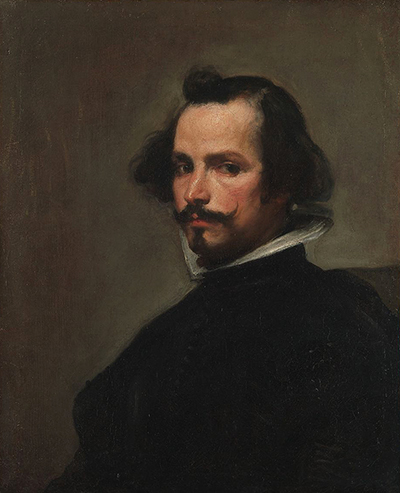
The man has turned his face towards us while his body remains at an angle. His eyes come a little further round than his nose, which still points towards the left of the picture. The brightest light catches his forehead. Beneath it, a moustache spreads across the face in two dark strokes and turns upwards at the ends. The look is direct, even though much of the body is scarcely distinguished from the dark around it. In New York, the Metropolitan Museum of Art calls this painting Portrait of a Man and credits it as “Possibly by Velázquez”. The sitter’s identity remains open. [1]
The Met dates the painting to about 1650. It is an oil on canvas, 69.2 × 56.5 cm, and entered the museum in 1889 as a gift from Henry G. Marquand. Its accession number is 89.15.29. The name Caballero Marquand, used in Spanish scholarship, refers to the collector. It helps to identify the canvas among the many portraits catalogued under generic titles. The date places it near works Velázquez painted during his second Italian visit, the comparison on which much of the case for his authorship rests. [1] [2]
At a Glance
- CollectionThe Metropolitan Museum of Art, 89.15.29 [1]
- DateAbout 1650 [1]
- AttributionPossibly by Velázquez [1]
Contents
- The turn of the head
- What the paint examination found
- From a presumed self-portrait to an unnamed sitter
- The other Met portrait
The turn of the head
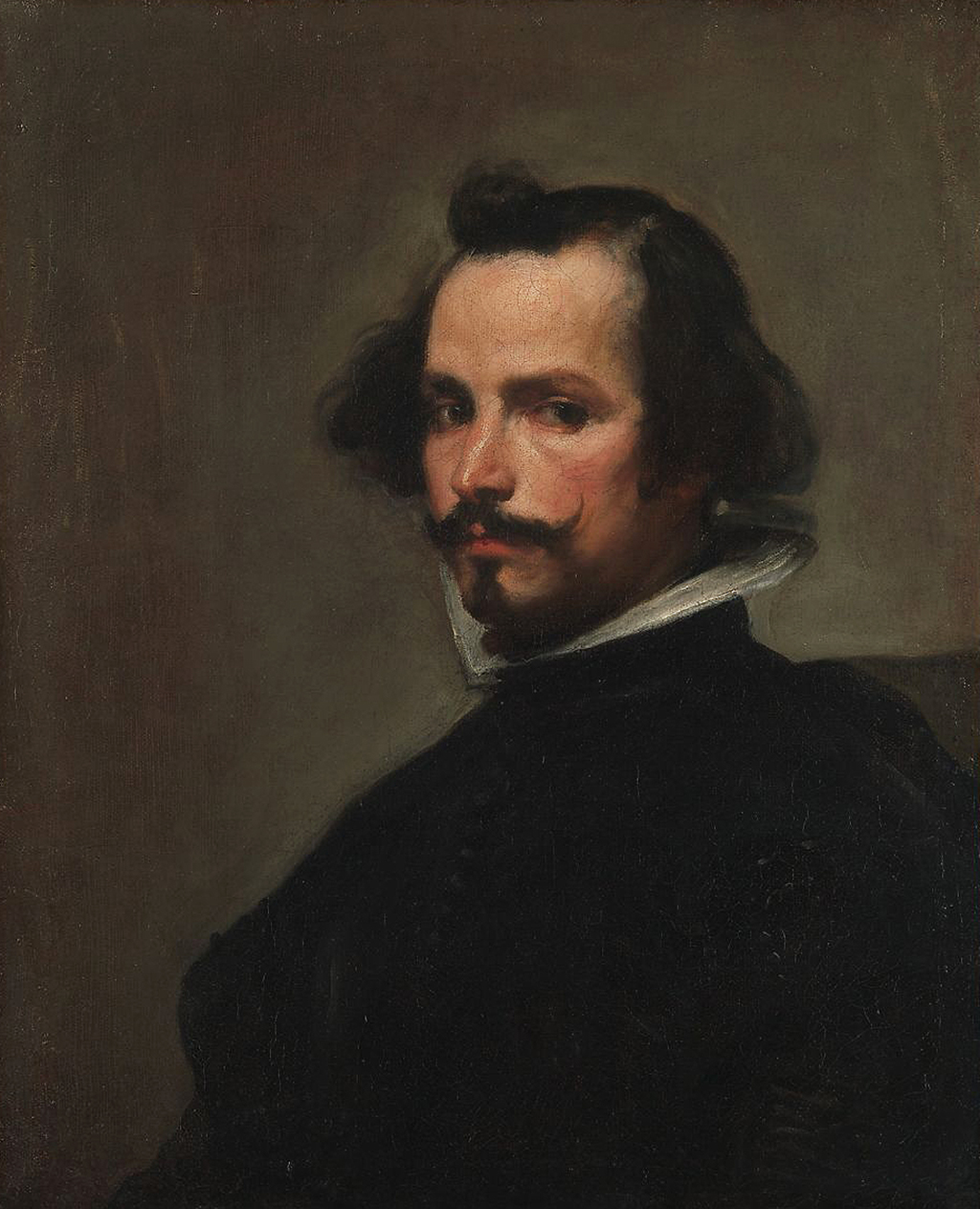
There is a wide interval between the figure’s hair and the top of the canvas, with more air in front of his face than behind his shoulder. This space gives the slight turn somewhere to go. The shoulder on our right is close to the edge of the picture and the coat takes up much of the lower half. Trace the line from the lower left towards the chin and the clues to the position of the body change. A broad dark contour leads first to the angular point of the collar, then to the shorter curve of the jaw. The painter fits the head onto the body with a few sharply differing directions. The eyes can appear to catch us in the middle of that turn. [1]
The broad light on the forehead has a ragged border against the hair. Near the brow, the skin colours become warmer. The cheek on our right carries some pink where it begins to turn away, and the shadows beside the nose make the eye sockets seem to sit further back. The dark point above the eye on our left is tiny beside the expanse of forehead. It has the weight of a stroke placed by itself. The moustache catches the eye with its extended tips, while the short beard breaks up around the mouth and chin. From a distance these marks gather into an expression. Up close, each contributes a different kind of edge to the face. [1] [2]
The collar makes the head’s angle particularly easy to follow. Its front point is low and close to the chin, while the strip of cloth behind the jaw rises towards the hair. Only part of the collar reads as nearly white. Its lower edge passes through greys that pick out the cloth against the coat and let the back of the neck recede. The black costume can take a moment to come into focus. The outer shoulder on our right starts out with a definite slope, then darkens into the lower corner. On our left the contour softens, with a band of light beside it blending the figure into the brown-grey setting. Against the broad dark coat, the little diagonal of pale collar does the work of several larger folds. [1] [2]
The dark form behind the shoulder on our right reads as the back of a seat. Javier Portús describes the man as seated and draws attention to the short hair, raised forelock and lack of insignia. He compares the hair and beard with those in a print of Gregorio de Tapia dated to 1644. The print gives a dated comparison for the fashion. Within the painted likeness the raised hair, tips of the moustache and narrow collar make a series of small interruptions to the otherwise subdued silhouette. The dress offers a line of enquiry about the sitter’s milieu, while the face and clothes leave his name and function open. [1] [2]
What the paint examination found
A research project begun at the Met in 2014 brought the Marquand canvas and other works associated with Velázquez into the conservation studio. In the study published in 2019, Portús and the museum collaborators document revisions around the Marquand sitter’s collar. They describe dark lines running between the underside of the chin and the back of the neck in infrared images, along with angled marks associated with the collar point. They interpret the lower lines as a preliminary laying-in that helped the painter set the head in place. The changes around that point show how the painter adjusted the finished contour of the collar. The authors also consider whether the dark point over the sitter’s right eye may belong to this process of placing the features. That last suggestion remains an interpretation of the mark. [2]
The Met’s collection summary draws attention to the similarity of the canvas weave and ground preparation to those of Velázquez’s Portrait of Juan de Pareja, painted in Rome in 1650. The ground is the preparation between the canvas and the paint that forms the image. The published examination reports a relatively open weave in both portraits, compared with canvases commonly used by Velázquez in Madrid. Both examined grounds also contain particles characteristic of washed wood ash. Comparison of a sample in cross-section can show the positions of these particles and of the coloured layers above them. The Marquand sample includes a further iron-rich layer in the preparation. The two canvases share some working materials and methods, and the measured weave and layer structure show differences of their own. [1] [2] [3] [4]
The comparison is also visible on the surface. In the Marquand portrait a small light-grey touch helps divide the dark hair from the neck. The study identifies a similar decision in the portrait of Pareja. From a few feet away the mark reads as space where two dark tones might otherwise run together. Around Pareja’s throat the broad, irregular lace collar makes the turn of his body visible across a much larger area. The Marquand figure has only a narrow strip of light to bring neck, chin and shoulder into relation. The eye can work out both poses, though the painters had different expanses of pale fabric to work with. [1] [2] [3]
Portús argues for Velázquez and proposes Rome around 1649–50. The link to Pareja makes that a specific setting in which to consider the painting. The Met keeps the date at about 1650 and presents as one theory a Spaniard painted by Velázquez in Italy during his journey of 1649–51. It also allows for Juan Bautista Martínez del Mazo, Velázquez’s son-in-law and an artist able to work in a manner close to his. The underdrawing, in the museum’s account, is consistent with Velázquez. Its forms and the similarities to Pareja give the attribution grounds beyond a general impression of style. The museum’s wording still leaves room for a painter familiar with the same procedures. [1] [2] [3]

Juan de Pareja (ca. 1608–1670). The securely identified Met portrait provides a comparison for lighting and the turn of the head. View Portrait of Juan de Pareja.
From a presumed self-portrait to an unnamed sitter
José Luis Colomer traces the painting back to the collection of Manuel Godoy and follows it through the dealer William Buchanan and the Marquesses of Lansdowne to Marquand. In 1883 Charles B. Curtis described a portrait of this appearance in the Lansdowne collection. He gave its direction of turn, dark hair, clothes, narrow collar and greyish ground, and recorded a sale by Buchanan to the Marquess in 1814. He thought the features resembled Velázquez’s. His account helps explain how the face became known under the painter’s name. The proposed Godoy and Lansdowne history is an account of the picture’s later ownership, with the early steps reconstructed from records made long after the proposed sitting. [5] [6]
Colomer cites a letter from the London dealers Agnew’s to Marquand dated 2 March 1889 in the Met archives. Marquand bought the portrait from Agnew’s as a presumed self-portrait and gave it to the museum in the same year. The accession number secures the identification at that point. The 1954 Met catalogue put it under the workshop of Velázquez and retained a question about whether the face was his. On the Marquand painting’s label at the Met’s 2009 exhibition, the workshop credit remained and a suggestion that Mazo might have painted his own portrait appeared as a hypothesis. [1] [5] [7] [8]
The identity of the painter and the identity of the sitter can therefore lead in different directions. Portús and his collaborators compare the face with a figure identified as Mazo in the View of Zaragoza and reject a match. Portús also raises the possibility that the man could be Juan de Córdoba, a Spanish agent closely associated with Velázquez in Rome. His proposal depends in part on the argument for where the portrait was painted. The museum retains the descriptive title, and its authorship line still admits the possibility of Mazo even with the sitter unnamed. [1] [2]
The other Met portrait
The Met’s Portrait of a Man, Possibly a Self-Portrait is a second canvas, 49.7.42, from the Jules Bache Collection. The museum dates it to about 1635 and credits the painting to Velázquez. In both compositions a man with dark hair turns a watchful face out of a subdued background. The Marquand sitter’s swept-up forelock exposes more of the centre of the forehead. His pale collar has a pointed front on our left, and the costume falls into a large, nearly continuous dark shape. In the Bache portrait the curls drop beside the forehead, the visible sweep of collar appears behind the jaw on our right, and brown and blue-grey passages give the shoulder and sleeve more separate shapes. The two faces can be told apart from their silhouettes before any comparison of features. [1] [9]
Michael Gallagher’s account of removing discoloured varnish and old retouching in Velázquez Rediscovered concerns the Bache painting. For that painting, the Met proposes a connection to a face looking out of The Surrender of Breda. The infrared examination of the Marquand canvas brings us back to the small differences between the two sides of the collar and the underside of the jaw. Those few centimetres preserve signs of the painter adjusting the thing that first draws us in, the relation between a body turned to the side and a man looking back. [1] [2] [9] [10]
Artworks directory
Frequently Asked Questions
The Metropolitan Museum of Art, 89.15.29 [1]
About 1650 [1]
Possibly by Velázquez [1]
There is a wide interval between the figure’s hair and the top of the canvas, with more air in front of his face than behind his shoulder. This space gives the slight turn somewhere to go. The shoulder on our right is close to the edge of the picture and the coat takes up much of the lower half. [1]
Discussion
Look again at the images and ideas explored in Portrait of a Man. These editorial prompts invite your observations.
Reader Insights
How does the way the face meets the dark surround affect the direction of the gaze?
Which parts of the attribution question can the painted surface help answer?
Join the Conversation
Share a detail, comparison or question about Portrait of a Man below.
References
- The Metropolitan Museum of Art, Portrait of a Man, possibly by Velázquez, 89.15.29, object 437875. Collection record and reproduction. View source.
- Javier Portús, with Dorothy Mahon, Silvia A. Centeno and Federico Carò, “El mejor Velázquez”, ARS Magazine 42 (2019), pp. 58–69. Illustrated study. View source.
- The Metropolitan Museum of Art, Diego Velázquez, Juan de Pareja (ca. 1608–1670), 1971.86, object 437869. Collection record and reproduction · 2023 exhibition overview. View source 1. View source 2.
- Silvia A. Centeno, Federico Carò, José Luis Lazarte Luna and Dorothy Mahon, “Plant Ash in Ground Preparations”. Met research essay and comparative micrographs. View source.
- José Luis Colomer, “Competing for a Velázquez: New York Collectors after the Spanish Master”, in Collecting Spanish Art: Spain’s Golden Age and America’s Gilded Age (2012), pp. 252–54, especially fig. 2 and nn. 9–10. Author’s copy. View source.
- Charles B. Curtis, Velazquez and Murillo (1883), pp. 82–83, no. 201. Digitised catalogue. View source.
- The Metropolitan Museum of Art, A Concise Catalogue of the European Paintings in the Metropolitan Museum of Art (1954), p. 98. Digitised catalogue. View source.
- The Metropolitan Museum of Art, Velázquez Rediscovered gallery labels (2009), label for 89.15.29. Watson Library archive. View source.
- The Metropolitan Museum of Art, Diego Velázquez, Portrait of a Man, Possibly a Self-Portrait, 49.7.42, object 437874. Collection record and reproduction. View source.
- Michael Gallagher, “A Velázquez Unveiled”, in Velázquez Rediscovered (2009), pp. 16–22, for the Bache painting, 49.7.42. Met exhibition publication. View source.






