


 by Tom Gurney
Tom Gurney BSc (Hons) is an art history expert with over 20 years experience
Published on June 19, 2020 / Updated on October 14, 2023
Email: tomgurney1@gmail.com / Phone: +44 7429 011000
María de Austria, Queen of Hungary: Introduction
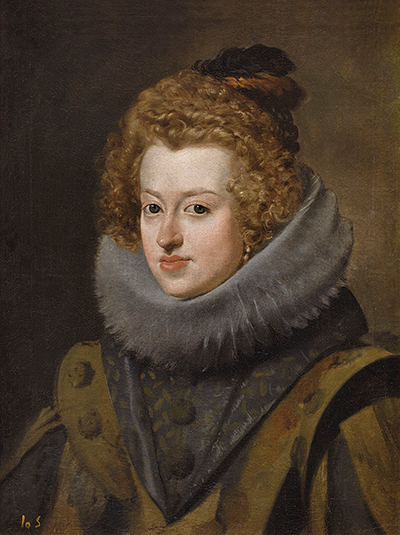
A sweep of grey gauze rises almost to María’s ear on the right of Diego Velázquez’s portrait. Follow it down and the folds gather in a shallow curve beneath her chin. Her eyes meet ours across the slight turn of her head, and a darker fold of the ruff recedes into the collar behind. The painting is an oil on canvas measuring 59.5 × 44.5 cm, now in the Museo Nacional del Prado in Madrid (P001187). It is usually dated around 1630. The small canvas depicts Philip IV’s sister María Ana, also called Maria Anna of Spain. The title comes from her marriage to the Habsburg king of Hungary. Her later role as Holy Roman Empress belongs to a different moment in her life. [1] [2] [3]
At a Glance
- CollectionMuseo Nacional del Prado, P001187 [2]
- Usually datedAround 1630 [1] [3]
- SitterMaría Ana, sister of Philip IV [1]
The evidence for María’s portrait
A document dated to late October includes the Infanta among the royal sitters.
The 1630 dating remains an interpretation of Prado P001187.
Pacheco records the sitting. Its connection to the surviving canvas is uncertain.
María and Ferdinand meet in person
1631 [1]The meeting followed years of negotiations and exchanges of portraits.
Contents
- A face framed by hair and gauze
- The Spanish Infanta and the Hungarian queen
- The Naples account and the 1628 commission
- Portraits sent and kept
A face framed by hair and gauze
The light falls most clearly across the forehead, the bridge of the nose and the cheek on our right. The turn brings that cheek into view while narrowing the other side of the face. The eyes make a second, smaller adjustment back towards the viewer. Velázquez draws the upper lids sharply enough for the direction of the look to register at once. Elsewhere he lets the features emerge through gentler shifts. A narrow shadow between the lips and a faint warmth below it are enough to give the mouth shape. The chin is fully lit where it meets the ruff, with the line along its base softer than the shadow at the nostril. [1] [3]
Look at the upper edge of the hair. The curls above the forehead pick up the light in broken strokes, while the coils behind them become harder to distinguish as they approach the dark ornament at the crown. The pale loops beside the face have something of the irregularity of the folds below. In the ruff the strokes lengthen, following the pull of the gauze from its attachment at the neck. A softly lit turnover at the outside edge shows how the collar widens towards the back. Even at this scale the light has different work to do on hair, skin and cloth. The hair catches it in short touches, the skin carries it in more continuous passages and the gauze makes it seem to spread between several layers. [1] [3]
Below the ruff the costume gives the portrait a second structure. Dark edging on the bodice descends into a V. Tawny bands with round ornaments rise towards the shoulders, with a dark stripe carrying that movement out of the frame on the right. The orderly lines of the dress make the slightly tilted ruff easier to notice. The sides and lower edge of the canvas cut through the sleeves and bodice, and the painted background supplies no furniture or architectural lines. Its brown varies in tone, deeper along the left of the head and warmer towards the right. That small change keeps the head distinct even where individual curls disappear into shadow. [1] [2]
The Spanish Infanta and the Hungarian queen
María was the daughter of Philip III of Spain and Margaret of Austria, and the younger sister of Philip IV. In 1623 Charles, Prince of Wales and the future Charles I, came to Madrid during negotiations for a marriage to her. The English match fell through. She was subsequently betrothed to her cousin Ferdinand of Habsburg, who was crowned in Hungary in 1625 and in Bohemia in 1627. The proxy marriage took place in Madrid in 1629. María travelled to join Ferdinand and met him in person in February 1631, the year of their wedding in Vienna. By her Naples stop in 1630 she was already referred to as Queen of Hungary. She was queen consort of Hungary and Bohemia through her marriage and became Holy Roman Empress in 1637, when her husband succeeded his father as emperor. María and Ferdinand’s daughter, Mariana of Austria, married her maternal uncle Philip IV in 1649 and became Queen of Spain. [1] [3] [4] [5]
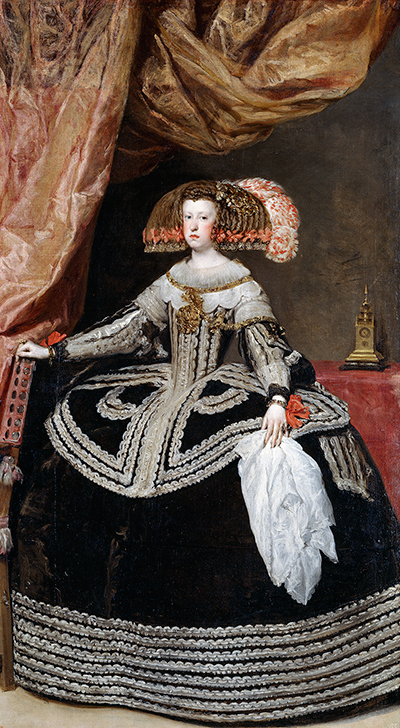
Queen Mariana of Austria. The full-length portrait depicts the sitter’s daughter, Mariana of Austria, whose name can easily be confused with hers. View Queen Mariana of Austria.
The Naples account and the 1628 commission
On his first Italian journey, Velázquez sailed from Barcelona in August 1629 and spent about a year in Rome. Francisco Pacheco, his former teacher and father-in-law, reports that Velázquez stopped in Naples on the way back from Rome and painted a portrait of the Queen of Hungary to bring to Philip IV. That statement, published in Arte de la pintura in 1649, records a likeness made in Naples and names its intended recipient by title. It gives neither a description of the composition nor a day on which María sat. The Prado’s 1990 catalogue identified the surviving canvas with this account and proposed 13 August to 18 December 1630, the limits it gives for María’s stay in Naples. Those dates describe the possible interval for the work if the identification is correct. [2] [3] [6]
A document from late October 1628 changes how securely we can make the connection. It concerns a commission to Velázquez for royal family portraits, including one of María, while she was still a Spanish infanta awaiting her marriage. The commission provides a second setting in which the Prado picture could have been made. It establishes that a likeness was requested and leaves the completion of the paintings and the identity of any surviving canvas open. The year 1628 rests on an event in Madrid records. The year 1630 rests on Pacheco’s account of Naples and the chronology of María’s journey. The dimensions and distinctive dress of the Prado canvas are absent from both accounts. [1] [3] [6]
Juan J. Luna, writing in the Prado’s 2015 portrait catalogue, explains how the same picture can sustain both readings. José Gudiol preferred the earlier date because of the way the face is modelled, which he linked to likenesses of Philip IV and the Infante Don Carlos painted before the Italian journey. Luna favoured 1630 because of the brief, lively strokes in the hair and the softness of the ruff. He compared the hair to the head in Apollo in the Forge of Vulcan, a painting associated with Velázquez’s time in Italy. Looking back at María’s portrait, the firm contours of the eyes and the broken highlights at her temples make it possible to follow both arguments across a few centimetres of paint. [3]
Portraits sent and kept
There is a reason for taking Pacheco’s account of the intended recipient seriously. Likenesses passed between the Spanish and Austrian Habsburg courts during the marriage negotiations. In 1629 Ferdinand II sent an envoy to Madrid to present María with a diamond jewel bearing her future husband’s likeness. Years later, during one of Ferdinand’s absences, María wrote to ask him for a portrait small enough to carry with her. She explained that she already had his large portrait in her room. Her letter of 2 June 1635 distinguishes between two ways of keeping someone’s likeness close, by setting it in a familiar room and by having it travel with her. The Prado portrait is much larger than a miniature. In the Naples account the direction of travel is also different, from the departing sister back to her brother’s court. [1] [6]
How the surviving canvas entered royal custody is harder to trace. The Prado’s 1990 catalogue connected it to a likeness recorded in Velázquez’s rooms in the Alcázar at his death in 1660, and listed later inventory appearances at the Quinta del Duque del Arco and the Buen Retiro. It left the painting’s arrival at the Prado undated, proposing a possible match with an entry for an unidentified woman in the museum’s 1828 catalogue. Luna treats the link to the 1660 record as tentative. The early inventories lack enough detail to follow the chain securely all the way to the museum, which identifies its provenance as the Royal Collection. The idea that the bust was a study for a larger composition also remains a proposal. Other portraits of the sitter survive, including a full-length in Prague listed as the work of Velázquez’s workshop. Its existence shows how much the choice of format changes what a royal portrait can present. It leaves the original purpose of the Prado bust open. [2] [3] [7]
Velázquez’s full-length image of María’s daughter, dated 1652–53 by the Prado (P001191), offers another way to see what the smaller format does. Mariana of Austria stands beside a chair with a handkerchief hanging from one hand. Bright bands of trim carry the eye down the bodice and around the breadth of the skirt, below a curtain that rises over the figure. A viewer must take in several feet of painted fabric and furnishings before seeing the whole design. In the mother’s portrait the nearest edge of the costume leads up almost at once to the head, and the face, gauze and curls can be seen together from close by. The grey collar makes that concentrated viewing possible. Its pale curve carries the eye round the head to the small changes of light on which this likeness depends. [2] [8]
Artworks directory
Frequently Asked Questions
María Ana, Queen of Hungary, was Philip IV’s sister. Mariana of Austria was María Ana’s daughter and later became Philip IV’s second wife. [1] [4]
Museo Nacional del Prado, P001187 [2]
Discussion
Look again at the images and ideas explored in María de Austria, Queen of Hungary. These editorial prompts invite your observations.
Reader Insights
How does the light across the ruff guide your eye towards María’s face?
What would help identify the Prado bust with the sitting that Pacheco describes?
Join the Conversation
Share a detail, comparison or question about María de Austria, Queen of Hungary below.
References
- Andrea Sommer-Mathis and Christian Standhartinger, “Le suplico me ynbíe un rretrato chiquito suyo para que le pueda traer conmigo. La emperatriz María Ana de Austria (1606–1646) y el uso de los retratos en la corte imperial de Viena”, Librosdelacorte.es, no. 28, 2024, pp. 397–429, especially pp. 404–405, fig. 3 and n. 24, and pp. 407–410, including the letter of 2 June 1635, HHStA, HausA, FKA, leg. 31-4-3, fols. 98–99. Spanish. View source.
- Museo Nacional del Prado, Velázquez, exhibition catalogue, Madrid, 1990, no. 22, pp. 154–157, Prado 1187 (P001187), and no. 71, pp. 408–411, Prado 1191 (P001191). Spanish. View source.
- Juan J. Luna, “Doña María de Austria, reina de Hungría”, El retrato español en el Museo del Prado. Del Greco a Sorolla, Museo Nacional del Prado and Acción Cultural Española, 2015, pp. 50–51, Prado P001187. Spanish. View source.
- Neue Deutsche Biographie, “Maria Anna (Mariana)”, vol. 16, 1990, entry for Mariana of Austria (1634–1696), genealogy and marriage. German. View source.
- Mark Hengerer, “Ferdinand II. (1619–37) und Ferdinand III. (1637–57)”, in Werner Paravicini (ed.), Höfe und Residenzen im spätmittelalterlichen Reich, Ostfildern, 2003, pp. 404–417, especially p. 404 for Ferdinand III’s crowns and accession. German. View source.
- Francisco Pacheco, Arte de la pintura, Seville, 1649, pp. 103–105, “El primer viaje a Italia”, transcribed by Santiago Arroyo Esteban for the Universidad Complutense de Madrid. Spanish. View source.
- Boletín Oficial del Estado, Order CLT/868/2026, 11 August 2026, no. 203, annex item 29, workshop of Diego Velázquez, Retrato de la infanta María Ana, Národní galerie v Praze, DO 4985. Spanish. View source.
- Museo Nacional del Prado, Memoria de actividades 2022, p. 478, Velázquez exhibition loan to the Accademia Carrara, La reina doña Mariana de Austria, P001191. Spanish. View source.







