


 by Tom Gurney
Tom Gurney BSc (Hons) is an art history expert with over 20 years experience
Published on June 19, 2020 / Updated on October 14, 2023
Email: tomgurney1@gmail.com / Phone: +44 7429 011000
King Philip IV of Spain (1644): Introduction
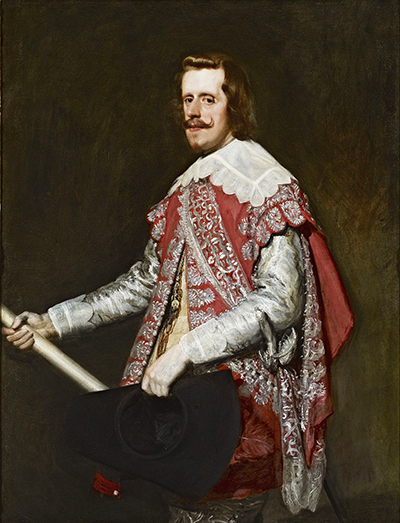
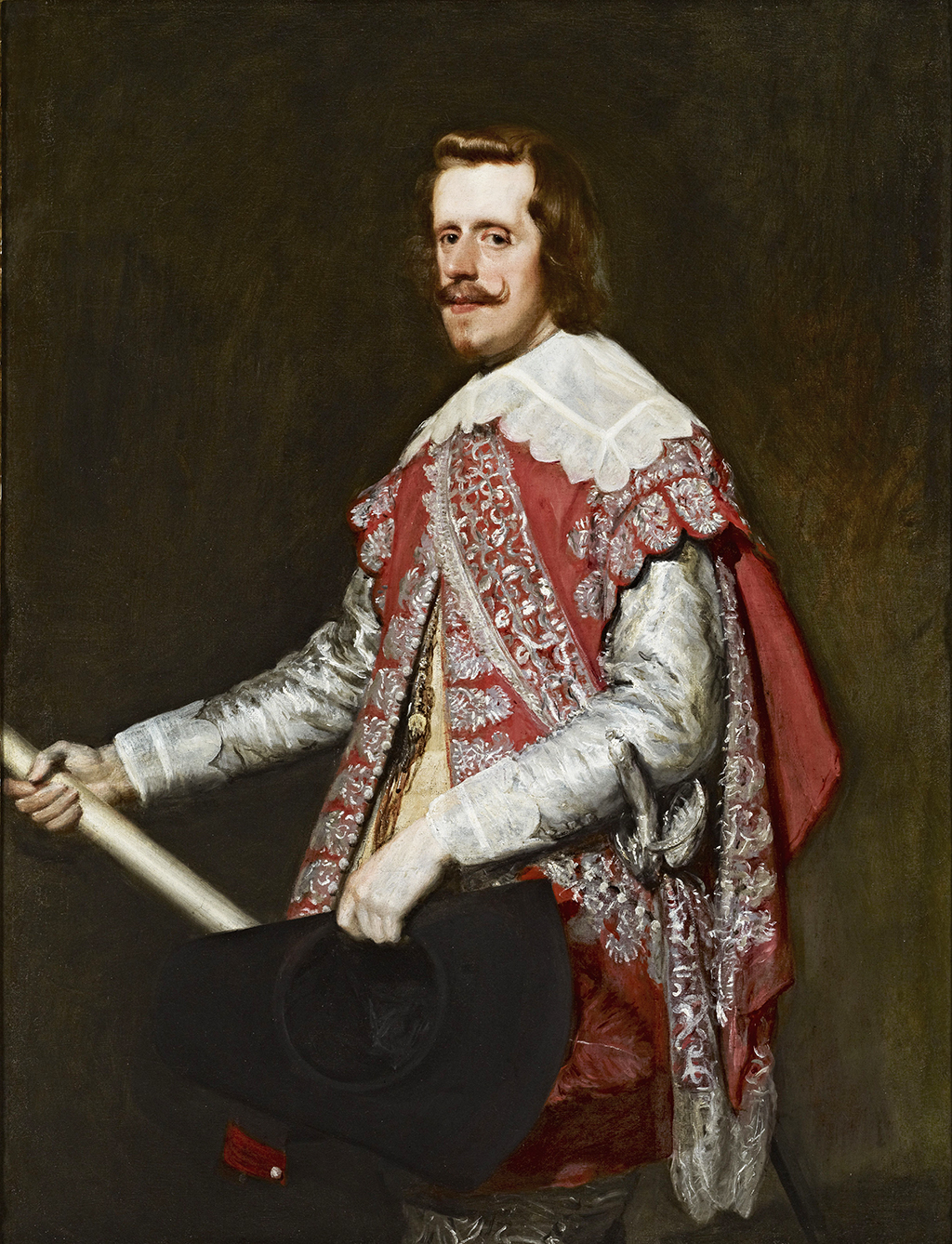
Philip IV holds out his baton at about waist height. The white staff points down into the space beside him, where its firm outline makes it easy to pick out. His other hand holds a black hat whose brim nearly disappears into the dark around it. Both hands are occupied, and both are low enough to leave the broad white collar, the red coat and the king’s face in full view. His shoulders are turned slightly. His gaze reaches us across that turn, with little movement in his expression. [1] [2]
Velázquez painted King Philip IV of Spain at Fraga, in Aragon, in 1644. A Spanish army was besieging nearby Lérida, now Lleida, and the king was following operations from Fraga. By 10 August the canvas was in Madrid, where it hung beneath a gold-embroidered canopy at a thanksgiving service for the recovery of the city. The painting is an oil on canvas measuring 129.9 × 99.4 cm. It belongs to The Frick Collection in New York as 1911.1.123 and is often called the Fraga portrait. [1] [2] [3] [4]
At a Glance
Contents
- What the silver does
- Three sittings at Fraga
- Under a canopy in Madrid
- The painter moved the hat
- The same sitter in London
What the silver does
Start where the coat opens, on the viewer’s left. A band of silver-coloured ornament follows the bright red edge down from the shoulder. Nearby the sash takes a different course across the chest to the sword. Its diagonal is easier to follow if you step back. At close range, grey and lilac strokes sit among flecks and curves of white. Some marks make short chains of light, while others gather where the cloth turns or overlaps. The dark intervals make us supply parts of the pattern ourselves. Velázquez can give a thick band of fabric a continuous edge with a series of interrupted highlights. [1] [2]
The white collar has a different kind of breadth. It falls onto the shoulders in relatively flat planes and casts thin shadows where it meets the coat. Its edge brings the eye round to the jaw. The silver ornament below it is busy across a much larger area, but the collar makes a clearing around the head. The face is surrounded by warm brown hair and the white band beneath it. A narrow shadow under the nose and the upward flicks of the moustache give the lower half of the face a few decisive lines. The mouth is closed, and the eyes hold their direction while the broken strokes of the clothing continually shift ours. It is possible to read the expression as reserved or attentive. Much of that impression depends on the stillness Velázquez gives the face within such animated painting. [1] [2]
The Frick identifies the garment as a crimson sobreveste, or overcoat, and the collar as a valona. The black hat, a montera, carries a red plume. A sword hangs from the sash, its hilt catching light near the left hand. In a small reproduction the pale staff is easily mistaken for paper rolled into a tube. Look at the way Philip’s fingers close around it and how its sides continue below the grip. This is a general’s baton, held at a diagonal that opens a wedge of dark space between it and the coat. Spanish troops of the period had no standard uniform. The Frick notes that soldiers might wear garments of a similar cut in cheaper materials. The cut could speak of the campaign, while the quantity and quality of the silver ornament declared the wearer’s rank. [1] [2] [5]
Three sittings at Fraga
The court travelled to Aragon in the course of a war with France and following the rebellion that had broken out in Catalonia in 1640. Philip and his entourage were based at Fraga by early May 1644, within reach of the siege of Lérida. Velázquez travelled as a court servant with access to the king as well as the painter responsible for his likeness. The Frick’s historical dossier connects the outfit in the painting with the dress Philip wore to review his troops. Green fields, fortifications and even the floor of the temporary studio fall outside the painted view. The king carries the circumstances of the sitting in the clothes and objects he brought to it. [2] [5] [6]
A palace household account transcribed as document 177 in the Corpus Velazqueño records an order made at Fraga on 1 June 1644 to make a room fit for the king to be painted. The room had no proper floor, its walls needed propping up, and an opening had to be made for a window. An entry names the carpenter Pedro Colomo and puts the charge for an easel at six reales. Another records that the portrait took three days on separate occasions, with a load of rushes bought each day for the floor. The account records a wooden case and wrapping to send the likeness to the queen. These are expenses incurred to make and move the painting. Their small particulars establish where it was made and how the sittings were organised even though the dates of the individual sittings are unspecified. [3] [5] [6]
The contrast in materials runs from the rushes under the king’s feet to the silver thread along his sleeves. It also helps explain the practical work implied by the term court painter. Before Velázquez could begin, a room had to be shored up and a window opened. The easel had to be made locally. Once the sittings were over, the canvas had to be packed for the journey to a court that had stayed behind. There is room in this history for skilful improvisation as well as the ordinary labour of the people who prepared the workroom. [3] [5]
Under a canopy in Madrid
On 16 August 1644 the chronicler José Pellicer y Tovar reported that the king had sent the queen a likeness in the dress he wore on campaign. Pellicer specified red and silver and a baton. He recorded that the Catalan community had secured the loan of the portrait, that it had been hung beneath a canopy embroidered in gold, and that a crowd came to see it. Copies were already being made, he said. The Avisos entry, transcribed as document 178 in the Corpus Velazqueño, is a particularly good match for the surviving composition because of the dress and baton Pellicer singles out. The Frick places the display in the church of San Martín on 10 August, six days before the report. [2] [3] [5]
The royal preacher José Laínez addressed the congregation at San Martín. A published version of his thanksgiving sermon survives, with an engraving by Juan de Noort recorded in the University of Seville’s copy. Pérez d’Ors’s study of the sermon for the Frick shows how Laínez set out the terms in which the people in the church were invited to understand the portrait. He invoked Mars, the Roman god of war, and credited the recovery of the city to divine favour. Philip took the role of a father able to pardon. This let the preacher speak about reconciliation to an audience attending a celebration of a victory over opponents who included the king’s own subjects. The engraving accompanying the printed text develops the sermon’s argument in a different form, with the king above weapons and crowned by personifications of Religion and Faith. [2] [5] [7]
The Frick canvas has neither battlefield nor allegorical figures. Its military signs lie within the reach of Philip’s hands. The sword sits at his side, the baton is lowered, and the hat is held off the head. The ceremony supplied the victory, the canopy supplied the formal place of honour, and the sermon supplied a way of reading the king’s composure. A visitor looking at the canvas today can still trace the distribution of the brightest paint. Collar, cuffs and silver ornament make separate points of light from which the figure can be assembled at a distance. How they actually appeared to each person inside the church, and how every person took the preacher’s message, remain open questions. [1] [2] [5]
The painter moved the hat
In 2009 Michael Gallagher treated the portrait at The Metropolitan Museum of Art for the Frick. Discoloured varnish and wax had dulled differences across the surface. The cleaning brought back the contrast between the brocade, intervening greys and broad passages of red. Gallagher and the examining team used microscopy, X-radiography and infrared reflectography to investigate the canvas. The Frick’s report identifies changes Velázquez made as he worked. He raised the hat and adjusted the left hand and cuff to meet it, reshaped the outline of the coat, lowered the sword and narrowed the sash. [5] [8]
Those changes are worth considering together. The hat now comes up into the band of activity around the sword and cuffs. Light on the wrist helps us locate the hand even where the hat blends into the background. The sash has room to pass down through the front of the coat without covering as much of it. The Frick’s dossier allows for the possibility that Philip moved between sittings and favours a deliberate reconsideration of the composition. The records of the sittings and the evidence under the surface tell us different things. They give us the time available with the model and show how much Velázquez could change while working on the picture. [3] [5] [8]
X-radiography also confirmed alterations to the format of the canvas. The dossier uses a slightly larger workshop version in a private collection at the time of the exhibition to help explain the hint of boot decoration at the lower edge of the Frick painting. That version shows a greater extent of the fringe. It provides a clue to the earlier reach of the image. Dulwich Picture Gallery owns another copy, DPG249, which it dates to 1644–60 and assigns to Velázquez’s workshop, with Juan Bautista Martínez del Mazo as a possibility. Pellicer’s notice establishes that copying began early. Neither the Dulwich attribution nor the study of the larger canvas identifies one of Pellicer’s copies by name. [3] [5] [9]
The same sitter in London
In Philip IV of Spain in Brown and Silver, painted about 1631–32 and now in the National Gallery, London, silver spreads across a much longer figure. We can look down to the king’s shoes and across to the table covered in red velvet. The hat rests on that table, leaving one hand free to hold a petition that carries Velázquez’s signature. The curtain and furniture give the figure surroundings in which to stand and act. In the Fraga portrait, the hat has moved into the king’s hand and the baton projects into the surrounding dark. The tighter frame allows the hands and coat to take up a large share of the picture. The earlier painting distributes its signs of ceremony from the feathers of the hat to the distant floor. [1] [10]
The National Gallery’s later Philip IV of Spain (NG745), dated about 1656, comes closer still. Its black coat and dark background nearly join at parts of the shoulder. Small marks pick out the gold chain and the Order of the Golden Fleece, and a light edge defines the collar under the regular waves of his hair. With the hands outside the view, the moustache, the skin beneath the eyes and the fall of light on the cheeks carry an unusually large share of the likeness. The silver and crimson at Fraga divide our attention between that same recognisable face and the king’s equipment. The three canvases let us see how Velázquez could change the amount of body and surroundings he gave a sitter, and how much that choice affects what we notice first. [1] [10] [11]
Henry Clay Frick acquired the Fraga portrait in 1911. The Frick Art Research Library’s collecting files document the transaction with the dealers, while the museum’s dossier records a price of $475,000. That purchase belongs to the painting’s life as a collector’s work. Pellicer described another kind of interest in 1644, when people gathered in a church to see the king’s likeness and painters began to make copies. The coat, hat and baton were visible enough for him to recognise and report. They still give the modern viewer a route into the particular encounter that his account records. [2] [3] [12] [13]
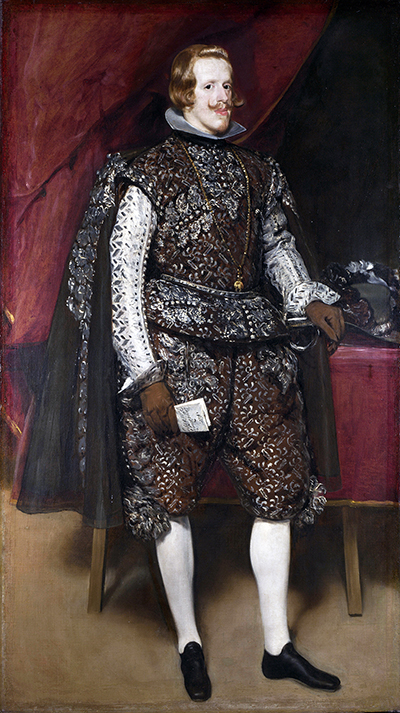
Philip IV of Spain in Brown and Silver. The standing London portrait makes the pattern of the clothes and the display of the king’s hands work on a larger scale. View Philip IV of Spain in Brown and Silver.
Artworks directory
Frequently Asked Questions
Oil on canvas [1]
The Frick Collection, 1911.1.123 [1]
Discussion
Look again at the images and ideas explored in King Philip IV of Spain (1644). These editorial prompts invite your observations.
Reader Insights
What does the light on the silver embroidery draw out of the red costume?
Compare this portrait with Brown and Silver. How does the change in format affect your sense of the king’s presence?
Join the Conversation
Share a detail, comparison or question about King Philip IV of Spain (1644) below.
References
- The Frick Collection, King Philip IV of Spain, 1644, collection object 271. See also the Frick’s illustrated object entry at Google Arts & Culture. View source 1. View source 2.
- The Frick Collection, ‘History and Function’, The King at War. View source.
- Ángel Aterido Fernández, ed., Corpus Velazqueño. Documentos y textos, vol. I (Madrid, 2000), pp. 162–163, docs. 177–178. Archivo General de Palacio, Gastos de la Furriera for 1644, and José Pellicer y Tovar, Avisos, 16 August 1644. View source.
- Jesús Escobar, Habsburg Madrid: Architecture and the Spanish Monarchy, introduction, fig. 4. View source.
- The Frick Collection, Spanish-Themed Fall Features: A Keenly Anticipated Examination of Velázquez’s Portrait of Philip IV, 2010, pp. 2–6. View source.
- Pablo Pérez d’Ors, C. Richard Johnson Jr. and Don H. Johnson, ‘Velázquez in Fraga: a new hypothesis about the portraits of El Primo and Philip IV’, The Burlington Magazine 154 (2012), pp. 620–625. View source.
- José Laínez, Acción de gracias a Dios Nuestro Señor por la entrada triunfal en la Ciudad de Lerida, Pamplona, [1644], University of Seville copy, Biblioteca Virtual Miguel de Cervantes. View source.
- The Frick Collection, ‘Frick Collection Announces Return to Public View of Treated and Examined Velázquez Portrait’, pp. 2–3. View source.
- Dulwich Picture Gallery, Philip IV, King of Spain, DPG249. View source.
- The National Gallery, London, Philip IV of Spain in Brown and Silver, NG1129. View source.
- The National Gallery, London, Philip IV of Spain, NG745. View source.
- The Frick Collection, ‘Chronology and Map’, The King at War. View source.
- Frick Art Research Library, Finding Aid for the Art Collecting Files of Henry Clay Frick, box 9, folder 28. View source.







