


 by Tom Gurney
Tom Gurney BSc (Hons) is an art history expert with over 20 years experience
Published on June 19, 2020 / Updated on October 14, 2023
Email: tomgurney1@gmail.com / Phone: +44 7429 011000
The Venerable Mother Jerónima de la Fuente: Introduction
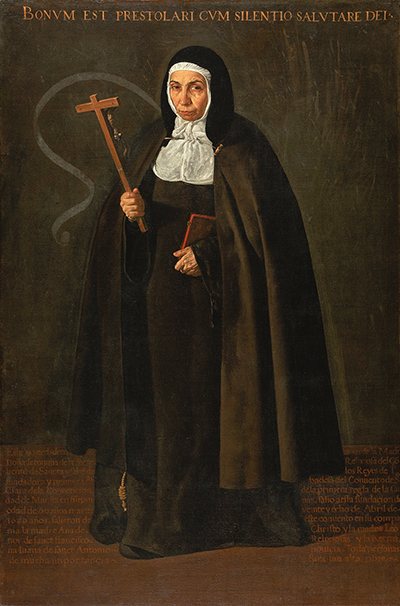
Mother Jerónima raises a crucifix in her right hand. The wooden shaft angles into the dark space beside her face, where the crossbar catches the light. Below it, the fingers around the wood form a tight, illuminated cluster. Her left hand closes over the edge of a book held against her waist. Velázquez makes the two actions easy to read from across a room. Up close they have quite different qualities. The book rests against the body, held steady by the curl of the fingers. The crucifix projects beyond the dark bulk of her habit, where you can follow its diagonal all the way from her knuckles to its upper tip. [1]
This is the full-length portrait in the Museo Nacional del Prado, inventory P002873. The Prado dates it to 1620 and gives its dimensions as 160 × 110 cm, oil on canvas. Its sitter, also known by her religious name Jerónima de la Asunción, belonged to the Franciscan Poor Clares of Santa Isabel de los Reyes in Toledo. She passed through Seville in 1620 on her way to found a convent in Manila. Velázquez painted her during that Spanish leg of the journey. The painting has its own later history in Toledo and Madrid, and a second full-length version, identified by its provenance from the Fernández de Araoz collection, differs in details that are easy to see once you know where to look. [1] [2] [3]
At a Glance
The portrait and Jerónima’s journey
The signed date identifies the painting. The departure date in the later inscription concerns Jerónima’s voyage.
Jerónima reaches Manila
1621 [7]The travellers entered the city on 5 August after making landfall on Luzon in July.
Cleaning reveals the signature
1926 [1]The Toledo convent had known the work as a painting by Luis Tristán.
Acquired from the convent in Toledo
1944 [1]The state acquired the signed canvas with support from the Prado’s trustees.
Contents
- Face, habit and hands
- What the painting says about her journey
- How the two full-length portraits differ
- A portrait kept in Toledo
Face, habit and hands
The brightest area is the white headcloth and wimple, running up close to the temples and falling into a much broader arrangement of folds below the chin. Thin ridges in the white catch the light, especially where the cloth gathers around the neck. A narrow fastening crosses the folds. Above it the face has a range of warmer colours. The shadows at the inner corners of the eyes, under the nose and below the lower lip are small and sharply placed. The set of the mouth can seem stern at a distance. In the Prado catalogue’s large detail, its shape is more complex, with a slightly irregular line where the lips meet and a subtle change of colour towards the corner. Each mark contributes to the likeness without giving us a reliable account of what she was thinking. [1]
From the head downwards the brown Franciscan habit absorbs much of the light. Its broad mantle is particularly legible on the viewer’s right, where a long edge travels down from the shoulder before turning near the bottom. Elsewhere the contours soften into the surrounding brown. Small differences between the warm field, the dark fabric and the lit edges are enough to make the figure stand apart from the background. The hem establishes a standing position, although the heavy folds hide the shape of the feet. A short stretch of pale cord appears low on the viewer’s left. The book’s reddish edging does something comparable higher up, providing a fine line where one dark surface overlaps another. [1]
The objects help explain the pose. The weight of the closed book can be inferred from where the hand braces it and where it presses into the cloth. The raised hand is supported visually by the long sleeve beneath it, but the cross is balanced in the grip and leans away from the body. Its upper bars present the back to the viewer, so the small figure of Christ is largely hidden from this angle. The disposition of the crucifix gives Jerónima’s wrist and hand as much work to do in the picture as the sacred object itself. In the later Christ Crucified, Velázquez brings the wounded body into clear view from the front and gives it most of the canvas. Here a cross small enough to hold helps define the person holding it. [1]
The physical presence has often invited comparison with sculpture. In the Prado exhibition catalogue, Julián Gállego drew attention to the mass of the cloak and the modelling of the sitter. The National Gallery’s guide to The Sacred Made Real, which exhibited the privately held version, compared the browns used for its flesh with those Pacheco applied to Juan Martínez Montañés’s carved Saint Francis Borgia. The comparison helps explain how the head and hands can appear to advance from the drapery. It also gives a context for the young painter’s practice. In Seville, Velázquez trained with Francisco Pacheco, whose work included painting carved figures. The portraits leave a question about which actual crucifix Jerónima held. The legibility of the wood and metal in paint is something we can judge directly. [1] [4] [5]
What the painting says about her journey
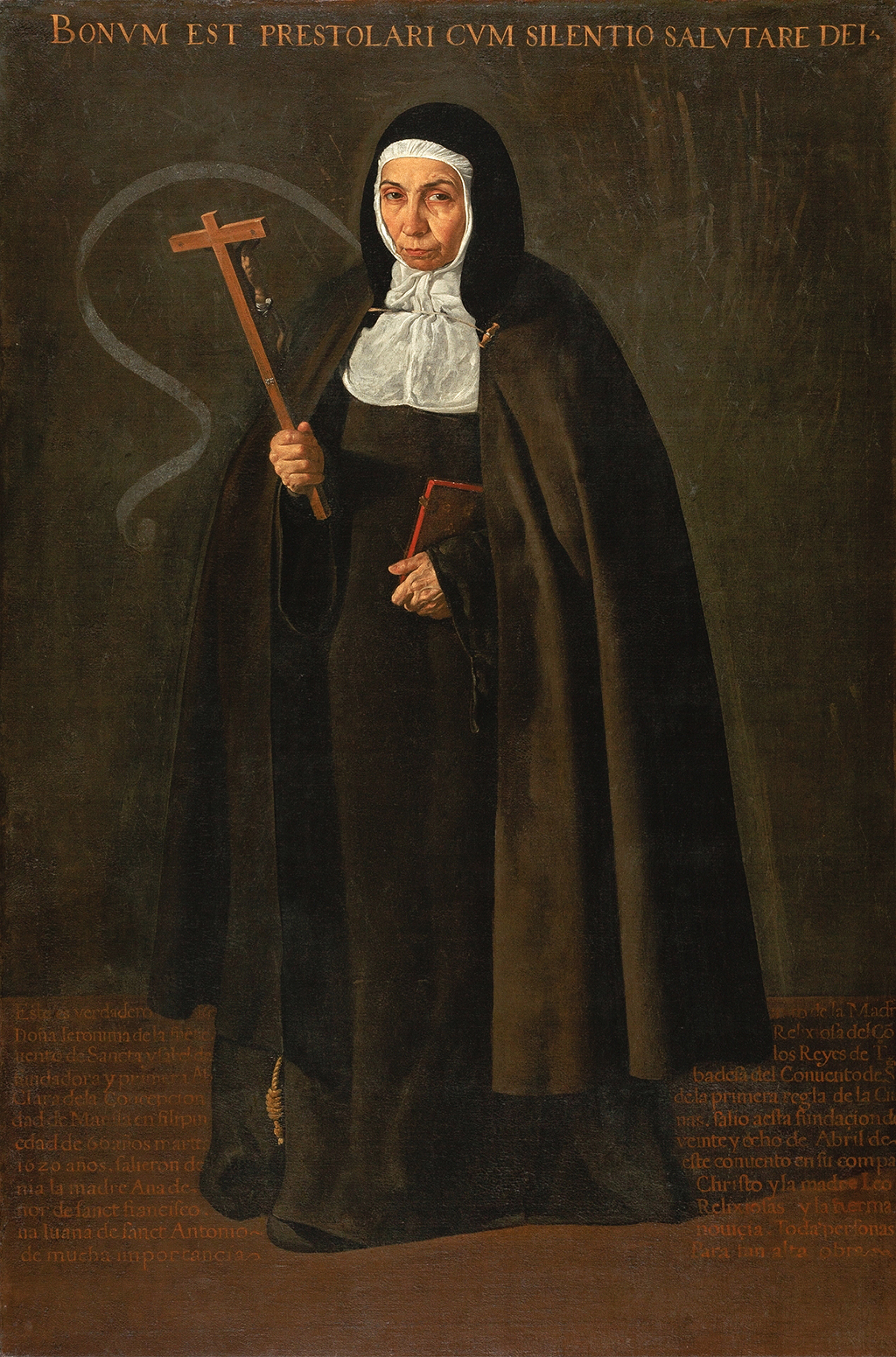
Read across the top and the broad gold-coloured capitals form a single line. They read “BONVM EST PRESTOLARI CVM SILENTIO SALVTARE DEI”, a rendering of Lamentations 3:26 meaning that it is good to wait in silence for God’s deliverance. Waiting, silence and deliverance belong to the verse. The words run across the space above the folded cloth and firmly closed mouth, giving the portrait a devotional register alongside the likeness. Lower down the writing changes scale and language. In much smaller Spanish lettering arranged in two blocks around the habit, an inscription identifies the woman, names her convent in Toledo and calls her foundress and first abbess of Santa Clara de la Concepción in Manila. It begins by calling this her ‘true portrait’. [1] [6]
The inscription records her departure at the age of 66 on 28 April 1620 and names three companions associated with Santa Isabel, Ana de Cristo, Leonor de San Francisco and the novice Juana de San Antonio. The date belongs to the departure recorded in the text. The signature and year uncovered in cleaning give the painting its date, and the usual reconstruction places the sitting during Jerónima’s stay in Seville later that spring. The two dates refer to different moments in the same year. The Prado’s 1990 catalogue treats the Spanish inscription as a later addition. Its wording looks back on a foundation that lay ahead of Jerónima when she sat for the picture. The two text blocks turn a standing likeness into a record of people, places and a completed undertaking. [1] [3]
John N. Crossley and Sarah E. Owens reconstruct the journey from Ana de Cristo’s account and records in Spanish, Philippine and Vatican archives. The women sailed from Spain and reached New Spain by way of the Caribbean. Their party stopped in Mexico City, where two more nuns joined them. From there they travelled overland to Acapulco to take the Manila galleon. One of the women died after the ship left Acapulco. The group made landfall at Bolinao, on Luzon, on 24 July 1621 and entered Manila on 5 August. By keeping landfall and arrival in the city distinct, the archival reconstruction accounts for the course of the last leg as well as the length of the voyage. [7]
Securing the permission and backing for the foundation took years. Crossley and Owens trace the work of Hernando de los Ríos Coronel, the Philippines’ representative at the Spanish court, and the role of people already in Manila who pledged their support. The convent was established there in 1621 and Jerónima died in Manila in 1630. Ana de Cristo, one of the women named at the foot of the painting, later became abbess and wrote about Jerónima and their travels. The manuscript preserves a companion’s account of experiences that the portrait condenses into a name, a departure date and the name of a new house. [7] [8]
How the two full-length portraits differ
The quickest way to distinguish the Prado canvas from the Fernández de Araoz version is to follow the crucifix. In P002873 the flat back of the wood faces us and parts of the figure are visible past its edge. In the Araoz picture the cross has rotated, so that Christ’s body is more readily discernible in profile. The Araoz canvas also preserves the pale curving ribbon that rises near Jerónima’s mouth and loops into the space beside the cross. Known as a phylactery, this kind of painted scroll gives written words the position of speech. The Araoz ribbon reads “SATIABOR DVM GLORI/FICATVS FVERIT”, with the slash marking the division across the scroll. It expresses satisfaction in God being glorified, with an echo of the last verse of Psalm 17. The Prado painting once carried a scroll in much the same place. The ribbon and words were removed during restoration, leaving traces of the curve visible in the Prado catalogue plate. The surviving line across the top and the Spanish text below belong to other parts of the picture. [1] [3] [9]
That change matters at viewing distance. The clearest line in the open space to the left of the Prado sitter is now the diagonal of the raised crucifix. The pale ribbon in the Araoz picture gives that same space a more complex shape, drawing the eye in a loop from the level of the face out beyond the cross and back down towards the hand. As the letters become legible, the association with the mouth makes the words seem to come from the person in the portrait. The Spanish caption along the foot has a different effect. Its author speaks about her and names the women who left with her. The Araoz scroll lets the viewer encounter both voices in a single canvas. [1] [3]
Benito Navarrete Prieto discusses a comparison first proposed by Joan Ainaud de Lasarte. A print by Michael Lasne after a design by Francisco Ribalta represents the Valencian priest Jerónimo Simó holding a crucifix and a book, with a ribbon carrying a line from a hymn. Scenes from Simó’s life surround him. The resemblance helps place Jerónima’s scroll within a practice of making likenesses of people known for their piety. In the Prado canvas the story belongs chiefly to the small writing at the foot. A format that elsewhere surrounded the central figure with episodes from a life can here accommodate a physically dominating likeness and a concentrated account of a single undertaking. The comparison offers a possible precedent for Velázquez’s design. [9]
The Prado painting was known at Santa Isabel as a work by Luis Tristán until cleaning associated with a Franciscan exhibition in 1926 revealed Velázquez’s signature and the date 1620. Prado restorer Jerónimo Seisdedos subsequently located the second portrait at the same convent. The state acquired the first from the community with help from the museum’s trustees in 1944. When the Prado exhibited the two together in 1988, it was possible to compare the two canvases as well as their painted surfaces. The 1990 exhibition catalogue records the then familiar account that both carried the artist’s signature and date. José Manuel Cruz Valdovinos, discussing the technical work of Carmen Garrido, treated the Araoz signature and date as inauthentic and questioned the traditional attribution of that painting to Diego Velázquez. Prado technical researchers Maite Jover de Celis and María Dolores Gayo subsequently cited the different preparatory layers of the two canvases as an instance of distinguishing between work done in Seville and work done in Madrid. The National Gallery exhibited the Araoz picture under Velázquez’s name in 2009, and the 2025 exhibition publication by IOMR also identifies both as the work of the artist. Those attributions concern the execution of the portrait, whereas the signature concerns a mark on its surface. The Prado portrait’s status as a signed 1620 work is secure. The date and authorship of the private version remain matters of scholarly judgement. [1] [3] [4] [10] [11]
A portrait kept in Toledo
Both full-length portraits have a provenance from Santa Isabel de los Reyes. Gállego proposed that Jerónima’s fellow nuns in Toledo might have commissioned a likeness and that Pacheco could have introduced the commission to Velázquez. That would fit the convent’s interest in remembering one of its members and the painter’s relationships in Seville. The surviving evidence establishes the Toledo provenance and shows that the wording of the Spanish caption honours the sisters’ part in the founding. The identity of whoever ordered the picture and the room it was first intended for remain uncertain. An original commission for a likeness and the later decision to record the journey on it could have been made at different moments. [1] [3]
Velázquez’s Adoration of the Magi, also in the Prado, gives another view of what the painter was doing just before 1620. In that altarpiece, directional light picks out the faces and hands of a tightly grouped company, and the kneeling visitor brings his gift towards the child. In Jerónima’s portrait the same attention to grip, weight and side lighting is concentrated in a single person. The hands have the firmness needed to make the book and crucifix credible as objects in use. The face has enough specificity to sustain the name written below it. From where you stand in front of the canvas, the sharply defined hand around the cross and the small changes of light around the eyes remain visible long before you can make out the names of the people who kept her company. [1] [12]
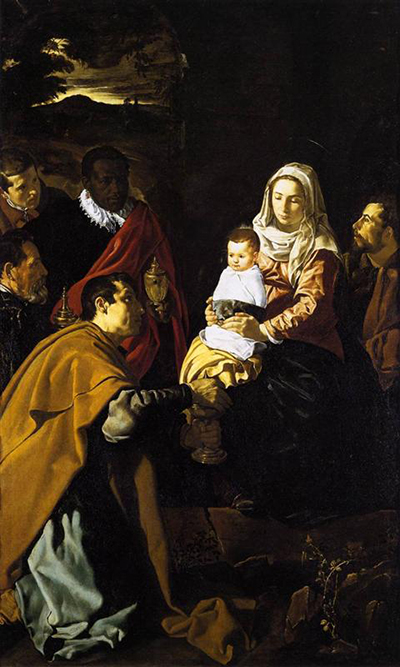
The Adoration of the Magi. Directional light gives faces and hands weight in another securely dated early work. View The Adoration of the Magi.
Artworks directory
Frequently Asked Questions
Museo Nacional del Prado, P002873 [2]
1620 [2]
Oil on canvas [2]
The brightest area is the white headcloth and wimple, running up close to the temples and falling into a much broader arrangement of folds below the chin. Thin ridges in the white catch the light, especially where the cloth gathers around the neck. A narrow fastening crosses the folds. [1]
Discussion
Look again at the images and ideas explored in The Venerable Mother Jerónima de la Fuente. These editorial prompts invite your observations.
Reader Insights
How do the cross and book change the pose?
What can the inscriptions establish about this canvas and the other full-length version?
Join the Conversation
Share a detail, comparison or question about The Venerable Mother Jerónima de la Fuente below.
References
- Julián Gállego, Velázquez, Museo del Prado, 1990, cat. 6, pp. 84–88, including the Prado plate and detail and the Fernández de Araoz comparison (Spanish). View source.
- Museo Nacional del Prado, Retratos, item 1, La venerable madre Jerónima de la Fuente, inventory P002873 (Spanish). Museum guide and collection record. View source 1. View source 2.
- IOMR, Michelangelo + Velázquez, TEFAF Maastricht exhibition publication, 2025, pp. 48–55 and 60–65, comparisons, inscriptions and commission hypothesis. View source.
- National Gallery, The Sacred Made Real, exhibition guide, 2009, room 2, cat. 13 and cat. 16, X5581, privately held Jerónima portrait. View source.
- Instituto Andaluz del Patrimonio Histórico, Velázquez y Sevilla, early biography, section on apprenticeship with Pacheco (Spanish). View source.
- The Holy See, Nova Vulgata, Lamentations 3:25–28 (Latin). View source.
- John N. Crossley and Sarah E. Owens, ‘The First Nunnery in Manila: The Role of Hernando de los Ríos Coronel’, The Catholic Historical Review 102, no. 3, 2016, pp. 469–491, especially pp. 470–471 and 485–488. View source.
- Sarah E. Owens, Nuns Navigating the Spanish Empire, University of New Mexico Press, 2017, description of Ana de Cristo’s manuscript and the Manila foundation. View source.
- Benito Navarrete Prieto, ‘Realismo y naturalismo’, in Pablo González Tornel, ed., Creer a través de los ojos, Ediciones Trea, 2021, pp. 40–42, figs. 9–10 (Valencian, Spanish and English). View source.
- José Manuel Cruz Valdovinos, ‘Precisiones sobre algunos retratos de Velázquez’, in Benito Navarrete Prieto, ed., En torno a Santa Rufina. Velázquez de lo íntimo a lo cortesano, Fundación Focus-Abengoa, 2008, pp. 67–69 (Spanish). View source.
- Maite Jover de Celis and María Dolores Gayo, ‘Velázquez and his choice of preparatory layers: different place, different colour?’, in Ground Layers in European Painting 1550–1750, CATS proceedings, 2020, pp. 44–54, at p. 54, n. 44, on Garrido and Gómez Espinosa’s technical comparison. View source.
- Julián Gállego, Velázquez, Museo del Prado, 1990, cat. 8, La adoración de los Magos, P001166, pp. 94–99 (Spanish). View source.







