


 by Tom Gurney
Tom Gurney BSc (Hons) is an art history expert with over 20 years experience
Published on June 19, 2020 / Updated on October 14, 2023
Email: tomgurney1@gmail.com / Phone: +44 7429 011000
Joseph’s Bloody Coat Brought to Jacob: Introduction
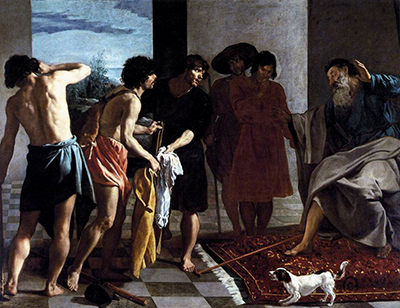
A young man in black holds out a crumpled piece of white cloth. Across the room, an older man in a green robe leans from his seat, one hand extended towards the group and the other raised beside his head. He is Jacob, and the cloth belongs to his son Joseph. The men bringing it expect him to recognise it. Diego Velázquez made that recognition the turning point of Joseph’s Bloody Coat Brought to Jacob, known in Spanish as La túnica de José. The oil on canvas measures 213.5 × 284 cm and is held by Patrimonio Nacional at the Royal Monastery of San Lorenzo de El Escorial, inventory 10014694. It is generally dated around 1630, although Patrimonio Nacional has also published a wider range of about 1630–34. [1] [2] [3]
At a Glance
- CollectionPatrimonio Nacional, 10014694 [1]
- Usually datedAround 1630 [2] [3]
- LocationRoyal Monastery of San Lorenzo de El Escorial [1]
From royal purchase to El Escorial
Traditional date of Joseph’s Bloody Coat
Around 1630 [2] [3] [5]The first Italian journey provides context. The exact place of execution remains open.
The paintings share a purchase and an early palace location.
Gallegos describes Joseph at the Buen Retiro
1637 [2]The poem records the subject in the palace’s early history.
Contents
- What the brothers bring
- From the cloth to Jacob’s chair
- Rome and the comparison with Apollo
- Brown ground and light brushwork
- From the Buen Retiro to El Escorial
What the brothers bring
In Genesis 37, Jacob gives Joseph a distinctive tunic, a visible mark of his preference for the son born in his old age. The brothers resent Joseph. Their hostility grows when he tells them about his dreams, in which the others bow down to him. When Jacob sends Joseph out to find his brothers with the flocks, they strip him of the garment and throw him into a dry cistern. Reuben tries to save him by arranging for him to be left alive in the pit. Judah proposes selling him to a passing caravan. The account names both Ishmaelites and Midianites in the passage about the sale. Joseph is taken to Egypt. [4]
The brothers slaughter a goat and dip Joseph’s tunic in its blood. They send the garment to their father with a message asking him to identify it. Jacob recognises it and concludes that a wild animal has killed Joseph. The question about the garment gives the brothers’ deception its force. Jacob can verify something he knows intimately, a piece of clothing he gave to his son. From that recognition he draws the conclusion the brothers have prepared for him. Genesis goes on to describe him tearing his clothes and mourning for many days. Velázquez has chosen the instant when the evidence is before him and his own clothes are still gathered about him. [3] [4]
Five young men stand before Jacob. The two most active figures stand close to each other just left of centre. The light cloth falls from the hand of the man in black, where its broken folds stand out against his dark clothes. Beside it, the bare-shouldered man handles a second, ochre-coloured length of fabric. Gonzalo Redín describes the tunic and a bloodstained white shirt in the exhibition catalogue for De Caravaggio a Bernini. Velázquez gives two people a part in the display and makes their hands almost meet. The effect is to gather attention into a small area of a very large canvas. Genesis names Reuben and Judah earlier in the story, and Julián Gállego proposed names for the two men as a question. The gestures establish their role in presenting the cloth while leaving their individual identities open. [2] [3] [4]
From the cloth to Jacob’s chair
The men occupy a shallow band across much of the canvas. Within it, Velázquez makes small changes of stance carry a surprising amount of space. At the left, a bare back turns towards us and a bent arm brings the man’s hand near his face. The next man presents a profile, with one heel lifting as his upper body inclines towards Jacob. The black-clad presenter stands a little farther back. Beyond him, a broad hat partly hides one figure, and another lowers his face beside it. The familiar suggestion that the man at the left is pretending to weep fits the story and his gesture. His turned back leaves his expression out of view, so we have to decide how much to infer from the movement alone. [3]
Below the figures, the alternating squares of the pavement narrow towards the back of the room. A staff lies diagonally near the bare feet on the left. On the right, the fringed edge of the carpet crosses the tiles where Jacob receives the men. These are useful lines to follow because they let us locate the bodies even where the silhouettes overlap. The landscape opening at the left gives the eye a deeper distance still. The sky and trees appear between close-set figures, where a moment later a shift of shoulders could close off part of the view. Redín associates the chequered floor with Venetian painting, particularly Tintoretto. Its work here is very specific. It lets the viewer see how close the men have come to Jacob and how much space he still has to reach across. [2] [3]
Jacob’s carpet and raised seat give his position the formality of an audience. His response loosens that arrangement. One hand opens towards the men as his other palm rises towards the upper right. The broad sleeve drops beneath the extended arm, and the heavy folds across his lap take a different direction from his leaning head. His bare foot reaches into the foreground along the edge of the carpet. We can read the scale of the disturbance in his whole figure, from his place on the seat to the fingers at the edge of the canvas. [3]
The small dog at his feet is poised across the carpet’s front border. Its muzzle points towards the brothers, its forelegs are braced and its tail curls high. The white flank catches the eye low in the painting, where it echoes the brighter folds higher up. Gállego and Redín both read the dog as barking at the men, and Redín sees it as a warning to Jacob. That interpretation grows out of the way Velázquez divides attention in the room. Jacob looks towards what he is being shown. The animal faces the people who brought it. [2] [3]
Rome and the comparison with Apollo
Velázquez left Spain in 1629 on his first journey to Italy. His teacher and father-in-law Francisco Pacheco describes his study of painting and sculpture in Rome. Writing in 1724, Antonio Palomino placed Joseph and Apollo in the Forge of Vulcan in that Roman period. The Prado’s 1990 catalogue likewise dated Joseph to 1630 in Rome. Redín broadened the likely dates and considered whether Velázquez worked on the picture in Madrid after returning in 1631. The composition makes a strong case for the importance of the Italian journey. The where and when of its execution still depend on how the later testimony, the painting itself and the date of its sale are weighed. [2] [3] [5] [6]
The back of the man at the left is one place to see what that study offered a painter. The lifted arm stretches one shoulder and changes the shape of the lit surface down to the waist. The folds of the blue-green wrap keep the turn going below it. Gállego links the figure to Roman and Bolognese figure study and compares the picture’s strong lights and darks with Guercino. Javier Portús places the two Velázquez paintings alongside large Roman narrative pictures of the period, in which painters made different gestures and expressions legible across a wide canvas. Those comparisons help explain why the nude has so much room in the story. The man can partly withhold his face and still convey an action clearly through his posture. [3] [7]
The two pictures give comparable weight to news about people outside the frame. Apollo tells Vulcan of an affair that the sun god has witnessed. The smiths turn from their work and its equipment towards the speaker. In Jacob’s room the men give their account credibility through the thing they hold, and their victim supplies the explanation himself. In the forge, attention travels towards the person who knows what happened. At El Escorial, the person we watch most intently is the one who least understands what the others have done. Gállego saw a shared interest in the power of speech to move people to action. The visible article of clothing gives that comparison a further dimension. [2] [3] [4] [7]
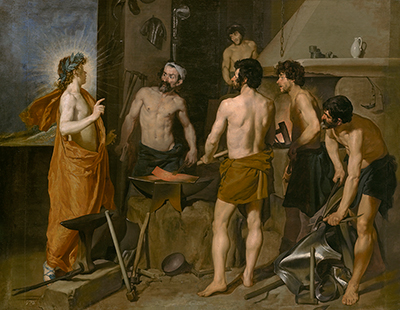
Apollo in the Forge of Vulcan. Compare the patterns of light and the arrangement of reactions in the painting acquired alongside Joseph. View Apollo in the Forge of Vulcan.
Brown ground and light brushwork
Larry Keith and Dawson W. Carr describe the coarse, open weave of the canvas and the brown ground beneath the paint in Joseph. The ground is the preparatory layer laid over the canvas. Their published detail of a leg shows how its brown contributes to the middle tones of the flesh, carrying the shape between the brighter painted passages and the shadow. As the lighting turns across the bare limbs, some parts of the body are built with very little paint. The authors propose that the materials were sourced in Italy. They distinguish this preparation from the pale grey ground used in Apollo, which gave Velázquez a cooler, lighter base for passages of thin paint. [8]
Patrimonio Nacional’s account of the 2015 restoration gives a closer sense of what survived on the surface. The conservators removed discoloured varnish and dirt and retouched small points where the paint was missing. They considered an old lining, which may have subjected the picture to too much heat and pressure, a possible source of the damage. Cleaning made existing revisions and brushmarks easier to see, along with traces of pencil near the bottom. The conservators describe lightly handled passages and contours left open alongside thicker accents. The folds of cloth in the central group and the summarily painted figures behind it offer places to look for the difference in emphasis. [9]
From the Buen Retiro to El Escorial
Philip IV acquired Joseph and Apollo in 1634 through Jerónimo de Villanueva, the protonotary of Aragón, as part of a larger purchase of paintings from Velázquez. Both were recorded in the wardrobe rooms at the Buen Retiro. Redín considers the possibility of a planned joint display, citing the shared horizontal format, the corresponding figure groups and the opposing directions of light. The size of the two canvases is close today, and Gállego and Redín both draw on the evidence of old copies for a wider original composition in Joseph. The copies suggest that there was more space around the man at the left and more of the setting behind Jacob. The shared purchase and palace location establish an early association. Whether the works were first conceived as a pair remains open. [2] [3] [8]
Manuel de Gallegos described the grieving patriarch in his 1637 poem on the Buen Retiro, as quoted by Redín. By 1665 Joseph was in the chapter rooms at El Escorial. Gállego notes that the monk Francisco de los Santos praised it in the 1667 edition of his description of the monastery. Apollo followed a different path from the Buen Retiro, through the Royal Palace and into the Prado in 1819. [2] [3]
The El Escorial canvas travelled to Paris for the Grand Palais Velázquez exhibition in 2015, where Patrimonio Nacional presented the restoration. The institution subsequently listed it among the paintings on view in the renovated chapter rooms at El Escorial in 2021. Those records show two very different settings in which the public has been able to see the same work. At its full scale, the distance from the folds of the shirt to Jacob’s opened hands is large enough for the exchange to register across a room. The dog, close to the lower edge, rewards the viewer who comes nearer. [9] [10] [11]
Artworks directory
Frequently Asked Questions
Patrimonio Nacional, 10014694 [1]
In Genesis 37, Jacob gives Joseph a distinctive tunic, a visible mark of his preference for the son born in his old age. The brothers resent Joseph. Their hostility grows when he tells them about his dreams, in which the others bow down to him. [4]
The men occupy a shallow band across much of the canvas. Within it, Velázquez makes small changes of stance carry a surprising amount of space. At the left, a bare back turns towards us and a bent arm brings the man’s hand near his face. [3]
Discussion
Look again at the images and ideas explored in Joseph’s Bloody Coat Brought to Jacob. These editorial prompts invite your observations.
Reader Insights
Where does your eye go first when you follow the cloth across the room?
How do the figures respond in different ways to what the brothers have brought?
Join the Conversation
Share a detail, comparison or question about Joseph’s Bloody Coat Brought to Jacob below.
References
- Patrimonio Nacional, Normas de estilo de Reales Sitios, “Fotografías”, item 2, artwork data for Velázquez, La túnica de José, inv. 10014694. Spanish. View source.
- Gonzalo Redín Michaus, La túnica de José, in De Caravaggio a Bernini. Obras maestras del Seicento italiano en las Colecciones Reales, Patrimonio Nacional, Madrid, 2016. Spanish exhibition catalogue entry. View source.
- Julián Gállego, La túnica de José and La fragua de Vulcano, in Antonio Domínguez Ortiz, Alfonso E. Pérez Sánchez and Julián Gállego, Velázquez, Museo del Prado and Ministerio de Cultura, Madrid, 1990, cats. 25 and 23, especially pp. 168–173. Spanish. View source.
- United States Conference of Catholic Bishops, New American Bible, Revised Edition, Genesis 37, especially vv. 2–11 and 18–36, with notes on vv. 3 and 28. View source.
- Francisco Pacheco, Arte de la pintura, Seville, 1649, “Segunda parte: El primer viaje a Italia”, pp. 103–105. Spanish transcription by Santiago Arroyo Esteban. View source.
- Antonio Palomino, El Parnaso español pintoresco laureado, 1724, life of Velázquez, part III, “Del primer viaje que Don Diego Velazquez hizo a Italia con licencia de su Majestad”, around p. 330 in the transcription. Spanish. View source.
- Javier Portús, “Velázquez en Roma: De la pintura de historia al triunfo del retrato”, in Roma y España. Un crisol de la cultura europea en la Edad Moderna, vol. II, 2007, especially pp. 732–735. Spanish. View source.
- Larry Keith and Dawson W. Carr, “Velázquez’s ‘Christ after the Flagellation’: Technique in Context”, National Gallery Technical Bulletin 30, 2009, pp. 52–71, especially pp. 67–69, plates 22–24 and note 25. View source.
- Patrimonio Nacional, Memoria 2015, conservation section under “La túnica de José de Velázquez” and exhibition section on the Grand Palais Velázquez exhibition. Spanish. View source.
- Patrimonio Nacional, Préstamos, Grand Palais Velázquez section, Paris, 2015, inv. 10014694. Spanish. View source.
- Patrimonio Nacional, “Patrimonio Nacional finaliza la primera gran restauración de ‘La liberación de san Pedro’ de José de Ribera”, 12 February 2021, p. 1, on the chapter rooms at El Escorial. Spanish. View source.







