


 by Tom Gurney
Tom Gurney BSc (Hons) is an art history expert with over 20 years experience
Published on June 19, 2020 / Updated on October 14, 2023
Email: tomgurney1@gmail.com / Phone: +44 7429 011000
Infante Felipe Próspero: Introduction
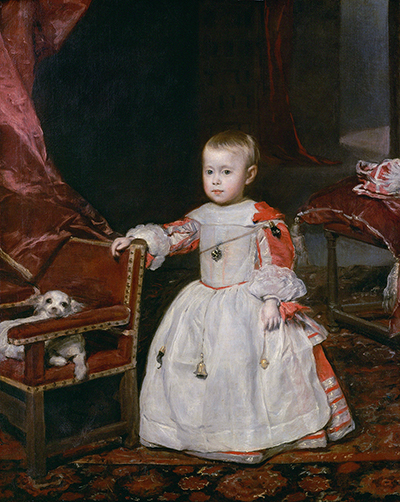
Felipe Próspero rests his right hand on the back of a red chair. The tips of his fingers curl over the corner where the upholstery meets a line of brass-coloured studs. A small white dog lies on the seat with its head lifted above the arm. Its eyes meet ours from below the level of the boy’s hand. We can take in both faces almost at once, then follow the edge of the chair to the rug and see how little of this substantial piece of furniture the standing child overtops. [1]
Diego Velázquez painted the son of Philip IV and Mariana of Austria in 1659, when Felipe was about two and heir to the Spanish throne. The oil on canvas is in the Gemäldegalerie of the Kunsthistorisches Museum in Vienna as GG 319. The museum records its overall height and width as 129 × 100 cm. Its companion in the history of gifts to Vienna is Velázquez’s Infanta Margarita Teresa in a Blue Dress, a separate portrait of Felipe’s elder sister. The museum says both went to Emperor Leopold I in the year they were painted. [1] [2] [3]
At a Glance
- CollectionKunsthistorisches Museum, GG 319 [1]
- Painted1659 [1]
- GiftSent to the Viennese court in 1659 [1] [2]
Felipe Próspero and the portraits sent to Vienna
The Prado’s court group shows Felipe’s elder sister before his birth.
News of the birth was marked by celebrations in the Spanish kingdoms.
The KHM places the two paintings in Vienna in the same year.
Contents
- How the chair sets the scale
- The other face in the picture
- The hanging ornaments
- The birth of an heir
- The gifts to Vienna
How the chair sets the scale
Felipe’s figure runs from the light on the crown of his head to a hint of red beneath his hem. The chair beside him establishes his size more immediately than the edges of the canvas do. Its back rises just far enough for his forearm to extend sideways, with the white cuff falling over the top. The arm of the chair projects towards the left edge of the painting and its seat runs back into the room. These angles give us a depth we can trace, from the hand on top all the way down to the legs and the shadow underneath. The red curtain behind the chair is painted in much broader folds. Where upholstery and hanging come together, the straight line of studs keeps the furniture legible. [1]
Look at the boy’s two hands in turn. The one touching the chair is partly hidden by its own cuff. The farther hand hangs down in front of the skirt, with its fingers near a little gold-coloured pendant. The red bow at that wrist and the folds of the sleeve draw the eye towards it. The stance is upright, but the arms are engaged at different heights and the broad skirt falls unevenly around them. There is enough information in these small differences to imagine the weight of the clothes and the space a child would need to move in them. [1]
The pale front of the costume also helps the figure hold its place in a room with large patches of darkness. The light on the white cloth changes between the relatively flat area across the chest, the gathered fullness at the wrists and the skirt spreading towards the rug. Cool grey strokes pick out some of the folds, while the lower edge of the skirt comes forward in a broad pale band. Along the right, bands of red and a narrow fringe of white are briefly visible where the outer skirt turns away. Red also leads from the shoulder down the sleeve and reappears in a fine line at the waist. These glimpses make it possible to follow the shape of the clothes even where most of a layer is covered by another. [1]
Objects sit at different distances behind the figure. The small table to the right has a red covering and a light bundle of folded material close to the edge. Behind it, there is a narrow patch of cooler light. The far curtain almost disappears except where its red edge catches the light. The rug gives the most continuous view of the floor, and its irregular reds and darks link the chair to the almost white skirt. The distant passage is much less insistent. Velázquez gives the room enough depth to let the head stand well forward of it, even though walls and furnishings are only partly described. [1]
The other face in the picture
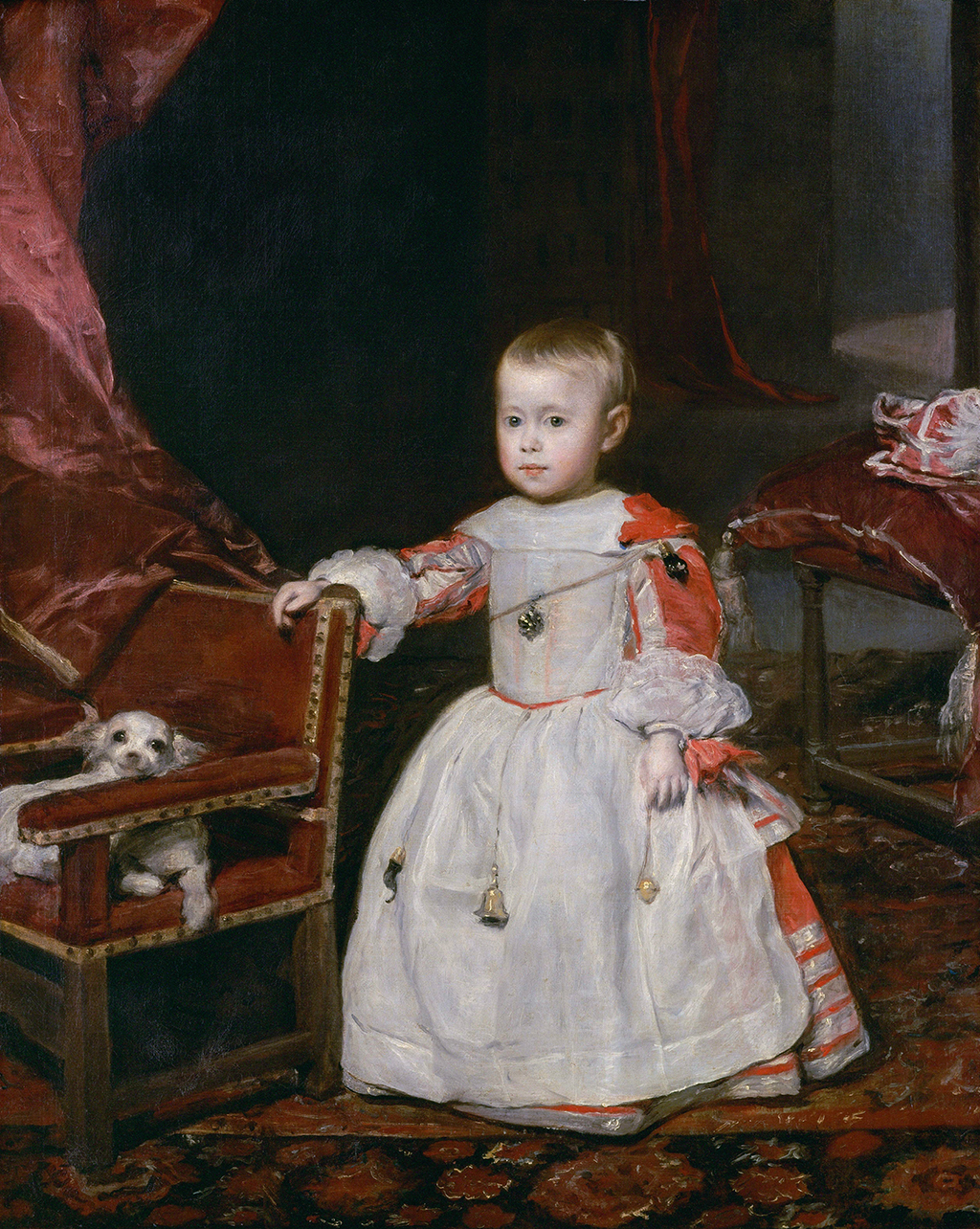
The dog occupies the upholstered seat so fully that we see its body in pieces. The red arm passes across it between the head and the little foreleg hanging down at the front. A few pale, irregular touches at the sides of the face suggest the loose fur of the ears. The black accents of the eyes and nose are close together and stand out even at a distance. The painter needed a clear account of those small intervals for the animal to look back at us. A change in the position of one eye would have changed the direction of its attention. [1]
The dog and the prince have different ways of appearing in the same light. The boy’s collar sets a clean boundary under his face and the brow and cheek are softly modelled above it. Across the dog’s muzzle the whites run into greys in shorter, broken marks. Its paws and body are suggested by much looser patches under the arm of the chair. A lively effect comes from the distribution of detail. Velázquez gives the animal the concentration of a face in a portrait and allows the upholstery to conceal much of the rest. The small white paw over the seat also rewards a glance back up at the prince’s hand over the chair back. The two figures meet the furniture at different levels and each contact tells us how a different body fits its surroundings. [1]
In Las Meninas, painted three years earlier, the much larger dog lies low across the foreground. Its back provides a long shape at floor level, and one figure brings a foot towards it. The little dog in Felipe’s portrait comes up off the floor to the level of the upholstery, and its raised face attracts the eye in its own right. In both paintings a dog helps give the room a scale a viewer can grasp. The shift from floor to chair changes where we look for that measure. [1] [4]
The hanging ornaments
The pale front of the costume supplies a surface against which even the smallest ornaments can be seen. A dark object at the shoulder is picked up by the red beneath it, while a lighter pendant is visible lower down near the boy’s left hand. The bell shape near the middle of the skirt has enough dark around its flared foot for the outline to read against a fold. The attachments matter too. A narrow cord or chain draws our eye between the dark cluster on the chest and a point above it. These objects sit out from the fabric at different angles and interrupt its falls of light. [1]
The jewellery historian Natalia Horcajo Palomero singles out two of the painted objects, a higa de azabache and a small gold bell. Marie-France Morel locates the dark jet hand on Felipe’s left shoulder, to our right. A higa is a clenched hand with the tip of the thumb showing between the first two fingers. Jet, the dark material in this example, and the gesture itself were both credited with warding off the evil eye. In the belief Horcajo describes, a look prompted by admiration or envy could bring harm, and children were thought especially susceptible. The bell drew its protective force from the sound it could make. Horcajo explains that ringing was believed to drive away harmful spirits. The Museo del Traje cites the bells visible in several Spanish court portraits, including this one, as evidence that such objects were familiar in the costume of young sitters. [5] [6] [7]
Morel identifies the pendant by his lowered hand as a pomander, a vessel for scent. She reads the hanging ornament on the chest as a small silver case, possibly for relics. She leaves open whether the object to the left of the bell is a piece of mane or an animal paw. Her descriptions invite us to retrace the distribution of the objects. The fittings for the three at the waist and the case suspended across the chest turn a largely white costume into a surface marked by small purposeful interruptions. Morel observes that children in earlier portraits could be shown with still more charms, and that these could include both devotional objects and forms credited with protective powers. [1] [6]
There is a second kind of evidence in the written descriptions of the boy’s possessions. Horcajo, drawing on Jesús Hernández Perera’s study of Velázquez and jewellery, discusses a list including two jet hands set with diamonds, a coral hand and a gold bell. Philip IV ordered Felipe’s charms to pass to the expected child who became Carlos II. That record reveals the value the family put on these small things and how they could pass from one child to another. The paint gives us their place on a dressed body. A list of objects the boy owned cannot by itself put each item in a particular place on the canvas. [5]
The birth of an heir
Felipe Próspero was born on 28 November 1657. Philip IV’s earlier son Baltasar Carlos had died in 1646. With Felipe’s birth, the court again had a male heir, known as Prince of Asturias. This is the title by which the Biblioteca Digital de Madrid catalogues a contemporary account of the celebrations in Segovia. Printed in Madrid in 1658, Alonso de Córdoba Maldonado’s report names both parents and describes the child as a long-awaited prince in its title. The celebration belonged to the city as well as to the family it honoured. [8] [9]
Ceremony had already given the infant a public place long before Velázquez showed him standing by a chair. Inmaculada Rodríguez Moya describes how Felipe was carried to baptism in the royal palace chapel by the Countess of Salvatierra, using a chair of crystal and gold adorned with coral. His godmother was his elder half-sister María Teresa, the daughter of Philip IV and Isabel de Borbón. The baptismal chair belongs to the recorded ceremony. The chair in Velázquez’s painting shows another way an object of adult scale could take part in the presentation of a small child. The prince himself makes the brief contact with it that fixes his place in the scene. [1] [8] [10]
Felipe died on 1 November 1661, before his fourth birthday. That date comes from the history of the royal family. The subdued colours of the room or the shades across his skin tell us how the picture is painted. The lively shifts between those shades, the precise measure of the hand by the chair and the watchfulness of the dog are all features available to a viewer, whatever they know of the boy’s short life. [1] [8]
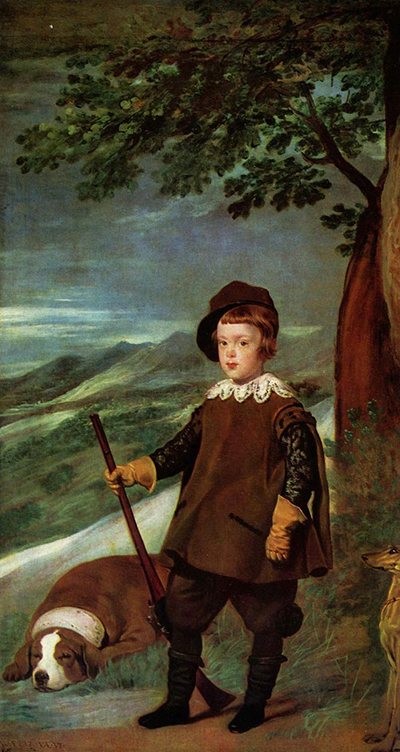
Prince Baltasar Carlos as a Hunter. The prince in hunting dress shows an earlier way to picture a young heir through pose, costume and objects. View Prince Baltasar Carlos as a Hunter.
The gifts to Vienna
The Kunsthistorisches Museum records the 1659 portrait as a gift to the Viennese court. Its account in Only in Vienna links the shipment with Velázquez’s portrait of Margarita Teresa in a blue dress and names Leopold I as the recipient. Margarita married him in 1666. A portrait of Felipe could give a relative abroad a likeness of a child they might otherwise know from a description. It could also show an heir at the age and in the dress in which the court wished him to be seen. The description of the paintings as gifts gives substance to both aspects of that exchange. [1] [2] [3] [8]
The two canvases present the children differently. Margarita’s sleeves and the skirts of her blue and silver gown extend well to either side of her head. She occupies much of the width available to her, with part of a table visible on the left. Her two hands are spaced across the lower part of the costume, one holding a muff. The pale bands and scattered highlights let the eye trace the width of the dress before it returns to the face. Felipe stands among much more prominent furnishings, and the chair lets us estimate his height before he has our full attention. In his picture the small dark interruptions on the pale apron bring the eye close. In Margarita’s, the silver marks also gather into larger patterns when we step back. In each case, the handling of cloth changes how we judge the space that the child occupies. [1] [2] [3]
The works appeared together again in Madrid in the Prado’s 2013–14 exhibition Velázquez y la familia de Felipe IV. The Spanish state guarantee lists them consecutively as GG 319 and GG 2130, both dated 1659 and both from the Kunsthistorisches Museum. The Prado included another likeness from Vienna, of María Teresa. In an exhibition about court portraiture that gathering made the family relationships visible again. For Felipe’s portrait, the double encounter with the prince and the dog remains a good place to start. Viewing the work alongside other royal likenesses makes the red chair, and the small hand placed over its corner, all the more particular to him. [11] [12]
Artworks directory
Frequently Asked Questions
Kunsthistorisches Museum, GG 319 [1]
1659 [1]
Felipe’s figure runs from the light on the crown of his head to a hint of red beneath his hem. The chair beside him establishes his size more immediately than the edges of the canvas do. Its back rises just far enough for his forearm to extend sideways, with the white cuff falling over the top. [1]
The dog occupies the upholstered seat so fully that we see its body in pieces. The red arm passes across it between the head and the little foreleg hanging down at the front. A few pale, irregular touches at the sides of the face suggest the loose fur of the ears. [1]
Discussion
Look again at the images and ideas explored in Infante Felipe Próspero. These editorial prompts invite your observations.
Reader Insights
How do the arm of the chair and the dog establish the child’s scale?
Which of the small hanging objects can you distinguish in the painting itself?
Join the Conversation
Share a detail, comparison or question about Infante Felipe Próspero below.
References
- Kunsthistorisches Museum, Gemäldegalerie, Infante Philipp Prosper, 1659, inventory 319. Object record and reproduction (English). View source.
- Kunsthistorisches Museum, Only in Vienna, section on Infanta Margarita in a Blue Dress. Date and gift to Leopold I (English). View source.
- Kunsthistorisches Museum, Gemäldegalerie, Infanta Margarita in a Blue Dress, 1659, inventory 2130. Separate object record, reproduction and provenance (English). View source.
- Museo Nacional del Prado, Las Meninas, P001174, visual guide, and illustrated guide to Las Meninas (Spanish and English respectively). View source 1. View source 2.
- Natalia Horcajo Palomero, ‘Amuletos y talismanes en el retrato del Príncipe Felipe Próspero de Velázquez’, Archivo Español de Arte 72, no. 288 (1999), pp. 521–530, especially pp. 522 and 527 and fig. 1 (Spanish). View source.
- Marie-France Morel, ‘Les amulettes portées par les petits enfants en Espagne aux XVIIe et XVIIIe siècles’, Avisos de Viena 10 (2025), pp. 56–100, especially pp. 83–85 and fig. 30 (French). View source.
- Museo del Traje, ‘Bell’. Collection display text discussing comparable court portraits (English). View source.
- Real Academia de la Historia, ‘Margarita María Teresa de Austria’. Family, succession, Felipe’s dates and Margarita’s marriage (Spanish). View source.
- Biblioteca Digital de Madrid, Alonso de Córdoba Maldonado’s account of festivities in Segovia for the birth of Felipe Próspero, printed in Madrid by Diego Díaz de la Carrera, 1658. Bibliographical record BDCM20210110122 (Spanish). View source.
- Inmaculada Rodríguez Moya, ‘El bautismo regio en la corte hispánica: arte y ritual del siglo XVI al XVII’, Archivo Español de Arte 91, no. 364 (2018), pp. 349–366, especially p. 359 and fig. 6 (Spanish). View source.
- Boletín Oficial del Estado, Orden ECD/1613/2013, Annex, entries 4 and 5. State guarantee and exact inventory numbers of the two loans (Spanish). View source.
- Museo Nacional del Prado, ‘El Museo del Prado amplía el horario de la exposición Velázquez y la familia de Felipe IV su último día de apertura’, 5 February 2014. Exhibition notice and list of highlights (Spanish). View source.







