


 by Tom Gurney
Tom Gurney BSc (Hons) is an art history expert with over 20 years experience
Published on June 19, 2020 / Updated on October 14, 2023
Email: tomgurney1@gmail.com / Phone: +44 7429 011000
Head of a Young Woman: Introduction
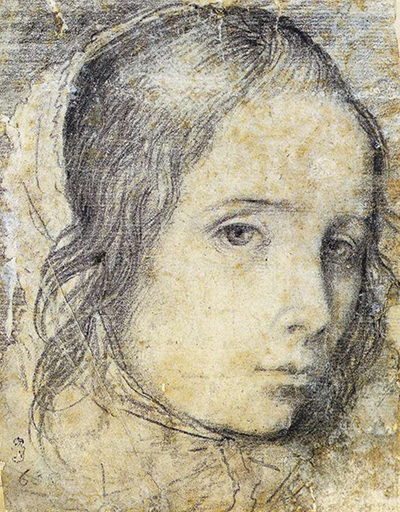
The young woman turns towards the right edge of the sheet, but her nearer eye looks back towards us. A few dark marks set the pupil under the curve of the upper lid. The other eye is visible in the shadow beside the nose. Loose strands of hair run down towards the lower left, where they give way to thinner lines around the neck. The face fills most of a sheet only about fifteen centimetres high. There is just enough room beneath the chin for the artist to suggest a knot in the head covering and the beginning of a shoulder. [1]
The Biblioteca Nacional de España in Madrid catalogues the drawing under Diego Velázquez as Cabeza de muchacha and dates it around 1620. It is drawn in black pencil on yellowish laid paper and measures 151 × 116 mm in the library's catalogue. Its shelfmark is DIB/16/40/22, and its number in Ángel María de Barcia's 1906 drawings catalogue is 493. In the library's tricentenary exhibition catalogue it appeared as Cabeza de niña, with a date of about 1618–20. Both entries describe the small head from Velázquez's early years in Seville. [1] [2] [3]
At a Glance
- CollectionBiblioteca Nacional de España, DIB/16/40/22 [2]
- Dated by the libraryAround 1620 [2] [3]
- MediumBlack pencil on yellowish laid paper [1] [2]
Contents
- How the head turns
- The paper and its backing
- The larger drawing in the library
- From Seville to the Madrazo collection
- A study for a named portrait
How the head turns
Follow the arch of the nearer eyebrow to where it stops above the bridge of the nose. The light forehead and cheek occupy a broad, continuous area, with small changes of tone around the eye socket. Darker strokes are concentrated along the right side of the face. That narrow strip of shading lets us see the far eye and the edge of the nose without flattening them into one outline. Below, two short marks give the lips their shape, and the shadow under the chin separates the face from the loose gathering of cloth. Each feature is treated a little differently as the face turns. [1] [3]
There is a similar variation in the way the pencil moves around the head. Near the crown, the darker marks show the direction in which the hair has been drawn back. Along the left temple, individual strands follow longer arcs and a lock curls out towards the margin. Oblique strokes in the background fill the gap above the head. At the lower edge the shoulder and cloth are only lightly indicated, and the paper between the marks becomes easier to see. The eye returns to the face because the distinctions of tone are finest there. Around the clothing, a change in the direction of a line can be enough to suggest where one surface folds over another. [1] [3]
The paper and its backing
The exposed paper has a warm tone, doing some of the work of the light across the forehead and cheek. The term laid paper describes a support made on a mould whose wires leave a pattern of lines in the sheet. The library's online record gives the medium as black pencil. In their study for the 2019 congress on paper history, library specialists Isabel Clara García-Toraño Martínez and María Represa Martín also report slight touches of white chalk in their discussion of both drawings. Looking at a reproduction, it can be difficult to distinguish those small additions from the pale paper around them. The tricentenary catalogue gives slightly different measurements, 150 × 117 mm, for the same sheet. [1] [2] [3]
The sheet has a second support. The catalogue records a pencilled number 63 at the lower left of the head and two graphite portraits on the reverse of the backing. One is an anonymous nineteenth-century portrait of a man. The other is identified as a portrait of Raimundo de Madrazo by his brother Federico. The backing consequently brings together drawings from very different periods. The seventeenth-century head and its pencil medium belong to the front sheet. The graphite entries describe the later work on the back. Navarrete Prieto also records a possible collection mark near the foot of the front sheet, so faint that he leaves its identification open. [2] [3] [4]
The larger drawing in the library
The library also holds the Bust of a Young Woman, DIB/16/40/21, Barcia 492. The taller sheet gives the sitter's shoulders and chest much more room. Her head turns slightly, and the wrap over her head makes a pale shape above the hair before the fabric falls to the side. Look below the face and you can follow the longer movement of the clothes towards the lower border. In the smaller drawing the narrow space beneath the chin brings that movement to a quick stop. The shape of the larger picture depends much more on the dress and the width of the shoulders. In the head, a loose lock of hair and a few lines beneath the jaw do much of the work of placing the figure on the page. [1] [3] [5]
The eyes in both drawings have a similar way of returning our attention as the face turns. Their pencilled features and softly shaded cheeks help explain why the works are often discussed together. The 2011 catalogue describes a family resemblance and reports disagreement about whether the drawings show the same model. It also discusses earlier attempts to name the sitter. The library specialists' later study rejects the suggestion that she was Juana Pacheco, Velázquez's wife, and records no established association between either sheet and a painting. The title describes what survives on the paper. The woman's name remains unknown. [1] [3] [5]
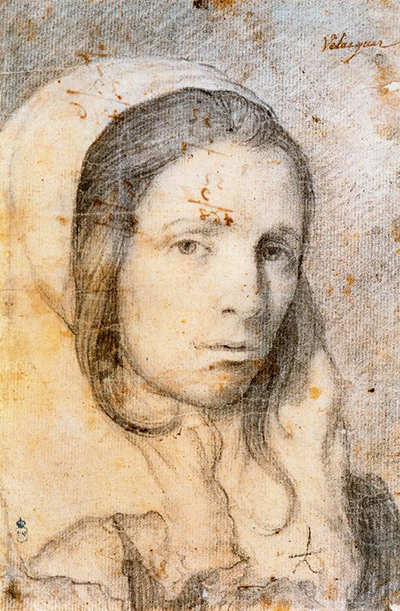
Cabeza de muchacha (the bust-length study). The larger sheet includes more of the headdress and shoulders. It has its own accession and collection history. View Bust of a Young Woman.
From Seville to the Madrazo collection
The date around 1620 places the drawing in Velázquez's Seville period, close to his training with Francisco Pacheco. In his treatise on painting Pacheco recalled Velázquez practising the drawing of heads from life. He mentions materials including charcoal, chalk and blue paper in his account of those exercises. The yellowish paper of this head has its own material history. Its selective shading shows what that practice could yield in a drawing where even a slight change in the shadow above an eye alters the expression. The tricentenary catalogue draws attention to the strength of the darker strokes in the hair and the economy of the few marks that make the knot beneath the chin. [1] [3]
The drawing passed through the collection of the painter José de Madrazo. Library researchers Elena Santiago Páez and Beatriz Hidalgo Caldas identify it among the Madrazo drawings acquired by the Biblioteca Nacional at the end of the nineteenth century, with the family portrait on the backing part of its surviving history. Barcia catalogued it under Velázquez in 1906. The library's record traces support for that attribution through August L. Mayer, Francisco Javier Sánchez Cantón and José López-Rey. It also records that Gridley McKim-Smith judged the attribution probable in 1980. The library presents the drawing under Velázquez's name today. [2] [3] [4]
A study for a named portrait
In the Study for the Portrait of Cardinal Gaspar de Borja y Velasco, dated 1643–45 by the Real Academia de Bellas Artes de San Fernando, a head again takes up most of a narrow sheet of laid paper. Black pencil locates the brow, nose and mouth, with fewer strokes needed to bring the shoulders into view. In the cardinal's study the dark band beneath the brow and the high collar draw attention to the hollows and angles of the face. The Academy catalogues its sheet as a study for a portrait known in several painted versions. Its exhibition catalogue also cites Juan Carreño de Miranda's testimony, given in 1658, that Velázquez painted a portrait for the cardinal. The painted versions give scholars particular features to compare with the drawing, while Carreño's account places the commission in Velázquez's working life. For the young woman's head the surviving evidence leads back to the drawing itself and to the related sheet in the library. [1] [6] [7]
Artworks directory
Frequently Asked Questions
The small drawing is in the Biblioteca Nacional de España in Madrid, where its shelfmark is DIB/16/40/22. The Museo Lázaro Galdiano in the same city holds a separate Cabeza de muchacha, inventory 01535. That work is a 25 × 18 cm oil painting of a woman in strict profile to the left. The museum records continuing doubts about its authorship. [2] [8]
Biblioteca Nacional de España, DIB/16/40/22 [2]
Discussion
Look again at the images and ideas explored in Head of a Young Woman. These editorial prompts invite your observations.
Reader Insights
Where does the paper help make the face look lit?
How does the narrow sheet affect your sense of the turn of the head?
Join the Conversation
Share a detail, comparison or question about Head of a Young Woman below.
References
- Isabel Clara García-Toraño Martínez and María Represa Martín, ‘El fondo de dibujos de la Biblioteca Nacional de España’, Actas XIII Congreso Internacional de Historia del Papel en la Península Ibérica, 2019, pp. 137–138, figs. 28–29 (Spanish). View source.
- Biblioteca Nacional de España, Cabeza de muchacha, DIB/16/40/22, Barcia 493, bdh0000057648, catalogue record in the Biblioteca Digital del Patrimonio Iberoamericano (Spanish). View source.
- Benito Navarrete Prieto, ‘Cabeza de niña’ and ‘Cabeza de muchacha’, Biblioteca Nacional de España. 300 años haciendo historia, Biblioteca Nacional de España and Acción Cultural Española, 2011, pp. 104–107 (Spanish). View source.
- Elena María Santiago Páez and Beatriz Hidalgo Caldas, ‘Procedencias de los dibujos españoles e italianos del siglo XVI conservados en la Biblioteca Nacional de España. Algunas aportaciones’, in Benito Navarrete Prieto and Gonzalo Redín Michaus, eds., Dibujos españoles e italianos del siglo XVI en la Biblioteca Nacional de España, 2021, pp. 26–27 and n. 45 (Spanish). View source.
- Biblioteca Nacional de España, Cabeza de muchacha, DIB/16/40/21, Barcia 492, bdh0000035391, catalogue record in the Biblioteca Digital del Patrimonio Iberoamericano (Spanish). View source.
- Real Academia de Bellas Artes de San Fernando, Estudio para el retrato del cardenal Gaspar de Borja y Velasco, D-2211, collection record (Spanish). View source.
- Ascensión Ciruelos Gonzalo, ‘El retrato del cardenal Gaspar de Borja y Velasco por Diego Velázquez’, in José María Luzón Nogué, ed., Velázquez en Italia. Entre Luigi Amidani y Juan de Córdoba, Real Academia de Bellas Artes de San Fernando, 2022, pp. 152–162, cat. 18 and figs. 42–43 (Spanish). View source.
- Museo Lázaro Galdiano, Cabeza de muchacha, 01535, collection record (Spanish). View source.







