


 by Tom Gurney
Tom Gurney BSc (Hons) is an art history expert with over 20 years experience
Published on June 19, 2020 / Updated on October 14, 2023
Email: tomgurney1@gmail.com / Phone: +44 7429 011000
Philip IV of Spain in Brown and Silver: Introduction
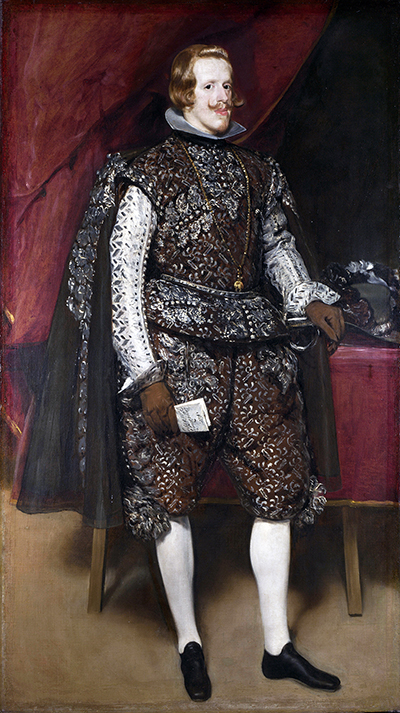
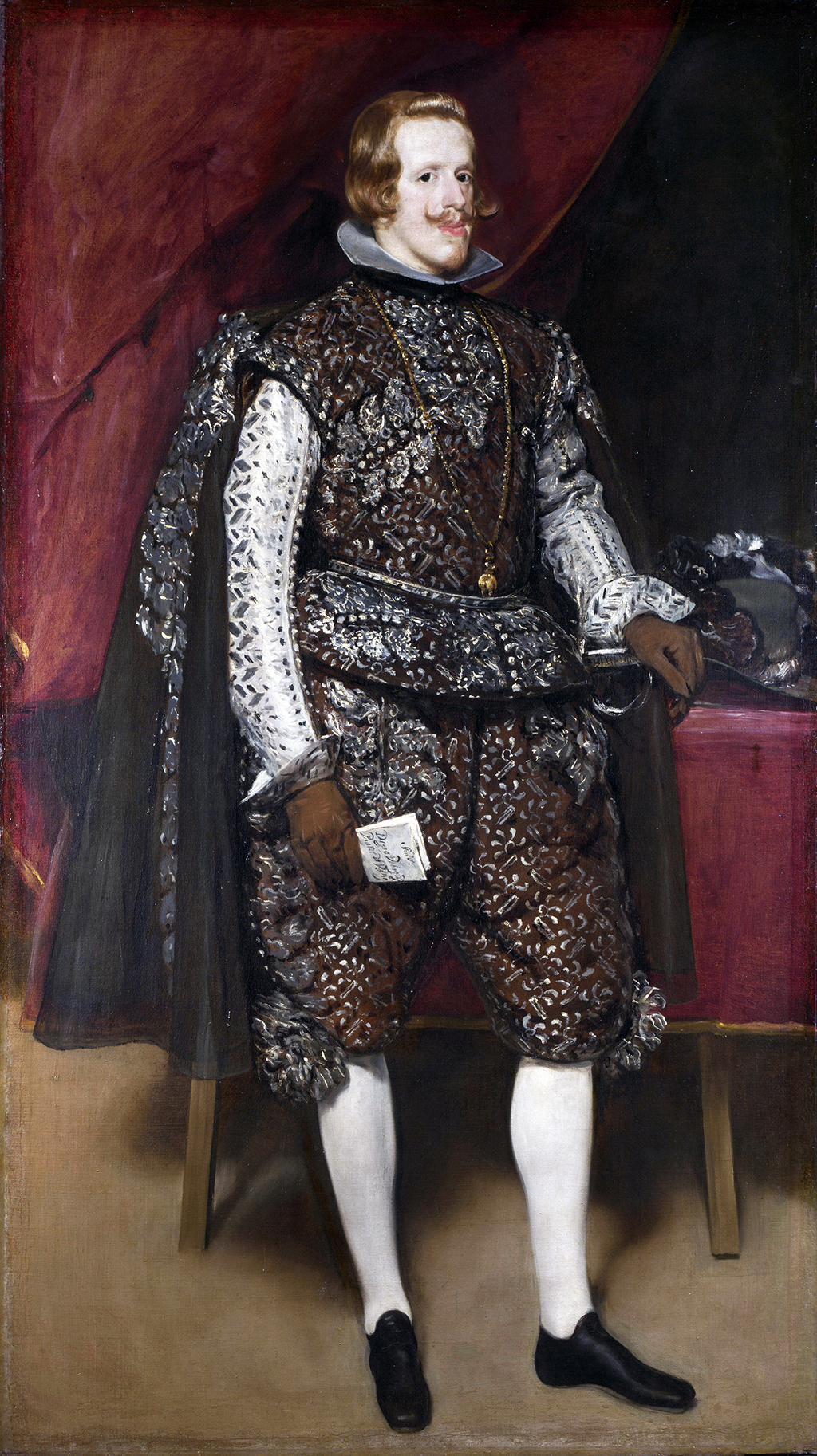
The paper in Philip IV’s right hand is scarcely wider than his glove. He lets it hang at thigh height, where its little rectangle of light interrupts the silver pattern of his breeches. Its angle follows the fall of his hand, and the writing is small enough to make us lean in. Across the canvas his other hand rests on the hilt of a sword. The two gestures are almost idle. They give the standing figure something to do, and each puts an object associated with the exercise of royal authority within easy reach. [1]
The National Gallery in London dates Philip IV of Spain in Brown and Silver to about 1631–32. The work is an unlined oil on canvas, 195 × 110 cm, and entered the collection in 1882 as NG1129. A photograph brings the figure into view all at once. At nearly two metres high, the painting allows a different sort of encounter. From a distance, it is possible to take in the length of the body and the brilliance of the clothes together. See the paper, the collar or the silver at close quarters and a few centimetres of canvas can hold the eye in place. [1]
At a Glance
- CollectionNational Gallery, London, NG1129 [1]
- MediumOil on canvas [1]
- Technical evidenceThe National Gallery’s bulletin discusses the ground, folds and raised paint of NG1129. [2]
Contents
- The king, the table and the space between them
- How the silver catches the light
- What the king is holding
- Could the clothes mark the oath to Baltasar Carlos?
- Three ways to paint a standing king
- From El Escorial to the National Gallery
The king, the table and the space between them
Philip’s right shoe points almost straight out of the picture. His left turns to the side, giving his lower body a wider base than the head might lead us to expect. The stockings separate the legs distinctly from the darker floor beneath the table. Both shoes can be seen against the light ground, including the tip of the one pointing towards us. There is very little space below them. By bringing the feet so close to the lower edge, Velázquez lets the king occupy a great deal of the picture’s height while still leaving a clear strip of floor on which he can stand. [1]
The table sits behind Philip on our right. His body conceals much of the top, but the edge of the hanging red cloth continues behind his legs. Two plain table legs below it give us something to measure the depth by. The shoes are lower in the picture than the ends of the table legs, and there is a patch of open floor in front of the cloth. These intervals help place Philip in front of the furniture without making the setting feel like a deep interior. The feathered hat crops up just behind his left hand. A few pale touches mark the headgear against the dark wall and keep that corner from receding completely. [1]
The curtain establishes a different kind of distance. It sweeps diagonally above Philip’s shoulder, coming close to the back of his head before opening onto a stretch of dark wall. The cape drops in a long line in front of the red hanging on our left. The curtain, cape and table covering each mark a successive plane, yet Velázquez needs only a few folds and edges to keep them apart. At the centre, where so much of the costume consists of broken strokes, the long, largely unbroken edge of the cape gives the body a boundary. [1]
The head sits slightly to the right of the centre of the body as we see it. His high forehead is lit broadly, and the projecting ends of his curled moustache describe a much narrower turn than the shoulders below. He meets our eye from a small patch of light held between the darker fall of the curtain and the grey-white band of the collar. The collar’s near edge curves below the chin and its far side seems to rise behind it. That little change in height makes it possible to read the neck and head as turned even before following the nose or the line of the eyes. The eyes are directed outwards and the mouth is closed, leaving the elaborate costume and the work of the hands to convey much of the formality of the pose. [1]
How the silver catches the light
The white sleeves read as a different material from the embroidered breeches. In the sleeve on our left, along the arm holding the paper, pale strokes surround a series of dark openings. Their spacing changes where the arm bends and where the cuff tightens around the glove. The breeches have wider intervals of brown, with little hooks and dashes of light. Near the knee, where the material gathers, those marks close up. The pattern responds to the shape of the garment, telling us where a surface projects, turns or bunches. The National Gallery describes the sleeveless jacket and breeches as a once purplish-brown fabric with woven silver motifs, silver appliqués and buttons. It identifies silver lace on the cloak and regards the white sleeves as probably silk. [1]
Stand back and the sleeve on our left makes a high, continuous band of light, with its brightest stretch near the forearm. The sleeve on our right folds across a shorter distance towards the sword. Its silver is strongest close to the cuff, where several ridges of cloth seem to meet the turned-back fabric. The waist changes direction again. Two bright edges run across it, dividing the close pattern of the torso from the much larger shapes of the breeches. The small gold pendant of the Order of the Golden Fleece hangs just above this change of direction. Its long, fine chain is easy to miss at first. Following it down from the shoulder draws a slender line through the busier marks of the jacket. [1]
The paint helps explain why the surface works at such different distances. In the National Gallery’s Technical Bulletin, Paul Ackroyd, Dawson Carr and Marika Spring identify the warm brown visible through the costume of NG1129 as the painting’s ground. The ground is the prepared surface on the canvas. In the costume it also does work as a visible colour. Thin black applications give the folds their shadows, and small raised strokes of grey and white provide the pattern and light. A turn of fabric can therefore be established by changing the amount of ground we see, the weight of the dark paint and the placement of the pale marks. One look at a patch of the breeches can give an impression of furrows and loops. Step back and they take on the sheen of decoration running over a swelling form. [1] [2]
The costume makes this economical handling particularly easy to see. In the stockings, the shading uses much longer transitions. The white narrows towards the ankle with a soft grey down one side. The toes and heels have firmer outlines, and their dark surfaces take only a few lights. The curve of the leg under the stocking is implied by a broad change in tone. Higher up, the flashes on the breeches do much of the same modelling in short steps. The contrast becomes clearest where the two surfaces meet at the knee. [1] [2]
What the king is holding
The paper has a defined outer edge and warms slightly in the fold, while the cuff above it scatters into little fragments of light. It is also one of the few light surfaces low in the painting whose straight edges suggest a flat plane. The glove makes a soft dark border along one side of it. The dark strokes within the sheet have their own direction, as if the text belonged to a surface held at an angle to us. A document that Philip could easily lift or turn becomes a small point of stillness amid the flashes of silver. [1]
The National Gallery identifies the sheet as a petition, gives the painter’s name in the inscription and renders the words describing his office as ‘Painter to Your Majesty’. The writing places Velázquez inside his own composition as a person addressing the sovereign. A signature in the corner would sit at our edge of the painting. Here it is in the king’s keeping. The device also fits the portrait’s unequal gestures. One hand carries business that might be presented to him. The other rests on the object he wears as a sign of rank. We can read such a pose as an invitation to imagine a royal audience. The painting supplies the gesture and the petition, and the identity of any person present at a sitting would require separate evidence. [1]
In his study of Velázquez’s early, lost equestrian likeness of Philip, Héctor Ruiz Soto draws attention to the rarity of the London signature among the painter’s known portraits of the king. The National Gallery thinks the head here was probably painted from life and used as a model for heads in other portraits by Velázquez and his workshop. That account gives the face another function. Within this canvas it looks out over a particular arrangement of richly dressed body, sword and petition. In another portrait the likeness could be used at a different scale above other clothes. Here the painter’s name stays with the paper in Philip’s hand. [1] [3]
Could the clothes mark the oath to Baltasar Carlos?
Baltasar Carlos, Philip’s son and heir, was born in 1629. On 7 March 1632 the Cortes of Castile swore allegiance to him at San Jerónimo el Real in Madrid. Such ceremonies made the succession visible during the reigning king’s lifetime. The National Gallery compares the costume in the painting with a contemporary description of Philip’s dress at the oath and proposes that the portrait might commemorate it. The gallery’s proposed date is consistent with that connection, and the marked departure from the plainer clothes of Philip’s early standing portraits gives reason to look at the dress as evidence. [1] [4] [5]
The oath and the proposed commission have different kinds of support. José Antonio Fernández Fernández’s study of the clothes made for heirs to the Spanish throne uses wardrobe accounts and reports of the ceremony to document the clothing prepared for Baltasar Carlos. The accounts record a crimson satin baquero, a child’s long gown, made for the prince and richly worked with gold. They connect that particular garment to the oath through written evidence about its making and use. The connection to Philip’s portrait rests on the similarity the National Gallery sees between the king’s described dress and his painted one. A resemblance can suggest the kind of occasion for which the outfit was suitable. The canvas carries no depiction of the prince, the act of swearing or the church. Its furnishings read as the setting for the king’s solitary presence, leaving its first audience and place of display open. [1] [4]
Three ways to paint a standing king
The Metropolitan Museum of Art’s full-length Philip IV (1605–1665), King of Spain, probably 1624, also has a paper, a sword and a table. The Met catalogues it as a version painted by Velázquez himself after an earlier likeness for the king. Conservator Michael Gallagher discusses the signed receipt of 4 December 1624 and the comparison with the first composition revealed beneath Velázquez’s later reworking of the Prado canvas. In the Met painting, the broad sweep of the black cape and the narrowness of the canvas put emphasis on the figure’s outline. The white collar and paper stand well apart in the dark costume, and the table’s colour is confined to the right edge. In Brown and Silver, the sweep of the curtain carries the red from the furniture up and across the space behind the king. A pose already capable of making an austere image of office can sustain a much fuller display of coloured cloth. [1] [5] [6]
The Frick Collection’s King Philip IV of Spain of 1644 brings the figure much nearer. Its three-quarter-length format takes the feet and floor out of the picture. A plain background allows the broad red military costume and its silver decoration to fill the lower part of the canvas. The hand holding a baton gathers attention close to the body, where the paper in Brown and Silver draws it down to the side. The Frick’s exhibition dossier cites contemporary records of the work’s making on campaign and of its display in a Madrid church during a victory celebration. The 1644 portrait thus has evidence of early ceremonial use of a kind the London portrait’s costume has led scholars to look for. Their expense and brilliance are visible in both works. The circumstances have to be established for each. [1] [7]
Velázquez gives the face almost the whole task of holding the viewer in London’s later Philip IV of Spain, which the National Gallery dates about 1656. In that head-and-shoulders picture the narrow whites of the collar come out of a dark mass that is barely distinguishable from the space behind it. There is no length of floor to cross with the eye before returning to the face, and no counterpart to the bright sheet below the waist. Brown and Silver repeatedly sends the eye away from Philip’s gaze. The face, hand, paper and cuff become small areas of emphasis in a much larger field. [1] [8]
 Diego Velazquez.jpg)
Philip IV of Spain, about 1656. The later London likeness gives the face a more prominent role within a narrower format. View Philip IV of Spain.
From El Escorial to the National Gallery
The provenance published by the National Gallery identifies NG1129 with near certainty as the portrait of Philip IV recorded in the library of El Escorial in 1764. It suggests that the painting had probably been taken there in the seventeenth century. The library record gives the work an identifiable setting more than a century after its proposed date. The earlier suggestion allows for an established royal portrait to have been moved and shown in a setting quite different from the space represented on the canvas. [1]
The gallery traces its removal in November 1809 on behalf of Joseph Bonaparte, who gave it to General Dessolle in January 1810. The dealer Samuel Woodburn bought it from Dessolle’s daughter and sold it to William Beckford. After Beckford’s death in 1844 it passed to his son-in-law, the 10th Duke of Hamilton. The National Gallery purchased it at the Hamilton sale in 1882 for 6,000 guineas. That collection history follows an object that changed hands repeatedly, while the pose and the petition still address the viewer in the terms of Philip’s court. [1]
Artworks directory
Frequently Asked Questions
National Gallery, London, NG1129 [1]
Oil on canvas [1]
Philip’s right shoe points almost straight out of the picture. His left turns to the side, giving his lower body a wider base than the head might lead us to expect. The stockings separate the legs distinctly from the darker floor beneath the table. [1]
The white sleeves read as a different material from the embroidered breeches. In the sleeve on our left, along the arm holding the paper, pale strokes surround a series of dark openings. Their spacing changes where the arm bends and where the cuff tightens around the glove. [1]
Discussion
Look again at the images and ideas explored in Philip IV of Spain in Brown and Silver. These editorial prompts invite your observations.
Reader Insights
Follow the changes in the silver paint from the front of the garment to the sleeves. Where is the pattern clearest?
What changes when you read the paper first as a painted object and then as a signed petition?
Join the Conversation
Share a detail, comparison or question about Philip IV of Spain in Brown and Silver below.
References
- The National Gallery, London, Diego Velázquez, Philip IV of Spain in Brown and Silver, NG1129. Object details, reproduction, in-depth account and provenance extracted from Neil MacLaren, revised by Allan Braham, The Spanish School (1988). Collection record. View source.
- Paul Ackroyd, Dawson Carr and Marika Spring, “Mazo’s Queen Mariana of Spain in Mourning”, National Gallery Technical Bulletin 26 (2005), p. 51, “Painting”. Technical bulletin. View source.
- Héctor Ruiz Soto, “‘Yo, a quien cabe tanta parte de su felicidad’. Pacheco, Velázquez y el retrato ecuestre perdido de Felipe IV”, Atlante 20 (2024), paragraph 23. Article. View source.
- José Antonio Fernández Fernández, “El atuendo de los príncipes herederos en el juramento de lealtad de las Cortes de Castilla (siglos XVI y XVII)”, Hipogrifo 10, no. 1 (2022), pp. 501–550, section 8 and the comparative table. Article. View source.
- The Metropolitan Museum of Art, Diego Velázquez, Philip IV (1605–1665), King of Spain, 14.40.639. Collection record. View source.
- Michael Gallagher, “Velázquez’s Philip IV in the Metropolitan Museum”, Metropolitan Museum Journal 45 (2010), especially pp. 187–190 and fig. 8. Conservation study. View source.
- The Frick Collection, The King at War: Velázquez’s Portrait of Philip IV (2010–11). Exhibition dossier and reproduction. Exhibition record. View source.
- The National Gallery, London, Diego Velázquez, Philip IV of Spain, NG745. Collection record. View source.







