


 by Tom Gurney
Tom Gurney BSc (Hons) is an art history expert with over 20 years experience
Published on June 19, 2020 / Updated on October 14, 2023
Email: tomgurney1@gmail.com / Phone: +44 7429 011000
Three Musicians: Introduction
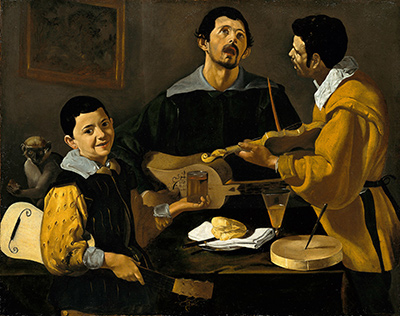
A boy holds out a full glass and grins at us. Behind him a guitarist sings with his head tipped back, while the violinist on the right turns towards the singer. In Three Musicians, the person who catches our eye is the one holding a drink. His companions carry on with the music, and for as long as we meet his gaze we occupy a place in their audience. The open mouth, the sideways glance and the lifted glass give three different kinds of attention to a group that scarcely has room to move. [1] [3]
The Gemäldegalerie in Berlin catalogues the painting under Diego Rodríguez de Silva y Velázquez and dates it to 1616–1618 in Seville. It is an oil on canvas measuring 90.4 × 113.2 cm according to the current collection record, which identifies it as 413F and records its purchase in 1906 from the collection of R. Langton Douglas, London. The museum’s account also records questions about whether Velázquez painted it himself. The young man’s glass and the closely grouped players belong to a composition that circulated in several versions. [1] [2]
At a Glance
Contents
- The players and their audience
- Light on the table
- A tavern and the five senses
- The Berlin painting and the other versions
- Painting ordinary things in Seville
The players and their audience
The singer looks upwards, his face lifted just above the level of his companions. The violinist answers him in profile. We can follow the turn of his head and the neck of the violin back towards the centre of the group. The guitarist’s instrument crosses the space beneath the faces and gives that exchange a physical connection. The boy on the left makes the only direct human appeal beyond the frame. He holds the glass level in his left hand, and the light on its rim draws the eye back down from his smile. Behind him, a monkey holding a pear also looks out. Its face takes longer to find, making its echo of the boy’s gaze easy to miss. [1] [4]
Berlin identifies the singing player’s guitar and the accompanying violin. Anna Margules also describes the boy’s instrument as a smaller guitar. Part of the rounded body peeps out from behind his sleeve. At this instant he is occupied with the glass, leaving the singer and violinist to suggest the sound of the performance. Margules proposes that they are singing a tono humano, a kind of Spanish secular song. That gives the scene a possible musical setting. The gestures show how the players might accompany one another, while the canvas leaves the particular song unidentified. [1] [3]
Light on the table
The table takes up little space for the number of things it does. Its green cloth gives the folded white napkin a dark surround, and a sliver of silver plate catches the light under the fabric. The bread sits high enough to interrupt that pale patch with its crust. A knife lies ready to hand nearby. Further to the right, a second blade rises from a shallow round box beside a partly filled glass that flares towards its mouth. From one object to the next, light changes character. It is broad on the cloth, broken on the bread and concentrated into narrow highlights on the glass and plate. The two drinks make a small comparison of their own. One has been lifted towards the viewer, while the other stays among the things on the table. [1] [4]
These surfaces are easier to locate than some of the figures’ bodies. We can place the napkin on the plate and the bread on the napkin with confidence. Back from the tabletop, shoulders and sleeves overlap, and the dark clothes of the boy and the singer give few clues to the distance between them. The ochre on the boy’s sleeve and on the violinist’s clothing brings the eye across the group, while the collars and faces break up the shadow above. The framed landscape at the upper left sits far enough back to mark a wall, yet there is little clear space between that wall and the people. The painting gives us considerable detail within a room whose depth remains hard to judge. [1] [4]
A tavern and the five senses
A little food and drink, music and people pressed around a small table suggest a tavern. That is the setting Berlin considers first. The framed landscape complicates the inference, since it could belong to a more comfortable interior. It also adds a second sort of looking to the scene. The boy looks straight at us while the landscape asks us to peer into an image so dim that we can scarcely make it out. Its presence helps explain why the museum entertains an allegory of the senses. The musicians invoke hearing, the bread and drink suggest taste and smell, the differences between the table objects invite us to imagine touch, and the outward looks and the picture within the picture bring sight into play. [1]
The monkey opens up a different reading. Berlin points to a tradition in which an animal eating fruit could suggest human appetite and the pull of instinct. The two glasses give that reading something to work with, especially beside the singer’s upward roll of the eyes. The same arrangement can make for a good joke. The first thing the boy does with his drink is share the fun with the spectator through a look, which the monkey then repeats from the shadows. A visitor who initially follows that joke can come to the still life and the landscape later, in much the same way as the eye adjusts to the darker corners of the room. [1]
The Berlin painting and the other versions
The Gemäldegalerie describes five surviving versions and regards its own as the strongest in quality. Its catalogue entry names Velázquez as painter, while the accompanying discussion sets out two readings of the canvas. Some scholars have questioned whether the work is entirely his because the direction of the light varies and parts of the space fit together awkwardly. Others see those same features as signs of a very early work, possibly made while he was still training with Francisco Pacheco. The specificity of an individual face or a glass rim can make the whole scene seem persuasive even when the arrangement of the bodies is harder to reconcile. That difference between the handling of a detail and the construction of the room is at the centre of the debate. [1]
The count concerns versions of a composition. One example of why the individual canvases matter is the Los tres músicos shown on loan at the Museo Diocesano Barbastro-Monzón. The museum’s account records a three-year stay for that painting from the Arthispania collection. Its loan history belongs to a different canvas from 413F, which Berlin acquired in 1906. The Berlin record gives the overall count and the grounds for the debate around its own canvas. The order of the versions and the hands responsible for them would require evidence specific to each work. [1] [5]
Painting ordinary things in Seville
Velázquez trained in Seville with Francisco Pacheco, who later became his father-in-law. Pacheco praised his pupil’s skill in the bodegón, a form that can encompass kitchen or tavern pictures with a prominent still life. Berlin notes that Pacheco even situated such work in the tradition of ancient painting. The attention given here to folds, reflections and the shape of a mouth is part of what made familiar subjects worth sustained attention. A tavern picture could ask as much of a painter’s ability to observe hands and faces as it did of his ability to differentiate wood, glass and metal. [1] [2] [6]
The date range Berlin gives falls on either side of a documented change in the painter’s working life. On 14 March 1617, Velázquez showed his work and answered questions before Pacheco and Juan de Uceda, the two examiners of the Seville painters’ guild. The resulting licence let him practise as a master, open a shop and take on assistants and apprentices of his own. A date at the earlier end of Berlin’s range could therefore place the canvas in his years with Pacheco. A date at the later end would put it alongside the work he produced as a licensed painter in his own right. [1] [7]
The Hermitage Luncheon, another early Seville painting, also groups three figures around a table and puts a glass and food within reach of their gestures. Its white cloth spreads beneath the meal and gives the separate objects a continuous light ground. In Berlin, the white is concentrated in a folded napkin and the darker table lets the glints on the glass compete more directly with the faces. The Hermitage picture gives a meal the social energy of a shared occasion. In Three Musicians, the food stays close at hand while the people direct their attention towards the performance and across the edge of the canvas. [1] [8] [9]
In An Old Woman Cooking Eggs of 1618, the Scottish National Gallery’s canvas, the eggs become visible through their changing consistency as they cook. The lit objects carry information about a process that takes time. Berlin poses a related problem for painting through sound. Much of the action is supplied by what we infer from the raised chin, the bow and the hands against the instruments. In both paintings a dark setting leaves room for ordinary materials to register clearly. In the kitchen the hand and the utensil guide us to the pan, where the work is taking place. In the Berlin picture the boy’s glass catches our eye before his companions’ gestures give us a reason to imagine what we might hear. [1] [10]
The Christ in the House of Martha and Mary in London makes a different use of the objects within reach. There, a woman working at a mortar stands beside fish, eggs and garlic. A scene on the back wall provides another set of figures and an occasion to think about the effort of preparing food. The National Gallery describes the uncertainty over how the two spaces connect. The small landscape in Berlin has a much less explicit relationship to the people before it. It gives the eye somewhere to rest away from their action, then sends us back to the boy, who seems to have noticed our presence from the beginning. [1] [11]
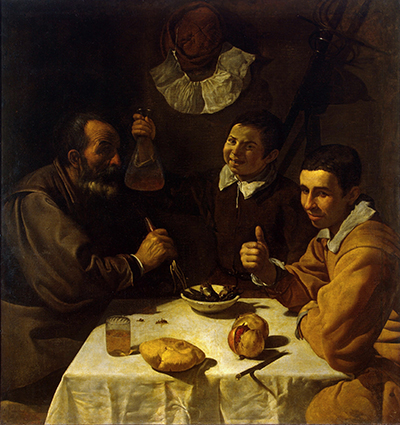
The Lunch (Завтрак). The Hermitage painting offers a comparison for three figures grouped tightly around a table. View The Lunch.
Artworks directory
Frequently Asked Questions
Gemäldegalerie, Berlin, 413F [1]
1616–18 [1]
Discussion
Look again at the images and ideas explored in Three Musicians. These editorial prompts invite your observations.
Reader Insights
How does the raised glass change your place in the scene?
Which parts of the painting suggest sound or movement to you?
Join the Conversation
Share a detail, comparison or question about Three Musicians below.
References
- Gemäldegalerie, Staatliche Museen zu Berlin, Die drei Musikanten (The Three Musicians), inventory 413F, object 870321, collection record and Sven Jakstat’s catalogue discussion in German and English. View source.
- Staatliche Museen zu Berlin, El Siglo de Oro. The Age of Velázquez, 2016 exhibition checklist, p. 3, German object data. View source.
- Anna Margules, ‘Velázquez y la música de su época’, in Miguel Ángel Ramos Sánchez (ed.), En torno a Velázquez, Comunidad de Madrid, 1999, pp. 133–136, Spanish. View source.
- Museo del Prado, Velázquez, 1990 exhibition catalogue, p. 26, Berlin painting reproduced as Los tres músicos in the biographical essay, Spanish. View source.
- Museo Diocesano Barbastro-Monzón, ‘Conferencia: La mujer en el Renacimiento: Imagen, símbolo y retrato’, 9 May 2025, notice documenting the concluded Arthispania loan, Spanish. View source.
- National Gallery, London, ‘Diego Velázquez (1599–1660)’, artist biography. View source.
- Archivo Histórico Provincial de Sevilla, Carta de examen de Velázquez como pintor, 14 March 1617, Spanish transcription hosted by the Instituto Andaluz del Patrimonio Histórico. View source.
- State Hermitage Museum, The Luncheon, inventory 389, collection catalogue, entry 52, pp. 72–73. View source.
- State Hermitage Museum, Luncheon, collection entry and painting reproduction on Google Arts & Culture. View source.
- National Galleries of Scotland, An Old Woman Cooking Eggs, Scottish National Gallery collection record. View source.
- National Gallery, London, Kitchen Scene with Christ in the House of Martha and Mary, NG1375, collection record and in-depth description. View source.







