


 by Tom Gurney
Tom Gurney BSc (Hons) is an art history expert with over 20 years experience
Published on June 19, 2020 / Updated on October 14, 2023
Email: tomgurney1@gmail.com / Phone: +44 7429 011000
The Jester Calabacillas: Introduction
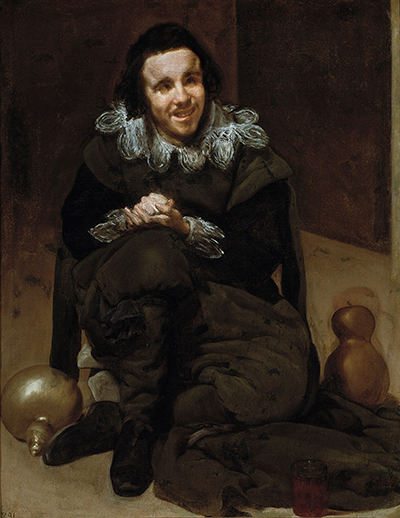
Two hands meet over a raised knee. Their pink and ochre brushstrokes are so close that it takes a moment to see where one hand ends and the other begins. Above them, a collar spreads across both shoulders in loops of white and grey. The man’s head tilts towards the right of the canvas, and his lips part in a smile. This is the seated portrait by Diego Velázquez that the Museo Nacional del Prado catalogues as El bufón Calabacillas (The Buffoon Calabacillas), P001205. The oil on canvas measures approximately 106 × 83 cm and is dated 1635–39 in the Prado’s collection index. The title preserves the customary identification with Juan Calabazas, an entertainer who served Philip IV. [1] [2] [3]
At a Glance
- CollectionMuseo Nacional del Prado, P001205 [1] [2]
- Painted1635–39 [1]
- SitterTraditionally identified as Juan Calabazas [2]
Contents
- The hands, collar and smile
- A corner of a room and two rounded objects
- Juan Calabazas at court
- A royal inventory and a misleading name
- The standing portrait in Cleveland
- Seated and standing at the Spanish court
The hands, collar and smile
Follow the sleeves from the shoulder to the wrist. On our right, the elbow hangs low and the forearm rises inward across the body. On the left, the dark sleeve and cuff are partly lost against the raised knee, but the direction of the forearm becomes clear as it reaches towards the other hand. The thumbs and curled fingers lie so close together that their contours are interrupted. A pale patch on top of the hands gives them weight, while shorter strokes pick out individual fingers at the edges. Velázquez places this small knot of light just where the arms and the knee come together. [2]
At the throat, the collar breaks into broad scallops. A few strands of grey-white paint sweep round each lobe, doubling back like threads. The cuffs use smaller loops and finer marks. Viewed from several steps away, the collar reads as a continuous piece of lace, and the two cuffs bracket the hands. Close up, there are dark gaps between the strokes and passages where several strands appear to have been drawn together with a single movement of the brush. The 1990 Prado catalogue records the older suggestion that the hands were unfinished and questions it. In the painting, their loose edges belong with the lace and with the quick touches that describe the face. [2]
The forehead is the broadest patch of warm light. A shadow enters near the hairline and deepens around the eyes. Light catches the bridge of the nose, one cheek and the edges of the parted lips. The features are legible even though there is little hard outlining, and the partly shadowed eyes hold the face in an oblique encounter with the viewer. The smile occupies a small area, but its upturned ends catch the light directly above the brighter strokes of the collar. The surviving records tell us about a court servant’s employment. The shifts of light around this man’s mouth and eyes tell us how Velázquez made an expression visible. [2] [3]
A corner of a room and two rounded objects
The portrait gives very little of the room away. Behind the figure, a dark plane ends at a slim upright near the right edge. Below it, a diagonal marks the junction with the ochre floor. The floor is clearest beside the figure and along the bottom of the canvas. On our left, a shoe projects towards the corner, with warm floor showing around its tip. Near the middle, another shoe points down towards the frame. On the right, folds of dark green cloth spread into the foreground. These different directions let us work out the sitter’s position even though much of the clothing merges into the shadows. [2]
The objects beside him have quite different profiles. The one on our left lies sideways with its narrow end towards the foreground. A bright highlight sits high on its rounded body, and much weaker touches follow the narrowing neck. The object on our right stands upright, with two rounded sections joined at a waist. Its brown tones are closer to those of the floor, and some of its lower edge disappears behind the dark folds. The left-hand gourd draws the eye by its sheen. The upright object is easier to recognise by the line of its silhouette. [2]
On the Prado’s detail plate a faint, broader reddish form remains visible around the top of the upright object. The catalogue discusses this passage as a revision and gives a large jar as a possible earlier form. If it began as a jar, the shift towards a double-lobed shape would have changed what a viewer saw in it as well as how it balanced the rounder gourd across the canvas. The visible revision gives the jar reading a basis. Its precise shape and the reason for changing it remain open. The Spanish word calabaza means gourd, so the painted objects also offer a visual clue to the name Calabazas or Calabacillas. That clue has been central to the identification. [2] [4]
Juan Calabazas at court
The Prado records that Juan Calabazas served first in the household of the Cardinal-Infante Ferdinand and entered the service of Ferdinand’s brother, Philip IV, in 1632. Its 1990 catalogue gives July for the transfer and October 1639 for Calabazas’s death. It also records that he was addressed as Don and received food rations and access to a carriage and mule. The Spanish term bufón belongs to this household setting, where gentes de placer, or entertainers, served the royal family. The documentary category covered people with different talents and duties. [2] [3] [5]
A record of proposed changes to clothing allowances in September 1637 puts Calabazas among other named members of the household. It provides for clothes as ordered by the chamberlain and linen on the basis of eight shirts. Other entries concern musicians, barbers and wardrobe staff, and the entertainers listed include Pablo de Valladolid. This puts both men within the practical organisation of the Spanish court, where clothes were supplied and accounted for. It also gives some context to the conspicuous attention paid to lace in the painting. The allowance records a provision for Calabazas. Which garments he actually wore for Velázquez remains unknown. [4]
A royal inventory and a misleading name
The painting was recorded around the beginning of the eighteenth century at the Torre de la Parada, the royal hunting lodge near Madrid. A 1747 entry at the Torre has often been associated with the canvas because it describes a laughing figure without a frame. The expression is a useful clue, although the inventory gives no name. By 1772 the painting was at the Palacio Nuevo. The 1772 entry, no. 1012, notes its origin at the Torre and describes a court entertainer with a Flemish-style collar. The collar does real work in that entry. It identifies a conspicuous feature of the canvas even while the sitter goes unnamed. José Manuel Cruz Valdovinos has used the entry to trace the move from the Torre to the new palace. The painting entered the Prado in 1819. These records establish stages in its display, with the original commission and first hanging location less securely documented. [2] [4]
The name Bobo de Coria is a misleading historical label, with bobo used as a disparaging term. It was firmly attached to the work by the time it circulated in print. An etching made by Louis Croutelle after a drawing by José Juan Camarón, dated 1791–1800 by the Istituto Centrale per la Grafica, uses the old name in its inscription and says that the original was in the Royal Palace in Madrid. The 1834 inventory of the Real Museo de Pinturas still calls the canvas the portrait known by that name. Gregorio Cruzada Villaamil proposed the identification with Calabazas in 1885, drawing on the gourd and a resemblance to another likeness. The Prado’s 1990 title explicitly calls the Coria name erroneous. The surviving print and museum inventory explain why the old label can still turn up when tracing the picture’s history. [2] [4] [6] [7]
The standing portrait in Cleveland
The Cleveland Museum of Art catalogues its own Portrait of the Jester Calabazas, 1965.15, as Velázquez, about 1631–32. In this much taller oil on canvas, the figure stands in black with a miniature portrait of a woman and a pinwheel. One arm extends the miniature into open space and the pinwheel catches the light against the black costume. Its shaft cuts a diagonal across the figure and extends into the lower right of the canvas. A folding seat and a pilaster give the pose architectural context. The Prado portrait draws the hands together, puts the objects on the floor and lets the pale lace spread out around the face. The smaller canvas still contains the figure from head to foot, with his bent legs taking up much of the area a standing portrait would fill with the length of the body. Each arrangement determines where the viewer looks after meeting the face. [2] [8]
The name in Cleveland has a different basis from the visual pun in Madrid. The Prado’s 1990 catalogue reproduces a 1701 Buen Retiro inventory description of a Calabacillas by Velázquez holding a small portrait and a note. The miniature is a point of correspondence. The object Cleveland identifies as a pinwheel makes the match less straightforward, and a 1789 Retiro entry calls a portrait with similar objects Velasquillo while also reporting the older name Calabacillas. The Prado catalogue explains that some scholars accepted the link with the 1701 inventory and others doubted it. There was also disagreement about the painter, which Cleveland currently identifies as Velázquez. There was also an inventory entry for a portrait of Calabacillas in the collection of the Marqués de Leganés, recorded in 1637, 1642 and 1655. That painting has yet to be located. These are separate strands of evidence. The gourd, the small portrait and the name in the Leganés inventory each connect to a different object or description. [2] [8] [9]
Seated and standing at the Spanish court
In Pablo de Valladolid, another Velázquez in the Prado, a standing entertainer opens one arm at chest height and gathers his cloak with the other. Because the room has scarcely any visible boundary, the gap below the open arm becomes part of the gesture. The seated man in Calabacillas encloses the space between his arms. The collar fans out, but the cuff strokes converge at the hands, and the line along the floor gives the sitter’s compact pose a definite place in the room. The two pictures offer very different ways of looking at someone whose work kept him close to the royal household. [2] [5]
Return to the Madrid canvas and follow the sequence from the upright object to the cuff, hands and face. The same ochre that helps establish the floor comes up in warmer touches on the knuckles and cheek. The grey-white lace interrupts that progression at the wrists and throat, gathering light where the figure turns inward. The sitter’s name has occupied cataloguers for centuries. Much of the painter’s work in making him recognisable is concentrated in those few inches between collar and hands. [2]
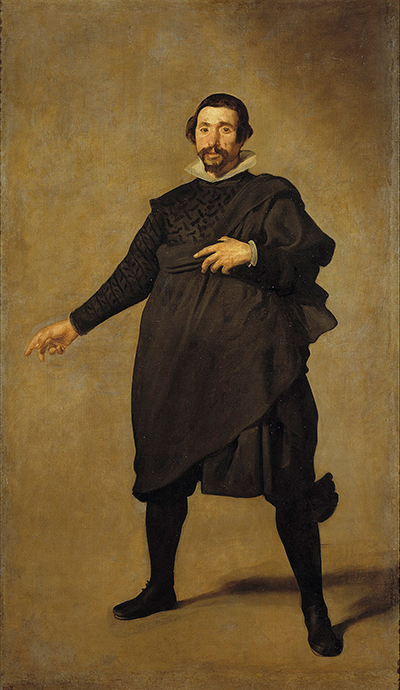
Pablo de Valladolid. Compare the compression of the seated pose in Calabacillas with the long, standing silhouette of Pablo. View Pablo de Valladolid.
Artworks directory
Frequently Asked Questions
1635–39 [1]
Traditionally identified as Juan Calabazas [2]
Follow the sleeves from the shoulder to the wrist. On our right, the elbow hangs low and the forearm rises inward across the body. On the left, the dark sleeve and cuff are partly lost against the raised knee, but the direction of the forearm becomes clear as it reaches towards the other hand. [2]
Discussion
Look again at the images and ideas explored in The Jester Calabacillas. These editorial prompts invite your observations.
Reader Insights
Where do the edges of the clasped hands give way to separate strokes?
How do the rounded objects affect the way you see the sitter’s pose?
Join the Conversation
Share a detail, comparison or question about The Jester Calabacillas below.
References
- Museo Nacional del Prado, The Buffoon Calabacillas, 1635–39, English collection index, and Spanish object entry El bufón Calabacillas, P001205. View collection index. View object record. View source 1. View source 2.
- Museo del Prado, Velázquez, Madrid, 1990, cat. 53, El bufón Calabacillas, llamado erróneamente el Bobo de Coria, pp. 322–325, and cat. 20, Don Juan de Calabazas (Calabacillas), pp. 142–145. Spanish. View catalogue. View source.
- Museo Nacional del Prado, Reencuentros. Parada V. Una Corte a nuestro encuentro, exhibition interpretation for the court portraits. Spanish. View source.
- José Manuel Cruz Valdovinos, “Rompiendo una lanza por Don Diego de Acedo, ‘El Primo’, y otra por Morra, el enano vestido de colorado”, Archivo Español de Arte, 97 (386), 2024, article 1256, especially pp. 1–2, 8–10 and nn. 49–51, 63–64. Spanish. View article. View source.
- Museo Nacional del Prado, The Female Perspective labels, P-1198, Pablo de Valladolid, revised label text and photograph. View source.
- Istituto Centrale per la Grafica, Louis Croutelle after José Juan Camarón, etching after Velázquez’s El bufón Calabacillas, S-FN7185, dated 1791–1800 in the collection record. Italian, with Spanish print inscription. View object record. View source.
- Real Academia de Bellas Artes de San Fernando and Fundación Ramón Areces, Poder, patrimonio y cultura en España, object 1509, P001205, with Inventario General de los Cuadros de S. M. (1834), no. 232, fol. 409 recto. Spanish. View source.
- Cleveland Museum of Art, Portrait of the Jester Calabazas, about 1631–32, 1965.15. View object record. View source.
- José Juan Pérez Preciado, El Marqués de Leganés y las artes, Universidad Complutense de Madrid, doctoral thesis, 2008, vol. 2, p. 387, catalogue entry for the unlocated El bufón calabacillas, Marqués de Leganés inventory no. 549. Spanish. View catalogue page. View source.







