


 by Tom Gurney
Tom Gurney BSc (Hons) is an art history expert with over 20 years experience
Published on June 19, 2020 / Updated on October 14, 2023
Email: tomgurney1@gmail.com / Phone: +44 7429 011000
Self-Portrait (Valencia): Introduction
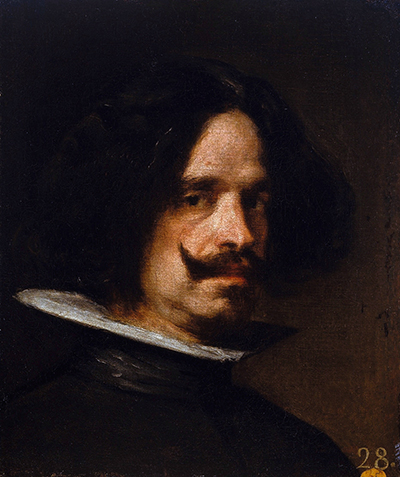
The white collar is the first clear edge below the face. Follow it towards the shoulder and the dark coat is already giving way to the brown of the background. Above it, the head turns slightly and the eyes come back towards us. The shift is small enough to miss when the painting is reproduced at thumbnail size. At the scale of the canvas, it gives the impression that we have just caught the attention of a man who was looking elsewhere. [1] [2]
This is Diego Velázquez’s Self-Portrait in the Museu de Belles Arts de València, inventory 572, an oil on canvas about 45 × 38 centimetres. It belongs to the Real Academia de Bellas Artes de San Carlos. The Academy identifies both the sitter and painter as Velázquez. A Spanish state loan order dates the picture to 1640, while a Valencia museum exhibition guide places the likeness around his second trip to Rome, when he was about fifty. The records agree on which painting they are describing. They give different estimates of when he made it. [1] [2] [3]
At a Glance
- ObjectAutorretrato, inventory 572 [1] [2]
- OwnerReal Academia de Bellas Artes de San Carlos [1] [3]
- Dimensions45 × 38 cm [2] [3]
Contents
- The face, collar and dark coat
- When did Velázquez paint himself?
- What condition meant for the attribution
- The younger man in Madrid
- The study in New York and the painter in Las Meninas
- How Fortuny put the Valencia portrait into print
- A photograph for the centenary
- From the photograph to the Prado entrance
The face, collar and dark coat
Start with the forehead, where the light spreads most evenly. It then narrows down the nose and opens out across one cheek. The eyes sit deeper within that light, held in shadow under the brows. From there the eye travels readily to the broad moustache, which helps mark the turn of the face. Its two ends extend across surfaces that recede by different amounts. The little point of dark beard below the mouth brings the eye back towards the chin. [1] [2] [4]
The hair gives the outline a different rhythm. It has enough breadth at the sides of the head for us to see how much of the face is in light even though the whole picture is dark. At the temples, the transition from skin to hair has places you can follow precisely. Further out, hair and background come close in tone. If you trace the outline from the crown down towards the shoulders, some stretches are easy to follow and others ask you to judge where one dark shape ends. The effect lets the face keep its volume without enclosing the whole figure in a line. [1] [4]
The collar is the stiff, flat golilla associated with men’s dress in the reign of Philip IV. Its pale shape makes the head’s angle legible against the dark clothes. There is enough variation in the white to suggest that the cloth turns back towards the neck, and the pale edge sets off the shadow under the chin. The coat takes up much of the bottom of the canvas, where the eye has relatively few details to follow. It provides the space for the light on the face to register without competing with it. [2] [4]
The portrait ends below the shoulders. There are no hands in the visible composition, and the dark field supplies few clues about the space around the man. A look directed out of a picture can belong to a sitter taking instructions or to a painter studying a reflection. Here the difference between the angle of the head and the direction of the gaze makes that act of looking unusually noticeable. Imagine trying to keep the turn of your head steady while moving your eyes between two places. The picture makes that small adjustment feel possible. [1] [2] [4]
When did Velázquez paint himself?
The face encouraged scholars to estimate the artist’s age. In the entry for this canvas in the Prado’s 1990 catalogue, Julián Gállego records that Juan Allende-Salazar and Bernardino de Pantorba thought the sitter looked about forty. They placed the work in 1638–40. Aureliano de Beruete proposed 1644–49, and César Pemán suggested the 1650s by comparison with the figure in Las Meninas. The Valencia museum’s guide to its Ignacio Pinazo exhibition likewise describes the appearance of a man of about fifty, around the time of Velázquez’s second Roman trip. Jonathan Brown’s comparison in Velázquez Rediscovered gives the Valencia painting to the 1640s. [2] [4] [5]
Look at the dark under the eyes and the modelling alongside the nose and you can see why age became part of the argument. How old someone appears depends partly on the direction of the light and the pose. A head isolated in a bust portrait also gives us more time to consider each feature than a face among several figures in a painted room. The decades proposed by different writers show how much judgement is involved in turning a painted appearance into a date. The earlier history of the canvas is incomplete. Both Gállego and the Academy trace it through the papal collections and José Martínez, and the Prado catalogue records that Francisco Martínez Blanch gave it to the Academy in 1835. [1] [4]

Las Meninas or The Family of Philip IV. The figure at the easel provides a different kind of painted likeness of Velázquez, made for a much larger composition. View Las Meninas.
What condition meant for the attribution
Gállego records a revealing disagreement. Elizabeth du Gué Trapier felt the canvas was too poorly preserved for a confident attribution. José Camón Aznar also doubted whether the surface allowed him to judge the hand with certainty, even though he accepted the identification of the sitter through the comparison with Las Meninas. His position is possible because a copy can preserve the features of the person in an original. Identifying a face and attributing the paint on the canvas require different evidence. The owner’s catalogue and the Valencia museum’s published materials now both present the work under Velázquez’s name. [1] [2] [4]
There is also a documented intervention. In a study of the Valencian restorer José Renau Montoro, Enrique Moreno Ribelles and colleagues identify this particular portrait among the paintings Renau treated with the Pettenkofer system. Their source is the material Renau submitted in connection with his application for a municipal restorer’s post in 1926. The article describes a method in former use and identifies its application to this canvas. It gives the historical condition debate a more specific background, while leaving the origin of any individual dark passage or edge to be established by examination of the painting. [4] [6]
The younger man in Madrid
In the same 1990 exhibition catalogue, a picture from the Prado’s own collection appeared under the title Autorretrato (?). It is catalogue no. 7, the work the Prado calls Portrait of a Man, P001224. A dark coat, light golilla and steady gaze make the comparison with Valencia intelligible. The younger figure has shorter hair and a slimmer moustache, and his features sit above the collar with a different balance of light and shadow. In Madrid the gaze remains level even as the head turns. The painter makes the eyes register across that turn, the effect that led Jacinto Octavio Picón to think that the sitter was checking himself in a mirror. [4] [7] [8]
The catalogue also records a proposed resemblance to the model for Velázquez’s Saint John on Patmos. Pantorba thought the saint’s uplifted head would be awkward for an artist watching his own reflection and entertained the possibility that both works depicted Juan Velázquez de Silva, probably the painter’s brother. He still left the model’s identity open. A likeness that looks self-conscious can prompt the idea of a mirror, and the comparison with a second painting can prompt an entirely different explanation for the same face. [7]
The study in New York and the painter in Las Meninas
The Metropolitan Museum of Art’s Portrait of a Man, Possibly a Self-Portrait, 49.7.42, dates to about 1635. In this work the eye settles on the modelling of the face while the edges of the figure grow intermittent. During treatment in 2009, Met conservator Michael Gallagher removed discoloured varnish and later paint that had made the costume and contour look more fully worked. The Met now attributes the painting to Velázquez and considers it likely to be a study for the face at the far right of The Surrender of Breda. The museum also allows the possibility that the study depicts the painter. Brown accepted the connection with the man in Breda but saw the Valencia portrait and Las Meninas as evidence against identifying the Met sitter as Velázquez. [5] [9]
An inventory drawn up after Velázquez’s death lists a portrait of him with the clothing still to be finished. The surviving New York painting gives that description a plausible visual counterpart because its costume is sketchier than its head. The Met proposes the link conditionally. Its conservation findings concern that particular canvas, and the inventory’s brief wording leaves room for another work. There is a second painting called Portrait of a Man in the same museum, accession 89.15.29, with its own attribution history. [5] [9] [10]
In Las Meninas of 1656, Velázquez is the man standing beside the large canvas at the left, with brush and palette in his hands. The moustache and the dark hair falling to either side of the face give a viewer a place to begin comparing him with Valencia. Look at the shoulders as well. In the small portrait the turn is contained almost entirely within the head and the collar. In Las Meninas the painter’s working hand, the height of the canvas and the company around him give the turn a setting. His outward look could belong to someone who has paused with the brush ready and is about to work again. [4] [5] [11]
Return to Valencia and follow the line of the light collar up towards the face. The first thing that breaks the stillness is the eyes, which can seem to attend to something just beyond where we stand. The cropped view leaves us in that encounter for as long as we care to look. [1] [4]
How Fortuny put the Valencia portrait into print
In Paris in 1874, readers opening Charles Davillier’s edition of the Mémoire de Velazquez encountered the painter’s face before they reached the text. Auguste Aubry’s title page advertises an etched portrait by Marià Fortuny alongside Davillier’s introduction, translation and notes. The model was the small oil now numbered 572 at the Museu de Belles Arts de València, the 45 × 38 centimetre canvas belonging to the Real Academia de Bellas Artes de San Carlos. The book reprinted an account of forty-one paintings sent by Philip IV to El Escorial. The attribution of that account to Velázquez was disputed, but the portrait gave readers a face to associate with the voice they were about to read. [12] [13] [14] [15]
Fortuny had to make decisions about the painting before he could put the head on a copper plate. In his study of Fortuny’s use of photography, Emiliano Cano traces the etching back to a photograph, possibly by Jean Laurent, and a supplementary drawing. Davillier’s account explains the need for the second image. The hair and shadow were hard to distinguish in the photograph, and the drawing helped clarify the obscurer passages. At the scale of a book illustration, the printmaker had to decide how much of that darkness to divide into readable forms. The Museu Nacional d’Art de Catalunya holds a small impression dated 1873, measuring 12.5 × 10 centimetres, which it catalogues as etching with ink applied by brush. [15] [16] [17]
Charles B. Curtis described the print in 1883 under his entry for the Valencia painting. He recorded a dedication from Fortuny to Davillier and distinguished proofs on parchment from impressions bearing the facsimile of Velázquez’s signature. Curtis owned one of the proofs himself. He also reported that Fortuny worked through five plates before he was satisfied. The signature seen in the book belongs to the design of the nineteenth-century print. It identifies the artist whose face and work are being presented, while the dedication records the relationship between the engraver and the editor. Curtis also listed a lengthened wood engraving of the Valencia likeness in the illustrated Spanish press in January 1876 and again in an almanac for 1879. The brief bust could be reduced to fit a small plate or extended to suit another printed format. [12] [18]
A photograph for the centenary
By 1899 the Valencia likeness had a prominent place in the celebrations for the three hundredth anniversary of Velázquez’s birth. The Prado opened its dedicated Velázquez room on 6 June. Yolanda Hansa Rubio identifies the Valencia self-portrait as the image on the first numbered page of the illustrated catalogue published by J. Laurent y Cía. She also cites a receipt signed by the Prado’s director, Luis Álvarez, recording the arrival of the painting from Valencia on 3 June through the Marqués de Montortal. The catalogue gave the visiting portrait a place before the entries and small reproductions that followed. A reader could encounter the painter face to face on paper and then turn to the works gathered for the occasion. [19] [20]
A different book from the centenary names the person behind its reproduction. In Velázquez fuera del Museo del Prado, Manuel Mesonero Romanos credits Luis Tramoyeres Blasco, secretary of the school and conservator of the Valencia museum, with taking the photograph directly from the painting. The caption explicitly records authorisation to reproduce it. Mesonero Romanos presents that direct photographic link as his reason for trusting the likeness. His account also distinguishes the short Valencia bust from the longer figure in Munich. The two pictures may look closely related around the hair, moustache and turn of the face, as he observed, while the larger canvas shows considerably more of the figure. The Alte Pinakothek now catalogues its portrait, inventory 920, under a follower of Velázquez. [21] [22]
From the photograph to the Prado entrance
Mesonero Romanos gives the photograph a second use. He reports that Aniceto Marinas used it for the statue then destined for the Prado. Madrid’s municipal inventory records that the Círculo de Bellas Artes initiated the monument, with Marinas responsible for the sculpture and Vicente Lampérez y Romea for the pedestal. Installed in 1899 on the axis of the museum’s main façade, it places a seated bronze figure at the approach to the building. The pedestal sets the painter’s name on the front, his birth and death years on the sides, and the Spanish artists and the Círculo behind the commission on the back. [21] [23]
The bronze shows how much the sculptor had to supply once he took a likeness from a head-and-shoulders painting. The canvas stops above the hands. Marinas gives the painter a palette, brushes and a mahlstick, the support against which a painter can steady the working hand. The sword, the cloak gathered behind the seat and the cross of Santiago on the chest give the figure the public standing of a knight as well as a painter. In Valencia the face has the dark field to itself. Outside the Prado, the likeness has to be read from below and from a distance, as part of a nearly two-metre figure on a high pedestal. The tools and insignia establish who is being honoured before a passer-by is close enough to examine his face. [13] [21] [23]
The Valencia oil also furnished the model for a woodcut by Otto B. de Kat. The Rijksmuseum names the Valencia painting in its record for the print, which measures 36 × 27.5 centimetres and is catalogued as a woodcut on transparent paper. The museum acquired it in 1990 and gives a broad date range of 1917–1990. Fortuny’s small etching was made to introduce a particular book, while the Amsterdam sheet preserves a later printmaker’s response to the same painting on a scale much closer to the canvas. Between the two prints stands Marinas’s public figure, where a face carried from Valencia by photograph became part of the architecture of a museum visit. [13] [17] [21] [23] [24]
Artworks directory
Frequently Asked Questions
Gállego records a revealing disagreement. Elizabeth du Gué Trapier felt the canvas was too poorly preserved for a confident attribution. José Camón Aznar also doubted whether the surface allowed him to judge the hand with certainty, even though he accepted the identification of the sitter through the comparison with Las Meninas . [1] [2] [4]
Discussion
Look again at the images and ideas explored in Self-Portrait (Valencia). These editorial prompts invite your observations.
Reader Insights
How do the slight turn of the head and the space around it shape your sense of the sitter’s attention?
What evidence would help you judge when the portrait was painted?
Join the Conversation
Share a detail, comparison or question about Self-Portrait (Valencia) below.
References
- Real Academia de Bellas Artes de San Carlos, owner’s collection entry for Diego Velázquez, Autorretrato. View source.
- Museu de Belles Arts de València, Pinazo. La historia y el retrato: de la gran tradición al modernismo, exhibition guide, catalogue no. 30, Diego Velázquez, Autorretrato, inv. 572. View source.
- Ministerio de Educación, Cultura y Deporte, Orden ECD/1123/2015, annex no. 15, state loan guarantee for La península melancólica. View source.
- Julián Gállego, Autorretrato, catalogue no. 67, in Velázquez, Museo del Prado and Ministerio de Cultura, 1990, pp. 392–395. View source.
- Jonathan Brown and Michael Gallagher, Velázquez Rediscovered, Metropolitan Museum of Art, 2009, especially pp. 10–14, figs. 4–9 and the conservation discussion. View source.
- Enrique Moreno Ribelles, Pilar Roig Picazo, Mª Ángeles Carabal Montagud and Jacob López-Cano Ausejo, “José Renau Montoro y la plaza de restaurador artístico-pictórico municipal (1926)”, Arché 2, 2007, especially p. 66 and n. 32. View source.
- Julián Gállego, Autorretrato (?), catalogue no. 7, in Velázquez, Museo del Prado and Ministerio de Cultura, 1990, pp. 90–93. View source.
- Museo Nacional del Prado, public gallery information, Retrato de hombre, P001224. View source.
- Metropolitan Museum of Art, Portrait of a Man, Possibly a Self-Portrait, 49.7.42. View source.
- Metropolitan Museum of Art, Portrait of a Man, 89.15.29. View source.
- Museo Nacional del Prado, El Museo del Prado en Palencia, entry 2, Las Meninas or The Family of Philip IV, P001174. View source.
- Charles Davillier, ed., Mémoire de Velazquez sur quarante et un tableaux envoyés par Philippe IV à l’Escurial, Paris, Auguste Aubry, 1874, title page and frontispiece. View source.
- Real Academia de Bellas Artes de San Carlos, Autorretrato, owner’s collection record. View source.
- Museu de Belles Arts de València, Pinazo. La historia y el retrato, catalogue no. 30, Velázquez’s Autorretrato, inv. 572. View source.
- Grischka Petri, “Frente a Velázquez: las portadas en la literatura velazqueña del siglo XIX”, 2015, pp. 179–180, fig. 5. View source.
- Emiliano Cano, “Mariano Fortuny y Marsal (1838–1874) y la fotografía”, discussion of the photograph and drawing used for the etching. View source.
- Museu Nacional d’Art de Catalunya, Marià Fortuny, Retrato de Velázquez, 1873, 007348-G. View source.
- Charles B. Curtis, Velazquez and Murillo, 1883, p. 82, catalogue no. 198. View source.
- Museo del Prado, Catálogo ilustrado de la sala de Velázquez en el Museo del Prado de Madrid, J. Laurent y Cía., 1899, digitised copy from Harvard University. View source.
- Yolanda Hansa Rubio, La nueva Sala de Velázquez en el Museo del Prado (1899), UNED, pp. 42–43 and n. 36. View source.
- Manuel Mesonero Romanos, Velázquez fuera del Museo del Prado, 1899, “Valencia. Museo Provincial”, portrait entry and plate credit, pp. 76–77 in the digital edition. View source.
- Bayerische Staatsgemäldesammlungen, Alte Pinakothek, Bildnis des Velázquez, follower of Velázquez, inv. 920. View source.
- Ayuntamiento de Madrid, Velázquez, municipal monument record for the bronze by Aniceto Marinas. View source.
- Rijksmuseum, Otto B. de Kat, Zelfportret van Diego Velázquez, RP-P-1990-361. View source.






