


 by Tom Gurney
Tom Gurney BSc (Hons) is an art history expert with over 20 years experience
Published on June 19, 2020 / Updated on October 14, 2023
Email: tomgurney1@gmail.com / Phone: +44 7429 011000
The Needlewoman: Introduction
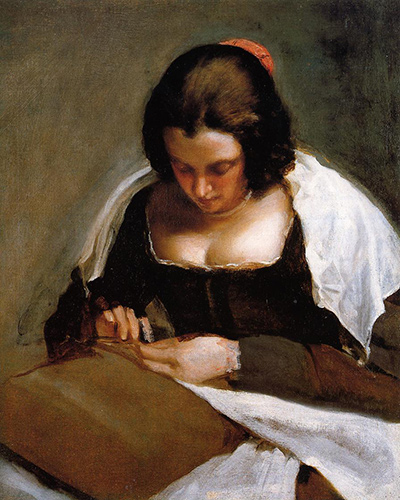
The woman in Velázquez’s The Needlewoman inclines her head towards a piece of pale cloth in her lap. Her eyes, cheek and the shadow beneath her nose are all legible, even though the face is turned down and away. Her hands take longer to make out. A thumb and a few pale strokes give us the action, with dark marks around the fingers that leave their exact position open. The difference in finish is unusually easy to see. The face has the soft transitions of a developed painting, while the area it looks towards still contains signs of how Velázquez laid out and adjusted the figure. [1] [2]
The National Gallery of Art in Washington catalogues the oil painting as the work of Diego Velázquez, dates it to about 1640–1650 and gives its overall dimensions as 74 × 60 cm. It entered the Gallery in 1937 with the Andrew W. Mellon Collection and has the accession number 1937.1.81. The Spanish catalogue of the 1989–1990 Velázquez exhibition included the same canvas as no. 61, La costurera. Its account shows how much the unfinished surface has mattered to questions of attribution and date. [1] [2] [3]
At a Glance
- CollectionNational Gallery of Art, Washington, 1937.1.81 [1]
- PaintedAround 1640–50 [1]
- MediumOil on canvas [1] [2]
Contents
- From the face to the hands
- What the examination found
- The edges and the 1988 treatment
- The woman in the inventory
- Attribution and date
- Painting a task in progress
From the face to the hands
Light runs down the slope of the forehead and the bridge of the nose, while the lower cheek and the side of the neck turn gradually into shadow. A reddish tone in the cheek carries some of the warmth of the flesh into that transition. Along the side of the face the hair becomes harder to distinguish from the space behind it. Higher up, the small red mark at the back of the head gives us a bright point to look at before the slope of the brow leads downwards again. The mark could be a hair covering or a fastening. Its small scale gives it a different job from the long pale passage over the shoulders, which widens the figure as it reaches the upper arms. [1] [2]
The white fabric changes in weight across the chest. In some places it reads as a stroke caught by the light, and in others the dark dress shows through. A few separate light marks along the square neckline suggest trim. The plain expanse of the dress then carries the eye down to the hands. There the cloth across the lap makes a much smaller light shape than the material at the shoulders. It is easy to find even where the fingers are difficult to follow. The dark fleck that the Gallery suggests may be a thimble is a good example of the scale on which we are reading the action. The pale fabric and the gathering of both hands already suggest a sewing gesture, with the needle and any thread harder to distinguish. [1] [2] [3]
Velázquez puts the action near the bottom of a vertical canvas. The cushion is scarcely separated in tone from the background, so the route from the eyes to the hands also takes us from the most modelled part of the figure towards one of its flattest surroundings. There are no other figures to direct her attention, and the crop gives us little of the room around her. We have to follow the direction of her head and the meeting of her hands to understand what holds her attention. The impression of concentration comes partly from the distance between those two points, across the lighter folds and the rising dark of the sleeve. [1] [2]
What the examination found
The National Gallery’s systematic catalogue describes a fairly coarse original canvas attached to a heavier secondary fabric. Its technical notes record a very thin reddish-brown ground, or preparatory coat, through which the tops of some of the weave remain exposed. Near the left edge, traces of a preliminary design in black paint are still visible over the preparation. The catalogue identifies the exposed ground in the cushion at lower left. The broad patch there makes a useful place to see how much of the picture’s effect can be carried by a surface prepared for painting. A change in tone and the position of the fabric above it are enough to suggest something supporting her work. [2]
The Gallery also records pentimenti, traces of decisions revised in the course of painting. The most conspicuous are around the hands, with others at the neckline and beside the lower left of the hair. They give the dark strokes in these passages a practical role. A stroke could place an edge early on, and a subsequent change could move that edge while leaving a trace of its first position. The hands therefore preserve evidence of both a first arrangement and adjustments to it. The notes describe where changes occur. The full sequence of individual moves, and the ultimate appearance Velázquez might have given the hands, remain open. [2]
The face brings a different use of the thin paint into view. The Gallery describes translucent paint in the modelling, with the texture of the weave contributing to the play of shadow. Looking along the nose towards the cheek, one tone shades into the next over a short distance. Along the bodice, a few small accents of white interrupt the dark in quick succession. Each accent works at the scale of a mark, whereas the light across the face seems to travel over a continuous surface. The Gallery describes the face as the one passage that appears finished. The technical record gives that judgement a basis in the distribution of paint, from the exposed preparation and first indications of form to the worked transitions in the flesh. [1] [2]
The edges and the 1988 treatment
The canvas also shows signs of its later physical history. It was reduced along its four edges and subsequently expanded. Part of the original painted surface had been turned over to fasten the canvas and was later brought back into view. The technical notes record the removal of heavy retouching from that strip in 1988. Small curves in the weave near the edges, known as cusping, suggest that the present proportions are close to the original ones. They support an approximate reconstruction of the format. The current dimensions give the size of the painting as it survives. [1] [2]
The Gallery’s annual report adds that removal of darkened varnish revealed areas of underpainting. This makes a difference to how we understand the open passages. Someone seeing the picture under a strongly discoloured coating would have had less access to the fine differences between a dark outline and the paint beside it. The catalogue separately records minor losses and light abrasion, especially in the background and cushion. The surface now visible contains evidence of work by the painter, subsequent wear and later treatment. The unfinished state can be traced most clearly through features such as the earlier outlines around the hands and the exposed preparation, which the examination describes in relation to the more developed face. [2] [4]
The woman in the inventory
An inventory of Velázquez’s possessions drawn up in August 1660, shortly after his death, listed another head of a woman doing needlework. His son-in-law, the painter Juan Bautista Martínez del Mazo, and Gaspar de Fuensalida compiled the inventory. It puts the entry in a room of the Casa del Tesoro, where Velázquez had lived adjoining Madrid’s royal Alcázar. The modern Gallery provenance lists the painting as in the artist’s possession at his death. The systematic catalogue qualifies the connection to this particular entry as probable. The wording fits the subject and the prominence of the head, but gives neither dimensions nor a sitter’s name in the description quoted by the catalogue. [1] [2] [3]
August L. Mayer proposed that the sitter was Velázquez’s daughter Francisca, who married Mazo. He based his argument on a perceived likeness to women in Mazo’s Family Portrait and Velázquez’s The Lady with a Fan. José Gudiol suggested the artist’s wife, Juana, instead. The family group that Mayer used for comparison was probably painted after Francisca’s death and Mazo’s remarriage, which undermines that particular comparison. In the Wallace Collection portrait the woman turns her face towards the viewer, with white gloves and a fan prominent against her dark clothes. The woman in Washington tilts her face down to work, compressing the apparent length of her features. Even such a difference in viewing angle complicates a comparison based on likeness, and the Gallery’s catalogue leaves her anonymous. [2] [3] [5]
The pose could be used in a likeness of someone Velázquez knew, or in a picture whose chief subject was the action. The 1660 entry describes the work through its subject. The sitter’s identity, the picture’s intended use and the reason the painting stopped at this stage remain unknown. In the securely recorded part of its later history, Christiane de Polès sold the canvas to Wildenstein in Paris in 1926. The painting passed through Knoedler to Andrew W. Mellon in 1927 and came to the Gallery as a gift in 1937. [1] [2] [3]
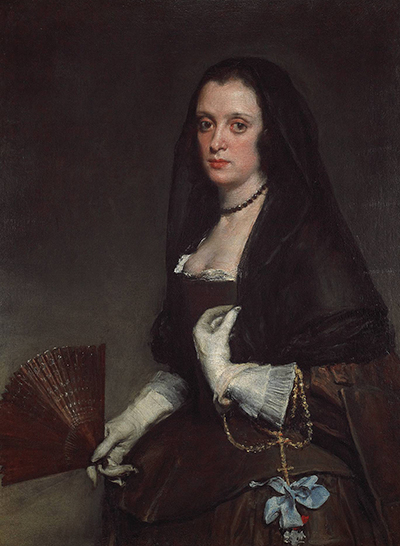
The Lady with a Fan. The Wallace portrait offers a comparison for how a further developed surface defines a sitter’s clothes and hands. View The Lady with a Fan.
Attribution and date
The exhibition catalogue records how differently scholars once read the gap between the face and the rest of the figure. Francisco Javier Sánchez Cantón initially entertained the possibility that Mazo had worked on a painting begun by Velázquez, before changing his position more than once. Gudiol, who accepted the whole as Velázquez’s work, drew attention to how few marks the hands needed to convey an action. The Washington catalogue finds correspondences with Velázquez’s mature painting in both the translucent modelling of the face and the economical strokes around the bodice. The comparison involves the relationship between the different passages, including the abbreviated ones. It is a stylistic argument and supports an approximate date. [2] [3]
Painting a task in progress
Velázquez had made a household task the focus of an earlier picture, An Old Woman Cooking Eggs, now in the Scottish National Gallery. In that painting of 1618, a spoon and an earthenware dish draw attention to two yolks and the whites forming around them. The glow on the eggs and the highlights on the vessels give the eye several distinct surfaces to inspect. Surrounding shadows let the edges of these objects stand out. Each material contributes to what we understand of the task, down to the changing consistency of the eggs in the pan. [6]
In The Needlewoman, the hands are the part of the action we have to work hardest to read. There is no equivalent of the shining pan to give the work a distinct centre. The lit forehead and cheek tell us where to look, and the brush marks beneath draw the pieces of the action together just enough for us to recognise it. If we start at the cushion and look upwards, the movement is from exposed preparation and revised outlines to the gradations in the face. Looking down again, the same differences in paint stages carry the eye along the woman’s line of attention, right to the small patch of pale cloth between her fingers. [1] [2] [6]
Artworks directory
Frequently Asked Questions
National Gallery of Art, Washington, 1937.1.81 [1]
Around 1640–50 [1]
Light runs down the slope of the forehead and the bridge of the nose, while the lower cheek and the side of the neck turn gradually into shadow. A reddish tone in the cheek carries some of the warmth of the flesh into that transition. Along the side of the face the hair becomes harder to distinguish from the space behind it. [1] [2]
Discussion
Look again at the images and ideas explored in The Needlewoman. These editorial prompts invite your observations.
Reader Insights
Which parts of the hands help you recognise the woman’s task?
How does the change in finish affect where you look first?
Join the Conversation
Share a detail, comparison or question about The Needlewoman below.
References
- National Gallery of Art, Washington, The Needlewoman, accession 1937.1.81, collection record, reproduction, provenance and exhibition history. View source.
- Jonathan Brown and Richard G. Mann, Spanish Paintings of the Fifteenth through Nineteenth Centuries, National Gallery of Art, 1990, pp. 116–119, object entry and technical notes for accession 1937.1.81. View source.
- Museo del Prado, Velázquez, 1990 exhibition catalogue, no. 61, La costurera, pp. 356–359, Spanish. View source.
- National Gallery of Art, Washington, Annual Report 1989, pp. 42–43, post-treatment photograph and Painting Conservation report. View source.
- Wallace Collection, The Lady with a Fan, P88, object 64963, collection record. View source.
- National Galleries of Scotland, An Old Woman Cooking Eggs, NG 2180, collection record and John Leighton’s account. View source.







