


 by Tom Gurney
Tom Gurney BSc (Hons) is an art history expert with over 20 years experience
Published on June 19, 2020 / Updated on October 14, 2023
Email: tomgurney1@gmail.com / Phone: +44 7429 011000
Cardinal-Infante Ferdinand of Austria as a Hunter: Introduction
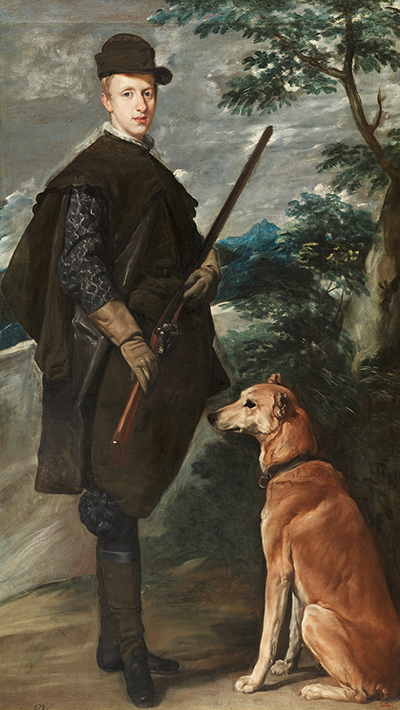
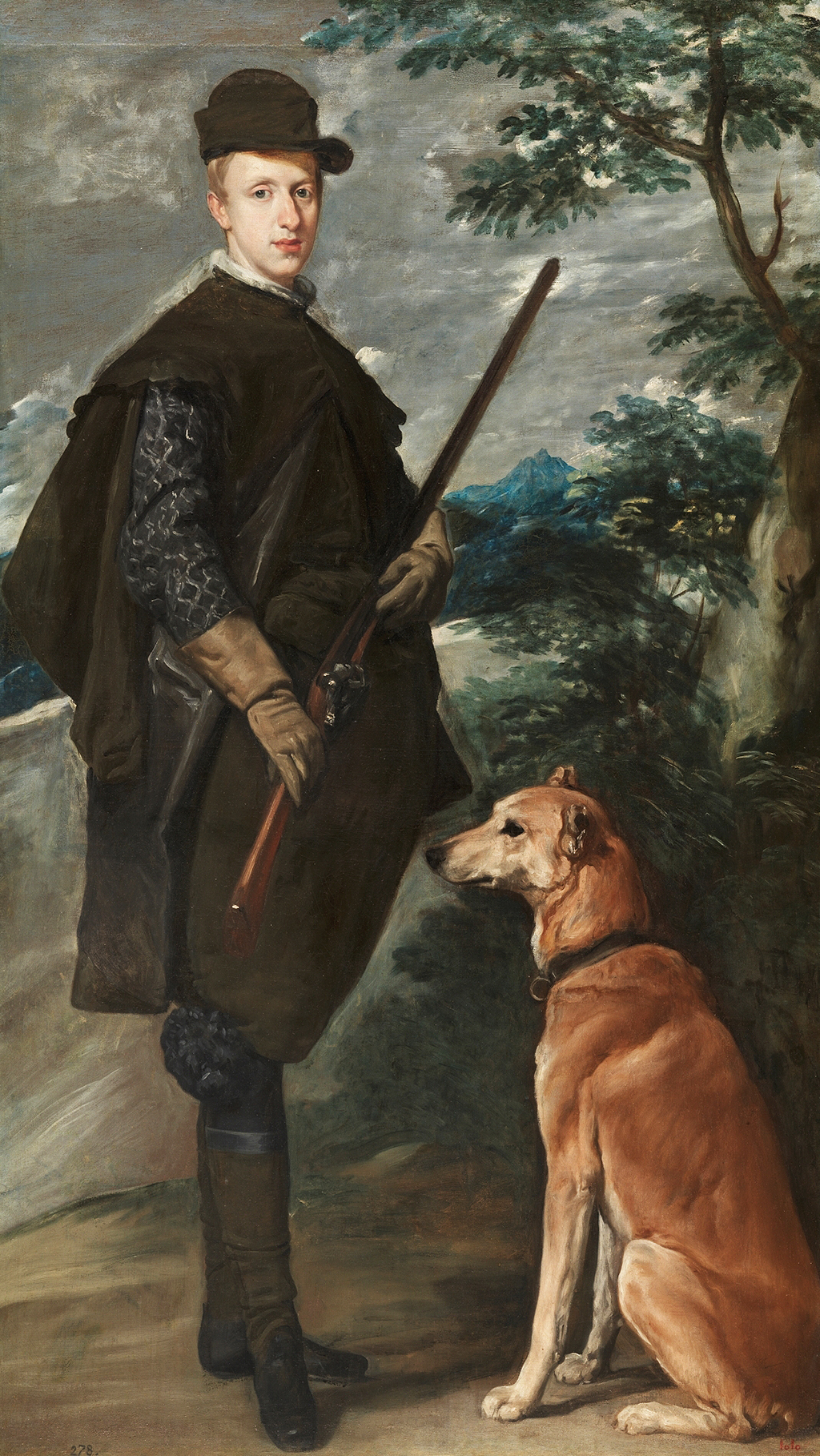
Ferdinand turns his face towards us while his shoulders remain angled across the picture. He holds a hunting gun with both gloved hands, its barrel rising diagonally into a gap between his head and the tree. At ground level a cinnamon-coloured dog sits beside him, tall enough for its muzzle to reach his knee. Diego Velázquez painted this full-length oil on canvas, now in the Museo Nacional del Prado, Madrid, under accession P001186. The recorded dimensions are 191 × 107 cm, and the painting is generally dated about 1632–34. It was one of three royal hunting portraits that hung at the Torre de la Parada in the hills of El Pardo, near Madrid. [1] [2] [3]
At a Glance
- CollectionMuseo Nacional del Prado, P001186 [1]
- PaintedAround 1632–34 [2]
- Original settingTorre de la Parada [3]
Ferdinand and the hunters at the Torre de la Parada
The contemporary itinerary records the departure for Barcelona. The voyage abroad followed in 1633.
The date range leaves the exact sitting open.
The lodge inventories
1701 and 1747 [9]Both list Ferdinand, Philip and Baltasar Carlos together in a room.
Contents
- The figure in hunting dress
- The king’s younger brother
- Three hunters at the Torre de la Parada
- From the lodge to the Royal Palace and Prado
- Goya studies Ferdinand
The figure in hunting dress
The high black cap is tilted just enough to give each side of the head a different outline. The brim projects sharply on the right, above the shadow that falls over one eye. The other cheek is broadly lit, with a little pink in the flesh and a stronger red at the mouth. A narrow white collar separates the face from the dark cape. It picks up the light again behind the neck, where it borders the brown-green sky. At this point the edges are precise enough to hold the likeness at a distance. Farther down, the sleeve emerges from the cape in short, broken touches of silver that give a sense of patterned fabric even where individual marks are hard to follow. [1]
The cape spreads towards the left edge and hangs almost to the knee. One pale glove lies across the lower part of the gun, and the other, higher up, is seen against a brighter patch of landscape. Their spacing lets the eye follow the line from the wood at Ferdinand’s thigh to the barrel in the sky. The long shadowed breeches and boots draw the silhouette inward again. At the bottom of the picture one boot projects towards us and the other angles across the ground. This small change of direction at his feet carries through to the turned shoulders and the face that looks back. Velázquez gives the figure an alertness that depends on the turn of the body and the varying pressure of the outlines. The embroidered-looking sleeve extends the polish of a court portrait into the equipment and clothes of the hunt. [1]
The dog has enough space to be studied in its own right. Its forelegs make a pair of pale vertical strokes, its haunch fills the lower right, and a dark collar with a hanging ring separates the tawny coat from the lighter throat. The muzzle points across the composition, towards the space at Ferdinand’s knees. Imagine a viewer starting with the sitter’s face. The light gloves carry the eye down to the muzzle, while the dog’s uplifted head and the barrel turn it back upwards. The tree gives the animal a dark setting and rises close behind it to the top of the frame, where its leaves reach towards the sitter’s cap. In between, a sliver of distant blue hill is visible past the gun. The near tree and the distant hill give the narrow strip of landscape depth, leaving the two figures close to us. [1]
The king’s younger brother
Ferdinand was a son of Philip III and Margaret of Austria and a younger brother of Philip IV. He received the cardinalate in 1619, at the age of ten. This portrait presents the prince through an activity practised by the royal family. The dog, gun and boots tell a viewer what he is equipped to do, and the tailored cape and patterned sleeve bring the occasion within the conventions of a court likeness. A later portrait in the Prado by Gaspar de Crayer shows the same man in a scarlet cape over white ecclesiastical dress. In Rubens’s equestrian portrait commemorating Nördlingen, Prado P001687, a sash crosses his armour and a figure of Victory flies above him. The clothing and setting in each portrait make a different aspect of his position immediately visible. [1] [4]
The young face in Velázquez’s portrait has a bearing on its date. The contemporary account of Diego de Aedo y Gallart records that Ferdinand left Madrid with Philip IV for Barcelona on 12 April 1632. Ferdinand subsequently sailed from Barcelona for Genoa in 1633 and reached Brussels on 4 November 1634, where he took up the government of the Spanish Netherlands. He died there in 1641. A Madrid sitting from life would therefore plausibly belong to the period before the April 1632 departure. The wider date given to the painting allows for work on the portrait after Ferdinand had left court. [1] [5] [6]
Julián Gállego, writing in the Prado’s 1990 catalogue, considered several ways the picture might have been made. Velázquez might have had a likeness to work from, such as a study or an earlier portrait. The hunting clothes might have been introduced as the purpose of a full-length portrait changed. Gállego also discussed the possibility that a finished portrait had already been painted and that its success led to the other two. These are alternative reconstructions. The itinerary sets a limit on how late we can reasonably place a Madrid sitting. The date of that sitting and the order in which the three commissions took shape remain open. [1] [5]
Three hunters at the Torre de la Parada
At the lodge Ferdinand’s portrait hung with Philip IV as a Hunter (P001184) and Prince Baltasar Carlos as a Hunter (P001189). The Prado’s 1990 catalogue records the three canvases at the same height, with Philip’s the widest. A viewer could compare the adult brothers at close to the same apparent scale. Philip holds his gun on a descending diagonal and has a dog down low at his side. The greater width lets the king and his dog spread out across the foreground, and the tree on the left throws the king’s silhouette into relief. Ferdinand’s tall seated dog takes up more of the right-hand side, where the tree in turn helps frame the animal. The tilt of the gun sends the eye higher. In both pictures the faces retain their own patches of open sky, a device that helps the family resemblance register across two quite different arrangements. [1] [3]
The nephew has a canvas of much the same scale as Ferdinand’s, and his small figure leaves the landscape more room. His nearer dog lies flat in the foreground, broadening and lowering the base of the composition. Another dog, a greyhound, is partly visible at the right edge. The animals make it possible to judge the child’s stature within a format shared with the grown men. They also suggest different kinds of stillness. In the boy’s portrait the resting dog extends along the ground, while in Ferdinand’s a seated animal raises its head and maintains its own line of attention. The hunting dress ties the boy to his father and uncle, and his size makes his place in the family visible. The Prado dates his portrait to 1635–36. [1] [7]
A radiograph shows a sewn strip at the top of Ferdinand’s canvas. In his discussion of the image, Mario Criado Pérez reads the hidden painting as an earlier layout, worked with the canvas the other way up. He proposes that Velázquez carried over the likeness when he turned the canvas and painted the finished figure, possibly using another model for the body. The evidence of the strip is firmer than this reconstruction of how the face and pose were made. [8]
The added cloth also bears on how the portraits might have been prepared for display. Criado Pérez discusses Ferdinand’s addition alongside the separate upper strip on Baltasar Carlos’s canvas, drawing on the Prado conservator Carmen Garrido’s examination. Garrido noted similarities between the added strips, including marks of the former stretchers at the same distance from the joins and similarities in the way pigment was ground in the orange-coloured layer. These findings led her to consider whether the two extensions were made at the same time. She proposed that Ferdinand’s upper strip gave more room to the revised composition and that the prince’s was added to bring the heights into line with the king’s. The tall format now leaves a pause between the cap and the top edge, with room for the sky on one side and the leaves on the other. The joins establish that the canvases were enlarged. Their purpose and timing remain matters of interpretation. [8]
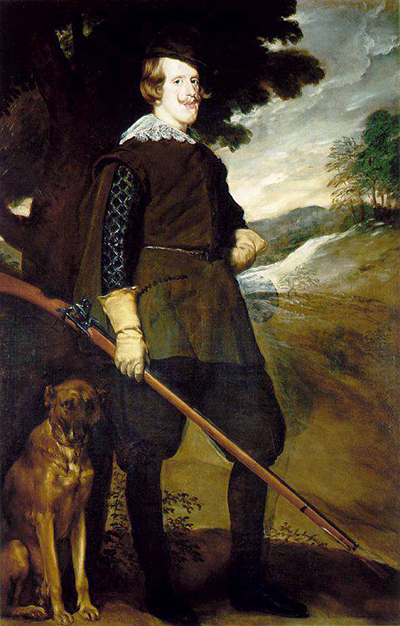
Philip IV as a Hunter. The companion king’s portrait repeats the format of a standing hunter with a dog and a gun. View Philip IV as a Hunter.
From the lodge to the Royal Palace and Prado
The testamentary inventory transcribed by Svetlana Alpers, begun in 1701 after the death of Charles II, records the three royal portraits in the seventh room of the lodge, with paintings of hunts and animals. In the 1747 inventory Ferdinand appears again, as a hunter in the third room, the Gallery of the King, with the two other Velázquez portraits listed in that room. These records establish that the paintings were displayed together by the early eighteenth century. Their precise positions on the walls and the date of the first installation are unknown. Among the other lodge pictures was a separate hunt scene by Pieter Snayers in which Ferdinand took part. A hunt viewed across a landscape gives a spectator a sense of the event’s scale, whereas Velázquez’s standing figure allows for a closer encounter with a particular participant. [1] [9]
Ferdinand helped administer another part of the lodge decoration from the Netherlands. In a letter of 20 November 1636 he told Philip that Rubens had received the king’s order and started some of the works for the Torre de la Parada. From Brussels he followed the progress of that commission and authorised payment. The letter concerns the Flemish paintings. It documents Ferdinand’s participation in the enterprise years after he had left Madrid and gives the later grouping of his portrait with those of his brother and nephew a particular resonance. Gállego records P001186 in the Royal Palace inventories of 1772 and 1794 and at the Prado from 1819. [1] [9]
Goya studies Ferdinand
During the Royal Palace period, Francisco de Goya studied Velázquez’s Ferdinand in a red-chalk drawing now in the Hamburger Kunsthalle. The small sheet, dated about 1778–79, preserves the figure’s turn and the strong diagonal of his gun. Goya reduced the size of the dog and gave less attention to the bright pattern on the sleeve. These changes leave the figure more isolated. Comparison with the engraved image shows how the sky darkened and folds in the costume became less distinct. The surviving proofs document Goya’s work on the plate as he experimented with the tones around the face and dog. The print’s caption identifies Velázquez’s life-size painting as being in the Royal Palace of Madrid. [10] [11]
In the oil the breadth of the dog’s back makes it a counterweight to the falling cape. Goya’s smaller animal leaves the lower portion of his image with a different balance, and the figure asserts itself more immediately. Returning from the print to the canvas brings back the intermediate tones that do so much of the work in Velázquez. Warm tawny fur and pale gloves stand forward against the trees and clothing, and the cool light through the narrow opening in the landscape keeps the upright man and his dog within a space that extends well behind them. [1] [10] [11]
Artworks directory
Frequently Asked Questions
Museo Nacional del Prado, P001186 [1]
Around 1632–34 [2]
Torre de la Parada [3]
The high black cap is tilted just enough to give each side of the head a different outline. The brim projects sharply on the right, above the shadow that falls over one eye. The other cheek is broadly lit, with a little pink in the flesh and a stronger red at the mouth. [1]
Discussion
Look again at the images and ideas explored in Cardinal-Infante Ferdinand of Austria as a Hunter. These editorial prompts invite your observations.
Reader Insights
How does the dog’s raised head return your attention to Ferdinand?
How does the direction of the gun change the portrait’s rhythm compared with the king’s?
Join the Conversation
Share a detail, comparison or question about Cardinal-Infante Ferdinand of Austria as a Hunter below.
References
- Julián Gállego, Velázquez, Museo del Prado exhibition catalogue, 1990, no. 44, pp. 270–274, P001186. See also nos. 43 and 45 for P001184 and P001189. Spanish. View source.
- Stephen M. Hart and Alexander Samson, eds., Philip IV and the World of Spain’s Rey Planeta, Tamesis, 2023, front matter, p. viii, fig. 13, with the Prado’s accession, dimensions, medium and date. English. View source.
- Musée du Louvre, Antoon Van Dyck. Catalogue raisonné des tableaux du musée du Louvre, 2023, no. 18, §7 and n. 36, exact accessions and destination of the three Velázquez hunters. French. View source.
- Musée du Louvre, Antoon Van Dyck. Catalogue raisonné des tableaux du musée du Louvre, 2023, no. 23, §§8–11 and fig. 23-4, including the distinct Prado portraits by De Crayer and Rubens. French. View source.
- Diego de Aedo y Gallart, Viaje del Infante Cardenal D. Fernando de Austria, Antwerp, 1635. Title-page itinerary in the University of Vienna’s Tieck database. Spanish. View source.
- Sagrario López Poza, “Relaciones impresas (años 1632–1642) sobre el Cardenal Infante don Fernando de Austria”, in Las relaciones de sucesos en los cambios políticos y sociales de la Europa moderna, 2015, pp. 142–147, including the documented 1633 voyage to Genoa. Spanish. View source.
- Museo Nacional del Prado, Explore the Collection, English index entry for Prince Baltasar Carlos in Hunting Dress, 1635–36. English. View source.
- Mario Criado Pérez, La medida original. El problema de los formatos en la pintura de Velázquez, Universidad de Salamanca, 2011, pp. 102–106, radiograph on p. 103 and nn. 140 and 143, citing Carmen Garrido’s Velázquez. Técnica y evolución (1992), p. 401. Spanish. View source.
- Svetlana Alpers, The Decoration of the Torre de la Parada, Corpus Rubenianum Ludwig Burchard, part IX, Phaidon, 1971, pp. 28–30, 122–128 and appendix II, 1701 testamentary inventory and 1747 inventory. English and Spanish. View source.
- Fundación Goya en Aragón, El infante Don Fernando, Goya’s preparatory drawing in the Hamburger Kunsthalle, catalogue entry 691. Spanish. View source.
- Fundación Goya en Aragón, El infante Don Fernando, print catalogue entry 690, with inscription, editions and record of the plate at Calcografía Nacional. Spanish. View source.







