


 by Tom Gurney
Tom Gurney BSc (Hons) is an art history expert with over 20 years experience
Published on June 19, 2020 / Updated on October 14, 2023
Email: tomgurney1@gmail.com / Phone: +44 7429 011000
The Triumph of Bacchus: Introduction
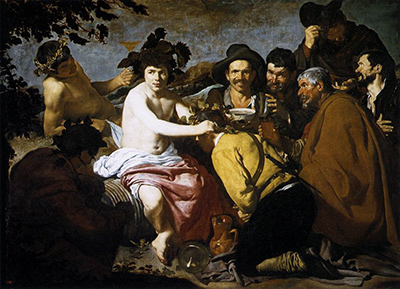
Bacchus is lowering a wreath onto a man's head. The man has dropped to his knees, folding forward until his face almost disappears. Above him, a drinker looks straight out of the picture with a bowl in his hand and a grin on his face. The two gestures are close enough to take in at once. One draws attention to the ceremony, while the other makes a place for us among the people watching it. [1]
Diego Velázquez painted The Triumph of Bacchus in Madrid in about 1628–29, shortly before his first journey to Italy. The oil on canvas belongs to the Museo Nacional del Prado in Madrid, where it is numbered P001170. Prado exhibition materials give its dimensions as 165 × 225 centimetres. The picture is also known as Los Borrachos, or The Drunkards, and the Prado uses The Feast of Bacchus in English. These names can send the eye in different directions across the same gathering. [1] [2]
At a Glance
- Also known asLos Borrachos [1] [2]
- MediumOil on canvas [1] [2]
- CollectionMuseo Nacional del Prado, P001170 [1] [2]
Contents
- A handful of leaves
- The company on the right
- Triumph or drinking party?
- A royal payment and a painting made in Rome
- Goya redraws the gathering
- From the treasury to the king’s rooms
- A painter the king could watch at work
- Two ways to honour Bacchus at the Alcázar
A handful of leaves
The ceremony takes up remarkably little space. Bacchus extends his arms, but the leaf crown is partly lost against the dark clothing and shadows behind it. The clearest guide to the action is the god's pale forearm. Look along it to where the hands meet the foliage, then down to the kneeling man's bent shoulders. The bright ochre jacket gives his back almost the weight of a second face. It bears the creases of the pose, bunching behind the shoulders and gathering at the elbow. His clasped hands are lower down, near his waist. The act of receiving the crown is as visible in his body as it is in Bacchus's hands. [1]
Bacchus wears his own crown of vine leaves. Its irregular shape pushes up into the sky, with dark clusters of foliage around the head. Below it, his body is the brightest sustained form in the painting. The front of his shoulder catches a broad light that continues along the arm, and smaller changes of tone round the chest and belly. Where the torso twists towards the kneeling man, the head turns the other way. His eyes follow something off to our left. The hands are close to finishing their work while the face seems free to attend elsewhere. [1]
The god sits on a barrel. Its curved bands show between the shadowed figure in the foreground and the folds of white cloth at Bacchus's hip. Rose-coloured drapery falls across his legs, leaving one knee and part of a leg exposed. The foot hangs near the ground, close to an earthenware vessel. If you follow the picture down from the leaves to the foot, his elevation is only the height of a wine cask. The barrel gives him a place of honour and makes that place intelligible in the terms of the feast. [1] [2]
At the left, a second partly bare figure reclines under the foliage, with a slender-stemmed glass held aloft. The face and shoulder are in a warmer, lower light than Bacchus's. A third figure, heavily clothed and turned away, fills the lower left. The dark shoulder in the foreground covers part of the barrel and makes the reclined figure seem farther back. Beyond the bodies there is open land and sky. Velázquez gives us enough landscape to feel the gathering has room around it, then lets shoulders, hats and leaves obscure most of the view. [1]
The company on the right
The man with the bowl offers the quickest way into this half of the canvas. His front teeth show in a smile and his stare is direct. The bowl is held just below his face, with its pale rim making a shallow horizontal curve. It projects towards us as readily as the face does. A dark-haired companion edges close to him, his head tilted into the narrow space between the bowl-holder and the older man in profile. From a distance the two faces seem to share a reaction. Close up, the older man's profile is fixed elsewhere, towards the centre of the group. Velázquez makes room for that difference with little more than a change in the angle of a head. [1]
Other gestures carry attention up and out from the bowl. The man higher up lifts a broad hat, and you can see his fingers against its brim more easily than you can read his face. At the right edge a lean figure turns inwards with a hand to his chest. The older man's cloak falls in a long stretch of brown, with a curve that brings the eye down towards the kneeling figure and the press of clothing at ground level. The people on this side of the canvas are packed tightly, yet you can follow how each is placed through the small bits of body and garment left in view. [1]
The vessels give the company another set of relationships. The shallow bowl is held at chest height, the glass on the left is raised near a head, and a jug stands at the kneeling man's feet. The earthenware reads through a bright patch on its rounded side and darker lines around the neck and handle. A low reflection beside it points to glass. Neither object needs much floor space to establish that we are looking at things that can be picked up, emptied and put down again. Their relative sizes and positions also steady a composition in which so many bodies lean. [1] [3]
Velázquez had studied these differences in surface in his early Seville paintings. In An Old Woman Cooking Eggs, dated 1618, light distinguishes the earthenware dish, kitchen utensils and eggs as they begin to set. The material changes are slow enough for us to watch. In The Triumph of Bacchus, we might first notice the shoulder of the god or the bowl under the drinker's grin, then find the jug and glass on our second pass through the picture. A technique learnt in the kitchen has become one of the ways a crowded outdoor scene directs attention. [1] [4]
Triumph or drinking party?
The Triumph of Bacchus gives the god of wine the leading role. At the Uffizi in Florence, Caravaggio's Bacchus brings the same god within reach through a young man's body, a basket of fruit and a glass of wine offered to the viewer. Julián Gállego compared Velázquez's Bacchus with Caravaggio's types. Consider where the offer comes from in the later painting. Bacchus is occupied with the wreath and the glass rises behind his shoulder. The man who brings his drink closest to our attention is a member of the company. Velázquez gives a companion a welcoming gesture that Caravaggio gives to the god. [1] [5]
There is a ceremonial gravity to the bowed head and the deliberate descent of the crown. Gállego saw a resemblance to an Adoration of the Magi. In Velázquez's earlier Adoration of the Magi, the kneeling visitor helps establish the importance of the child through his very position, below and turned towards him. The kneeling man in Bacchus similarly makes it easy to tell who presides, even with so many competing faces. But the dark brim and conspicuous smile just beyond his back create a different relation to the viewer. A man can acknowledge us while another is absorbed in paying homage. [1] [3]
That smile makes Los Borrachos a plausible name even if we have been looking mainly at the coronation. The title draws attention to men's clothes, cups and expressions, and to the possibility that the ceremony is a game. The Spanish wording is traceable through the changing descriptions of the work. As Aldana Romina Hereñú records, the 1636 Alcázar inventory named Bacchus on his barrel crowning a drunkard, and later seventeenth-century records described Bacchus crowning his companions. The 1819 museum catalogue called it Bacchus Crowning the Drunkards. The 1828 catalogue called it Gathering of Drinkers, and in 1843 Pedro de Madrazo acknowledged Los Borrachos as the name by which the picture was known. By moving the companions into the title, successive catalogues made their part in the event harder to overlook. [6]
The titles leave scope for several readings of the crown. The Prado's label for its travelling exhibition in Castilla-La Mancha emphasised wine's ability to ease hardship. There is room for that idea in the moment of recognition offered to the kneeling man and the convivial expressions around him. Gállego found a curious solemnity in the scene as well. The two impressions can linger together because the figures respond so differently. Try following the line of the belt across the kneeling man's back towards the tight bunch of cloth at his ankle. The effort of holding the pose gives the crowning an earnestness that the grin has little power to dispel. [1] [2]
Velázquez, Los Borrachos or the Triumph of Bacchus · Smarthistory · Watch on YouTube
A royal payment and a painting made in Rome
On 22 July 1629 Philip IV issued an order to his treasurer for 400 silver ducats for Velázquez. The document assigns 100 to a painting of Bacchus made in the king's service and the remaining 300 to other works. In the Corpus Velazqueño transcription the king refers to the painting as something the artist has made. That makes the order good evidence that a Bacchus already existed in July. The date belongs to the document, and the 1990 Prado catalogue places the painting's execution probably in the preceding months. It records other proposals, including a suggestion of later retouching. The first recorded Alcázar inventory entry, in 1636, anchors the picture in the palace collection by that year. [1] [6] [7]
Velázquez's Apollo in the Forge of Vulcan, painted in Rome in 1630, is a close comparison for the problem of putting a god among a group of men. Apollo raises a finger to deliver his news, and the response passes from one worker to the next. Their hands still belong to their work even as their heads turn to listen. In Madrid, Velázquez had already given the gathering around a god different speeds of reaction. Bacchus holds his arms out to complete a task. The bowed companion keeps still. The hat is in motion, and the bowl comes forward. The two scenes give their stories pace through the different things each body is doing. [1] [3] [8]
The preparations beneath the two paintings differ. A sample from the rose-coloured drapery in Bacchus, reproduced in cross-section by Larry Keith and Dawson W. Carr, shows colour containing a red lake pigment over a thick red-brown ground. The ground is the layer laid on the canvas before the image is painted. Keith and Carr describe a pale grey ground in Apollo, with the potential for a wider range of light and dark tones where the paint was applied thinly. It could also be warmed locally with translucent brown paint. The sample from Bacchus gives a view beneath one coloured passage. Along Bacchus's outstretched arm, the visible change from pale skin to dark fabric and leaves makes the gesture clear. [3]
The two canvases also reached the royal collection by different routes. The 1629 order concerns a work made in Philip IV's service. The catalogue records that the independently painted Apollo was bought from Velázquez in 1634 by Jerónimo de Villanueva. Bacchus is documented in the Alcázar inventories of 1636, 1666, 1686 and 1700. It survived the palace fire of 1734, passed to the Buen Retiro and appears in Royal Palace inventories in 1772 and 1794. It entered the Prado in 1819. [1] [7] [8]
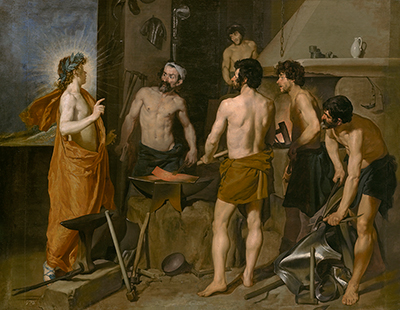
Apollo in the Forge of Vulcan. A second mythological painting sets a god among recognisably ordinary people, this time in the close quarters of a forge. View Apollo in the Forge of Vulcan.
Goya redraws the gathering
Francisco de Goya made an etching after Velázquez in 1778, while the canvas was still in the royal collection. The Metropolitan Museum of Art holds an impression as A False Bacchus Crowning Drunkards, accession 24.97.1. In the inscription Goya calls the figure a Baco fingido, a feigned Bacchus. The etched scene is 43.5 centimetres wide and preserves the painting's orientation. The ritual still sits between the seated god and the figure bent towards him. The Met points to changes in the expressions. Goya's Bacchus looks older, and the companions' faces are more emphatically drawn. [9]
Where Velázquez uses the dark of the left foreground to let a figure almost disappear into his surroundings, Goya etches a closely worked patch around the man's shoulder. A lighter edge catches his cheek and brings his bowed head into view. Pale paper serves for Bacchus's forearm, the drapery and the high points of the older man's cloak. The bowl-holder shows a regular streak of teeth, and fine dark lines around the mouth sharpen his grin. Even at the size of the etching, that face is among the first to come forward. Its persistence helps explain what the shorter title saves from a painting full of quieter gestures. [1] [9]
An image of the gathering makes a further appearance in Édouard Manet's 1868 portrait of Émile Zola. A print after the Velázquez hangs behind a reproduction of Manet's Olympia, partly concealed on the wall above Zola's desk. The Musée d'Orsay reads it as a sign of the painter's and writer's shared taste for Spanish art. Gállego identified it as Goya's etching, while the Musée d'Orsay tentatively indexes it under Nanteuil. The small painted fragment still shows the young god's light body and the crowd pressed around him. In Madrid the bodies approach life size. In the portrait, a sliver of the feast is enough to make it recognisable. [1] [10]
From the treasury to the king’s rooms
The order for Velázquez’s payment begins with a chest and three keys. Philip IV directs his treasurer general, Mateo Ibáñez de Segovia, to draw the silver from the royal coffers with the involvement of the two officials responsible for auditing the treasury, who hold two of the keys. The document gives the full sum in two forms, as silver ducats for payment and as 150,000 maravedís for the account. Bacchus gets a line of his own. The other pictures are covered by a collective entry, a reminder that the clarity with which one picture emerges from the paperwork is unusual even within this single transaction. [11]
The order also follows the paintings beyond the moment of payment. The clerk of the royal household board, the Bureo, is to register the order and arrange for the pictures to be charged to the person who has received them or will receive them. That person will have to account for them in turn. The king authorises the treasury to enter the payment against its own accounts with the order and an acknowledgement from Velázquez or his representative. A final clause even ratifies compliance if it has already taken place under the chief accounting officer’s instructions. The dated sheet settles what can pass in the accounts, while leaving the actual day of payment open. [11]
The recipient named in the order is the painter. The person to be made answerable for the pictures is left unnamed, as is the room in which the Bacchus was to hang. Here the palace inventory supplies a different kind of information. Emily Umberger notes that in 1636 the canvas was recorded in the king’s bedroom in the lower summer apartments of the Alcázar. This brings the picture into a specific part of the household within seven years of the order. How it reached that room, and whether the room had been chosen when Velázquez began work, remain open questions. [11] [12]
A painter the king could watch at work
Four days after the treasury order, the Parma ambassador Flavio Atti wrote from Madrid to the Duchess of Parma about Velázquez’s impending journey. In explaining how the visitor should be received, he dwelt on an unusual combination of duties. As an usher of the royal chamber, Velázquez went ahead of the king’s cup when Philip was about to dine or sup. Atti also said that he had often seen Velázquez paint in the king’s apartments, where Philip himself frequently watched him at work. For a diplomat advising a distant household on how to receive a visitor, these details helped establish the painter’s degree of access to the king. [13]
Atti singles out portraiture as Velázquez’s particular occupation. The treasury order from the same week happens to name a mythological picture. Taken together, the two documents show how selectively each kind of record describes a painter’s work. The ambassador gives the Duchess a familiar way to place an individual at court. The accountants need to distinguish a named picture from the group of works being paid for alongside it. Atti leaves the canvases he saw unnamed. His letter gives us a firsthand account of the king watching Velázquez paint, while the order identifies a subject on which the painter had recently worked in royal service. [11] [13]
The Venetian ambassador Alvise Mocenigo gives a second account of the preparations on 28 July. He says the Count-Duke of Olivares, acting on the king’s orders, had passports and letters of recommendation sought for Velázquez. Mocenigo supplied a passport and letters for contacts in Venice and on the mainland, reporting that the painter intended to spend time in Venice to study his profession. Atti privately suspected an intelligence-gathering purpose, whereas Mocenigo took the study plans seriously. Their judgements concern the same proposed journey and tell us something about the different readings invited by an artist who travelled with royal backing. The money recorded for paintings and the diplomatic help recorded for travel belong to the same week of court business. [11] [13] [14]
Two ways to honour Bacchus at the Alcázar
By 1666 the palace inventory offers a comparison from another room. Umberger identifies a Sacrifice to Bacchus by the Neapolitan painter Massimo Stanzione in the king’s dining room, together with a Bacchic canvas by Jusepe de Ribera. The two are recorded there again in 1686. Stanzione’s painting, now at the Prado and generally dated to the mid-1630s, offers a useful comparison because the same royal collection gave space to both versions of Bacchic ritual. The surviving records give separate settings for Velázquez’s painting in 1636 and the Neapolitan paintings in the later inventories. A three-picture ensemble remains a hypothesis. [12] [15]
In Stanzione’s canvas worshippers cluster round an elevated statue. Arms rise towards it from different parts of the gathering, and the movement continues through the figures farther out, where children and offerings occupy the foreground. The height of the statue sets a direction for all that activity. In Velázquez, the god is low enough to reach the kneeling man with his hands. The direction of the gift changes as well. Stanzione’s people bring things to the god, while Velázquez’s Bacchus confers a distinction upon one of the people who have gathered. In each painting you can tell what the company has come together to do by following the objects that the figures carry or bestow. [12] [15] [16]
The larger scale of Stanzione’s composition gives space to several acts of worship at once. A spectator can move from figures bearing offerings to the statue and back down to the children at the feast. In Velázquez a single exchange has to carry the ceremony. The kneeling man lowers his head and receives the crown inside the circle of people who have come to drink. The inventories allow us to place these different pictorial choices within the history of one collection. The dining-room painting presents a group doing honour to the visible image of a god. The painting documented in the summer bedroom gives the god the more intimate task of singling out a guest. [12] [15] [16]
Artworks directory
Frequently Asked Questions
The ceremony takes up remarkably little space. Bacchus extends his arms, but the leaf crown is partly lost against the dark clothing and shadows behind it. The clearest guide to the action is the god's pale forearm. [1]
The man with the bowl offers the quickest way into this half of the canvas. His front teeth show in a smile and his stare is direct. The bowl is held just below his face, with its pale rim making a shallow horizontal curve. [1]
Discussion
Look again at the images and ideas explored in The Triumph of Bacchus. These editorial prompts invite your observations.
Reader Insights
How does Bacchus’s brightly lit figure change the way you see the group around him?
Where do the kneeling figure and the onlookers pull your attention in different directions?
Join the Conversation
Share a detail, comparison or question about The Triumph of Bacchus below.
References
- Julián Gállego, “Los borrachos o El triunfo de Baco,” in Velázquez, Museo del Prado and Ministerio de Cultura, 1990, cat. 21, pp. 146–152, with colour plate and details (Spanish). View source.
- Museo Nacional del Prado, El Museo del Prado en Castilla-La Mancha, label for El triunfo de Baco o Los borrachos, P-1170 (Spanish), agreement published in the Boletín Oficial del Estado, annex I, no. 28 (Spanish), and The Prado in Jerez, checklist no. 10. View source 1. View source 2. View source 3.
- Larry Keith and Dawson W. Carr, “Velázquez's ‘Christ after the Flagellation’: Technique in Context,” National Gallery Technical Bulletin, vol. 30, 2009, pp. 52–71, especially pp. 56–58, 67–69, plates 10–13 and 23, and note 11. View source.
- National Galleries of Scotland, Diego Velázquez, An Old Woman Cooking Eggs, NG 2180. View source.
- Patrizia Naldini, Uffizi Galleries, Caravaggio, Bacchus, inv. 1890 no. 5312. View source.
- Aldana Romina Hereñú, Los nombres de Velázquez. Un estudio sobre los títulos vulgares en la obra de arte y la relación público-museo en la España del siglo XIX, Universidad Nacional de San Martín, 2024, pp. 146–149, with inventory and catalogue transcriptions (Spanish). View source.
- Felipe IV, order to the treasurer general, 22 July 1629, Archivo General del Palacio Real, Reinados, Felipe IV, Casa, leg. 129. Transcription published by the Centro de Estudios Europa Hispánica, doc. 84, Corpus Velazqueño 67 (Spanish). View source.
- Julián Gállego, “La fragua de Vulcano,” in Velázquez, Museo del Prado and Ministerio de Cultura, 1990, cat. 23, pp. 158–162 (Spanish). View source.
- Metropolitan Museum of Art, Francisco de Goya after Diego Velázquez, A False Bacchus Crowning Drunkards, 1778, etching, 24.97.1. View source.
- Musée d'Orsay, Édouard Manet, Émile Zola, 1868, RF 2205 (French). View source.
- Philip IV, “Cédula al tesorero general para librar a Velázquez 400 ducados, a cuenta de la pintura de «Baco» y de otras pinturas que realizaba para Felipe IV,” 22 July 1629, Centro de Estudios Europa Hispánica, doc. 84, Corpus Velazqueño 67. View source.
- Emily Umberger, “Velázquez and Naturalism I: Interpreting Los Borrachos,” RES: Anthropology and Aesthetics 24 (1993), pp. 21–43, especially pp. 35–37 and note 49. View source.
- Flavio Atti, letter to the Duchess of Parma, 26 July 1629, Centro de Estudios Europa Hispánica, doc. 85, Corpus Velazqueño 68. View source.
- Alvise Mocenigo, letter on Velázquez’s journey to Italy, 28 July 1629, Centro de Estudios Europa Hispánica, doc. 87, Corpus Velazqueño 70. View source.
- Beatriz Calvo, La fortuna de la pintura barroca comisionada por el VI conde de Monterrey, durante el siglo XX, Fondazione 1563, 2024, especially fig. 6, p. 99. View source.
- Julián Gállego, “Los borrachos o El triunfo de Baco,” in Velázquez, Museo del Prado and Ministerio de Cultura, 1990, cat. 21, pp. 146–152, with colour plate and details. View source.







