


 by Tom Gurney
Tom Gurney BSc (Hons) is an art history expert with over 20 years experience
Published on June 19, 2020 / Updated on October 14, 2023
Email: tomgurney1@gmail.com / Phone: +44 7429 011000
The Adoration of the Magi: Introduction
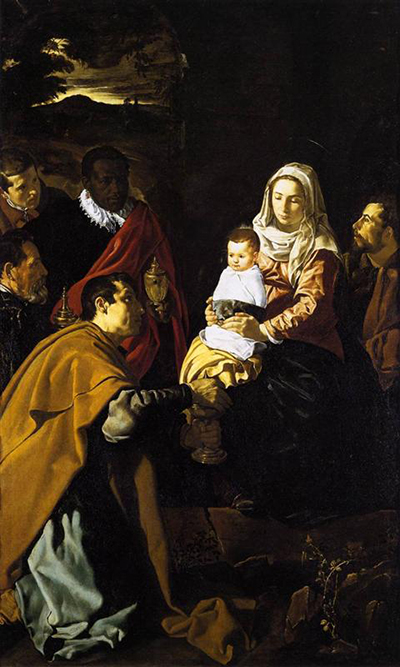
The most conspicuous thing in Diego Velázquez’s Adoration of the Magi is the white cloth wrapped around a child. His body is held upright by Mary’s two hands, while his eyes turn to the left. Below him a man has dropped to one knee, his ochre cloak spreading out behind him. The man’s face is in profile and partly in shadow. His weight, the rise of his shoulder and the direction of his gaze all lead towards the small, illuminated face above him. Velázquez painted the scene in Seville in 1619, when he was about twenty. The canvas measures 203 × 125 cm and is in the Museo del Prado in Madrid, inventory P001166. [1] [2] [3]
At a Glance
Contents
- The visit to Bethlehem
- The kneeling visitor and Mary’s hands
- Light, paint and the edges of the canvas
- Seville, Pacheco and the possible sitters
- Two ways of seeing a sacred event
- From Seville to the royal museum
The visit to Bethlehem
In Matthew’s Gospel, Magi from the east come to Jerusalem asking about the newborn king of the Jews, whose star they have seen. Herod consults the chief priests and scribes and sends the visitors to Bethlehem. The star goes ahead of them and stops above their destination. Inside the house they find Jesus with Mary, fall down in homage and offer gold, frankincense and myrrh. Their departure also matters to Matthew’s narrative. Warned in a dream, they return to their country by a different way, avoiding Herod. Velázquez takes the interval between arrival and departure, when the travellers have found the person they came to see. [4]
Matthew names the gifts and leaves the visitors’ number, names and ages unspecified. The three gifts helped establish a tradition of three Magi. The practice of depicting them as kings drew on biblical passages such as Psalm 72, in which rulers bring tribute, and Isaiah 60, in which nations come to the light bearing gold and frankincense. In western European art the visitors became familiar as Gaspar, Melchior and Balthazar. Their ages, origins and individual gifts could vary. From the late fifteenth century, painters often depicted Balthazar as a young Black African ruler. The red-cloaked figure with the lace collar belongs to that visual tradition, while the bearded man traditionally read as Joseph and the partly visible page bring two further witnesses into the painted scene. Matthew’s description of the visit mentions Mary, Jesus and the Magi. [1] [4] [5]
A comparison with Juan Bautista Maíno’s Adoration of the Magi, also in the Prado, shows how many choices were open to a painter treating the subject. Maíno gives his star a place high in an architectural opening and makes it legible through the beam that descends towards the group. The visitors’ dress offers patterns, bright fabrics and conspicuous headgear. In Velázquez’s canvas the Magi’s clothes are chiefly masses of heavy cloth. The gleam of vessels and Balthazar’s lace collar distinguish individual figures within the crowd. The narrow band of sky at the upper left lets the eye travel out briefly, while the brightest surfaces in the group gather around the place of homage. [1]
The kneeling visitor and Mary’s hands
The long descent of the foreground visitor’s cloak gives an unusually clear sense of the body inside it. At the shoulder the ochre folds are broad and shallow. Near the floor, where the green garment emerges, the folds buckle and overlap. The man’s back and bent arm fill the left foreground, while his face is tucked almost into his own shoulder. You can read the kneeling movement from across a room. The vessel and the smaller movements of his hand become legible as the eye adjusts to the darkness in the gap between him and the Virgin. The painter gives the offer of a gift a bodily scale before he gives the object itself much light. [1]
Mary’s hands occupy that same part of the painting. One comes around the child’s side from behind. The other lies across his lap over a dark band between patches of light fabric. Follow the sequence down from the child’s forehead to the edge of the white wrapping and then to the line of her fingers. It shows how securely she holds him, and how little room there is for him to move. The face, though, is alert. His eyes travel sideways, while Mary’s lowered lids turn her attention towards the activity immediately below them. Joseph, pushed to the right edge, tips his head upwards. A little light catches his brow, nose and cheek, just enough to give that upward turn a direction. [1]
Julián Gállego’s 1990 Prado catalogue records how differently critics have read Mary’s bearing. Gállego found a spiritual concentration in her expression. Bernardino de Pantorba saw a Sevillian girl absorbed in the practical business of holding a child. The way Velázquez brings her eyes and her grip into the same downward line gives both readings something to work with. Her grip also explains why the foreground visitor’s movement can be so slight at the point of the exchange. Mary has already turned and steadied the child for the encounter. [1]
The other visitors are visible in pieces. Behind the foremost figure the older man’s face and beard emerge close to the left edge. The lace at Balthazar’s neck is a sharp punctuation in the darkness above the kneeling man. Its irregular white border draws the eye sideways across his chest, where the long turn of red fabric leads it back down. The page has barely enough space for a face and a little of his attire. Each figure has a different distance from the child, yet the overlapping outlines compress those distances into a narrow band on the surface. The room implied by the bodies is only partially described by the setting. [1]
Light, paint and the edges of the canvas
Gállego described a source of light high to the left. The direction is easy to follow along Mary’s veil, through the child’s white wrapping and down to the high points of the kneeling man’s cloak. Two adjacent folds can receive quite different amounts of light. On Mary’s sleeve the lit ridges are close and small, shaped by the bend of her elbow. On the magus’s cloak the light falls in wider bands. Beyond the group there is a low ridge in the distance, a little foliage against the sky and what the catalogue describes as the shaft of a column, hard to see. Near the lower right, small marks at the edge of leaves and stones are enough to give the eye a point of reference on the ground. [1] [6]
The dark areas of the painting have a different legibility in the published X-radiograph. In her study of the Metropolitan Museum’s Supper at Emmaus, conservator Charlotte Hale reproduced a mosaic X-radiograph of the Prado Adoration. The image registers the distribution of lead-white-bearing paint and lets the viewer trace broad folds in the kneeling man’s clothes. Hale singled out the long strokes in Mary’s skirt and the tiny highlight on her fingernail as examples of the freedom of Velázquez’s brush in this early picture. She also cited Carmen Garrido’s infrared study of the Adoration, which identified adjustments made with strokes of black paint. The broad strokes and the corrections are two different kinds of evidence for how Velázquez defined forms. [7]
Hale also discusses the painting’s patterned canvas and the similarity of its ground to the preparation used for other early pictures. She draws the comparison with the Met Supper at Emmaus and with several works from the Seville period, including the National Gallery’s kitchen scene. A patterned support is a feature of the fabric beneath the image. The ground is the preparatory layer over it. The fine light bordering the painted leaves or catching Mary’s nail belongs to the image applied over both. Looking at those three layers of evidence helps account for the difference between what the eye sees in the gallery and what can be recovered under examination. [7]
The abrupt end of the crowd at either edge has prompted a separate question about the canvas’s original size. The 1990 Prado catalogue discusses a nineteenth-century lithograph after the painting by Cayetano Palmaroli. Its composition has more space at both sides, giving the visitors and page at left and Joseph at right greater room. José López-Rey considered a larger original format and allowed that the lithographer might have supplied the extra space in making the print. Gállego argued that the present concentration suits the design, while acknowledging how difficult it is to judge the proportions of an altarpiece without knowing its architectural setting. The lithograph records a wider treatment of the scene. The original width remains a matter of debate. [1] [8]
Seville, Pacheco and the possible sitters
The date is recorded on the stone below the Virgin’s foot. The 1990 Prado catalogue follows the customary reading of 1619 and notes José Camón Aznar’s earlier proposal of 1617. The Prado’s published listing uses 1619, and the Andalusian Institute of Historical Heritage identifies this as the earliest surviving dated painting by Velázquez. The young painter had qualified through Seville’s painters’ guild in 1617 and married his former teacher Francisco Pacheco’s daughter Juana in April 1618. The Adoration belongs to his first years of independent work, before the visits to Madrid that led to his appointment as royal painter in 1623. [1] [2] [9]
The possibility of a Jesuit commission comes from what is known of Pacheco’s connections and from a much later account of the picture’s ownership. Pacheco’s writings and portraits attest to his contacts with the Society of Jesus. Gállego discusses the proposal that the picture was made for the chapel of the Jesuit novitiate at San Luis in Seville. The two-metre height and vertical concentration make the suggestion of an altar setting understandable. Javier Portús, writing in the Prado’s 2007 exhibition catalogue, reports an eighteenth-century mention of the painting at San Luis. That would place it there well after its execution. Gállego also reads the close, tangible presentation of the episode in relation to the emphasis on imagining sacred events through the senses in Ignatius of Loyola’s Spiritual Exercises. That interpretation would suit a Jesuit setting, whose role as the first destination of the canvas remains hypothetical. [1] [10] [11]
Pacheco, who later took pride in having trained Velázquez for several years, reported that as a boy his pupil worked from a young model whom he set to pose in different ways and with different expressions. The record of that practice invites attention to the specificity of faces in the painting. The different profiles, the amount of cheek exposed to the light and the different ways each head tips towards the child have compositional work to do before any possible resemblance is considered. Gállego suggested that Mary might portray Juana and Jesus their first daughter Francisca, baptised in 1619. He also discussed proposals that Pacheco might have posed for Melchior and Velázquez for Gaspar, the kneeling visitor, and mentioned more tentative guesses for Balthazar. Portús later made a stronger case for the oldest king by comparing him with Pacheco’s self-portrait in his own Last Judgement, today at the Musée Goya in Castres. These are suggestions about possible models. A marriage record, a baptism and a familiar-looking face provide circumstances in which posing could have occurred. They leave the identities unresolved. [1] [7] [9] [12] [11]
Two ways of seeing a sacred event
The thick shoulders and solid folds have also suggested Seville’s painted wooden sculpture to Gállego and the close grouping of a sculpted altarpiece to Portús. Gállego singles out the resemblance between Mary’s collected expression and that of Juan Martínez Montañés’s Virgin known as La Cieguecita, illustrated in the 1990 catalogue. In the Adoration the fold on Mary’s sleeve reads as a raised ridge partly because the dark immediately beneath it appears to fall back so quickly. That alternation of projecting ridge and deep recess reappears on the cloak of the kneeling man. It is a way for a painter to suggest the thickness a sculptor would need to give to the material itself. [1] [11]
A different devotional use for a likeness is suggested by Velázquez’s portrait of the Franciscan Mother Jerónima de la Fuente. Alfonso E. Pérez Sánchez places the sitting in Seville in June 1620, before she sailed on her way to establish a convent in Manila, and connects the portrait with the nuns’ wish to keep an image of their absent superior. In that painting an alert, direct look meets the viewer and the nun’s fingers close firmly around a crucifix. In the Adoration, the corresponding emphasis on a face and a pair of hands serves the immediate exchange inside the picture. The portrait shows how a young painter could draw on the same close attention to grip and expression for a religious community whose needs were different from those of a congregation before an altarpiece. [13]
In the horizontal Kitchen Scene with Christ in the House of Martha and Mary, probably painted in 1618, light makes the holding of a mortar and the surface of fish register before the eye travels up to the small biblical episode. The National Gallery reads that scene as visible through an opening, while recording interpretations of it as a picture or a reflection. The Adoration gives comparable weight to hands, fabrics and objects within one continuous group. Where the kitchen picture asks the eye to move between a near action and a smaller gathering at the upper right, the Adoration draws the eye straight from a bent back to the child whom the visitor is approaching. [1] [14]
Two other early religious paintings help show the range of these solutions. In Saint John the Evangelist on the Island of Patmos, the saint turns from an open book towards a tiny woman in a break in the clouds. In its companion The Immaculate Conception, a fully visible Virgin stands above a landscape, with her hands joined and her eyes lowered. Each figure is strongly lit from the upper left, and the National Gallery calls attention to the related colours of their clothes. John’s upward gaze directs the viewer away from him. The Virgin’s lowered gaze invites the viewer to consider the illuminated figure herself. The larger Adoration has room to make such different lines of sight part of a single crowd, arranging Joseph’s upturned profile, the child’s sideways look and Mary’s lowered head within a short span. [1] [15] [16]
Those two London pictures were documented together in the chapter house of the Shod Carmelites in Seville in 1800. The National Gallery considers the convent a possible first destination and leaves the identity of the commissioner open. The evidence for that later Carmelite setting is distinct from the proposed Jesuit destination of the Adoration. It shows one way early paintings by Velázquez were used in a religious institution in the city, as companion canvases placed together so that the vision reported by the Evangelist and the monumental Virgin could be viewed in relation to each other. [15] [16]
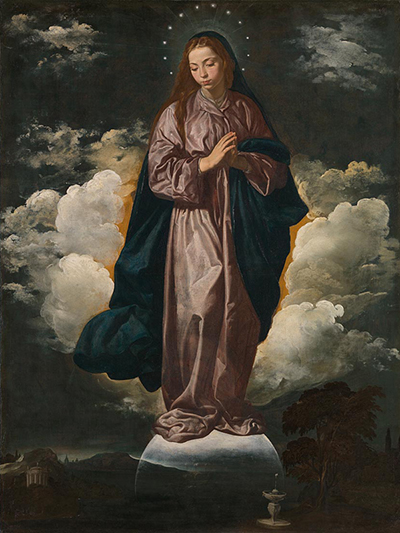
The Immaculate Conception. Compare how related early Seville religious paintings use a focused light to give figures volume. View The Immaculate Conception.
From Seville to the royal museum
The older literature places the Adoration in the collection of Francisco de Bruna at Seville in the late eighteenth century. Gállego treats the reported sighting there by the traveller Richard Twiss as unverified. Some of Bruna’s collection reportedly came from the Jesuits, an indirect reason for pursuing the possible earlier institutional connection. The provenance reported by the 1990 catalogue goes on to record an offer to the Crown by Bruna’s nephew Luis Meléndez and associates the painting with El Escorial, where an older attribution to Francisco de Zurbarán was reported. The catalogue dates its entry into the Prado to 1819. By the royal museum inventory of 1834 it appears as no. 119 in the first gallery, under Velázquez’s name. [1] [3] [10]
A viewer in the museum can see the encounter from farther back than a reproduction usually permits. From that distance the white around Jesus reads first, then the pale enclosure of Mary’s veil. With a closer look the small echo between her bent fingers and the shadows on the sleeve becomes visible, and farther down the visitor’s cloak seems to take on weight again. The painter has made the sequence of looking follow the visitors’ own discovery. The rest of the journey, from the light in the sky to the faces high in the shadows, can be taken after the eye has found the child. [1]
Artworks directory
Frequently Asked Questions
In Matthew’s Gospel, Magi from the east come to Jerusalem asking about the newborn king of the Jews, whose star they have seen. Herod consults the chief priests and scribes and sends the visitors to Bethlehem. The star goes ahead of them and stops above their destination. [4]
Discussion
Look again at the images and ideas explored in The Adoration of the Magi. These editorial prompts invite your observations.
Reader Insights
Follow the line of hands towards the child. Where do the lit faces draw your eye next?
What details help you distinguish the scene from an ordinary group portrait?
Join the Conversation
Share a detail, comparison or question about The Adoration of the Magi below.
References
- Julián Gállego, La adoración de los Magos, catalogue no. 8, in Antonio Domínguez Ortiz, Alfonso E. Pérez Sánchez and Julián Gállego, Velázquez, Museo del Prado and Ministerio de Cultura, 1990, pp. 94–99. Spanish. View source.
- Museo Nacional del Prado and Centro de Estudios Europa Hispánica, 2018 agreement for Alrededor de Velázquez: estudios dispersos, annex entry 1166, Adoración de los Reyes Magos, Boletín Oficial del Estado. Spanish. The English title appears as The Adoration of the Magi, no. 51 in the National Museum of Western Art’s Prado exhibition checklist. View exhibition checklist. View source 1. View source 2.
- Poder, patrimonio y cultura en España, Adoración de los Reyes Magos, Prado P001166, with royal museum inventory of 1834, no. 119, fol. 408r. Spanish. View source.
- United States Conference of Catholic Bishops, Matthew 2:1–12 and notes, New American Bible, Revised Edition. View source.
- J. Paul Getty Museum, Balthazar: A Black African King in Medieval and Renaissance Art, exhibition gallery text, “The Magi in Medieval Manuscripts”. View source.
- Inge Fiedler, Zahira Veliz Bomford and Frank Zuccari, “Technique and Style: Clues to Authorship in the Chicago Saint John in the Wilderness”, Art Institute of Chicago Museum Studies 31, no. 2, 2005, especially fig. 15b, detail of the Prado Adoration. View source.
- Charlotte Hale, “Dating Velázquez’s The Supper at Emmaus”, Metropolitan Museum Journal 40, 2005, pp. 67–78, figs. 2 and 5, and notes 14, 18, 25 and 29. View source.
- Cayetano Palmaroli after Diego Velázquez, Adoración de los Reyes Magos, lithograph, reproduced in Walter Armstrong, Velazquez: A Study of His Life and Art, p. 19. View source.
- Instituto Andaluz del Patrimonio Histórico, Biografía de Velázquez, early chronology and family records. Spanish. View source.
- Instituto Andaluz del Patrimonio Histórico, La adoración de los Magos, entry for Prado 1166 in Velázquez y Sevilla. Spanish. View source.
- Javier Portús, Adoración de los Reyes Magos, in Fábulas de Velázquez. Mitología e Historia Sagrada en el Siglo de Oro, Museo Nacional del Prado, 2007, p. 311, excerpted in Velázquez en el Museo del Prado, module 2, pp. 8–9. See also the portrait discussion on pp. 6–7. Spanish. View source.
- Francisco Pacheco, Arte de la pintura, Seville, 1649, “Inicio y llegada a la corte de Felipe IV”, particularly pp. 101–102. Spanish transcription by Santiago Arroyo Esteban, Universidad Complutense de Madrid. View source.
- Alfonso E. Pérez Sánchez, La venerable madre Jerónima de la Fuente, in El retrato español. Del Greco a Picasso, Museo Nacional del Prado, 2004, pp. 342–343, excerpted in Velázquez en el Museo del Prado, module 2, pp. 5–6. Spanish. View source.
- The National Gallery, London, Diego Velázquez, Kitchen Scene with Christ in the House of Martha and Mary, NG1375, object record and audio description. View source.
- The National Gallery, London, Diego Velázquez, Saint John the Evangelist on the Island of Patmos, NG6264, object record and “Two Paintings for the Shod Carmelites, Seville”. View source.
- The National Gallery, London, Diego Velázquez, The Immaculate Conception, NG6424, object record and series account. View source.







