



 by Tom Gurney
Tom Gurney BSc (Hons) is an art history expert with over 20 years experience
Published on June 19, 2020 / Updated on October 14, 2023
Email: tomgurney1@gmail.com / Phone: +44 7429 011000
Portrait of Pope Innocent X: Introduction
Pope Innocent X sits with a sheet of paper in his left hand. Its near corner lifts from the white cloth below it, and two fingers hold it in place. His right hand lies on the arm of his chair, its fingers curving down over the edge. He has turned his face towards us while his chair and shoulders still sit at an angle. The effect is of an encounter already under way. We seem to have caught the Pope between one thing he was attending to and whatever he now sees in front of him. [1]
Diego Velázquez painted this likeness in Rome around 1650, during his second Italian journey. The sitter, Giovanni Battista Pamphilj, was pope from 1644 to 1655. The original is an oil on canvas measuring 141 × 119 cm, held by the Galleria Doria Pamphilj in Rome as FC 289. The gallery proposes a date between the end of 1649 and January 1650. The portrait hangs in a chamber made for it in the nineteenth century, where a marble bust by Gian Lorenzo Bernini gives us another way of seeing the same man. [1] [2] [3]
At a Glance
- SitterGiovanni Battista Pamphilj, Pope Innocent X [1] [4]
- DateAround 1650 [1]
- CollectionGalleria Doria Pamphilj, Rome, FC 289 [1]
Contents
- How the Pope meets our eye
- What the reds do
- The Pope and the circumstances of the sitting
- Other ways to pose a pope
- Which portrait went to Madrid?
- Juan de Pareja in Rome
- A room for the portrait
- Francis Bacon’s seated figure
- The Pope in the Pamphilj reception hall
- The Wellington portrait in the Spanish royal inventories
- What the examination at Apsley House found
- A copy in the Madrid academy
How the Pope meets our eye
The figure fills the canvas from cap to lap. Velázquez shows enough of the chair to establish its angle. The upholstered back rises on the left of the picture, behind Innocent’s right shoulder, and its gold-coloured border picks out an upright just where the deep red of the furniture approaches the deep red of the hanging. Below, the line of the armrest projects towards us. We can judge how close the Pope is through these few fixed pieces of furniture. The room beyond them, almost entirely given over to fabric, offers few distances of its own. [1]
The head is a small part of all that painted surface. Its force comes partly from how little empty space the artist puts around it. From above, the red cap presses down towards the brow. Below, the little white collar comes up close to the jaw. Where the turn of the face reveals the nearer ear and cheek, the planes are lit and clearly modelled. Under the hat and on the farther side of the nose, the shadows are close enough to those lit areas to make the head seem to turn as we look. [1]
The eyes and mouth ask for different sorts of attention. The eyes are open and directed out of the picture. The narrow line of the mouth, the whiskers around it and the lighter beard below give the lower face its own quieter activity. Look at the colours immediately under the eyes and then at the larger patches on the cheeks. The reds in the flesh come and go in size and strength. They allow us to register the changes of the face without the painter drawing a sharp line round every fold. The crease between the brows is one element in that construction. On its own it might simply indicate concentration. Set beside the turned head, the arrested hands and the forward look, it helps make the Pope’s attention feel unusually exact. [1]
The two hands keep the figure from becoming an immobile emblem of office. The weight of his right forearm belongs to the furniture. His left hand holds something light enough to move. These are small, unequally weighted actions, and the paper provides an especially fine measure of their difference. It angles into the open part of the picture, where its pale surface can be seen against the robe. Follow that edge back to the fingers and the paper acquires a slight resistance, as if it could spring away if the pressure were released. Looking there also moves us briefly out of the sightline of the sitter. The portrait gives us something he could be reading or handling, then returns us to his face. [1]
What the reds do
The cap, the short shoulder cape or mozzetta, the chair and the hanging all occupy a close stretch of colour. Stand back and they make one broad surround for the head and the garment below. At closer range each surface has a different way of catching light. The cap has a broad, softly illuminated face and a darker edge just above the eyebrows. The cape breaks suddenly into thin, bright ridges where its folds turn. The upholstered chair settles into larger areas of red, with little marks of gold along the structure. The hanging has space to darken across the back of the picture. Our sense that these objects are made of different things depends on the width, edge and direction of the highlights as much as on the reds themselves. [1] [3]
The cape is particularly quick to read as cloth in movement, even though the sitter is still. There is a broad sweep of pinkish light across the shoulder and a much tighter cluster of highlights where the red gathers near the forearm. The lines of light change course at the little fastenings down the front. Across the chair and hanging, where the marks are longer or less abrupt, the red seems heavier. That distribution makes the Pope’s body distinct from the furniture even where their colours nearly meet. [1]
The whites also have to do several jobs. The collar is a brief light interruption between face and cape. The garment far below takes up a much larger area, with broad shadows under the overlap of the cape and brighter folds turning out across the lap and sleeve. The sheet of paper occupies a smaller, flatter plane. Its changes of direction are concentrated along a few definite edges. A painter using a very light tone in all three places still has to distinguish a band of cloth near the skin, the weight of a garment over a seated body and a thin sheet caught in the hand. The way Velázquez distributes their edges lets the distinction survive even in a small reproduction. [1]
The face shares pinks and reds with the surrounding cloth, so it belongs to the same light as the cape. The shaded eye sockets, the greyer tones around the beard and the small light accents give it a different texture. The pale page forms a second, cooler concentration lower down. Its writing makes it something we can try to read, as well as something we can see. The sheet bears the painter’s name and the address to the Pope. Velázquez placed his signature inside the scene, on the piece of paper in the sitter’s keeping. The placement allows the author of the image to appear, briefly, inside the encounter he has arranged. [1] [5]
The Pope and the circumstances of the sitting
Giovanni Battista Pamphilj succeeded Urban VIII in September 1644. By then he had worked as a lawyer and an auditor of the Roman Rota, a court of the Holy See, and had served as a papal diplomat, including years in Spain. He had encountered the court of Philip IV well before Velázquez painted him. His election also revealed the limits of Spanish influence in Rome. Spain’s veto blocked Giulio Sacchetti, a candidate acceptable to pro-French interests, without enabling it to install its own preferred candidate. Pamphilj secured a large majority in that contested conclave. Velázquez’s sitter was a Roman political figure with long experience of the Spanish monarchy and of the difficult negotiations within which that relationship operated. [4] [6]
The portrait followed the Peace of Westphalia of 1648. The Doria Pamphilj places it in a period of renewed papal closeness to Habsburg Spain. Innocent had his own reasons to oppose parts of the settlement, including the loss of ecclesiastical property and changes to the religious arrangements of the Empire. Although the agreements ended the Thirty Years’ War, the conflict between the Spanish and French crowns continued, and mediation between those powers remained an objective of papal diplomacy. The portrait belongs to that charged setting. Its paper and its composed sitter can suggest the business of government while the painter’s inscription identifies the sheet as part of the presentation of the portrait. [1] [5] [6] [7]
Innocent also presided over the Holy Year of 1650, when Rome received visitors from across Catholic Europe. He entrusted Francesco Borromini with a major renovation of San Giovanni in Laterano for the Jubilee. The construction project and the ceremonies made the office highly visible in the city. A painted likeness offered a different view of the same office. Velázquez makes the cut of the garments and the quality of the chair readily legible, then leaves the rest of the space almost empty. The scale of the encounter is that of a person in a room, seen closely enough for his eyes to matter. [1] [7] [8]
Velázquez had travelled to Italy on Philip IV’s business. The University of Teramo traces the opening of the journey to late 1648 and places his arrival in Rome in the summer of 1649. Along the way he sought paintings for the Spanish collection, acquiring works by Veronese and Tintoretto in Venice. His brief also called for sculpture and copies after Italian works. It brought him into sustained contact with artists, agents, owners and the people responsible for getting works safely made and moved. He was also painting members of the papal court during the Rome stay. The portrait of Innocent came out of a trip that was already as much about negotiating work as making it. [8] [9]
Some of that work can be dated to the day. A contract of 13 December 1649, made under the supervision of Velázquez’s Roman agent Juan de Córdoba Herrera, concerns three bronze copies after antiquities for the Octagonal Room of the Madrid Alcázar. On 7 January 1650 Velázquez contracted with Matteo Bonuccelli, an assistant of Bernini, for twelve bronze lions to support six porphyry tables in the Alcázar’s Hall of Mirrors. In April he contracted for plaster copies of three statues in the papal collection at the Belvedere. These documents put Bernini’s circle, the papal collections and the demands of Philip IV’s palace within the same stretch of the painter’s working life. Each is precisely dated evidence for that commission. The painted audience with Innocent has a chronology of its own. [10]
The owning gallery’s proposed interval places the portrait close to those first two contracts. Antonella Parisi and Benito Navarrete Prieto place the making of the portrait later, in August 1650. Navarrete describes a dispatch found by Salvador Salort Pons. On 13 August 1650 Francesco Gualenghi reported from Rome to the Duke of Modena that a celebrated Spanish painter attached to the royal household was preparing the Pope’s portrait. He relayed the painter’s surprise at the Pope’s ability to endure the heat in a stifling room. The date belongs to the dispatch and places work on the likeness in August. Around 1650 remains a convenient catalogue date, while the report provides a specific reason to favour the later part of that year over the gallery’s proposed interval. [1] [2] [11] [12]
The gallery’s visitor account passes on the story that Innocent called the likeness too true. It gives no source for the reported words at the sitting. A different story recorded by the seventeenth-century writer Carlo Cesare Malvasia and later passed on by Antonio Palomino has a papal attendant mistake the painting for the Pope in a dim room and tell a group of courtiers to lower their voices. These are stories people told about the painting’s power. The story of the attendant even gives the imagined mistake a setting, where a person glimpsed in low light might plausibly be taken for a pope one was expecting to find. [2] [12]
The Ambitious Face: Portrait of Innocent X, Velazquez, 1650 · Mackenzie LearnTravelArt · Watch on YouTube
This work in Velázquez’s career
The Rokeby Venus
1647–51 CatalogueJuan de Pareja
1650 [19]Portrait of Pope Innocent X (current article)
c. 1650 [1]Las Meninas
1656 CatalogueOther ways to pose a pope
Raphael’s Pope Julius II, painted in 1511 and now in the National Gallery in London, offers an earlier solution to the problem of making a seated pope present. The National Gallery traces the influence of the angled, three-quarter-length format through later ecclesiastical and ruler portraits, including Velázquez. Raphael also brings the sitter close. The Pope’s hands have specific occupations, one with a cloth and another in contact with the chair, and the cap and short cape leave his face free. Julius lowers his eyes, and it is possible to take time over the picture in the feeling that his attention is elsewhere. Innocent’s face turns towards the space in which we stand. The settings also do different work. The green behind Julius clarifies the red and white silhouette. Velázquez’s deep red hanging puts the outline of Innocent’s cap and clothing at the mercy of small differences in light. [1] [13]
In Rome the Doria Pamphilj brings Velázquez’s painting together with an almost contemporary likeness from the hand of Bernini. Bernini’s bust, made around 1650 in white Carrara marble, has the folds, edge and buttons of a mozzetta. The garment has a visible weight and pull across the shoulders. The head can be seen in profile and from below as a visitor shifts position. A raised plane or a cut into the marble catches light and casts a shadow, and those lights change with the position of the viewer and the illumination of the room. In the painting the moving observer finds the same reflections on the cape and the same turn of the face from wherever they look. The sculptor gives the visitor a body to move around. The painter gives us a sitter who seems to meet us in a position already chosen. [1] [2] [3]
The gallery identifies the bust in the chamber as Bernini’s second version. It considers it probable that Bernini made it to replace a first bust, now in the First Wing, after a flaw appeared in the stone near the beard during carving. The two busts are a case in which the reason for repeated work may lie in the physical behaviour of a material. Their proximity to the canvas also makes it unusually easy to compare the attention each artist gives to the same small details. Think of Bernini’s buttons setting up a short line of shadows and Velázquez’s buttons interrupting the reflections in the red cape. The buttons locate the garment over the body in both works, each by the means of its own medium. [2] [3]
There were other means of circulating the Pope’s image in three dimensions. The Metropolitan Museum of Art owns a bronze bust after a design by Alessandro Algardi, whose services to Innocent included a monumental portrait of the Pope in bronze and work for the Pamphilj villa. The piece at the Met belongs to the history of that sculptural design. The several surviving treatments in paint, marble and bronze help explain why an inventory entry giving only the sitter’s name can be difficult to match to a specific surviving object. They also show how adaptable the likeness was. A head and the distinctive clothing could travel between different media and settings even when the furniture, gestures and implied audience of the full painted composition did not. [14]
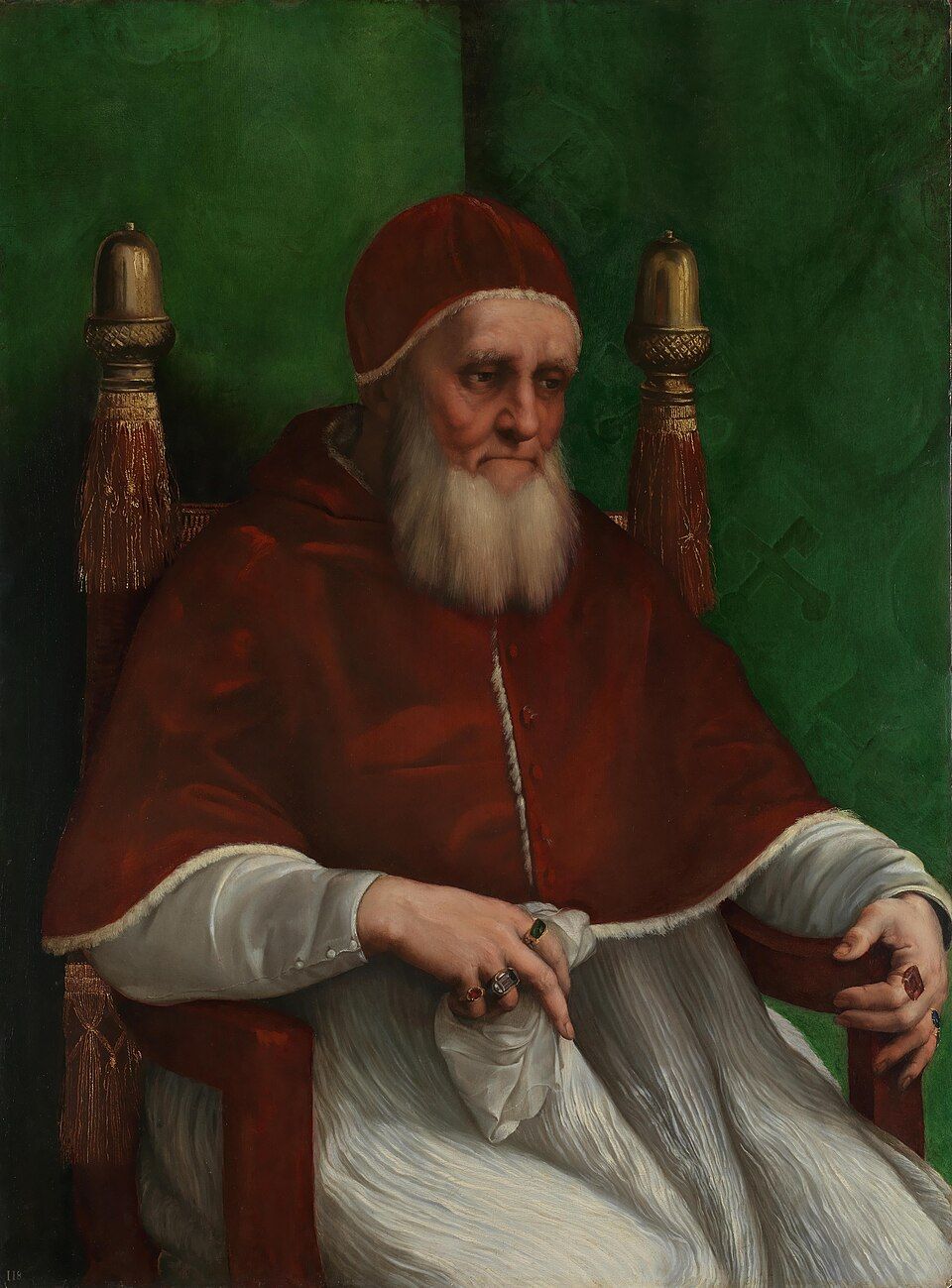
Raphael, Pope Julius II, 1511, National Gallery, NG27. Compare the turn of the seated figure, the placement of the hands and the angle of the chair. Image source. Public domain. Resized for display.
Which portrait went to Madrid?
An account close to the events gives a useful foothold. In a letter of 8 July 1651, according to the National Gallery of Art’s Spanish paintings catalogue, the papal nuncio Giulio Rospigliosi informed Cardinal Pamphilj that Velázquez had returned with a portrait of the Pope and that Philip IV had been very pleased with it. The letter establishes that a painted likeness travelled to the Spanish court with Velázquez. The identification of that likeness with a particular surviving canvas depends on a further step, connecting its later ownership to the letter. The same catalogue notes a portrait of the Pope in the inventory drawn up after the painter’s death and leaves open whether that entry describes the picture mentioned by Rospigliosi. [15]
The Wellington Collection’s Pope Innocent X, at Apsley House in London, has often been considered the candidate. The collection presents it under Velázquez’s name and describes its identification with the picture taken to Madrid as traditional. English Heritage also presents the London painting as by Velázquez, following research undertaken in 2006, and leaves open the separate question of whether it is the piece that came back to Spain. Its composition brings the face and red-clad shoulders close, without taking in the hands and the paper. The change in format alters the kind of attention the face receives. In Rome we can look away from it towards the sitter’s hands and decide how they bear on the look. In London there is far less space for our attention to leave the head. [16] [17]
The National Gallery of Art in Washington holds its own Pope Innocent X, an oil on canvas measuring 49.2 × 41.3 cm, dated about 1650 and currently catalogued as the work of an anonymous artist associated with Velázquez. Its record follows the picture through the Walpole collection in England, the collection of Catherine II in Russia, the Hermitage and eventually the Andrew W. Mellon Collection. The earlier gallery catalogue explains how the work had been regarded by some writers as a study and subsequently judged a reduced copy by an unknown painter. The close crop looks plausible as a study until one considers that it can equally be the result of selecting the head from an already finished design. An X-radiograph published in the Washington catalogue shows another state beneath the visible image, with a closer-fitting cap and an ermine-trimmed cape. The catalogue identifies the Roman portrait’s clothes as the summer costume and those in the underlying Washington image as the winter costume. The evidence of revisions helps explain why the Washington picture drew attention as a possible study, but the museum retains the anonymous attribution. Its X-radiograph records the making of the Washington canvas. [15] [18]
Those two smaller paintings clarify the importance of apparently secondary things in the Roman canvas. The set of the shoulders and head remains recognisable when isolated. In the larger picture the elbow has somewhere to rest, the seated body takes up space, and the Pope has a letter-shaped object to hold in the middle of his encounter with the viewer. Copying the head can retain the person’s identity while leaving behind part of the situation Velázquez devised for him. [1] [16] [18]
Juan de Pareja in Rome
Velázquez’s portrait of Juan de Pareja, dated 1650 by the Metropolitan Museum of Art, offers a contemporary comparison. Pareja, born in southern Spain and of African descent, was enslaved by Velázquez at the time of the sitting. The painter signed manumission papers in Rome that were to take effect by 1654. Pareja went on to establish a career as a painter in Madrid. The two subjects occupied radically unequal positions in the society in which Velázquez worked. Both pictures give an individual face a pronounced hold on the viewer’s attention. [19]
Pareja’s body also angles away while the face turns towards us. In the Met picture the white collar spreads on either side of his neck, against clothes and background largely in quiet earth colours. It brings the eye up to the curls, the dark eyes and the visible planes of the face. The papal portrait covers a larger field, with an elaborate chair, bright dress and two hands to bring into play. The different range of incident makes the painted turns of the two heads particularly interesting to compare. Each head comes into focus in the middle of a body that remains angled, and each picture builds that movement through the turn of the shoulders before we arrive at the eyes. [1] [19]
Navarrete records the public display of Pareja’s likeness in Rome for the feast of Saint Joseph in March 1650. The Pope’s portrait is associated with the papal household and later family display. A painting exhibited through an artists’ association could make the painter’s skill visible to a wider gathering in the city, and the two likenesses had very different ways of reaching viewers. Pareja later made a public image of himself within the large Calling of Saint Matthew of 1661, now in the Museo Nacional del Prado. His figure looks out from the far left of the composition. The surviving painting offers another encounter with the man who faced Velázquez’s canvas in Rome, here as the painter of the scene and a figure within it. [12] [19] [20]

Juan de Pareja (ca. 1608–1670). Compare the angle of the head and the directness of the gaze in the two Roman portraits. View Portrait of Juan de Pareja.
A room for the portrait
The painter and writer Marco Boschini, writing about the work in his Venetian verse dialogue Carta del navegar pintoresco, praised its character as Venetian painting. His response, recorded by Navarrete, offers a view from within seventeenth-century painting of what could be striking about the portrait. Next to the story about the papal attendant, his praise points in a different direction. One response turns attention to how the image was made, while the other imagines a viewer so convinced by the image that the means of making it disappear. [12]
The palace’s early inventories suggest a family setting for the Pope’s likeness. Stephanie C. Leone’s study of the Palazzo al Collegio Romano discusses a painted portrait of Innocent X in the rooms recorded at the death of his nephew Prince Camillo Pamphilj in 1666. She describes its identification with Velázquez’s work as tentative. A portrait of a papal relative was an intelligible presence in this princely household. The identification requires evidence specific enough to trace this canvas, particularly when so many depictions of Innocent circulated in the family’s sphere. [21]
A later display decision is documented by the owning gallery. In the mid-nineteenth century Prince Filippo Andrea V Doria Pamphilj commissioned architect Andrea Busiri Vici to create a special chamber at the end of the First Wing. Putting the portrait there changed the way it could be encountered. In a gallery hung with many works one can take in several pictures in a single sweep. Here the approach has an end point. The painted Pope is given one principal sightline, and the neighbouring marble lets the visit turn into a comparison of two actual objects. The cabinet makes it possible to spend time where a viewer of the original is most rewarded for it, between the quick recognition of a pope and the slower reading of the gestures and surfaces. [1] [2] [3]
Francis Bacon’s seated figure
In 1953 Francis Bacon made Study After Velázquez’s Portrait of Pope Innocent X, an oil on canvas now at the Des Moines Art Center. Bacon worked from reproductions of the Roman portrait, as the Art Center’s account explains. His study retains the seated figure and the forward orientation of the face, along with suggestions of the outline of a throne. The linear gold-coloured structure around the figure and a veil of vertical strokes change the space. Velázquez allows us to picture a piece of furniture supporting the body. Bacon lets the straight lines describe an enclosure through which the sitter is partly visible. [22] [23]
Bacon opens the mouth in a scream, altering the point at which the face draws us in. Velázquez’s mouth is a subdued detail immediately below the arresting look. Bacon makes the open mouth legible even as other parts of the head are broken up or drawn across by the vertical marks. The word Study in the title announces the older work as the subject of a sustained act of looking. The literal sitter is the concern of Velázquez’s portrait. What can happen to that image when its setting, gestures and expression are put under pressure is the concern of Bacon’s painting. In Rome the paper still rests in Innocent’s hand, his eyes still meet ours, and the chair still holds him at the distance of a visitor he has just looked up to see. [1] [22] [23]
The Pope in the Pamphilj reception hall
Around 1680, a working inventory of the Palazzo al Collegio Romano placed a portrait of Innocent X in the great reception hall, or salone. Stephanie C. Leone identifies this entry with the Doria Pamphilj canvas. The record names the painter, a detail that Francesca Cappelletti points out was unusual for portraits in seventeenth-century inventories. The name gives the entry greater weight than the earlier record of a likeness of Innocent in the room where Prince Camillo Pamphilj died in 1666. The painting may have moved from that room to the salone. The proposed move depends on whether both entries describe the same canvas. [24]
The hall belonged to the apartment of Camillo’s son, Prince Giovanni Battista Pamphilj, who shared his great-uncle’s birth name. Leone counts fifty-five paintings in the salone around 1680, including devotional pictures, landscapes and a large Tribute Money that Camillo had commissioned from Mattia Preti. The Pope was the sole portrait Leone identifies in that arrangement. Visitors entering the prince’s reception rooms would have encountered a family likeness among pictures that asked them to attend to quite different subjects. The named painter gave the family portrait a further distinction within the collection. [24]
The inventory accumulated entries over time. Leone uses the presence of a portrait of Innocent XI, elected in 1676, and a consignment dated 1680 to explain why the document is dated approximately. By the securely dated inventory of 1709, the hall had been rehung around landscapes. The two lists catch the same room at different stages in its use. The earlier arrangement shows how the Pope’s likeness could speak for the family in a room used to receive visitors, long before the painting had a cabinet of its own. [24]
The Wellington portrait in the Spanish royal inventories
The 1772 inventory puts a half-length portrait of Innocent X in the passage to the royal pew at Madrid’s Royal Palace. It credits Velázquez and gives the height as one vara, about 84.7 centimetres, with a slightly smaller width. The Wellington canvas measures 82 by 71.5 centimetres. Its format and scale make it a plausible match. The inventory also gives the Marqués de la Ensenada as the source of the picture, part of a purchase by Charles III. That earlier owner matters. Even if the inventory identifies the London canvas, the route into Charles III’s collection leaves its whereabouts in Philip IV’s time open. [25]
The Wellington Museum catalogue follows the portrait through later records, with entries in 1789 and 1794 in the prince’s apartment and an 1811 entry in the former Council of State room. It records its capture at Vitoria in 1813. The list William Seguier drew up when the paintings from Joseph Bonaparte’s baggage reached London includes a Portrait of Innocent X at number 28. The museum catalogue cross-references that line to its entry for the canvas now at Apsley House. A further royal inventory of 1814 complicates the sequence by repeating a picture of the same description and size. José López-Rey proposed that this was a clerical error. The surviving records give the London portrait a much fuller history around 1800 than they do around 1651. [25]
What the examination at Apsley House found
At London’s Guildhall exhibition in 1901, the catalogue dated the Wellington painting to 1649 and proposed that it was the study for the larger Roman work. That entry records how the painting was understood when it was lent by the Duke of Wellington. Later, López-Rey accepted Velázquez’s hand in the head but assigned much of the dress and background to an assistant. Enriqueta Harris, comparing the London and Roman portraits closely, judged both to be by Velázquez and put the Doria painting first. A painter’s authorship and the order of the two canvases were distinct questions even among scholars who accepted the London head. [26] [25]
Larry Keith cleaned and examined the London portrait in 2006. The revised Wellington catalogue reports that he found continuity between the paint of the head and the red shoulder cape, suggesting that the two passages were executed at the same time. The catalogue also records thin paint and wear, especially in the background. Those observations matter when judging a picture whose passages differ in finish and whose surface has changed with age. Dawson Carr found no evidence to determine which of the two portraits came first. English Heritage now presents the Wellington painting as by Velázquez. Its catalogue attribution can therefore stand alongside an open question about when and for whom this particular version was made. [25] [27]
A copy in the Madrid academy
In 1759, during his years as a funded student at the Spanish court, Ginés Andrés de Aguirre made copies as part of his training. The Real Academia de Bellas Artes de San Fernando dates its 69-by-54-centimetre Inocencio X to that year and attributes it to him. Aguirre’s instructions, modelled on those of students funded to work in Rome, called for him to copy particularly accomplished paintings and sculptures accessible at court. The papal likeness thus had a place in the training of a Spanish painter a century after Velázquez’s visit to Italy. [28]
The academy’s inventory compiled between 1796 and 1805 names Aguirre as the copyist and places his model in Madrid’s New Palace. The word original there describes the work from which the copy was taken. Read alongside the Roman and royal records, the entry supports the presence of a model in Madrid and leaves the identification of that model with the surviving Wellington canvas open. The academy’s own catalogues changed their wording, too. In 1817 the picture appeared in the portrait room as a copy after Velázquez. In 1824 it appeared under Velázquez’s name. Today the academy again identifies it as a copy and qualifies the attribution to Aguirre. The successive labels let us follow changes in the reputation of the same object while the painting itself remained in the academy collection. [28] [29]
Artworks directory
Frequently Asked Questions
Around 1650 [1]
Galleria Doria Pamphilj, Rome, FC 289 [1]
The figure fills the canvas from cap to lap. Velázquez shows enough of the chair to establish its angle. The upholstered back rises on the left of the picture, behind Innocent’s right shoulder, and its gold-coloured border picks out an upright just where the deep red of the furniture approaches the deep red of the hanging. [1]
Discussion
Look again at the images and ideas explored in Portrait of Pope Innocent X. These editorial prompts invite your observations.
Reader Insights
Follow the direction of the chair, hands and face. How does each angle shape your sense of when the sitter turned?
What does Bernini’s bust let you see about the sitter that is harder to judge in the painting?
Join the Conversation
Share a detail, comparison or question about Portrait of Pope Innocent X below.
References
- Galleria Doria Pamphilj, Diego Velázquez, Portrait of Pope Innocent X Pamphilj, FC 289, object record and reproduction. View source.
- Galleria Doria Pamphilj, The Gallery, “The Velázquez Cabinet”. View source.
- Galleria Doria Pamphilj, Gian Lorenzo Bernini, Portrait of Pope Innocent X Pamphilj, object record and reproduction. View source.
- Galleria Doria Pamphilj, “Giovanni Battista Pamphilj”, Biographies Rome. View source.
- Ximo Company, “Velázquez: las claves de un genio excepcional”, in Miradas a la pintura de época moderna entre España e Italia, printed pp. 96–98, especially fig. 11 and the transcription of the signed paper (Spanish). View source.
- Dizionario Biografico degli Italiani, “Innocenzo X, papa”, election, foreign policy and Westphalia (Italian). View source.
- Holy See, Innocenzo X, Jubilee history, Westphalia and the Holy Year of 1650 (Italian). View source.
- VIVE – Vittoriano e Palazzo Venezia, David García Cueto, “Tu solus Didacus in Urbe. Il secondo soggiorno di Velázquez a Roma”, lecture synopsis (Italian). View source.
- Università degli Studi di Teramo, “I viaggi in Italia di Diego Velázquez”, second journey (Italian). View source.
- Archivio di Stato di Roma, “Il soggiorno di Velázquez a Roma”, three Roman notarial contracts, 30 Notai Capitolini, Ufficio 32, vols 143–145 (Italian). View source.
- Antonella Parisi, “Illustrissimo signor don Giovanni di Corduba Errera”, in Velázquez in Italia, printed p. 118 and note 20, fig. 21 (Italian). View source.
- Benito Navarrete Prieto, “Retratos de Velázquez en su segundo viaje a Italia”, in Velázquez in Italia, printed pp. 13–14 and 24–26, especially notes 58–61 (Spanish). View source.
- Carol Plazzotta and Tom Henry, National Gallery, Portrait of Pope Julius II, NG27, collection catalogue entry. View source.
- Metropolitan Museum of Art, After a composition by Alessandro Algardi, Pope Innocent X, bronze and related versions. View source.
- Jonathan Brown and Richard G. Mann, National Gallery of Art, Spanish Paintings of the Fifteenth through Nineteenth Centuries, Pope Innocent X, 1937.1.80, printed pp. 124–127, fig. 1 and notes 3–9. View source.
- Wellington Collection, Pope Innocent X, Apsley House object entry and reproduction. View source.
- English Heritage, Paintings Quiz, question 9, Apsley House attribution and identification. View source.
- National Gallery of Art, Anonymous artist, Pope Innocent X, 1937.1.80, current object record and provenance. View source.
- Metropolitan Museum of Art, Diego Velázquez, Juan de Pareja (ca. 1608–1670), 1971.86, object record and reproduction. View source.
- Metropolitan Museum of Art, Juan de Pareja, Afro-Hispanic Painter, exhibition announcement, exhibition overview and caption for the Prado’s Calling of Saint Matthew. View source.
- Stephanie C. Leone, “Prince Giovanni Battista Pamphilj (1648–1709) and the Display of Art in the Palazzo al Collegio Romano, Rome”, Memoirs of the American Academy in Rome 58 (2013), pp. 181–214, section 4, fig. 7 and note 37. View source.
- Des Moines Art Center, Francis Bacon, Study After Velázquez’s Portrait of Pope Innocent X, 1980.1, collection report. View source.
- Des Moines Art Center, Audio tour transcriptions, Jim Demetrion on the 1953 Bacon. View source.
- Stephanie C. Leone, “Prince Giovanni Battista Pamphilj (1648–1709) and the Display of Art in the Palazzo al Collegio Romano, Rome”, Memoirs of the American Academy in Rome 58 (2013), pp. 181–214, especially sections 3–5 and notes 37, 58 and 60–61. View source.
- C. M. Kauffmann, revised by Susan Jenkins and Marjorie E. Wieseman, Catalogue of Paintings in the Wellington Museum, Apsley House (2009), no. 185, pp. 309–312 and Seguier’s list, appendix, no. 28. View source.
- Guildhall, Descriptive and Biographical Catalogue of the Exhibition of the Works of Spanish Painters (1901), no. 122, pp. 116–117. View source.
- English Heritage, “Face-to-face”, Apsley House portrait entry. View source.
- Real Academia de Bellas Artes de San Fernando, Inocencio X, no. 0370, object record and historical inventory extracts. View source.
- Real Academia de Bellas Artes de San Fernando, Noticia de las pinturas que posee la Real Academia de San Fernando según el orden de su numeración, c. 1796–1805, transcription, no. 104 and notes 70–72. View source.





