



 by Tom Gurney
Tom Gurney BSc (Hons) is an art history expert with over 20 years experience
Published on June 19, 2020 / Updated on November 5, 2026
Email: tomgurney1@gmail.com / Phone: +44 7429 011000
The Waterseller of Seville
A boy reaches for a glass of water. An older man steadies its foot, while another drinker lifts a vessel in the shadows behind them. There is no bustling crowd and no view down a street. Instead, Diego Velázquez gives this small exchange the concentration of a ceremony. Light catches the boy's white collar, passes through the glass and spreads across an enormous earthenware jar. Water, almost invisible in itself, becomes the thing that brings people, objects and gestures together.
The Waterseller of Seville, in the Wellington Collection at Apsley House, London, belongs to Velázquez's early years in Seville. English Heritage dates it broadly to about 1617–23; its teaching material uses 1620. About 1620 is therefore a useful shorthand, rather than a precisely documented year. Painted in oil on canvas, it measures 107.7 × 81.3 cm. [1] [2] [3]
At a Glance
Where the painting sits in Velázquez’s career
Contents
- Three people, three distances
- A jar within reach
- The fragile centre
- An everyday subject, carefully staged
- Does the water mean wisdom?
- Painting and the physical surface
- From Fonseca to Apsley House
- The pottery behind the water trade
- Selling water by the glass
- From an estate valuation to a royal inventory
- How the painting became part of the Spanish Gift
- The Florence version and the question of authorship
Three people, three distances
The waterseller fills the right side of the canvas. His brown garment makes a broad, warm shape against the darkness, while the white shirt showing through its openings gives the arm a separate rhythm. His head is uncovered. A strong nose, lined forehead and greying beard make the face particular without turning it into a caricature. The shallow downward inclination of his head seems to slow the action: serving a drink becomes something requiring attention.
The boy stands close enough for their hands to meet, yet their faces remain apart. The man looks downward; the boy's eyes turn across the old man's body. Between them, the glass is suspended in a little pocket of light. The Wellington Collection's commentary draws attention to this lack of exchanged glances. Their physical proximity does not produce the easy friendliness we might expect in a scene of buying and selling. [4]
Behind the boy, the third figure is harder to grasp. His face rises above a dark vessel held to his mouth, and only gradually separates from the background. He supplies a second stage of the action: one customer is already drinking while another receives his serving. The arrangement makes the foreground transfer feel momentarily arrested. We can follow what happens before and after it without seeing either foreground figure move.
Notice, too, how the three heads avoid a straight horizontal row. The boy is low at the left; the background drinker's head rises above him; the older man's brightly illuminated face anchors the right. Their uneven grouping keeps the dark upper half alive. The painting would become much flatter if the middle figure were removed, even though he is the person easiest to overlook.
A jar within reach
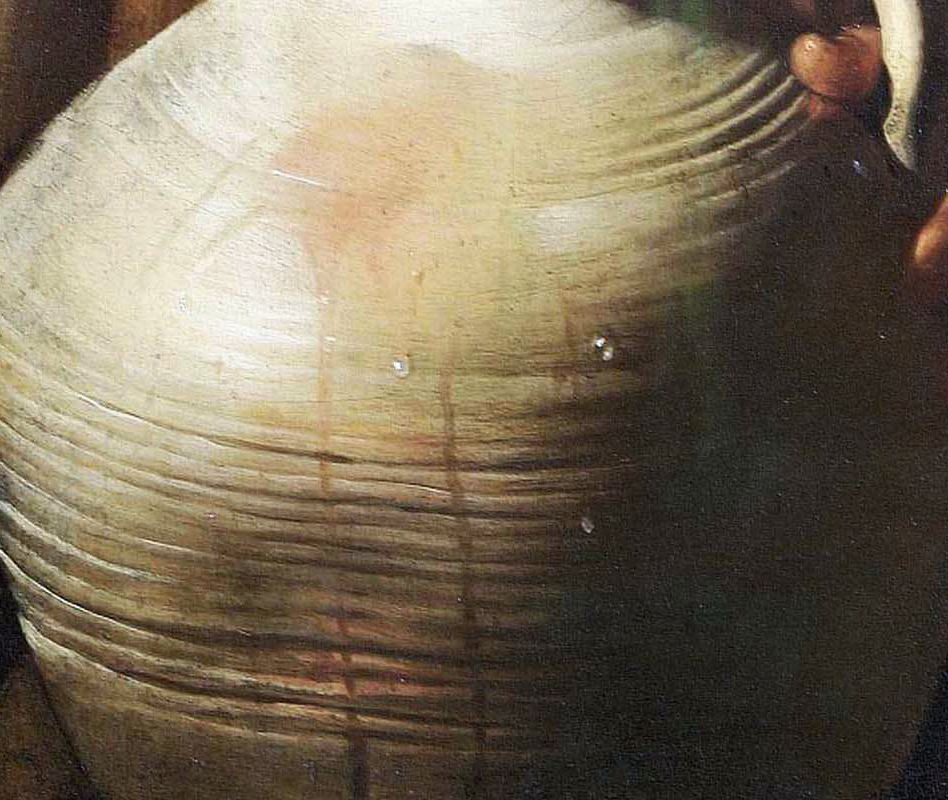
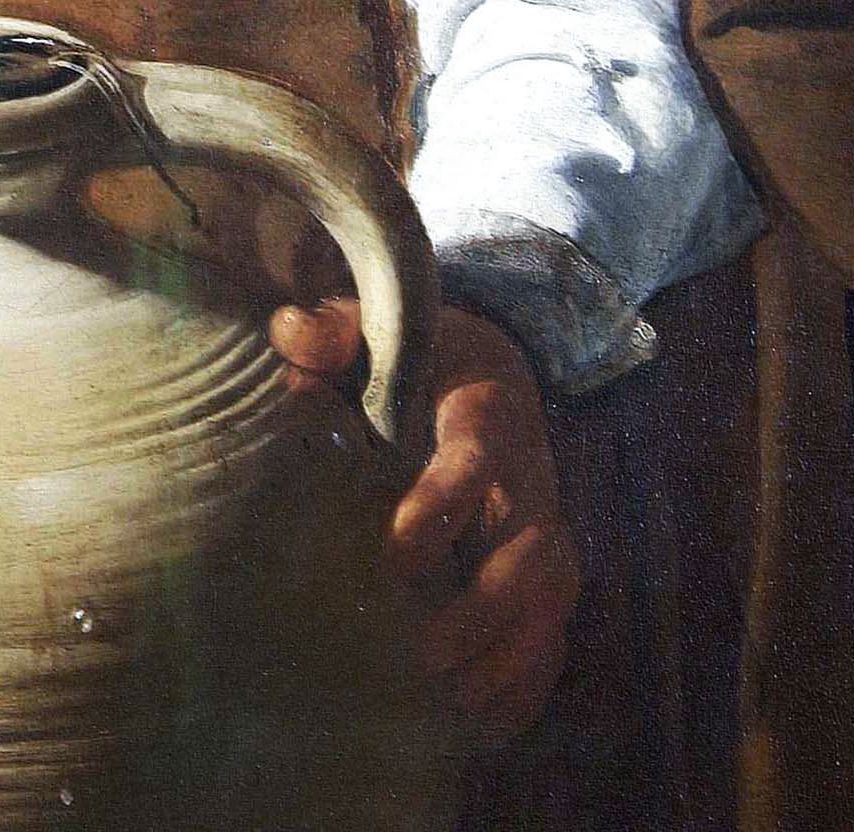
The great water jar dominates the lower foreground. Its body extends beyond the bottom edge, so we cannot see its resting place. The waterseller's left hand curls around its handle while its rounded shoulder catches the light. Fine horizontal ridges describe the pot's manufacture, and darker streaks descend over its surface. Against that warm, opaque body, tiny bright droplets become startlingly distinct.
The jar is both a container and an obstacle. It pushes forward into the space where a viewer might stand, blocking our approach to the man. At the same time, its large, simple curve gives us the most immediate way into the picture. The eye can move over the rounded clay before finding the smaller, more intricate meeting of fingers and glass above it. There is a generous difference of scale between this immense working vessel and the delicate serving glass.
A second jar stands to the left on a narrow support, with a little two-handled bowl resting on its mouth. Here the surface is greener and shinier, broken by reflected light and small irregularities. It offers a compact answer to the foreground pot: another rounded belly, another handle, another open mouth, but a different finish. Velázquez makes the differences readable without displaying the objects against a neutral background.
English Heritage's teaching commentary presents this variety of glass, pottery and cloth as a demonstration of the young painter's ability. That is an inviting way to look. Compare the brief white marks on the glass rim with the broader brightness of the sleeve, then the broken highlights on the glazed pot. Each surface asks for a different kind of attention, and each helps us understand the others. [2]
The fragile centre
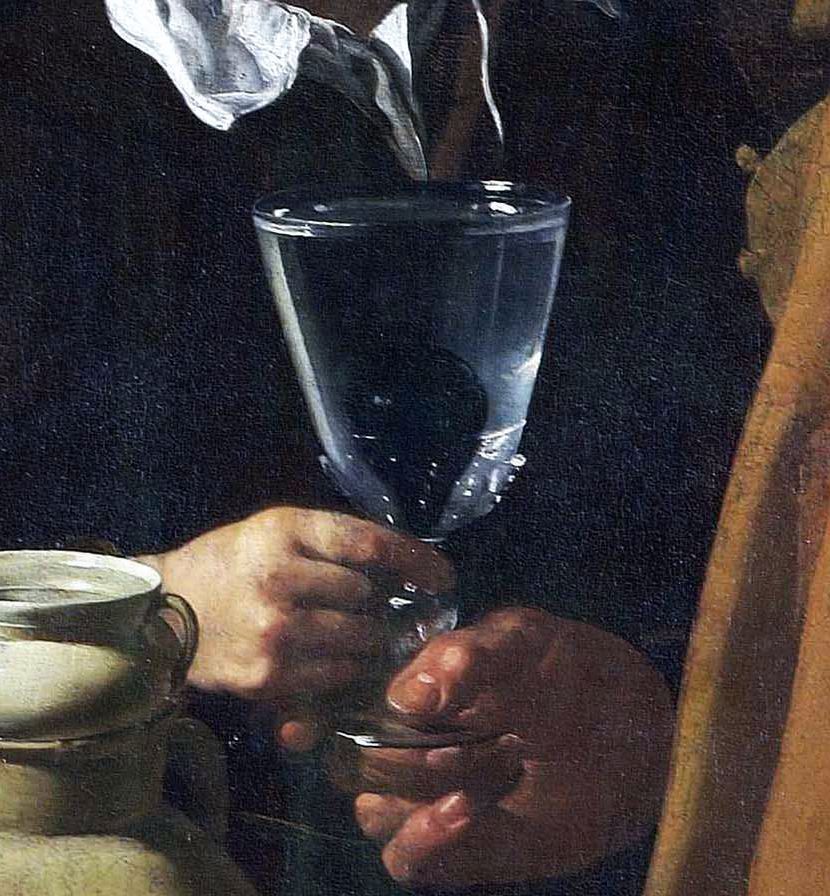
The glass is much taller and more elegant than a plain tumbler. Its broad bowl narrows towards a slender stem; the boy grips it near that stem while the waterseller supports it below. Their fingers almost form a second vessel around the first. The large pot can be handled with the whole strength of a hand. This object needs a more measured touch.
The contrast matters socially as well as visually. English Heritage connects the fine glass with a prosperous household and suggests a possible Venetian origin. The painting itself cannot establish the boy's biography or name the workshop that made the glass. But its conspicuous delicacy makes it reasonable to notice differences of possessions and appearance within this encounter. [2]
A dark shape is visible low inside the bowl. It has often been called a fig, but the collection catalogue also records the possibility that it is part of the glass's decoration. It is best left as an unresolved detail. [3] Even without deciding what it is, we can see how it complicates the transparency: the glass is no longer simply a clear outline with water inside. It contains a small darkness that draws the eye towards the hands.
Annotated Details from The Waterseller of Seville
Follow the three numbered details to look more closely at the forms and surfaces discussed in the article.
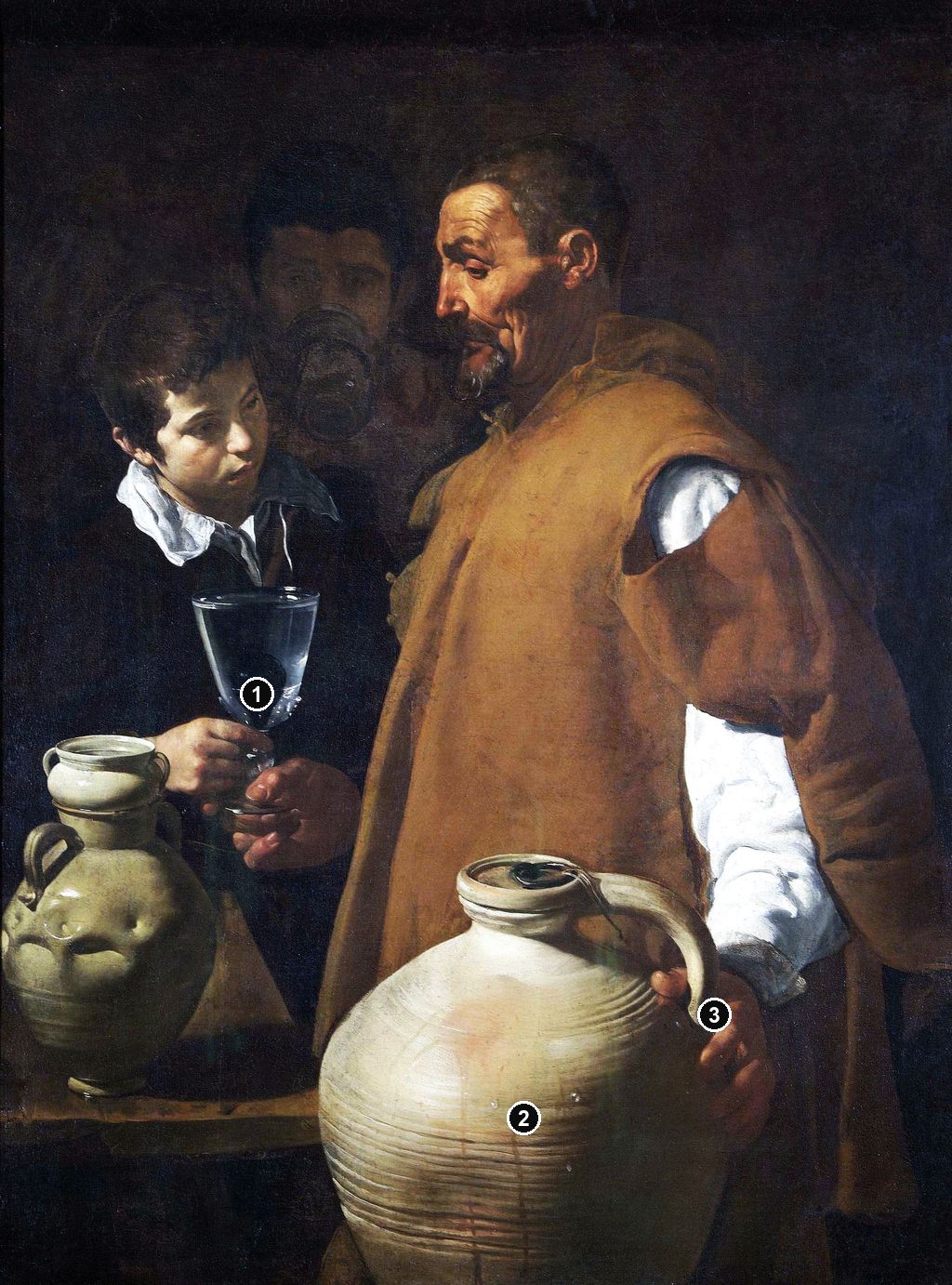
Details from THE WATERSELLER OF SEVILLE
Wellington Collection, Apsley House. Public-domain reproduction via Wikimedia Commons.
Glass between the hands
Thin bright marks define the rim and stem. Two hands approach the glass from different directions; the dark form within its bowl remains difficult to identify. [3]
The rounded earthenware jar
Curving horizontal bands follow the swelling jar. Its broad, opaque surface offers a striking contrast with the fragile transparent glass above.
A hand at the handle
The fingers curve around the handle and continue along the far side of the jar. The grip connects the man’s body with the heavy vessel in the foreground.
An everyday subject, carefully staged
English Heritage places the painting among Velázquez's early bodegones: scenes of eating, drinking and everyday life in which objects occupy an unusually important place. The waterseller's trade also gave the picture an immediately recognisable subject. Carrying and selling water belonged to a world in which households could not assume a modern supply from a tap. [1] [2]
Yet the setting is strikingly unspecific. No street sign, doorway or distant building identifies a particular spot in Seville. There is no visible payment and no exchange of coins. The action has been reduced to its essential equipment: vessels, water, hands and people. This concentration allows a working occupation to occupy the canvas with the weight usually associated with a more formally elevated subject.
The man's clothing deserves another look in this context. The brown outer garment is plain, and the exposed shirt interrupts its heavy shape. But the face above it is alert and composed. The picture does not invite a laugh at his expense. Nor does it require us to imagine a sentimental friendship between the customers and the seller. Their encounter has its own restrained human interest, built from the care with which one person passes something to another.
This dignity also explains why a simple occupational title has never exhausted discussion of the painting. Viewers sense that the figures have been arranged with exceptional deliberation. What remains uncertain is whether that deliberation carries a particular hidden story.

An Old Woman Cooking Eggs. The battered cookware is a comparison for the care given to water jars and other ordinary working objects in The Waterseller. View An Old Woman Cooking Eggs.
Does the water mean wisdom?
In the Prado's 1990 exhibition catalogue, Julián Gállego reads the differing ages as a possible meditation on human life, with the older man passing knowledge to youth. The idea grows from visible contrasts: aged and youthful faces, giving and receiving, the third figure already drinking. But it is an interpretation, rather than an explanation recorded by Velázquez. [5]
Manuela Mena Marqués later proposed a more specific classical subject: Diogenes teaching the children of Xeniades. Her argument connects the philosopher's lessons in simplicity and drinking water with the grave older figure and his young companions. She also relates the proposed educational meaning to the learned interests and cathedral office of Juan de Fonseca, the picture's early owner. This supplies a thoughtful account of why an apparently ordinary transaction might feel so ceremonial. [6]
The proposal should remain distinguishable from the scene we can actually identify. Nothing painted beside the figures names Diogenes or Xeniades. Mena's reading draws its force from a conjunction of objects, gestures, literary passages and patronage context. A viewer can test those correspondences while continuing to see a waterseller. The pleasure of the painting lies partly in that capacity to sustain a straightforward encounter and invite further thought without giving away an unequivocal key.
Painting and the physical surface
The illusion of solid things was made through a less orderly process than the finished image suggests. The collection catalogue summarises technical observations by Zahira Véliz: pointed brush lines occur around parts of the figure, and underlying white brush wipes near the hands and goblet indicate that these passages were completed in stages. These working traces were not meant to compete with the finished forms. [3]
That distinction is useful when looking closely at a reproduction. The jar's simulated wetness, the painted texture of a shirt and the actual texture of aged paint are different things. A photograph brings them together on one flat screen. Some marks help describe the depicted object; others belong to the history of making and preserving the canvas.
In August 2020, Factum Foundation recorded the painting at Apsley House using panoramic composite photography and the Lucida 3D Scanner. The project documented colour and surface relief, with data supplied to the collection for study and preservation. Its photographs show work on the back as well as the front of the picture. [7] A painting famous for making clay, cloth and water look tangible is itself a material object, with a support and surface that deserve the same careful attention.
From Fonseca to Apsley House
The early connection with Juan de Fonseca places the painting within the network that helped Velázquez establish himself in Madrid. The Prado catalogue records the work with Fonseca in 1623, but its wording leaves open whether the artist gave or sold it to him. Early ownership does not by itself prove an original commission. [5]
The picture subsequently entered the Spanish royal collection. Its journey to Britain came through war: it was among the paintings taken from Joseph Bonaparte's baggage after the Battle of Vitoria in 1813. Wellington asked the Spanish government what should happen to the recovered pictures, and Ferdinand VII allowed him to retain them. The painting consequently became part of the collection at Apsley House. [5]
Other painted versions complicate the title's history. The collection catalogue identifies copies associated with Florence, Baltimore and the former New York art market in which the seller wears a cap. The Apsley House figure is bareheaded. Those pictures should not be treated as interchangeable illustrations of this canvas. [3]
Here, in the London painting, the uncovered head remains one of the most arresting passages. The light travels across forehead, ear and cheek, then descends to the hands and the vast pot. Returning to that sequence after considering its possible meanings brings us back to the immediate achievement: an ordinary service made absorbing through the exact appearance of people and things.
The pottery behind the water trade
An alcarraza was a vessel designed to keep drinking water cool. Alfonso Pleguezuelo describes the fine Andalusian wares also called tallas as thin-walled vessels turned from pale, calcareous clay. Water could seep through the pores of an unglazed vessel, and evaporation from the outside drew heat from the contents. Pleguezuelo also records glazed examples, which he associates with winter use, when the cooling effect was unnecessary. The moisture Velázquez paints on the large foreground jar is consistent with the behaviour of porous earthenware. Its appearance alone gives little basis for assigning it to the fine white ware that potters and their customers distinguished by name. [9] [10]
The archaeologists Fernando Amores Carredano and Pina López Torres include The Waterseller in their study of Sevillian alcarrazas. Their catalogue of painted examples identifies a jug with a ring foot, grooved handles and a band of relief formed by pinching the clay. The details matter because they can be compared with fragments from the city itself. At Calle Azafrán, for instance, an excavated jug has grooved handles with turned-out ends, a cylindrical neck and a band of comma-shaped impressions. These are parallels in the way potters shaped and finished their vessels. The excavated jug provides evidence for the local repertoire of forms from which an artist working in Seville could draw. [10]
The excavations also explain why paintings are valuable to historians of this craft. Thin-walled jugs often survive as fragments, some discarded in household cesspits where they occur alongside glazed tablewares and imported ceramics. The authors trace elements of the local tradition through excavated vessels from the thirteenth-century Triana market site and fifteenth-century finds at La Cartuja. Taken together, the excavated fragments and painted examples allow the history of an everyday vessel to be followed across several centuries. The fragments preserve the potters’ marks in clay, while the painting shows how several sorts of vessel could serve a single act of drinking. [10]
Selling water by the glass
Pleguezuelo distinguishes the azacán, who delivered water to households in large jars, from sellers who served passers-by. Some of the latter set up a tray on a wheeled stand. Others carried a jar on the shoulder and held glasses in the free hand, making them ring to attract customers. The occupation recorded in the painting’s title therefore covered several kinds of work. Here Velázquez concentrates on service by the glass, the part of the trade in which a vessel passed directly between seller and drinker. [9]
The stemmed glass can also be understood as part of a vendor’s equipment. Pleguezuelo points to a Sevillian price schedule of 1627 that lists glass from several centres. He allows Venice as a possibility for the painted glass and names Cadalso, Barcelona and Seville as other plausible sources. He also cites accounts of street vendors using glassware, including an early description of water sold in fine glasses in Valladolid. This evidence makes it possible to imagine the glass belonging to the seller. The boy’s possession of it lasts for the duration of the exchange we see. [9]
From an estate valuation to a royal inventory
The most concrete early record comes from January 1627, when Velázquez appraised the pictures in Juan de Fonseca’s estate. In the inventory, the work is described simply as a picture of a waterseller and credited to Velázquez. It was valued at 400 reales, the highest valuation in the collection. Manuela Mena Marqués records that Gaspar de Bracamonte acquired it at the estate sale for 330 reales, a separate figure for a separate transaction. The appraisal puts the painting in Fonseca’s possession by the time of his death. The terms on which Fonseca first obtained it remain uncertain. [11]
The next stages are less evenly documented. The Wellington catalogue lists the Cardinal-Infante Don Fernando as a traditional owner and records the painting securely at the Buen Retiro around 1700–01, in entry 496. That royal inventory adds the nickname el Corzo de Sevilla. Its appearance some seven decades after the estate appraisal makes it evidence of how the figure was known at court by then, with the sitter’s identity still uncertain. Later records place the canvas in the passage to the king’s pew in 1772 and in the king’s dining room in 1794. Those room assignments give the painting a traceable history within the royal household. [11] [12]
How the painting became part of the Spanish Gift
Wellington’s correspondence puts dates to the transfer from the Spanish royal collection. On 16 March 1814, he wrote to his brother Henry, the British minister in Spain, asking that someone be selected to inspect the pictures in London and identify the king’s property. His initial inspection of the captured baggage had given him little idea of the quality of the paintings. In September 1816 he raised the matter again with the Spanish minister in England, the Count of Fernán Núñez, whose reply conveyed Ferdinand VII’s wish that he keep them. The correspondence records the gap between the battlefield recovery and the royal decision that gave the group its name, the Spanish Gift. [13]
The Florence version and the question of authorship
The Florence canvas has a collecting history of its own. Fulvia Zaninelli’s archival study dates its entry into Alessandro Contini Bonacossi’s collection to July 1932 and identifies it among the works then attributed to Velázquez in the dealer’s display at Villa Vittoria. The Uffizi traces the later passage of the Contini Bonacossi collection into public ownership in 1969. The attribution recorded in the dealer’s collection belongs to that twentieth-century history. [14] [15]
Julián Gállego’s Prado catalogue entry records how José Gudiol once considered the Florence painting a possible first version and later left it out of his 1973 catalogue. Gállego describes a drier handling and singles out the cap worn by the seller. The cap changes the outline of the head and covers a passage in which the London canvas gives full play to the light across the bare forehead. The Wellington catalogue classes the Florence work as a copy, and the Walters Art Museum independently catalogues its own, differently sized canvas as a seventeenth-century copy after Velázquez. A shared title can thus lead to separate objects, each with its own catalogue history. The Florence painting’s priority remains an earlier scholarly proposal. [16] [12] [17]
Artworks directory
Frequently Asked Questions
Oil on canvas [1]
Discussion
Follow the exchange around the transparent glass, then compare it with the large earthenware jar.
Reader Insights
Where does a reflection make water visible?
How does the shadowed third figure change the scene?
Which surface feels most tangible?
Join the Conversation
Share a detail, comparison or question about The Waterseller of Seville below.
References
- English Heritage, Apsley House Collection Highlights: The Waterseller of Seville, object facts and collection commentary, undated. View source.Splash image: The Waterseller of Seville, about 1620. Wellington Collection, Apsley House. Public-domain reproduction via Wikimedia Commons
- English Heritage, Curators' Collections: Apsley House — The Waterseller of Seville, teaching commentary, undated. View source.
- C. M. Kauffmann, revised by Susan Jenkins, The Waterseller of Seville: National Inventory of Continental European Paintings catalogue record, VADS, record 33630, object fields and Notes, undated. View source.
- The Wellington Collection, The Waterseller of Seville, collection commentary and painting image, undated. View source.
- Julián Gállego, “El aguador de Sevilla,” entry 3, in Antonio Domínguez Ortiz, Alfonso E. Pérez Sánchez and Julián Gállego, Velázquez, Museo del Prado exhibition catalogue, 1990, pp. 68–73 (in Spanish). View source.
- Manuela B. Mena Marqués, “El aguador” de Velázquez o una meditación sobre la cultura clásica: “Diógenes y los hijos de Xeníades”, Archivo Español de Arte 72, no. 288 (1999), pp. 391–413, especially pp. 406–412 (in Spanish). View source.
- Factum Foundation, Recording Velázquez's The Waterseller of Seville and Two Young Men Eating at a Humble Table, 2020 project report. View source.
- National Gallery, London, Diego Velázquez, Saint John the Evangelist on the Island of Patmos, NG6264. Collection record, artist dates and painting date; accessed 28 October 2026. View source.
- Alfonso Pleguezuelo Hernández, Cerámicas para agua en el barroco español: una primera aproximación desde la literatura y la pintura, 2000, pp. 135–138. View source.
- Fernando Amores Carredano and Pina López Torres, Las cerámicas finas –alcarrazas blancas– de Sevilla en la Edad Moderna: la expresión barroca de una tradición almohade, in Estudios de Prehistoria y Arqueología en homenaje a Pilar Acosta Martínez, Universidad de Sevilla, 2009, pp. 563–571, especially figs. 1–3 and 6. View source.
- Manuela B. Mena Marqués, «El Aguador» de Velázquez o una meditación sobre la cultura clásica: «Diógenes y los hijos de Xeníades», Archivo Español de Arte 72, no. 288, 1999, pp. 393–395, including the estate sale footnote on p. 395. View source.
- C. M. Kauffmann, revised by Susan Jenkins, The Waterseller of Seville, National Inventory of Continental European Paintings, VADS 33630, Provenance, Description and Notes. View source.
- C. M. Kauffmann, revised by Susan Jenkins, Catalogue of Paintings in the Wellington Museum, Apsley House, English Heritage and Paul Holberton Publishing, 2009, introduction, pp. 11–12, including the transcribed correspondence. View source.
- Fulvia Zaninelli, Alessandro Contini Bonacossi, antiquario (1878–1955): The Art Market and Cultural Philanthropy in the Formation of American Museums, PhD thesis, University of Edinburgh, 2018, p. 195. View source.
- Gallerie degli Uffizi, Inaugurate agli Uffizi le sale della Collezione Contini Bonacossi, 2018, institutional account of the collection’s transfer and installation. View source.
- Julián Gállego, El aguador de Sevilla, entry 3 in Velázquez, Museo del Prado exhibition catalogue, 1990, pp. 68–73, especially pp. 70–71. View source.
- The Walters Art Museum, The Water Carrier Of Seville, object 37.1191, attribution, dating and measurements. View source.






