


 by Tom Gurney
Tom Gurney BSc (Hons) is an art history expert with over 20 years experience
Published on June 19, 2020 / Updated on October 14, 2023
Email: tomgurney1@gmail.com / Phone: +44 7429 011000
View of the Villa Medici in Rome: Introduction
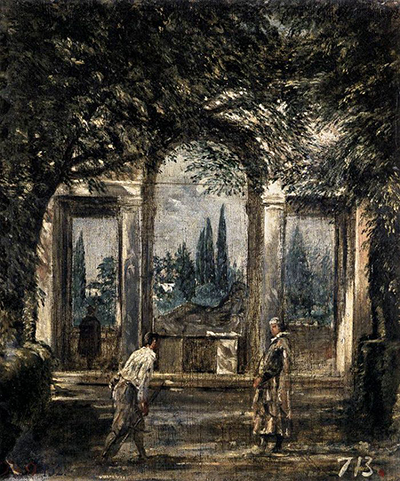
An open arch looks from a shaded garden onto a distant stand of cypresses. Two people meet in front of the pavilion. One bends forward, his pale shirt catching the light, while the other stands upright in a longer, darker garment. Between them, deeper in the picture, a stone figure lies across the foot of the arch. At first the patch of pale sky is easier to spot than the statue. The eye has to adjust to the shade before it can separate the reclining body from the ledge beneath it. [1] [2]
This is the smaller of Diego Velázquez’s two painted views of the Villa Medici in the Museo Nacional del Prado, Madrid. It is an oil on canvas, 44 cm high by 38 cm wide, catalogued as P001211 and generally dated to about 1630. The Prado’s Spanish title specifies the statue of Ariadne, and the English title used by its technical researchers is View of the Gardens of the Villa Medici, Rome, with a Statue of Ariadne. An older name, El mediodía (Midday), distinguishes the painting from the separate view known as La tarde (Afternoon). These names describe the pictures’ effects of light and have long served to tell the two canvases apart. [1] [2] [3]
At a Glance
- CollectionMuseo Nacional del Prado, P001211 [1] [3]
- Usually datedAround 1630 [1] [2] [3]
- MediumOil on canvas [1] [2]
Dating and recording the Villa Medici views
The open pavilion
Around 1630 [1]The Prado’s exhibition panel favours a date around the first Italian journey.
Four small landscapes in the royal payment
1634 [6]The account does not identify either Villa Medici view individually.
Both views recorded at the Alcázar
1666 [1]The inventory establishes royal ownership of the companion paintings.
Recorded at the Buen Retiro
1772 [1]The royal records follow the work to a different palace after the Alcázar fire.
Contents
- From the shaded path to the distant trees
- Ariadne and the view from the loggia
- Which visit to Rome?
- What the paint and the inventories establish
From the shaded path to the distant trees
Branches arc in from the left and join the dark mass of leaves across the top. On the right the foliage drops almost to the ground. The opening they leave between them follows the curve of the stone arch loosely enough for twigs and leaves to cross the sky. Below, the pale uprights divide the view into three parts. The central opening rises to a round head while the two narrower openings have flat lintels. That arrangement is called a serliana, after the architectural writer Sebastiano Serlio. Velázquez lets the upper parts of the stonework disappear into the canopy, but enough of the lintels and supports remain clear for the viewer to follow the design. [1] [2]
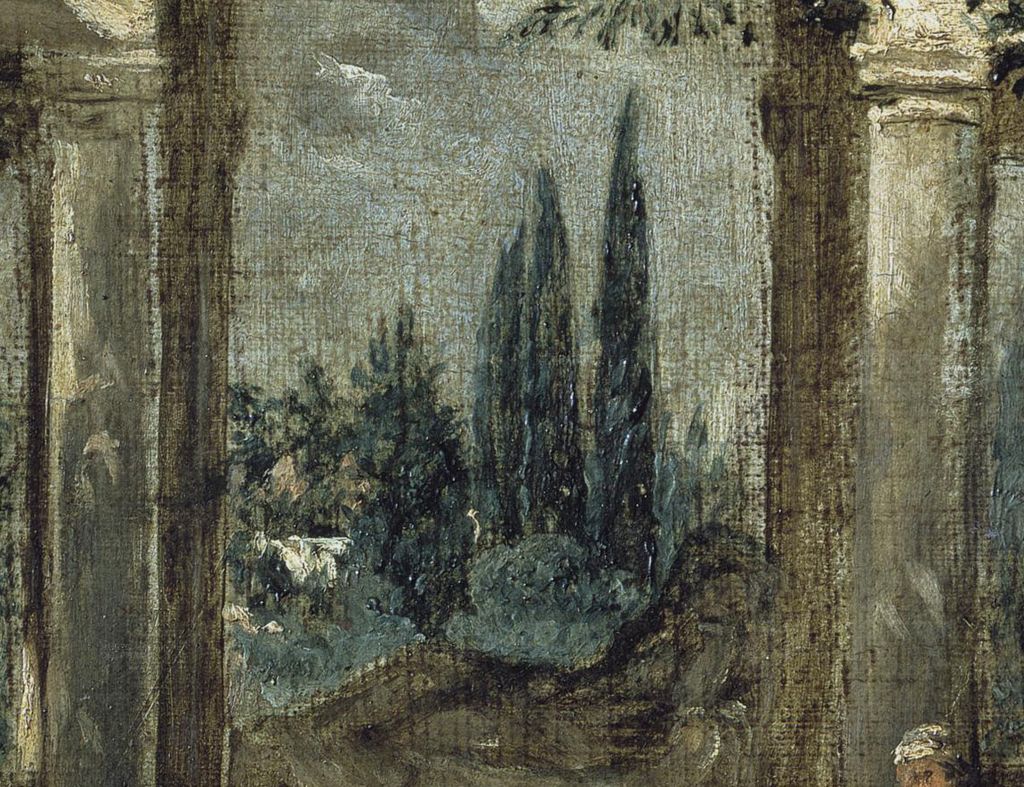
The stone offers several surfaces for the light to fall on. The forward edge of an upright catches a pale stroke while the face that turns into the passage is darker. Low horizontal strokes carry the eye along the shallow steps at the base. Beyond the steps, the two side openings give partial views of trees and sky. The middle opening offers more room and the tallest cypresses stand almost at its centre. They rise out of the lower scrub in thin, uneven points. A few light touches among the trees suggest sun falling on the farther ground. The dark canopy overhead and the softened colours beyond the stonework give that patch of distance room to open up within a small canvas. [1] [2]
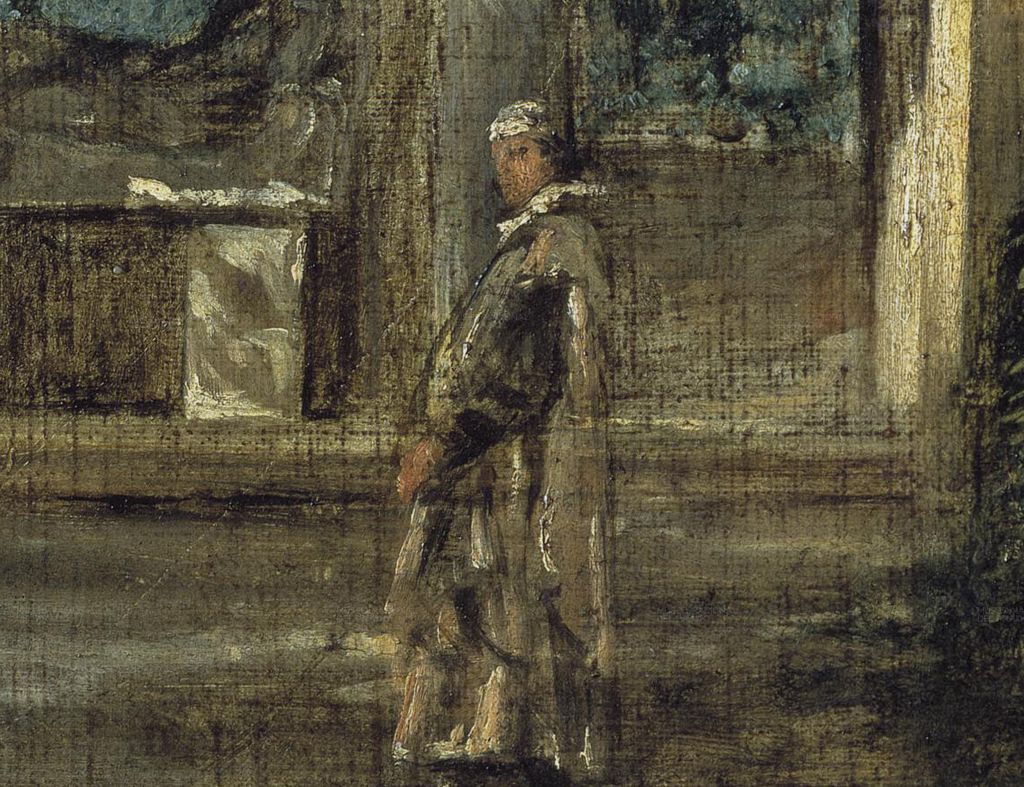
The people occupy different depths. The man in the pale shirt bends at the waist as he faces the upright figure. A few thin strokes suffice to show light running across his shoulder and down his sleeve. His lower body is harder to separate from the green and brown around it. The standing figure reads as a vertical beside the right-hand pier, with a patch of light at the head and broken strokes down the clothing. Julián Gállego, writing for the Prado’s 1990 exhibition, read the encounter as a gardener attending to a man in ecclesiastical dress. He also picked out a third figure in shadow in the left opening, apparently looking out from the loggia. The small silhouette allows the viewer to imagine approaching the view from inside the architecture. [1] [2]
At forty-four centimetres high, the original is small enough for the upper canopy, arch and figures to register together at close range. Closer still, the light in the shirt breaks into several strokes, and the top of the arch gives way to a mesh of branches. The distant grey of the sky and the sharper light on the stone sit close together on the canvas. Moving back would bring the recession into clearer focus as those separate touches resolve into lit edges and distant foliage. A large reproduction can make a stroke on a sleeve or the edge of a pier look emphatic. At the scale of the canvas, those accents have to share the viewer’s attention with the air and ground around them. [1] [2]
Ariadne and the view from the loggia
The reclining sculpture gives the eye a horizontal resting point below the vertical cypresses. Only a narrow length of its plinth reads clearly in the shade. Gállego located the pavilion on the Aurelian Wall above the stretch known as the Muro Torto and understood the opening to look towards the land of the present Villa Borghese. The intervening drop helps explain how the foreground and distant trees can sit so close together in the composition. The tops of trees appear inside the arch while the lower ground between the two hills falls out of sight. With Velázquez’s viewpoint on the garden side, we can look towards the view with the people in front of us while remaining a few steps back from the opening. [1] [4]
A documentary catalogue of the Medici collections identifies the sleeping figure in the loggia as the marble long called Cleopatra and now read as Ariadne. It records the sculpture in that position until its removal to Florence in 1787. Gállego compared it with a reclining Ariadne that Velázquez acquired for Philip IV, now in the Prado. The two marbles explain both the older name of the pavilion and an easily overlooked distinction. The one in the picture belonged to the Medici garden. The one acquired for the Spanish king is a separate sculpture of the same subject. The garden statue’s long residence in the loggia helps locate the painting, while spanning both of Velázquez’s Roman visits. [1] [4]
The View of the Grotto Façade at the Villa Medici, Prado P001210, uses the same form of arch at another place in the garden. Its boards interrupt the view at the face of the building, and tall dark trees rise behind the terrace. In P001211 the three openings carry the eye beyond the screen of stone. Philip Conisbee, in the National Gallery of Art’s study of early open-air painting, also drew a distinction in the handling. He described the brushwork of the Ariadne canvas as thin and loose compared with the more sustained application of paint in the boarded view. The difference can be followed in the surfaces that receive the light. A board and a block of masonry give it a firm edge in the grotto view. Leaves, sleeves and the turns of the stonework break that edge repeatedly in the Ariadne canvas. [1] [5]
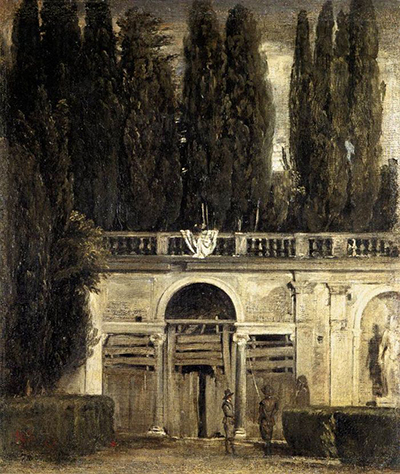
View of the Villa Medici Garden (boarded grotto facade). The companion shows a different garden structure whose arch is partly closed by boards. View View of the Grotto Façade at the Villa Medici.
Which visit to Rome?
Velázquez’s first Italian journey took him to Rome before his return to Spain in January 1631. Francisco Pacheco, his teacher and father-in-law, recalled that Velázquez arranged to stay at the Villa Medici for more than two months during the summer of 1630. He had been lodged at the Vatican under Cardinal Francesco Barberini’s patronage and sought a place better suited to spending the summer and studying. The villa gave him access to its garden and antiques. Pacheco establishes that access to the site during the first visit. His account leaves the two canvases unmentioned. Gállego also drew an early stylistic comparison with the landscape in Joseph’s Tunic, which Velázquez painted on that trip. The comparison brings a way of handling light and distance into view even though the garden occupies a different place in the larger narrative work. [1] [2]
A payment from 1634 supplies another reason for considering the early date. In the document transcribed by Gregorio Cruzada Villaamil, Velázquez received payment for a group that included the picture of Joseph, the picture of Vulcan and four small landscapes. Cruzada Villaamil suggested that the two views of the Villa Medici might be among the four. Gállego’s entry for P001211 records a possible purchase for Philip IV through Jerónimo de Villanueva, the protonotary of Aragon. If the landscapes in the document included P001211, the canvas would have been in Spain well before the second journey. The account names other subjects individually but groups the four small landscapes together. It establishes the transaction without identifying any of those landscapes. [1] [6]
Arguments for a later date gave different weight to the free handling of the paint and to evidence from the villa. In 1981 Enriqueta Harris took up research by Glenn M. Andres on works at the grotto, including repairs documented in early 1649. As Gállego reports her argument, the temporary closure visible in the boarded painting might have been in place when Velázquez returned to Rome in May that year. The reasoning brings both canvases into the period from May 1649 to November 1650 if they were painted close together. On the Ariadne canvas the opening remains clear. The late dating of the Ariadne view in this argument depends on the two paintings having been made in the same period. The 1990 catalogue presented both datings and gave Harris’s case space in the entry for the Ariadne view. [1] [7]
Annotated Details from The Villa Medici Garden
Choose a numbered detail to see a closer view.
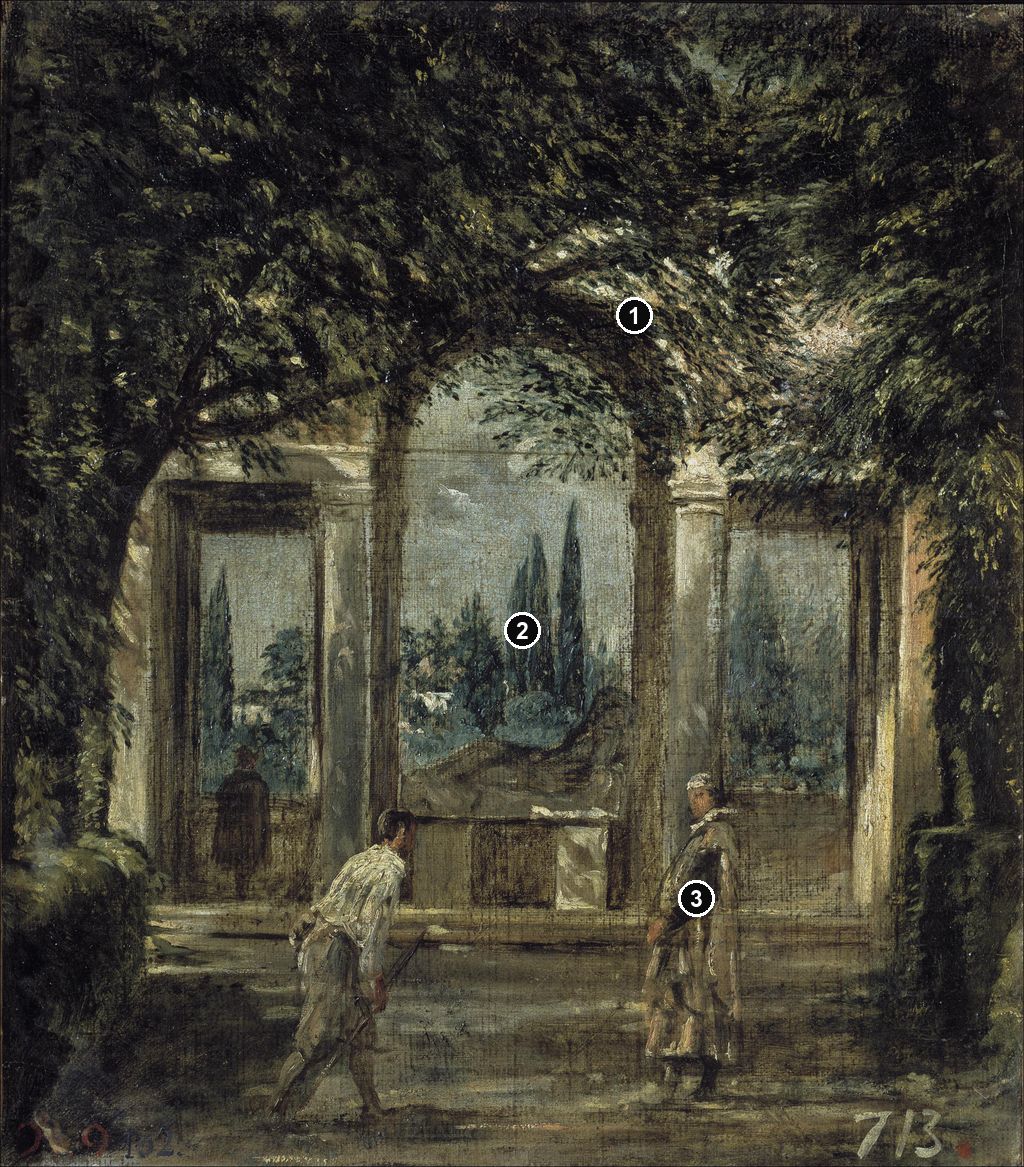
Details from THE VILLA MEDICI GARDEN
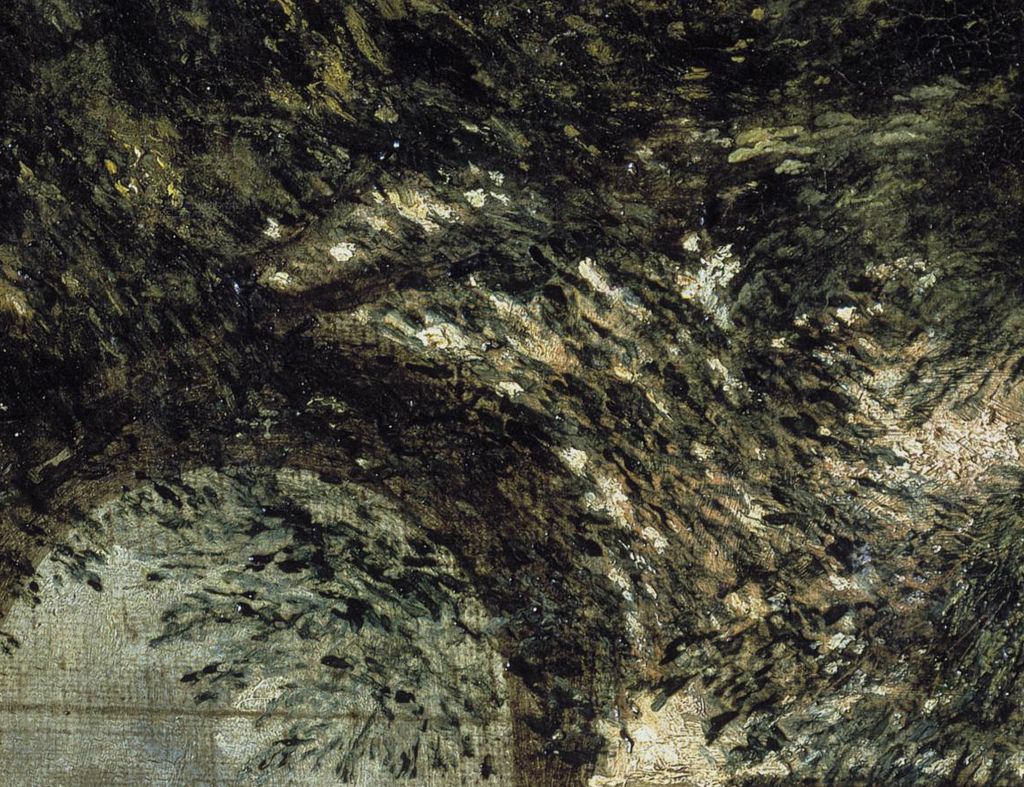
Broken light in the canopy
Small pale strokes interrupt the mass of dark leaves where they cross the edge of the pavilion. [1]
A view through the pavilion
The vertical supports frame a bright opening with trees beyond. The low parapet interrupts the view nearer the foreground. [1]
The figure near the right support
A small figure in shadow stands near the vertical support. The touch of light on the head makes it easier to pick out the figure against the view beyond. [1]
Prado P001211 via Wikimedia Commons, public domain. Numbered labels and detail crops added.
What the paint and the inventories establish
A minute sample taken from a green leaf at the lower right gives an indication of how Velázquez prepared P001211. Prado researchers Maite Jover de Celis and María Dolores Gayo published a cross-section showing a brown clay-based preparation under a second priming of lead white and charcoal black. That upper layer gave Velázquez a light grey surface to paint on. They compared the clay-based layer with the preparation in Joseph’s Tunic and contrasted it with several portraits painted in the second Roman period, where their samples showed a different grey preparation without the lower brown clay layer. Their study places the garden views in the first Italian period. Its comparison gives a material reason for the early dating, while leaving room for choices of canvas preparation to vary with format and subject. [2]
The two paintings are small oils in their own right. Their loose handling puts them in the discussion of studies made directly from nature, but their medium and their separate Prado records matter when comparing them with drawings of artists working in the Roman countryside. For example, Conisbee discusses a drawing by Jan Asselijn of artists working outdoors as evidence of the practice among northern painters in Rome. It offers a parallel for how an easel might be taken into a landscape. The painting of Ariadne gives us evidence of a particular light effect, while the drawing records painters at work in a different setting. Neither provides a timetable for the stages of work on P001211. [1] [2] [5]
The Prado’s exhibition catalogue traces the Ariadne view through the Alcázar inventories of 1666 and 1686, then to the Buen Retiro, where it is listed in 1772. Both Villa Medici views had been recorded at the Alcázar in 1666, and the catalogue places their move to the Buen Retiro after the palace fire of 1734. The Prado has held P001211 since 1819. The shared collection history and the recurrence of the same architectural form give good reason to look at the canvases together. The inventories establish when the two paintings are known to have shared a collection. They leave the timing and circumstances of the commission or purchase open. [1]
A pale inventory number survives at the lower right of the Ariadne view, where it stands out on the dark ground. The record of a painting kept in a royal collection, it sits next to the small flecks that give the shaded leaves their shape. Follow those strokes upwards and the view changes again, from ground near the figures to the cool space held between the shaded stone uprights. It is through that opening that the canvas gives the strongest sense of the place Velázquez found in the garden. [1] [2]
Artworks directory
Frequently Asked Questions
Discussion
Look again at the images and ideas explored in View of the Villa Medici in Rome. These editorial prompts invite your observations.
Reader Insights
What comes into view when you follow the openings between the columns?
Which details help distinguish this view from the boarded grotto painting?
Join the Conversation
Share a detail, comparison or question about View of the Villa Medici in Rome below.
References
- Julián Gállego and Museo Nacional del Prado, Velázquez, Madrid, 1990, cat. 65, pp. 380–383, with cat. 64, pp. 374–379, for comparison. Spanish. View source.
- Maite Jover de Celis and María Dolores Gayo, ‘Velázquez and His Choice of Preparatory Layers: Different Place, Different Colour?’, in Ground Layers in European Painting 1550–1750, 2020, pp. 47–49, figs. 5–6, Prado P001211. View source.
- Museo Nacional del Prado, visitor information and numbered works list, p. 13, Vista del jardín de la Villa Medici de Roma con la estatua de Ariadna, P1211. Spanish. Numbered works list. Prado exhibition panel dating both views to about 1630. View source 1. View source 2.
- Alessandro Cecchi and Carlo Gasparri, La Villa Médicis, vol. 4, Le collezioni del cardinale Ferdinando: I dipinti e le sculture, Rome, 2009, pp. 296–297, cat. 533, ‘Loggia della Cleopatra’. Italian. View source.
- Philip Conisbee, ‘The Early History of Open-Air Painting’, in In the Light of Italy: Corot and Early Open-Air Painting, National Gallery of Art, Washington, 1996, p. 36 and figs. 8–9. View source.
- Gregorio Cruzada Villaamil, Anales de la vida y de las obras de Diego de Silva Velazquez, Madrid, 1885, p. 72, transcription and discussion of the 1634 payment record. Spanish. View source.
- Enriqueta Harris, ‘Velázquez and the Villa Medici’, The Burlington Magazine 123, no. 942, September 1981, pp. 537–541. Opening summary at the journal and the repair argument discussed in reference 1, cat. 64. View source.








