


 Diego Velazquez.jpg)
 by Tom Gurney
Tom Gurney BSc (Hons) is an art history expert with over 20 years experience
Published on June 19, 2020 / Updated on October 14, 2023
Email: tomgurney1@gmail.com / Phone: +44 7429 011000
Philip IV of Spain: Introduction
The stiff white collar in Diego Velázquez’s late portrait of Philip IV catches the eye almost as quickly as the king’s face. Its edge holds firm beneath the chin, where shadow and the grey of a small beard make the face harder to trace. Farther down, gold appears in brief strokes against black. Philip is shown at bust length, with his attention directed out of the picture. The National Gallery in London catalogues the work as Philip IV of Spain, by Diego Velázquez, about 1656. The oil on canvas measures 64.1 × 53.7 cm and is inventory number NG745. [1]
At a Glance
Contents
- The head, the collar and the dark coat
- Three ways of framing the king
- The Prado portrait and the 1657 engraving
- Painted versions and the London canvas
The head, the collar and the dark coat
The brightest part of the forehead leads down to the bridge of the nose. Light breaks around the eyes, where the skin beneath the lower lids is modelled in warmer and cooler tones. The lids themselves are barely drawn. A shallow dark accent can suggest both the shape of an eye and the depth of the socket. Javier Portús, who compared the London painting with a related portrait in the Prado when they hung close together in Madrid, picks out a stroke beneath the outer corner of Philip’s left eye. The mark helps turn the form around the socket. A similar stroke in the Prado painting makes this a particularly telling detail to compare. [1] [2]
The tips of the upturned moustache can be followed farther than the lower edge of the beard. The mouth is a short seam under the broadest part of the moustache, while the grey low on the chin is so close in tone to the flesh that its boundary is hard to locate. In the hair, a few bands of light describe its fall towards the shoulders. The darks at the extremities of the hair and in the ground are close enough that the outline becomes intermittent. The face stays legible through these losses of definition because the painter establishes its broader planes so firmly. [1] [2]
The white collar, known as a golilla, is easier to follow. It projects as a flattened shape beneath the head and shifts in tone where it turns away from the light. On the coat, the embroidery and fastenings catch in short strokes with spaces between them. Distance brings those discontinuous marks together into buttons, trim and a chain. The embroidery describes the meeting of sleeve and shoulder only in patches. Elsewhere, subtle tonal changes and the sweep of the cloak suggest the fall of dark cloth. Across the breast the chain bears the insignia of the Golden Fleece. Its small area of brightness is enough to register the honour without competing with the white collar. [1] [2]
 in Detail Diego Velazquez.jpg)
Three ways of framing the king
In the earlier Philip IV of Spain in Brown and Silver, about 1631–32, the standing king has a similar flat collar and upturned moustache, but his face takes up a much smaller share of the canvas. Silver embroidery carries light down the length of the costume. The furniture and the paper Philip holds give the hands a place in the composition. His head is seen within that larger arrangement of garments, objects and stance. The London bust keeps the familiar signs around the head and lets the collar do on a small scale some of what the silver pattern does across the standing figure. [1] [3]
The Frick’s King Philip IV of Spain was painted in campaign dress at Fraga in 1644. Against a plain background, the lower edge of the head is framed by a wide, lace-edged collar, called a valona. Its pale edges and the silver in the king’s rose-red clothes carry the eye down past the face to the baton and hat. The bright surround in the Frick painting extends into a display of military rank. In the later portrait, the black clothing keeps the lighter edges close to the head and shoulders, with the king’s face taking up correspondingly more space. The Thirty Years’ War ended with the Peace of Westphalia in 1648. The Franco-Spanish war in which Philip had campaigned in 1644 continued until the Treaty of the Pyrenees in 1659. [1] [4] [5] [6]
In a letter of 8 July 1653 to Sor Luisa Magdalena de Jesús, Philip explained why his own likeness had been missing from a group of family portraits she had received. According to the letter, quoted by Portús, nine years had passed since a portrait of him had been made. He was reluctant both to submit to Velázquez’s slowness and to see himself grow old. The remark helps place the mature likenesses in relation to the Fraga sitting. The heavy lids and softening jaw are visible evidence of how age was painted. The letter gives us something the painted face cannot supply by itself, in Philip’s own account of his reluctance to sit. [2] [4]
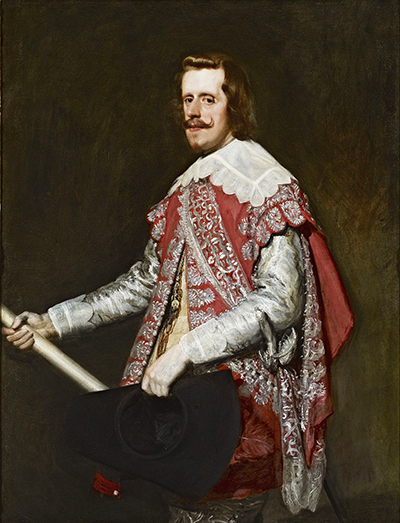
King Philip IV of Spain. The Frick portrait offers an earlier likeness for comparing the treatment of the collar, face and eyes. View King Philip IV of Spain (1644).
The Prado portrait and the 1657 engraving
The Prado’s bust-length Philip IV (P1185) has a plainer garment and dispenses with the Golden Fleece. There is also more variation in the sheen of the hair. Portús proposes that this is the portrait made from life after the 1653 letter, and that the London picture represents a further stage in which the hair was simplified and court insignia added. He reads the London composition as a studio adaptation made under Velázquez’s supervision, probably with some intervention by the painter himself. The National Gallery lists Velázquez as the artist. The degree of workshop participation in NG745 remains a matter of interpretation. [1] [2]
The timing becomes clearer when the two paintings are set alongside two engravings by Pedro de Villafranca. The face in his 1655 print for the rule book of the Order of Santiago resembles the Prado portrait. By 1657 the likeness recognisable from the London painting was appearing in Francisco de los Santos’s Descripción breve de San Lorenzo el Real de El Escorial. Mark McDonald identifies the print as catalogue number 49b and compares it directly with NG745. Villafranca reverses the pose for the plate and retains the collar, shoulder ornaments and insignia. The painter’s transitions from light to dark become marks of varying density made with the burin. The print supplies a date by which the London type was in circulation. [2] [7] [8]
The Biblioteca Valenciana’s impression gives that likeness a setting of its own. Philip appears in an oval surrounded by fruit and small figures, with a crowned cartouche above containing a section through the royal pantheon. Below the portrait is a view of El Escorial. The order of the images connects the reigning monarch to the monastery and its dynastic burial chapel. A reader opening the book saw a face with the same concentrated arrangement of hair and dress as the London likeness, now framed by buildings, ornament and lettering. [7] [8]
Painted versions and the London canvas
The National Gallery describes pupils making copies that were given to members of court and visiting dignitaries. Portús traces a group of paintings derived from the type represented by NG745 or a closely related model. The Cincinnati Art Museum’s Philip IV, King of Spain (1927.425), catalogued by that museum as a studio work, offers an example. The face, collar and scattered accents on the clothes remain recognisable across the series. Their repetition gives an idea of how painters could maintain a standard royal likeness while varying the handling of the paint from one canvas to another. [1] [2] [9]
The specific London canvas can be placed in Prince Demidoff’s collection at San Donato, Florence, by September 1862. The National Gallery records that it was still there in September 1864 and that the gallery bought it from Emanuel Sano in Paris in June 1865. Its original destination remains uncertain. The book and the workshop portraits document the circulation of the likeness centuries before the acquisition records document this canvas entering the National Gallery. [1] [2] [7] [8]
Artworks directory
Frequently Asked Questions
About 1656 [1]
Oil on canvas [1]
National Gallery, London, NG745 [1]
Discussion
Look again at the images and ideas explored in Philip IV of Spain. These editorial prompts invite your observations.
Reader Insights
Where does the dark costume lose its edge, and where does a small highlight keep the shape legible?
Compare the framing with Brown and Silver. What do you notice sooner in the closer portrait?
Join the Conversation
Share a detail, comparison or question about Philip IV of Spain below.
References
- National Gallery, London, Philip IV of Spain, NG745 View source.
- Javier Portús Pérez, “Velázquez y el último retrato de Felipe IV (a propósito del cuadro del Museo de Bellas Artes de Bilbao)”, Bilbao Fine Arts Museum Bulletin 9 (2015), pp. 107–130 View source.
- National Gallery, London, Philip IV of Spain in Brown and Silver, NG1129 View source.
- The Frick Collection, The King at War, exhibition press release and illustrated dossier and curatorial account of the Fraga portrait View source 1. View source 2.
- German History in Documents and Images, Peace Treaties of Westphalia, 1648 View source.
- Documents de droit international, Traité des Pyrénées, 7 November 1659, with facsimile of the treaty as printed in Dumont View source.
- Mark McDonald, Pedro de Villafranca: Printmaker at the Court of Philip IV, pp. 51, 60, figs. 15–16 and cat. 49b reference View source.
- Biblioteca Virtual Miguel de Cervantes, Retrato de Felipe IV, Pedro de Villafranca, 1657, Biblioteca Valenciana Nicolau Primitiu impression View source.
- Cincinnati Art Museum, Philip IV, King of Spain, 1927.425 View source.







